Where to buy
Check the latest price, availability and delivery on Amazon. Orders are placed on Amazon. We may earn a commission from qualifying purchases.
- Best overall for modern homes: Govee COB LED Strip Lights 2 Pro, 16.4 ft, RGBWWIC, 1,344 LEDs/m, Matter — Check on Amazon
- Govee RGBIC LED Strip Lights, 32.8 ft, with Covers and Diffuser Channel — Check on Amazon
- Philips Hue Solo Lightstrip, 33 ft, White and Color Ambiance (select the 33 ft size on the listing) — Check on Amazon
- Govee LED Strip Light M1, 16.4 ft, RGBICW with Matter (buy two for two zones) — Check on Amazon
See 2 more Amazon options
- Govee COB LED Strip Light Pro, 16.4 ft, RGBICW with Matter (2024 flagship) — Check on Amazon
- PAUTIX Addressable CCT Smart IC COB LED Strip Lights, 32.8 ft, 2700K–6500K (buy two for a 65.6 ft white run) — Check on Amazon
Read the full guide ↓
Disclosure: As an Amazon Associate, dailyhomedecorating.com earns from qualifying purchases. Links to Amazon on this page are affiliate links; they cost you nothing extra. Listing details such as price and availability change often, so check the current Amazon listing before you buy.
A modern interior is the hardest room a strip light will ever work in, for a simple reason: there is nowhere to hide. A strip can be bright, cheap and clever and still fail all three.
The budget needs its own honesty before any pick is named. Two hundred dollars sounds like the tier where strip lights stop compromising, but the shelf between $150 and $200 for a single strip is nearly empty — it holds essentially three products, and the category’s real volume sits a full tier lower. So this guide treats $200 the way a modern project actually spends it: as a system budget. The Philips Hue pick needs a Bridge to unlock its full feature set, and that separate purchase takes the honest from-zero system over this budget — stated here rather than buried; check the current price on Amazon for the strip and factor the hub in before you commit. And the 2024 Govee flagship sits a step below its successor in this tier; check the current price on Amazon before you choose between the two generations. Below you will find the quick picks, the three tests applied pick by pick, detailed reviews, a comparison table, a modern-home buying checklist, the mistakes minimal interiors punish hardest, and answers to the questions this tier always raises.
Quick Picks
Short on time, or comparing several options at once? Each row below names the modern-home job and the strip that does it, with a link to the listing.
| Modern-home job | Pick | Why it stands out | Link |
|---|---|---|---|
| Best overall for modern homes | Govee COB LED Strip Lights 2 Pro, 16.4 ft | The only strip here that passes the line test naked — a maker-claimed 1,344 LEDs/m under a diffusing surface, dotless in direct view, with real white chips and Matter — check the current price on Amazon | Check on Amazon |
| Best finished fixture in a box | Govee RGBIC LED Strip Lights with Covers, 32.8 ft | The diffuser channel is included, so the line is straight because the track is straight — the closest thing to a complete architectural fixture in one box — check the current price on Amazon | Check on Amazon |
| Best invisible ecosystem | Philips Hue Solo Lightstrip, 33 ft | Thirty-three feet of one disciplined color inside the Hue scene system — but the maker rates it at the same 1,700 total lumens as the 10 ft, and full features need a Bridge | Check on Amazon |
| Best two-zone architecture | Govee LED Strip Light M1, 16.4 ft (buy two) | Two kits inside this budget: two independent premium lines, each with a real white channel and Matter — no shared power supply, no far-end fade | Check on Amazon |
| Best flagship value | Govee COB LED Strip Light Pro, 16.4 ft (2024) | Last generation’s dotless COB flagship — 1,260 LEDs/m, RGBICW, Matter — positioned below its successor in this tier; check the current price on Amazon | Check on Amazon |
| Best white-only system | PAUTIX Addressable CCT Smart IC COB Strip, 32.8 ft (buy two) | Two reels inside this budget cover 65.6 ft of dotless tunable white — a cove run no single box sells at this tier | Check on Amazon |
How These Picks Were Chosen
The first filter was verification, applied exactly as in the general guide for this tier: every pick below has a real Amazon listing and fits this $200 budget in the configuration its review recommends — which is why two picks are framed as builds rather than boxes. Two M1s together stay inside this budget, and two PAUTIX reels together do the same; both builds buy something no single box at this tier sells. One genuinely eligible strip is discussed in prose but deliberately not linked: Govee’s COB Strip Light 2 in 32.8 ft sits at the same premium end of this tier as our top pick and would otherwise rank near the top of this guide, but its Amazon listing code could not be pinned to the two-source verification standard this series requires, so it appears in the “What $200 Buys” section without a purchase link. A modern guide that links only what it can verify is slower to write and easier to trust.
The second filter was the three tests, applied at project level rather than product level, because that is how a modern room experiences a strip. The off-state test is the one buyers forget: tape residue, a visible gray track on a white wall, a strip sagging between clips — the installation is furniture in a minimal room even when it is dark, and it is graded as furniture.
The third filter was the control layer, because in a modern home the switch is part of the design. The picks that speak Matter or sit inside the Hue platform can disappear into wall scenes, voice and schedules — the invisible layer — and that invisibility is scored here as a design feature, with one caveat carried through every review: on the M1, Matter carries a single color per strip while the gradients live in Govee’s app, so the invisible layer receives less than the app holds. Brightness and color-rendering figures were treated as maker claims throughout — Govee’s 540 lumens per meter and CRI above 92 for its flagship are attributed to Govee every time, and Signify’s 1,700 lumens for the Hue is a first-party datasheet rating with a catch its review does in the open.
The Three Tests, Applied at System Level
It is worth pausing on why these tests are scored at the level of the project rather than the product, because the distinction is where modern installs succeed or fail. The picks below were ranked by how completely each answers all three, and the reviews say plainly where each one fails — because in a modern interior, a partial pass is visible from across the room.
The 6 Best LED Strip Lights for Modern Homes Under $200
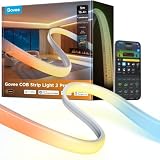
Govee COB LED Strip Lights 2 Pro, 16.4 ft
Who it suits: Modern-home buyers with one short, visible run — a media wall line, a stair stringer, the reveal under a floating shelf — who want light that reads as architecture rather than as a product, and a control layer that vanishes into the home’s platform.
Begin with the line test, because this strip is the only pick in the guide that passes it with nothing helping. The construction is COB — chip-on-board — at a density Govee claims as 1,344 LEDs per meter, under a continuous diffusing surface. The emitters are Govee’s RGBWWIC arrangement — addressable color segments plus dedicated warm-white and cool-white chips — so the whites are manufactured by white diodes across a claimed 1,000K to 10,000K range rather than mixed from color channels, the distinction that decides whether a line can light a room or only decorate it. The kit runs on an included 48W adapter, trims at cut marks printed every 6.5 cm, and sits at the premium end of this tier — check the current price on Amazon. Short footage at flagship density makes it the premium light in this guide per foot, bought deliberately, for the one property money cannot add later: density.
The compromises are length, finality and youth. And the flagship is young — launched in September 2026 — so its long-term record is a promise rather than a history, and Govee’s one-year strip warranty is the shortest commitment among this guide’s premium names. Judged by the three tests — a flawless line, hardware that hides, an off-state that leaves nothing but a clean reveal — it is the most complete short strip the category sells.
- The line, unaided: COB construction at a maker-claimed 1,344 LEDs per meter — dotless in direct view and in reflection, the only pick that needs no channel to look finished.
- Real white alongside color: RGBWWIC chips with dedicated white emitters, a claimed 1,000K–10,000K range, and a maker-claimed CRI above 92.
- An invisible control layer with no toll: Wi-Fi app, Alexa and Google voice, and Matter — check the current price on Amazon.
Honest limitation: Sixteen feet is one feature run, not a room; cutting is permanent — Govee’s own wording is that a cut strip cannot be reconnected or extended; and the density, output and CRI figures are the maker’s claims for a product launched in September 2026, backed by a one-year warranty.
Choose it if one visible line is the room’s feature and it must be flawless switched on and invisible switched off. Skip it if your route is longer than 16 feet or bends through several zones — the Covers kit or the two-zone M1 build below covers real projects for similar money.
Govee RGBIC LED Strip Lights with Covers, 32.8 ft
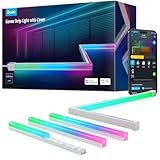
Who it suits: Finish-first modern buyers — anyone whose line will run in direct view along a skirting line, a ceiling edge, a cabinet face or a studio wall, and who wants the installed, straight-edged look of a fixture without sourcing channel, corners and strip from three different suppliers.
Every other pick in this guide hands you a strip and leaves diffusion and mounting as homework. This kit is the exception, and under the modern lens that makes it the most conceptually honest product here: the box contains two 16.4 ft RGBIC strips, the adapter and control box, and the cover track itself — lengths of diffuser channel with inside and outside corner pieces, per the maker’s package list. Understand the division of labor plainly, because the review’s honesty depends on it: the strip inside is a conventional 60-LEDs-per-meter RGBIC design, the same density as the M1 below, which on its own would blend at a distance and dot up close. The value is the friendliest in the guide: a finished install — strip, channel and corners together — without a separate hardware purchase; check the current price on Amazon.
The compromises are rigidity, borrowed smoothness and commitment. Within its brief — one finished line of color, installed once and meant to stay — nothing else at this tier does as much of the job in a single box.
- The fixture in a box: diffuser channel with corner pieces included, turning a 60-LEDs/m strip into a straight, softened, architectural line.
- Real footage with a full control layer: 32.8 ft as two 16.4 ft strips, Wi-Fi app control, Alexa and Google voice, and Matter per the listing.
- A finished install in one purchase: strip, channel and corners together, so the footage arrives ready to mount — check the current price on Amazon.
Honest limitation: The flawless line is the channel’s work, not the emitters’ — the strip alone is standard density; the track makes the install rigid and semi-permanent; and whites are RGBIC mixtures rather than dedicated-white light.
Choose it if the line will be visible, the run is straight, and you want the fixture look without a separate channel purchase. Skip it if your route curves, you rent, or you need the dotless quality to live in the strip itself — the COB picks carry their diffusion with them.
Philips Hue Solo Lightstrip, 33 ft
Who it suits: Hue households furnishing a modern interior around scenes — buyers with a genuinely long run, a full ceiling perimeter or a long cove, who want one disciplined color washing the room as part of a whole-home lighting composition, and who already own, or have honestly budgeted for, the Bridge.
Under the modern lens, the Hue’s proposition is not the strip; it is the layer. That single-color discipline, a limitation in a party guide, is close to a virtue here — a modern line does not chase, segment or perform; it holds a tone. The long strip therefore buys length, not brightness — check the current price on Amazon: spread across 33 feet, the output becomes a gentle, even wash, which is exactly right for a perimeter glow and exactly wrong for anyone expecting three times the light. Everything beyond Bluetooth — out-of-home control, real routines, grouping with a houseful of Hue lights, entertainment sync, Matter and full voice integration — is unlocked by the Bridge, which is a separate purchase and part of this pick’s true cost, with a newer Bridge Pro above the standard Bridge. Strip plus Bridge bought from zero takes the system over this guide’s budget, stated here as it was in the introduction. The link on this page opens the Solo family listing, whose default view is the shorter kit — select the 33 ft size deliberately, and check the current price on Amazon before you buy.
The compromises are the toll, the format and the tape. The toll is unique in this guide: no other pick asks for a second purchase to unlock its own features, and on a permanent 33 ft perimeter install the deliberately limited Bluetooth mode is a poor long-term answer, so the Bridge is not really optional — budget it or choose a Govee. The tape is the third: Hue strips carry the category’s most documented adhesive complaints, and 33 feet of perimeter is a great deal of peel-and-stick to trust above a minimalist wall — plan on clips or a channel from the start, which the off-state test demands anyway. Against those stand a two-year warranty, a maker-rated life of about 25,000 hours, and the deepest software support in smart lighting. Judged as a system bought from zero, its honest price is not under $200, and this guide will not pretend otherwise.
- The longest quality line in the guide: 33 ft of Hue RGBWW color holding one disciplined tone — check the current price on Amazon.
- The invisible layer, complete: scenes, routines and grouping with the whole Hue home, once the Bridge is in place; Bluetooth with no hub at all until then.
- A published output rating — Signify’s 1,700 lumens at 4000K — with the caveat that it is the same total as the 10 ft version.
Honest limitation: The full feature set needs a Bridge bought separately, making the true system cost more than the strip alone — over budget from a standing start; the strip shows one color along its length with no segments, cannot be extended, and the listing’s default size is the 10 ft kit, so the 33 ft option must be selected deliberately.
Choose it if your home already runs on Hue, or the long line must join a scene system badly enough to budget the hub on top. Skip it if you want a complete, hub-free $200 system, or light that moves along the run — the Govee picks do both.

Govee LED Strip Light M1, 16.4 ft — Buy Two
Who it suits: Two-zone modern projects — a media wall and a headboard reveal, a desk line and a shelf line — where the design calls for two separate, composed lines of light rather than one long one, and where the home’s platform speaks Matter.
The M1 also appears in this series’ lower-tier guides, where a single kit is the purchase. Here two M1s together stay inside this budget — check the current price on Amazon for each kit — and what that buys is not 32.8 feet of strip but two independent installations, each with its own adapter, its own controller and its own place in the home’s scenes. Buying the build as two complete kits also leaves the channel and clips a serious modern install wants to be planned as part of the same system budget, rather than as an afterthought.
The compromises are the Matter caveat, the density ceiling and the management of two — and under this lens the first deserves its plainest words. Over Matter, the M1 behaves as a single-color strip: one color along its length, with brightness and white temperature adjustable, while the gradients, segments and music modes that justify its premium positioning live only inside the Govee app. The density ceiling is the second cost: 60 LEDs per meter blends well, and inside a reveal or channel it passes the line test comfortably, but in direct view at close range the COB flagships are visibly smoother. Govee publishes no CRI figure we could verify for the M1. None of that dethrones the build for its brief: it is the only way this budget composes premium light in two places at once, on credentials that will outlive any single app’s fashion.
- Two zones inside the budget: two M1s together fit this tier — check the current price on Amazon — each independently powered, controlled and scene-ready.
- Premium light per zone: RGBICW chips at 60 LEDs per meter with a real warm-white channel, Matter over Wi-Fi, and the full Govee scene library.
- No long-run physics: separate adapters mean no far-end voltage drop breaking the line, and no shared point of failure.
Honest limitation: Over Matter each strip is single-color — the segmented effects live only in Govee’s app; 60 LEDs per meter is dense but not dotless like the COB picks in direct view; and two kits mean two controllers, two adapters and two hiding places to plan.
Choose it if the project is two short lines in two places, composed as one system. Skip it if you have one run and want it flawless — the COB 2 Pro at the top of this guide spends the same money on one perfect line.

Govee COB LED Strip Light Pro, 16.4 ft (2024)
Who it suits: Density-first modern buyers who want the dotless flagship line and are willing to take last generation’s model in exchange for keeping more of the budget for channel, clips and the rest of the install.
Two years before the COB 2 Pro above, this strip was the flagship, and most of what made it one survives intact. It launched in September 2024 as the premium end of Govee’s range, and at 16.4 feet it is this guide’s value flagship: the previous generation, positioned below its successor in this tier — check the current price on Amazon to confirm the gap before you buy. In a modern project, choosing the earlier generation leaves more of the budget for the channel that the off-state test will eventually demand, without giving up the dotless line that is the reason to buy COB at all.
The compromises are generational, and they are stated as plainly as this series’ discipline requires. The white architecture is a step behind the successor, and the density, while still dotless, sits just below the newest flagship. Check the current price on Amazon before buying, and compare it with the successor’s current price on Amazon — if the two sit close together, the argument for this pick weakens and the COB 2 Pro is the buy. The family caveats carry over unchanged: cutting is one-way and the offcut cannot be reconnected, the adhesive wants clips or channel on any run that matters, and Govee’s strip warranty is one year. Within its terms — the same flawless line, the same invisible control, for less than the newest model — it is the thinking modern buyer’s COB.
- Near-flagship density: COB construction at 1,260 LEDs per meter — a dotless line in direct view and in reflection, within a step of the successor.
- RGBICW chips with a dedicated white emitter, Matter over Wi-Fi, app and voice control, and no hub required.
- Previous-generation value: the dotless flagship line for less than its successor — check the current price on Amazon.
Honest limitation: Always confirm the current price on Amazon before buying, since the value case depends on it staying clearly below its successor; it publishes no verifiable CRI figure, its white architecture is a generation behind the COB 2 Pro, and cutting is one-way like every Govee flagship.
Choose it if you want the dotless flagship line and keeping more of the budget for the rest of the install matters more than the newest white chips. Skip it if the current price on Amazon sits close to the successor’s — at that point the successor is strictly the better buy.

PAUTIX Addressable CCT Smart IC COB LED Strip Lights, 32.8 ft — Buy Two
Who it suits: White-light modernists — anyone whose interior is lit in shades of white and whose project is a long cove, a full ceiling perimeter or a kitchen’s cabinet line, rendered as one dotless, tunable wash rather than as color.
This pick is a build, and the guide says so in its name, because the product it recommends does not exist as a product: nobody sells a 65 ft smart COB white strip at this tier. What exists is this reel — 32.8 ft of addressable COB at 560 LEDs per meter, a continuous dotless line of white that can move, with chasing and flowing effects rendered in whites tunable from 2700K to 6500K, a 24V supply and smart controller in the kit, and Alexa voice control on top of the maker’s app — check the current price on Amazon. Bought twice, the build stays inside this budget and covers 65.6 feet: a living room’s full cove, a kitchen’s cabinet run with the island besides, a hallway that finally stops looking like a corridor. For the modern lens this is the purest purchase in the guide — no color at all, just the temperature and movement of white, which is the palette minimal interiors actually live in — and the two-reel structure is a feature disguised as a compromise: each reel runs on its own supply from its own outlet, so the far-end dimming that haunts single-adapter long runs never gets the chance, and the light at foot sixty-five is the light at foot one. Because each reel sits low in this tier, the two-reel build keeps comfortable headroom inside this budget even though long footage is the purchase — headroom a single flagship line does not leave.
The compromises are color, coordination and proof. Color first: this is a white strip — its animation is done in shades of white, serene in a cove and a limitation the moment a household wants the line to celebrate anything; buyers who want color should take any Govee above. For static or gently shifting white scenes — the modern use — the two halves agree on a look and hold it; for a single synchronized sweep around a room, one long strip is the honest tool and this build is not it. Within its terms — dotless, animated, long, white, and comfortably under budget as a two-reel build — nothing else in the tier does what this build does.
- A run no box sells: two 32.8 ft reels total 65.6 ft of addressable, dotless COB white inside this budget — check the current price on Amazon.
- Voltage drop designed out: each reel runs on its own 24V supply, so the far end matches the near end and the line never fades.
- Headroom in the budget: two reels together sit low in this tier, leaving room for channel, clips and the rest of a finished install.
Honest limitation: White only — its effects are shades of white, not color; two kits means two controllers that do not synchronize with each other; and output and CRI figures are the maker’s own, from a specialist brand with a smaller support operation.
Choose it if you are lighting a long cove, perimeter or cabinet run in white and want it smart, animated and dotless. Skip it if you need one synchronized sweep from a single controller, or any color at all — the Govee picks above are the color tools.
Comparison Table
| Product | Format & length | Light & control | Modern verdict | Link |
|---|---|---|---|---|
| Govee COB LED Strip Lights 2 Pro | COB strip, 16.4 ft, maker-claimed 1,344 LEDs/m | RGBWWIC color + real white; Wi-Fi app, voice, Matter | Passes the line test naked — the one true architectural line | Check on Amazon |
| Govee RGBIC Strip Lights with Covers | Standard strip in channel, 32.8 ft (2 x 16.4 ft), 60 LEDs/m | Segmented RGBIC color; Wi-Fi app, voice, Matter per listing | The complete fixture in a box — line, housing and off-state solved together | Check on Amazon |
| Philips Hue Solo Lightstrip, 33 ft | Standard strip, 33 ft, not extendable | Single-color RGBWW; Bluetooth app, full features via Bridge | One disciplined tone inside the whole-home scene layer — if the Bridge is already paid for | Check on Amazon |
| Govee LED Strip Light M1 (buy two) | Dense strip, 2 x 16.4 ft, 60 LEDs/m | RGBICW with real white channel; Matter + Govee app | Two composed zones — but the invisible layer receives one color, not the gradients | Check on Amazon |
| Govee COB LED Strip Light Pro (2024) | COB strip, 16.4 ft, 1,260 LEDs/m | RGBICW with real white chip; Wi-Fi app, voice, Matter | The same flawless line, one generation back — check the current price on Amazon before anything else | Check on Amazon |
| PAUTIX Addressable CCT COB (buy two) | COB strip, 2 x 32.8 ft, 560 LEDs/m | Addressable tunable white with chasing effects; app + Alexa | The purest modern purchase: white only, dotless, with the most footage in this tier | Check on Amazon |
How to Choose an LED Strip Light for a Modern Home Under $200
- Admit what the budget is: a system, not a strip. Between $150 and $200 there are only a handful of single strips. The general framing of this tier is set out in Best Led Strip Lights Under $200; this guide applies it to interiors where the light is the design.
- Run the line test before reading any other specification. Density is checkable and decides what you see: 1,260–1,344 LEDs per meter disappears, 560 per meter of COB disappears, 60 per meter blends or needs a diffuser channel, and spaced emitters dot — in direct view and, worse, doubled in every reflective surface the room owns. If the strip or its reflection will be visible, density is the purchase.
- Grade the off-state. Walk the route at noon in your head: a gray track on a white wall, tape edges lifting at a corner, a control box sitting in view. If the honest answer is “visible and ugly,” the route or the product is wrong.
- Plan the concealment of the whole circuit. The strip is the easy part. A pick whose controller must sit in view has failed the room’s basic requirement, however beautiful its light.
- Ask where the white comes from. RGB and RGBIC strips fake white by mixing colors, and on pale walls, skin and food the mixture shows. Accepting mixed white in a strip you will read or cook by is paying flagship money for a party trick.
- Choose the control layer as a design decision. Bluetooth app: one room, one phone, a screen in a room designed to have none. Matter and Hue: the invisible layer — scenes that set the whole home at once — with the M1’s caveat that Matter carries a single color while the gradients stay in the vendor app. Every rung is also a dependency on a network, an account and a company’s servers; choose the highest rung you will actually use, and no higher.
- Do the ecosystem arithmetic out loud. The Hue Solo 33 ft strip is only part of the purchase: its full feature set sits behind a Bridge bought separately, with the Bridge Pro above that — together the system runs over this budget. Check the current price on Amazon for the strip and count the hub before you commit. Neither answer is wrong; buying the Hue without having done the sum is.
- Count the whole install, not the reel. Channel, diffuser, clips and connectors are part of a modern install, not accessories: a flagship strip at the top of this tier leaves only a small share of this budget for exactly the hardware that finishes it, and the Covers kit exists because its box already contains the channel other installs buy separately. A bare strip plus its finishing hardware routinely costs more than the kit that included them.
- Consider two kits before one flagship. Two separately powered lines dodge voltage drop, survive a single failure, and let two zones hold different tones inside one scene. For projects in two places, the build is usually the smarter $200.
- Plan the cut before you buy. Every pick here trims at printed marks, and on all of them the cut-off section is dead — Govee prints the rule on its flagship pages: once cut, the strip cannot be reconnected or extended. On premium-density strip, measure twice is not a proverb; it is the budget.
What $200 Buys a Modern Home — How the Budget Is Allocated
Because this tier is a system budget, the useful question is not which single strip fills it but what a complete, finished modern install looks like within it. Three honest allocations cover most projects. The single-line allocation: the COB 2 Pro takes the premium end of the tier, leaving a small share of the budget for the aluminum channel and clips that turn a perfect strip into a permanent fixture — the flagship spends its share on density and lets the remainder finish the job; check the current price on Amazon. The finished-fixture allocation: the Covers kit sits below the flagship end of the tier because its box already contains its own housing, leaving more of the budget for a second zone’s start, a run of channel for another room, or simply unspent. The two-zone allocation: two M1s together fill this budget as two complete kits — check the current price on Amazon — with each zone independently powered and controlled. Against those, the Hue allocation must be stated without flinching: the 33 ft Solo plus a Bridge bought separately is a good system and not an under-$200 one, which is why this guide recommends it to households that already own the hub and to no one else.
Three further products belong in this section precisely because they cannot be linked. The first is Govee’s own COB Strip Light 2 in 32.8 ft: 840 LEDs per meter of RGBIC COB — dotless like the flagships, though without their dedicated white chips, so its whites are tuned mixtures — positioned at the same premium end of this tier as the COB 2 Pro, including at Govee’s own store. The second is Philips Hue’s Gradient Lightstrip in 80 inches, the only Hue strip that runs several colors along its length at once, positioned at the premium end of this tier at US retailers with a maker rating of 1,800 lumens and a published CRI above 80 — a genuinely premium product whose US Amazon listing we likewise could not pin (the listing code that surfaces belongs to the UK 240-volt version), and whose full features would need a Bridge on top in any case, taking the complete system beyond this budget. The third is Govee’s non-COB Strip Light 2 Pro in 32.8 ft, positioned in the middle of this tier: the flagships’ color generation with real white chips at standard density — the right answer for a long run that will hide in a cove, where COB density would never be seen. If your honest project is smaller than all of this — one short run of simple color in one room — the step down is real, and the picks in Best Led Strip Lights For Modern Homes Under $100 cover the M1 and the Hue’s shorter lengths without the system framing.
Will It Fit a Modern Room?
Physically, strips fit anywhere — that is their appeal — so the real questions are optical and electrical. Electrical second: every run starts within reach of an outlet, because the adapter’s lead is short and no strip here can be powered from its far end; the two-kit builds turn that constraint into a plan, with each line’s hardware concealed near its own outlet.
The same budget reads differently through the other lenses in this series, and the differences are instructive. In apartments, permanence is the negotiation — adhesive, channel screws and a landlord’s paint — and the trade-offs are scored for exactly that situation in Best Led Strip Lights For Apartments Under $200. In bedrooms the questions soften and sharpen at once: light washes a ceiling beautifully from a headboard cove, but a control box’s standby glow and an app’s brightness floor matter at 2 a.m., and the sleep-first picks live in Best Led Strip Lights For Bedrooms Under $200. In small rooms you are always close enough to see the dots a spaced strip makes, which is why the dedicated shortlist in Best Led Strip Lights For Small Rooms Under $200 leans so heavily on density and diffusion. First, prepare the surface like you mean it: clean, dry, fully cured paint, and a test section before the full run — most “defective adhesive” stories are unprepared-surface stories, and the rest are gravity stories that clips would have solved, on an entry-level strip or a flagship alike. Second, respect the cut marks and the voltage: cut only where the strip says to cut, never power a strip from a supply that did not come with it or match its voltage, and keep adapters and control boxes out of splash zones and steam — none of the six picks here is waterproof.
Common Buying Mistakes
- Judging a strip by its product photos. Renders show the line the marketing department wanted; density figures and the diffuser tell you the line you will get. A modern room will grade the real one, in reflection, every evening.
- Forgetting the off-state. A strip that is beautiful at 8 p.m. and a visible gray tape line at noon has failed a minimal interior for sixteen hours a day. Grade the installation dark before you buy it.
- Comparing strips without weighing footage against tier position — paying flagship money for a short run when the same budget buys a finished longer install, or the reverse, without knowing which you did.
- Believing a longer strip is a brighter strip. Hue rates its 10 ft and 33 ft Solo strips at the same 1,700 total lumens; the long one spreads that output over three times the length. Length and brightness are separate purchases.
- Treating a maker’s CRI or lumen claim as a measurement. The COB 2 Pro’s CRI 92+ and 540 lumens per meter are Govee’s figures, published to no standard a buyer can audit — better than silence, not the same as verification.
- Forgetting the Bridge in the Hue math. The strip plus a Bridge bought separately is a complete system that runs over this budget; with the Bridge Pro it runs further over. It can be a good system, but it is not an under-$200 purchase.
- Buying the listing’s default size. The Hue Solo link opens on the 10 ft kit; the 33 ft configuration this guide recommends must be selected deliberately, and the current price on Amazon checked, before checkout.
- Assuming Matter means full features. On the M1, Matter carries a single color per strip; the gradients and music modes stay in Govee’s app. Check what your platform actually receives before paying flagship money for a standard.
- Cutting first and reading the manual second. On every Govee flagship here, a cut strip cannot be reconnected or extended; the offcut is waste, permanently, on premium-density strip.
- Trusting the adhesive on a flagship. Price does not improve peel-and-stick backing; clips and channel are part of a $200 install, not an optional extra on a budget one — and on pale modern walls, a fallen strip takes the paint story with it.
Final Recommendation
- Most modern homes, one visible line: Govee COB LED Strip Lights 2 Pro, 16.4 ft.
- A finished fixture in one box: Govee RGBIC LED Strip Lights with Covers, 32.8 ft.
- Hue color on a long run, Bridge already owned: Philips Hue Solo Lightstrip, 33 ft.
- Two zones, one composed system: Govee LED Strip Light M1, 16.4 ft — buy two.
- Flagship density for less: Govee COB LED Strip Light Pro, 16.4 ft (2024).
- Long dotless white runs: PAUTIX Addressable CCT Smart IC COB Strip, 32.8 ft — buy two.
Our top two frame the modern decision. The COB 2 Pro is the purity answer: the densest, most finished light in the guide, flawless in direct view and in reflection, with real white chips and every modern control standard, hub-free, for one short line — check the current price on Amazon — the strip you buy when the line is the room’s architecture and there is exactly one of it. Measure your run, run the three tests on your own room before you run them on any product, count the density before the lumens, count the whole system including any hub, check the current price on Amazon and the selected size, and mount it like you expect it to stay — in a modern home, you will be looking at the installation, on and off, for years.
Frequently Asked Questions
Why does density matter more in a modern home than in any other room?
Because nothing forgives the light. Density — 1,260 to 1,344 LEDs per meter of COB, or a good diffuser channel over a standard strip — is what turns the same product category into a drawn line of light. It is the first specification to check and the last one to compromise.
Is a flagship strip light actually better than a budget one?
At specific, checkable things — not at everything. The flagship COB 2 Pro buys emitter density no budget strip approaches (a maker-claimed 1,344 LEDs per meter against spaced diodes), dedicated white chips instead of mixed white, and Matter alongside Wi-Fi — check the current price on Amazon. A lower-tier PAUTIX reel buys more than twice the footage, dotless white of its own, and a complete kit. Decide whether your run needs density and white quality, or footage, and the tier difference explains itself.
Does the Philips Hue Solo 33 ft need a Bridge?
Not to light up. Budget honestly: the Bridge is a separate purchase on top of the strip — check the current price on Amazon for the strip and allow for the hub — so the full Hue experience runs over this guide’s budget from a standing start, and is stated as such in the review. If you already own a Bridge, none of that applies and the Solo is simply the longest quality line here.
Why does the 33 ft Hue Solo have the same lumen rating as the 10 ft?
Because Signify rates the Solo family’s total output at 1,700 lumens at 4000K regardless of length — the longer strip uses the same class of power supply and spreads its output over more than three times the footage. The practical result: the 33 ft strip is a gentle perimeter wash, noticeably dimmer per foot than its short sibling, while the 10 ft feels concentrated and bright. In a modern interior that evenness is often the point — a wash, not a beam — but buy the 33 ft for coverage, never expecting three times the light, and if a long run must also be a bright one, two separately powered shorter runs are the honest route.
Can I cut a Govee COB strip and rejoin the pieces later?
No. You can trim the COB 2 Pro at its printed cut marks — they come every 6.5 cm — and the 2024 COB Pro at theirs, but Govee’s own wording for the flagship line is that once cut, the strip cannot be reconnected or extended. That rule, on premium-density strip, is the costliest sentence in this guide: measure the run twice, buy the length that covers it with the offcut assumed lost, and settle corners and gap jumps with planning before ordering, not during the install.
What does the COB 2 Pro’s “CRI 92+” claim actually tell me?
Less than it appears to, and more than nothing. CRI — color rendering index — describes how faithfully a light shows colors compared with a reference source, and a figure above 90 is the range associated with quality white light. Govee publishes 92+ for the COB 2 Pro, which signals that the flagship’s white is engineered for rendering, and its dedicated white chips support the claim’s plausibility. But it is the maker’s figure, measured to no standard this guide can audit, and most rivals publish no CRI at all — so treat it as a statement of intent from the manufacturer, corroborated by the strip’s white-chip architecture, not as a laboratory result.
Should I buy one $200 strip or two cheaper kits?
It depends on whether your project is one line or two. One continuous visible line — a media wall, a feature cove — rewards the single flagship: one controller, one app entry, one unbroken sweep of light, which is the COB 2 Pro’s brief. Two places, or one very long white run, reward the builds: two M1s give two independent Matter zones inside this budget — check the current price on Amazon — and two PAUTIX reels give 65.6 ft of dotless white with headroom to spare in this tier, each half on its own power supply so neither suffers voltage drop. What two kits cannot do is synchronize with each other or share a controller — if one synchronized sweep is the requirement, buy the single strip and accept its length.