Where to buy
Check the latest price, availability and delivery on Amazon. Orders are placed on Amazon. We may earn a commission from qualifying purchases.
- Best overall for bedrooms: Govee COB LED Strip Lights 2 Pro, 16.4 ft, RGBWWIC, 1,344 LEDs/m, Matter — Check on Amazon
- Govee LED Strip Light M1, 16.4 ft, RGBICW with Matter (buy two for two zones) — Check on Amazon
- Govee RGBIC LED Strip Lights, 32.8 ft, with Covers and Diffuser Channel — Check on Amazon
- Philips Hue Solo Lightstrip, 33 ft, White and Color Ambiance (select the 33 ft size on the listing) — Check on Amazon
See 2 more Amazon options
- Govee COB LED Strip Light Pro, 16.4 ft, RGBICW with Matter (2024 flagship) — Check on Amazon
- PAUTIX Addressable CCT Smart IC COB LED Strip Lights, 32.8 ft, 2700K–6500K, Alexa Voice Control (buy two for a full cove) — Check on Amazon
Read the full guide ↓
Disclosure: As an Amazon Associate, dailyhomedecorating.com earns from qualifying purchases. Links to Amazon on this page are affiliate links; they cost you nothing extra. Listing details such as price and availability change often, so check the current price on Amazon before you buy.
A bedroom is the hardest room in the house to light with a strip, and the reason is geometry. In every other room you stand, walk and look down at things. At $200 that rule is finally affordable in full — and it is also why this budget needs reframing before a single product is named.
Here is the reframe, stated plainly because the general guide for this tier states it too: between $150 and $200 there is barely a shelf of single strips at all. At the top of this tier it holds only a handful of products — Govee’s flagship COB strip and Philips Hue’s longest Solo lightstrip are two of them — and much of the category’s real market sits in the band below. So $200 in a bedroom is not a strip price. Spent one way, $200 buys a single flagship COB feature and leaves room in the budget for clips and channel. Spent another way, it buys two independent zones. Spent a third way, it buys a long ecosystem strip whose hub requirement pushes the complete system beyond this budget — a fact this guide prints in the open rather than in a footnote, because a bedroom light that cannot run a wake-up routine without a second purchase is a different product from the one on the box. For every linked pick below, check price on Amazon to see where it sits today.
Three honesty notes govern everything below. The 2024 Govee COB flagship below sits just below the flagship tier occupied by its successor — check the current price on Amazon before treating it as the value option, because its case rests on staying clearly below the newer model. And the Hue strip needs a Bridge, sold separately, to unlock routines, schedules and out-of-home control — a complete system that starts beyond this guide’s budget. A guide that hides them is not a guide.
Quick Picks
Short on time, or comparing several options at once? Each row below names a bedroom job and the strip that does it, with a link to the listing — check price on Amazon for each pick.
| Bedroom job | Pick | Why it stands out | Link |
|---|---|---|---|
| Best overall for bedrooms | Govee COB LED Strip Lights 2 Pro, 16.4 ft | A maker-claimed 1,344 LEDs/m of dotless light with real warm-white chips — the headboard or cove run you can look straight at from the pillow; check price on Amazon | Check on Amazon |
| Best two-zone bedroom | Govee LED Strip Light M1, 16.4 ft (buy two) | Two kits form the two-zone build inside this tier: headboard and floor path as separate zones, each with its own power, scenes and warm-white channel; check the current price on Amazon | Check on Amazon |
| Best visible run | Govee RGBIC LED Strip Lights with Covers, 32.8 ft | The diffuser channel is in the box, so a standard-density strip reads as one soft line from the bed; check price on Amazon | Check on Amazon |
| Best for wake-up routines | Philips Hue Solo Lightstrip, 33 ft | Hue’s routine engine is the best dawn simulation in the category — but full features need a Bridge, so the complete system sits above this tier; check price on Amazon | Check on Amazon |
| Best flagship value | Govee COB LED Strip Light Pro, 16.4 ft (2024) | Last generation’s dotless COB flagship — 1,260 LEDs/m, real white chip, Matter — positioned below its successor in the range; check the current price on Amazon | Check on Amazon |
| Best white cove build | PAUTIX Addressable CCT Smart IC COB Strip, 32.8 ft (buy two) | Two reels give a long run of dotless, tunable white that can drift and chase — no color, by design; check price on Amazon | Check on Amazon |
How These Picks Were Chosen
The first filter was the budget, applied to the configuration each review actually recommends — which is why two of the six picks are framed as builds rather than boxes. A bedroom rarely needs one heroic run; it needs a feature run and a supporting run, so the M1 appears as a pair forming a two-zone build inside the $200 budget and the PAUTIX as a pair of reels forming a long white cove build that also fits this tier. Everything else sits in or near the upper part of this tier: the COB 2 Pro as the flagship option, the Hue Solo 33 ft as the long ecosystem option, the 2024 COB Pro positioned below its successor, and the Covers kit as the finished-install option lower in the tier. For each one, check price on Amazon rather than relying on any fixed figure, because listings move. One genuinely eligible strip is discussed in prose but not linked: Govee’s COB Strip Light 2 in 32.8 ft sits near the top of this tier and would otherwise rank near the top, but its Amazon listing code could not be pinned to the two-source verification standard this series requires, so it appears in the allocation section below instead of the tables.
The second filter was the bedroom itself, applied as four tests. The pillow test: can you look at the run, or its reflection in a window or wardrobe door, from lying down, without counting diodes? Peel-and-stick backing is the weakest component of every strip in this guide, and a strip that lets go at 3 a.m. falls on the bed. That rule is stated in the checklist and repeated in the install notes.
We did not use these strips ourselves. We read the maker listings, manuals, datasheets and specification pages, and compared the things that decide whether a strip works in a bedroom: the footage in the box; the emitter density and whether the light reads as dots, blends, or a continuous line at pillow distance; where the white comes from; the low end of the dimming range, because a bedroom strip is judged at 5 percent brightness, not at full power; how control actually works at night — Wi-Fi app and voice, Matter, routines and schedules, or Bluetooth tethered to a phone that is supposed to be face-down; whether the strip can be cut (all six can, at marked points) with the rule Govee prints on its flagship pages — once cut, the strip cannot be reconnected or extended; and the standby behavior nobody advertises, because a control box’s status LED glowing across a dark room at 2 a.m. is a bedroom defect even when it is a living-room irrelevance. Brightness and color-rendering figures were treated as maker claims throughout: Govee’s 540 lumens per meter and CRI 92+ for the COB 2 Pro are attributed to Govee every time they appear, Signify’s 1,700 lumens is a first-party datasheet rating, and where no figure could be verified, this guide prints none.
The 6 Best LED Strip Lights for Bedrooms Under $200
Govee COB LED Strip Lights 2 Pro, 16.4 ft
Who it suits: The bedroom with one run that matters — a headboard halo, a ceiling cove above the bed, a floating-shelf line — where the light will be looked at, from the pillow, every night, and where warm white matters as much as color.
This is the strip the pillow test was invented for. The construction is COB — chip-on-board — at a density Govee claims as 1,344 LEDs per meter, roughly twenty times the emitter count of a standard strip, sealed under a continuous diffusing surface. There are no dots to hide because there are no visible dots: mounted along a headboard or washing a ceiling from a cove, it reads as a fixture, not a gadget, from two feet away on a pillow. The kit runs on an included 48W adapter and trims at cut marks printed every 6.5 cm. Check the current price on Amazon — it sits at the flagship end of this tier, bought deliberately, for the one run your eyes rest on.
The compromises are length, finality and evidence. Length first: 16.4 feet is a feature, not a room. None of that dethrones it for its brief. Judged on what can be checked — construction, white architecture and control — it is the most complete bedroom feature strip the category sells.
- The densest light in the guide: COB construction at a maker-claimed 1,344 LEDs per meter — a dotless line that survives being looked at from a pillow.
- Real warm white alongside color: RGBWWIC chips with dedicated white emitters across a claimed 1,000K–10,000K range, plus a maker-claimed CRI above 92.
- Routines without a hub: Wi-Fi app scheduling for sunset and wake-up scenes, Alexa and Google voice from the bed, and Matter — check price on Amazon.
Honest limitation: Sixteen feet is one feature run, not a room; cutting is permanent (Govee’s own wording: a cut strip cannot be reconnected or extended); and the headline density, lumen and CRI figures are the maker’s claims for a product launched in September 2026, backed by a one-year warranty.
Choose it if one visible run above or behind the bed deserves the best light Govee makes, and your evenings end in warm white rather than color. Skip it if you need two zones or a full perimeter — the M1 pair and the PAUTIX build below spend the same budget on coverage.
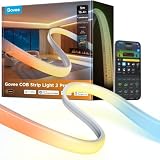
Govee LED Strip Light M1, 16.4 ft — Buy Two
Who it suits: The bedroom as a two-zone system — a headboard run for the evening and a low floor-level run for the barefoot path to the bathroom — where each zone needs its own brightness, its own scene and its own schedule.
Of all the ways to spend $200 in one bedroom, this is the allocation this guide would defend first, because it matches how a bedroom is actually used after dark. Two M1 kits together form the two-zone build inside this budget — check the current price on Amazon for the pair — and what that buys is not 32.8 feet of strip but two separate 16.4 ft installations, each with its own 24V adapter, its own controller and its own entry in the app. Zone one lives at the headboard or in the cove: the evening light, warm and dim. Matter over Wi-Fi joins Apple Home, Alexa, Google Home and SmartThings, the Govee app holds 64-plus scenes and music sync, and each strip trims at its marks and can extend toward 32.8 ft with Govee’s kits. When the M1 is positioned lower in the tier, the same two-zone build leaves more of the budget for the channel and clips a serious install wants.
The compromises are the Matter caveat, the density ceiling and the management of two, and the first one deserves its plain words under the bedroom lens specifically. Over Matter, the M1 behaves as a single-color strip — one color along its length, with brightness and white temperature adjustable — while the gradients, segments and sunset scenes that justify its place in the tier live only inside the Govee app. Govee publishes no CRI figure we could verify for the M1. None of that dethrones the build for its brief: it is the only way this budget lights a bedroom in two honest zones at once.
- Two zones inside the budget: two M1 kits, each independently powered, scheduled and controlled — check price on Amazon.
- Premium light per zone: RGBICW chips at 60 LEDs per meter with a real warm-white channel — the floor-path zone can run a true warm dim, not a blue mix.
- No long-run physics: separate adapters mean no far-end voltage drop, and one zone’s failure never darkens the whole room.
Honest limitation: Over Matter each strip is single-color — the sunset gradients and music modes live only in Govee’s app; 60 LEDs per meter is dense but not dotless like the COB picks at pillow distance; and two kits mean two controllers, two adapters and two app entries to manage.
Choose it if your bedroom plan is a headboard zone plus a night-path zone, and you will run the scenes from Govee’s app where they actually live. Skip it if you have one run and want it flawless — the COB 2 Pro at the top of this guide spends the same budget on one perfect line.

Govee RGBIC LED Strip Lights with Covers, 32.8 ft
Who it suits: The bedroom where the strip must run in direct view — a straight line along the ceiling edge above the bed, a skirting line, a wardrobe face — and where a bare dotted strip would fail the pillow test every single night.
Every other pick in this guide hands you a strip and leaves diffusion as homework. This kit is the exception, and in a bedroom that exception is worth a ranking of its own: the box contains two 16.4 ft RGBIC strips, the adapter and control box, and the cover track itself — lengths of diffuser channel with inside and outside corner pieces, per the maker’s package list — so the strip clicks into a straight, rigid line and the frosted cover does the smoothing the emitters alone cannot. Its position in the tier is part of the appeal: it sits in the middle of this budget as a finished install, not just a bare strip — check the current price on Amazon. For a buyer whose alternative was a bare strip plus channel bought separately plus an evening matching them, the kit’s all-in-one approach is the argument.
The compromises are rigidity, borrowed diffusion and permanence. Rigidity first: a strip in a track goes where a track can go — straight runs and the provided corners — and the channel fixes the route in a way bare tape never does; a curved cove, a tight radius around a wardrobe, or a rental you must return unmarked are all arguments for a different pick. Within its brief — a finished, viewable line of color over or around the bed, installed once and meant to stay — nothing else in the tier does as much of the job in one box.
- The finished install in a box: diffuser channel with corner pieces included, turning a 60-LEDs/m strip into a softened line that passes the pillow test.
- Real footage: 32.8 ft as two 16.4 ft strips, with Wi-Fi app control, Alexa and Google voice from the bed, and Matter per the listing.
- Mid-tier positioning for a finished install: channel included in the box — check price on Amazon.
Honest limitation: The dotless look is the channel’s work, not the emitters’ — the strip alone is standard density; the track makes the install rigid and semi-permanent, and whites are RGBIC mixtures rather than dedicated-white light for the last hour of the day.
Choose it if the run will be visible from the bed, the route is straight, and you want the fixture look without a separate channel purchase. Skip it if you rent, your route curves, or you need dotless light from the strip itself — the COB picks carry their diffusion with them.
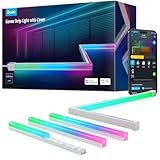
Philips Hue Solo Lightstrip, 33 ft
Who it suits: Hue households whose bedroom runs long — a full ceiling perimeter or a long cove — and whose mornings run on routines; buyers who already own a Bridge, or who have done the hub arithmetic below with their eyes open.
Start with the system question, because this pick is a system question, and in a bedroom that question has a twist in Hue’s favor that this guide will state as fairly as the one against it. The Solo line is one strip sold in three lengths, and Signify’s own datasheet rates the family’s output at 1,700 lumens at 4000K (1,500 at 2700K) — the same total for this 33 ft strip as for the 10 ft version in the under-$75 guide. The long Solo therefore buys length, not brightness: spread across 33 feet, the output that makes the short strip punchy becomes a gentle, even wash. Check the current price on Amazon for the 33 ft configuration. Out of the box, though, the strip runs over Bluetooth in the Hue app — dimming, color, basic scenes, within range of your phone — and Bluetooth has no repeating schedule that survives your phone leaving the room. The routines that justify this pick live behind the Bridge. The link on this page opens the Solo family listing, where the 10 ft kit is the default view: select the 33 ft size before checkout, and check the current price on Amazon for that size, which can differ from the shorter configurations and from other retailers such as Best Buy.
The compromises are the toll, the format and the tape. The toll is real, unique in this guide, and stated at full size: the Bridge is a separate purchase from Hue, with the newer Bridge Pro positioned above the standard Bridge — so strip plus Bridge takes the complete system beyond this guide’s budget. No other pick here asks for a second purchase to unlock its own headline features, and in a bedroom the withheld feature is the headline: a wake-up routine is not an extra, it is the product. On the other side of the ledger stand a two-year warranty, a maker-rated life of about 25,000 hours, and the deepest software support in smart lighting. Judged as a strip, superb and long. Judged as a bedroom system bought from zero, its honest place is above this tier — and this guide would rather lose the pick its ranking than hide that.
- The longest quality run in the guide: 33 ft of Hue RGBWW color — a gentle, even wash, which suits dawn light; check price on Amazon.
- The best routine engine in the category: Hue’s timed wake-up and wind-down fades — unlocked by a Bridge, not by the strip alone.
- A published output rating: Signify rates the strip at 1,700 lumens at 4000K — with the caveat that it is the same total as the 10 ft version; backed by a 2-year warranty.
Honest limitation: The routines and full feature set need a Bridge, sold separately, making the true system cost more than this budget from a standing start; out of the box it is Bluetooth-only, the strip shows one color along its length with no segments, it cannot be extended, and the listing’s default size is the 10 ft kit, so the 33 ft option must be selected deliberately.
Choose it if you already own a Hue Bridge, or want Hue’s wake-up routines badly enough to budget the hub on top and say so. Skip it if you want a complete, routine-running bedroom setup for $200 all-in with no second purchase — the Govee picks schedule from their apps with no hub at all.

Govee COB LED Strip Light Pro, 16.4 ft (2024)
Who it suits: The bedroom buyer who wants the dotless flagship experience on the headboard run and is willing to take last generation’s model in exchange for a lower position in the tier — leaving more of the budget toward clips, channel or a second small run.
Two years before the COB 2 Pro at the top of this guide, this strip was the flagship, and most of what made it one is still here. It launched in September 2024 as the premium end of Govee’s range, and at 16.4 feet it is this guide’s value flagship: positioned below its successor in the range — check the current price on Amazon to confirm that gap still holds before buying. In a bedroom budget the difference matters qualitatively — it is the headroom for the clips and channel the above-the-bed rule requires, bought with the strip instead of after it.
The compromises are generational and evidential. The live Amazon price must be checked before buying, and if it has converged on the successor’s position at the top of the tier, the argument for this pick collapses and the COB 2 Pro above is the buy. Within its terms — flagship density, real white, hub-free routines, and a lower tier position than the successor — it is the thinking buyer’s COB.
- Near-flagship density: COB construction at 1,260 LEDs per meter — a dotless line at pillow distance, within a step of the successor’s claimed figure.
- RGBICW chips with a dedicated white emitter, Matter over Wi-Fi, app scheduling and voice control — routines run with no hub purchase.
- Positioned below the successor in the tier — check the current price on Amazon before buying.
Honest limitation: Its value case depends on the live listing staying clearly below the successor, so it must be confirmed on the live listing before buying; it publishes no verifiable CRI figure, its white architecture is a generation behind the COB 2 Pro, and cutting is one-way like every Govee flagship.
Choose it if you want the dotless flagship experience and the saving versus the successor — best spent on the clips this guide insists on — matters more than the newest white chips. Skip it if the live price has crept close to the successor’s — at that point the successor above is strictly the better buy.

PAUTIX Addressable CCT Smart IC COB LED Strip Lights, 32.8 ft — Buy Two
Who it suits: The bedroom being lit as architecture — a full ceiling cove or crown line in dotless, tunable white that can drift warm at night and brighten cool in the morning — where color was never the point and one long unbroken wash was.
This pick is a build, and the guide says so in its name, because the product it recommends does not exist as a product: nobody sells a 65 ft smart COB white strip at this tier. What exists is this reel — 32.8 ft of addressable COB at 560 LEDs per meter, a continuous dotless line of white that can move, with chasing and flowing effects rendered in whites tunable from 2700K to 6500K, a 24V supply and smart controller in the kit, and Alexa voice control on top of the maker’s app — positioned toward the lower end of this tier per reel; check the current price on Amazon. Bought twice, it covers 65.6 feet and still fits this budget as a two-reel build: a full bedroom ceiling perimeter with the cove above the wardrobe besides, in light with no diodes to count from the pillow because COB construction never had visible diodes to begin with. What remains of the $200 budget after the two-reel build is exactly the headroom for the aluminum channel a cove install deserves.
The compromises are color, coordination and proof. Color first, as with every PAUTIX: this is a white strip. Its animation is done in shades of white — elegant in a cove at midnight, and a genuine limitation for anyone who pictured a sunset gradient crawling across the ceiling, because no setting on this strip will ever produce one; buyers who want color should take any Govee above. Its manuals and listings are unusually specific, which is the right kind of evidence, but the buyer is trading a giant’s ecosystem for a specialist’s strip. Within its terms — dotless, animated, long, white, and comfortably under budget as a two-reel build — nothing else in the tier lights a bedroom ceiling the way this build does.
- A run no box sells: two 32.8 ft reels total 65.6 ft of addressable, dotless COB white — check price on Amazon — leaving budget for channel.
- A full day’s arc in white: tunable 2700K–6500K with flowing white effects — cool and scheduled for morning, warm and dim for the last hour.
- Voltage drop designed out: each reel runs on its own 24V supply, so the far corner of the cove matches the near one.
Honest limitation: White only — its effects are shades of white, not color, so there is no sunset gradient to be had; two kits means two controllers that do not synchronize with each other; and output and CRI figures are the maker’s own, from a specialist brand with a smaller support operation.
Choose it if your bedroom project is a full cove or perimeter in white and you want it smart, animated and dotless. Skip it if you need one synchronized sweep from a single controller, or any color at all — the Govee picks above are the color tools.
Comparison Table
| Product | Format & length | Light & control | Best bedroom use | Link |
|---|---|---|---|---|
| Govee COB LED Strip Lights 2 Pro | COB strip, 16.4 ft, maker-claimed 1,344 LEDs/m | RGBWWIC color + real white; Wi-Fi app, voice, Matter | The one headboard or cove run you look at from the pillow | Check on Amazon |
| Govee LED Strip Light M1 (buy two) | Dense strip, 2 x 16.4 ft, 60 LEDs/m | RGBICW with real white channel; Matter + Govee app | Headboard zone plus floor-level night path, as a two-kit build in this tier | Check on Amazon |
| Govee RGBIC Strip Lights with Covers | Standard strip in channel, 32.8 ft (2 x 16.4 ft), 60 LEDs/m | Segmented RGBIC color; Wi-Fi app, voice, Matter per listing | A finished, pre-diffused line in direct view from the bed | Check on Amazon |
| Philips Hue Solo Lightstrip, 33 ft | Standard strip, 33 ft, not extendable | Single-color RGBWW; Bluetooth app, routines via Bridge | Wake-up routines on a long perimeter, for homes with a Bridge | Check on Amazon |
| Govee COB LED Strip Light Pro (2024) | COB strip, 16.4 ft, 1,260 LEDs/m | RGBICW with real white chip; Wi-Fi app, voice, Matter | Flagship dotless light positioned below the successor | Check on Amazon |
| PAUTIX Addressable CCT COB (buy two) | COB strip, 2 x 32.8 ft, 560 LEDs/m | Addressable tunable white with chasing effects; app + Alexa | 65.6 ft of dotless white for a full bedroom cove | Check on Amazon |
What $200 Buys in a Bedroom: Four Allocations
Because this budget is a system budget, the most useful thing this guide can do is show the systems. Plan one — the flagship feature: one COB 2 Pro behind the headboard or in the cove, leaving room in the budget for the mounting clips the above-the-bed rule requires. Plan two — the two-zone bedroom: two M1 kits, headboard zone plus floor-path zone, each on its own schedule; when the M1 sits lower in the tier, the same plan leaves more headroom for channel and clips. Plan three — the finished line: the Covers kit for a straight, pre-diffused run in direct view, leaving headroom for a second small purchase or for adding an outlet where the run actually starts. Plan four — the white ceiling: two PAUTIX reels for a full dotless cove, leaving headroom for aluminum channel, the install the cove deserves. Govee’s COB Strip Light 2 in 32.8 ft — 840 LEDs per meter of RGBIC COB, dotless like the flagships but without their dedicated white chips, so its whites are tuned mixtures — sits near the top of this tier and would otherwise rank second here; it is discussed rather than linked because its Amazon listing code could not be pinned to this series’ two-source verification standard, and a bedroom’s last-hour white is exactly where its mixed-white compromise would show. And the Hue plan, stated honestly: the Solo 33 ft plus a Bridge, sold separately, takes the complete system beyond this budget — plan five, the one that does not fit, included so that nobody assembles it by accident at checkout. For every plan, check the current price on Amazon before committing.
How to Choose an LED Strip Light for a Bedroom Under $200
- Allocate before you compare. Decide which of the tier’s bedroom plans you are funding — one flagship feature run, two independent zones, one finished pre-diffused line, or a full white cove — before comparing products, because the four do not compete with each other and a strip chosen against the wrong plan disappoints even when it is excellent.
- Apply the pillow test ruthlessly. You will view this light lying down, at two to four feet, for an hour a night. Density is the specification that decides what you see: 1,260–1,344 LEDs per meter of COB disappears, 560 per meter disappears, 60 per meter blends only with a diffuser or a hiding place. If the run or its reflection in a window or wardrobe door will be visible from the bed, density — or the Covers kit’s channel — is the purchase.
- Ask where the white comes from, because the last hour depends on it. RGB and RGBIC strips fake white by mixing colors, and the mix reads cool and thin at low brightness — daylight at midnight. Dedicated white chips (the COB 2 Pro’s RGBWWIC arrangement, the white emitters of the COB Pro and the M1, the Hue’s RGBWW emitters, or a white-only COB build) produce the warm, low light a bedroom actually ends its day in.
- Judge dimming at the bottom, not the top. A bedroom strip lives at 5 percent. Check that the pick dims smoothly to a glow rather than stepping or flickering at its floor, and that its warmest setting is genuinely warm. Headline brightness is a living-room metric; the lumen totals here are maker figures in any case, and the Hue’s shows why totals mislead — the same 1,700 lumens serve its 10 ft and 33 ft strips alike.
- Run the from-the-bed test on every control claim. The hierarchy is routine, voice, remote, app. A schedule that fires without you beats a voice command, which beats a remote on the nightstand, which beats an app on a phone that is charging across the room on Do Not Disturb. Then check what your chosen platform actually receives: on the M1, Matter carries a single color while the sunset gradients stay in Govee’s app, and the Hue’s repeating routines wait behind its Bridge.
- Do the ecosystem arithmetic out loud. The Hue Solo’s routines sit behind a Bridge, sold separately, with the Bridge Pro positioned above the standard Bridge — a complete system that sits beyond this budget. The Govee picks schedule from their apps with no hub. Neither answer is wrong; buying the Hue for its wake-up routine without having accounted for the hub is.
- Mount anything above the bed like it matters, because it does. Peel-and-stick backing is the most-complained-about component across this category, and a strip that lets go at night falls on the sleeper. Clips or screws for every run above or behind the bed, channel where the run is long, and a test section on clean, fully cured paint before the full install — at any point in this tier, gravity does not check the receipt.
- Plan the cut and the circuit before you buy. Every pick here trims at printed marks, and on all of them the cut-off section is dead — Govee prints the rule on its flagship pages: once cut, the strip cannot be reconnected or extended. Each run also starts within reach of an outlet, because the adapter’s lead is short; the two-kit builds turn that constraint into a plan, with each zone’s outlet near its own controller. Adapters and control boxes live somewhere ventilated and out of bedding, never buried behind pillows.
- Check the standby glow before the first night. Control boxes carry status LEDs, and a pinpoint of blue or green light that a living room never notices can be the brightest object in a dark bedroom. Position the box where its indicator faces a wall or the floor, or cover the indicator with a dot of electrical tape — and factor a partner’s light sensitivity into where the bright end of the run goes.
- Check the current price on Amazon, and the configuration, at checkout. Positions within this tier shift, so confirm where each pick sits today rather than relying on a fixed figure. And buy the size the review recommends — the Hue link opens on the 10 ft kit, and the 33 ft configuration must be selected deliberately.
Common Buying Mistakes
- Assuming the $150–$200 shelf is crowded. It holds a handful of strips; most of what search results surface at this price is a shorter strip at a marked-up listing, a television accessory, or a bare commercial reel with no power supply. Verify what the listing actually includes.
- Spending the whole budget on one run when the bedroom needed two zones. A flawless headboard strip does nothing for the barefoot trip at 3 a.m.; the two-zone allocation exists because bedrooms have two lighting problems, not one.
- Believing a longer strip is a brighter strip. Hue rates its 10 ft and 33 ft Solo strips at the same 1,700 total lumens; the long one spreads that output over three times the length. For a wake-up wash that is fine — bought knowingly.
- Trusting adhesive above a bed. Cost does not improve peel-and-stick backing, and the failure mode in this room is a strip on a sleeping person. Clips or channel, every time, no exceptions for flagships.
- Buying the Hue for its routines and skipping the Bridge. The strip alone is only part of the system; out of the box, Bluetooth gives you an app and a remote’s worth of control, not a self-running dawn.
- Assuming Matter means full features. On the M1, Matter carries a single color per strip; the sunset gradients and music modes — the scenes a bedroom buys it for — stay in Govee’s app.
- Judging a bedroom strip by its full-brightness photos. The product you live with is its 5 percent warm white at 11 p.m. Mixed RGB white, invisible in the listing photos, is the coldest light in the room at exactly the wrong hour.
- Cutting first and reading the manual second. On every Govee flagship here, a cut strip cannot be reconnected or extended; the offcut is waste, permanently.
- Expecting two kits to behave as one strip. Two controllers do not synchronize chases or share a power supply; a build is two installations that agree on a look, which in a bedroom — zones on different schedules — is usually what you wanted anyway.
- Forgetting the control box in the room plan. Its adapter needs an outlet and air, its standby LED needs a wall to face, and its infrared or radio receiver — where fitted — needs a path to the bed. A strip planned to the last inch with a homeless controller is an unfinished install.
Final Recommendation
- Most bedrooms, two zones: Govee LED Strip Light M1, 16.4 ft — buy two.
- One visible run, done perfectly: Govee COB LED Strip Lights 2 Pro, 16.4 ft.
- A finished line in direct view: Govee RGBIC LED Strip Lights with Covers, 32.8 ft.
- Wake-up routines, Bridge already owned: Philips Hue Solo Lightstrip, 33 ft.
- Flagship density for less: Govee COB LED Strip Light Pro, 16.4 ft (2024).
- A full white cove: PAUTIX Addressable CCT Smart IC COB Strip, 32.8 ft — buy two.
Our top two frame the bedroom’s real decision. The M1 pair is the allocation most bedrooms should make: a headboard zone that warms and dims toward sleep and a floor zone that lights the 3 a.m. path at a few percent, each on its own power and its own schedule — check the current price on Amazon for the pair — provided you accept that its gradients live in Govee’s app and that 60 LEDs per meter wants hiding at pillow distance. The Covers kit is the pragmatist’s finished line, the PAUTIX build is the white-ceiling answer, the 2024 COB Pro is the same flagship idea positioned lower in the tier for buyers who will put the headroom toward clips, and the Hue is the best morning software in the category, with the honest caveat that the complete system sits above this budget once the Bridge is included. Pick the allocation first, mount everything above the bed like gravity is real, check the current price on Amazon, and let the room run itself.
Frequently Asked Questions
Is $200 too much to spend on strip lights for one bedroom?
On one strip, usually yes — and this guide is built on that admission. The $150 to $200 shelf holds only a handful of single strips, so the honest uses of the budget are allocations: one flagship feature run, two independent zones, a finished install with its diffuser channel included, or a two-reel white cove with room left for mounting. If your bedroom needs one short run of simple color and nothing else, the picks in Best Led Strip Lights For Bedrooms Under $100 cover the M1 and shorter Hue lengths without the system framing, and the budget saved is real.
Why does diode density matter more in a bedroom than anywhere else?
Distance and duration. In a bedroom you view the light lying down, two to four feet from the headboard wall, for the last hour of the day — close enough and long enough to count individual diodes on a spaced strip and to see them doubled in a window or wardrobe door. Density is the fix that cannot be faked by an app: COB strips at a claimed 1,260 to 1,344 LEDs per meter and white COB at 560 per meter present as continuous lines of light, while 60-per-meter strips need a diffuser channel or a hiding place to pass the same test.
Can these strips actually work as a wake-up light?
Yes, with one honest division. The Hue’s wake-up routine is the most polished in the category — gradual, precisely timed, repeating weekly — but it lives behind the Bridge, so a Bridge-less Hue strip offers Bluetooth scenes, not a self-running dawn; budget for the hub as a separate purchase beyond this tier, or choose a Govee. Whichever you pick, a long, gentle wash wakes better than a short bright one, which is the one context where the Hue’s length-without-extra-lumens arithmetic works in its favor.
What is the best light for getting up at night without waking a partner?
A separate, low zone — which is why the two-zone M1 build tops this guide. A floor-level run under the bed frame or along the skirting, set to a warm white or deep amber at a few percent on its own schedule or voice command, lights the path to the bathroom without raising the room’s light level or firing the main feature run. A single-strip bedroom can imitate this with a dim warm scene, but it cannot light the floor and keep the headboard dark at once; that independence is what the second kit buys.
Is it safe to mount a strip above the bed?
It is safe when it is mounted, and the distinction is the mounting. Peel-and-stick backing is the most failure-prone component in this category at every price, and above a bed the failure lands on a person — so every run above or behind the bed in this guide is specified with clips, screws or a screwed channel, on a clean and fully cured surface, with adapters and control boxes kept clear of bedding and pillows where they can be smothered. The strips themselves are low-voltage; the discipline is mechanical, and it is not optional anywhere in this tier.
Why does the same Hue strip claim the same brightness at 10 ft and 33 ft?
Because Signify rates the Solo family at one total output — 1,700 lumens at 4000K — regardless of length, so the longer strip spreads the same light over more than three times the footage. The extra spend buys coverage, evenness and ecosystem, not intensity. This guide treats every brightness figure in the category as a maker figure, but Hue’s is at least a first-party datasheet rating, and the lesson generalizes: compare density, white architecture and control before you compare any headline number.
Should I buy one flagship strip or two mid-priced ones?
Match the purchase to the room’s problems. One flagship (the COB 2 Pro, or the 2024 Pro positioned below it in the tier) wins when a single visible run carries the room and will be looked at nightly — density and white quality are per-run properties that a second cheaper strip cannot add to the first. Check the current price on Amazon for either option before deciding.