Where to buy
Check the latest price, availability and delivery on Amazon. Orders are placed on Amazon. We may earn a commission from qualifying purchases.
- Best overall for apartments: Govee LED Strip Light M1, 16.4 ft, RGBICW with Matter — Check on Amazon
- Philips Hue Solo Lightstrip Base Kit, 16 ft, White and Color Ambiance — Check on Amazon
- Govee COB LED Strip Light Pro, 9.8 ft, RGBICW with Matter — Check on Amazon
- Philips Hue Lightstrip Plus V4 Base Kit, 80 in, White and Color Ambiance — Check on Amazon
See 2 more Amazon options
- PAUTIX RGB Smart IC COB LED Strip Lights, 20 ft, Addressable, 24V Kit with SP548E Controller — Check on Amazon
- Govee RGBIC Neon Rope Light 2, 16.4 ft, with Matter and Shape Mapping — Check on Amazon
Read the full guide ↓
Disclosure: As an Amazon Associate, dailyhomedecorating.com earns from qualifying purchases. Links to Amazon on this page are affiliate links; they cost you nothing extra. Listing details such as price and availability change often, so check the current Amazon listing before you buy.
At the lower tiers of this category, renting mostly argues for spending less: an inexpensive strip is a consumable, and a consumable cannot hurt a deposit. At $100 the argument inverts, and this guide is built on the inversion. Every pick below is therefore audited in two columns. The first column is what travels: the adapter, the control box, the app account, the scenes you built, the smart-home pairings — and, in the Hue case, a Bridge that is quite literally a once-a-decade purchase that moves from apartment to apartment to house without losing any of its function. The second column is what stays: footage stuck to a landlord’s paint, pieces trimmed to fit this kitchen and no other, and any channel or clip screwed into property that is not yours. A hundred feet of budget tape peeled off a rental ceiling is a Saturday of labor and a deposit argument. The footage in this tier is short because short is what survives a move.
Three honesty notes from the general guide survive the change of lens, and each one changes meaning slightly in a rental. First, positioning: the flagships here sit at the top of this budget tier — check the current price on Amazon for each pick before you buy, because listings change often. What $100 buys in this tier is density and construction, not length: 60 LEDs per meter at the guide’s low end, 1,260 per meter at the top, dedicated white channels instead of white mixed from color, and Matter on three picks, with the denser, better-built strips concentrated at the upper end of the band. Second, the Hue toll: both Hue picks run in a limited Bluetooth mode out of the box, and the full feature set still sits behind a Bridge that is a separate purchase — check price on Amazon for the Bridge as well — so a Hue strip bought from zero is a system purchase, not just a strip purchase. Third, the PAUTIX kit is included on an explicit check-price basis: check price on Amazon and buy only if the live listing for the 20 ft kit sits within the under-$100 budget. Brightness gets the same treatment throughout: Hue’s published ratings (1,600 lumens for the Lightstrip Plus, 1,700 for the Solo) are maker figures and are reported as such, and Govee publishes no verifiable total lumen figure for either flagship, so this guide prints none and judges their light by density instead.
Quick Picks
Short on time, or comparing several options at once? Each row below names a renter situation and the strip that suits it, with a link to the listing.
| Buyer type | Pick | Why it stands out | Link |
|---|---|---|---|
| Best overall for apartments | Govee LED Strip Light M1, 16.4 ft | 60 LEDs per meter, a real warm-white channel and Matter — one short run on your own furniture that packs up whole at move-out; check price on Amazon | Check on Amazon |
| Best ecosystem that travels | Philips Hue Solo Lightstrip, 16 ft | Sixteen finished feet at the upper end of this tier — check price on Amazon; the Bridge it wants is a buy-once asset that moves with you forever, so count the strip and the Bridge together as the system | Check on Amazon |
| Best visible run on your own furniture | Govee COB Strip Light Pro, 9.8 ft | 1,260 LEDs per meter under silicone — a dotless line short enough to live entirely on a bookcase or desk you own; check price on Amazon | Check on Amazon |
| Best for a long lease | Philips Hue Lightstrip Plus V4, 80 in | The only pick that grows, to 32 ft with extensions — worth it when the lease is long; check price on Amazon, and its trimmed offcut can rejoin another base, the guide’s only non-waste cut | Check on Amazon |
| Best long dotless color | PAUTIX RGB Smart IC COB Strip Kit, 20 ft | Twenty feet of addressable COB color with supply, controller and RF remote in one box that travels as a unit — sold on a check-price basis in this guide | Check on Amazon |
| Best shape light, with a warning | Govee Neon Rope Light 2, 16.4 ft | A bendable rope for wall shapes — check price on Amazon — but its box ships screws a renter must not put in a landlord’s walls; clip it to your own furniture instead | Check on Amazon |
How These Picks Were Chosen
The first filter was the budget, applied exactly as in the general guide: every strip below has a real Amazon listing for the length named in its review, positioned within this under-$100 tier — check the current price on Amazon before ordering, because listings change often. The Govee M1, the Govee COB Pro and the Hue Lightstrip Plus all sit at the top of the band, while the Hue Solo sits just below that top tier within the same budget. The PAUTIX kit is included on an explicit check-price basis: its listing, model and box contents are verified, and the instruction is to check price on Amazon and buy only if the 20 ft kit sits within the $100 budget. Prices belonging to the PAUTIX family’s longer listing belong to a different listing and were deliberately not borrowed for the 20 ft kit.
The second filter is this guide’s own: the travels-versus-stays audit. Money sitting in footage peeled off a landlord’s ceiling travels at whatever is left after the peeling, which for adhesive-backed strips is often nothing. Money sitting in extensions, channels and screws installed into the landlord’s property does not travel at all — it is a gift to the next tenant, purchased with your deposit as collateral. Ranked by that audit, the short dense strips win this tier for renters almost by definition, and the one long pick (the PAUTIX at 20 ft) survives the audit only because its whole kit — supply, controller, remote — is a self-contained unit and its footage is the kind of run a renter puts in a channel rather than on paint.
The third filter was mounting discipline, and it is absolute: nothing in this guide requires, or quietly assumes, a screw in the landlord’s wall, a channel screwed under the landlord’s cabinets, or any modification you would have to disclose at inspection. The fourth filter was the category’s usual one, unchanged: we did not use these strips ourselves. We read the maker listings, manuals and specification pages, and compared footage, emitter density, whether white comes from a dedicated channel or a color mix, how control actually works (app over Wi-Fi, Bluetooth, or Matter — and what each path leaves behind), and whether cutting is one-way. On five of the six picks it is: trim at the marks and the cut-off piece cannot be reconnected and lit again, which in a rental means the trimmed piece was fitted to this apartment and dies with the lease. The single exception — the Hue Plus’s offcut, reattachable to another base unit — is named every time it matters, because for a renter it is the difference between waste and luggage.
Before Anything Sticks: The $100 Renter Rules
Four rules govern every review below, and they are worth stating once, plainly, before the products. Rule one: your furniture is the mounting surface of first resort. The back of a bookcase, the underside of a desk, the top edge of a headboard you own — these surfaces are yours, they move when you move, and a strip mounted on them is an asset with a handle. Rule two: every foot stuck is a foot to peel. Removal is not free and it is not instant: budget the hairdryer-and-patience hour per room at move-out, and run a one-foot test patch for a week before committing a full run to any painted surface. Rule three: channels and clips are rented discipline, screws are ownership. An aluminum channel makes a strip look built-in and protects it — and a channel screwed under a landlord’s cabinets is a modification, full stop. If a mounting plan needs a drill, it needs written permission or a different plan. Rule four: price the system in two columns before you buy. Write down what travels and what stays. If the stays column holds more than about a third of the money, the purchase belongs to a homeowner’s guide — or to the cheaper tiers, where the stays column is small enough to write off, as the apartment picks in Best Led Strip Lights For Apartments Under $75 are designed to be.
The 6 Best LED Strip Lights for Apartments Under $100
Govee LED Strip Light M1, 16.4 ft
Who it suits: Most renters in this tier — anyone with one short, high-value run (behind a desk setup, along a bookcase, above a headboard you own) who wants flagship light quality in a form that packs into a single box on moving day.
The M1 is the best-balanced strip in the general guide, and the renter audit makes it stronger, not weaker. Its four-in-one RGBICW chips pack 60 LEDs into every meter — double the density of standard smart strips — with a dedicated warm-white emitter beside the color ones, so whites come from a white diode rather than from red, green and blue arguing with each other. Its smart credentials are the most portable in the guide: Matter over Wi-Fi joins it to Apple Home, Alexa, Google Home and SmartThings, so the pairings and routines you build in this apartment re-form in the next one in minutes, on whatever platform you are running by then. On positioning it sits at the top of this budget tier — check the current price on Amazon before you buy. Renters with a flexible timeline can watch the listing over time; renters furnishing now should know the hardware is the same whenever they order it.
The compromises are the Matter caveat, the cutting rule and the value-per-foot trade-off. Cutting is one-way: the manual is explicit that detached pieces cannot be reconnected, so a trim made to fit this apartment’s desk wall is a trim that fits no other wall — measure the run in the next place before assuming the strip survives the move intact, and prefer routing excess along a hidden edge over cutting at all. For its length, this is a premium, density-first strip rather than a bulk reel; that is the trade-off of density, and it is why this is a one-run purchase. Govee publishes no CRI figure and no total lumen figure we could verify, so its brightness reputation rests on testing coverage — The Verge called it the brightest strip it had tested — rather than on a specification this guide can print. None of that dethrones it for renters: it is the pick whose money travels most completely.
- The portable flagship: 60 LEDs per meter of RGBICW chips with a real warm-white channel, in a 16.4 ft run sized for your own furniture.
- Matter over Wi-Fi joins every major platform, so the smart layer re-forms in the next apartment instead of being rebuilt.
- 24V adapter included; cuttable at the marks and extendable with Govee kits toward 32.8 ft — though renters should route excess rather than cut.
Honest limitation: Over Matter it is a single-color strip — the segmented effects live only in Govee’s app; cut pieces cannot be reconnected, so a trim fitted to this apartment stays fitted to this apartment; and, positioned at the top of this tier, it is a one-run purchase, not a whole-room one — check price on Amazon.
Choose it if one short run deserves the best all-round light and you want the whole purchase to leave with you. Skip it if you need to outline a whole room — the bulk reels in the lower guides cover four times the length for less money, as consumables a renter can write off.
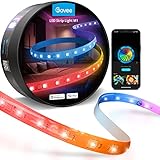
Philips Hue Solo Lightstrip, 16 ft
Who it suits: Renters making a long-term smart-lighting decision — anyone whose run is finished and measured (a full cabinet wall, a ceiling cove in a long lease, a staircase) and who understands that the real purchase here is not the strip but the ecosystem it plugs into.
The Solo’s renter case begins with the system logic the general guide states and this lens reframes — check price on Amazon for the strip itself. The full feature set — out-of-home control, real schedules and routines, grouping with a houseful of Hue lights, entertainment sync, voice assistants and Matter — sits behind the Hue Bridge, which is a separate purchase, so count the strip and the Bridge together when you judge the system. The Bridge is bought once, it is the size of a coaster, it holds every routine and pairing you build, and it moves from this apartment to the next one to a house you eventually buy without losing any of its function. A renter who plans to be in Hue for a decade is not overpaying for a strip — they are investing in a platform that carries across every home they will live in, and the strip itself is a good one: sixteen finished feet of RGBWW strip, physically the same strip as the Lightstrip Plus by Hue coverage’s own account, rated by the maker at 1,700 lumens — a first-party figure, reported as one — and, for its length, among the better-value premium picks in this guide.
The compromises are finality, format and the Hue line’s adhesive reputation, which matters more in a rental than anywhere else. Adhesive: Hue strips carry the category’s most documented grip complaints, and in a rental a failed bond is not just an annoyance — a strip that sags and gets re-stuck with stronger tape is a deposit risk being manufactured in real time. Budget for the Bridge as a probable purchase rather than a hypothetical one, and the Solo remains the best-value door into the one ecosystem a renter can genuinely take with them.
- The ecosystem pick: 16 finished feet of Hue color — check price on Amazon — with a maker-rated 1,700 lumens.
- The Bridge it wants — check price on Amazon — is a buy-once, moves-forever asset — the most portable part of the purchase in this guide.
- Bluetooth control in the Hue app with no hub at all; the Bridge unlocks routines, grouping, sync and Matter in every future home.
Honest limitation: It cannot be extended — 16 ft is the lifetime maximum — it shows a single color along its length, its adhesive is the line’s most-complained-about part (plan clips, especially on a landlord’s paint), and the full feature set needs a Bridge, so count the strip and the Bridge together as the system cost — check the current price on Amazon for both.
Choose it if your run is finished at 16 feet or less and you are buying into Hue for the long term. Skip it if the run might grow — that is the Plus below — or if $100 must be the whole system price, in which case the Govees are complete in the box.

Govee COB Strip Light Pro, 9.8 ft
Who it suits: Renters whose strip will be seen up close on something they own — the underside of open shelving, the edge of a desk, around a mirror on a dresser — and who want light that reads as one continuous line rather than a row of diodes.
If the M1 is density doubled, the COB Pro is density multiplied by twenty-one: 1,260 LEDs per meter packed onto the board and sealed in a soft silicone sleeve, producing a single unbroken band of light with no visible emitters at any distance. The rental virtue is its footage. The 9.8 ft version is the configuration in this guide — check price on Amazon — while the longer version in the same family sits above this budget tier and is outside this guide. It trims at marked points — coverage notes cut points every 8 cm — and runs on the included adapter, indoors only.
The compromises are footage, value per foot and the family caveats. For a short 9.8 ft run this is among the most premium picks per foot in this guide, and a renter whose feature run measures twelve feet faces the longer version above this tier or a different pick; there is no extension path that keeps this strip in budget. Judged on light that can be looked at directly, nothing else in the guide matches it; judged on portability, nothing else in the guide is smaller to pack.
- The densest light in the guide: 1,260 LEDs per meter under silicone, a continuous band with no visible diodes.
- Full color plus a real white channel: RGBICW with segmented effects, Matter, app and voice control.
- The most portable pick here: 9.8 ft lives entirely on one piece of your own furniture and coils into its box at move-out.
Honest limitation: Only 9.8 ft for a premium, density-first pick, with the longer version in the same family outside this budget; Matter carries basic control while effects live in Govee’s app, and no verifiable total lumen figure is published — check price on Amazon.
Choose it if the strip will be in direct view on furniture you own and dots are the one thing you cannot accept. Skip it if your run is longer than ten feet or hidden in a cove — the M1 covers more length within the same tier, and hidden strips do not need density.

Philips Hue Lightstrip Plus V4, 80 in
Who it suits: Renters on long leases and Hue households — anyone whose run will genuinely grow over years in the same home, and who values the one cutting exception in this guide enough to pay this guide’s premium for it.
The Lightstrip Plus is the elder statesman of smart strips, and the V4 base kit is its current form: 80 inches (about 6.6 feet) of RGBWW strip rated by the maker at 1,600 lumens — a first-party figure, reported as a maker’s rating like every other number in this category. Its defining feature is the one no other pick offers: it extends. Forty-inch extension pieces click onto the base strip’s six-pin connector, up to a 32-foot maximum on the original power supply and control box. The Plus is therefore the right rental pick under exactly one condition: a lease long enough, or a Hue commitment deep enough, that the growth happens slowly and the Bridge — a separate purchase, check price on Amazon — is already owned or already justified, so the system as a whole makes sense for a buyer starting from zero. Out of the box it runs over Bluetooth in the Hue app, within range of your phone, for up to about ten lights; check the current price on Amazon for the base kit. One listing note belongs in the review rather than a footnote: crawls of this kit’s Amazon page have at times shown no featured offer, so confirm a live, orderable offer within this budget before ordering — this is the first listing to recheck when this guide is published.
The compromises are the ecosystem toll, the value per foot and the format. For just 6.6 feet the base kit is the most premium pick per foot in this guide, and extensions soften but never erase that trade-off. Judged as a platform, it is superb. Judged as a rental purchase, it is a long-lease instrument — buy it when the years justify it, and let its reattachable offcut be the tiebreaker it genuinely is.
- The only growing pick: extendable from 80 inches to 32 feet with 40-inch extensions on one supply and controller.
- The only non-waste cut: a trimmed section can be reattached to another Lightstrip base with the included connector clip.
- Maker-rated 1,600 lumens with Hue’s RGBWW color consistency; Bluetooth with no hub, full features via the Bridge that travels with you.
Honest limitation: The full feature set needs a Bridge — check price on Amazon for both the strip and the Bridge and count them together as the system; for its short base length the base is the guide’s most premium light per foot, extensions fitted to this apartment do not travel, it shows a single color along its length, and its featured offer should be confirmed live.
Choose it if you already own a Hue Bridge, your lease is long, and your run will grow over years. Skip it if the lease is short or the run is finished — the Solo above is the same light in a longer finished length and a better-value position in this tier.

PAUTIX RGB Smart IC COB LED Strip Lights, 20 ft
Who it suits: Renters with one genuinely long feature run — a living-room perimeter on a long lease, a long cove above their own shelving wall — who want dotless addressable color from a single self-contained kit, and who will check price on Amazon before buying, because this pick is sold on a check-price basis in this guide.
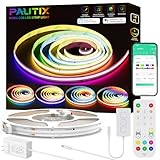
Start with the disclosure this pick owes you, in the review rather than the footnotes: this kit’s listing, model and box contents are verified, and it is included on a check-price basis — check price on Amazon, and if the live listing for the 20 ft kit described here sits within the under-$100 budget, it belongs in this guide; if it sits above that budget, it does not, and the honest move is to take the M1 or the COB Pro instead. Prices for the family’s longer listing belong to a different listing and are deliberately not used here. What the kit is, on the verified evidence: twenty feet (6.1 m) of addressable COB strip — WS2811 smart-IC chips under a continuous phosphor, so chasing, flowing multi-color effects render as a smooth band with no visible diodes, across a run twice the COB Pro’s length. For a renter, that completeness is the pick’s core virtue: the whole system is one box with one supply and one controller, it runs through the controller’s app with Alexa and Google Assistant compatibility per the listing, the RF remote works with no network at all, and at move-out the kit unplugs and travels as a unit in a way a multi-box ecosystem never quite does. The strip family is cuttable at marked points along the run.
The compromises begin with the check-price basis, which is not a formality: a pick sold on a check-price basis is a pick you must verify, and this kit’s siblings span a wide range of positions, so the check is the purchase discipline, not a courtesy. If white light is the main job, the white-only COB kits in the under-$75 guide are the better fit for that job. Fourth, the platform: the SP548E controller ecosystem is a specialist’s tool — capable, with deep DIY effect control, and a smaller, less polished app world than Govee’s or Hue’s, with support to match. What the kit offers in exchange is unique here: dotless addressable color at real length, in one box, from the brand that has made COB its whole business.
- Dotless color at length: 20 ft of addressable COB — chasing RGBIC effects with no visible diodes, the longest premium run in this guide.
- A complete, portable kit: strip, 24V/3.5A supply, SP548E controller and RF remote in one box that unplugs and travels as a unit.
- App control with Alexa and Google Assistant per the listing; the listing states UL listing and a six-year warranty.
Honest limitation: Sold on a check-price basis in this guide — check price on Amazon and buy only if the live listing for the 20 ft kit sits within the $100 budget; twenty feet is the guide’s biggest removal job if stuck to paint, so it belongs in a removable channel; whites are mixed RGB rather than from a dedicated channel, and the controller’s app ecosystem is a specialist’s, smaller than Govee’s or Hue’s.
Choose it if your run is 17 to 20 feet, must be dotless, must do color effects, and will be channel-mounted — and the live price checks out. Skip it if you want a pick whose position in this tier is settled without a live check, or white light as the main job.
Govee Neon Rope Light 2, 16.4 ft
Who it suits: Renters whose light is meant to be looked at — an outline above a desk, a shape over a headboard, a glowing line along a shelf edge — and who are willing to mount it the renter’s way, because the box’s own mounting plan is written for homeowners.
The rope is the different physical object in this guide: a thick silicone tube that diffuses its RGBIC emitters into a genuinely continuous glow, flexible enough to bend into shapes — Govee claims 14% more flexibility than the previous generation, a maker’s figure — with a shape-mapping feature in the Govee app that photographs your layout and assigns effects to the shape you actually built. It carries Matter alongside the app, Alexa and Google Assistant, matching the flagships’ smart credentials, and the 16.4 ft version sits in the upper part of this budget tier — check price on Amazon. In an apartment it is a trap with good intentions. Thirty-five screws are thirty-five holes in a landlord’s walls, and no glowing outline is worth the deposit conversation that follows. Mounted that way, the rope is genuinely rental-friendly: it is a single shaped object that unclips, coils and leaves, taking its shape-mapping setup with it in the app.
The compromises are form and finality, plus the screw discipline just described. Form: a rope is thick. Judged as what it is — the only pick designed from the start to be the visible feature — it has no rival in this guide, provided the screws stay in the box.
- Made to be seen: a silicone rope with a continuous glow, bendable into shapes with app shape mapping.
- Fully portable by construction: an untrimmable rope unclips, coils and leaves whole — its footage travels at a hundred percent.
- Matter, app and voice control; 16.4 ft — check price on Amazon.
Honest limitation: The box ships 35 screws a renter must not put in a landlord’s walls — clip it to your own furniture or removable hooks instead; it is a fixed, untrimmable length with a thick visible profile, wrong for hidden coves; whites are atmospheric rather than task light, and the shape effects live in Govee’s app while Matter carries basic control.
Choose it if the run is the decoration — a wall shape on your own furniture, an outline, a sign substitute. Skip it if the light should disappear into architecture; every flat strip above hides better, and none of them tempts you with a bag of screws.

Comparison Table
| Product | Format & length | Light & control | Rental verdict | Link |
|---|---|---|---|---|
| Govee LED Strip Light M1 | Dense strip, 16.4 ft, 60 LEDs/m | RGBICW with real white channel; Matter + Govee app | Best all-round portability: one furniture run, whole purchase packs in a box | Check on Amazon |
| Philips Hue Solo Lightstrip | Standard strip, 16 ft, not extendable | Single-color RGBWW; Bluetooth app, full features via Bridge | The Bridge is a lifetime asset; the strip is a finished-length consumable | Check on Amazon |
| Govee COB Strip Light Pro | COB strip, 9.8 ft, 1,260 LEDs/m | RGBICW dotless color; Matter + app + voice | Smallest move-out footprint: lives entirely on your own furniture | Check on Amazon |
| Philips Hue Lightstrip Plus V4 | Standard strip, 80 in, extendable to 32 ft | Single-color RGBWW; Bluetooth app, full features via Bridge | Long-lease pick: growth stays behind, but the offcut can rejoin another base | Check on Amazon |
| PAUTIX RGB Smart IC COB Kit | COB strip, 20 ft, addressable | Chasing RGBIC effects, dotless; SP548E app + RF remote | One self-contained kit that travels as a unit — channel-mount it or skip it | Check on Amazon |
| Govee Neon Rope Light 2 | Silicone rope, 16.4 ft, fixed length | RGBIC glow with shape mapping; Matter + app + voice | Travels whole by construction — but leave the included screws in the box | Check on Amazon |
How to Choose an LED Strip Light for an Apartment Under $100
- Run the travels-versus-stays audit before anything else. List what you are buying in two columns: electronics, controllers, Bridges and app setups travel; stuck footage, trimmed pieces and screwed-in channels stay. At this tier the audit, not the spec sheet, is the purchase. If the stays column holds more than about a third of the money, spend less or mount differently.
- Mount on your own furniture first. Bookcase backs, desk undersides, headboards and media consoles are surfaces you own, and a flagship run that lives entirely on them is an asset with a handle. The landlord’s walls are the last resort and the landlord’s ceiling is where removal labor concentrates — the opposite of the homeowner’s instinct, and correctly so.
- Treat screws as a permission question, not a mounting option. One pick in this guide ships thirty-five of them. A channel or clip screwed into the landlord’s property is a modification whatever the product box implies. Removable clips, channels clipped to your furniture, and rated adhesive hooks are the renter’s hardware drawer.
- Measure the run, then weigh length against density. The six picks here span a wide range of value per foot, because density has replaced footage as the thing being sold. Tape-measure the actual path on the furniture you own, including the drop to the outlet, and know which currency you are spending: feet, or quality per foot.
- Route excess; do not cut it. On five of the six picks, a cut-off piece cannot be reconnected and lit — and a piece cut to fit this apartment fits no other. The one exception, the Hue Plus’s reattachable offcut, is a genuine renter feature and is positioned like one.
- Separate the strip from the system — then split the system by portability. For the Hue picks, check price on Amazon for both the strip and the Bridge a buyer starting from zero will need. Compare complete systems, then ask which parts of the system you will still own in five years.
- Ask where the white comes from. Three picks produce white from a dedicated channel — the M1’s and COB Pro’s RGBICW chips, the Hues’ RGBWW emitters. The PAUTIX mixes its whites from color, smoothly but by mixture, and the rope’s whites are atmosphere. If the strip will light faces, food or fabric, this question outranks every scene mode.
- Check what your platform actually receives over Matter. Three picks speak Matter, and on the Govee strips Matter carries a single color with brightness and white control — the gradients, segments, shape effects and music modes stay in the maker’s app. For a renter this cuts both ways: the basics will re-pair anywhere, but the effects are rented from an app account, so keep the account.
- Decide about growth against your lease, not your hopes. Exactly one pick extends (the Hue Plus, at extra cost per 40 inches), one extends within its maker’s kit system (the M1, toward 32.8 ft), one is a finished length forever (the Solo), and one cannot be trimmed at all (the rope). Growth bought for a twelve-month lease is footage donated to the next tenant.
- Verify the live offer, not just the listing. Several picks sit at the top of this tier, one pick’s listing has at times shown no featured offer, and one pick is in this guide on a check-price basis. Confirm the exact model, the exact length, and an orderable offer at or under $100, in that order, before ordering.
Will a Premium Strip Fit a Rental’s Life?
Physically, everything here fits anywhere — that is the category’s appeal — so the rental questions are about surfaces, leases and light at close quarters. Surfaces first: in a small apartment you are always close to the strip, close enough to see its construction, which is why the dedicated shortlist in Best Led Strip Lights For Small Rooms Under $100 leans so heavily on density and on the rope — the same logic that makes a bookcase run in a studio a COB Pro’s home ground. Leases second: the bedroom is where premium strips earn their money longest, because a headboard run or a cove wash is used every night — but it is also where a control box’s standby glow and an app’s brightness floor matter at 2 a.m., and the bedroom-specific picks in Best Led Strip Lights For Bedrooms Under $100 are chosen with sleep in the room. And in a modern-styled rental, where the strip is often the only visible light source and there is no shade to forgive it, the finish of the light itself is the design decision; the style-first shortlist in Best Led Strip Lights For Modern Homes Under $100 scores exactly that. The through-line for renters is that a premium strip’s value is realized nightly and its risk is realized once, at move-out — so buy for the nights, and mount for the move.
Two installation rules protect both the strip and the deposit. First, the test patch: stick one foot to the least visible painted surface, live with it a week, then remove it with gentle heat and patience. That single experiment prices your removal risk better than any review, and it costs nothing. Second, respect the cut marks and the voltage: cut only where the strip says to cut, never power a strip from a supply that did not come with it or match its voltage, and keep adapters and control boxes out of sinks’ splash zones and steam — none of the six picks here is waterproof, and the kitchen-worthy picks belong under your own shelf edges or in clipped channels, not screwed beneath the landlord’s cabinets.
Common Buying Mistakes
- Sticking a premium flagship straight onto a landlord’s ceiling. The flagship’s value is its electronics and density; its footage should live on your furniture or in a removable channel, where the value can leave with you.
- Using the screws in the box. The rope ships thirty-five of them. Every one is a hole in someone else’s wall and a line item in a deposit dispute.
- Screwing an aluminum channel under the landlord’s cabinets to make a strip “look built-in.” Built-in is the landlord’s aesthetic, achieved with the landlord’s property. Clip the channel, or mount the strip on your own shelving.
- Cutting a strip to fit this apartment’s exact run. The offcut cannot be reconnected, and the fitted length fits no future room. Route the excess instead.
- Counting the Hue Bridge as pure overhead. It is the most portable part of the purchase — bought once, moved forever. The honest Hue math for a renter splits the system into a permanent asset and a per-home strip.
- Buying extensions for a short lease. Each 40 inches of Hue Plus growth is footage fitted to walls you will leave. Growth is a long-lease decision.
- Assuming Matter means full features. On the Govee picks, Matter carries a single color; the gradients and shape effects stay in the maker’s app. Check what your platform actually receives.
- Skipping the test patch. A one-foot, one-week test on painted drywall is the cheapest deposit insurance in this guide, and almost nobody does it.
- Skipping the live-offer check on a premium pick. Listings at this tier have shown no featured offer at times, and one pick in this guide is check-price by design. Confirm the model, the length and an orderable offer before ordering.
- Throwing the box away on day one. Controllers, connector clips and spare mounting hardware are exactly the parts that get lost, arrive faulty, or turn out to be the moving-day packing solution. Keep the packaging through the return window — and ideally until the move.
Final Recommendation
- Most renters: Govee LED Strip Light M1, 16.4 ft.
- Buying an ecosystem for every future home: Philips Hue Solo Lightstrip, 16 ft — plus the Bridge, counted as an asset.
- Visible runs on your own furniture: Govee COB Strip Light Pro, 9.8 ft.
- Long leases and growing Hue runs: Philips Hue Lightstrip Plus V4, 80 in.
- Long dotless color, price checked live, channel-mounted: PAUTIX RGB Smart IC COB Strip Kit, 20 ft.
- Light as decoration, screws left in the box: Govee Neon Rope Light 2, 16.4 ft.
Our top two frame the renter’s real decision at this tier. The M1 is the complete, portable answer: the densest conventional strip here, a real white channel, Matter done as well as anyone does it, and 16.4 feet that can live entirely on furniture you own — buy it if one run matters and you want the whole purchase to leave with you. The Hue Solo is the platform answer: a finished 16 feet of the guide’s best-documented color, attached to the one ecosystem whose hub is a lifetime asset — buy it if your planning horizon is measured in homes, not leases. Between them sit the COB Pro for runs that will be looked at, the Plus for leases long enough to grow into, the PAUTIX for dotless color at genuine length once its live price is verified and its channel is removable, and the rope for the rooms where light is the artwork — clipped, never screwed. None of the strips above pretends to be verified, waterproof or immortal. Measure your run, mount on what you own, count the density before the lumens, price the system in two columns, check the live offer, and keep the screws in the box.
Frequently Asked Questions
Is a $100 strip light a sensible purchase for a renter at all?
Yes — provided the money sits in the parts that travel. What is not sensible is a $100 strip stuck directly to a landlord’s ceiling: the footage becomes a removal job and the purchase becomes a consumable at a flagship price. The cheaper apartment shortlist in Best Led Strip Lights For Apartments Under $75 exists for installs you intend to write off; this tier exists for installs you intend to keep.
Will LED strip adhesive damage my landlord’s paint when I remove it?
It can, and the risk is priced by surface and time: on clean, fully cured paint, removed slowly with gentle heat, budget and premium backings usually come away cleanly; on fresh paint, textured walls or after a long hot summer, the same backing can lift paint. If a test patch lifts paint, you have learned the answer for the price of one foot of strip.
Does a Philips Hue strip really need a Bridge — and is the Bridge worth it for a renter?
Not to light up — and for a renter, the Bridge is arguably the best money in this guide. The Bridge unlocks out-of-home control, real schedules and routines, grouping, entertainment sync, and full voice-assistant and Matter integration. Check price on Amazon for the Bridge and for the strip, and count them together: a complete new Hue setup is a system purchase that sits above the strip alone, whichever Hue strip you choose. Unlike the strip, the Bridge is not fitted to any room: it holds your routines and pairings and moves to every future home, which is why this guide counts it as an asset rather than a toll.
Can I cut these strips to fit my apartment and reuse them in the next one?
Five of the six trim at printed cut marks — and on nearly all of them, the piece you cut off cannot be reconnected and lit again, so a length fitted to this apartment’s run is fitted permanently. The neon rope cannot be trimmed at all; it is a fixed 16.4 ft shaped with its clips. The renter’s strategy follows from the rule: route excess along hidden edges instead of cutting, and if you must cut, cut the end you can afford to lose.
What does $100 buy in an LED strip that $75 doesn’t?
Certainty and density. At $75, this category’s flagships sit at the very edge of the tier and depend much more on timing. At $100 those same strips sit squarely within the budget, Hue’s extendable Lightstrip Plus joins them in the same tier, and every pick is dense, diffused or rope-built rather than a spaced-emitter reel — check the current price on Amazon for each pick. The full side-by-side is in Best Led Strip Lights Under $100.
Why does one pick in this guide have no price?
Because this guide does not print static prices for any pick, and an invented figure would be worse than none at all. The PAUTIX 20 ft kit’s listing, model, box contents and specifications were all confirmed — so the guide includes it on a check-price basis: check price on Amazon, buy it only if the live listing for the full 20 ft kit sits within the $100 budget, and take the M1 or COB Pro instead if it sits above that budget. Prices for the family’s longer listing belong to a different listing and were deliberately not used.
Can I screw an aluminum channel under my rental’s kitchen cabinets?
Not without written permission, in this guide’s judgment. A screwed channel is a modification to the landlord’s property regardless of how small the screws are, and “the product came with hardware” is not a defense at inspection. If the kitchen is the landlord’s — and in a rental it is — the mounting must be reversible without tools leaving marks.