Where to buy
Best overall: Philips Hue Infuse Medium Ceiling Light, White
Best for a wall dimmer: WAC Lighting dweLED Vaughan 16″ LED Flush Mount, Aged Brass
Best smart value: Govee Ceiling Light Pro 15″
Best replaceable bulbs: Kichler 8110NI 15.25″ Flush Mount, Brushed Nickel
Best selectable color temperature: Artika Horizon LED Flush Mount Ceiling Light
Best with remote: KIWIVIC 16″ Dimmable Ceiling Light with Remote
Best Flush Mount Ceiling Light Under $300: The Honest Truth About a Very Thin Price Band
As an Amazon Associate, dailyhomedecorating.com earns from qualifying purchases made through links on this page. That does not change what we recommend, and it never changes a fixture’s specs: the lumen figures below are the manufacturers’ own published numbers, and every limitation we found is stated in the open, including how much of this price band simply is not sold on Amazon at all. Check the current price on Amazon for each pick, as prices change.
Three hundred dollars sounds like the budget where flush mount ceiling lights should get seriously good, and in a lighting showroom it is. On Amazon, the honest map looks different, and this guide will draw it before recommending anything. The most expensive mainstream flush mount Amazon itself stocks is a smart fixture, the Philips Hue Infuse Medium, which sits near the top of this budget — check the current price on Amazon. Above that, the upper part of the $300 budget on Amazon is mostly third-party listings for designer fixtures with changing prices and no stable featured offer. Meanwhile, several of the best fixtures in this exact price band — WAC’s Chapeau, positioned near the top of the band, and Kuzco’s Cruz, positioned in the middle of the band — are sold through lighting showrooms and are not orderable on Amazon at all, and the designer fixture readers most often picture, Kichler’s Ceiling Space LED, sits above this guide’s budget at an electrical distributor. So a truthful under-$300 guide is not six fixtures clustered near the top of the budget. It is the one genuine pick near the top of the band, the best wall-dimmer designer fixture whose price you should check on Amazon, and the strongest fixtures from the tiers below that still earn their place when you have this budget to spend — plus a clear account of what the extra money does and does not buy.
Two measurement warnings run through everything below. First, every lumen figure in this guide is a manufacturer’s own published number, produced with no common measurement standard shared across brands: a disc claiming 4,300 lumens and a designer fixture publishing 2,674 LED lumens were not tested the same way, and one maker in this guide — WAC — is unusually honest in publishing both its raw LED lumens and its much lower delivered lumens, which exposes how much light other brands’ headline numbers quietly assume away. Treat lumens as rough size classes, never as scores. Second, “dimmable” is three different features wearing one word.
The six fixtures that follow cover the real choices at this budget. There is a best overall that is also the smartest light here. There is a designer fixture with an aluminum body, 90 CRI, and the most honest spec sheet in the category, built for a proper wall dimmer. There is a smart value pick with color scenes and Matter support, positioned well below the Hue in the tier. There is exactly one fixture with ordinary replaceable E26 bulbs — the only pick that can be serviced forever with an inexpensive replacement bulb — because at this budget the industry has nearly abandoned sockets. And there are two thin LED discs, one with selectable color temperature from a big-box brand and one with a handheld remote, for the low ceilings and no-rewiring situations the deeper fixtures cannot serve. If your rooms are small, the companion guide to the Best Flush Mount Ceiling Light For Small Rooms Under $300 applies the same budget with a stricter depth limit.
Quick Picks
| Buyer type | Pick | Why it wins | Check |
|---|---|---|---|
| Best overall | Philips Hue Infuse Medium, White (B09QFS12M4) | The only fixture that genuinely lives near this budget on Amazon — check the current price on Amazon — with 2,350 maker-rated lumens at 4000K, tunable white 2000K–6500K plus full color, and app dimming — in a metal body just 3.3″ deep | Check on Amazon |
| Best for a wall dimmer | WAC Lighting dweLED Vaughan 16″ (B08XN59K4Z) | A real designer fixture: aluminum body, CRI 90, TRIAC/ELV dimming to 10%, and a spec sheet honest enough to publish delivered lumens (1,904) next to LED lumens (2,674) — check the current price on Amazon and buy only if it sits within this budget | Check on Amazon |
| Best smart value | Govee Ceiling Light Pro 15″ (B0F1N5HPVH) | 4,300 claimed lumens, RGBIC color ring, 2700K–6500K, and Matter over Wi-Fi — check the current price on Amazon — with most of the Hue’s capability from a lower tier in the band, with a plastic disc body as the trade | Check on Amazon |
| Best replaceable bulbs | Kichler 8110NI 15.25″ Flush Mount (B0014HCHO0) | The only pick with sockets: three E26 bulbs you choose and replace forever, behind a real glass dome from a real brand — it sits well below the top of this budget, so check the current price on Amazon and add bulbs to the real cost | Check on Amazon |
| Best selectable CCT | Artika Horizon LED Flush Mount (B08SJ5KCHV) | A big-box brand’s slim panel with 3000K/4000K/5000K selectable at install and dimming on most LED wall dimmers, claiming 1,800 lumens — check the current price on Amazon; it normally sits well below the top of this budget | Check on Amazon |
| Best with remote | KIWIVIC 16″ Dimmable Ceiling Light (B0FQ59XD6K) | Dimming and 3000K–6500K adjustment from a handheld remote — no dimmer switch, no rewiring, no app; check the current price on Amazon before buying | Check on Amazon |
How These Picks Were Chosen
Every fixture in this guide was checked against its manufacturer’s specifications and its Amazon listing during research for this article — diameter, depth, socket count or LED wattage, dimming method, materials, and warranty. Positioning in the band matters more at this budget than at any lower tier, so it is stated plainly in qualitative terms: the Philips Hue Infuse Medium sits near the top of this budget on Amazon, and the Govee Ceiling Light Pro sits in a lower tier, well below the top of the band — check the current price on Amazon for both.
The exclusion rules mattered as much as the inclusions. A fixture had to be a true flush mount — no pendants, no chandeliers, no semi-flush fixtures that drop a shade into the room. It had to be orderable on Amazon with a real listing behind it, which is why two excellent in-band fixtures, the WAC Chapeau (near the top of the band) and the Kuzco Cruz (in the middle of the band), appear in this guide as prose benchmarks rather than picks: during research they were sold through lighting showrooms, not Amazon, and a buying guide that links to a listing it cannot verify is not doing its job. Integrated-LED fixtures had to state their dimming method honestly: app dimming, remote dimming, and wall-dimmer dimming are three different things, and listings blur them constantly. And the Kichler Ceiling Space LED (10886NILED), the 17.25-inch designer fixture many readers will expect here, sits above this budget at an electrical distributor, so it appears below only as a labeled over-budget reference point.
One measurement warning applies to the whole guide. There is no shared standard behind the lumen figures printed on LED ceiling lights, and the Vaughan’s spec sheet below proves the point better than any lecture: WAC rates that fixture at 2,674 LED lumens and, in the next column, 1,904 delivered lumens — the light that actually leaves the fixture. Most brands publish only the bigger number, or something like it. When this article says a fixture “claims 4,300 lumens,” the word claims is doing real work: use the numbers to sort fixtures into small, medium, and large rooms, not to declare a winner by a few hundred lumens.
What $300 Actually Buys: The Thin Band, Explained
Readers who skimmed the cheaper guides in this series may wonder why this one does not simply present six fixtures between $200 and $300. The honest answer is that Amazon’s flush mount shelf does not contain six recommendable ones. In the lower tiers, Amazon is deep: dozens of competent LED discs, several smart fixtures, and the value lines of real brands. Toward the top of the budget, the shelf thins to a single smart fixture Amazon stocks itself — the Hue Infuse — plus third-party designer listings whose prices and availability shift constantly. The designer fixtures that fill the $200–$300 band in the wider market are distributed the old way, through showrooms and electrical distributors: WAC’s fabric-shaded Chapeau sits near the top of the band at a lighting retailer, Kuzco’s Cruz flush mount sits in the middle of the band through showrooms, and Kichler’s Ceiling Space LED sits above this budget entirely.
What the extra money buys, where it can be spent, is real — it is just specific. It buys materials: an aluminum fixture body instead of plastic, etched glass or fabric instead of a polycarbonate diffuser. It buys color quality: a published CRI of 90 instead of 80 or silence. It buys dimming done properly, on a wall dimmer, with a driver engineered for it and a five-year warranty behind it. And it buys light quality that is specified honestly, in delivered lumens, by a manufacturer that expects professionals to read the spec sheet. What it does not buy is more raw brightness: the brightest claimed figure in this guide belongs to the Govee, from a lower tier in the band, not to either designer fixture, because at this level you are paying for how light looks and how long the fixture lasts, not for lumen count. Readers furnishing a whole apartment will find the same budget logic applied room by room in the Best Flush Mount Ceiling Light For Apartments Under $300.
Three Ways to Dim — and One Way to Break a Smart Light
Because the six picks split across three incompatible dimming systems, the taxonomy deserves its own section before the reviews. Wall-dimmer dimming (TRIAC/ELV) is the traditional method: a dimmer switch on the wall chops the AC waveform, and the fixture’s driver interprets it.
The failure mode follows directly. Feed a smart fixture from a TRIAC wall dimmer and the chopped power it receives can make it flicker, buzz, drop offline, or die early; “my smart ceiling light is defective” returns very often trace back to a dimmer the fixture was never designed for.
The Fork in This Tier: Integrated LED or Replaceable Bulbs?
Five of the six picks are sealed LED fixtures and only one takes ordinary screw-in bulbs, and that imbalance is itself a finding about this price band: above $200, the replaceable-bulb flush mount is nearly extinct on Amazon. An integrated LED fixture like the Hue, Vaughan, Govee, Artika, or KIWIVIC below can be thin (about an inch to 3.4 inches here), efficient, and capable of tricks no bulb can do — tunable color temperature, color scenes, selectable CCT.
A bulb-based fixture like the Kichler is the opposite trade. It is deeper (6 inches here), it costs more than its listing price once you add bulbs, and it offers no built-in color changing. But every wear part is an inexpensive LED bulb you can buy anywhere, you choose the exact brightness, color temperature, and CRI yourself, and a fixture with a real glass shade will still be serviceable in fifteen years. Our honest recommendation at this budget: if you are spending toward the top of this budget on a primary living room, dining room, or bedroom light you plan to keep, the Vaughan’s build quality and warranty are the designer expression of the same instinct — but understand that it is still a sealed appliance, and the Kichler remains the only pick here whose light source you can replace in a hardware-store run. For hallways, closets, rentals, and low ceilings, the sealed discs are the right tool — and in a bedroom, where dim warm light matters most, the Best Flush Mount Ceiling Light For Bedrooms Under $300 weighs this fork room by room.
1. Best Overall: Philips Hue Infuse Medium Ceiling Light, White (B09QFS12M4)
Who it suits: Smart-home households — Hue, Alexa, Google, or Apple Home — who want the single best flush mount Amazon actually stocks near this budget: bright tunable white for real rooms, full color for atmosphere, and app dimming, in a fixture shallow enough for an 8-foot ceiling.
The Infuse Medium is a 15-inch round fixture, about 3.3 inches deep, built from metal and synthetic materials rather than the all-plastic construction of cheaper discs. Signify’s own datasheet rates it at 33.5 watts with an output of 2,350 lumens at 4000K and about 2,100 lumens at 2700K — manufacturer figures, as everywhere in this guide, but from the one maker whose numbers are at least consistent across its own range. The white range runs from 2000K candlelight-warm to 6500K daylight, and beyond white it produces the full Hue palette of 16 million colors. The design does one thing no flat disc here does: it throws light downward for the room and upward against the ceiling at the same time, so the fixture reads as a glow rather than a glowing plate, which is most of why it looks more expensive than the other smart pick below. Check the current price on Amazon — it sits genuinely inside this budget, near the top of the band, and it is the closest thing to a top-of-budget fixture that Amazon itself sells.
Control is entirely app-side. Out of the box it connects over Bluetooth to the Hue app for basic on/off, dimming, and color control of up to ten lights in a room; adding a Hue Bridge (sold separately) unlocks the full system — routines, out-of-home control, and Matter integration. Dimming is smooth and deep, down to a night-light glow, and voice control works through Alexa, Google Assistant, and Apple Home. What it does not do is wall-dimmer dimming: like every smart fixture, it wants a plain switch delivering full power, and Hue explicitly designs these fixtures to be dimmed in the app or with a Hue switch, not by a TRIAC dimmer chopping its power. The rated life is 25,000 hours — noticeably shorter than the 50,000-hour figures the designer pick below publishes — with a two-year warranty.
Pros: The most capable light Amazon stocks in this band — tunable white 2000K–6500K plus full color, in one fixture; up-and-down light distribution looks genuinely premium; metal-bodied and only about 3.3 inches deep, so it suits 8-foot ceilings; deep, smooth app dimming with scenes, schedules, and voice control; a mature ecosystem that will still be supported in five years.
The honest limitation: It is a sealed integrated fixture with a 25,000-hour rating — half the designer pick’s rated life — so when the electronics eventually fail, the whole fixture is replaced, and there is no bulb to change. Full features need a Hue Bridge at extra cost. It must not be wired through a standard wall dimmer.
Choose it if your home already runs on scenes, schedules, and voice, and you want the best single flush mount under $300 — check the current price on Amazon before buying. Skip it if your room is controlled by a wall dimmer you intend to keep, you refuse to control a ceiling light from a phone, or you want a fixture that can be repaired with a bulb.
2. Best for a Wall Dimmer: WAC Lighting dweLED Vaughan 16″ LED Flush Mount, Aged Brass (B08XN59K4Z)
Who it suits: Anyone with a proper dimmer switch on the wall and a traditional or transitional room — dining rooms, primary bedrooms, entryways — who wants a designer fixture from a professional lighting brand, with published specs they can trust and a five-year warranty behind them.
The Vaughan is what the $200–$300 band looks like when a real lighting manufacturer builds for it. The body is aluminum — metal, not metallized plastic — in an aged brass finish, 16 inches across and only 3 inches deep, with the driver concealed in the canopy for a clean ceiling line. WAC’s spec sheet is the most honest document in this guide: it rates the 30-watt LED module at 2,674 lumens at the source and then, in the next column, 1,904 delivered lumens — the light that actually escapes the fixture. That gap, roughly 29 percent lost to the diffuser and optics, exists in every fixture in this article; WAC is simply the only maker here that prints both numbers. Hold every other brand’s headline figure to that standard mentally. Color quality is equally grown-up: a fixed 3000K warm white at CRI 90, so wood, fabric, and skin tones render properly, and the fixture is damp-location listed and Title 24 compliant, with a rated life of 50,000 hours.
Dimming is the wall kind, done properly: the spec sheet rates it for ELV dimming from 100 to 10 percent and TRIAC dimming from 100 to 10 percent, which covers the great majority of LED-rated wall dimmers. This is the pick for the room where the dimmer already exists and the light must simply obey it — no app, no remote, no account. One candor about materials: the shade the light shines through is polycarbonate, not glass. It is a good polycarbonate — it will not yellow or crack the way bargain diffusers do, and it keeps the fixture light — but at this tier a reader deserves to know the diffuser is not glass, and now you do. A second candor: Amazon’s own spec table for this listing contradicts itself in places (it lists an E26 bulb base on a sealed LED fixture), which is exactly why this guide worked from WAC’s spec sheet instead. Designer fixtures move between third-party showrooms, so check the current price on Amazon, and buy only if it sits within this budget.
Pros: Real aluminum designer construction from a professional brand; CRI 90 at a flattering fixed 3000K; the most honest spec sheet in the category, with delivered lumens published; true TRIAC/ELV wall-dimmer dimming down to 10%; 50,000-hour rated life, damp listed, and a five-year warranty — double or more the coverage of the smart picks.
The honest limitation: The diffuser is polycarbonate, not glass, despite the designer tier. Color temperature is fixed at 3000K — there is no selecting or tuning your way out of it if you prefer 2700K or 4000K. It is a sealed LED fixture, so end of life means replacement, albeit after a rated 50,000 hours and inside a five-year warranty. And check the current price on Amazon; if the listing you find sits above this budget, it is out of this guide’s budget no matter how good the fixture is.
Choose it if you have a wall dimmer, value materials and color quality over features, and want the fixture a lighting professional would recognize. Skip it if you want tunable white or color, or prefer replaceable bulbs on principle.

3. Best Smart Value: Govee Ceiling Light Pro 15″ (B0F1N5HPVH)
Who it suits: Smart-home households who looked at the Hue above, liked the idea, and wanted a lower-tier option — anyone who wants bright tunable white, a color ambient ring, and Matter support, and is comfortable that the money went into light capability rather than materials.
The Govee Ceiling Light Pro is a 15-inch low-profile disc with two lighting systems inside: a main white light claiming 4,300 lumens — the highest figure in this guide, and a manufacturer claim to be read as “bright enough for a medium-large room,” especially next to the Vaughan’s carefully delivered 1,904 — adjustable from 2700K warm to 6500K daylight, and an RGBIC ambient ring that glows in colors and animated scenes independently of the main light. It connects over Wi-Fi, supports Matter alongside Alexa and Google Assistant, and sits in a lower tier than the Hue — check the current price on Amazon. Schedules, timers, and music-sync effects all run through the Govee app. For a bedroom, office, or kitchen that needs to be a 6500K work light at noon and a warm, dim, faintly colored glow at midnight, nothing else in this budget does as much for its tier.
The dimming precision matters here too. The Govee dims beautifully — through its app, by voice, and on schedules. It is not designed for a standard wall dimmer; like the Hue, it wants full, constant power from a plain switch, and feeding it from a TRIAC dimmer can cause flicker or damage. Two smaller honest notes: there is no remote in the box, so control is phone or voice or nothing, and the radio is 2.4 GHz Wi-Fi only, which occasionally complicates setup on mesh networks that merge their bands. As an integrated LED fixture it is a sealed appliance — when the electronics fail, the whole unit is replaced — and the body is a plastic disc that will never be mistaken for the Vaughan’s aluminum or the Hue’s metal. Govee also does not headline a high CRI figure for this model, so if rendering artwork or makeup colors perfectly is the priority, the Vaughan or a bulb fixture with 90+ CRI bulbs is the safer buy. Readers weighing it against the Hue for a design-led room should also see how it fares in the Best Flush Mount Ceiling Light For Modern Homes Under $300.
Pros: The most light capability for its tier in the guide — tunable white plus an independent RGBIC color ring; Matter support keeps it from being locked to one ecosystem; 4,300 claimed lumens is the highest output here; schedules and voice dimming are genuinely useful; positioned well below the top of the budget — check the current price on Amazon.
The honest limitation: No wall-dimmer compatibility and no included remote; a plastic-bodied disc aesthetic that will not pass for a designer fixture; no headline CRI figure; 2.4 GHz Wi-Fi only; and a sealed design that is replaced whole when it fails. Check the current price on Amazon, as its pricing moves with Govee’s sale calendar.
Choose it if scenes, schedules, and voice control are how your home already works and the budget matters. Skip it if you rely on a wall dimmer, want designer materials, or want a fixture that can be repaired with a bulb.

4. Best Replaceable Bulbs: Kichler 8110NI 15.25″ Flush Mount, Brushed Nickel (B0014HCHO0)
Who it suits: Anyone replacing a builder-grade “boob light” in a living room, bedroom, or dining room who wants a fixture from a real lighting brand, with real glass, that will never be orphaned by a dead LED driver — and who is untroubled that the smart choice in this budget still points at a fixture from a much lower tier.
The 8110NI is Kichler’s long-running value flush mount: a 15.25-inch diameter steel fixture, 6 inches tall, in brushed nickel, with a satin etched glass dome over three standard E26 sockets rated for up to 60 watts each. It was the best overall pick of the under-$200 guide in this series, and it holds its place in this budget for one simple reason: it is the only fixture in this guide whose light source you can replace forever. Three sockets is the detail that matters. With three decent LED A19 bulbs you choose everything yourself — roughly 800 lumens each for a bedroom, brighter for a dining room, 2700K for warmth or 3000K for a cleaner look, and 90+ CRI bulbs if color accuracy matters to you.
The candor section is short but real. Bulbs are not included, so add the cost of three good LED bulbs to the true cost. The design is traditional rather than fashionable — a swirled glass dome reads “classic” or “dated” depending on your taste — and at 6 inches deep it is twice the Vaughan’s profile, so it wants an 8-foot ceiling or better over walkways. It is rated for dry locations, so it belongs in living spaces and bedrooms rather than over a shower, and its one-year limited warranty is standard for its tier rather than generous. It sits far below this guide’s cap — check the current price on Amazon; if a third-party seller is positioning it near the top of this budget, walk away, because that is not its usual tier.
Pros: Real glass dome and steel body from an established brand; three replaceable E26 sockets mean brightness, color temperature, and CRI are your choice forever; dimmable per the manufacturer’s spec sheet with the right bulbs; 15.25-inch size suits medium and large rooms; typically sits far below this budget, leaving room in the budget for excellent bulbs.
The honest limitation: Bulbs cost extra, the traditional dome styling will not suit a crisp modern room, the 6-inch depth is the deepest here alongside its warranty being the shortest (one year), and its Amazon listing is often third-party — check the current price on Amazon and refuse inflated listings.
Choose it if you want the fixture you install once and service with bulbs for a decade. Skip it if your ceiling is under 8 feet, you want smart features or tunable color, or the traditional dome style clashes with your room.
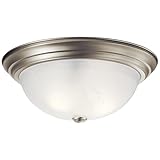
5. Best Selectable Color Temperature: Artika Horizon LED Flush Mount (B08SJ5KCHV)
Who it suits: Kitchens, laundry rooms, hallways, and bathrooms-adjacent ceilings in homes that want a slim brand-name panel, the ability to choose their color temperature once at installation, and dimming on an ordinary LED wall dimmer — without paying designer or smart-fixture money.
Artika is the big-box lighting brand sold through Costco and Home Depot, and the Horizon is its representative slim panel: a 24-watt integrated LED fixture claiming 1,800 lumens — a manufacturer figure, and a modest one next to the smart discs here, best read as “right for a kitchen, hallway, or small-to-medium room” rather than a living-room centerpiece. Its defining feature is selectable white: a switch on the fixture chooses 3000K, 4000K, or 5000K at installation, so the same SKU serves a warm hallway and a cool laundry room, and a wrong first guess is a ladder trip rather than a return. Dimming is the wall kind — Artika rates the Horizon as dimmable with most LED dimmers — which makes it, alongside the Vaughan, one of only two integrated picks here that obey a wall dimmer instead of demanding an app or a remote. That combination — selectable CCT plus wall dimming plus a brand with retail stores behind it — is rarer than it should be, and it is why the Horizon earns a place in a $300 guide despite sitting in a lower tier of the budget.
The honest limitations are about expectations. Output is the lowest claimed figure among the integrated picks here, so do not ask it to light a large living room alone. It is a sealed fixture: when the driver eventually fails, the whole panel is replaced. Materials are big-box standard — a slim modern panel that looks clean at ceiling distance and ordinary up close — not the Vaughan’s aluminum or the Kichler’s glass. The documentation even disagrees with itself on warranty: Amazon’s listing describes a five-year limited warranty while the printed manual in Artika’s documentation says three years, so confirm the live listing’s terms before relying on either number. Check the current price on Amazon, expect a big-box position well below the top of this budget, and if the marketplace listing looks inflated, this is one fixture you can comparison-shop at warehouse and home-improvement stores before buying.
Pros: Selectable 3000K/4000K/5000K at install — one fixture, three rooms’ worth of color temperatures; dims on most LED wall dimmers, no app or remote required; a real retail brand with stores and support behind it; slim panel profile suits lower ceilings; normally positioned far below the top of this budget.
The honest limitation: The lowest claimed output in the guide at 1,800 lumens — a supporting-room fixture, not a living-room anchor; sealed design replaced whole at end of life; big-box materials and finish; and a warranty term its own documentation states inconsistently (five years on the listing, three in the manual), so verify on the live page.
Choose it if you want selectable color temperature and wall-dimmer control from a mainstream brand at a mainstream tier. Skip it if the room is large or formal, you want maximum brightness, or designer materials matter more than convenience.
6. Best With Remote: KIWIVIC 16″ Dimmable Ceiling Light with Remote (B0FQ59XD6K)
Who it suits: Bedrooms and living rooms where the ceiling light is on a plain switch with no dimmer — older homes, rentals you cannot rewire, and anyone who wants to dim the overhead light from the bed or sofa without an electrician, an app, or a smart-home ecosystem.
The KIWIVIC solves a specific, common problem: dimming without a dimmer. Its 16-inch ultra-thin disc packs a 36-watt integrated LED claiming 3,600 lumens — a manufacturer figure; read it as large-room bright rather than a measurement — and the included handheld remote adjusts both brightness and color temperature across 3000K–6500K. That combination is genuinely useful in a bedroom: full cool brightness for getting dressed, warm and low for winding down, all without touching the wiring. The fixture installs on a standard junction box, the wall switch stays a plain switch, and the remote does the rest. The 16-inch diameter is a step up from the usual 12-inch budget discs, spreading light more evenly in rooms up to roughly 200 square feet, and the thin profile keeps it viable on the 8-foot ceilings where the Kichler’s 6-inch dome feels heavy.
Why does a value-tier disc belong in a $300 guide at all? Because it is the only remote-dimming representative worth recommending, and the remote is a legitimate third answer to the dimming question — for a renter who cannot change a switch and does not want a phone-controlled ceiling, it is not the cheap option, it is the only option. The trade-offs are stated plainly. It is a sealed integrated fixture from a budget brand, so failure means replacement and the support horizon is shorter than WAC’s or Kichler’s. Remote dimming is not wall dimming: if the remote is lost or its battery dies at the wrong moment, you are back to full-brightness on/off at the switch until a replacement arrives. The construction is plastic, as its tier dictates.
Pros: Real dimming and color adjustment with zero rewiring and no app; 16-inch size suits medium and large rooms; claimed 3,600 lumens is strong output for a thin disc; remote control is ideal for bedrooms; low profile suits 8-foot ceilings.
The honest limitation: Sealed LED appliance with a budget-brand support horizon; control depends on keeping the remote alive and findable; plastic construction — check the current price on Amazon before buying.
Choose it if you want dimmable ceiling light in a room that has no dimmer and cannot get one. Skip it if you want wall-dimmer control, smart-home integration (the Hue and Govee are the picks), or a serviceable bulb-based fixture.

Comparison Table
| Product | Size & light source | Color temperature | Dimming | Check |
|---|---|---|---|---|
| Philips Hue Infuse Medium | 15″ Ø × ~3.3″H; integrated LED, 2,350 lumens claimed at 4000K, metal body | 2000K–6500K tunable + full color | App / voice / Hue switch only — not for wall dimmers | Check on Amazon |
| WAC dweLED Vaughan 16″ | 16″ Ø × 3″H; integrated LED, 2,674 LED lumens / 1,904 delivered (maker’s spec sheet), CRI 90, aluminum | 3000K fixed | Yes — TRIAC / ELV wall dimmer, 100–10% | Check on Amazon |
| Govee Ceiling Light Pro | 15″ Ø disc; integrated LED, 4,300 lumens claimed | 2700K–6500K adjustable + RGBIC color | App / voice only — not for wall dimmers | Check on Amazon |
| Kichler 8110NI | 15.25″ Ø × 6″H; glass dome, 3 × E26 bulbs (not included) | Your choice of bulbs | Yes — with dimmable bulbs + LED-rated dimmer (per Kichler spec sheet) | Check on Amazon |
| Artika Horizon | Slim panel; integrated 24W LED, 1,800 lumens claimed | 3 selectable: 3000K / 4000K / 5000K | Yes — most LED wall dimmers | Check on Amazon |
| KIWIVIC 16″ with Remote | 16″ Ø thin disc; integrated 36W LED, 3,600 lumens claimed | 3000K–6500K via remote | Remote only — no wall dimmer needed | Check on Amazon |
How to Choose a Flush Mount Ceiling Light Under $300
- Spend the budget on the right axis. In this budget you are not buying more brightness — the brightest claim here is the Govee’s, from a lower tier. You are buying materials (aluminum, glass), color quality (CRI 90), warranty length, and honest specifications. If none of those matter in the room, a cheaper guide in this series will serve you better.
- Decide the light-source question first. Replaceable E26 bulbs (only the Kichler here) mean the fixture outlives its bulbs and you control brightness, color, and CRI. Integrated LED means thinner profiles and features, but the fixture is replaced whole when its driver dies — so warranty length becomes a real specification, and the Vaughan’s five years against the Hue’s two is a genuine difference.
- Match the dimming method to your wiring before anything else. Wall dimmer already installed → Vaughan, Artika, or Kichler with dimmable bulbs. Plain switch, no rewiring allowed → KIWIVIC’s remote. App/voice household → Hue or Govee. Never feed a smart fixture from a TRIAC dimmer, and never put a non-dimmable driver on a dimmer circuit.
- Read lumen claims the way WAC’s spec sheet teaches. Source lumens are not delivered lumens; the Vaughan loses about 29 percent between the two columns, and every other fixture here loses a similar share silently. As a planning figure, aim for roughly 20 delivered lumens per square foot in living spaces — then judge the installed result inside the return window.
- Measure depth against your ceiling. On an 8-foot ceiling, the discs and the 3-inch Vaughan work anywhere; the Kichler’s 6-inch dome belongs over beds, tables, and room centers rather than door swings and hallways. Depth, not diameter, is the number that decides whether a fixture feels oppressive.
- Size the diameter to the room. Roughly: slim panels and 12–15 inches for rooms under 150 sq ft, 15–16 inches for 150–250 sq ft. At this budget there is no honest 20-inch-plus flush mount on Amazon — oversize rooms need two fixtures or a showroom brand.
- Pick a color temperature strategy. Fixed 3000K (Vaughan) is the safest single choice for living spaces. Selectable CCT (Artika) insures you against a wrong guess. Tunable white (Hue, Govee, KIWIVIC) is for rooms that change jobs during the day. Bulb fixtures outsource the decision to an inexpensive replacement bulb — the most flexible answer of all.
- Check CRI where color matters. Over a dining table, art wall, or vanity, prefer a published CRI of 90 (Vaughan) or fit the Kichler with 90+ CRI bulbs. The smart discs do not headline CRI figures; their color quality is a party trick, not a rendering spec.
- Read the material line literally. “Aluminum” in the Vaughan’s listing means a metal body — and its diffuser is still polycarbonate, as this guide states openly. On the discs, housing and diffuser are plastic no matter how metallic the photos look. Glass appears exactly once in this guide, on the cheapest pick.
- Check the price like a professional. Four of these six picks are sold on Amazon largely by third parties, and their prices change. Check the current price on Amazon for each pick: the Vaughan only if it sits within this budget, the Kichler only in its usual lower-tier position, and the Artika and KIWIVIC only at value-tier positioning. A marketplace listing far above a fixture’s normal band is not a premium product — it is the same product at a worse position.
Common Buying Mistakes
- Assuming $300 buys a designer fixture on Amazon. Mostly, it does not — the band’s designer fixtures (the WAC Chapeau, near the top of the band, and the Kuzco Cruz, in the middle of the band) are sold through showrooms, and Kichler’s Ceiling Space LED sits over budget entirely. On Amazon, this budget buys one smart fixture near the cap and excellent fixtures from the lower tiers below it.
- Comparing fixtures by claimed lumens. A 4,300-lumen claim and a 2,674-lumen figure from different makers were not measured the same way — and the 2,674 comes with a delivered figure of 1,904 from the one maker honest enough to publish both. Use diameter, wattage class, and room size to shortlist.
- Putting a smart light on a wall dimmer. The Hue and Govee want a plain switch at full power; running one through a TRIAC dimmer is the most common cause of flickering, buzzing, and “defective” smart-light returns.
- Paying a third-party markup without noticing. Designer and big-box fixtures on Amazon are often listed by showrooms at prices far above their normal band. If the Vaughan shows above this budget or the Kichler is positioned near the top of it, you are looking at a markup — wait, or buy the fixture through its normal channels.
- Forgetting the bulbs in the cost. The Kichler plus three quality dimmable LED bulbs is the real install cost — still excellent value, but compare it honestly against integrated fixtures whose light is built in.
- Buying fixed 3000K for a room that wanted 2700K. The Vaughan’s one real inflexibility is its fixed color temperature. If your home is decorated warm and dim, either accept 3000K as a slightly cleaner white or choose a tunable or bulb-based pick.
- Ignoring the warranty gap. At this budget, warranty is a specification: five years (Vaughan, per WAC; the Artika’s own documents disagree between three and five) against two years (Hue) and one year (Kichler). On sealed fixtures that cannot be repaired, the warranty is the lifespan guarantee — read it before the lumen count.
- Expecting a 15-inch fixture to light a great room. No single flush mount in this guide honestly covers a 400-square-foot open plan. Two mid-size fixtures, or one fixture plus lamps, will always beat one oversized claim.
The Fixtures That Are Not Here — and Why
Three absences in this guide are deliberate, and explaining them is part of the recommendation. The WAC Chapeau (FM-49416) is arguably the best-looking fixture in the band — a 16-inch aluminum body with a fabric shade over an etched opal glass diffuser, 2,580 maker-rated lumens, and CRI 90, positioned near the top of this band at lighting retailers such as Butler Lighting and Lightopia. It is not a pick because it is not sold on Amazon: no orderable Amazon listing for it could be verified, and this guide links only to listings it can stand behind. If it appears on Amazon within this budget with a featured offer, it belongs at the top of this list next to the Vaughan. The Kuzco Cruz (FM22815), a sculptural flush mount positioned in the middle of this band through showrooms, is absent for the same reason — a real in-band fixture that Amazon’s shelf simply does not carry. And the Kichler Ceiling Space LED (10886NILED), a 17.25-inch integrated fixture available through an electrical distributor such as Cooper Electric, sits above this band — it is the honest answer to “what does the next tier up look like,” and it is labeled over budget wherever this guide mentions it. Together the three explain the shape of the whole guide: at $300, the limiting factor is not money, it is Amazon’s catalog.
Final Recommendation
For most smart-home households, buy the Philips Hue Infuse Medium: it is the one fixture that genuinely earns its position near the top of this budget on Amazon, with tunable white, full color, up-and-down light, and a metal body shallow enough for real ceilings — check the current price on Amazon — just keep it on a plain switch and budget for a Bridge if you want the full system. If your room answers to a wall dimmer, the WAC dweLED Vaughan is the grown-up buy — aluminum, CRI 90, honestly published delivered lumens, and a five-year warranty — provided the current price on Amazon sits within this budget. Choose the Govee if you want most of the Hue’s tricks from a lower tier — check the current price on Amazon — the Kichler if replaceable bulbs are a principle rather than a preference, the Artika for selectable color temperature on a wall dimmer, and the KIWIVIC when a remote is the only dimmer your wiring allows. And if your heart is set on a showroom designer fixture, know the honest routes: the Chapeau and Cruz through a lighting retailer, both in this band, or the Ceiling Space in the tier above this budget — the step-down guide, the Best Flush Mount Ceiling Light Under $200, covers the band where Amazon’s own shelf is deepest.
FAQ
Why are there not six fixtures priced between $200 and $300 in this guide?
Because Amazon does not stock six recommendable ones. The band’s designer fixtures are sold mainly through lighting showrooms — the WAC Chapeau (near the top of the band) and Kuzco Cruz (in the middle of the band) could not be verified as orderable Amazon listings during research — and the one designer fixture readers most expect, Kichler’s Ceiling Space LED, sits over budget. What Amazon does stock near the cap is the Philips Hue Infuse — check the current price on Amazon — plus excellent fixtures from the tiers below, which is what this guide honestly presents.
Is the Hue Infuse worth choosing over the Govee?
It depends on what you value. The Govee matches or beats the Hue on claimed brightness and adds an RGBIC ring and Matter.
What is the difference between LED lumens and delivered lumens?
LED lumens measure the light the diodes produce at the source; delivered lumens measure what actually leaves the fixture after the diffuser and optics take their share. WAC’s spec sheet for the Vaughan publishes both — 2,674 at the source, 1,904 delivered — a loss of about 29 percent.
Can I use one of these flush mounts with my existing wall dimmer?
Three of the six, yes: the Vaughan (TRIAC/ELV, 100–10%), the Artika (most LED dimmers), and the Kichler (with dimmable bulbs).
How many lumens do I actually need from a ceiling light?
As a planning figure, about 20 delivered lumens per square foot for living rooms and bedrooms and 30–50 for kitchens and work areas — so a 150 sq ft bedroom wants roughly 3,000 lumens of total light from all sources.
Do integrated LED ceiling lights really last 50,000 hours?
The diodes might; the driver electronics are the usual failure point, and in sealed fixtures they are not replaceable. Rated life still separates the field — the Vaughan’s 50,000 hours and five-year warranty against the Hue’s 25,000 hours and two years — but the only pick here whose light source is guaranteed replaceable forever is the bulb-based Kichler.
Can I put one of these flush mounts in a bathroom?
The Vaughan is damp-location listed, which suits a bathroom ceiling outside the shower enclosure.