Where to buy
Best overall for bedrooms: Philips Hue Infuse Medium Ceiling Light, White
Best with a remote: KIWIVIC 16″ Dimmable Ceiling Light with Remote
Best smart value: Govee Ceiling Light Pro 15″
Best for a wall dimmer: WAC Lighting dweLED Vaughan 16″ LED Flush Mount, Aged Brass
Best replaceable bulbs: Kichler 8110NI 15.25″ Flush Mount, Brushed Nickel
Best selectable color temperature: Artika Horizon LED Flush Mount Ceiling Light
Best Flush Mount Ceiling Light for Bedrooms Under $300: Warm Light, Deep Dimming, and Control From the Bed
As an Amazon Associate, dailyhomedecorating.com earns from qualifying purchases made through links on this page. That does not change what we recommend, and it never changes a fixture’s specs: the lumen figures below are the manufacturers’ own published numbers, every limitation we found is stated in the open — including which of these fixtures cannot actually produce a true 2700K warm white, whatever their marketing implies.
A bedroom ceiling light has the hardest job description in the house. It is the one light you look at directly, lying flat on your back, with dark-adapted eyes. It is the light that has to be bright enough to find a matching pair of socks at 7 a.m. and dim enough, warm enough, and gentle enough at 11 p.m. that it does not undo the last hour of winding down. Judge flush mounts by living-room standards and you will buy the wrong fixture. Judge them by bedroom standards — how warm the light truly goes, how low it truly dims, how it behaves when stared at from a pillow, and whether you can run it without getting up — and the ranking reshuffles completely, which is what this guide does.
Two honesty notes before the picks, because the bedroom versions of these fixtures inherit the market realities documented in the general Best Flush Mount Ceiling Light Under $300 guide. First, the $200–$300 band on Amazon is thin to the point of transparency: the only fixture Amazon itself stocks anywhere near the cap is a smart light positioned at the top of this band — check the current price on Amazon — and several designer fixtures that fill this band in showrooms — WAC’s Chapeau and Kuzco’s Cruz — are not orderable on Amazon at all, while Kichler’s Ceiling Space LED sits above this budget tier. Second, every lumen figure here is a manufacturer’s own number with no shared measurement standard behind it. One maker in this guide, WAC, publishes both its LED lumens (2,674) and its delivered lumens (1,904) — the light that actually leaves the fixture — and that roughly 29 percent gap between the two columns is the most useful number in the whole category, because every other brand’s headline figure quietly assumes the same loss away.
There is also a bedroom-specific honesty note, and it shapes the ranking more than price does. A true bedroom warm white is 2700K — the color of an old incandescent bulb, the color that tells your body the day is over. A surprising number of ceiling fixtures cannot produce it. Of the six picks below, one tunes down to 2000K, one reaches exactly 2700K, one lets you install 2700K bulbs of your own choosing, and three stop at 3000K — a cleaner, slightly more alert white that manufacturers still label “warm.” Three thousand kelvin is a perfectly good light for getting dressed. It is not the same light at midnight, and this guide will tell you, fixture by fixture, which side of that line each one falls on.
Quick Picks
| Buyer type | Pick | Why it wins in a bedroom | Check |
|---|---|---|---|
| Best overall for bedrooms | Philips Hue Infuse Medium, White (B09QFS12M4) | The warmest light here (down to 2000K), the deepest and smoothest dimming, sunrise and wind-down routines, and up-and-down light distribution that keeps glare off a pillow — check price on Amazon | Check on Amazon |
| Best with a remote | KIWIVIC 16″ Dimmable Ceiling Light (B0FQ59XD6K) | Dimming and color adjustment from a handheld remote on the nightstand — no dimmer switch, no rewiring, no app, no account; check price on Amazon and buy only at a value position in this band | Check on Amazon |
| Best smart value | Govee Ceiling Light Pro 15″ (B0F1N5HPVH) | True 2700K at the warm end, schedules and voice dimming from bed, and a claimed 4,300 lumens for morning brightness — positioned well below the top of this band; check the current price on Amazon | Check on Amazon |
| Best for a wall dimmer | WAC Lighting dweLED Vaughan 16″ (B08XN59K4Z) | A real designer fixture — aluminum body, CRI 90, published delivered lumens (1,904), TRIAC/ELV dimming to 10%, five-year warranty — but fixed at 3000K; check price on Amazon and buy only if it sits within this budget tier | Check on Amazon |
| Best replaceable bulbs | Kichler 8110NI 15.25″ Flush Mount (B0014HCHO0) | The only pick with sockets: three E26 bulbs you choose yourself — fit true 2700K, 90+ CRI bulbs and replace them forever behind a real glass dome; it is positioned well below the cap of this band, so check the current price on Amazon | Check on Amazon |
| Best selectable CCT | Artika Horizon LED Flush Mount (B08SJ5KCHV) | Choose 3000K, 4000K, or 5000K once at install and dim on most LED wall dimmers — but note there is no 2700K setting; check price on Amazon — it is normally positioned far below the top of this budget tier | Check on Amazon |
How These Picks Were Chosen
These are the same six fixtures as the general under-$300 guide in this series — deliberately. The bedroom question is not “which fixtures exist under $300,” because the honest answer to that is a short list shaped by Amazon’s thin top shelf. The bedroom question is “which of the fixtures that genuinely earn a place under $300 also earn a place over a bed,” and answering it meant re-testing the same verified data — diameter, depth, dimming method, color range, materials, warranty — against four criteria that living rooms forgive and bedrooms do not.
The first criterion is the warm floor: the lowest color temperature the fixture can actually produce, verified from spec sheets rather than listing adjectives. The second is dimming depth and dimming behavior at the bottom of the range, because a bedroom light spends half its life below 20 percent output, where cheap drivers flicker, buzz, or cut out entirely. Fixtures were re-ranked on those four axes, and two of them fall in the ranking precisely because of bedroom physics — the designer pick’s fixed 3000K and door-side dimmer, and the selectable-CCT pick’s missing 2700K setting — even though both are excellent lights by general standards.
No static prices are printed for any pick in this guide. For picks with an Amazon listing, check price on Amazon or check the current price on Amazon before buying, and judge each fixture by its position within this budget tier: the Philips Hue Infuse Medium sits near the top of the band, while the Govee Ceiling Light Pro sits well below that top tier. The other picks are likewise described by their qualitative position in the band rather than by a fixed figure. One exclusion deserves repeating here: a fixture had to be a true flush mount orderable on Amazon with a verifiable listing, which is why the WAC Chapeau and Kuzco Cruz — both real in-band designer fixtures sold through showrooms — are benchmarks in prose rather than picks, and why the Kichler Ceiling Space LED, which sits above this budget tier, appears only as a labeled reference point.
What a Bedroom Asks That a Living Room Doesn’t
Warmth is a floor, not a range. Listings advertise wide color ranges — “2700K–6500K” — because the wide range sounds capable. Light at 2700K and below reads to your eyes and your circadian system as evening; light at 3000K reads as a pleasant, slightly energized neutral; light at 4000K and above reads as morning, office, task. A fixture whose warm end stops at 3000K is not broken — it is a fine dressing and makeup light — but it will never produce the genuinely sleepy glow that ends a day, and no dimmer fixes that, because dimming changes brightness, not color. The warm-floor audit of this guide’s six picks: the Hue reaches 2000K, candlelight territory. The Govee reaches a true 2700K. The Kichler reaches whatever your bulbs reach — fit 2700K bulbs and it is a 2700K fixture. The KIWIVIC, the Artika, and the Vaughan all stop at 3000K.
Dimming depth is a bedroom specification. In a kitchen, a dimmer that bottoms out at 30 percent is a minor disappointment. In a bedroom it is a failed product, because the whole point of dimming a bedroom ceiling light is the last stretch: the 2 a.m. A quality wall-dimmer fixture like the Vaughan is rated to 10 percent on TRIAC and ELV dimmers, which is deep and honest. Remote fixtures like the KIWIVIC dim through their own driver and are at their best exactly here, because the person holding the remote is already in bed.
Glare is judged from a pillow. Every other room views a ceiling light at an angle, peripherally, while standing. A bright bare disc that looks crisp and modern from a doorway can be genuinely unpleasant from a bed. Depth matters too, in the opposite direction from hallways: over a bed, a deeper fixture is not a head-clearance problem, so the Kichler’s 6-inch dome is a non-issue here even though it would be the wrong choice over a walkway.
Control belongs at the bed, not the door. This is the criterion that most reshuffles the ranking. The bedroom-native controls are the phone app you already have in bed, the voice assistant on the nightstand, the handheld remote that lives beside the book, and — the deluxe version — the schedule that dims the light at 10:30 whether you remember or not.
1. Best Overall for Bedrooms: Philips Hue Infuse Medium Ceiling Light, White (B09QFS12M4)
Who it suits: Anyone whose bedroom is the room where light matters most — slow mornings, long evening wind-downs, reading in bed — and whose household already runs, or is willing to run, lights from a phone, a voice assistant, or a schedule.
Measured by the four bedroom criteria, the Infuse is not a close call. Its white range runs from 2000K to 6500K, which means it is the only fixture here that goes below 2700K into genuinely candle-warm territory — the color of light that makes a bedroom feel like the end of the day rather than a softer version of noon. Signify’s own datasheet rates the 15-inch fixture at 33.5 watts and 2,350 lumens at 4000K, with about 2,100 lumens at 2700K — manufacturer figures, as everywhere in this guide, but more than enough for a primary bedroom, where roughly 20 delivered lumens per square foot across all sources is the planning target and a ceiling fixture is rarely the only source. The body is metal rather than the all-plastic construction of cheaper discs, and at about 3.3 inches deep it sits comfortably on an 8-foot ceiling.
What separates it from every other pick, seen from a pillow, is where the light goes. Dimming is app-side and genuinely deep, down to a night-light glow, and it is smooth all the way down because the fixture dims its own electronics rather than interpreting a chopped wall signal. In practice the bedroom features are the routines: a wake-up automation that fades the light up over half an hour instead of an alarm’s hard edge, a wind-down scene that drops it to 2000K and 10 percent at bedtime, and voice control from the nightstand through Alexa, Google Assistant, or Apple Home. Check the current price on Amazon before buying.
Pros: The warmest light in this guide — down to 2000K, below the 2700K bedroom standard; deep, smooth, silent dimming to a night-light level; up-and-down distribution that keeps direct glare off a pillow; wake-up and wind-down routines that no dumb fixture can imitate; metal body only about 3.3 inches deep; a mature ecosystem that will still be supported in five years.
The honest limitation: It must not be wired through a standard wall dimmer — like every smart fixture, it wants a plain switch delivering full power and dims internally; feed it chopped power and you invite flicker and early failure. It is a sealed integrated fixture with a 25,000-hour rated life and a two-year warranty, so when the electronics eventually fail the whole fixture is replaced, and full features require a Bridge, which is an additional purchase. Signify also does not headline a CRI figure for this fixture, so if laboratory-grade color rendering is the priority, the Vaughan below is the more transparent buy.
Choose it if your bedroom runs on routines and you want the warmest, gentlest ceiling light under $300. Skip it if your room is controlled by a wall dimmer you intend to keep, or you refuse on principle to run a ceiling light from a phone.
2. Best With a Remote: KIWIVIC 16″ Dimmable Ceiling Light with Remote (B0FQ59XD6K)
Who it suits: Bedroom sleepers in older homes and rentals — anyone whose ceiling light sits on a plain switch with no dimmer, who cannot or will not rewire, and who wants full control of the overhead light from the bed without a phone, an app, or a smart-home account.
The KIWIVIC’s case in a bedroom is one sentence long: the dimmer lives on your nightstand. Its 16-inch ultra-thin disc packs a 36-watt integrated LED claiming 3,600 lumens — a manufacturer figure, best read as “large-room bright” rather than a measurement — and the included handheld remote adjusts both brightness and color temperature from wherever you are lying. That solves the oldest bedroom-lighting problem there is. The 16-inch diameter spreads light more evenly than the usual 12-inch budget discs across rooms up to roughly 200 square feet, and the thin profile keeps it unobtrusive on the 8-foot ceilings common in bedrooms.
Now the bedroom-specific candor, because this fixture has one real compromise and it is exactly on this guide’s main axis. Its color range runs from 3000K to 6500K — the warm end stops at 3000K, not 2700K. Dimmed low at 3000K, the light is soft and perfectly pleasant, and most sleepers will never object to it. But it is a cleaner, slightly more alert white than a true 2700K, and it cannot be tuned warmer no matter how the remote is set. If your evenings are built around genuinely amber light, the Hue above or the Govee below reaches a warmer floor; if your bedroom is primarily a place to sleep, dress, and read a little, 3000K dimmed is a compromise most people stop noticing within a week. The remaining trade-offs are the ones its price class dictates. It is a sealed integrated fixture from a budget brand, so failure means whole-fixture replacement and the support horizon is shorter than the designer brands’. The construction is plastic. Check price on Amazon before buying, and buy only if it sits at the value end of this band, as its positioning suggests; if a marketplace seller has priced it like a designer fixture, walk away.
Pros: Real dimming and color adjustment from bed, with zero rewiring and no app; a physical remote that works half-asleep, which no phone app honestly does; 16-inch size suits medium and large bedrooms; claimed 3,600 lumens is strong output for a thin disc; low profile suits 8-foot ceilings.
The honest limitation: The warm floor is 3000K, not a true 2700K — the one compromise that matters in a bedroom, stated plainly. Control depends on keeping the remote alive and findable. It is a sealed LED appliance with a budget-brand support horizon and plastic construction, and you should check the current price on Amazon before deciding.
Choose it if your bedroom has a plain switch, no dimmer, and no prospect of either changing — this is not the cheap option for that room, it is the only complete one. Skip it if true 2700K warmth is non-negotiable (that is the Govee’s trick in a comparable tier) or you want smart-home integration.

3. Best Smart Value: Govee Ceiling Light Pro 15″ (B0F1N5HPVH)
Who it suits: Smart-home households who want the Hue’s bedroom playbook — warm evenings, scheduled mornings, voice control from bed — at a lower position in this band, and who are comfortable that the emphasis went into light capability rather than materials.
The Govee earns the bedroom shortlist on a single specification the KIWIVIC cannot match: its white range starts at a true 2700K. That makes it the cheapest fixture in this guide that can produce a genuinely warm, sleep-appropriate evening light, and it pairs that floor with the strongest claimed output here — 4,300 lumens from the main white light, a manufacturer claim to be read against the Vaughan’s carefully delivered 1,904 below; in practice it is bright enough to be a bedroom’s only ceiling source with output to spare for morning dressing. It connects over Wi-Fi and supports Matter alongside Alexa and Google Assistant — check the current price on Amazon, as this pick is positioned well below the Hue at the top of the band.
Bedroom control is app and voice, which cuts both ways at midnight. Dimming through the app is smooth and deep. But there is no remote in the box, so the 2 a.m. Like the Hue, it must not be run on a wall dimmer; it wants full, constant power from a plain switch and dims internally, and feeding it from a TRIAC dimmer can cause flicker or damage. The radio is 2.4 GHz Wi-Fi only, which occasionally complicates setup on mesh networks that merge their bands. The body is a plastic disc that will never be mistaken for the Vaughan’s aluminum or the Hue’s metal, Govee does not headline a high CRI figure for this model, and as a sealed integrated fixture it is replaced whole when its electronics fail.
Pros: True 2700K warm floor — the cheapest route in this guide to genuinely sleep-warm ceiling light; the highest claimed output here for bright mornings; schedules and timers that automate wind-down and wake-up; Matter support keeps it out of a single ecosystem’s lock-in; positioned well below the top of this budget tier — check price on Amazon.
The honest limitation: No included remote — control is phone or voice or nothing, which is a real cost at 2 a.m. No wall-dimmer compatibility. A plastic disc aesthetic, no headline CRI figure, 2.4 GHz Wi-Fi only, and a sealed design replaced whole at end of life. Check the current price on Amazon before buying, as its positioning within the band can shift.
Choose it if you want smart bedroom light with a true warm floor and the Hue, positioned at the top of this band, is more than the room justifies. Skip it if you want a physical control by the bed (the KIWIVIC), designer materials (the Vaughan), or a fixture repairable with a bulb (the Kichler).

4. Best for a Wall Dimmer: WAC Lighting dweLED Vaughan 16″ LED Flush Mount, Aged Brass (B08XN59K4Z)
Who it suits: Primary bedrooms in homes with a proper dimmer already on the wall — ideally beside the bed, as some primary suites are wired — where the priorities are materials, color quality, and a fixture that will still look expensive in fifteen years.
The Vaughan is what this price band looks like when a professional lighting manufacturer builds for it. The body is aluminum — metal, not metallized plastic — in an aged brass finish, 16 inches across and only 3 inches deep, with the driver concealed in the canopy for a clean ceiling line. Its spec sheet is the most honest document in this guide: WAC rates the 30-watt LED module at 2,674 lumens at the source and then, in the next column, 1,904 delivered lumens, the light that actually escapes the fixture. That gap of roughly 29 percent exists in every fixture in this article; WAC is simply the only maker here that prints both numbers, and it is the right mental discount to apply to every rival’s headline claim. Color quality is equally grown-up: CRI 90, so wood, bedding, and skin tones render properly — a real consideration in the room where you get dressed and judge colors every morning. It is damp-location listed, Title 24 compliant, and rated for 50,000 hours behind a five-year warranty, double or more the coverage of the smart picks.
Dimming is the wall kind, done properly: the spec sheet rates ELV and TRIAC dimming from 100 down to 10 percent, which covers the great majority of LED-rated wall dimmers, and 10 percent is a genuinely deep floor for a wall-controlled fixture. Two bedroom candors follow, and they are why this fixture ranks fourth here despite being, object for object, the finest light in the guide. The first is color: the Vaughan is fixed at 3000K. There is no selecting, tuning, or warming your way out of it. Three thousand kelvin is flattering and calm, and many bedrooms will be happy with it forever — but it is not 2700K, and if your household’s evenings run amber, this fixture will always feel one notch more awake than the room wants. The second is geography: a wall dimmer controls from where the wall is. One materials candor completes the picture: the diffuser the light shines through is polycarbonate, not glass. Amazon’s own spec table for this listing contradicts itself in places (it lists an E26 bulb base on a sealed LED fixture), which is exactly why this guide worked from WAC’s spec sheet instead. Check price on Amazon before buying, and buy only if it sits within this budget tier.
Pros: Real aluminum designer construction from a professional brand; CRI 90 for honest color at the mirror and the wardrobe; the most honest spec sheet in the category, with delivered lumens published; true TRIAC/ELV wall-dimmer dimming down to 10%; 50,000-hour rated life and a five-year warranty; soft, even diffusion that behaves well viewed from a pillow.
The honest limitation: Fixed at 3000K — no path to a true 2700K evening warmth. Control lives at the wall dimmer, which in most bedrooms means at the door. The diffuser is polycarbonate despite the designer price class, it is a sealed fixture replaced whole at end of life, and you should check the current price on Amazon; if it sits above this budget tier, it is out of this guide’s budget no matter how good it is.
Choose it if materials, color quality, and warranty length outrank warmth tuning in your bedroom, and your dimmer is where you can reach it. Skip it if 2700K-or-warmer evenings are the point of the purchase, or you want to run the light from the bed.

5. Best Replaceable Bulbs: Kichler 8110NI 15.25″ Flush Mount, Brushed Nickel (B0014HCHO0)
Who it suits: Bedroom traditionalists replacing a builder-grade dome light — anyone who wants a real glass fixture from a real brand, exact control over the warmth and quality of the light itself, and a ceiling light that can be serviced with a hardware-store bulb for the next twenty years.
The 8110NI is Kichler’s long-running value flush mount: a 15.25-inch steel fixture, 6 inches tall, in brushed nickel, with a satin etched glass dome over three standard E26 sockets rated for up to 60 watts each. In a bedroom, its one structural advantage outweighs everything the sealed fixtures offer: the light source is your choice, forever. Three sockets means you decide the bedroom’s entire light character at the bulb rack. Fit three 2700K LED bulbs and this is a true warm-white fixture — warmer at its floor than three of the integrated picks above can ever go. Fit 90+ CRI bulbs and it out-renders every smart disc here. Fit dimmable bulbs and, per Kichler’s own spec sheet, it dims on a compatible LED-rated dimmer. Roughly 800 lumens per bulb is the sweet spot for a bedroom — bright in aggregate for morning dressing, and the etched glass dome softens all of it, which matters more in this room than any other: glass diffuses the way plastic imitates, and viewed from a pillow the dome is an even, gentle glow with no visible point of light behind it. And when a bulb dies in year six, the repair is a twist of the wrist, not a fixture replacement and an electrician’s visit.
The bedroom candor list is short and mostly about placement. At 6 inches deep this is the deepest fixture in the guide — irrelevant over a bed, where nobody walks, but a reason to keep it out of the path between bed and bathroom door on an 8-foot ceiling. Bulbs are not included, so allow for the separate cost of three good LED bulbs on top of the fixture, and choose dimmable ones if there is any chance of a dimmer in its future. The styling is traditional — a swirled glass dome reads “classic” or “dated” depending on your taste, and it will not sharpen a crisp modern room. It is rated for dry locations, which suits bedrooms and rules out mounting it inside an en-suite shower’s splash zone. Finally, check the current price on Amazon before buying: this fixture is positioned far below this guide’s cap, in the lower part of the band. If a third-party seller is asking a price approaching the top of this budget tier for it, walk away, because that does not match its value positioning.
Pros: The only pick whose light you can choose and replace forever — true 2700K and 90+ CRI are a bulb purchase away; real etched glass dome, the gentlest diffuser here for eyes in bed; three sockets give real aggregate brightness for dressing; steel body from an established brand; typically sells far below this budget, leaving money for excellent bulbs.
The honest limitation: Bulbs cost extra and control still lives at the wall switch or dimmer — there is no from-bed control without adding smart bulbs yourself. The 6-inch depth is the deepest here, the traditional dome styling will not suit a modern room, and its Amazon price is third-party and unstable: check the current price on Amazon and refuse inflated listings.
Choose it if you want to install once and service with bulbs for a decade, with exactly the warmth you chose. Skip it if you want routines, remotes, or app control built in, or your bedroom ceiling is low and the dome would hang over a walkway.
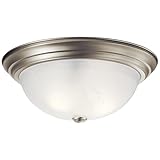
6. Best Selectable Color Temperature: Artika Horizon LED Flush Mount (B08SJ5KCHV)
Who it suits: Guest bedrooms, kids’ bedrooms, and spare rooms — spaces that change jobs and occupants — in homes that want a slim brand-name panel, the insurance of choosing a color temperature at install, and dimming on an ordinary LED wall dimmer without smart-fixture money or smart-fixture fuss.
Artika is the big-box lighting brand sold through Costco and Home Depot, and the Horizon is its representative slim panel: a 24-watt integrated LED fixture claiming 1,800 lumens — a manufacturer figure, and a modest one, best read as “right for a small-to-medium bedroom” rather than a large primary suite’s only light. Its defining feature is selectable white: a switch on the fixture chooses 3000K, 4000K, or 5000K at installation, so the same SKU can serve a warm guest room this year and a cooler teen’s room or home-office conversion later, and a wrong first guess costs a ladder trip rather than a return. For a secondary bedroom, that combination is often exactly right: no account, no remote to lose in a guest room, no Wi-Fi to explain to visitors — the light switch works the way light switches have always worked, just dimmable and with a color choice made once, sensibly, at install.
The bedroom limitation must be stated as plainly as the KIWIVIC’s, because it is the same one: the selectable range is 3000K, 4000K, and 5000K — there is no 2700K setting. The warmest this fixture can ever be is 3000K, the clean, slightly alert end of “warm.” In a guest room or a child’s room that doubles as a homework station, that is arguably a feature. In a primary bedroom bought for evening warmth, it is the reason this fixture ranks last here despite its genuine conveniences. Output is the other ceiling: 1,800 claimed lumens is the lowest figure among the integrated picks, so do not ask it to anchor a large bedroom alone — pair it with bedside lamps, which most bedrooms want anyway. It is a sealed fixture, replaced whole when its driver eventually fails. Materials are big-box standard — clean and slim at ceiling distance, ordinary up close — not the Vaughan’s aluminum or the Kichler’s glass. Check price on Amazon before buying: expect a big-box positioning far below the top of this budget tier, and if Amazon’s marketplace price looks inflated, this is one fixture you can comparison-shop at warehouse and home-improvement stores before paying it. Shoppers furnishing a whole rental unit rather than one bedroom will find the same fixture assessed under a landlord’s constraints in the Best Flush Mount Ceiling Light For Apartments Under $300.
Pros: Selectable 3000K/4000K/5000K at install — one fixture that survives a room changing jobs; dims on most LED wall dimmers, no app, remote, or account for guests to learn; a real retail brand with stores and support behind it; slim panel profile suits lower ceilings; normally priced far below this budget.
The honest limitation: No 2700K setting exists — 3000K is the warm floor, which caps its evening warmth in a primary bedroom. The lowest claimed output in the guide at 1,800 lumens; sealed design replaced whole at end of life; big-box materials; and a warranty term its own documentation states inconsistently (five years on the listing, three in the manual), so verify on the live page.
Choose it if the bedroom is a guest room, a child’s room, or a flex space where a simple wall-dimmer light with an install-time color choice beats smart features. Skip it if it is your primary bedroom and warm, low, from-bed light is the whole point — the Govee and Hue do that job properly.
Comparison Table
| Product | Size & light source | Warm floor | Control at midnight | Check |
|---|---|---|---|---|
| Philips Hue Infuse Medium | 15″ Ø × ~3.3″H; integrated LED, 2,350 lumens claimed at 4000K, metal body, up-and-down light | 2000K — warmest here | App / voice / routines — not for wall dimmers | Check on Amazon |
| KIWIVIC 16″ with Remote | 16″ Ø thin disc; integrated 36W LED, 3,600 lumens claimed | 3000K — no 2700K | Handheld remote — no wall dimmer needed | Check on Amazon |
| Govee Ceiling Light Pro | 15″ Ø disc; integrated LED, 4,300 lumens claimed, RGBIC ring | 2700K — true warm | App / voice / schedules — not for wall dimmers | Check on Amazon |
| WAC dweLED Vaughan 16″ | 16″ Ø × 3″H; integrated LED, 2,674 LED lumens / 1,904 delivered (maker’s spec sheet), CRI 90, aluminum | 3000K fixed — no warmer option | Wall dimmer — TRIAC / ELV, 100–10% | Check on Amazon |
| Kichler 8110NI | 15.25″ Ø × 6″H; glass dome, 3 × E26 bulbs (not included) | Your bulbs’ — 2700K if you fit them | Wall switch / dimmer with dimmable bulbs (per Kichler spec sheet) | Check on Amazon |
| Artika Horizon | Slim panel; integrated 24W LED, 1,800 lumens claimed | 3000K — selectable 3000/4000/5000K, no 2700K | Wall dimmer — most LED dimmers | Check on Amazon |
How to Choose a Flush Mount Ceiling Light for a Bedroom
- Check the warm floor before anything else. Find the lowest color temperature in the spec sheet, not the listing headline. 2700K or below is true bedroom warm; 3000K is the clean end of warm and cannot be dimmed into becoming warmer. Three of this guide’s six picks stop at 3000K — fine for dressing, short of ideal for winding down.
- Decide where control will live at midnight. App or voice (Hue, Govee), a remote on the nightstand (KIWIVIC), or a wall dimmer (Vaughan, Artika, Kichler with dimmable bulbs). In a bedroom this decision outranks brightness, materials, and price — a light you must get up to operate will annoy you every single night.
- Never feed a smart fixture from a wall dimmer. The Hue and Govee want a plain switch at full power and dim internally. Running one through a TRIAC dimmer is the most common cause of flickering, buzzing, and “defective” smart-light returns. If your bedroom circuit already has a dimmer you intend to keep, your shortlist is the Vaughan, the Artika, and the Kichler.
- Judge glare from the pillow, not the doorway. You will view this fixture head-on, from directly below, with dark-adapted eyes. Prefer diffusion (the Kichler’s etched glass, the Vaughan’s quality polycarbonate) or indirection (the Hue’s up-and-down throw). A bright, thin, modern disc that looks sharp from the door can be the harshest object in the room from the bed.
- Read lumen claims the way WAC’s spec sheet teaches. Source lumens are not delivered lumens; the Vaughan loses about 29 percent between the two columns, and every other fixture loses a similar share silently. As a planning figure, a bedroom wants roughly 20 delivered lumens per square foot from all sources combined — ceiling light plus lamps — so a modest fixture over the bed plus two bedside lamps usually beats one heroic ceiling claim.
- Weigh dimming depth, not dimming existence. “Dimmable” spans a fixture that glows at 1 percent and one that cuts out at 30. For bedrooms, the useful floors here are the smart fixtures’ near-zero app dimming and the Vaughan’s honest 10 percent wall-dimmer rating. If a listing will not state a low-end figure, assume the bottom of its range is not bedroom-grade.
- Decide the light-source question once. Replaceable E26 bulbs (only the Kichler here) mean exact warmth and CRI of your choosing, serviced forever with a replacement bulb. Integrated LED means thinner profiles, remotes, and routines — but the fixture is replaced whole when its driver dies, so warranty length becomes a real specification: five years (Vaughan) against two (Hue) and one (Kichler, on a fixture whose wear parts are bulbs).
- Match depth to placement, not habit. Over a bed, depth barely matters — the Kichler’s 6-inch dome is a non-issue there. Over the walkway between bed and bathroom on an 8-foot ceiling, it does. Place the fixture’s center over the bed or the room’s center, and keep deeper fixtures out of the midnight path.
- Size the diameter to the room. Roughly: slim panels and 12–15 inches for bedrooms under 150 sq ft, 15–16 inches for 150–250 sq ft. At this budget there is no honest 20-inch-plus flush mount on Amazon; a large primary suite is better served by a 16-inch fixture plus bedside lamps than by an oversized claim. Compact bedrooms with low ceilings get their own stricter treatment in the Best Flush Mount Ceiling Light For Small Rooms Under $300.
- Verify the price like a professional. Four of these six picks are sold on Amazon largely by third parties, and their prices drift. Judge each pick by the qualitative positioning given in the reviews: the Vaughan should sit within this budget tier, the Kichler is positioned well below the cap, and the Artika and KIWIVIC belong at the value end of the band. Check the current price on Amazon for each one. A marketplace listing far above a fixture’s normal band is the same product with a worse price, not a premium version.
Common Buying Mistakes
- Believing “warm white” on the box. Manufacturers label 3000K as warm white, and it is — compared to daylight. Compared to the 2700K your evening body clock expects, it is a notch too alert, and three of this guide’s six picks cannot go below it. The spec sheet’s lowest number is the only warm claim that counts.
- Putting a smart light on a wall dimmer. The Hue and Govee need full, constant power. A TRIAC dimmer in the circuit is the classic cause of flicker, buzz, and premature failure — and of one-star reviews blaming the fixture.
- Choosing by claimed lumens. A 4,300-lumen claim and a 2,674-lumen figure from different makers were not measured the same way — and the 2,674 comes with a delivered figure of 1,904 from the one maker honest enough to publish both. Bedrooms need gentle adequacy, not a lumen arms race.
- Forgetting that the switch is by the door. Buyers shop for brightness and materials, then discover every adjustment for the next decade requires getting out of bed. Decide the midnight control question before checkout, not after installation.
- Judging the fixture from the doorway. A ceiling light in a bedroom is viewed from below, at close range, for minutes. Install-day impressions standing up are the wrong test; the return window is for lying under it at night.
- Paying a third-party markup without noticing. If the Vaughan sits above this budget tier or the Kichler is priced near the top of the band, you are looking at a markup, not a fair positioning. Wait, or buy through the fixture’s normal channels.
- Forgetting the bulbs in the price — and the bulb spec. The Kichler plus three quality dimmable 2700K bulbs is the real install cost. Fit non-dimmable or 4000K bulbs and you have silently cancelled the two bedroom features the fixture was bought for.
- Assuming a thinner fixture is a better bedroom fixture. Thin discs win hallways and low ceilings. Over a bed, depth costs nothing and buys diffusion — the deepest fixture here, the glass-domed Kichler, is also the gentlest on the eyes.
- Skipping the step-down comparison. Several of these picks sit far below the top of this budget tier, and bedrooms under this budget are covered fixture-by-fixture in the Best Flush Mount Ceiling Light For Bedrooms Under $200 guide — if your room does not need the Hue’s routines or the Vaughan’s build, that guide is where the value is.
Final Recommendation
For most bedrooms, buy the Philips Hue Infuse Medium. It is the only fixture here that wins on all four bedroom criteria at once: the warmest light in the guide at 2000K, dimming that sinks smoothly to a night-light glow, up-and-down distribution that keeps a bright surface out of a sleeper’s direct view, and control — app, voice, and routines — that never asks you to leave the bed. Keep it on a plain switch, and budget for a Bridge if you want the full routine system. If the Hue’s ecosystem is more than you want, the KIWIVIC is the honest alternative: a remote on the nightstand, no rewiring, no account — accepting its 3000K warm floor as the price of that simplicity. Choose the Govee if you want a true 2700K floor and smart schedules at a lower position in this band — check price on Amazon — the Vaughan if your bedroom already answers to a good wall dimmer and you value aluminum, CRI 90, and a five-year warranty over warmth tuning, and the Kichler if replaceable bulbs are a principle — fit it with dimmable 2700K bulbs and it will still be serviceable when every sealed rival here is landfill. The Artika is the right light for the guest room down the hall. And if the room you are lighting is a design-led living space rather than a bedroom, the ranking reshuffles again — see the Best Flush Mount Ceiling Light For Modern Homes Under $300.
FAQ
What color temperature is actually best for a bedroom ceiling light?
2700K is the reference warm white — the color of a traditional incandescent bulb — and 2000K–2200K is warmer still, into candlelight territory. The practical rule is to check a fixture’s lowest available setting: the Hue in this guide reaches 2000K, the Govee reaches a true 2700K, the Kichler reaches whatever its bulbs are (fit 2700K), and the KIWIVIC, Artika, and Vaughan all stop at 3000K. Three thousand kelvin is pleasant and flattering, but it is measurably more alert than 2700K, and dimming does not close the gap — dimming changes brightness, not color.
Can I control a bedroom ceiling light without getting out of bed?
Three of these six, yes, three different ways. The KIWIVIC uses a handheld remote that lives on the nightstand — the lowest-tech and, half-asleep, arguably the best interface. The Vaughan, Artika, and Kichler are controlled at the wall, which in most bedrooms means at the door — a genuine, nightly consideration, not a footnote.
Why are there not six fixtures priced between $200 and $300 in this guide?
Because Amazon does not stock six recommendable ones, at any angle. The band’s designer fixtures are sold mainly through lighting showrooms — the WAC Chapeau and Kuzco Cruz could not be verified as orderable Amazon listings during research — and the designer fixture readers most expect, Kichler’s Ceiling Space LED, sits above this budget tier. What Amazon stocks near the cap is the Philips Hue Infuse — check the current price on Amazon — plus excellent fixtures from the tiers below, which is what this guide honestly presents.
Is a brighter ceiling light better for a bedroom?
Up to a point, and the point is lower than marketing suggests. A bedroom wants roughly 20 delivered lumens per square foot from all its light sources combined, and the ceiling fixture is rarely the only one. Remember too that claimed lumens are manufacturer figures with no shared standard: WAC’s spec sheet for the Vaughan publishes 2,674 LED lumens and 1,904 delivered lumens side by side, and that ~29 percent gap is the honest discount to apply to every headline number here.
Can I use one of these flush mounts with my existing wall dimmer?
Three of the six, yes: the Vaughan (TRIAC/ELV, 100–10%), the Artika (most LED dimmers), and the Kichler (with dimmable bulbs). The two smart fixtures — Hue and Govee — must not be run on a wall dimmer; they need full power and dim internally.
Will a flush mount look harsh lying in bed looking up at it?
It depends on diffusion and distribution, not on brightness alone. Thin discs with simple diffusers are the most direct view; dimming them low mitigates most of it. Judge any fixture from the pillow during the return window — that is the viewing position it was bought for.
Do integrated LED ceiling lights really last 50,000 hours?
The diodes might; the driver electronics are the usual failure point, and in sealed fixtures they are not replaceable. Rated life still separates the field — the Vaughan’s 50,000 hours and five-year warranty against the Hue’s 25,000 hours and two years — but the only pick here whose light source is guaranteed replaceable forever is the bulb-based Kichler, which is a real argument in a room you are furnishing once.