Where to buy
Check the latest price, availability and delivery on Amazon. Orders are placed on Amazon. We may earn a commission from qualifying purchases.
- Best overall: joelsantiques 60 Inch Solid Pine Floating Shelf, 12 Inch Deep, 2 Inch Thick — Check on Amazon
- URBANDI Rustic Fireplace Mantel Shelf, 60 Inch — Check on Amazon
- LUPWNEKA Solid Oak Floating Shelf, 36 Inch, 12 Inch Deep — Check on Amazon
- WOPITMER Solid Oak Floating Shelf, 36 Inch, 10 Inch Deep — Check on Amazon
See 2 more Amazon options
- FLYJOE Solid Maple Floating Shelf, 24 Inch
- BANFFLOW Solid Pine Floating Shelf, 3 Inch Thick, 24 Inch
Read the full guide ↓
Disclosure: As an Amazon Associate, dailyhomedecorating.com earns from qualifying purchases. Links to Amazon on this page are affiliate links; they cost you nothing extra. Listing details such as price and availability change often, so check the current Amazon listing before you buy.
The best floating shelves under $500 are not single shelves, and this guide will be straight with you about that before it recommends anything. When we researched this tier, we went looking for the $500 statement shelf — the thick slab of walnut or white oak, the designer system, the one purchase that empties the budget in a single box. It does not exist on Amazon in any form we could verify. The largest single floating shelf we could verify was a 60-inch solid pine shelf, handmade in the USA, sitting at the top of this tier — check the current price on Amazon. Past that point the trail goes cold: listings that gesture higher had no verifiable current offer or were trade-only, so we do not present them as Amazon picks. What $500 genuinely buys — and it buys a great deal — is a system: a five-foot anchor shelf over the sofa and a handcrafted mantel shelf over the fireplace, or a matched run of solid oak shelves across a whole wall, installed properly, with money left for the stud finder, the good anchors and, on the long shelves, an hour of a handyman’s time.
So this guide is built the way the money actually works at this tier. The six picks below are the strongest verified building blocks on Amazon right now: a 60-inch American-made pine shelf deep enough for a pantry row, a handcrafted 60-inch mantel shelf from an Ohio workshop, two solid oak shelves at 36 inches in 10- and 12-inch depths, a short solid maple shelf with the stiffest wood in the category, and a 3-inch-thick pine shelf whose maker states its load rating the honest way — per stud. Check the current price on Amazon for each pick — prices move, so this guide does not print static prices — every load figure is labeled as the maker’s own claim, and the section after the reviews lays out the system combinations out loud: which pairings of these shelves work as a system under $500, and what each combination does for a room. If you came here hoping to spend $500 on one shelf, the honest answer is to spend it on two or three of these instead — or to keep reading to the section on where the real $500-plus shelves live, because they do exist, just not in an Amazon buy box.
Quick Picks
Short on time, or comparing several options at once? Each row below names a buyer type and the product that suits it, with a link to the listing.
| Buyer type | Pick | Why it stands out | Link |
|---|---|---|---|
| Best overall | joelsantiques 60 Inch Solid Pine Floating Shelf, 12 Inch Deep | The largest verified single shelf on Amazon: 60 x 12 x 2 inches of solid Wisconsin pine, made in the USA | Check on Amazon |
| Best statement mantel shelf | URBANDI Rustic Fireplace Mantel Shelf, 60 Inch | A handcrafted 6-inch-tall beam-look mantel from a Cincinnati workshop — check price on Amazon | Check on Amazon |
| Best deep shelf for books | LUPWNEKA Solid Oak Floating Shelf, 36 Inch, 12 Inch Deep | Real solid oak a full 12 inches deep — two rows of books, not one | Check on Amazon |
| Best solid oak value | WOPITMER Solid Oak Floating Shelf, 36 Inch, 10 Inch Deep | Solid oak confirmed in the listing’s own copy — check price on Amazon | Check on Amazon |
| Best hardwood for a short span | FLYJOE Solid Maple Floating Shelf, 24 Inch | USA-sourced hard maple — the stiffest shelf wood sold — for desks and nurseries | Check on Amazon |
| Best thick profile | BANFFLOW Solid Pine Floating Shelf, 3 Inch Thick, 24 Inch | A full 3 inches thick, with a load rating stated per stud instead of as one headline number | Check on Amazon |
How These Picks Were Chosen
The first filter was the budget itself, applied honestly — and at this tier that meant verifying the ceiling before choosing anything. We checked the premium end of the category first: large solid-wood shelves, hardwood shelves, mantel shelves and workshop-made shelves sold through Amazon, and we required a real Amazon listing we could identify by ASIN for every candidate. Several well-known names were left out because we could not verify them to that standard in this session: a 60-inch set of two from a popular solid-pine brand, a 48-inch solid oak set of three, a live-edge elm set and a 72-inch oak picture ledge. What remains is what we could stand behind: six verified listings — check the current price on Amazon for each one before you buy.
We did not mount or load these shelves ourselves. We read the maker listings and specification pages, compared dimensions, thicknesses, materials and bracket systems, and cross-checked the details against independent sources. Load ratings in this category are maker figures, not independent test results, and at this tier they range from the admirably honest to the frankly optimistic — so each review below states whose number it is and how much weight to give it, and the buying checklist explains how to plan loads from construction instead of from the biggest number on the page. One pattern deserves naming up front, because it decides real purchases: in this category a species word in a title is sometimes a stain color, not a wood. Two of the picks below are pine wearing a walnut- or oak-toned finish, and both reviews say so plainly, because a buyer who thinks they are getting walnut’s stiffness and receives pine’s has been misled even if the shelf itself is good.
Fit numbers decided the borderline cases, because at 48 to 60 inches a shelf stops being decor and becomes a small building project. A shelf this long needs its bracket lagged into at least two, preferably three studs; it needs a wall that is actually flat; and on masonry it needs different anchors and a different drill than the kit in the box assumes. Where a listing was vague about a dimension or a rating, we say so in the review rather than guess, and the installation section below covers when to stop and hire the job out — which, at this tier, is more often than the listings admit.
The 6 Best Floating Shelves Under $500
joelsantiques 60 Inch Solid Pine Floating Shelf, 12 Inch Deep, 2 Inch Thick
Who it suits: Anyone with a long wall and a serious job for it — a pantry run, a kitchen wall of jars and cookbooks, a five-foot display line over a sofa or sideboard — who wants one continuous shelf instead of a row of short ones.
This is the largest floating shelf we could verify on Amazon, and the top-of-tier single shelf in this guide — check the current price on Amazon. The board is solid pine, 60 inches long, a full 12 inches deep and 2 inches thick, made in the USA from Wisconsin pine with a patented heavy-duty hidden bracket in US steel. The depth is the headline: at 12 inches this is a shelf that takes dinner plates, storage jars, a row of hardcovers with room behind them, or the appliance-adjacent clutter of a real pantry — the jobs that 6- and 8-inch shelves only pretend to do. Joel’s Antiques, the maker, also does something almost nobody in this category does: it publishes a tiered weight-capacity table by shelf length instead of one inflated number. In the maker’s own listing copy, shelves of 18 to 30 inches are rated at 30 lb, 36 to 54 inches at 45 lb, and the 60 to 72 inch band at 50 lb. Those are still maker figures, and they assume the bracket is lagged into studs — but a maker who lowers the rating as the shelf gets longer is telling you something true about physics, and it is why this shelf leads the guide.
The honest engineering caution belongs here too. Sixty inches is beyond the span at which any solid wood shelf, of any species, stays flat under a heavy, evenly spread book load on end brackets alone; the 2-inch thickness does real work — stiffness scales with the cube of thickness, so this board is roughly eight times as stiff as a 1-inch board of the same pine — but if your plan is a full five feet of hardcovers, budget for a center support or load the middle third lightly and keep the heavy rows over the bracket ends. Installation is a two-person job with a long level, and the bracket must find studs: at this length you will cross three or four of them, which is the good news, but a wall that bows will telegraph the gap along the back edge. Finished by hand in a range of stain colors, it reads as furniture, not hardware — which, at the top of this tier, is the least it should do.
- The largest verified single floating shelf on Amazon: 60 x 12 x 2 inches of solid pine.
- Made in the USA from Wisconsin pine, with a patented heavy-duty hidden bracket in US steel.
- Maker publishes a tiered capacity table by length — 50 lb for the 60 to 72 inch band — instead of one headline number.
Honest limitation: It is one shelf, not a set, and at 60 inches it will sag in the middle under a full-length row of heavy books unless you add center support or load it thoughtfully; the 12-inch depth also invites overloading, which the 50 lb maker rating does not forgive.
Choose it if you have a long wall, studs to hit, and a pantry, kitchen or display job that needs real depth. Skip it if your wall is masonry you cannot drill confidently, or your load is five feet of hardcovers with no center support.
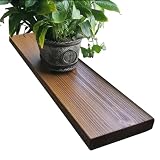
URBANDI Rustic Fireplace Mantel Shelf, 60 Inch (Brown, 60L x 6H x 8D)
Who it suits: Anyone whose fireplace wears a builder-grade nothing — or whose living room wall needs one big, warm, beam-scale gesture — and who wants it handcrafted in the USA rather than molded in a factory.
Urbandi is a real workshop: it began as a one-person business and handcrafts its pieces in Cincinnati, Ohio, and this mantel shelf is its signature product. The shelf measures 60 inches long, 8 inches deep and a full 6 inches tall, built from pine boards with a matte polyurethane finish in a range of stain colors, and it hangs on a hanger-board cleat of the kind cabinet shops have used for decades. Check the current price on Amazon for this mantel; roundups cite the maker capacity at 75 lb. As a piece of visual architecture it earns its place at the top of this tier: the 6-inch face gives you the beam look that photographs promise, the finish shrugs off the dust-and-greenery reality of mantel styling better than raw wood, and because it is a shelf and not a surround, it works just as well as a statement ledge in an entryway or over a sideboard where there is no fireplace at all. Pair it with the joelsantiques shelf above and the two together make a whole living room’s worth of anchor shelving inside this budget — check price on Amazon for both before you order.
The honesty note is construction. This mantel is a hollow box built from pine boards, not a solid beam — the maker’s own description says so — and that is a feature for weight and installation (a solid 60-inch beam would be a two-person, lag-bolt ordeal) right up until someone treats it like a solid beam. Load it with mantel decor, framed photos, stockings and greenery, all of which it handles easily; do not load it with a library, and never let anyone sit or stand on it. Over a working fireplace, also respect clearance: local codes and fireplace manufacturers set minimum distances between a combustible shelf and the firebox opening, commonly around a foot or more depending on depth, and that measurement — not the styling photo — decides where the cleat goes.
- Handcrafted in Cincinnati, Ohio, from pine boards with a durable polyurethane finish.
- A true beam-scale profile: 60 inches long with a 6-inch-tall face and 8-inch depth.
- Maker capacity cited at 75 lb; hangs on a cabinet-style hanger board.
Honest limitation: It is a hollow box, not a solid beam — strong enough for mantel loads, wrong for book loads or sitting — and above a working fireplace, code clearances to the firebox may push it higher than the styling photos suggest.
Choose it if your fireplace or main wall needs one warm, substantial focal shelf. Skip it if you need a working bookshelf — that is the joelsantiques or the oak shelves below — or if your fireplace clearances leave no legal place to hang it.

LUPWNEKA Solid Oak Floating Shelf, 36 Inch, 12 Inch Deep
Who it suits: Book people. Anyone whose shelf has to carry a real row of hardcovers, a TV console’s worth of equipment, or kitchen storage bins — and who wants solid oak under the load rather than pine or MDF.
Most floating shelves are 6 to 8 inches deep, which is a display ledge pretending to be storage. This one is a full 12 inches deep in solid oak, 36 inches long, on a screw-mounted metal support bracket — check price on Amazon. The depth changes what the shelf is for: two rows of paperbacks, one row of hardcovers with framed prints behind them, storage bins that actually fit, a coffee station with the machine on the shelf instead of under it. And the species matters at this depth, because a deeper shelf invites more total weight per foot. Oak’s stiffness — its modulus of elasticity runs around 1.76 million psi, against pine’s roughly 1.24 million — is what keeps a loaded 36-inch span honest over years rather than months, and oak’s surface hardness means the shelf edge survives the daily knocks that dent softwood. It is the shelf in this guide we would load with books first and apologize for least.
Two cautions keep the review honest. First, depth is a lever: a 12-inch shelf loaded front to back puts more torque on its bracket than the same weight on an 8-inch shelf, so the bracket’s stud fixings — not the board — set the real limit, and this listing does not publish a headline load rating in the data we reviewed; plan from construction, keep the heaviest items against the wall, and treat a full-depth row of hardcovers as the ceiling, not the starting point. Second, LUPWNEKA is a marketplace brand rather than a workshop name, so finish and grain will vary more from shelf to shelf than the American-made picks above; order both shelves for a matched run at the same time, from the same listing, and check them side by side before drilling anything.
- Solid oak a full 12 inches deep — the deepest hardwood shelf we verified at this level.
- Oak’s stiffness and hardness suit genuine book and storage loads, not just display.
- Screw-mounted metal support bracket — check price on Amazon.
Honest limitation: No headline load rating was published in the listing data we reviewed, and the 12-inch depth multiplies bracket torque — the wall fixings, into studs, decide what it can really carry.
Choose it if your shelf is furniture for books, bins or a coffee station. Skip it if your wall is drywall-only with no stud where the shelf must go — no bracket makes 12 inches of loaded oak safe on plasterboard alone.

WOPITMER Solid Oak Floating Shelf, 36 Inch, 10 Inch Deep
Who it suits: Buyers who want verified solid oak at the standard display depth — above a desk, along a kitchen wall, over a console — and who would rather pay for the wood than for extra inches of it.
This is a strong value pick in this tier for a floating shelf whose listing’s own copy — not just its title — confirms solid oak: 36 inches long, 10 inches deep, on a steel bracket mount — check price on Amazon. The 10-inch depth is the category’s honest middle: deep enough for a row of hardcovers, a plant with a real pot, or dinnerware, without the bracket torque of the 12-inch shelf above. Oak at 36 inches is comfortably inside its safe span at this depth, so a shelf bought for books and kitchen gear should stay flat for years if the bracket is fixed into studs as the listing directs; the listing guidance favors sturdy walls, which is the maker quietly telling you the same thing this guide keeps saying — the wall is half the product. As a system piece it is the best value in the guide: two of these plus the Urbandi mantel make a fireplace focal point with a matched oak run, and two plus the LUPWNEKA oak above make a three-shelf oak wall — all as system combinations inside this tier; check the current price on Amazon for each shelf before you order.
The limitation is a missing number. WOPITMER does not publish a weight-capacity figure for this shelf — not in the listing copy we reviewed, and not in the independent engineering roundup that ranked it the best overall oak shelf you can buy. That silence is not disqualifying; oak’s stiffness at this span is well understood, and the roundup’s own sag calculations put a 36-inch oak shelf of this depth comfortably inside safe limits for book loads. But it does mean you should plan the load from construction — a shelf of hardcovers, yes; a shelf of cast iron and stoneware, no — and it means the makers who do publish honest numbers, like the two pine picks in this guide, deserve the credit they get below. If a published, conservative rating matters more to you than the species, the BANFFLOW at the end of this guide is your shelf.
- Solid oak confirmed in the listing’s own copy, 36 x 10 inches — check price on Amazon.
- The standard 10-inch depth suits books, plants and kitchen gear without deep-shelf bracket torque.
- The best system value here: pairs and triples stay far under the $500 line.
Honest limitation: The seller publishes no load rating at all, so heavy loads have to be planned from the wood and the bracket rather than from a number — and the listing’s own guidance points it at sturdy, studded walls.
Choose it if you want real oak, at the sensible depth, as the value pick in this tier — check the current price on Amazon. Skip it if you need a published load figure to plan around, or your wall cannot offer the bracket a stud.

FLYJOE Solid Maple Floating Shelf, 24 Inch
Who it suits: Anyone furnishing a nursery, a child’s room, a small desk wall or a bright kitchen corner — anywhere a short shelf has to be genuinely strong and the pale, even grain of maple suits the room.
Maple is the engineer’s shelf wood: hard maple posts the highest stiffness figures of any common shelf species — a modulus of elasticity around 1.83 million psi — along with a hard, dent-resistant surface, which is why it ends up in butcher blocks and bowling lanes. This FLYJOE shelf is solid maple sourced in the USA, 24 inches long, in a glued-lumber construction — check price on Amazon. The seller rates it at 100 lb per shelf. That is the most aggressive rating in this guide relative to size, and we repeat it as exactly what it is — a seller’s claim, not a test result. It is directionally believable only because maple at a 24-inch span has enormous structural margin; even so, the bracket and its wall fixings will give up long before the maple does, so the honest working number is whatever your studs and bracket are worth, not the round hundred on the page. At 24 inches this is also the most premium pick here per inch of shelf, and the review should say so: you are paying for the stiffest wood in the category in the size where stiffness matters least, because a 24-inch span barely tests any solid wood.
So why does it earn its place? Because at this tier, some shelves are bought as equipment rather than as spans. In a nursery, the shelf over the changing table carries board books, a sound machine and a monitor, gets bumped daily, and must never, ever come off the wall — a short, massively over-built shelf in the hardest common wood, fixed into studs, is a rational purchase, and maple’s light color is the one that matches the room. The same logic serves a desk wall that will hold a monitor arm’s worth of gear on one short run, or a coffee corner where the shelf takes daily knocks from mugs and machines. Buy it as the strongest small shelf, not as a bargain: on pure shelf length for the tier, the oak picks above give you more coverage.
- Solid USA-sourced hard maple — the stiffest, hardest common shelf wood.
- Seller-rated at 100 lb per shelf; treat as a claim, and let the bracket and studs set your real limit.
- Light, even grain suits nurseries, kids’ rooms and bright kitchens.
Honest limitation: For 24 inches it is the weakest shelf-length value in this guide, and the 100 lb headline is a seller figure no maple board can cash if the bracket is in drywall.
Choose it if a short span has to be over-built, hard-wearing and pale. Skip it if you are covering wall length — the oak and pine picks give you far more shelf coverage in this tier.

BANFFLOW Solid Pine Floating Shelf, 3 Inch Thick, 24 Inch
Who it suits: Buyers who love the chunky, beam-like profile — over a desk, flanking a fireplace, in a bathroom — and who read load ratings the way engineers do: per fixing, not per headline.
Almost every shelf in this category is three-quarters of an inch to an inch and three-quarters thick. This one is a full 3 inches of solid pine, 24 inches long and 8 inches deep, finished in a dark walnut stain — check price on Amazon. The thickness is not just a look. Bending stiffness scales with the cube of thickness, so a 3-inch pine board is dramatically stiffer than a standard pine shelf — stiff enough, on the engineering numbers, to out-sag a thin hardwood shelf despite pine being the softest wood in this guide. And BANFFLOW states its rating the way this guide wishes everyone did: 35 lb per stud, 70 lb with the bracket fixed into two studs. That framing tells you the truth about every floating shelf ever sold — the rating lives in the wall fixings, not in the board — and it lets you plan a real load instead of a hopeful one. Two of these flanking a fireplace or stacked over a desk make a strong system pairing that leaves much of this tier’s budget for the room’s other anchor — check price on Amazon for the pair.
The honesty notes are about surface and species. The finish is a walnut-toned stain on pine, not walnut wood: pine’s softness (a Janka hardness around 380, against walnut’s roughly 1,010) means this shelf will dent and mark under the kind of daily abuse a kitchen or entryway delivers, and no stain changes that. The 3-inch profile is also genuinely bulky — in a small bathroom or a low-ceilinged room it can read as a beam dropped from a barn rather than a shelf, which is either the point or the problem depending on your room. And at 24 inches it is a short shelf: the thick profile buys stiffness you only partly need at this span, so what you are really purchasing is the look, plus the most honestly stated rating in the category. For the right room, that is a fair trade, openly made.
- A full 3 inches thick — the cube-law stiffness makes this pine shelf flatter under load than thin hardwood shelves.
- The most honest rating in the guide: 35 lb per stud, 70 lb across two studs, per the seller.
- Dark walnut-stained finish gives the beam look — check price on Amazon.
Honest limitation: It is pine under a walnut-colored stain — it dents like pine, whatever the title implies — and the 3-inch profile overwhelms small rooms and short walls.
Choose it if you want the chunky profile and a rating you can plan from. Skip it if the shelf will take daily hard knocks in a kitchen or entryway, where oak’s or maple’s harder surface earns its premium.

Comparison Table
| Product | Size and material | Maker load claim | Best use | Link |
|---|---|---|---|---|
| joelsantiques 60 Inch Floating Shelf | 60 x 12 x 2 in, solid Wisconsin pine | Tiered table: 50 lb at 60–72 in, into studs | Pantry runs, kitchen walls, long display lines | Check on Amazon |
| URBANDI Rustic Mantel Shelf, 60 Inch | 60 x 8 in, 6 in face, hollow pine box | 75 lb (maker figure cited in roundups) | Fireplace mantels and statement ledges | Check on Amazon |
| LUPWNEKA Solid Oak Shelf, 36 Inch | 36 x 12 in, solid oak | None published in listing data reviewed | Book rows, bins, coffee stations | Check on Amazon |
| WOPITMER Solid Oak Shelf, 36 Inch | 36 x 10 in, solid oak | None published by the seller | Desks, kitchens, console walls | Check on Amazon |
| FLYJOE Solid Maple Shelf, 24 Inch | 24 in, solid USA maple, glued lumber | 100 lb per shelf (seller claim) | Nurseries, desk walls, hard-knock corners | Check on Amazon |
| BANFFLOW Solid Pine Shelf, 24 Inch | 24 x 8 x 3 in, solid pine, walnut stain | 35 lb per stud; 70 lb on two studs | Chunky-profile display and desk shelves | Check on Amazon |
How to Choose a Floating Shelf Under $500
- Decide whether you are buying a shelf or a system. At this tier the honest unit of purchase is the wall, not the board: one anchor shelf plus one or two supporting shelves, in the same wood and finish, will always beat a single shelf that happens to cost more.
- Read the material line, not the title. Species words in titles are sometimes stain colors — two picks in this guide are pine under walnut- or oak-toned finishes. The listing’s own bullet copy and spec table state the real material; believe them over the headline.
- Match the span to the species. Solid hardwood at 36 inches is comfortably inside its safe span at book loads. Pine at 60 inches is past every species’ unassisted comfort zone — buy thickness (2 inches or more) and plan a center support or a thoughtful load.
- Let thickness do the work. Stiffness scales with the cube of thickness: doubling a board from 1 to 2 inches makes it about eight times stiffer in the same wood. A thick pine shelf can out-perform a thin oak one; a thin anything will sag at length.
- Translate every load rating into studs. Ratings assume the bracket is lagged into studs. Per-stud figures (35 lb per stud on the BANFFLOW) are the honest currency; a single headline number with no mounting condition is marketing. On drywall alone, with the plastic anchors in the box, plan on a fraction of any rating — light decor only.
- Count the studs before you order the length. A 60-inch bracket crosses three or four studs at 16-inch spacing — good. A shelf that must land between two specific points may cross only one. Measure the wall, find the studs with a finder, and let their positions choose the shelf length, not the other way round.
- Depth is a lever, not a bonus. A 12-inch shelf invites twice the load of a 6-inch shelf and multiplies the torque on its bracket. Deep shelves belong on studs, with the heaviest items against the wall.
- Budget the installation, not just the shelf. At this tier the hidden costs are a good stud finder, a long level, toggle bolts or masonry anchors matched to your wall, and — for 60-inch shelves, masonry walls or any shelf over a bed or sofa — an hour or two of a handyman’s time. That money is part of the $500, and it is the part that keeps the shelf on the wall.
- Check the configuration and the live price. Every pick here is sold in other sizes and finishes at other prices. Confirm the exact size named in this guide on the listing before you buy, and check the current price on Amazon for that configuration, because other sizes and finishes are priced differently.
The Verified Ceiling: What Happened When We Hunted for a $500 Shelf
Because this guide’s title promises a tier, the research started at the top: we went looking for the single best floating shelf $500 can buy on Amazon, expecting a thick walnut slab or a designer system to fill the role. Here is what the hunt actually found. The top-of-tier single floating shelf we could verify on Amazon was the joelsantiques 60-inch. Behind it, the verified field thins fast — a handcrafted mantel next, then a cluster of genuinely good solid-wood shelves lower in this tier — check the current price on Amazon for each one. Listings exist that gesture higher, but when we chased them they dissolved into one of three things: an offer no source could confirm, a trade or cabinet-shop listing that has nothing to do with an Amazon buy box, or a custom workshop whose made-to-order shelves in walnut and white oak are premium commissions sold through the workshop’s own site, in four to six weeks, not through Amazon. We could have filled this guide with those names and guessed prices. It would have been fiction, so instead the guide says what the evidence says: on Amazon, verified, this tier is led by a single large shelf, with the rest of the field sitting below it as system building blocks.
That finding is not a disappointment; it is the most useful fact in this guide, because it changes what a smart $500 does. It does not buy a better board — past the joelsantiques and the Urbandi mantel, there is no verified board left to buy. It buys coverage and correctness: two rooms anchored instead of one, three matching oak shelves instead of a single long one, the premium shelf plus the professional installation that a top-of-tier shelf deserves and a basic shelf never gets. The next section lays out the combinations in the open, pairing by pairing, so you can spend the tier the way it actually exists — and if your heart is set on one $500 object, the honest route is a custom workshop order off Amazon, in walnut or white oak, cut to your wall to the sixteenth of an inch, with the four-to-six-week wait that real furniture involves.
What $500 Buys: The System Math
Here are the combinations of this guide’s picks that work as a system under $500, and what each one does — check the current price on Amazon for each shelf and confirm the pairing still fits the tier before you order. The joelsantiques 60-inch shelf plus the Urbandi mantel is the top pairing: a five-foot working shelf for the kitchen or living room and a beam-scale mantel for the fireplace, the two anchor walls of most houses. The Urbandi mantel plus two WOPITMER oak shelves gives a fireplace focal point and a matched oak run for the desk or dining wall. The joelsantiques plus the LUPWNEKA deep oak is the combination we would choose for a kitchen that needs a pantry wall and a coffee station, with room in the tier left for installation help. A three-shelf oak wall — LUPWNEKA, WOPITMER and the FLYJOE maple — builds a full wall from the hardwood picks. And two BANFFLOW thick-profile shelves are the budget play inside the tier: the beam look in two rooms, with much of the tier still available for whatever the room needs next.
Notice what every one of those combinations has that a hypothetical $500 shelf would not: a second wall. Floating shelves fail as purchases not when they sag but when they are lonely — one expensive shelf styled within an inch of its life, surrounded by rooms that still have nowhere to put anything. The system spend fixes the kitchen and the fireplace, or the desk wall and the nursery, in one order, in matching wood, with one installation afternoon. That is what this tier is actually for, and it is why the guide’s final recommendation below spends the money the way the combinations do. If you recognize your house in one of those pairings, you have found your purchase. If you only need one wall done well, buy the single shelf that fits it from the picks above, keep the change, and let Best Floating Shelves Under $300 show you what the remainder does at the next tier down.
Will These Work With Your Walls?
Every rating and recommendation in this guide assumes the same wall: wood studs, 16 inches on center, with the bracket lagged into at least two of them. If that is your wall, all six picks install the way their listings describe, with the tools in a normal drill-driver kit plus a stud finder and a level long enough for the shelf. A 36-inch shelf crosses two to three studs; a 60-inch shelf crosses three to four, and should use them. Load the shelves gradually the first week, and re-check level after the first real load — a shelf that drops a degree under weight is telling you a fixing is in drywall, not stud, whatever the finder said.
The other walls are where this tier earns its caution. On drywall with no stud where the shelf must go, toggle bolts are the only honest anchor, and even good toggles derate a long, deep shelf to light display duty — the oak and 60-inch picks do not belong on toggles at book loads. On brick, block or concrete, the shelves themselves are fine and the included hardware is not: you need a hammer drill, masonry anchors rated for the load, and the patience to drill them plumb, which is the single most common place a DIY install at this size goes wrong. On plaster-and-lath, find the studs by magnet or by test holes inside the shelf line, because lath alone will not hold a bracket under torque. And over a bed, a crib or a sofa, the standard rises again: at 48 inches and up, or on any masonry wall, hiring a handyman for an hour is not an extravagance but the correct line item — a falling 60-inch shelf is a genuine injury risk in a way a falling picture frame is not. None of this is a reason to buy a smaller shelf. It is a reason to spend this tier’s money the way the guide keeps suggesting: some on the shelf, some on the wall it hangs from. For room-by-room versions of this advice, see Best Floating Shelves For Apartments Under $500, Best Floating Shelves For Bedrooms Under $500, Best Floating Shelves For Modern Homes Under $500 and Best Floating Shelves For Small Rooms Under $500.
Common Buying Mistakes
- Hunting for a single $500 shelf on Amazon, then either overpaying for an unverifiable listing or giving up — the tier is a system budget, not a single-shelf price point.
- Believing the species in the title. “Walnut” and “oak” in shelf titles are often stain colors over pine; the material line in the listing’s own copy is the truth.
- Comparing headline load ratings across brands. One maker’s 100 lb assumes perfect stud mounting; another’s 50 lb is a tiered table by length. Ratings are only comparable when the mounting conditions match.
- Bolting a 60-inch shelf’s bracket into one stud and a row of drywall anchors, then loading the middle. Length multiplies torque; long shelves need every stud they cross.
- Loading a deep shelf like a shallow one. A 12-inch shelf full of books can outweigh a 6-inch shelf’s entire rating; keep heavy items against the wall and count depth as load.
- Skipping the stud map. Ordering the length you want and discovering the studs disagree is how shelves end up mounted off-center, off-level, or into plasterboard.
- Treating a hollow mantel shelf like a solid beam. It is a strong box for mantel loads, not a step, a seat or a bookcase.
- Hanging a combustible mantel shelf at styling-photo height over a working fireplace without checking the clearance your fireplace and local code require.
- Judging solid wood by the first board out of the box. Grain and knots vary, especially in pine; for a matched run, order all shelves at once and compare them before drilling.
- Spending the whole $500 on shelves and nothing on installation — then mounting furniture-grade wood with the wrong anchors.
Final Recommendation
- Most houses, two anchor walls: joelsantiques 60 Inch Solid Pine Floating Shelf plus the URBANDI Rustic Mantel Shelf — the top pairing in this tier; check price on Amazon for both.
- Kitchens and pantries: joelsantiques 60 Inch for the long run, LUPWNEKA Solid Oak for the deep station shelf.
- Book walls: LUPWNEKA Solid Oak, 12 Inch Deep, on studs — and load it like the bracket matters, because it does.
- Oak on a system budget: WOPITMER Solid Oak — buy two or three and build the wall.
- Nurseries and hard-knock corners: FLYJOE Solid Maple — the strongest short shelf here.
- The beam look for less: BANFFLOW 3 Inch Thick — buy a pair as a system pairing; check price on Amazon.
Our top spend is the pairing: the joelsantiques 60-inch shelf and the Urbandi mantel together, because between them they cover the two walls that dominate most living spaces — the long working wall and the fireplace — with American-made, solid-wood pieces whose capacities we could verify — check the current price on Amazon for both. If your project is one room rather than two, take the single pick that matches it: the LUPWNEKA for books, the WOPITMER for oak value, the FLYJOE where a short shelf must never fail, the BANFFLOW where the chunky profile is the point. And if you arrived here determined to own one extraordinary shelf, believe the research: that shelf is a custom workshop commission in walnut or white oak, ordered off Amazon as a premium commission with a month’s patience — while the best version of this exact budget, spent where the evidence points, is the system above. Measure your wall, map your studs, check the live price and configuration on the listing, and order the combination that matches the rooms you actually have.
Frequently Asked Questions
Can you really buy a floating shelf for $500 on Amazon?
Not one that we could verify. In our research, the top-of-tier single floating shelf we could verify on Amazon was a 60-inch handmade solid pine shelf, followed by a handcrafted mantel shelf — check the current price on Amazon for both. Higher listings could not be confirmed, and genuinely expensive shelves — custom walnut or white oak commissions — are sold through workshops’ own sites, not Amazon. Under $500 on Amazon is honestly a system budget: two or three excellent shelves, properly installed.
How much weight can a floating shelf actually hold?
Whatever its bracket’s wall fixings can hold — the board is rarely the weak part. Maker claims in this guide run from a tiered 50 lb for a 60-inch shelf to a seller-claimed 100 lb for a 24-inch maple shelf, and all of them assume lag fixings into studs. The honest planning figures are per-stud: around 35 lb per stud is a representative maker rating for a quality bracket. On drywall anchors alone, treat any long or deep shelf as light-display only, whatever the listing says.
Is a 60-inch floating shelf going to sag?
Under a full-length row of heavy books on end brackets alone, some sag over time is likely in any species — 60 inches exceeds the comfortable unassisted span of solid wood at normal thickness. A 2-inch-thick board resists far better than a standard shelf (stiffness scales with the cube of thickness), and the practical fixes are simple: add a center support, keep the heaviest items over the bracket ends, or choose two 36-inch hardwood shelves instead of one 60-inch run.
Solid wood, veneer or MDF — does it matter at this price?
Yes, and at this tier you should accept nothing less than solid wood. MDF sags roughly four times as much as solid hardwood at the same span and thickness and swells in humid rooms; veneer over MDF wears the look without the structure. Every pick in this guide is solid wood — but read the material line anyway, because species names in titles are sometimes stain colors: two picks here are honestly labeled pine under walnut- or oak-toned finishes.
Should I hire someone to install shelves at this size?
For a 36-inch shelf into studs, a confident DIY install with a stud finder and a long level is reasonable. At 60 inches, on masonry, plaster-and-lath, or anywhere over a bed, crib or sofa, hiring a handyman for an hour is the right call — the shelf is heavy, the bracket must be plumb and level across three or four studs, and the cost belongs in this tier’s budget from the start. Two people minimum for the long shelves, hired or not.
What is the best single purchase if I only want one shelf?
The joelsantiques 60-inch if your wall and load suit it — it is the largest, deepest verified shelf in the guide, with the most honestly published capacity figures. For a book wall, the LUPWNEKA solid oak at 12 inches deep; for a fireplace, the Urbandi mantel. Each is a complete purchase on its own; the system framing in this guide exists because the budget allows more, not because any single pick is half a product.