As an Amazon Associate, Daily Home Decorating earns from qualifying purchases. Product information and images may change; verify current dimensions, selected configuration, seller, delivery, and return terms before buying.
Finding the best sofa for a narrow doorway starts with the delivery route, not the living-room dimensions. Measure doors, hall turns, stairs, and package sizes, then compare removable parts, modular designs, assembly, and failed-delivery terms before ordering.
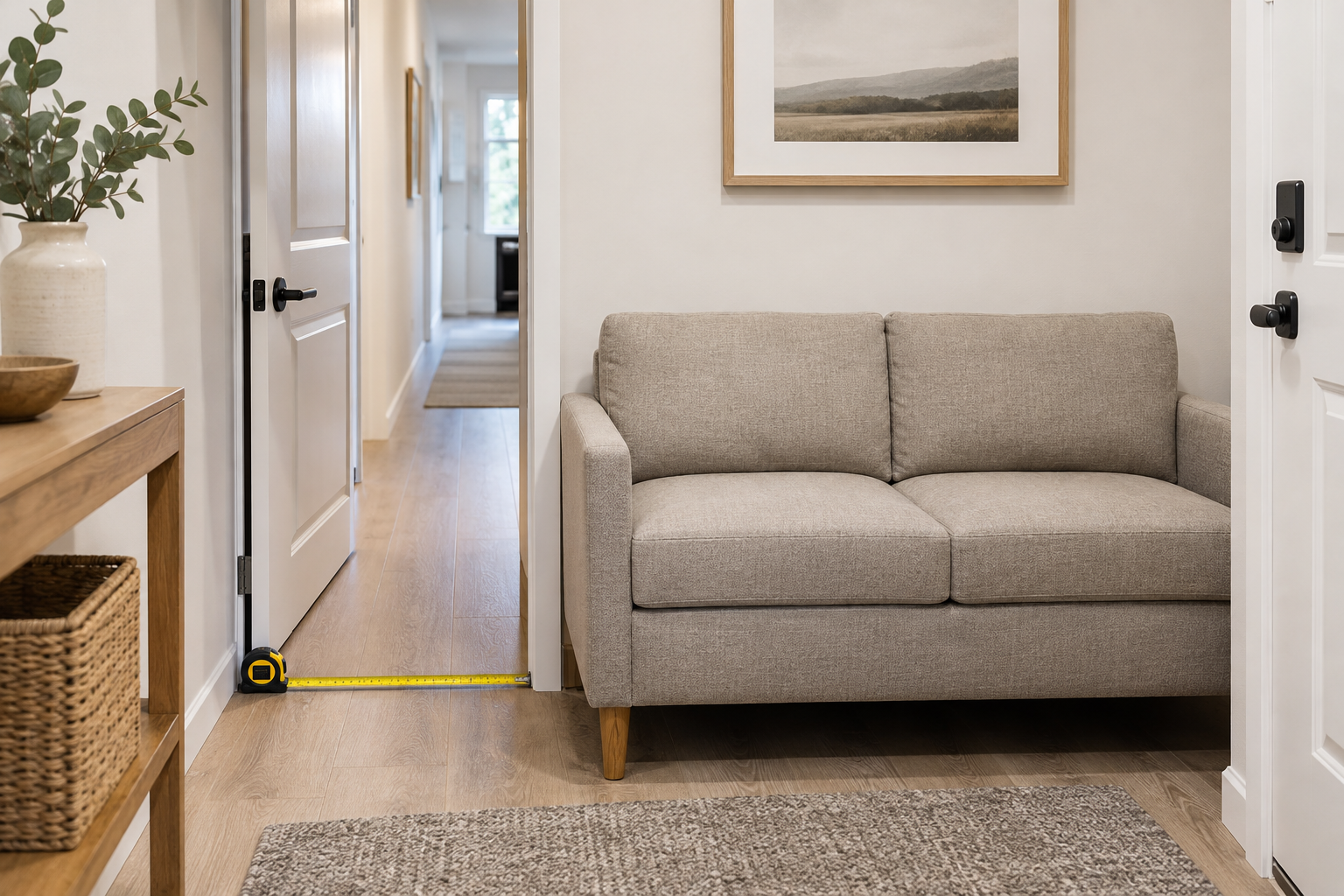
Why narrow doorways change the sofa search
A sofa can fit the living room and still fail to reach it. Narrow entry doors, hallway turns, stairwells, elevators, and interior doorways create a delivery path with several pinch points. The advertised sofa width is only one part of the problem: depth, height, diagonal length, packaging, and detachable parts can all affect whether it passes. A sofa marketed for apartments is not automatically suitable for a narrow doorway. Measure the route before shopping, then compare those dimensions with the assembled sofa and the boxes. A realistic plan can identify whether a smaller loveseat, a modular design, removable arms, or a boxed sofa is the better option. The goal is successful delivery without forcing furniture through a space that can damage the item or home.
Map the whole delivery route
Measure every part of the route from the delivery point to the final room. Include the exterior entrance, vestibule, hall, elevator, stairwell, landings, turns, and the room doorway. Measure clear width and height, not just the nominal door size; trim, handles, closers, and rails reduce clearance. For a turn, record the space available to rotate a long object and the height of the ceiling above the corner. Check doors that can be removed safely and whether building rules allow it. Draw a simple route with the narrowest points marked. The smallest opening is not always the limiting one: a wider doorway followed by a tight hallway turn may be harder. Measure twice and keep the figures together for the delivery team.
Measure door openings correctly
Measure the clear opening with the door fully open, from the inside edge of the door to the opposite stop. Include the height from floor to the underside of the frame. If the door can be removed, measure the frame opening and confirm with the building owner or manager before taking it off. Do not count on compressing a rigid sofa or forcing it through. Also measure the distance from the doorway to the opposite wall, because a sofa may need room to tilt or rotate after entering. Take note of handles and protruding hardware. A few inches can determine whether a sofa passes upright, on its side, or not at all. Compare measurements with the delivery company’s clearance requirements before finalizing an order.
Account for diagonal and pivot space
A long sofa may pass through an opening diagonally even when its width exceeds the door clearance, but that depends on the opening height and the room on both sides. Measure the longest diagonal of the doorway and the sofa’s depth and height; product diagrams or manufacturer support may help determine whether a tilt is possible. A hallway corner needs pivot space: the item must rotate without colliding with the opposite wall. Stairwells add headroom and landing constraints. Avoid making a guess from one dimension. If the delivery service offers a fit check, provide precise measurements and ask what happens if the sofa cannot be delivered. A documented route assessment is safer than relying on a generic “fits through standard door” statement.
Use sofa dimensions and package dimensions
Product pages may list only the assembled item. Ask for each shipping carton’s length, width, height, and weight, plus the number of boxes. A sofa that arrives disassembled or compressed can have more manageable packages, but it may require assembly and time for cushions to recover. A boxed sofa still needs to move through the hallway and turn into the room. Compare the package dimensions with the tightest opening and check whether the delivery carrier has a smaller-item threshold or special handling rules. Keep enough room inside the final room to unpack and assemble. Save the dimension diagram and package information before ordering; it is useful for both delivery planning and resolving a problem if the selected product differs from the listing.
Removable parts can make a difference
Some sofas have removable legs, backs, arms, or modular seats. These pieces may reduce the dimensions that must pass through a doorway, but do not assume that a part detaches just because it looks separate. Check the manual, product description, or manufacturer support for the actual procedure and tools. Ask whether removing a part affects the warranty or requires professional service. Measure the largest remaining section after disassembly, not just the smallest components. Reassembly should be stable and secure, and the parts must be reinstalled according to instructions. A sofa with removable parts may be a practical choice when the room is accessible only through a narrow entry, provided the disassembly process is clear and the main frame still fits the route.
Compare modular and compact designs
Modular sofas arrive as separate seats or blocks that can be carried individually and assembled in the room. They can be easier to maneuver than a one-piece couch, especially when each module is small enough for the route. Check how modules connect and whether the arrangement can be expanded or reconfigured later. A compact loveseat may avoid the need to disassemble anything, but its seat width and comfort should still suit the household. Measure every component and the largest assembled configuration. Modular furniture is not automatically easy to deliver: a large corner unit or oversized chaise may still be difficult to pivot. Select the layout based on both the route and daily use, then confirm the seller’s assembly and return policies.
A compact apartment sofa to compare

An API result for a 71-inch two-seat apartment couch describes screw-free assembly and an armrest tray. A compact outer width may help in a small home, but the shipping cartons and largest rigid component determine doorway fit. Check package sizes, whether the arms detach, and if the seat arrives compressed. The product title also includes a washable cover and elevated seat wording; verify the selected option’s actual specifications and care instructions. A smaller couch can simplify delivery but still have deep cushions or broad arms. Use its current listing as one comparison point and confirm each measurement with the seller before ordering.
Removable arms and backs

A 57-inch modular loveseat listing from the API search describes removable armrests and a backrest. Those features could make it easier to carry components through a constrained route, but verify the exact disassembly process and the largest part once separated. A compressed or boneless style may feel and perform differently from a conventional framed sofa, so review the construction, cushion support, and setup instructions. Confirm that every component can be reassembled securely and that the selected cover and configuration match the photos. The listing provides a useful example of a modular approach, not proof that it will fit a particular home. Compare all package and doorway measurements before purchasing.
A small sofa bed option

A 66-inch convertible sofa bed surfaced in the search with a removable cover and apartment-oriented description. A sleeper sofa adds another constraint: the bed mechanism may make the frame heavier or less separable, and the open bed needs clearance in the room. Check the shipping dimensions separately from the unfolded sleeping footprint. Confirm whether arms or legs detach and whether the mattress or mechanism ships in a separate box. If the doorway is narrow, ask for an explicit delivery-fit assessment. Do not assume that a compact couch bed is easy to maneuver merely because its width is modest.
Consider box sofas carefully
Compressed or boxed sofas can simplify delivery because cushions or modules ship in smaller cartons. However, the package may be heavy, and a carton can be difficult to turn even when the sofa inside is small. Check the listed box dimensions and weight, the carrier’s delivery process, and whether the product needs a long recovery period after unpacking. Follow setup instructions and allow materials to expand before evaluating shape and comfort. Confirm that the compressed format is compatible with the frame and upholstery and that returns remain possible after opening. A boxed sofa may be a useful solution, but the package route and setup should be checked just as carefully as the assembled dimensions.
When a loveseat is the practical choice
A loveseat may be the simplest answer when the route cannot accommodate a full sofa. It can fit through tighter openings and leave more room in the destination, but compare the usable seat width, arm width, seat depth, and back support. A smaller sofa should not be chosen only to solve delivery if it will be uncomfortable or too small for regular users. If a household needs more seats, consider a pair of loveseats or modular chairs that arrive separately. Measure each piece and plan the arrangement in the room. A practical small sofa is one that fits the route, suits the users, and leaves clear paths after it is placed.
Ask for a delivery fit guarantee
Before ordering, ask who is responsible if the sofa cannot pass through the route. Some sellers or delivery services offer a measurement check; others may charge for failed delivery, return freight, or restocking. Get the policy in writing and ask whether the team will remove doors or packaging. Clarify if they deliver to the room or only to the building entrance. If you live in a condo or apartment, check building requirements for elevator reservations and protection of walls. The seller may need exact dimensions and photographs of the narrowest turns. A clear fit-check process can save time and money, especially when the product is large or the delivery route has several difficult corners.
Protect the home during delivery
Measure not only whether the sofa fits but also whether it can be moved without damaging the walls, floors, doors, or railings. Clear the route, move fragile objects, and protect vulnerable corners where appropriate. If using a professional delivery team, confirm that they bring the necessary equipment and have the access details. Do not attempt to force a heavy frame through a tight doorway or lift beyond what is safe. For an unusually constrained route, consider a furniture installer or delivery service experienced with that type of building. Document the condition of the item and home before delivery, and inspect the sofa before discarding packaging.
Check assembly time and tools
A sofa that is delivered in parts may require assembly. Review the steps, tools, number of people, and approximate time before buying. If the user cannot assemble it, arrange help or a professional service. Confirm that hardware comes with the item and that all parts can be carried safely through the route. Follow the instruction manual exactly, especially when connecting frames or attaching legs. After assembly, check that the sofa sits level and that connectors are locked. Keep the manual for future moves. Assembly can turn a difficult one-piece delivery into a manageable project, but only if the work is clear and safely within the household’s ability.
How to compare candidates side by side
Make a simple comparison sheet with the assembled width, depth, and height; package dimensions; largest rigid section; removable parts; weight; assembly needs; and delivery policy. Add seat height, usable depth, cushion style, and room footprint so the delivery solution does not compromise comfort. Identify the narrowest route measurement and compare every candidate against it. If any dimension is uncertain, contact the seller before ordering. Save screenshots or a PDF of the product dimensions and the response. This process makes the choice less dependent on vague terms like “apartment sofa” or “easy delivery” and gives the delivery team the information it needs.
Avoid common measurement errors
Do not measure only the front door and forget interior halls or stair turns. Do not use the nominal door width when the open door, stop, and handle reduce clearance. Do not compare the sofa’s width with a package measurement unless you know the relevant part can be removed. A sofa may fit vertically through the doorway but fail to pivot in the hallway. Do not assume the delivery company will remove doors, hoist furniture through a window, or carry it upstairs. Do not discard packaging until the sofa has been inspected. Measure the whole route and confirm responsibilities before checkout.
What if no full sofa fits?
If no full-size model passes the route, consider two smaller modules, a loveseat, apartment chairs, or a sofa assembled from parts in the room. A window hoist or balcony lift may be possible in some buildings, but it requires professional assessment, permission, and appropriate safety arrangements. It should not be improvised. Measure the largest individual piece and compare the cost of special delivery with a different configuration. A smaller sofa may also be easier to move in future. Focus on a seating plan that provides enough capacity and comfort rather than forcing a large item into a home where access is limited.
Delivery day checklist
Before delivery, clear the route and confirm the arrival window and access instructions. Keep the measurements, order details, and delivery policy available. Ask the team to pause before moving the sofa through any tight turn so the path can be checked. Inspect each package and component for damage, then compare the delivered model with the order. Assemble according to the instructions and allow cushions to recover as directed. Do not discard packaging until you have confirmed that everything is present and acceptable. If a problem occurs, take photos and contact the seller within the stated window.
Frequently asked questions
How do I know if a sofa fits through a doorway? Measure the clear opening, sofa or package dimensions, and the room needed to pivot. Get a fit check when the route is complex. Can a sofa be moved diagonally? Sometimes, but doorway height, sofa depth, and pivot space all matter. Are modular sofas easier to deliver? Often, if each module and package fits the route; verify dimensions. Can sofa arms be removed? Only if the manufacturer says they detach; do not force parts. Are boxed sofas easier to move? They may have smaller packages, but carton size, weight, and assembly still matter. What if the sofa does not fit? Review the failed-delivery and return terms before buying, and contact the seller promptly.
Final checklist
Measure every doorway, hallway, landing, turn, and elevator. Record clear widths and heights, not nominal sizes. Compare assembled dimensions, package dimensions, and largest rigid components. Confirm removable parts, tools, assembly, delivery placement, and failed-delivery costs. Map the sofa footprint in the room and make sure it suits its users. Ask the seller for a route assessment if a turn is uncertain. A sofa that fits both the delivery path and the living space is the better purchase, even if it is a little smaller or arrives in several modules.
Make delivery part of the buying decision
The delivery route is part of the product’s real-world fit. A sofa that is perfect on paper but impossible to bring inside is not a workable choice. Factor delivery support, assembly, return pickup, and any building requirements into the total decision. A modular or compact piece may cost more or look different than the first sofa you considered, but it can reduce risk and improve future flexibility. Compare dimensions and policies before paying, and keep the fit details accessible to everyone involved in delivery. Planning ahead lets the new sofa arrive without turning moving day into a stressful improvisation.
Related guides: compact sofa options, mail-order sofa delivery guide, and Home & DIY.
Certain content on this site comes from Amazon and may change. Amazon product images and listing details are supplied through Amazon Creators API. Confirm the exact option, seller, dimensions, materials, and current terms before purchase.
How delivery teams evaluate a difficult route
Delivery teams may need to tilt, rotate, or partially unpack furniture, but they work within specific safety and service limits. Ask what dimensions they want in advance and whether they require the doorway and stairwell to be clear. Provide photos of tight turns and measurements from floor to ceiling at landings. Clarify whether they can remove packaging, detach legs, or take a door off its hinges. Do not assume these services are included in a standard delivery charge. If the route requires equipment or a specialized crew, arrange it before the shipment is scheduled. A short conversation with the carrier can identify an issue that a sofa listing does not mention.
Keep a written record
Save the exact product page, selected variant, dimension diagram, package measurements, delivery policy, and any seller response about fit. This record is useful if the shipment arrives in different cartons or the delivered model does not match the measurements provided. Confirm that the order reference matches the configuration discussed with the seller. When the delivery team arrives, point out narrow turns before they begin carrying the furniture. If a fit problem occurs, stop rather than forcing the item through and contact the seller about next steps. Clear documentation can help resolve a failed delivery more quickly and makes it easier to compare another model without repeating the entire measurement process.
Plan for a future move
Even if the sofa fits the current home, a future move may involve a different elevator, stairway, or doorway. Modular pieces and replaceable components can be easier to transport than a large rigid frame. Keep the assembly instructions and note how the sofa separates. If you choose a one-piece sofa, keep its dimensions for the next move. Avoid discarding small connectors or hardware when the sofa is rearranged. Thinking ahead is especially helpful for renters who may change apartments more often than homeowners. A sofa that can be moved through ordinary routes has practical value beyond the day it is delivered.