Affiliate disclosure: DailyHomeDecorating.com may earn from qualifying purchases through links in this article. As an Amazon Associate, this site earns from qualifying purchases. The product examples and images were retrieved through Amazon Creators API and may change. We have not tested these sofas. Prices and availability can change; confirm the selected model, configuration, materials, delivery, and current price on the live listing before buying.
Shopping for the best mid-range sofas is a balancing exercise. You may want a frame and support system with useful everyday comfort, a fabric that suits your home, and a recognizable service or return process without paying for extensive customization or luxury branding. “Mid-range” has no fixed price boundary across sizes, sellers, or markets. A simple two-seat sofa and a large sectional can occupy very different budgets, and prices change with upholstery, sales, delivery, and availability.
This guide helps you decide what the middle of your own budget should buy. It compares sofa types, key construction questions, upholstery, comfort, dimensions, and total cost, then offers a short list of current Amazon examples with different materials and formats. These listings are not a definitive market ranking or hands-on test. Use them as starting points and compare them with reputable local retailers and furniture makers.

Quick answer: define your price range before shopping
Set a total delivered budget and write down what matters most: number of seats, comfort, fabric, durability information, room dimensions, warranty, delivery, and repair support. Then compare products that meet your essential needs instead of picking the sofa with the most features. A reasonable mid-range choice is not simply the cheapest item below a luxury price; it is the option whose specifications, comfort, seller support, and expected maintenance fit the amount you can spend.
Compare the full order cost. Include chosen upholstery, taxes, delivery, assembly, old-furniture removal, protection plans, and accessories. Check whether throw pillows shown in the photo are included. A sale price can be attractive but may omit room placement or have a limited return window. If a seller cannot explain the return process or warranty, decide whether the low price compensates for the uncertainty.
What “mid-range” means in practice
There is no universal price cutoff for a mid-range sofa. Retailers use different definitions, and market prices vary by size and construction. Rather than declaring a fixed dollar band, divide your own budget into three practical categories: entry-level, target, and stretch. Compare a few sofas in each category using the same dimensions and upholstery type. This reveals whether a price difference reflects more seating, better service, a preferred fabric, or simply a retailer’s current promotion.
Decide on a maximum before browsing sale pages. A sofa sold at a discount can still exceed your intended budget after delivery and upgrades. If your target price covers only the sofa, add a separate allowance for shipping, assembly, and taxes. Leave room for the features you truly need; a reversible chaise or removable cover may be more valuable than a decorative accent pillow or built-in charging port.
Think in terms of trade-offs, not bargain labels. A lower-priced sofa may offer an appealing profile but sparse construction information. A higher-priced sofa may include more fabric choices or dealer service without a better fit for your room. Use written specifications to determine whether the difference is meaningful to you. A mid-range budget should buy clarity about the product as well as a style you like.
Types of mid-range sofas to compare
Three-seat stationary sofas
A standard three-seat sofa is a useful baseline for comparisons. It often fits a living room, apartment, or office without the extra width of a large sectional. Check the usable width of each seat, not just the outside width. Arms can reduce seating space. Ask whether cushions are removable, how the seat is supported, and what the upholstery is made from.
Loveseats and apartment sofas
A loveseat or compact sofa can free up floor space and may cost less than a full-size model, but compare its seat depth and inside width carefully. Some “loveseats” are broad and deep; others offer upright seating for two. In a small room, narrow arms can be a better use of space than simply choosing the shortest overall width.
Sectionals
A sectional provides a chaise or corner seat in one configuration, but the total cost can grow when you add modules, connectors, or a storage ottoman. Measure the full L or U shape and delivery route. Make sure the chaise orientation matches your room. If the layout may change, check whether pieces can be rearranged and whether the hardware is included.
Sleeper sofas
A sleeper gives you seating and an occasional bed, but the mechanism and mattress require additional checks. Measure the open-bed footprint and verify mattress dimensions. Test conversion if you can. A sofa bed that stays within budget but is difficult to open or uncomfortable for guests may not be a good value.
Construction information worth asking for
Ask what the frame is made from and how it is joined. “Wood frame” is broad; request the exact materials and construction details for the model. Find out which components use solid wood, plywood, engineered wood, or metal. Ask how corners are reinforced and whether the frame has a written warranty. Avoid treating marketing descriptions such as “heavy duty” or “built to last” as proof without model-specific details.
Ask about seat support, such as sinuous springs, webbing, or another system, and whether replacement parts are available. Ask what the cushions contain and whether they can be removed or replaced. Foam density, fiber wraps, down blends, and spring cores can feel very different. The product name alone will not tell you which firmness suits your household. Request a specification sheet or visit a showroom to test the feel.
Look at seams, cushion alignment, upholstery pattern matching, and the back finish. A tidy display sample is a useful check for visible finishing but does not prove the inside construction. If you are ordering online, look for clear photos of the exact model from multiple angles and read reviews that identify the same size and upholstery. Ask the seller questions before purchase if the core specifications are missing.
Comfort and fit for your body
Measure seat height, seat depth, back height, and arm height. A deep seat can work for lounging but leave shorter users without stable foot support. A shallower seat can make upright conversation easier but feel cramped for taller people. Cushion firmness is personal, so try the exact sofa if possible. Sit for several minutes, lean back, and stand up to see how the sofa feels during ordinary use.
Pay attention to the number of people who will use the sofa at once. A three-seat label does not guarantee three adults will feel comfortable; the arms and cushion divisions affect usable width. If users have different comfort preferences, test the seats individually. Check whether back pillows move or flatten and whether they can be replenished. A mid-range purchase should fit daily habits, not just the room photo.
Consider the sofa’s role. A formal sitting room may need firmer, upright seating. A family room may need washable or replaceable covers and sturdy cushions. A media room may benefit from deeper seats, but the sofa should still allow easy movement. If older adults or people with mobility limitations will use it, verify seat height and arm support in person.
Upholstery, maintenance, and household needs
Compare fiber content, fabric construction, color, cleaning code, and sunlight guidance. Polyester blends, microfiber, leather, linen, velvet, and textured fabrics all behave differently. A “performance” label does not mean the sofa is stainproof or clawproof. Ask what treatment, if any, is applied and which cleaners are approved. For a light sofa, consider how it will look with pets, children, jeans, and frequent use.
Request a swatch and view it in your room at different times of day. Compare it with your floor, rug, curtains, and wall color. A gray fabric may appear blue or green under certain lighting, while cream can shift warm or cool. If the sofa is made to order, confirm the exact fabric number and whether the finished product can vary slightly from a swatch. Keep the sample with your order documents.
Ask whether cushion covers are removable and whether they can be professionally cleaned or laundered. Removable does not mean machine-washable. Check the sewn-in label and manufacturer’s guide. If you have pets, ask about hair visibility and snag risk, but remember no fabric is guaranteed against damage. Choose care requirements you can realistically follow rather than assuming a low-maintenance label solves every problem.
Mid-range sofa examples to compare
These current Amazon examples illustrate four different options: faux-leather upholstery, full leather, a three-seat fabric sofa, and a compact chenille sofa. The examples are not ranked by price because Amazon offers and variations can change. We have not tested them and cannot confirm that they fit every definition of mid-range. Check current prices, seller details, exact material, measurements, return terms, and warranty in the live listing.

ASIN: B08CZXRRWC

ASIN: B0H11MM979

ASIN: B0GTQ756YJ
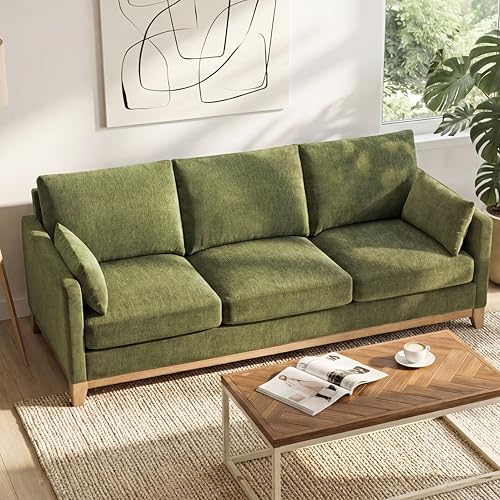
ASIN: B0GZLNV9Z1
Before clicking buy, open the exact size and color variation. Check whether the product is a sofa, loveseat, set, or sectional and whether the product page includes all pictured pieces. Read the listed frame and upholstery details. If the description does not state a cleaning code, ask the seller. Confirm delivery into your room, assembly, old-sofa removal, and the process for reporting transit damage.
Compare delivery and service, not just price
Measure the room and the delivery route. Record the available width, depth, walking paths, door swings, stairs, landings, elevator size, and interior door openings. Ask for package dimensions and whether legs or backs detach. A sofa can fit along the wall but fail to turn into the living room. Confirm whether delivery is curbside, threshold, room-of-choice, or white-glove service and whether setup is included.
Read the return policy before buying. Check the return window, pickup charges, restocking fees, condition requirements, and whether a made-to-order item can be canceled. Save the listing and any seller responses. If the sofa arrives damaged, photograph the box and product and report the issue within the stated time. A low price can become a poor value if a return is difficult or service is unavailable.
Review the warranty for the frame, springs, cushions, reclining mechanism if present, upholstery, and labor separately. Understand exclusions for wear, stains, fading, pets, commercial use, and cleaning damage. Ask who handles claims and whether a local technician can service the product. Check if replacement cushions, covers, legs, or parts are available. Repair access is an important part of ownership value.
How to build a fair comparison
Make a short comparison sheet with the exact model, size, seat dimensions, upholstery, frame, support, cushion construction, warranty, delivery, return terms, seller, and total delivered cost. Mark unknown information instead of assuming. If one seller provides a detailed specification and another gives only broad adjectives, account for that uncertainty. Compare two or three models with similar seat count and material so the price difference is easier to explain.
Choose your must-haves before evaluating extras. If your main priority is back support, test seat and arm dimensions first. If the sofa must fit an apartment, focus on access and footprint. If you have pets, assess upholstery care and cushion replacement. If you want a long-term centerpiece, look for repair and warranty support. A built-in USB port or decorative pillow may be nice but should not outrank comfort and fit.
Set an expected-use horizon without turning it into a promise. Estimate how long you expect to keep the sofa and whether the price difference between two models is worth it for your household. A simple divide-the-cost-by-years calculation can help compare budgets, but it does not predict actual durability. Use warranty, repairability, construction, and care requirements as evidence rather than extrapolating from price alone.
Common mid-range sofa shopping mistakes
- Using an arbitrary price band: Compare by size, materials, and service, because a loveseat and sectional differ greatly.
- Comparing sale price only: Include delivery, assembly, tax, and return costs.
- Buying the wrong dimensions: Measure both the room and the route into it.
- Assuming a material label guarantees performance: Request fiber composition and care instructions.
- Skipping comfort testing: Check seat depth, height, firmness, and arm support.
- Trusting generic claims: Ask for model-specific frame, suspension, and cushion details.
- Ignoring service: Check warranty process and replacement part availability.
- Forgetting what the price includes: Confirm whether pillows, ottomans, and matching pieces are extra.
Frequently asked questions
What is a mid-range sofa?
It is a sofa positioned between basic entry-level choices and premium or luxury options, but there is no fixed price cutoff. Compare similar sizes and materials within your own budget.
How much should I spend on a mid-range sofa?
Set a maximum delivered budget based on the size, construction, comfort, and service you need. Add taxes, shipping, assembly, fabric upgrades, and any return or protection costs.
Are mid-range sofas good quality?
They can be, but category labels do not establish quality. Check the frame, support, cushion construction, upholstery, warranty, and seller service for the exact model.
Is a leather sofa a good mid-range buy?
It depends on the exact leather, construction, price, and care needs. Verify whether the listing describes genuine leather, bonded material, or a faux-leather cover.
Is a sectional worth buying?
A sectional can provide flexible seating, but measure the full layout and delivery route. Compare the cost and whether modules can be reconfigured or replaced.
Which sofa material lasts longest?
No material name guarantees lifespan. Fiber, weave, frame, cushion support, use, cleaning, and repair options all affect how long a sofa remains useful.
Should I buy a sofa online or in a store?
Online shopping offers broad comparison, while a showroom lets you test comfort and see materials. Consider return terms, service, and delivery for either channel.
What should I check in a sofa warranty?
Review frame, suspension, cushions, upholstery, mechanisms, labor, and transport separately. Note exclusions and who handles service in your area.
How do I find a sofa that fits a small room?
Measure the room and delivery path, compare outside and inside dimensions, and consider narrow arms or raised legs. Tape the footprint before ordering.
Are removable sofa covers machine washable?
Not necessarily. Follow the sewn-in care tag and manufacturer’s instructions. Some removable covers require professional cleaning or a specific process.
How can I tell whether the sofa is comfortable?
Try the exact model, sit for several minutes, and test your normal positions. Compare seat height and depth with your body and the other people who will use it.
What is the best sofa size for three people?
Measure usable seat width, not only overall width. Arm thickness, cushion divisions, and seat depth affect how comfortably three people can sit.
Should I choose firm or soft cushions?
Comfort is personal. Try both if possible and ask what the cushions contain, whether they can be replaced, and how they may change with use.
Are Amazon examples in this guide independently tested?
No. The items are current listings found through Amazon Creators API; we did not physically test their comfort, materials, or durability.
How often do sofa prices change?
Retail prices and promotions can change by seller, fabric, size, and season. Confirm the current price and full delivered cost when you are ready to order.
Should I buy the cheapest sofa that meets my size?
Not automatically. Compare construction detail, comfort, fabric care, warranty, delivery, and return terms before deciding whether the lower price is worthwhile.
What is the difference between mid-range and luxury sofas?
The terms vary by seller. Compare actual options, materials, customization, service, and construction instead of treating labels as standardized grades.
Can a budget sofa last a long time?
It may, but no price tier promises a specific lifespan. Care, construction, use, and repair support affect ownership, so check the model’s details.
Are sofa protection plans worth it?
Compare the price, covered events, exclusions, claim process, and overlap with the manufacturer warranty. Do not assume every spill or defect is covered.
What if a sofa listing lacks frame details?
Ask the seller or manufacturer for model-specific specifications. If you cannot get a clear answer, decide whether that uncertainty is acceptable before purchasing.
Final thoughts
The best mid-range sofa is the one that fits your budget after delivery and gives you the comfort, materials, specifications, and service you value. Compare similar sizes and upholstery, measure both room and access route, and read return and warranty terms. A price tier is only a starting point; the exact product details determine whether a sofa makes sense for your home.
For more value-focused seating, read our built affordable sofa guide, luxury sofa comparison, and affiliate disclosure.
Certain content on this site comes from Amazon and may change. Product names, images, features, prices, and availability are supplied through Amazon Creators API and can update. Confirm the exact variation, seller, current price, delivery, and return terms on the listing.
Plan for the full ownership cost
The checkout amount is only one part of what a sofa costs to own. Ask whether the retailer charges for delivery to your room, assembly, stairs, packaging removal, or haul-away of an old sofa. These services can change the real cost enough to affect which model fits your budget. Confirm the price for your zip code and delivery conditions rather than relying on a national estimate or a free-shipping badge that applies only to threshold delivery.
Consider whether you will need a rug, floor protectors, replacement cushions, a cleaning service, or a matching ottoman. You do not need to buy all of these at once, but knowing what is essential helps you avoid overspending on the sofa and leaving no budget for the rest of the room. If the sofa has delicate fabric or a specific cleaning requirement, include that maintenance in your decision.
Financing can make a large purchase appear smaller, but compare the full amount due and any interest, fees, or deferred-interest conditions. Read the payment terms before using a financing offer. The sofa should fit your budget even if the promotion ends or the balance is not paid within a special period. Do not mistake a monthly payment for the product’s actual value or total price.
How to decide where to spend more
Spend more when the upgrade improves a requirement that matters every day. A better-fitting seat, useful delivery service, or a cover that is easier to maintain may be worth more than a decorative detail. If one model has a removable cover and the other does not, compare cleaning instructions, replacement-cover cost, and whether removable means washable. Check whether the more expensive fabric changes the lead time or return eligibility.
Do not pay extra for vague claims alone. Words such as “premium,” “heavy duty,” “luxury,” and “performance” may not describe a measurable difference between two models. Ask for the frame material, suspension type, cushion construction, fabric content, and warranty in the same level of detail for each choice. If a seller cannot explain an upgrade, treat the benefit as unknown until you have evidence.
Also consider how much customization you need. A ready-to-ship sofa may be less expensive and arrive faster than a made-to-order version, while custom upholstery can help match a room or fit a specific layout. Custom orders can have stricter cancellation and return rules. Confirm the exact color, fabric code, dimensions, production window, and total price before approving the order.
Checklist for comparing mid-range sofas
Before you choose, write down the maximum delivered price, required seat count, minimum and maximum dimensions, upholstery preference, care limits, and delivery constraints. Then ask each seller the same questions. Keeping the comparison consistent reduces the temptation to overlook missing information in a product listing that looks appealing.
- Does the sofa fit the room and every doorway or stair turn on the delivery route?
- What are the seat height, seat depth, and usable seat width?
- What are the frame, suspension, and cushion materials for this exact model?
- What fabric or leather is on the selected variation, and what is its cleaning code?
- Are the cushions reversible, removable, or replaceable?
- What does the warranty cover, and who handles service?
- What does delivery include, and what happens if the sofa arrives damaged?
- What is the total price after taxes, options, assembly, and removal fees?
- Can the seller provide replacement parts or covers later?
If the seller can answer these questions clearly, you can compare the sofa on more than its photo and price. If important answers are missing, decide whether you are comfortable taking that risk. You can also contact the manufacturer directly for model-specific information. Save responses and product specifications with your receipt so you can refer to them during delivery, cleaning, or a warranty request.
Getting the most from a mid-range sofa
Follow the manufacturer’s maintenance instructions from the first week. Vacuum with the recommended upholstery attachment, keep the sofa out of direct sunlight if instructed, and rotate cushions only if the design allows it. Address spills promptly using the approved method, and do not assume that a generic cleaner is safe for every cover. Care cannot prevent every sign of use, but consistent, appropriate maintenance helps you avoid damage from harsh or incompatible cleaning.
Protect the sofa during a move. Remove cushions and follow the maker’s instructions for lifting; do not drag a heavy sofa by an arm or footrest. Keep the model number and assembly instructions. If a cushion or leg needs attention, contact the retailer before making a repair that could affect warranty coverage. A repairable sofa may stay useful longer than one whose parts are discarded when a single component fails.
Review your room layout after living with the sofa for a few days. A side table may need to move closer, or the rug may need adjustment to keep the seating group balanced. Small changes in lighting, pillows, and a throw can refresh the room without changing the furniture. Avoid assuming that a mid-range sofa needs a full matching set; mixing a simple sofa with a different chair or table can make the space feel more personal and can fit a smaller budget.
Can I find a mid-range sofa during a sale?
Yes, but confirm the sale applies to the exact size, fabric, and configuration. Compare the final delivered price and return terms with the regular listing before deciding.
Does a higher price mean better construction?
Not automatically. Ask for frame, suspension, cushion, and warranty details for both sofas and compare what the price difference actually buys.
Should I buy a sofa with a chaise?
A chaise adds lounging space but requires additional floor area. Check the orientation, total dimensions, and whether the chaise can be moved to the other side.
How do I know whether a sofa is too deep?
Compare the seat depth with your leg length and typical posture. Try the model in person or check return terms if ordering online.
What is better: removable or attached cushions?
Removable cushions can be rotated or replaced when designed for it, while attached cushions can stay tidier. Compare comfort, care, and repair options.
Can I buy a sofa without seeing the fabric first?
You can, but a swatch lowers the risk of color and texture surprises. Check the seller’s policy for fabric variation and returns.
How many years should a mid-range sofa last?
There is no reliable lifespan tied to a price category. Construction, use, maintenance, and repairability all affect how long it remains comfortable.
Is faux leather a good budget option?
It may suit your budget and style, but verify the exact material, cleaning instructions, warranty, and how the cover is applied to the sofa.
Should I choose a sofa with a matching loveseat?
Only if both pieces fit your layout and needs. Compare the total set cost, dimensions, and delivery against purchasing separate pieces.
What if my sofa feels different from the showroom sample?
Check whether the sample used the same fabric and cushion option. Ask the retailer to compare the delivered model to your written order.
Is delivery included in online sofa listings?
It varies by seller and location. Verify the service type, room placement, assembly, stairs, and packaging removal for your address.
Can I negotiate delivery fees?
Retailer policies vary. Ask whether a delivery package or promotion is available, and confirm any change in writing before checkout.
Should I choose a neutral sofa for resale?
Neutral upholstery may coordinate with more rooms, but no color guarantees resale value. Choose a material and shade you can live with comfortably.
How can I make a mid-range sofa look more expensive?
Fit, clean upholstery, thoughtful lighting, and a well-sized rug matter more than adding many accessories. Keep pillows and tables in proportion to the sofa.
What does “ready to ship” mean?
It may indicate quicker availability, but ask when the item can actually be delivered to your address and whether it is the exact selected variation.
Can a mid-range sofa be made in the USA?
Possibly, but country of origin depends on the exact model and components. Verify the manufacturer’s claim for the item you are ordering.