Disclosure: Daily Home Decorating participates in the Amazon Associates program. Qualifying purchases through links in this guide may earn us a commission at no extra cost to you. Product options, leather types, dimensions, and availability can change; verify the current listing before ordering.
A leather triple-recliner sofa is a three-seat sofa designed so multiple seats can recline. The phrase sounds straightforward, but models vary: some have three independent footrests, some recline only at the ends, and others combine powered seats with a fixed center console. “Leather” may mean genuine leather on selected contact areas, bonded leather, faux leather, or a mixed upholstery package. This guide explains how to compare the details before choosing a sofa for a living room or media area.
Examples linked below are current Amazon listings returned by the Creators API. They illustrate different manual and power configurations; they are not a hands-on product ranking. Check the exact model, material description, recline functions, dimensions, and seller information on the live page.
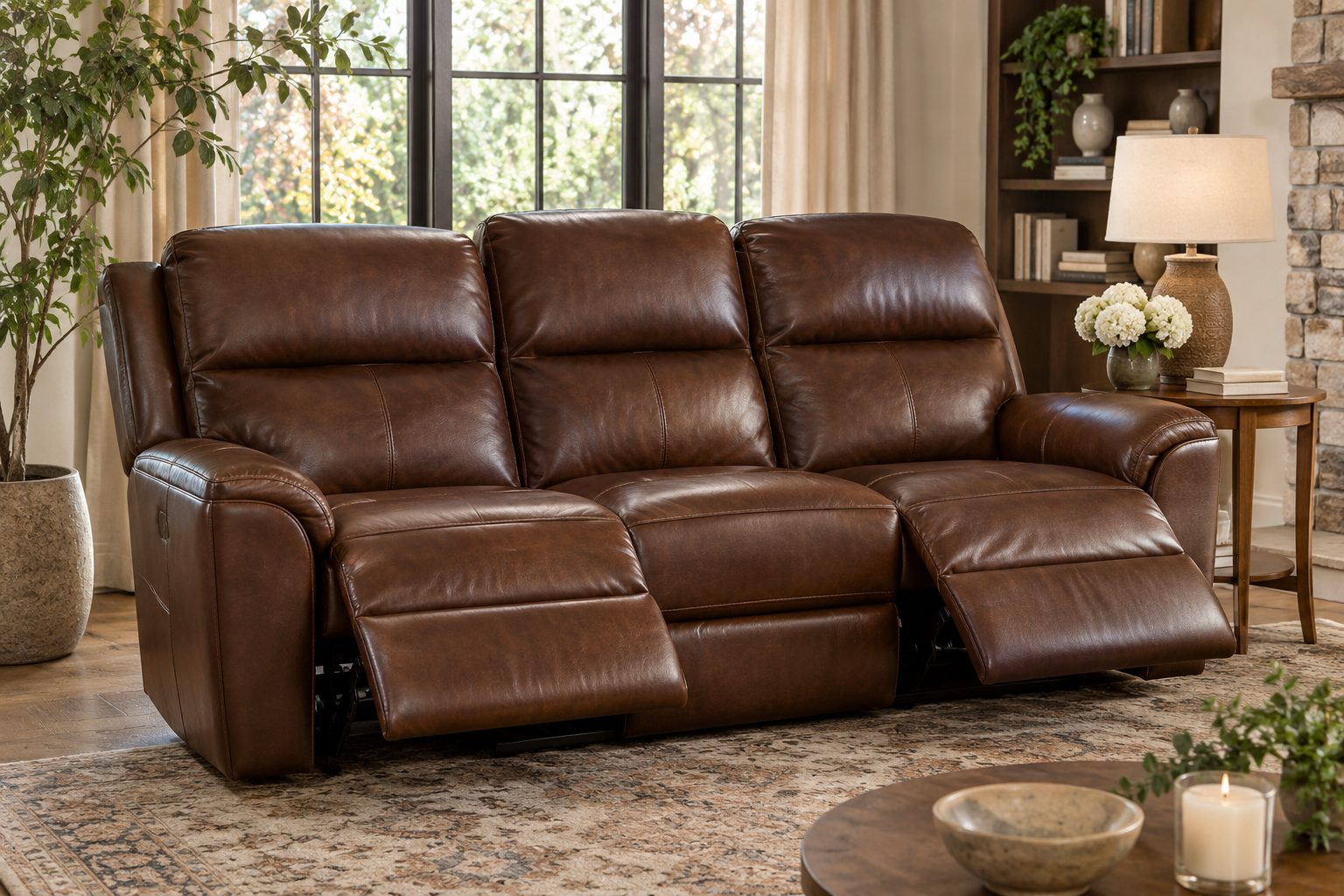
Confirm which seats actually recline
Do not assume that “triple recliner” means all three positions recline. Some sofas have two reclining end seats and a stationary center seat, while others allow all three seats to move. Product titles and photos can be ambiguous. Look for an explicit feature list or a diagram showing each seat in the open position.
Check whether the center seat includes a drop-down table, cupholders, storage, or controls. That feature can be useful for a media room, but it may prevent the center position from reclining. If all three users need to recline, confirm each seat’s function before ordering. A seller’s answer in writing is better than inferring from the appearance.
Also confirm whether the footrests operate independently. One user may want to recline while another remains upright. Ask whether a middle seat can recline without moving the neighboring seat and whether the backrest and footrest have separate controls.
Choose manual or powered reclining
Manual mechanisms can operate with a handle, lever, or body-weight shift. They do not require a nearby electrical outlet, but the effort and release method vary. Test the mechanism if possible and check whether the user can return the seat upright easily. A manual sofa may still need space behind and in front to move.
Powered models may use buttons or touch controls and can offer a smoother adjustment. They need a power source and have electrical components that may require service. Confirm the cord length and outlet location, and keep cords away from moving parts and walking paths. Follow the manufacturer’s instructions for connecting the sofa and any USB or charging ports.
Ask how the sofa behaves during a power interruption and whether it has a manual release or backup method. Not all models offer one. Check the warranty for the motor, electrical controls, frame, and upholstery separately; coverage can differ by component.
Understand the upholstery description
“Leather sofa” is not a complete material specification. Genuine leather may be used on seating surfaces with other materials on sides or backs. Other products may use bonded leather or synthetic upholstery. Read the listing carefully for terms such as “leather match,” “faux leather,” “leather-look,” or “bonded leather,” and ask which surfaces use each material.
Material affects touch, appearance, wear, and care. Genuine leather can develop visible marks and surface changes. Faux leather can be easier to wipe in some situations but may have different durability and peeling behavior. No broad label guarantees a particular lifespan. Ask for the exact material composition and follow the manufacturer’s care guidance.
If a listing uses “genuine leather” in the title, look for a detailed material breakdown. Confirm whether the back and sides are leather or a coordinating material, and which parts are leather on the seating area. If the seller cannot explain the construction, consider that uncertainty before comparing prices.
Measure the sofa and its reclined footprint
Measure the full width, depth, and height in the upright position. Then check how far the sofa extends when each seat reclines. A model that fits against a wall upright may need clearance behind it, while the footrest extends into the room. The exact motion depends on the mechanism, so use the manufacturer’s dimension diagram for the specific model.
Mark the sofa’s footprint with painter’s tape and include the open footrests. Leave clear walking routes around the furniture and account for coffee tables, doors, vents, and nearby seating. If the sofa sits in a narrow room, ensure that another person can pass while one seat is reclined.
Measure the delivery route separately: entry doors, hallways, stair turns, and elevator interiors. Ask whether the back, feet, or arms can be removed and whether the sofa arrives in sections. Confirm delivery access and return costs before purchase. A three-seat reclining sofa can be heavy and difficult to maneuver.
Check seat fit and comfort
Compare seat height, depth, inside width, arm height, and back angle. A reclining mechanism does not guarantee comfortable upright seating. Sit in each position if possible, including the center seat. Check whether the headrest supports your preferred posture and whether the seat remains comfortable before reclining.
Seat cushions may use foam, fiber, or a layered fill. Ask what the manufacturer specifies and whether cushions can be replaced. Firmness terms are subjective. Reviews can offer useful observations about cushion compression or mechanism feel, but they cannot predict every user’s comfort.
Consider who will operate the controls. Buttons should be reachable without twisting or leaning across another seat. A lever should be easy to access. If different people use the sofa, make sure control placement and mechanism force work for them. For specific mobility needs, assess the exact model in person or with qualified guidance.
Manual mechanisms, power systems, and service
Look for clear product information about frame materials, reclining hardware, motors, and warranty. A generic “heavy-duty mechanism” phrase does not explain construction. Ask the seller what the frame is made from and what support covers the reclining components.
For power models, check whether controls include a home position, independent headrest adjustment, or USB charging. These features vary and may add components that can need service. Confirm whether charging ports are standard USB or another connection and what power source they use. Do not assume a port’s output or compatibility without checking the specifications.
Ask where service is handled and whether replacement motors, switches, or power supplies are available. For a large sofa, repair access can matter. Read the warranty for labor, shipping, and exclusions; a long frame warranty may not cover motors or upholstery for the same period.
Product examples to compare
These current Amazon listings illustrate different materials and reclining configurations. Verify exactly how many seats recline, whether the upholstery is genuine or faux leather, and the dimensions in the live listing.


Plan power and room layout
Powered reclining sofas need access to an outlet. Plan the cord route before moving the sofa into place and keep cords from crossing walkways or sitting under the moving mechanism. Do not use damaged cords or unapproved extension arrangements. Follow the sofa’s electrical instructions and consult a qualified electrician if the room lacks a suitable outlet.
Place the sofa so each seat can recline without hitting a wall, table, or another chair. A wall-hugging mechanism may reduce rear clearance, but the product must explicitly identify it. Do not assume a model is wall-hugging because its listing says “space saving.” Check the full reclining dimensions.
Use side tables where they remain reachable when the seats are open. Cupholders built into the sofa can help, but they do not replace a stable table for items that should not be placed near moving parts. Keep loose items clear before reclining and follow the manufacturer’s operating guidance.
How to compare product listings
Make a table with upholstery type by surface, number of reclining seats, manual or power operation, overall width, upright depth, reclined depth, height, weight, power requirements, warranty, and delivery terms. Mark any missing detail as unknown instead of guessing. This makes it easier to compare a less expensive manual model with a powered sofa that has different materials and features.
Review the exact variation and seller. Product pages may group colors or configurations under one listing, and a photo may show a different version from the one selected. Check the model number and included components at checkout. Save the relevant specifications and return policy.
Customer reviews can reveal delivery issues, assembly steps, control placement, and early mechanism problems. Look for repeated details and recent reviews for the same model. Reviews do not verify material composition or warranty terms; use manufacturer information for those questions.
Common mistakes to avoid
A common mistake is assuming all three seats recline because the product title says “triple recliner.” Another is treating every leather-look surface as genuine leather. A third is measuring only the upright sofa and forgetting the reclined footprint and delivery route.
Do not ignore power access or cord routing for an electric model. Do not place a table where it will collide with a footrest. Do not assume a manual mechanism is effortless or a powered mechanism is maintenance-free. Read the instructions and warranty before deciding.
Finally, do not select solely by the number of features. Consider whether you will use cupholders, storage, USB ports, and adjustable headrests. Extra features can add cost and complexity; choose the ones that fit your household and room.
Care and maintenance
Follow the upholstery care instructions for the exact material. Use only approved cleaners and test them in a hidden area when permitted. Avoid harsh chemicals or excess moisture. Keep the sofa away from prolonged direct sunlight or heat if the manufacturer warns that these can affect the finish.
Operate each seat as instructed and keep the mechanism clear of toys, cables, and bedding. Do not force a footrest or adjust a power seat while an object is trapped underneath. If a mechanism becomes noisy, loose, or uneven, stop using that function and contact the seller or service provider.
Keep the model number, purchase date, warranty documents, and service contacts. Ask whether replacement cushions, motors, or switches are available. Regular inspection can identify a problem early, but use the maker’s maintenance schedule rather than inventing a service interval.
Final checklist
- Confirm whether one, two, or all three seats recline.
- Verify genuine leather versus faux, bonded, or mixed upholstery.
- Measure both upright and reclined footprints plus delivery access.
- Check controls, power needs, cord routing, and mechanism warranty.
- Test seat height, depth, support, and ease of operation.
- Review care instructions, return costs, and service availability.
The best leather triple-recliner sofa is the one whose seats work as expected, whose materials are clearly described, and whose open footprint fits the room. Verify each reclining position, measure the full movement, and compare upholstery and service terms before you buy. These checks matter more than a feature-heavy title.
For related buying advice, read our reclining sectional guide, leather sectional guide, and sofa comfort guide.
Think about the center seat
The center position can make or break the usefulness of a three-seat recliner. Some models include a console that folds down with cupholders or storage; others offer a regular middle cushion. Check the center seat’s width and whether its armrests are shared with the end seats. A console can be convenient for drinks and remotes, but it may reduce seating space or prevent that position from reclining.
If three people will sit on the sofa regularly, compare the center cushion’s depth and firmness with the end seats. Some center positions have a different cushion shape. Ask whether the center seat can be used comfortably while both ends are reclined. A product photo showing an empty center console does not prove the seating arrangement works for your household.
Consider whether removable trays or cupholders are part of the sofa or separate accessories. Integrated parts may be harder to replace if damaged. Find out whether the center storage can be accessed when the neighboring seats recline and whether it interferes with a coffee table.
Leather care and daily use
Different leather finishes have different care requirements. The manufacturer may recommend wiping with a dry or slightly damp cloth, using a specific conditioner, or avoiding certain products. Read the care instructions for the exact sofa rather than applying a general leather treatment. Some coatings can be damaged by products intended for another finish.
Faux leather and bonded materials may have separate cleaning directions. Avoid assuming that a leather conditioner is suitable for synthetic upholstery. If the material label is unclear, contact the maker before applying a cleaner or polish. A hidden spot test may reveal an immediate reaction but does not replace product compatibility guidance.
For a reclining sofa, clean around seams and moving joints without soaking the mechanism. Keep liquids and crumbs away from switches and power components. Follow the maker’s guidance for cleaning and unplugging an electric model before any maintenance if the instructions require it.
Households with children or pets
Think about how children and pets interact with the sofa. Reclining footrests create moving gaps, so follow the manufacturer’s warnings and keep hands, feet, toys, and pet paws clear while operating the mechanism. Teach children not to play with the controls. Do not rely on a cover to make a moving part safe.
Leather and synthetic upholstery can both show scratches, marks, or wear. The exact result depends on the finish and how the sofa is used. If pets climb onto the arms or children eat on the sofa, check the care instructions and warranty exclusions. A throw or fitted cover may protect a high-use area, but it must not interfere with recliner movement or ventilation.
For households that need frequent cleaning, choose a material whose approved care routine you can realistically follow. Ask whether cushions or panels can be replaced if they wear more quickly than the frame. A warranty may exclude damage from claws, spills, or misuse, so read the terms rather than assuming “family friendly” means all damage is covered.
Compare single sofas with sectionals
A three-seat reclining sofa has a straight footprint and can fit rooms where a sectional’s return would block a route. A sectional can provide more lounging space or a chaise, but it may be harder to place and move. Compare the total seats, room footprint, reclined clearance, and intended activities rather than assuming one configuration is automatically more comfortable.
If the sofa is part of a matching set, check whether the loveseat or chair uses the same upholstery and finish. Color can vary slightly between batches or materials. Confirm the exact swatch name and whether the pieces are manufactured together. If you purchase over time, ask the retailer about how to match the fabric later.
Do not purchase a set solely because the price appears lower. Consider whether each piece fits the room and whether all seats have the features you need. A matching chair without a recliner may be useful for guests who prefer an upright seat.
Delivery and assembly planning
Large reclining furniture may arrive in multiple pieces or require assembly. Confirm whether the sofa comes through the doorway in one section, whether backs detach, and whether the carrier provides room-of-choice delivery. Measure the narrowest part of the route and any sharp turn. Check whether the package can be brought upstairs and whether the building has elevator restrictions.
Ask about assembly of the backs, power connections, and console. Keep all packaging until the sofa has been inspected and tested. If a component is missing or damaged, photograph it and contact the seller promptly using the stated claim process. Do not attempt to operate a damaged power mechanism.
After placement, ensure the sofa is level and not pressing against a wall or cord. Test each seat separately and then together, checking that footrests do not contact tables or rugs. If the room layout changes, unplug and move the furniture according to the maker’s instructions rather than dragging it by the reclining arms.
Value, warranty, and service
Compare total cost rather than sticker price alone. Delivery, assembly, protection plans, and return fees can change the final amount. Ask whether the warranty is backed by the manufacturer or retailer and whether service requires an in-home visit or shipment of parts. Understand who pays labor and shipping if a motor or switch needs replacement.
Look for parts support. A seller that can supply a control switch, power adapter, cushion, or mechanism component may make repair easier. Ask for the model number and a parts list. If replacement parts are not available, decide whether that uncertainty is acceptable for the purchase.
Review coverage terms for upholstery, frame, springs, reclining mechanism, electrical parts, and cushions separately. Warranties may exclude normal wear, commercial use, or damage from cleaning products. A long warranty period does not necessarily mean every component has the same coverage.
Use a sit test or a careful online review
In a showroom, test all positions and controls. Sit upright in each seat, recline one end while another remains upright, and check whether the center position stays comfortable. Raise and lower the footrests without forcing them. Listen for unusual noises and see whether the headrest supports you naturally.
When shopping online, look for detailed reviews that describe the buyer’s room, usage, and exact model. Pay attention to recurring comments about mechanism noise, assembly, material accuracy, and delivery. Verify current specs with the manufacturer because review pages can combine multiple colors or versions.
Ask the seller specific questions if an important detail is missing: “Do all three positions recline?” “Is the seat upholstery genuine leather on the backs and sides?” “What clearance is needed behind the sofa?” “Can replacement motors or cushions be ordered?” Save the responses with your order records.
Set a budget around the features you will use
Price differences may reflect upholstery, mechanisms, frame construction, power features, and service options. Compare the exact model and configuration rather than assuming two sofas are equivalent because both have three seats. Decide which features matter most—such as independent reclining, a center console, or power headrests—and compare the total delivered price for those features.
Do not treat a marketplace title as a complete specification. Verify the material and mechanisms with the listing and manufacturer. If the included warranty or delivery service is unclear, ask before purchasing. A lower upfront cost may not be the best value if the sofa cannot be delivered, repaired, or used as intended.