Affiliate disclosure: Daily Home Decorating may earn a commission if you buy through links in this guide, at no extra cost to you. As an Amazon Associate, we earn from qualifying purchases.
The best contemporary corner sofas combine a clear modern profile with enough seating, comfort, and room flexibility for everyday life. “Corner sofa” can mean an L-shaped sectional with a chaise, a modular arrangement with a corner seat, a U-shaped conversation sofa, or a curved piece that softens the room. Contemporary styling can include slim arms, low profiles, modular pieces, clean upholstery, or sculptural shapes. Choose the layout first, then compare dimensions, seat depth, cushion feel, frame, fabric, and how the sofa fits the room.
This guide explains how to compare contemporary corner sofa layouts and features without treating a style label as a quality guarantee. Product examples are Amazon listings returned through Amazon Creators API; we have not purchased or physically tested them. Configurations, fabrics, dimensions, and product photos can change. Verify the exact chaise orientation, module count, overall size, assembly, seller, delivery, and return terms on the live listing before ordering.
For related layout help, see our two-sofa corner-fireplace guide, compare reclining sectional construction, or browse Home & DIY.
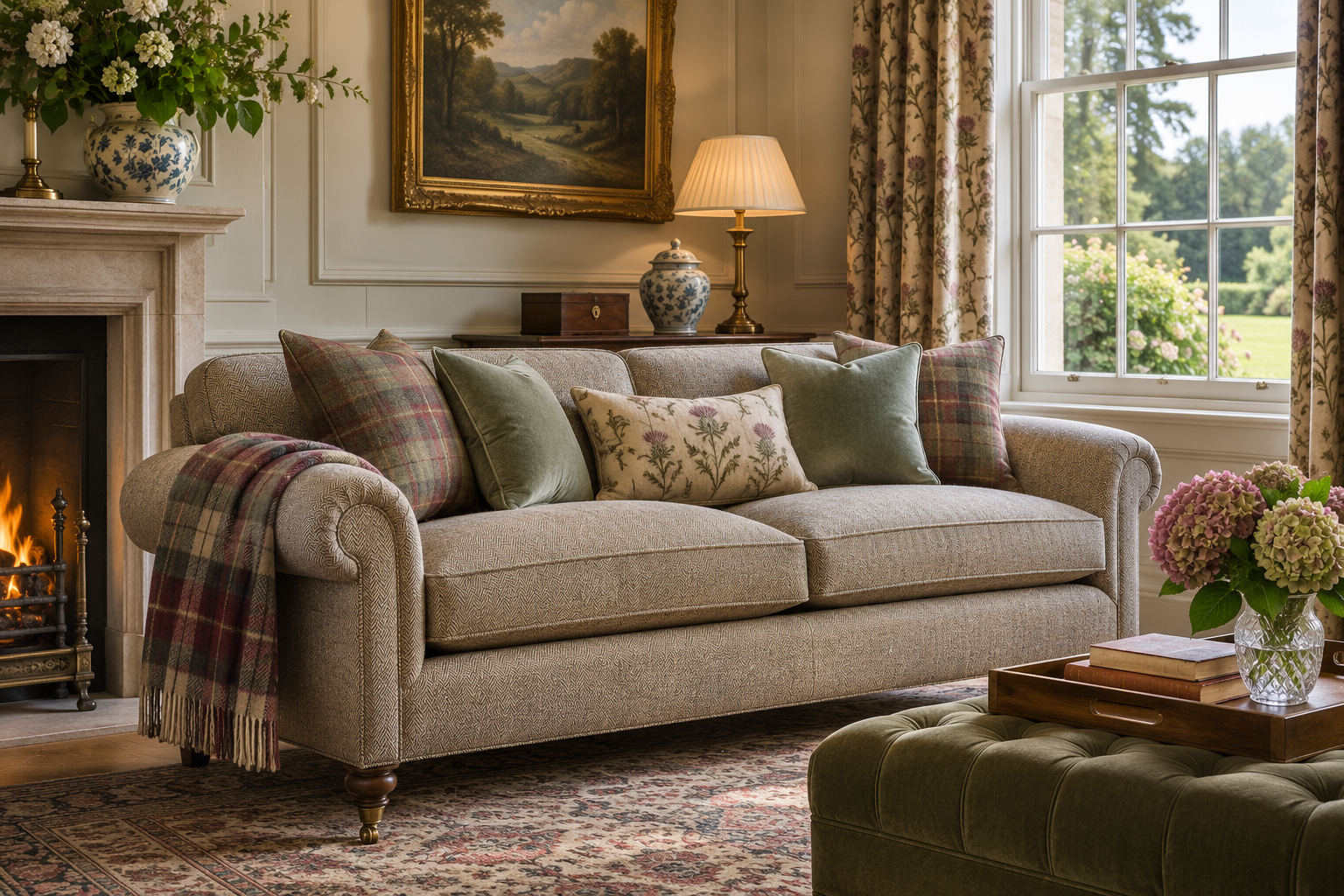
Quick layout guide
- L-shaped with chaise: works well when you want a long seat for stretching out and have a clear side for the chaise.
- Modular corner sectional: offers flexibility if modules can be rearranged and connectors stay secure.
- U-shaped sofa: creates a conversation zone for a larger room but needs substantial floor space.
- Curved corner sofa: softens a room and encourages conversation, but can be harder to align with walls and rectangular rugs.
- Compact corner sofa: may fit an apartment, but check usable seat width and whether the corner seat is comfortable.
Make a floor plan before shopping. A corner sofa occupies more space than its side-view photo suggests, and the chaise or return can block a doorway if its orientation is wrong. Tape the full outline on the floor and test the room’s walking paths.
What contemporary design means for a corner sofa
Contemporary design changes with current furniture trends, so the label may describe many different silhouettes. Some models have low arms and a simple box shape; others use curved corners, visible legs, broad cushions, or modular pieces. The term does not specify frame materials, cushion quality, fabric, or durability. Compare the physical design rather than relying on a listing’s style category.
Look at the sofa from the front, side, and back. If the piece will float in the room, check whether the rear upholstery is finished and whether connectors or support legs are visible. A sleek photo may hide the depth of the arms or the way the modules join. Request additional views and measurements if the listing does not show them.
Think about how long you want the style to feel current. A simple shape and neutral upholstery can adapt to changing rugs and accessories. A bold curved profile or vivid fabric can make the sofa a focal point. Either can work; the choice depends on whether you want the sofa to blend in or define the room.
Choose between L-shaped, U-shaped, and curved layouts
L-shaped with chaise
An L-shaped sofa usually has a standard seating run joined to a chaise or return. The chaise gives one person space to stretch out while the remaining seats support conversation. It works well when one side of the room can remain open. Confirm whether the chaise is left-facing or right-facing from the manufacturer’s stated viewpoint, because product photos can make orientation confusing.
Check how the chaise relates to the room’s main path. A chaise that points toward an entry may create a barrier, while one placed along a wall can make the seating area feel organized. Measure the full chaise depth and any gap needed to reach a nearby table or window.
U-shaped sectional
A U-shaped sofa places seating on three sides and can suit a large family room or media space. It creates a defined conversation area and gives several people a place to sit. The footprint is wide and deep, so measure both arms and the central opening. Make sure people can enter and leave seats without climbing over the corner or chaise.
Think about the center table and rug before choosing a U-shaped configuration. A table that is too large can make the opening feel cramped; one that is too small may seem disconnected. A rug should relate to the whole conversation area, not only the middle seat.
Curved or semi-circular corner seating
A curved sectional can soften a room full of straight walls and rectangular furniture. It encourages people to face one another and can work as a focal piece in an open space. The curve may not sit flush against a wall, and standard rectangular rugs or coffee tables may need a more deliberate layout. Leave room behind and at the ends so the shape feels intentional.
Measure the curve at its widest point and mark the outline with tape. Observe it from the entrance and adjacent seating. A curved sofa can require more room than its width suggests because the front edge bows into the floor area. Confirm the number of seats and whether individual sections can be moved.
Measure the room and delivery route
Measure the sofa’s total width, depth, height, and each return or chaise. Also measure doorways, stair landings, hallway turns, elevator openings, and the route to the final position. Ask for package dimensions and whether legs or arms can be removed for delivery. A modular sofa may arrive in multiple boxes, but the largest module still needs to fit through the tightest point.
Use painter’s tape to outline the full arrangement, including ottomans and side tables. Walk around it as you would in daily life. Open doors, drawers, and windows; check heating vents and outlets; and make sure the sofa does not block the route to another room. Consider how much space remains for a coffee table and whether people can reach it from the corner seats.
Leave the manufacturer’s recommended clearance around recliners or moving mechanisms. Clearance needs vary by model, so use the sofa’s manual rather than a generic measurement. If the sofa is fixed, still allow enough space to clean behind it and move through the room.
Seat depth, height, and comfort
Seat depth influences whether the sofa works for upright sitting or lounging. A deep seat can feel relaxed but may leave shorter users unable to sit back with their feet on the floor. A shallower seat may suit conversation and reading but provide less room to stretch out. Measure from the front edge to the back cushion and compare it with a sofa you already find comfortable.
Seat height should be considered under body weight because cushions compress. Sit on the exact model if possible and test whether your feet rest naturally and whether standing feels easy. A low profile may look modern but be less convenient for some users. Ask how thick the cushions are and whether the listed dimension includes a loose cushion.
Test each position, not just the middle seat. Corner seats can feel different because their cushions meet at an angle. Chaise seats may have a different firmness or support. If the household includes people of different heights or preferences, have each regular user try the sofa.
Cushions, suspension, and frame
Seat cushions may use foam, fiber, feathers, springs, or layered combinations. Ask for the exact construction and whether cushions are reversible or replaceable. A soft cushion may feel welcoming at first but can compress more; a firm one may support upright sitting but feel less relaxed. Sit for several minutes and see how the cushion returns when you stand.
Sectional frames can connect through brackets, clips, hooks, or other systems. Ask how the modules stay together and whether the connectors are included. After assembly, the sections should align and remain in place during normal use. Check whether the corner piece can be moved or whether the layout is fixed.
Suspension may use springs, webbing, platforms, or combinations. These systems can all work when designed well. Ask what supports each seat and how the warranty covers the frame and suspension. A “solid wood” or “high-density foam” phrase in a title is not enough to evaluate the full construction.
Upholstery for a contemporary living room
Contemporary corner sofas are available in woven fabric, chenille, velvet, leather, faux leather, and other upholstery. Consider touch, temperature, color, cleaning, pets, and sunlight. Ask for fiber content and the care code. A term such as “linen look” may describe appearance rather than a pure linen fiber, so read the full specification.
Choose color in the room’s light. Large sofas occupy a broad visual area, so a small swatch may not show the overall effect. Request a sample, view it near the floor and walls, and compare it in daytime and evening light. Neutral colors can make it easier to change accessories; a saturated shade can make the sectional a focal point.
For a busy household, ask about removable covers, replacement cushions, and approved cleaning methods. A removable cover is not always washable, and a “stain-resistant” claim does not mean stain-proof. Follow the manufacturer’s instructions and verify any performance claim for the exact fabric option.
Color, legs, and the visual footprint
A corner sofa is one of the largest objects in a living room, so color can change how large it feels. A light neutral may visually recede against pale walls, while a dark shade can ground the arrangement and make it more prominent. This is not a strict rule; texture, contrast, lighting, and the floor color all influence the effect. Request a swatch if available and compare it with the room’s rug and walls before choosing.
Visible legs can make a contemporary sofa appear lighter because more floor shows beneath it. A skirted or low-base design may feel more grounded. Check the height of the legs and the space beneath the frame if you plan to use a robot vacuum or need to clean under the sofa. Do not assume a low-profile sofa has clearance for a floor-cleaning device.
Consider the sofa’s back and sides as part of the visual footprint. A corner sectional placed in the center of an open-plan room can divide the space, so choose a finished rear panel and upholstery that look intentional from behind. If the sofa will sit against a wall, verify that the arm and back dimensions do not interfere with windows, heating, or wall art.
Care and long-term flexibility
Ask how to vacuum, spot-clean, and maintain the selected upholstery. Follow the maker’s instructions for cushion rotation and do not flip cushions unless the design permits it. If the sofa is modular, keep track of the connector hardware and labels so you can reassemble it in the correct order after a move.
Consider whether the layout might change. A reversible chaise or modular corner may adapt to a future room, but only if the pieces are designed to reconfigure. Check whether the arms, connectors, and upholstery allow alternate arrangements. A fixed L-shape may be a better choice if the room plan is stable and the intended orientation is clear.
Keep the model number, assembly instructions, care label, warranty, and order record. Ask whether covers, cushions, legs, or connectors are available separately. Replacement parts can help extend the sofa’s useful life and make a modular arrangement easier to maintain.
Storage, sleeper, and recliner features
Some contemporary corner sofas add storage ottomans, cup holders, USB ports, sleeper beds, or reclining seats. Features can be useful, but they change the sofa’s footprint and maintenance. Check where cables run, whether an outlet is accessible, how storage opens, and whether the feature is included in the selected configuration.
A sleeper sectional should be evaluated in both sofa and bed modes. Confirm the open mattress dimensions and clearance, and check whether cushions need to be removed. A reclining corner sofa needs model-specific operating clearance and accessible power. Follow the manufacturer’s instructions and keep moving parts free from cords and rugs.
Do not pay for features you will not use. Each mechanism can add weight, assembly, and potential service needs. Choose the design based on the household’s routine rather than a long product title.
Rugs and coffee tables for corner layouts
A rug can connect the sectional and coffee table into one seating zone. Use tape to test candidate rug sizes and check how much remains visible beneath the sofa. Some layouts place only the front feet on the rug; others position the entire sectional on a larger rug. Choose the arrangement that suits the room and does not create a trip edge.
The coffee table should be reachable from the regular seats without blocking the path into the corner. A round or oval shape may be easier to walk around, while a rectangular table can provide more surface in a long L-shaped arrangement. Measure the full seating outline and table footprint together.
For a curved sofa, a round or oval table may echo the shape, but it is not mandatory. For an L-shaped sofa, a compact rectangular or nesting table may fit the center. Test reach from the corner, chaise, and end seats rather than choosing only by appearance.
Contemporary corner sofa examples
These Amazon listings illustrate reversible, V-shaped, and curved sectional designs. They are examples for comparing layouts, not hands-on test winners. Confirm the dimensions, upholstery, module count, orientation, and current seller terms before buying.

Mofolit 100-inch L-shaped sectional
ASIN: B0F2H8YCZG
The listing describes a reversible chaise and a cream upholstery option. Verify the assembled dimensions, chaise configuration, material, and room fit for the exact variant.
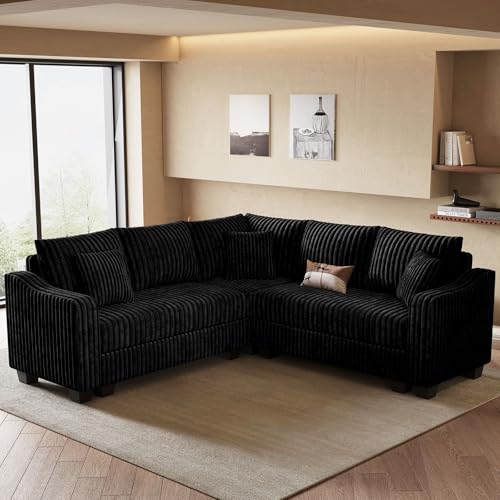
Belffin convertible sectional couch
ASIN: B0FPQP1GVY
The listing describes a reversible corner layout in corduroy. Confirm how the pieces connect, whether the configuration can be changed, and the overall width and depth.

KEIKI six-seat curved sectional
ASIN: B0G5WFN3GJ
The listing describes a semi-circular modular sofa with chenille upholstery. Check the total footprint, how the modules connect, and whether the curved layout suits the room.
How to assess a listing and showroom sample
Read beyond the headline. Look for overall width and depth, seat dimensions, module count, fabric content, frame details, cushion fill, assembly requirements, and warranty. If a product page groups several sizes or colors, confirm the exact option in the order summary. Ask the seller about missing measurements before purchase.
At a showroom, test the corner, chaise, and standard seats. Sit upright and lounge, check arm height, and see whether cushions shift. Walk around the sofa and view the back if it will float in the room. Ask whether the floor model matches the configuration and upholstery that will be delivered.
For an online purchase, compare measurements with furniture you own and use the return policy as part of the decision. Check shipping, room-of-choice placement, assembly, packaging removal, and return pickup. Keep the packaging until you inspect the sofa and verify the mechanism and connectors.
Common corner sofa mistakes
One mistake is selecting a chaise orientation from a product photo without confirming the seller’s viewpoint. Another is measuring the wall but not the delivery route or open footprint. A third is choosing a large sectional before checking how a coffee table, rug, and walking path will fit.
It is also easy to assume the corner seat will be comfortable because the rest of the sofa is. Try the corner separately; its cushion angle and back support may feel different. On modular designs, verify that pieces stay aligned and that connectors do not create gaps.
Finally, do not equate contemporary styling with quality. Check the frame, cushion, suspension, upholstery, warranty, and service options. A clean silhouette can hide construction details that should be confirmed before ordering.
Frequently asked questions
What is a corner sofa? It usually refers to a sectional arranged in an L or U shape, though listings may also use the term for curved or modular designs. Check the actual configuration and measurements.
Should I choose an L-shaped or U-shaped sofa? An L shape may fit a more compact room or one open side; a U shape offers seating on three sides but needs a larger footprint. Tape both outlines on the floor.
How do I know which chaise side to choose? Confirm the seller’s left/right viewpoint and compare it with the room plan. Do not infer orientation from a reversed product photo.
Are modular corner sofas practical? They can adapt to a room if modules connect securely and the arrangement can be changed as expected. Check connectors and replacement-part availability.
What table works with a corner sofa? Round, oval, rectangular, or nesting tables can all work. Choose one that is reachable from every regular seat and leaves clear paths.
How much room does a corner sofa need? It depends on the exact model and layout. Use manufacturer dimensions and mark the full footprint, including chaise or recliner movement, before buying.
What fabric suits a contemporary sectional? Woven fabric, chenille, velvet, leather, and performance upholstery all appear in modern designs. Compare feel, cleaning, fiber content, and household use.
Can a corner sofa float in a room? Yes, if the back is finished and the layout leaves clear circulation. Confirm rear upholstery and view the sofa from all sides.
Final checklist
- Choose L-shaped, U-shaped, curved, or modular based on the room layout.
- Confirm chaise orientation and total module dimensions.
- Measure the room, delivery route, and open mechanism footprint.
- Test the corner, chaise, and standard seats for comfort.
- Check frame, connectors, cushions, upholstery, and warranty.
- Plan the rug, coffee table, lighting, and walking paths.
The best contemporary corner sofa is a layout that fits your room and a seat that feels good in everyday use. Compare the actual shape, dimensions, chaise direction, cushions, construction, and upholstery rather than relying on a style label. Mark the footprint before buying and confirm current seller details. That makes it easier to choose a modern sectional that works beyond the product photo.
Continue with our corner fireplace seating layout, read the sofa comfort guide, or browse Home & DIY.
Certain content on this site comes from Amazon and may change. Amazon product images and listing details are supplied through Amazon Creators API. Confirm the exact option, seller, dimensions, materials, and current terms before purchase.