Affiliate disclosure: Daily Home Decorating may earn a commission if you buy through links in this guide, at no extra cost to you. As an Amazon Associate, we earn from qualifying purchases.
The best coffee tables for reclining sofas are the ones that leave the footrests and walking path clear while keeping drinks and remotes within reach. A fixed table may work in a spacious room, but it can block the recliner when it opens or sit too far away for someone who is leaning back. C-shaped side tables, nesting tables, compact lift-top tables, or no central table at all may be more practical depending on the sofa mechanism and room layout.
This guide compares table types and explains how to plan around manual and power recliners. We include Amazon examples returned through Amazon Creators API; we have not purchased or tested these products. Images and listing details can change, so verify current dimensions, height, materials, caster locks, and assembly details before buying. The clearance required by a reclining sofa varies by model; always follow that sofa’s own manual and product information.
For general measurement help, see our coffee table sizing guide, compare a color-specific option in our dark charcoal sofa coffee table guide, and plan the seating area with our living room rug guide.
Quick picks by room and recliner type
- Power recliner with a footrest that extends forward: keep the center of the room clear or use side tables that stay outside the moving path.
- Reclining sofa with a non-moving middle seat: a small table may work in front of the fixed seat if it does not interfere with the adjacent recliners.
- Small living room: consider a C-shaped side table or a pair of nesting tables you can move when a seat reclines.
- Need a surface for meals or a laptop: compare a stable lift-top coffee table or a side table that can slide beside the seated user.
- Want a conventional coffee table: choose a compact footprint and test the fully extended footrest before finalizing placement.
- Footrests fill the room: skipping a central table is a valid layout choice; add end tables for drinks and remotes.
Start with the recliner, not the table. Find the sofa’s upright and fully extended dimensions in the manufacturer’s manual. Measure the full range of movement, then mark that space on the floor. Only after that should you place the table, rug, and side seating around the moving parts.
Why reclining sofas change coffee-table planning
A standard sofa stays in one position, so its coffee table can be placed at a consistent reach distance. A reclining sofa changes shape when the footrest opens and sometimes when the back tilts. That movement can bring the occupant’s feet closer to the center of the room and alter how much space is available for a table. A coffee table that feels reachable while seated upright may become an obstacle when the seat reclines.
Power models can include moving footrests, adjustable headrests, or seats that shift forward during operation. Manual models can also extend substantially. Wall-hugger recliners are designed to reduce the space needed behind the sofa, but they still have model-specific placement requirements and a forward movement range. Check the product manual rather than using a general number from another brand.
Think about how the room is used. If people recline frequently, a flexible arrangement may be more comfortable than a fixed table. If the sofa’s center seat remains upright while the outer seats recline, one smaller table may serve the middle seat. If all positions recline, a row of side tables may keep drinks available without occupying the shared footrest area.
Measure the complete recline range first
Check the sofa manufacturer’s product sheet or operating manual for the dimensions in the upright and fully reclined positions. Some brands publish clearance needs behind the back and in front of the footrest; use the instructions for your exact model and configuration. The distance can differ between manual, power, zero-wall, and sectional recliners, so do not assume a generic clearance will be adequate.
Use painter’s tape to mark the full front edge of every extended footrest and any moving seat base. Include room for people to step around the reclined user and for nearby doors to open. If the manual shows several positions, test the one that moves farthest. A coffee table should not sit in the mechanism’s path or require a person to stand up just to close the footrest.
Check the rear and side clearances too. A recliner can hit a wall, side table, lamp, or window treatment as it moves. A sectional may have a recliner on the end while the chaise or corner unit remains stationary. Mark each part separately; one measurement for the whole sofa can miss a footrest that projects farther than its neighbor.
When possible, open the actual sofa in the showroom and test the proposed table position with a comparable table or floor markers. Ask the salesperson to show the model manual and explain what counts as the required clearance. If the sofa is already at home, recline it fully and measure rather than estimating from product photos.
Choose the right table type
C-shaped side tables
A C-table has a base that may slide beneath the sofa or chair while the tabletop reaches over the seat edge. It can keep a drink, book, or laptop close without placing a large table in front of the footrest. It is especially useful for one person who wants a personal surface at the side of a reclining seat.
Check the sofa’s underside height, base structure, and mechanism before choosing a C-table. Some recliners have a low frame, crossbars, wiring, or moving components where the table’s base would need to slide. The table must not interfere with moving parts or pinch a cord. Measure the base clearance and top height, and confirm that the table remains stable when used from the sofa.
Nesting tables
Nesting tables provide one or two extra surfaces that can be pulled closer when needed and nested out of the way afterward. They work well in shared rooms where guests may need more places to set things down. Choose a set light enough to move but stable enough not to slide when bumped. Keep the nested tables outside the recliner path when no one is using them.
Lift-top coffee tables
A lift-top table can bring a surface closer for dining or laptop use while the user remains seated. Check the opening direction and the raised tabletop’s reach; the lid should not collide with the recliner or crowd someone’s knees. Look at hinge or gas-spring operation, weight limits, and whether the table has an edge or compartment that could catch fingers. Confirm the manufacturer’s safety and assembly instructions.
Lift-top designs can be bulky, and their raised position may occupy the same space as a footrest. Before buying, measure both the closed footprint and the full raised position. The tabletop should not extend across a path used to enter or leave the seat.
Rolling coffee tables
Casters can make a coffee table easier to move aside when someone reclines or needs clear floor space. Check whether all wheels lock and whether the locks are easy to reach. A rolling table that moves when someone leans on it may be less useful than a stationary one. Consider the floor surface, rug pile, and table weight, and test it on the type of flooring in the room.
Do not assume a wheeled table is safe to move while loaded. Follow the maker’s weight and handling instructions. Keep it out of the footrest path and park it where it cannot roll into a person’s legs or block the walkway.
Round or oval coffee tables
Rounded corners can make it easier to move around a table in a busy seating area. A round table may fit between reclining seats if the sofa’s footrests do not extend into that space. Oval tables offer more reach along a longer sofa while avoiding sharp corners at the ends. Shape alone does not solve clearance, so test the footprint with the recliners open.
End tables and no coffee table
For many reclining sofas, end tables are the simplest solution. Place one beside each frequently used seat, with enough room for the recliner to move and the user to get in and out. A small drink table or a narrow lamp table can hold remotes and beverages without creating an obstacle in the middle of the room.
You can also use no coffee table. The room may feel more open and allow the recliners to operate freely. A rug can still define the seating area, and a sofa console or side table can provide storage. There is no rule that a living room must have a central table.
Height and reach from the reclined position
Measure the sofa arm and seat height, then compare them with the table top. A side table is often easiest to use when the surface is close to the arm height, but the precise fit depends on the recliner’s shape and the person seated there. A surface that is too low may be awkward to reach while leaning back; a very high table can feel unstable or block the view.
Try reaching from both the upright and reclined positions. Check whether a drink or remote can be placed down without twisting across the footrest. For a C-table, confirm the top reaches over the seat without pushing into the user or blocking the recliner controls. For a standard coffee table, test reach from the seat closest to the table while the footrest is extended.
Keep fragile items away from the moving footrest. Avoid placing a glass or hot drink where a user’s legs might knock it while reclining. If the sofa has a center console or drop-down table, consider whether it already provides enough surface for drinks, making a large central table unnecessary.
Amazon examples for flexible recliner layouts
These examples were returned through Amazon Creators API for C-shaped side tables, lift-top tables, and rolling coffee tables. They illustrate different layout options and are not hands-on recommendations. Product images and listings can change. Confirm current size, under-sofa clearance, material, caster locks, table stability, seller, and return terms before buying.

Tribesigns C-shaped sofa side table
The API listing describes a brown C-table designed to slide beside a sofa. Check the base height and depth against the recliner’s underside and verify that the table cannot contact the moving mechanism.
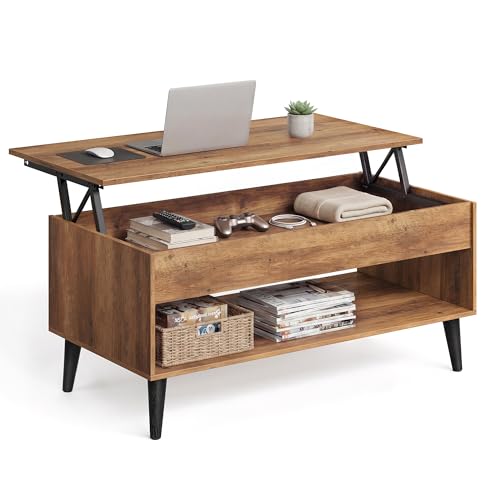
VASAGLE lift-top coffee table
The API title describes a lift top, storage, and a gas-spring mechanism. Measure the raised surface and check whether it overlaps the footrest or entry path when open.

WILLIAMSPACE round coffee table with casters
The API listing describes a two-tier round table with wheels. Check whether the casters lock and whether the table stays stable on your floor and rug when someone reaches from the recliner.
These cards are examples to inspect, not proof that a specific design will fit every reclining sofa. Use the exact dimensions from the listing and the sofa manual. If a table’s base enters the space beneath the recliner, confirm with the manufacturer that it is safe to position there.
How to arrange a table with different recliner layouts
Two-seat reclining loveseat
A small loveseat may have two independent footrests and a narrow center gap. A large fixed table can block both seats at once. Consider one narrow side table at each end, or a pair of C-tables that can be moved with the person using the seat. If the center console folds down, test whether it already provides drink holders and a surface.
Three-seat reclining sofa
Some three-seat recliners have moving end seats and a fixed middle seat. A compact round or square table can serve the middle position if it stays outside the end footrests. Other models have three independent recliners, which may need the entire area in front kept clear. Check the exact seating configuration rather than assuming the middle seat is stationary.
Reclining sectional
A reclining sectional may combine chaise, console, corner seat, and power recliner modules. Map where each footrest opens and identify the main walkway through the room. A small movable table beside the console may be more practical than one large table centered in front. If you have a fixed chaise next to a recliner, the coffee table may sit in front of the chaise but must still clear the moving seat.
Wall-hugger or zero-wall model
These models reduce the need for space behind the sofa, but their seating motion still needs room. Read the manufacturer’s manual for the required wall gap and moving dimensions. Do not assume that less space behind the sofa means a coffee table can sit closer in front.
Make a full-size floor plan before ordering
Use painter’s tape or cardboard to mark the coffee table’s top and legs, then open every recliner position. Walk through the room as if you were carrying a drink or helping a guest reach a seat. This reveals whether the table is only clear when the sofa is upright or whether it remains practical in daily use. Mark the side tables too, since they can affect access to controls and power buttons.
For a sectional, test each seat independently. A left-side footrest may clear the table while a right-side one hits it because the sofa is angled or the modules differ. Check recline from the end seats and from the center seat if it moves. If one table must slide out each time, ask whether someone can move it without lifting a heavy piece or reaching across a moving mechanism.
If you are comparing two table sizes, try both outlines on the floor. The larger option may provide more surface for snacks and remotes, but it could narrow the route. The smaller table may preserve movement yet be inconvenient for the number of people using the sofa. A split arrangement with one small central table and separate C-tables can sometimes provide both access and surface area.
Think about surface care and stability
Recliner users may keep drinks, snacks, and devices close at hand, so choose a surface that is easy to wipe and stable when reached from the seat. Check the table’s weight limits and base design. A tall, narrow side table can be convenient but may tip if someone leans on it. For a lift-top design, use the top only as directed and avoid placing a heavy object where it could shift as the mechanism opens.
Follow care instructions for glass, stone, wood, and metal. A table that is easy to move should still stay put when a person rests a hand on it. If the product uses casters, confirm that the brakes lock securely on your floor. If it uses adjustable feet, level the table so that cups or devices do not slide when the top is lifted.
Rugs, lamps, and surrounding furniture
Position a rug so it anchors the sofa without bunching beneath the footrests. If a recliner base moves across the rug, check the manufacturer’s guidance and make sure the pile does not catch or obstruct the mechanism. A rug can define the seating area even when you choose not to use a central coffee table.
Place floor lamps and side tables where they will not be struck by the back or footrest. Keep cords out of moving parts and walkways. A recliner’s power cable should follow the product instructions; do not route it beneath a table base or where casters can roll over it. If you move a C-table or rolling table often, decide where it will park when the recliner is open.
Think about the whole route around the seating group. People should be able to walk past the sofa without squeezing between a footrest and a sharp table corner. In a tight room, a lamp table behind or beside the sofa may provide a surface without occupying the central floor area, provided it respects the model’s rear clearance.
Common mistakes to avoid
- Buying before measuring the fully extended footrest: upright dimensions do not show the full movement range.
- Using generic clearance numbers: follow the manual for the exact sofa model.
- Sliding a C-table beneath moving parts: make sure the base cannot contact linkages, cords, or the reclining platform.
- Assuming all seats recline the same way: sectional modules and center seats may differ.
- Choosing a lift top without checking its open footprint: the raised surface may block a footrest or entry path.
- Forgetting wheel locks: a rolling table can shift when someone leans on it.
- Putting fragile items in the footrest path: keep drinks and decor away from moving legs and seats.
- Assuming a central table is required: side tables or no coffee table can work better in a recliner room.
Frequently asked questions
Can I use a coffee table with a reclining sofa?
Yes, if it remains outside the sofa’s required movement area and does not block a walking path. Measure the fully reclined position and follow the manufacturer’s manual.
What is the best coffee table shape for a recliner sofa?
There is no one shape for every room. Round or oval tables can ease circulation; compact rectangular tables can work with a fixed center seat; side tables can keep footrest paths open. Choose after mapping the exact recliner range.
Are C-shaped tables good for recliners?
They can bring a surface close to the seat without a large table in front. Check whether the base fits beneath the sofa and does not touch moving parts or cables.
Should I remove the coffee table when reclining?
If the table is inside the footrest path, move it before using the recliner. A flexible layout with side tables can avoid that repeated step. Follow the product’s operating instructions.
Can a lift-top table work in front of a power recliner?
It can if the table and raised top do not overlap the footrest or entry path. Measure the closed and lifted positions, and check the tabletop’s reach from the reclined seat.
How much space should I leave between a recliner and coffee table?
Use the clearance dimensions in your sofa’s manual, including the full footrest extension. Generic spacing advice for stationary sofas may not leave enough room for a particular recliner.
Final checklist
- Read the manual for upright, reclined, and wall-clearance dimensions.
- Mark every moving footrest and path on the floor.
- Choose a central table only if it stays clear during movement.
- Compare C-tables, nesting tables, lift tops, rolling tables, and side tables by exact dimensions.
- Keep cords and fragile items away from moving parts.
- Verify stability, wheel locks, assembly, and return terms before buying.
The best coffee table for a reclining sofa is the one that supports the way you use the seats without blocking their movement. A central table can work when the layout allows it, while C-tables, end tables, nesting pieces, or an open floor area may be more convenient. Measure your exact sofa in motion, follow its manual, and choose the table after the clearance is clear.
Continue with our coffee table sizing guide, read the reclining sectional guide, plan with the living room rug guide, and browse Home & DIY.
Certain content on this site comes from Amazon and may change. Amazon product images and listing details are supplied through Amazon Creators API. Confirm the exact option, seller, dimensions, materials, and current terms before purchase.