Shopping for the best Canadian-made sofas starts with deciding what “made in Canada” means for the exact model you want. A Canadian-owned brand may manufacture in another country, while a Canadian factory may use imported leather, foam, hardware, or fabrics. The best Canadian-made sofa for your home balances verified production origin with comfort, construction, upholstery, dimensions, delivery, warranty, and repair support. This guide compares Canadian manufacturers to research and explains how to verify claims, including when you are shopping for a Canadian-made leather sofa.
Affiliate disclosure: This article contains affiliate search links. As an Amazon Associate, this site may earn from qualifying purchases. Amazon.com did not return maker-verified ASINs for the Canadian manufacturers discussed here, so the links search each exact brand and product category. A search result is not proof that a sofa is Canadian-made; confirm the manufacturer, model, seller, and origin directly before ordering.
Quick answer: Start with manufacturers that state where production happens, then verify the selected model. Current examples to research include Brentwood Classics, Canadian Boss, Aman Furniture, LeatherCraft, Choice Leather, and Kavuus. These companies describe Canadian manufacturing on their own sites, but their materials, model ranges, sales channels, and production details differ. Compare the origin claim, construction, comfort, leather coverage, delivery, warranty, and repair options before choosing.
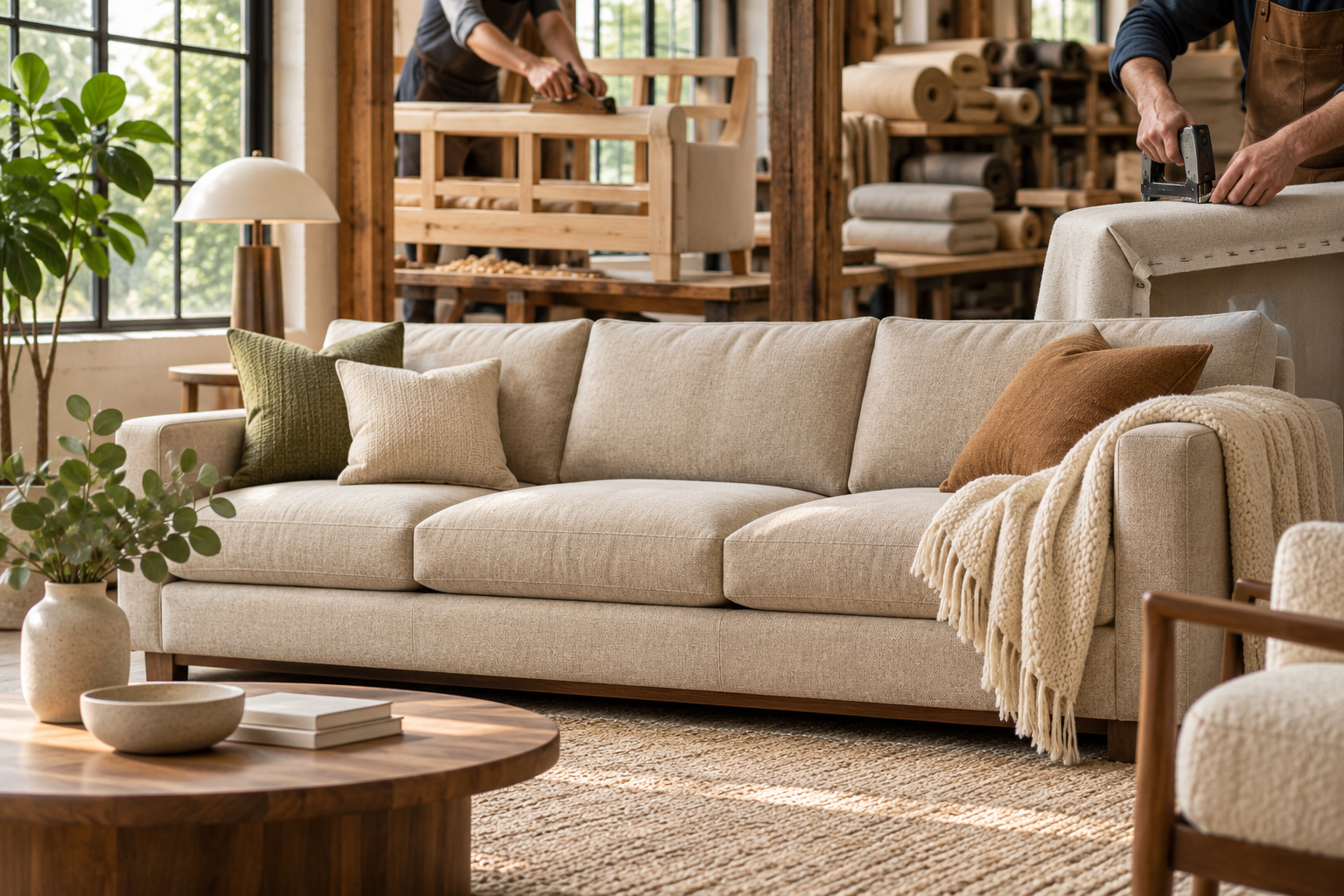
Canadian sofa makers to compare
The makers below publish Canadian manufacturing or production information. These are starting points rather than a tested ranking. Their sites may primarily serve Canadian customers and can change product options over time. Ask which exact model is built in Canada and where its key manufacturing stages take place.
Brentwood Classics
Brentwood Classics describes itself as a Canadian family business making custom, bench-made sofas and states that its pieces are made in Canada from frame cutting through final stitching. Its range includes sofas, sectionals, and chairs. Ask about the current frame, cushion, fabric, and leather options for a specific model, as well as lead time and dealer availability in your province.
The maker’s origin statement is useful, but it does not mean every raw material is Canadian. Ask where upholstery, foam, springs, and hardware are sourced if domestic inputs matter to you. Compare the selected model’s dimensions and warranty with other makers rather than assuming every bench-made sofa feels the same.
Canadian Boss Leather
Canadian Boss Leather describes its furniture as built in an Ontario factory and offers customizable leather sofas and sectionals. Its FAQ says its leather is sourced from Europe because it notes there are no tanneries currently operating in Canada. This is a useful example of Canadian furniture manufacturing using imported upholstery material: the frame and sofa may be made locally even if the hide is not.
The company says customers can select options such as leather type and color, seat depth, cushion firmness, length, orientation, arms, legs, and stitching. Verify which choices apply to the model you are considering. Ask for the full warranty wording and an estimated timeline, especially for a custom build.
Aman Furniture
Aman Furniture describes itself as a Canadian manufacturer serving furniture retailers. Its site identifies manufacturing and upholstery in Etobicoke, Ontario, and shows both fabric and leather collections, including a named genuine-leather series. Aman is dealer-focused, so consumers may need to contact local furniture retailers to see models or request a quote. Ask which nearby dealer carries the relevant collection.
Because a manufacturer may sell wholesale rather than directly to homeowners, the dealer’s delivery, warranty, and return terms are part of the decision. Confirm the model number, covering, and production origin on the retailer’s paperwork. Ask whether the displayed sofa has the same cushion fill and leather option as the configuration being ordered.
LeatherCraft Furniture
LeatherCraft Furniture describes itself as a Canadian maker of leather sofas, sectionals, recliners, chairs, and ottomans, with manufacturing in Toronto and dealers across Canada. Its model brochures can provide useful details about dimensions, leather options, and components. Ask a dealer which models are current, what leather grades are offered, and whether the brochure corresponds to the latest production.
For a leather sectional, confirm whether every contact surface is leather or whether some panels use a matching material. Check the direction of the chaise, module dimensions, and mechanism clearance. Ask how the maker handles replacement cushions or repairs once the sofa is in your home.
Choice Leather
Choice Leather describes its leather and fabric furniture as made in Canada and lists sofa models with stated materials and warranty details. Its website identifies online-only leather furniture and refers to top-grain leather options. Check current stock and delivery estimates directly, since online inventory and price can change.
Read the material specification for the exact product. “All leather” is a useful claim, but ask whether it applies to every panel, including the back and sides, and whether the chosen color changes the material. Verify the warranty exclusions and how the company handles service outside its home area.
Kavuus
Kavuus says it is based in Delta, British Columbia, and makes custom sofas and sectionals in Canada. Its site describes made-to-order options for fabric, comfort level, dimensions, and leg style and shows apartment sofas, modular sectionals, sleepers, and other designs. Confirm which current models can be ordered in leather if leather is essential; its homepage features multiple upholstery categories and not every model necessarily offers the same materials.
Custom choices can help solve an unusual room layout, but ask whether they alter the price, lead time, warranty, or return eligibility. Confirm the final dimensions in writing and ask how modules connect if you choose a sectional.
Tagged Amazon searches for the makers
The current Amazon.com Creator API search did not verify product ASINs for these exact Canadian manufacturers. Use the tagged searches only as a way to check whether a maker or model appears on Amazon; search results can be incomplete or unrelated. Direct manufacturer and dealer pages are the better source for origin and specification checks.
Search Amazon for Brentwood Classics Canadian-made sofas · Search Amazon for Canadian Boss leather sofas · Search Amazon for Aman Canadian-made leather sofas · Search Amazon for LeatherCraft Canadian-made sofas · Search Amazon for Choice Leather sofas · Search Amazon for Kavuus Canadian-made sofas
How to verify “Made in Canada”
Brand ownership, design, assembly, and manufacturing location are different claims. Ask where the specific sofa is manufactured and where the last substantial transformation happens. Confirm whether the frame is built in Canada, whether upholstery and final assembly occur there, and whether the statement applies to the exact model rather than only a selected collection.
The Competition Bureau of Canada explains that a “Made in Canada” claim is generally not challenged when at least 51% of the total direct costs of producing or manufacturing the good were incurred in Canada, the last substantial transformation occurred in Canada, and the claim includes a qualifying statement such as “Made in Canada with imported parts.” It separately describes a “Product of Canada” claim as requiring at least 98% of direct production or manufacturing costs in Canada and the last substantial transformation in Canada. The Bureau also says it does not approve or certify such claims. Read its current Made in Canada claims guidance for the full explanation.
For a sofa, imported materials are common. Leather may come from Europe, foam or mechanisms from elsewhere, and wood from a different region. That does not automatically contradict a Canadian manufacturing claim. The important questions are what the company is claiming, which operations happen in Canada, and whether the description is clear enough for you to make an informed choice. Ask for a written explanation if the site uses broad phrases such as “Canadian brand,” “designed in Canada,” or “local craftsmanship.”
How to choose a Canadian-made leather sofa
Start by deciding whether you want genuine leather on all upholstery panels or only the areas that contact the body. Some sofas use leather on the seat and arms with a coordinated material on the back or sides. Ask for the panel-by-panel specification. Confirm whether the leather is full-grain, top-grain, corrected-grain, split, or another category, and ask what finish protects the surface.
Color and finish change the way leather feels and wears. Aniline leather tends to show natural variation and marks more readily; a protected finish can appear more uniform. Semi-aniline falls between those broad categories. The maker’s terminology may differ, so ask what the finish means for cleaning, sunlight, spills, and patina. Request a physical swatch and view it under the light in your home.
Leather origin and sofa manufacturing origin are separate. A Canadian sofa can use imported hides, as Canadian Boss states on its FAQ page. If local material sourcing matters, ask where the leather, frame wood, foam, and metal components originate. You may find a product that is manufactured in Canada but not made entirely from Canadian inputs; decide which part of the origin story matters most to you.
Frame, suspension, and cushion questions
Ask about frame materials, joinery, and reinforcement. Hardwood, engineered wood, and metal can all be used in furniture; the material label alone does not tell you how the frame is designed or assembled. Ask for details about joints, support rails, and the manufacturer’s weight guidance. If possible, inspect the underside or ask the showroom to explain the construction.
Suspension can use springs, webbing, a platform, or combinations. These choices create different feels and maintenance needs. Ask how the seat is supported and what wear is expected over time. A warranty may cover the frame longer than the cushion, fabric, leather, or mechanism, so read each section separately.
Cushions may contain foam, fiber, feather, or layered fillings. Ask what the seat and back use, whether the cushions are reversible, and how often they should be turned or plumped. Loose cushions may be easier to replace; fixed cushions can offer a cleaner appearance. Check whether replacement interiors and covers are available in the future.
Try sitting upright, leaning back, and reclining. Check seat height, depth, back angle, and arm support. A deep sofa may suit tall people and relaxed lounging but may feel awkward for shorter users. If you cannot visit a showroom, compare measurements with a sofa you already find comfortable and ask for a sample cushion if the maker offers one.
Measure for delivery and daily use
Measure the intended sofa footprint and the route from the delivery vehicle to the room. Record door openings, hallway width, stair turns, elevator measurements, and landings. Compare these with both assembled dimensions and package dimensions. Ask whether legs, backs, or arms detach and whether delivery includes room placement and assembly.
For sectionals, verify the chaise orientation, each module’s size, and how the pieces connect. A custom size may help a challenging room but could change lead time, price, and return rights. Get all dimensions and configuration choices in writing. Leave room for walkways, doors, windows, radiators, and side tables after the sofa is in place.
For a recliner or sleeper, measure the open position as well as the closed sofa. Check electrical connections for powered seats and the bed dimensions for a sleeper. Ask how to operate the mechanism and whether replacement parts are available. A beautiful sofa that cannot open fully in your room is not a useful fit.
Price, lead time, warranty, and repair
Compare the total price with fabric or leather grade, cushion options, custom sizing, delivery, assembly, and applicable taxes. Dealer prices may differ by region or promotion. Ask whether a quote is valid for a fixed period and which configuration it covers. For made-to-order furniture, request a realistic lead-time range and ask how delays are communicated.
Read the warranty for frame, workmanship, cushions, upholstery, and mechanisms separately. Ask who provides service, whether the manufacturer supports repairs across provinces, and who pays transportation. Find out whether the seller can supply replacement cushions, covers, legs, springs, or hardware. Repair access can matter greatly years after the initial purchase.
Understand the cancellation and return rules before approving custom upholstery or paying a deposit. Some customized sofas cannot be returned for a change of preference. Ask what happens if a sofa arrives damaged, has a manufacturing defect, or differs from the specification. Keep the signed order, swatches, model numbers, warranty, and delivery notes.
Shopping across provinces or from outside Canada
Canadian manufacturers may sell through regional dealers rather than directly to consumers. Ask which retailer serves your postal code and whether the showroom displays the exact collection. Delivery coverage, fees, and warranty service may depend on where you live. A dealer in another province could offer a model you like but charge more to deliver it or require you to use a distant service center.
Buyers outside Canada should confirm whether a maker exports furniture to their country before spending time on customization. Ask for the complete delivered cost, including freight, customs charges, brokerage, and taxes. Confirm who handles damage claims and whether the warranty applies outside Canada. A Canadian-made item may be a poor value once cross-border transport and return costs are included.
Use the manufacturer’s showroom locator or contact page to find an authorized seller. If a retailer claims to carry a particular brand, verify the relationship with the maker. Keep the quote and model details, and ask whether the seller can order replacement parts later. This is especially useful for custom leather pieces, where matching a hide color years later may be difficult.
Common mistakes to avoid
- Assuming a Canadian-owned company manufactures every sofa in Canada.
- Treating “designed in Canada” as the same claim as “made in Canada.”
- Expecting every material in a Canadian-made sofa to be Canadian-sourced.
- Assuming every model in a manufacturer’s range uses the same origin or construction.
- Buying leather without checking which upholstery panels are genuine leather.
- Choosing a custom sectional before checking delivery access and configuration.
- Comparing warranties without checking separate coverage for frames, cushions, and leather.
- Relying on an Amazon result as evidence of origin or manufacturer authorization.
Buyer checklist
Before ordering, identify the exact model and ask where its frame, upholstery, and final assembly take place. Ask what imported materials are used and what the “Made in Canada” claim covers. For leather, confirm the grade, finish, color, and panel coverage. For all upholstery, ask about the cleaning code and maintenance routine.
Confirm the dimensions, cushion filling, suspension, frame description, weight limit, delivery route, lead time, warranty, return terms, and service contact. Request swatches and a written quote that names the selected options. Save the product sheet and ask the retailer to record any special promises on the order.
Think about how the sofa will be used: daily family seating, occasional guests, formal entertaining, or a media room. Choose a seat depth and cushion feel for the people who will use it. If repairability matters, ask about replacement parts now rather than waiting until something wears out. These checks are useful whether you are choosing a Canadian-made leather sofa or a fabric sectional.
Frequently asked questions
Are Canadian-made sofas better?
Manufacturing location alone does not determine comfort or durability. Compare frame, suspension, cushions, upholstery, warranty, and service. “Made in Canada” may be an important preference, but it is one part of the purchase decision.
Can a sofa be made in Canada with imported leather?
Yes. Canadian Boss states that its furniture is manufactured in Canada while its leather comes from Europe. Ask each maker where materials and production steps originate.
What is the difference between Made in Canada and Product of Canada?
The Competition Bureau describes different cost and transformation criteria for the two claims. Its current guidance says a Made in Canada claim generally involves at least 51% of direct costs in Canada, last substantial transformation in Canada, and a qualifying statement. Product of Canada has a higher direct-cost threshold. Read the Bureau’s current guidance for details.
Where can I find Canadian-made leather sectionals?
Canadian Boss, LeatherCraft, and Aman publish information about Canadian-made leather furniture. Verify current models, local dealers, leather options, dimensions, and warranty directly with each manufacturer or retailer.
Are Canadian sofa brands sold on Amazon?
Some products may appear on marketplaces, but the current Amazon.com search did not verify product ASINs for the manufacturers in this guide. A search result may be unrelated or unauthorized. Use official maker and dealer pages to confirm the exact product and origin.
Final thoughts
The best Canadian-made sofa combines a verified manufacturing story with the comfort, materials, and support your household needs. Compare makers by the exact model, not by a country label alone. For leather, verify hide type, finish, and coverage; for every sofa, measure the delivery route and understand the warranty and repair process.
For related furniture planning, read our Australian-made sofa guide, British-made sofa guide, and built-for-value sofa guide. See our affiliate disclosure.
Certain content on this site comes from Amazon and may change. Amazon search results are not proof of Canadian manufacture or authorized seller status. Confirm origin, exact model, materials, availability, delivery, and warranty with the manufacturer or dealer.