Affiliate disclosure: Daily Home Decorating may earn a commission if you buy through links in this article, at no additional cost to you. As an Amazon Associate, we earn from qualifying purchases. We could not verify exact Amazon ASIN matches for the camelback models below; Amazon links are model-name searches, not direct product links. Product details and images are taken from current manufacturer or retailer pages, not hands-on testing. Confirm current price, fabric, dimensions, lead time, and return terms before ordering.
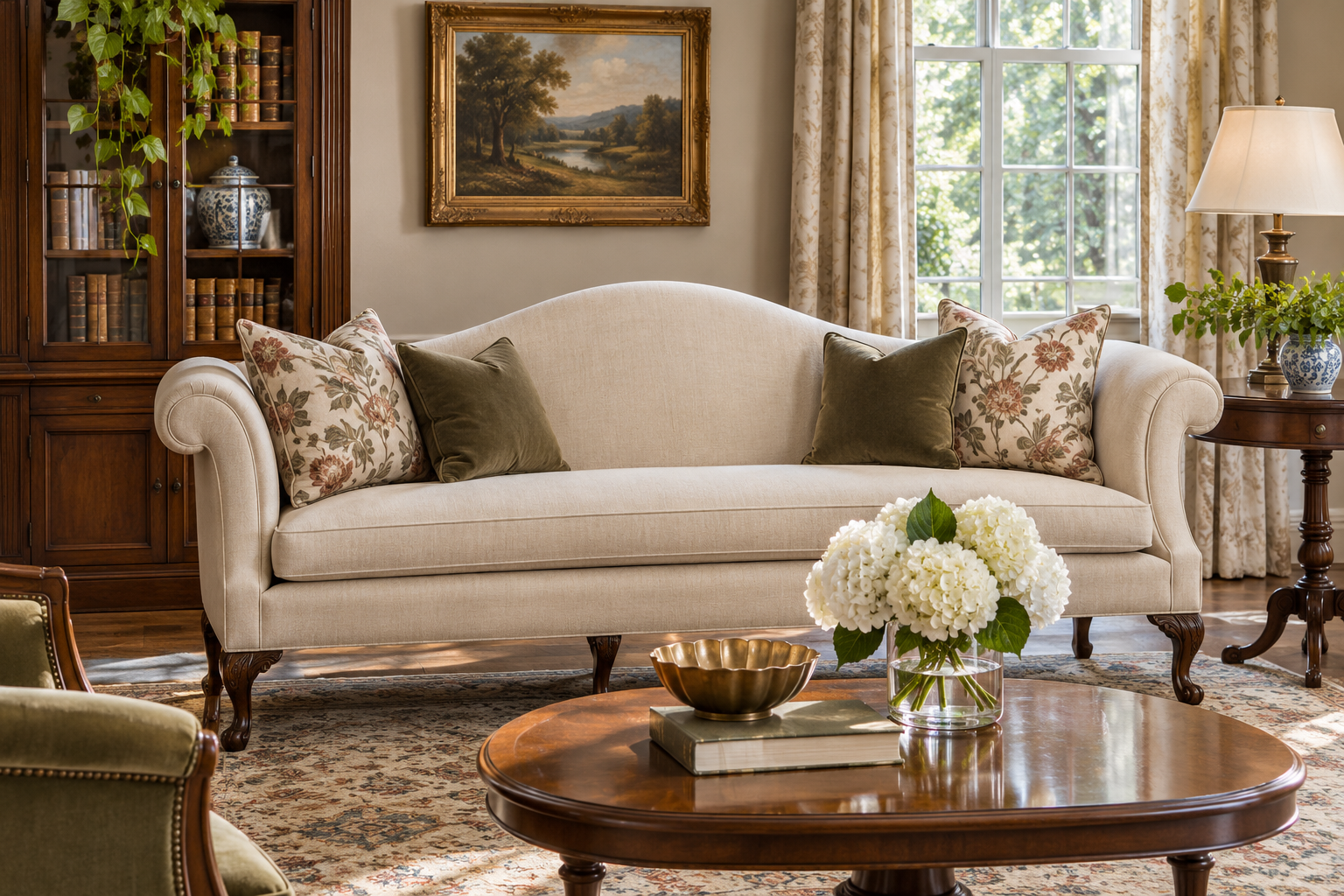
The best camelback sofas pair the style’s raised, curved back with proportions and upholstery that work in your room. A classic camelback usually has a high point near the center of the back that slopes toward the arms; many versions add rolled or scrolled arms, exposed legs, and a tailored seat. Contemporary interpretations can soften the curve or change the arm and cushion design. Because “camelback” describes a silhouette rather than one standardized build, compare the exact back shape, frame, seat support, dimensions, and cushion construction.
This guide compares named camelback sofas from makers that publish useful details and explains how to choose a style. We include an American-made compact option, a bespoke English model, and a higher-end Los Angeles-made design. Prices and availability can change. We have not tested these sofas in person and do not claim one is the most comfortable; use measurements and the maker’s specifications to shortlist models, then try a showroom sample when practical.
For broader room planning, see our living room rug guide and browse additional ideas in Home & DIY.
Quick picks: camelback sofa styles to compare
| Model | What stands out | Best for | Check before buying |
|---|---|---|---|
| Irvin’s Camelback Sofa | 72-inch width, hardwood frame, 8-way hand-tied springs, made to order in selected fabrics | Buyers wanting a traditional silhouette in a smaller footprint | Current lead time, delivery region, and non-returnable order policy |
| Max Rollitt Camelback Sofa | Made to order in the UK with beech frame, latex-core feather-wrapped seat, and custom dimensions | Shoppers seeking a bespoke historic interpretation | Quote, fabric, finish, lead time, and final measurements |
| Nickey Kehoe Camelback Sofa | 82-inch design with curved back, tufting, removable seat, and cushion clips | Buyers looking for a tailored luxury sofa with a clear published footprint | Price, stock location, chosen slipcover, delivery, and final-sale exclusions |
These options span different price and customization levels, so compare them as distinct categories rather than assume their specifications are interchangeable. One offers a relatively compact 72-inch size, another is bespoke to a client’s needs, and the third lists a standard 82-inch version. A camelback can be formal, but its scale, upholstery, and leg finish determine whether it feels traditional, relaxed, or eclectic in a modern room.
1. Irvin’s Camelback Sofa: best for a smaller traditional footprint
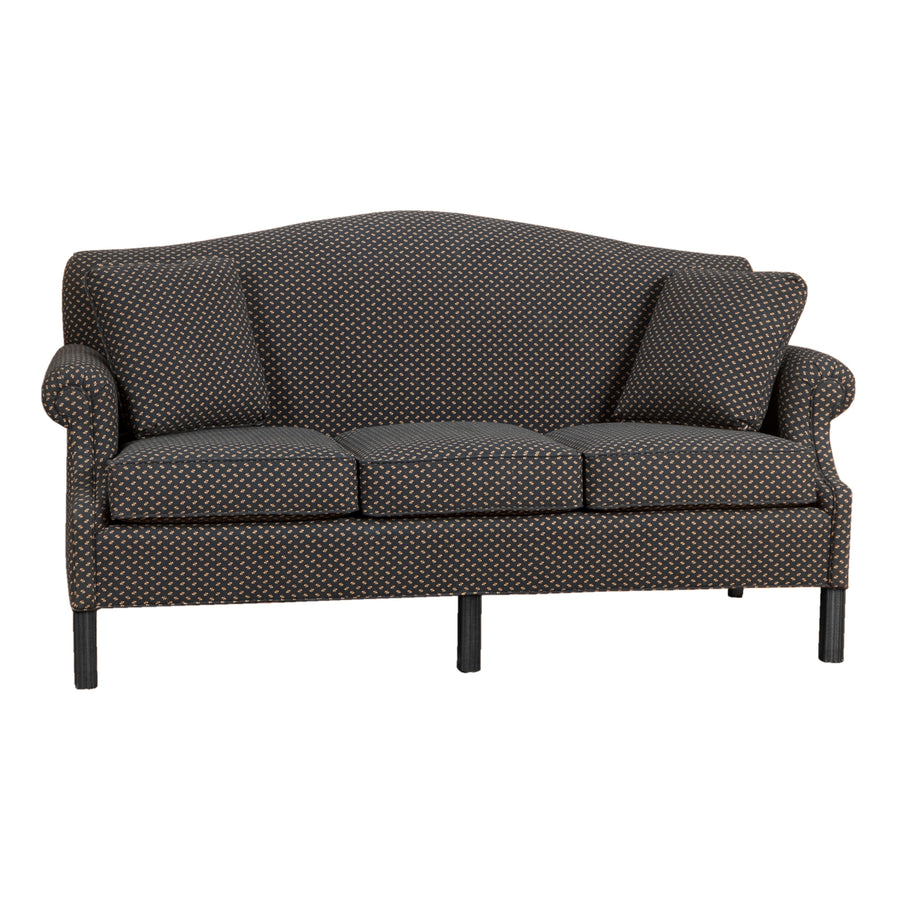
Irvin’s lists its Camelback Sofa at 72 inches wide, 33 inches deep, and 38 inches high. The maker describes a hardwood frame and 8-way hand-tied springs, with two matching pillows and fabric choices. This smaller width can be easier to place than a larger formal sofa, but it still needs a 33-inch-deep footprint plus room for people to walk, side tables, and the full delivery route.
The product page says the item is made to order and non-cancelable and non-returnable. It also notes delivery through a white-glove service to the inside of the home, setup, and packaging removal, while availability is limited to selected states and the listed lead time is four months. These terms materially affect the purchase, so verify they remain current and confirm the destination falls within the retailer’s delivery map before ordering. Do not choose a custom fabric until you understand whether the selection locks the order.
The 8-way hand-tied spring detail is a construction feature worth discussing with the seller, but it does not by itself establish how the sofa will feel or how long the cushions will retain their shape. Ask what the seat cushion fill is, whether it is reversible, how the frame is joined, and what the warranty covers. Try a comparable seat if possible; seat depth and back angle are especially important on traditional silhouettes.
Amazon search for the exact product name: Irvin’s Camelback Sofa P11201. No exact ASIN was verified, so this link searches the model name and item code; for actual configuration and availability, check Irvin’s product page.
2. Max Rollitt Camelback Sofa: best for bespoke historic detail

Max Rollitt bases its Camelback Sofa on a Georgian example from around 1760. The maker says the original’s curved back gives the style its name and describes its own interpretation as a hand-made beech-frame sofa with a sloping cutaway arm, polished walnut legs, and a single seat cushion with a latex core and feather wrap. It is made to order in the UK, and the standard size is listed at 246 cm wide, 89 cm deep, and 101 cm high.
This is a large sofa and should be treated as a made-to-measure project. The maker says dimensions can be altered, with custom size and fabric requests handled by enquiry. Ask for a drawing or written specification that shows overall width, seat height, seat depth, back height, arm projection, and leg clearance. Confirm how a requested change affects price, production time, return eligibility, and delivery access.
A feather wrap can give a softer surface feel, while a latex core contributes a different support character. Ask how much maintenance the seat needs, whether it requires regular turning or plumping, and whether a replacement cushion can be ordered later. People who prefer a firm, low-maintenance seat should compare the cushion options and test a sample before committing. These details are more useful than the maker’s style story when predicting day-to-day comfort.
Amazon search for the exact name: Max Rollitt Camelback Sofa B-CAMS. We did not verify an exact Amazon ASIN; the sofa is ordered directly from the maker. See its product specifications for current dimensions and enquiry details.
3. Nickey Kehoe Camelback Sofa: best for tailored luxury design
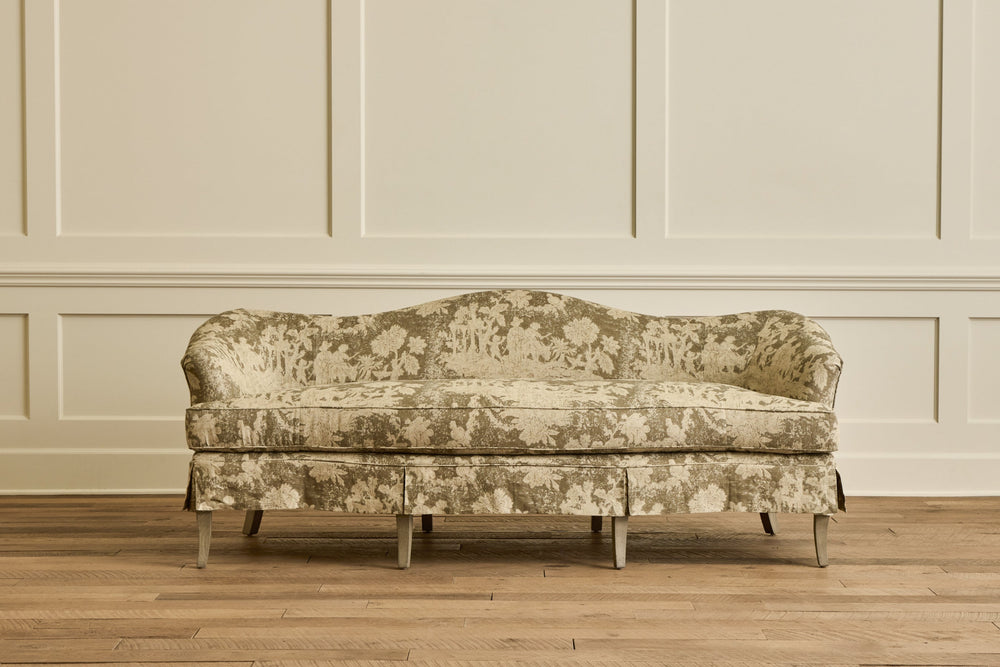
Nickey Kehoe’s Camelback Sofa combines a curved back and legs with deep tufting. Its product page lists an 82-inch width, 36-inch depth, and 33-inch height, with an 18-inch seat height and 22- to 25-inch inside seat depth. The maker says it is handmade in Los Angeles and describes a removable seat with built-in cushion clips. The page shows specific upholstery and wood finish combinations, so compare the displayed product with the exact variant you intend to buy.
That 82-inch width offers more seating length than the Irvin’s 72-inch model while remaining narrower than the standard Max Rollitt version. The inside seat depth range is notably deep for some users; shorter household members may want to test the seat and see whether a lumbar pillow improves posture. The 18-inch seat height is another useful measurement for anyone who cares about ease of standing up.
Check the stock status and location. The page for the specific slipcovered version says it is in stock in New York, while other variants may be custom or available in different finishes. The retailer’s policy distinguishes made-to-order and sale items from standard online orders, and some are final sale. Confirm the exact item’s return eligibility, white-glove delivery fee, and whether the fabric shown is included in the current price.
Amazon search for the exact listing: Nickey Kehoe Camelback Sofa 52228. We did not find a verified direct ASIN for the made-to-order sofa. For live stock, materials, and terms, use the Nickey Kehoe product page.
George Smith Chippendale: another classic camelback to compare
George Smith identifies its Chippendale Sofa as a camelback and offers a fixed-seat and a loose-cushion version. Its US product page lists fabric, wood-finish, nail, and trim choices, with multiple widths available by configuration. This is a high-end made-to-order example; request a current quote and full delivery terms before comparing it with a stock model. See the Chippendale Sofa with fixed seat specification and use the exact Amazon search only as a discovery aid: George Smith Chippendale Sofa with fixed seat. We did not verify an Amazon ASIN for this model.
What makes a sofa a camelback?
The defining feature is a raised or arched back that rises toward a central hump and slopes down toward the arms. Traditional versions often have rolled or scrolled arms, a tight upholstered back, a single or split seat, and exposed legs. Some examples add button tufting, nailhead trim, skirts, or carved feet. Modern interpretations may retain the curved back while simplifying the arms, upholstery, and base.
The exact curve can vary. One sofa may have a high central crest and a deep dip above the arms, while another has only a subtle arch. A reverse camelback changes the curvature or visual emphasis. Product descriptions may call a sofa “camel style” loosely, so inspect a straight-on photograph and verify that the back shape is actually the one you want.
Do not confuse a camelback with every curved sofa. A curved outside back can bow toward a wall without rising in the center; a Lawson or English roll-arm sofa may have rolled arms but a relatively straight back. If the hump is important, ask for a side or front elevation drawing and compare the back’s height at the center and arms.
How to choose the right camelback shape
High, formal crest
A pronounced hump creates a traditional focal point and can feel stately in a formal living room, library, or reception room. It may sit taller than nearby contemporary furniture, so check the height against windows, art, and shelving. The back profile is visible from across the room and should be balanced by enough visual space around it.
Soft, low arch
A gentler curve is easier to combine with transitional or contemporary furniture. It preserves the silhouette without making the sofa feel ceremonial. Look at the sofa in profile and from the rear if it will float away from a wall. Check whether the slope affects shoulder support for taller users.
Rolled or scrolled arms
Arms affect both style and usable seat width. Rolled arms can look classic and provide a comfortable place to rest an arm, but they may occupy more width than slim square arms. Compare inside seating width, not just the outer sofa measurement. A wide arm can make a small sofa feel compact inside.
Exposed legs and skirt
Exposed legs make a camelback sofa feel lighter and reveal some of the floor underneath. A skirt creates a softer, more traditional look and can hide the base, but it may be harder to vacuum under. Ask whether leg finish, skirt, trim, or nailhead details are standard or upgrades.
Measure the room and delivery path
Record the available wall length and the sofa’s full width, depth, height, and seat footprint. Use masking tape to outline the sofa on the floor. Include side tables, lamps, a coffee table, and a clear route through the room. The camelback crest can project higher than nearby furniture, so map the visual height as well as the floor plan.
Measure the entry door, hallway, corners, stair turns, landings, lift, and path to the final room. The sofa may be wider than a doorway even if the room is spacious. Ask the retailer whether legs or backs can be detached, what the largest rigid dimension is, and whether a delivery team will assess the route. For a bespoke sofa, request the access check before construction begins.
Make sure the sofa’s arms and seat depth fit the way you sit. A deep seat is comfortable for some people to lounge, but it can leave shorter users without foot support. A tall back may feel supportive, but only if the crest, shoulder position, and cushion profile work together. Test the sofa in person or ask about return terms before treating a photo as evidence of comfort.
Frame, springs, cushions, and upholstery
Ask what the frame is made from and how the joints are constructed. Hardwood, beech, and other solid timber frames are common in traditional designs, but the material name does not reveal the joint quality or support layout. Ask whether the frame is glued, screwed, dowelled, corner-blocked, or reinforced, and which components the warranty covers.
Suspension can include hand-tied springs, sinuous springs, webbing, or other systems. Each has a different feel and maintenance profile. Ask for a construction description and the model-specific seat build. A traditional appearance does not guarantee traditional spring construction, and a contemporary frame can still use robust support. Evaluate the real specification, not the style label.
Cushion interiors can change the maintenance burden. Foam seats are often easier to keep tidy, while feather wraps or loose fillings may need plumping to preserve their shape. A single bench cushion can create a clean line but can be awkward to handle; separate cushions allow more rotation. Ask whether covers and cushions can be replaced individually and whether spare fabric is available.
Fabric, leather, and slipcovers each have trade-offs. Velvet and mohair add depth but can show pile marks; linen can wrinkle; patterned fabrics need careful matching; leather develops natural variation. Slipcovers can be practical when removable and washable, but check whether the exact cover is designed to come off and whether cleaning is professional or domestic. Request swatches and review the cleaning code.
How to style a camelback sofa
Use the sofa’s curved outline as a visual anchor. A camelback can sit against a paneled wall, fireplace, or bookcase, but it can also float in a room if the rear upholstery is finished. Leave enough visual space above the crest for art or a mirror; a frame hung too low can compete with the curve.
Pair a formal camelback with less formal pieces to avoid making the room feel like a period set. A simple coffee table, contemporary lamp, or textured rug can balance carved legs and tufting. Repeat one finish or color from the sofa elsewhere, but vary the materials. For example, brass nailheads can echo a lamp detail without requiring every metal object to match exactly.
For a small room, choose a narrow model with exposed legs and restrained upholstery. A skirted, wide-armed sofa can look heavier and make the footprint appear larger. Measure traffic paths and preserve enough negative space so the arch remains visible. A solid color may show the silhouette clearly, while a small pattern can soften a formal profile.
For rug placement, decide whether the sofa’s front legs will sit on the rug and make sure the rug extends enough to connect other seats. A too-small rug can make a traditionally styled sofa seem disconnected from the rest of the room. Our rug sizing guide covers common living-room arrangements.
What to ask before ordering a made-to-order sofa
- Where is this exact model manufactured, and which parts are built or upholstered elsewhere?
- What are the outside and usable seat dimensions, including height at the arms and center crest?
- What frame, suspension, seat cushion, and back cushion materials are used?
- Can the fabric or leather be sampled, and are color variations expected?
- Which components are covered by the warranty, for how long, and how are claims handled?
- What is the current production and delivery estimate for my configuration?
- What delivery access measurements are required, and are white-glove fees included?
- Can a standard selection be returned, and how does a custom request affect cancellation rights?
- Are replacement cushions, covers, or feet available later?
Ask for answers in writing and ensure they match the order confirmation. The exact fabric code, leg finish, seat filling, cushion configuration, nailhead spacing, and size should all be recorded. Do not assume a salesperson’s verbal description will appear on the production ticket without confirmation.
Common camelback sofa buying mistakes
- Choosing by silhouette alone: check seat depth, height, support, and usable width.
- Assuming every curved back is camelback: verify the central rise and slope in the actual profile.
- Ignoring large arms: outer width can overstate the seat area.
- Forgetting delivery access: measure every narrow passage before a made-to-order build.
- Assuming custom means returnable: read cancellation and collection terms first.
- Treating a frame warranty as total coverage: cushions and upholstery may have separate or no coverage.
- Skipping fabric samples: colors and textures change with room light.
- Comparing different seat constructions as equals: ask about cushion interiors and springs.
Another mistake is buying a sofa that is too tall for the room’s architecture. A high crest can block a window line, artwork, or a low mantel. Measure from the floor to the crest and mark that height on the wall with painter’s tape. This simple check makes it easier to visualize whether the sofa will fit below existing trim or look crowded in a small room.
Frequently asked questions
What is the difference between a camelback and a Chippendale sofa?
Camelback describes the arched, raised center of the back. Chippendale is a design style often associated with scrolled arms and exposed legs; some Chippendale sofas have a camelback profile. The terms overlap in certain models but are not interchangeable for every sofa.
Are camelback sofas comfortable?
Comfort depends on seat depth, height, back angle, cushion filling, and the person sitting in it. The silhouette alone does not determine support. Test the model or compare precise measurements and cushion details before ordering.
Do camelback sofas work in modern rooms?
Yes. A restrained curve, simple upholstery, exposed legs, and a solid color can blend with modern furnishings. Pair a traditional outline with contemporary lighting, art, or a clean-lined coffee table to keep the room balanced.
Are camelback sofas good for small living rooms?
Some compact models can work well, but arm width and visual height matter. Measure both the outside width and the inside seat area, then tape the full footprint on the floor. Exposed legs and lighter fabrics can make the form feel less heavy.
Should I choose a fixed or loose seat cushion?
A fixed seat stays aligned and creates a tailored appearance. A loose cushion is easier to remove or rotate but may shift and require adjustment. Consider cleaning, maintenance, and whether replacement cushions are offered.
What fabric is best for a camelback sofa?
Choose based on household use and care preference. Tight weaves may snag less than loose fabrics, while velvet and chenille provide texture. Request swatches, read cleaning instructions, and ask how the warranty treats spills, fading, and wear.
Can camelback sofas be customized?
Many makers offer fabric, finish, or size options, but not all changes are standard. Ask what can be changed and how a custom specification affects price, lead time, warranty, and returns. Get the final order details in writing.
What is the best way to position a camelback sofa?
Place it where the back’s curve can be seen and leave space above the central crest. Against a wall, check window and artwork clearance; floated in the room, inspect the rear finish. Keep a useful walkway around its arms and front edge.
Final recommendation
For a smaller traditional footprint, start with Irvin’s 72-inch Camelback Sofa and verify its made-to-order return policy and delivery region. For a bespoke interpretation with a beech frame and custom sizing, compare Max Rollitt’s written quote and construction details. For a tailored 82-inch silhouette with a removable seat, review Nickey Kehoe’s current variant, stock location, and final-sale terms. George Smith’s Chippendale is another specific camelback design worth researching if you want traditional scrolled arms and multiple widths.
Measure the room and delivery route, sample fabrics, and compare cushion construction and warranty coverage before paying a deposit. Amazon searches below may not surface the exact maker models, so use the manufacturers’ product pages for verified details. For a complete room layout, explore our living room rug guide and Home & DIY.
We did not verify Amazon ASIN matches for these made-to-order camelback sofas. Amazon links are name searches and may show alternatives; check the maker’s current listing for exact product availability and terms.