Choosing among the best brown leather sofas in the UK means balancing leather quality, comfort, delivery, and how the sofa fits your home. Brown spans pale tan and caramel through cognac, chestnut, and dark chocolate, while “leather” can describe several different materials and coverage patterns. Retailers also offer traditional Chesterfields, compact two-seaters, large family sofas, corner arrangements, and recliners. This guide explains how to compare UK shopping options and what to verify before ordering.
Affiliate disclosure: This article contains an affiliate search link. As an Amazon Associate, this site may earn from qualifying purchases. Amazon.com search results may not represent UK products, retailers, delivery, or warranty coverage. Product availability and policies change; verify the seller and terms for your country before purchase.
Quick answer: Start by deciding the sofa size and leather type, then compare a retailer’s brown leather range, delivery service, warranty, and return policy. John Lewis and Furniture Village currently provide filtered brown leather sofa collections on their sites; DFS also lists brown corner-sofa options. These are useful places to compare, not an independent quality ranking. Test a similar model if possible and verify the construction of your chosen piece.
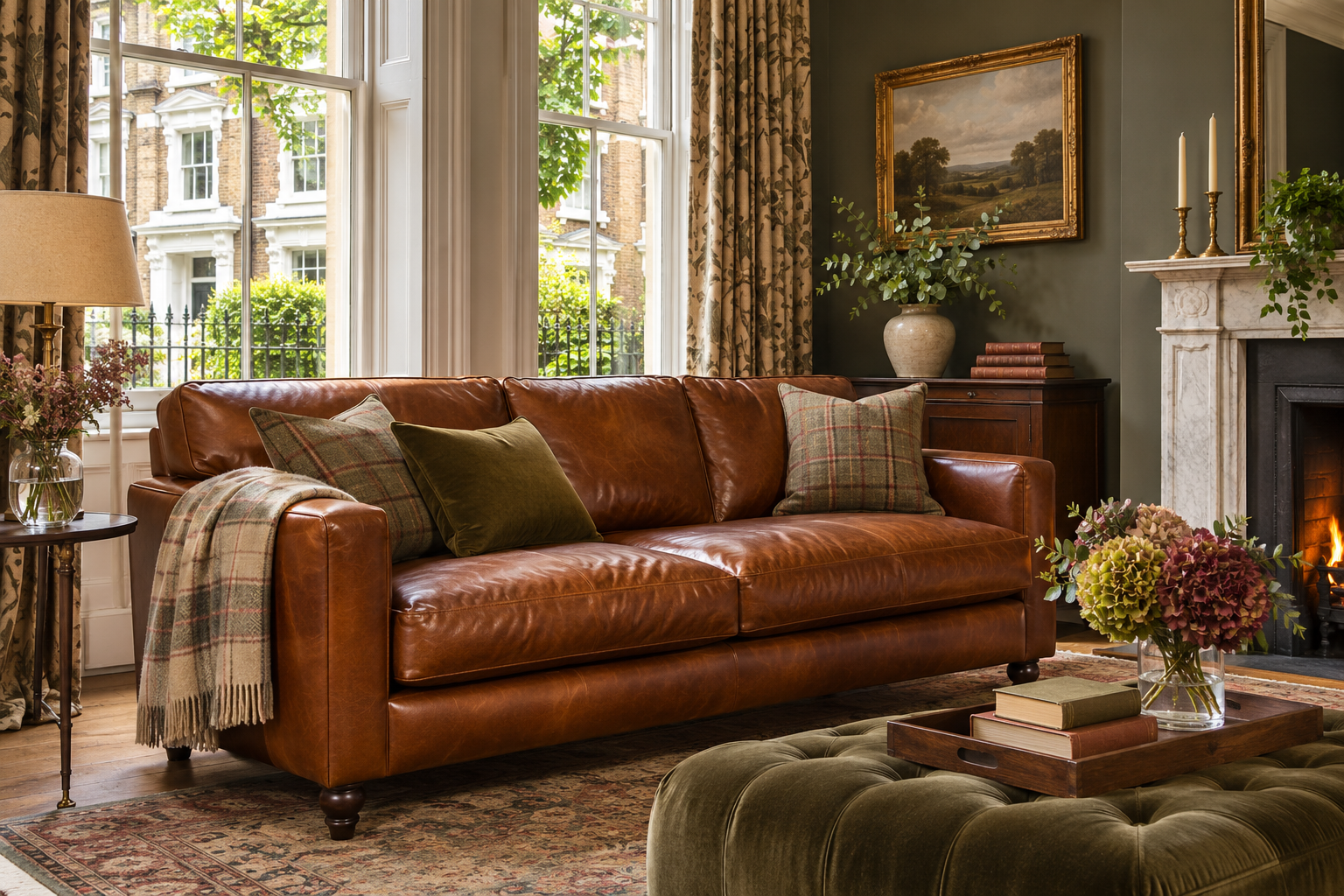
UK retailers to compare
John Lewis
John Lewis’s brown leather sofa collection includes filters for sofa type, size, material, color, delivery, and brand. Its current collection page lists multiple ranges and configurations, which can help shoppers compare two-seaters, three-seaters, corner sofas, and sofa beds in one place. Check each model’s page for leather specification, cushion details, delivery, assembly, and warranty rather than assuming every range uses the same construction.
Look at the model sizes and leg finishes, and consider whether the displayed shade is light tan, warm brown, or a darker tone. Ask whether a showroom has a floor sample in the leather you prefer. A product title or filter can help narrow choices but does not replace reading the material section for the exact item.
Furniture Village
Furniture Village’s brown leather sofa listing groups products by leather and brown color and provides filters for item type, brand, comfort, recliner, and other features. Its listings include different sizes and designs, from traditional profiles to contemporary and reclining options. Use filters to narrow the field, then verify whether “leather” describes every upholstered panel or selected contact areas.
When comparing a sale price, check whether it applies to the exact size, leather grade, and configuration selected. Ask about delivery, assembly, protection options, clearance, and return terms. Promotion labels and product ranges can change, so consult the live listing and order summary.
DFS
DFS’s brown corner-sofa collection can be a starting point if you need a chaise or corner layout. Some listings show multiple colors, sizes, and made-to-order options. Confirm whether the selected model is genuinely leather, leather match, or another material, and check the specified left- or right-hand orientation in the product diagram.
For reclining models, measure the open position and verify electrical requirements where relevant. Review delivery estimates and assembly details. A corner sofa may arrive in several pieces, so compare the module dimensions with your doorways and stairs as well as the room layout.
Retailer ranges are convenient for browsing, but the exact sofa’s construction and terms are what matter. Ask for a swatch where available, read the warranty, and keep the product page and final order details. Availability changes over time, so verify the current collection rather than relying on an old screenshot or price mention.
What “leather sofa” can mean
Retailer labels can include full-grain, top-grain, corrected-grain, split leather, bonded leather, and leather match. These terms describe different materials and construction approaches; they are not interchangeable. Leather match usually uses leather on some contact areas and a different material on non-contact panels. Bonded leather is made from leather fibers and a binder, not a single continuous hide. Ask which material covers the seat, arms, sides, and back.
Look for the full material description on the product page and ask the retailer to clarify any vague phrases. “Genuine leather” alone does not specify grade, finish, thickness, or how the surface will wear. If the sofa is a recliner or sectional, confirm that the material coverage is the same on every component. A footrest or side panel may use a different upholstery material.
Finish also matters. Aniline leather shows more natural variation and can mark more easily; protected or pigmented finishes are more uniform and may be easier to wipe according to care directions. Semi-aniline falls between those categories. Names and descriptions differ by retailer, so ask what finish is used and how it handles sunlight, spills, and body oils. Request the care instructions in writing.
Pick a shade that suits the room
Brown is not one color. Tan and caramel can brighten a room and pair with natural materials. Cognac often has a warm orange or golden undertone. Chestnut and medium brown can feel more neutral, while chocolate or espresso may read almost black in low light. Reddish brown can add depth but may be harder to match with cooler gray flooring.
Compare a swatch with your floor, rug, wall, and curtains in daylight and evening light. The same hide can look warmer under a yellow lamp and cooler beside a blue-gray wall. Phone screens and product photos are imperfect color references. If a showroom sample is available, view it next to your room materials before ordering.
Use contrast to define the sofa. A dark brown sofa on a dark floor can blend together; add a lighter rug, cushions, or side table. A tan sofa may look washed out against a cream wall, so include texture or a deeper accent color. Navy, forest green, rust, ivory, and warm wood often pair well with brown, but check undertones rather than matching colors by name alone.
Measure the sofa and the delivery route
Measure the room’s maximum sofa width, depth, and height. Include thick arms, chaise units, legs, and any recliner extension. Tape the footprint on the floor and keep doors, windows, radiators, vents, and walkways usable. If the sofa faces a coffee table, leave enough room to walk past it comfortably.
Measure the access route from the delivery vehicle to the room: entry door, hall, stairwell, landings, lift, and turns. Compare your narrowest opening with the sofa’s packaged dimensions and assembled dimensions. Ask whether the legs or arms detach and whether the back splits into sections. For a large corner sofa, confirm each module can pass through the route.
For a recliner, check how far the footrest extends and whether the back moves toward the wall. A wall-hugger still needs its stated clearance. For a sofa bed, record the open-bed dimensions and leave space to make the bed. A sofa that fits against the wall may block the room when converted.
Choose the right sofa shape
Two-seater
A two-seater can work in a small living room, bedroom, or reading area. Compare the width between arms, not just the outside dimensions. Wide arms reduce usable seat space. If two adults will sit there regularly, test the model together and check seat depth and cushion width.
Three-seater
A three-seater is a flexible choice for everyday family seating. The cushion count, arm design, and seat depth determine how roomy it feels. Separate cushions may be easier to rotate, while a long bench seat creates a continuous surface. Ask about the interior support and whether seat cushions can be replaced.
Corner sofa or chaise
A corner sofa accommodates group seating and can define a large room. It also takes more floor space and may be hard to reconfigure later. Confirm which side has the chaise and how the retailer defines left- and right-hand facing. Check whether the cushions or modules are reversible and whether additional sections can be ordered.
Recliner
A leather recliner prioritizes relaxation and may be manual or powered. Test the mechanism and see if it is easy to operate. Check whether the headrest moves, whether the footrest supports your legs, and what electrical connection is needed. Measure the reclined footprint; two recliners placed close together may need more clearance than expected.
Check British manufacture separately
Some shoppers want a brown leather sofa made in Britain; others mainly want a UK retailer, showroom, or delivery service. These are different requirements. A product sold by a British retailer may have been manufactured elsewhere, and a British brand may produce different models in different locations. If origin matters, check the exact range’s manufacturing statement rather than inferring it from the retailer’s address or brand history.
Ask where the frame is built, where upholstery takes place, and whether final assembly happens in Britain. Ask which materials and components are sourced locally and whether the answer changes by model. A product may be made in one country using leather from another; this does not automatically make it a poor choice, but it is useful context. Keep the answer with the order specification so you can verify that the product delivered is the one you selected.
For shoppers who care about repairability or local service, manufacturing origin may be one factor among several. Ask whether the retailer or maker can source replacement cushions, covers, feet, or reclining parts. Find out who handles a repair if the original maker is outside your country. A clearly written service route can be more useful over time than a broad “British design” or “British heritage” phrase.
Read product pages beyond the headline
Retail filters can narrow color and material, but the listing title is not a complete specification. Open the details for the exact size and selected variation. Check whether the price changes with leather grade, leg finish, cushion filling, or recliner option. Look for product dimensions, seat height, seat depth, delivery estimate, and weight if available. When a detail is missing, ask customer support before ordering.
Review photos from more than one angle. A sofa may use leather on the front and a coordinated material on the back or sides. Some images show a larger configuration than the starting price. Confirm whether matching chairs, footstools, scatter cushions, or chaise modules are included or sold separately. If a retailer’s model name appears in several ranges, make sure you compare the same version.
Customer feedback can reveal practical points such as delivery communication, assembly difficulty, and how a cushion feels after use. Read several reviews and notice whether they describe the same model and upholstery. A review of a fabric version may not tell you much about leather. Look for recurring details rather than treating a single rating as a guarantee.
Think about household use
For a busy family room, consider how often people eat, nap, or play on the sofa. A leather surface may be wiped according to its care code, but it can still scratch, mark, or show wear. If pets climb on the sofa, ask how the chosen finish responds to claws and whether the maker recommends a protective cover. If children use the sofa, keep a washable throw on the favorite seat and teach them how to handle spills promptly.
For a formal sitting room, a traditional Chesterfield or buttoned profile can create a strong focal point. It may have a firmer seat or deeper tufting than a relaxed family sofa, so test it rather than choosing from appearance alone. For a media room, consider recliners or a chaise and verify clearances for every seat. For a small flat, a two-seater or compact three-seater may leave room for a chair and better circulation.
Plan for seasonal comfort as well. Leather can feel cool when you first sit down and warmer after contact; a throw can change the feel without covering the whole sofa. A textured rug and fabric cushions can soften the room visually. Balance a brown leather sofa with lighter materials so the seating area does not feel heavy.
Comfort and construction checks
Sit on the sofa for several minutes. Try an upright position and a relaxed one. Check seat height, depth, back angle, cushion firmness, and arm height. Your feet should rest comfortably and the seat should support your back. Deep seats suit some taller people and lounging styles, but can leave shorter users unsupported. If you cannot test the model, compare its measurements with a sofa you already like.
Ask about the frame, joints, suspension, and cushion fillings. Hardwood, engineered wood, and metal may all appear in furniture; construction quality depends on design and assembly as well as material. Suspension might use springs, webbing, or a platform. Foam, fiber, and feather cushions feel different and may need different care. Ask how to rotate or plump cushions and whether replacements are available.
Review the warranty by component: frame, mechanism, cushions, leather, and workmanship may have different coverage. Find out how to make a claim, who pays for inspection or transport, and what normal wear excludes. For a power recliner, ask about the motor, wiring, and service process. Keep the receipt and product specification.
Care for brown leather
Follow the manufacturer’s care guide rather than using a generic cleaner. Dust with a soft cloth or vacuum attachment if permitted. Blot spills as instructed and avoid rubbing. Do not use alcohol, household disinfectants, or an unapproved conditioner; products made for car interiors may be unsuitable for furniture leather. Test any approved treatment in a hidden spot if the care guide allows it.
Protect the sofa from prolonged direct sunlight and heat, which can change color or dry the surface. Keep sharp buckles, keys, pet claws, and rough objects away. Use coasters and avoid leaving damp fabric on the leather. A regular, gentle cleaning routine is easier than trying to restore neglect later.
Leather develops creases and surface variation with use. Whether that change looks like attractive patina or unwanted wear depends on the finish and your preference. Ask the retailer for examples of the chosen leather after use and clarify which marks are expected. Natural hide variation may mean the delivered sofa differs slightly from a swatch.
Compare cost and delivery
Look at the complete price: upholstery grade, delivery, assembly, old-sofa removal, protection plans, and optional cushions or footstools. Check whether the displayed price refers to a smaller size or fabric option. Sale labels and financing offers have terms; review the total amount payable and the current promotion conditions.
Confirm whether the item is in stock, made to order, or available in a particular delivery window. Ask what happens if the delivery team cannot access the room or if the sofa arrives damaged. Understand the return policy and any collection fee, especially for a large piece. Save the exact product page and selected configuration.
If buying online, request swatches and check the seller’s dimensions carefully. If visiting a showroom, ask whether the floor sample is the same size and cushion fill as the model being sold. For clearance items, inspect the sofa and document any marks on the invoice. In every case, confirm leather coverage and warranty before placing the order.
Online search options
For an additional comparison, you can search Amazon for brown leather sofas with the UK query. Amazon.com may return products intended for the US market rather than British retailers, so check shipping destination, currency, material, seller, and warranty carefully. Treat this as an online discovery link, not a recommendation for any one product.
When comparing an online result with a UK retailer, use the same checklist: exact leather type, dimensions in centimeters or inches, seat construction, delivery route, return freight, and service location. A product that appears cheaper can have different shipping or support terms. If product information is incomplete, ask the seller before paying.
Frequently asked questions
Which UK retailer has the best brown leather sofas?
There is no single best retailer for every shopper. John Lewis, Furniture Village, and DFS offer online brown leather or brown corner-sofa collections to compare. Choose based on the exact model, comfort, material, delivery, service, and warranty.
Is brown leather better than fabric?
It depends on your preferences and routine. Leather has a distinct feel and develops surface changes over time; fabric offers a broader range of textures and may be easier to remove and clean if covers are washable. Compare the specific materials and care instructions.
What is leather match?
Leather match typically uses leather on selected contact areas and a different upholstery material on other panels. Ask the retailer to specify which parts are leather for the exact sofa.
Can I buy a brown leather sofa without seeing it?
You can, but color and comfort are harder to judge. Request a swatch, compare dimensions, read the return terms, and ask about the cushion fill and seat support before ordering.
How do I care for a leather sofa?
Use the maker’s care instructions. Avoid unapproved cleaners, protect the sofa from direct sun and heat, and blot spills as directed. Keep the care guide and warranty with your order records.
Final thoughts
The best brown leather sofa in the UK is the one that fits your space, feels comfortable, and has a material specification and service policy you understand. Compare retailers, test a similar seat, inspect leather coverage, and measure the delivery route. Taking time with those checks helps you choose a sofa for daily use rather than relying on color or a sale label alone.
For related advice, read our British-made sofa guide, Murrieta brown leather sofa guide, and sofa style guide. See our affiliate disclosure.
Certain content on this site comes from Amazon and may change. The Amazon.com link is a tagged search only and may not return UK-delivered products. Verify the exact seller, market, price, material, and terms before purchase.