Disclosure: As an Amazon Associate, dailyhomedecorating.com earns from qualifying purchases. Links on this page are affiliate links; they cost you nothing extra. Prices and availability change often, so check the current Amazon listing before you buy.
The storage ottoman vs ottoman question looks trivial until you try to answer it for a real room: both are upholstered, both rest your feet, both can seat a guest. The difference is everything that follows from a cavity and a lid, extra storage and extra seating flexibility on one side, extra responsibilities and moving parts on the same side, and a simpler, sometimes more comfortable piece on the other. This comparison works criterion by criterion, with a verdict on each, so the right choice for your household emerges from your priorities rather than from a generic winner.
Key Takeaways
- Choose storage if soft goods need a home in the room and you will open it weekly.
- Choose plain if you want the simplest footrest or seat, with no lid to manage and no cavity to keep dry.
- Safety differs: the plain ottoman has no cavity risks; the storage version needs a non-slamming lid and firm rules.
- Neither is ever a step stool, a ladder, or, in the storage case, a hiding place.
Safety First: Read This Before Anything Goes Inside
A storage ottoman is never a hiding place. Children must never climb inside a storage ottoman, and no game of hide-and-seek should ever involve one. A child inside a closed or closing ottoman can become trapped, and an enclosed, fabric-lined cavity can suffocate. Treat the inside of this furniture exactly as you would the inside of a chest, a trunk, or a washing machine: it is a space for blankets and objects only, never for a person, however small, and never for a pet. If children use the room, the ottoman stays closed, the rule is explained plainly and repeated, and younger children are supervised around it just as they would be around any lidded chest.
Hinged lids need safety hinges and stays. A heavy upholstered lid that falls shut can slam on small fingers, hands, or a head leaning into the cavity. Look for lids that hold themselves open at any angle, that close slowly, or that lift off completely rather than hinging down under gravity. Test the lid in the shop or on delivery day: open it halfway and let go. It should stay where you left it. If it drops, that model does not belong in a home with children, and it is a poor choice for anyone who will load it one-handed while holding laundry in the other arm.
A storage ottoman is not a step stool and it is not a ladder. Never stand on one to reach a shelf, change a bulb, or hang a picture, and never let a child stand or jump on one. The sitting ratings makers quote are static-load figures: they describe a seated adult settling down evenly, not a standing person shifting their full weight onto one foot, and not jumping, rocking, or perching on an edge. Use a storage ottoman for sitting and for resting feet, within the maker’s stated sitting guidance, and use a proper step stool with a handle for anything above shoulder height.
Store textiles dry, or do not store them at all. A closed ottoman has very limited airflow, and a blanket, throw, or cushion stored even slightly damp can mildew inside it, emerging weeks later with a musty smell that is hard to wash out and, in bad cases, visible spotting. Only store items that are fully clean and fully dry, leave the lid open for a few hours after the first loading on a humid day, and open the ottoman every week or two in damp climates to let the contents air. If a room itself is damp, a ventilated basket or an open shelf is the more honest storage choice.
In this guide
Storage Ottoman vs Ottoman: Side-by-Side Comparison
| Criterion | Storage ottoman | Plain ottoman |
|---|---|---|
| Storage | Enclosed cavity for soft goods | None |
| Seating and footrest | Yes, lid-dependent firmness | Yes, seat is the whole design |
| Moving parts | Lid, hinges or folding frame | None |
| Child safety duties | Non-slam lid, never hide inside, supervision | General furniture supervision |
| Care | Upholstery plus cavity airing | Upholstery only |
| Best room | Clutter-prone living rooms, bedrooms | Reading corners, formal rooms |
Soft storage is where these pieces genuinely excel. Blankets, throws, cushions, soft toys, seasonal textiles, and spare bedding compress a little, forgive an irregular cavity shape, and do not rattle, scratch, or stress the lining. Hard and heavy loads are a weaker fit. A cavity full of books or dumbbells strains hinges, bows a folding frame, and makes the whole piece miserable to move. If your storage problem is mostly hard objects, a shelved cabinet or a lidded crate in a cupboard will serve you better, and the ottoman can go back to holding the soft overflow it was designed for.
The room’s traffic pattern matters more than most listings admit. An ottoman placed in a walkway will be bumped, leaned on, sat on by guests who were never told it opens, and used as an impromptu drinks surface. It needs a wipeable finish, a stable base that does not rock on uneven boards, and a lid that stays put under casual use. An ottoman in a quiet reading corner faces a gentler life and can carry a more delicate fabric or a lighter frame. Be honest about which room yours will really live in, not the tidier room you imagine on delivery day.
A storage ottoman earns its floor space by doing at least two jobs at once, and the second job is usually the one that decides whether it stays in the room for a decade or gets donated within a year. A beautiful box that is uncomfortable to sit on becomes an obstacle. A supremely comfortable footrest with a shallow, awkward cavity becomes a footrest with a gimmick. Judge both halves of the bargain with equal suspicion, and be especially wary of showroom impressions: a lid that feels plush for thirty seconds may feel very different after a two-hour film, and a cavity that looks generous empty may swallow far less once a folded throw takes its share.
Storage and Clutter Control
Placement changes what the ottoman has to be. At the foot of a bed it becomes a blanket chest that also gives you somewhere to sit while you put on shoes. In front of a sofa it is a coffee-table substitute, a footrest, and a toy clear-up box in one footprint. In a hallway it catches scarves, gloves, and dog leads while offering a perch for tying laces. In a nursery it holds muslins and spare bedding within reach of the feeding chair. Each job weights the buying criteria differently, so name the primary job in one sentence before you compare a single model.
The honest starting point for any storage ottoman is what actually needs storing. In most living rooms the list is unglamorous and specific: two or three throws that live on the sofa all winter, a spare cushion or two, the board game that only comes out when guests do, a tangle of charging cables, and perhaps a knitting project or a child’s colouring books. None of that needs a cupboard. All of it benefits from being within arm’s reach of the seat it belongs to, which is precisely the gap a storage ottoman fills. Measure your pile before you shop, because the right cavity size follows from the pile, never the other way round.
The room’s traffic pattern matters more than most listings admit. An ottoman placed in a walkway will be bumped, leaned on, sat on by guests who were never told it opens, and used as an impromptu drinks surface. It needs a wipeable finish, a stable base that does not rock on uneven boards, and a lid that stays put under casual use. An ottoman in a quiet reading corner faces a gentler life and can carry a more delicate fabric or a lighter frame. Be honest about which room yours will really live in, not the tidier room you imagine on delivery day.
A storage ottoman earns its floor space by doing at least two jobs at once, and the second job is usually the one that decides whether it stays in the room for a decade or gets donated within a year. A beautiful box that is uncomfortable to sit on becomes an obstacle. A supremely comfortable footrest with a shallow, awkward cavity becomes a footrest with a gimmick. Judge both halves of the bargain with equal suspicion, and be especially wary of showroom impressions: a lid that feels plush for thirty seconds may feel very different after a two-hour film, and a cavity that looks generous empty may swallow far less once a folded throw takes its share.
Criterion verdict: storage ottoman, decisively, when the clutter is soft and used weekly; a draw when it is not.
Comfort as a Seat and Footrest
Colour choice is a storage decision too, because the ottoman will be one of the larger blocks of colour at the centre of the room. A tone matched to the sofa makes the piece recede and the room feel calmer and larger. A deliberate contrast makes it a focal point and hides the fact that it is, functionally, a box. Mid-tone, slightly textured fabrics hide the evidence of daily life best: pale solids show every mark, very dark solids show every pale fibre and pet hair. If the ottoman will double as a coffee table, remember that mugs and books will sit on your colour choice every day.
Legs and bases change both style and practicality. Short wooden legs lift the piece, let a vacuum pass underneath, and suit mid-century and traditional rooms. A flat, floor-sitting base feels more stable and more casual, hides the storage function better, and collects dust along its bottom edge instead of under it. Castors appear occasionally and help in rooms that reconfigure often, though they can wander on hard floors under a seated person. Whatever the base, the ottoman should sit level and silent: a rock or a creak on day one rarely improves with use.
Weight is a practical spec hiding in plain sight. A light folding ottoman can be carried to another room for guests, emptied and collapsed for a move, or lifted easily for vacuuming underneath. A heavy, framed piece stays where it is put, feels more substantial to sit on, and resists being knocked askew, but it will not be moved for cleaning without commitment. Consider who will move it, how often, and whether the floor beneath it needs regular attention. In homes with shedding pets, the answer to that last question tends to settle the weight debate on its own.
What is under the upholstery matters as much as the surface. A solid or well-braced frame keeps the seat firm and the lid aligned, while a purely folding frame trades some rigidity for the ability to collapse flat. Foam density decides whether the top feels like a seat or a sponge: firmer foam supports sitting and keeps the lid’s silhouette crisp, softer foam feels kinder under heels during a long film but can dip in the middle over time. Press the centre and the corners in person if you can. A lid that feels dramatically softer in the middle is telling you how it will age.
Criterion verdict: plain ottoman by a nose at equal tier, because its whole build serves the seat; the gap closes on well-made storage models.
Safety and Household Rules
Scale mistakes run in both directions. Too small, and the ottoman becomes a footrest with a token cavity that holds one throw and a remote, while the rest of the clutter stays on the sofa. Too large, and it dominates the room, blocks the walkway, and makes the sofa feel like it is docking with something. Cardboard is the cheapest design tool available: tape the footprint on the floor, live around it for a day, sit with your feet where the top would be. Ten minutes of theatre at home prevents the most expensive category of furniture regret, the piece that is fine in every way except the room.
Finally, do not let the ottoman become the room’s unexamined hazard. It should never be the step up to a high shelf, never the platform for a child reaching a counter, and never a hiding place in any game, and those rules need saying out loud to guests and children rather than assuming. Keep it out of the top-of-stairs landing and away from any spot where a lid left open blocks a route in the dark. Used as designed, a storage ottoman is one of the safest, most useful pieces in the house. The problems in this category almost always begin where the designed use ends.
The most frequent mistake is buying storage for a tidier, imaginary household. Owners picture folded throws and seasonal cushions, then in practice the cavity fills with whatever was in the way: broken toys awaiting a decision, cables for devices long gone, paperwork that belongs in a filing system. The ottoman then fails at its real job because its real job was never admitted. Be candid about what will actually go inside. If the honest answer is general clutter, choose the larger cavity, add a simple divider or fabric boxes inside it, and schedule a five-minute sort whenever the lid starts needing force to close.
A second mistake is ignoring the lid until it becomes the problem. Heavy lids discourage putting things away. Lids without a safety stay are a genuine hazard around children and a nuisance for everyone else. Lift-off lids get parked on the floor mid-task and tripped over. None of this appears in a product photograph. Decide how the lid will behave in your busiest, most distracted moment, not your calmest, and if children are in the home, let the safety requirements in this guide veto any model whose lid can fall shut under its own weight, whatever its other charms.
Criterion verdict: plain ottoman for simplicity. A storage ottoman is safe only with the rules in the safety section held firmly, and a household that doubts them should not buy one.
Durability and Maintenance
Upholstery decides both the look and the maintenance burden. Woven polyester fabrics shrug off daily use, clean easily with a damp cloth, and suit busy family rooms. Linen-look weaves read softer and more relaxed but show pressure marks and spills more readily. Velvet and velvet-look finishes bring depth of colour and a formal note, and they ask for gentle brushing and prompt attention to spills. Faux leather wipes clean in seconds, which parents and pet owners value, though lower-grade versions can crack or peel at the corners after a few years of flexing. Choose for the life the piece will actually lead.
Stitching and corners are the honest tell of build quality at every tier. Look for even seams, corners that sit square rather than twisted, and a lining that is attached rather than loose and bagging into the cavity. On folding models, check how the base panel sits: it should drop in flat and stay put, because a base that shifts makes the whole box feel unstable under a seated adult. On hinged models, examine the hinge itself. It should be metal, firmly screwed into frame rather than thin board, and paired with a stay or a soft-close action for the safety reasons covered in this guide.
Legs and bases change both style and practicality. Short wooden legs lift the piece, let a vacuum pass underneath, and suit mid-century and traditional rooms. A flat, floor-sitting base feels more stable and more casual, hides the storage function better, and collects dust along its bottom edge instead of under it. Castors appear occasionally and help in rooms that reconfigure often, though they can wander on hard floors under a seated person. Whatever the base, the ottoman should sit level and silent: a rock or a creak on day one rarely improves with use.
What is under the upholstery matters as much as the surface. A solid or well-braced frame keeps the seat firm and the lid aligned, while a purely folding frame trades some rigidity for the ability to collapse flat. Foam density decides whether the top feels like a seat or a sponge: firmer foam supports sitting and keeps the lid’s silhouette crisp, softer foam feels kinder under heels during a long film but can dip in the middle over time. Press the centre and the corners in person if you can. A lid that feels dramatically softer in the middle is telling you how it will age.
Criterion verdict: plain ottoman for fewest failure points; framed storage models with soft loads come close.
Flexibility and Moving House
Delivery and returns deserve a thought before ordering, because ottomans are bulky in opposite ways depending on type. Folding models arrive compact, assemble in minutes without tools, and are easy to return if the colour disappoints. Framed and hinged models arrive as furniture: check the delivery route, door widths, and stair turns before committing, and keep the packaging until you have tested the lid action, sat on it through a full evening, and loaded the cavity with your real belongings. A ten-minute test on delivery day is worth more than any amount of listing photography.
A sensible buying sequence starts with the contents, moves to the room, and only then reaches the catalogue. List what will live inside, measure the largest item, and note how often each item is used. Measure the footprint the room can spare, including walking space, and the seat height of the sofa or bed it will serve. Decide the lid type from the frequency of access and from who else uses the room, especially children. Only then compare models, because at that point most listings eliminate themselves and the remaining choice is genuinely about fabric, colour, and build. Shopping in the reverse order is how attractive, wrong ottomans get bought.
External size and internal capacity are different numbers, and listings do not always make the distinction kindly. Thick padded walls and a deep, cushioned lid can consume a surprising share of the footprint, so a generously sized ottoman may hold less than a slimmer-walled rival. Think in terms of what must fit: a folded double throw, a board game box, a spare cushion. If you can, compare cavity descriptions against those real objects rather than against abstract volume claims. When a maker gives no internal dimensions at all, treat that silence as information and look at a model that does.
Height deserves more attention than it usually gets. As a footrest, the ottoman top should sit at roughly the same height as the sofa seat or a touch lower, so legs rest level rather than propped or dangling. As extra seating, a very low ottoman puts adult knees uncomfortably high and makes standing up again a small effort, which guests will notice even if they are too polite to say so. As a coffee-table substitute, height relative to the sofa decides whether a mug feels naturally placed or precariously perched. One piece can do all three jobs, but only if its height was chosen with all three in mind.
Criterion verdict: folding storage ottoman for renters and reconfigured rooms; plain for a settled, permanent layout.
Strengths and Trade-Offs of Each Side
- Storage strengths: enclosed storage, double duty, guest flexibility.
- Storage trade-offs: lid safety duties, dryness discipline, more parts to age.
- Plain strengths: simplicity, seat-first comfort, nothing to maintain inside.
- Plain trade-offs: no storage, clutter needs another system, less adaptable.
A sensible buying sequence starts with the contents, moves to the room, and only then reaches the catalogue. List what will live inside, measure the largest item, and note how often each item is used. Measure the footprint the room can spare, including walking space, and the seat height of the sofa or bed it will serve. Decide the lid type from the frequency of access and from who else uses the room, especially children. Only then compare models, because at that point most listings eliminate themselves and the remaining choice is genuinely about fabric, colour, and build. Shopping in the reverse order is how attractive, wrong ottomans get bought.
Delivery and returns deserve a thought before ordering, because ottomans are bulky in opposite ways depending on type. Folding models arrive compact, assemble in minutes without tools, and are easy to return if the colour disappoints. Framed and hinged models arrive as furniture: check the delivery route, door widths, and stair turns before committing, and keep the packaging until you have tested the lid action, sat on it through a full evening, and loaded the cavity with your real belongings. A ten-minute test on delivery day is worth more than any amount of listing photography.
Value in this category is not the lowest tier or the highest; it is the match between build and duty. A lightly used guest-room ottoman does not need a heavy framed build, and paying for one buys little. A family-room ottoman opened six times a day, sat on by everyone, and expected to survive a decade earns a stronger frame, better hinges, and a harder-wearing fabric. Spend where the use is, save where it is not, and treat mid-tier, well-reviewed designs from established furniture brands as the default hunting ground for most homes. The cheapest option that fails in a year is the expensive one.
Who Each Option Suits and Who Should Skip Each
Placement changes what the ottoman has to be. At the foot of a bed it becomes a blanket chest that also gives you somewhere to sit while you put on shoes. In front of a sofa it is a coffee-table substitute, a footrest, and a toy clear-up box in one footprint. In a hallway it catches scarves, gloves, and dog leads while offering a perch for tying laces. In a nursery it holds muslins and spare bedding within reach of the feeding chair. Each job weights the buying criteria differently, so name the primary job in one sentence before you compare a single model.
Beware the two most common specification traps. The first is judging storage by external dimensions, which flatters thick-walled designs. The second is reading a sitting weight figure as a general strength promise. A static sitting rating describes one seated adult, settled evenly; it says nothing about standing, jumping, a child treating the lid as a stage, or two people dropping onto it at once during a party. Buy for the use you actually expect, keep the piece for sitting and foot-resting, and reach for a step stool, never the ottoman, when something is above shoulder height. Honest expectations are a feature of a good purchase.
Think about how often you will open it, because frequency should drive the lid choice. Daily-use storage, such as the throws you pull out every evening, wants a lift-off lid or a light hinged lid you can open with one hand while holding a mug in the other. Weekly storage tolerates a heavier, more structured lid. Seasonal storage, opened a handful of times a year, can prioritise capacity and looks over access entirely. Buyers often reverse this logic, choosing the grandest chest for the most-used items, and then quietly stop putting things away because opening it became a small chore. Convenience, repeated daily, beats capacity admired occasionally.
A storage ottoman earns its floor space by doing at least two jobs at once, and the second job is usually the one that decides whether it stays in the room for a decade or gets donated within a year. A beautiful box that is uncomfortable to sit on becomes an obstacle. A supremely comfortable footrest with a shallow, awkward cavity becomes a footrest with a gimmick. Judge both halves of the bargain with equal suspicion, and be especially wary of showroom impressions: a lid that feels plush for thirty seconds may feel very different after a two-hour film, and a cavity that looks generous empty may swallow far less once a folded throw takes its share.
A sensible buying sequence starts with the contents, moves to the room, and only then reaches the catalogue. List what will live inside, measure the largest item, and note how often each item is used. Measure the footprint the room can spare, including walking space, and the seat height of the sofa or bed it will serve. Decide the lid type from the frequency of access and from who else uses the room, especially children. Only then compare models, because at that point most listings eliminate themselves and the remaining choice is genuinely about fabric, colour, and build. Shopping in the reverse order is how attractive, wrong ottomans get bought.
How to Decide
Finally, do not let the ottoman become the room’s unexamined hazard. It should never be the step up to a high shelf, never the platform for a child reaching a counter, and never a hiding place in any game, and those rules need saying out loud to guests and children rather than assuming. Keep it out of the top-of-stairs landing and away from any spot where a lid left open blocks a route in the dark. Used as designed, a storage ottoman is one of the safest, most useful pieces in the house. The problems in this category almost always begin where the designed use ends.
Delivery and returns deserve a thought before ordering, because ottomans are bulky in opposite ways depending on type. Folding models arrive compact, assemble in minutes without tools, and are easy to return if the colour disappoints. Framed and hinged models arrive as furniture: check the delivery route, door widths, and stair turns before committing, and keep the packaging until you have tested the lid action, sat on it through a full evening, and loaded the cavity with your real belongings. A ten-minute test on delivery day is worth more than any amount of listing photography.
A sensible buying sequence starts with the contents, moves to the room, and only then reaches the catalogue. List what will live inside, measure the largest item, and note how often each item is used. Measure the footprint the room can spare, including walking space, and the seat height of the sofa or bed it will serve. Decide the lid type from the frequency of access and from who else uses the room, especially children. Only then compare models, because at that point most listings eliminate themselves and the remaining choice is genuinely about fabric, colour, and build. Shopping in the reverse order is how attractive, wrong ottomans get bought.
A second mistake is ignoring the lid until it becomes the problem. Heavy lids discourage putting things away. Lids without a safety stay are a genuine hazard around children and a nuisance for everyone else. Lift-off lids get parked on the floor mid-task and tripped over. None of this appears in a product photograph. Decide how the lid will behave in your busiest, most distracted moment, not your calmest, and if children are in the home, let the safety requirements in this guide veto any model whose lid can fall shut under its own weight, whatever its other charms.
Where to Buy: Representative Models for Each Side
Representative storage models in prose, by tier. For the plain side, the same brands’ non-storage ottomans follow the same fabric and frame logic, minus the cavity and lid, and should be judged on seat height, foam, and finish alone.

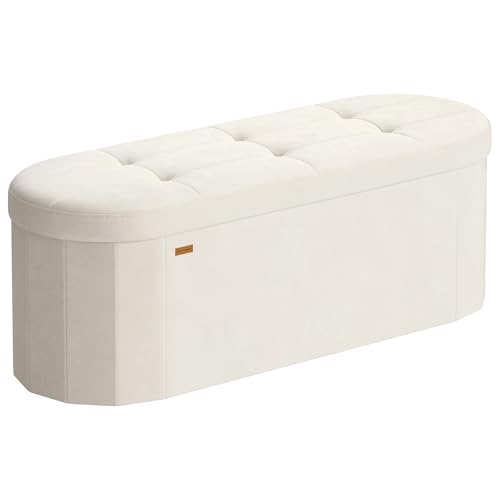
Songmics Folding Storage Ottoman Bench
Best for: households whose needs match its format. Not suited for: anyone expecting it to serve as a step, a ladder, or a hiding place, which no storage ottoman should ever be. Tier: entry-to-mid tier; check the current Amazon listing before you buy.
The Songmics Folding Storage Ottoman Bench is a collapsible bench format that folds flat when empty, suits renters and spare rooms, and gives a long, low profile that slides neatly at the foot of a bed or under a window. In daily use that format decides the experience more than any finish: how the lid behaves when your hands are full, how the cavity swallows a folded throw, and how the piece sits after a full evening of use all follow from it. Load it with soft goods first, confirm the lid action suits everyone in the house, and pay particular attention to the hinge or folding joints, because those are the parts that will be exercised thousands of times over the piece’s life.
Strengths and trade-offs, stated plainly. Strengths: it combines seating or foot-resting with genuinely useful enclosed storage in one footprint; its format suits the job described above; and it can be repositioned or repurposed as rooms change. Trade-offs: like every model in this category, its cavity has limited airflow, so only clean, fully dry textiles belong inside; its sitting guidance is a static-load figure for seated use only; and its lid must be treated with the respect set out in the safety section of this guide, especially in homes with children.
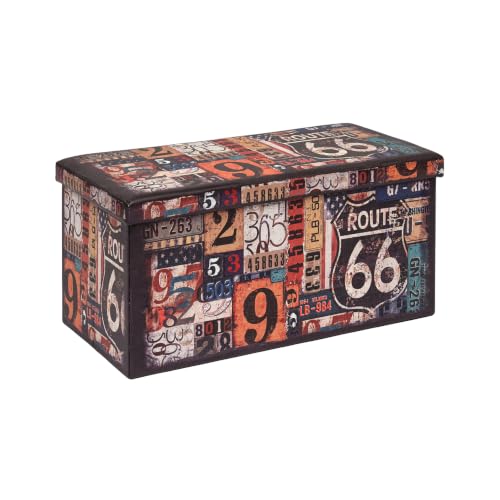
B FSOBEIIALEO Faux Leather Storage Ottoman
Best for: households whose needs match its format. Not suited for: anyone expecting it to serve as a step, a ladder, or a hiding place, which no storage ottoman should ever be. Tier: entry tier; check the current Amazon listing before you buy.
The B FSOBEIIALEO Faux Leather Storage Ottoman is a compact cube in faux leather that works as a single footrest, a small side seat, and a tidy box for remotes, chargers, and the everyday clutter that migrates across a living room. In daily use that format decides the experience more than any finish: how the lid behaves when your hands are full, how the cavity swallows a folded throw, and how the piece sits after a full evening of use all follow from it. Load it with soft goods first, confirm the lid action suits everyone in the house, and pay particular attention to the hinge or folding joints, because those are the parts that will be exercised thousands of times over the piece’s life.
Strengths and trade-offs, stated plainly. Strengths: it combines seating or foot-resting with genuinely useful enclosed storage in one footprint; its format suits the job described above; and it can be repositioned or repurposed as rooms change. Trade-offs: like every model in this category, its cavity has limited airflow, so only clean, fully dry textiles belong inside; its sitting guidance is a static-load figure for seated use only; and its lid must be treated with the respect set out in the safety section of this guide, especially in homes with children.

SIMPLIHOME Harrison Storage Ottoman
Best for: households whose needs match its format. Not suited for: anyone expecting it to serve as a step, a ladder, or a hiding place, which no storage ottoman should ever be. Tier: mid-to-premium tier; check the current Amazon listing before you buy.
The SIMPLIHOME Harrison Storage Ottoman is a more furniture-like build with a structured frame and upholstered finish, aimed at buyers who want the ottoman to read as a permanent piece rather than a temporary storage box. In daily use that format decides the experience more than any finish: how the lid behaves when your hands are full, how the cavity swallows a folded throw, and how the piece sits after a full evening of use all follow from it. Load it with soft goods first, confirm the lid action suits everyone in the house, and pay particular attention to the hinge or folding joints, because those are the parts that will be exercised thousands of times over the piece’s life.
Strengths and trade-offs, stated plainly. Strengths: it combines seating or foot-resting with genuinely useful enclosed storage in one footprint; its format suits the job described above; and it can be repositioned or repurposed as rooms change. Trade-offs: like every model in this category, its cavity has limited airflow, so only clean, fully dry textiles belong inside; its sitting guidance is a static-load figure for seated use only; and its lid must be treated with the respect set out in the safety section of this guide, especially in homes with children.

Christopher Knight Home Storage Ottoman
Best for: households whose needs match its format. Not suited for: anyone expecting it to serve as a step, a ladder, or a hiding place, which no storage ottoman should ever be. Tier: mid tier; check the current Amazon listing before you buy.
The Christopher Knight Home Storage Ottoman is a design-led option in the tufted, traditional direction, useful where the ottoman needs to hold its own visually beside a rolled-arm sofa or a reading chair. In daily use that format decides the experience more than any finish: how the lid behaves when your hands are full, how the cavity swallows a folded throw, and how the piece sits after a full evening of use all follow from it. Load it with soft goods first, confirm the lid action suits everyone in the house, and pay particular attention to the hinge or folding joints, because those are the parts that will be exercised thousands of times over the piece’s life.
Strengths and trade-offs, stated plainly. Strengths: it combines seating or foot-resting with genuinely useful enclosed storage in one footprint; its format suits the job described above; and it can be repositioned or repurposed as rooms change. Trade-offs: like every model in this category, its cavity has limited airflow, so only clean, fully dry textiles belong inside; its sitting guidance is a static-load figure for seated use only; and its lid must be treated with the respect set out in the safety section of this guide, especially in homes with children.

Adeco Storage Ottoman Chest
Best for: households whose needs match its format. Not suited for: anyone expecting it to serve as a step, a ladder, or a hiding place, which no storage ottoman should ever be. Tier: mid tier; check the current Amazon listing before you buy.
The Adeco Storage Ottoman Chest is a chest-style format with a generous single cavity, better for blankets and bulkier soft goods than for small items that would disappear into a deep, undivided space. In daily use that format decides the experience more than any finish: how the lid behaves when your hands are full, how the cavity swallows a folded throw, and how the piece sits after a full evening of use all follow from it. Load it with soft goods first, confirm the lid action suits everyone in the house, and pay particular attention to the hinge or folding joints, because those are the parts that will be exercised thousands of times over the piece’s life.
Strengths and trade-offs, stated plainly. Strengths: it combines seating or foot-resting with genuinely useful enclosed storage in one footprint; its format suits the job described above; and it can be repositioned or repurposed as rooms change. Trade-offs: like every model in this category, its cavity has limited airflow, so only clean, fully dry textiles belong inside; its sitting guidance is a static-load figure for seated use only; and its lid must be treated with the respect set out in the safety section of this guide, especially in homes with children.
Homebeez Folding Storage Ottoman
Best for: households whose needs match its format. Not suited for: anyone expecting it to serve as a step, a ladder, or a hiding place, which no storage ottoman should ever be. Tier: entry tier; check the current Amazon listing before you buy.
The Homebeez Folding Storage Ottoman is another folding design that prioritises easy setup and light weight, a sensible second ottoman for a guest room, a dorm, or a play corner that is reconfigured often. In daily use that format decides the experience more than any finish: how the lid behaves when your hands are full, how the cavity swallows a folded throw, and how the piece sits after a full evening of use all follow from it. Load it with soft goods first, confirm the lid action suits everyone in the house, and pay particular attention to the hinge or folding joints, because those are the parts that will be exercised thousands of times over the piece’s life.
Strengths and trade-offs, stated plainly. Strengths: it combines seating or foot-resting with genuinely useful enclosed storage in one footprint; its format suits the job described above; and it can be repositioned or repurposed as rooms change. Trade-offs: like every model in this category, its cavity has limited airflow, so only clean, fully dry textiles belong inside; its sitting guidance is a static-load figure for seated use only; and its lid must be treated with the respect set out in the safety section of this guide, especially in homes with children.
Final Recommendation by Use Case
A storage ottoman earns its floor space by doing at least two jobs at once, and the second job is usually the one that decides whether it stays in the room for a decade or gets donated within a year. A beautiful box that is uncomfortable to sit on becomes an obstacle. A supremely comfortable footrest with a shallow, awkward cavity becomes a footrest with a gimmick. Judge both halves of the bargain with equal suspicion, and be especially wary of showroom impressions: a lid that feels plush for thirty seconds may feel very different after a two-hour film, and a cavity that looks generous empty may swallow far less once a folded throw takes its share.
Frequently Asked Questions
Which is better, a storage ottoman or a plain ottoman?
Neither is better in the abstract. The storage ottoman wins when you have soft goods that need a home in that room and you will open it weekly. The plain ottoman wins when you want the simplest, most comfortable footrest or seat with no lid to manage and no cavity to keep dry. Most households can answer the question by looking at the sofa: if it is buried in throws, choose storage.
Is a plain ottoman more comfortable than a storage ottoman?
It can be, because its maker spends the entire build on the seat or footrest surface, with no cavity, lid mechanism, or folding structure to accommodate. In practice the difference at the mid tier is small, and a well-made storage ottoman is comfortable for films and guests. If all-day primary seating is the job, compare specific models on foam and height rather than assuming the category decides it.
Which is safer for a home with children?
A plain ottoman removes the cavity and lid risks entirely, which makes it the simpler safe choice. A storage ottoman can be used safely with a non-slamming lid, supervision, and absolute rules: never a hiding place, never climb inside, because a closed cavity can trap and suffocate, and never stand on either type. Households that doubt the rules will hold should choose the plain design without hesitation.
Which lasts longer, storage or plain?
Plain ottomans generally have fewer failure points: no hinges to loosen, no lid to misalign, no folding frame to bow. Storage ottomans that are framed, well-hinged, and loaded only with soft goods close most of that gap. In both cases the upholstery and foam usually age before the structure does, and care, airing, sunlight, and sensible use, matters more than the category label.
Can a plain ottoman work with separate storage instead?
Very well, and for some rooms it is the smarter system. A plain ottoman plus a lidded basket, a sideboard, or under-sofa boxes separates the jobs so each piece does one thing well, and the storage can be ventilated, which suits textiles in damp rooms. The cost is floor space and visual simplicity: two pieces where the storage ottoman uses one. Small rooms usually favour the combined piece; larger rooms can afford the separation.
Which should a renter choose?
Renters often favour a folding storage ottoman: it arrives compact, needs no assembly tools, stores the blankets that rentals never have cupboards for, and folds flat on moving day. A plain ottoman is equally move-friendly but solves no storage problem. If the rental is long-term and storage is plentiful, a framed plain or storage ottoman in a fabric you love becomes a keep-for-years piece rather than a stopgap.
Related Reading and Next Steps
Keep exploring with these related guides, chosen to sit alongside this one rather than repeat it.


