Disclosure: As an Amazon Associate, dailyhomedecorating.com earns from qualifying purchases. Links on this page are affiliate links; they cost you nothing extra. Prices and availability change often, so check the current Amazon listing before you buy.
This balanced assessment of spice rack pros and cons refuses the usual shortcut of listing easy advantages and forgiving drawbacks, because the category’s real ledger has a twist: the biggest pro and the biggest con are the same decision viewed from two sides. A spice rack organises brilliantly and stores brilliantly — or organises brilliantly while quietly storing your spices in the worst microclimate in the kitchen, since heat, light and steam degrade them and the convenient spot beside the stove is exactly where racks get put. Both columns below are argued honestly, with the placement question running through each, so you can weigh the trade for your own kitchen rather than for a listing photograph.

Key Takeaways
- The core pro: the whole collection visible and reachable, with a definite place for every jar.
- The core con: every rack spends scarce kitchen volume, and the tempting placements damage the contents.
- Drawer and cabinet formats stack the ledger positive; beside-the-hob countertop formats can tip it negative.
- Rigid systems trade jar freedom for order; open systems trade order for jar freedom.
- Most cons are reducible by format choice, measurement and one fixing check — few are inherent.
Quick verdict. For a household whose spice collection has outgrown a single shelf row, the pros of a spice rack outweigh the cons — provided the rack lives in a drawer or cabinet. For a small, stable collection, the cons win by default: the rack solves a problem you do not have. And for any collection, a rack placed beside the hob converts the category’s headline pro — convenience — into its headline con, accelerated flavour loss. Who should buy: the outgrown-collection household with dark storage to offer. Who should skip: the five-jar household, and anyone whose only available spot is warm and bright. The full argument follows; the value framing is in is a spice rack worth it.
In this guide
Spice Rack Pros and Cons: The Pros
Pro: the back-row problem actually ends
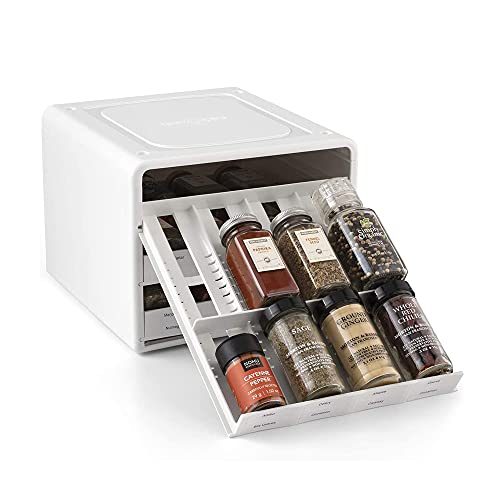
This is the founding promise and it is genuinely kept. Jars in a single shelf row hide everything behind the front line; stepped, slotted, angled and rotating formats all bring the full collection into one glance. The benefit compounds in the moment that matters — mid-recipe, pan live, one hand free — when the difference between seeing the smoked paprika and excavating for it is the difference between a calm cook and a small kitchen incident. Every format delivers some version of this pro, which is why the category exists and why households that adopt a rack rarely go back to the shelf row voluntarily.
Pro: a definite place for every jar is self-maintaining order
Slotted and stepped systems give each jar an address, and addressed storage maintains itself in a way open shelving never does: putting a jar back correctly becomes the easiest available action, so even a tired cook at the end of a long day does it without deciding anything. The second-order benefit is inventory control — an empty slot is a visible, specific reminder of what ran out, which improves shopping lists and quietly ends the duplicate purchases that happen when the original was hiding at the back of a shelf. Order that maintains itself is the rarest commodity in kitchen organisation, and a rack is one of the few purchases that supplies it.
Pro: the right format is also flavour preservation
This is why storage location matters more than rack design. A drawer or a cabinet interior is dark by default, stays close to room temperature, and is shielded from the steam plume that rises off a boiling pan. A rack that puts spices into that dark, cool, dry environment starts with an advantage no amount of clever tiering on a countertop can match. When you compare two racks, compare first where each one will actually live. A plain drawer insert in a cabinet away from the oven will preserve flavour better than a beautiful revolving countertop rack parked next to the kettle, and any honest assessment of a spice rack has to weigh the storage conditions it creates, not just the access it provides.
Count this pro at full weight for drawer and cabinet formats only — but there, it is substantial and continuous. The rack is not merely storing jars; it is holding them, hour after hour, in the conditions that slow flavour loss to its minimum. No other kitchen organiser doubles as an ingredient-quality device. The honest corollary belongs in the cons column, where the same placement logic runs in reverse for countertop formats.
Pro: wasted volume becomes working volume
Kitchens are full of volume that does no work: the inside face of a cabinet door, the dead depth behind a shelf’s front row, a narrow drawer too shallow for utensils, the vertical gap between shelves. Racks are unusually good at colonising exactly these spaces — door racks spend a surface, drawer liners spend a shallow drawer, risers spend the air above a shelf’s jars. A well-chosen rack can therefore add real storage without taking any from elsewhere, which is a pro few storage products can honestly claim. The measurement discipline in our spice rack buying guide is what turns this pro from theory into result.
Pro: the collection becomes legible to the whole household
A racked, labelled collection can be used correctly by everyone in the house — the partner who did not build the system, the teenager cooking alone, the guest helping with a holiday meal. Shelf-row storage, by contrast, is legible only to the person whose memory maps it. Legibility sounds soft and is not: it is the difference between a system that survives its creator’s busy month and one that decays the first week someone else does the cooking. Shared kitchens gain the most here, and gain it immediately.
Pro: it scales from a five-minute fix to a full system
The category’s entry ramp is gentle. A simple riser costs minutes and no commitment; if the habit sticks, the same kitchen can graduate to a drawer conversion or an in-cabinet system, and the riser retires to a pantry shelf still doing honest work. Few home improvements let you test the concept at the lowest tier before spending at the higher ones. This pro matters because the honest answer to ‘will we maintain a spice system?’ is unknowable in advance — the category lets you find out cheaply, in effort terms, before deciding.
The Cons
Con: the tempting placements are the damaging ones
Everything in this guide starts with one uncomfortable fact about spice storage: the enemies of flavour are heat, light, moisture and air, and the typical kitchen rack is placed within reach of all four. Ground spices and dried herbs do not spoil in a way that makes them dangerous in normal home use; they fade. The volatile aromatic compounds that make cumin smell like cumin and paprika taste like paprika evaporate and oxidise, and warmth speeds that process up considerably. A jar sitting beside a hob lives through daily cycles of rising steam and cooking heat, and a jar on a sunny countertop spends its days in direct light. Neither jar is being stored badly in the sense of being dirty or disorganised — both are being stored in the worst possible microclimate in the room, purely because that spot is convenient.
This is the category’s structural flaw: the rack’s convenience argues for the hob-side spot, and the hob-side spot is where spices fade fastest. No other con on this list actively harms the contents; this one does, silently, over months, in the format — countertop, beside the cooker — that marketing photographs favour most. It is entirely avoidable by placement discipline, but a con that requires discipline to avoid is still a con, and it belongs at the top of this column.
Con: every format spends a scarce resource
There is no free rack. Drawer formats spend a drawer; cabinet formats spend a shelf block; door formats spend swing clearance and hinge capacity; countertop formats spend worktop, the scarcest surface in most kitchens. The purchase price is the least of it — the real cost is the opportunity cost of the volume, paid daily, forever. Households that choose a format without honestly auditing which volume they can spare end up resenting the rack for a theft they authorised, and the resentment, not the hardware, is what kills the system.
Con: rigid systems hold your jars hostage
Slotted organisers and jar-set carousels deliver their beautiful order by assuming uniform jars — and the assumption bills you forever. Every new spice must be decanted, funnelled, labelled and dated to join the system; oversized and gift jars do not join at all; part-used originals accumulate in a secondary storage spot you now also need. The order is real and so is the labour, and households that underestimated the labour describe the same arc: a month of compliance, a season of exceptions, a quiet return to chaos with better hardware. Open formats invert this con into a smaller one — they accept every jar and enforce almost nothing.
Con: capacity ceilings invite overflow chaos
A rack holds what it holds. Collections grow by single jars — a recipe’s new spice, a market souvenir, a gift — and the jar that does not fit has to go somewhere: usually the counter beside the rack, then a small crowd beside the rack, then the realisation that the kitchen now runs two systems, one organised and one feral. Buying headroom softens this con without eliminating it, because no headroom survives a genuine change in cooking habits. The con is manageable and permanent, and pretending otherwise at purchase time is how it wins.
Con: door and wall formats can fail physically
Wall-mounted and door-mounted racks carry a load that surprises people. A full set of glass spice jars is genuinely heavy, and a rack concentrates that weight on a small number of fixings that then get tugged every time a jar is pulled out. Into plasterboard without proper anchors, screws will work loose; into a hollow door skin, over-door hooks are safer than screws but the rack must clear the door frame and the shelves behind it through the whole swing. Follow the fixing instructions for your wall type, use the anchors supplied or better ones rated for the material, and test the loaded rack with a firm pull before trusting it above a worktop where people stand. A spice rack failure is a shower of glass and paprika — preventable, and entirely a fixings problem rather than a rack problem.
No other kitchen organiser carries a failure mode like this, and honesty requires naming it in the cons column even though it is a fixings failure rather than a product failure. The rack is only ever as good as its anchors and the door’s hinges, and the load — glass, multiplied — is heavier than intuition says. Households unwilling to do the fixing work properly should read this con as disqualifying for the format and choose a drawer, cabinet or countertop design instead.
Con: upkeep is real, and powder is patient
Spice storage gets dirty in a specific way: fine powders escape every time a jar is opened, and they settle into tray corners, liner grooves and the threads of lids. A rack you cannot easily empty and wash will slowly become a rack you avoid emptying at all. Prefer designs that lift out in one piece, tolerate a sink of warm soapy water, and dry without trapping moisture in joints or fabric. Wipe jars before they go back, check lids for powder in the thread that stops them sealing, and treat the quarterly empty-and-wash as part of the system rather than an admission of failure. This maintenance reality is a genuine point of difference between designs, and it is one glossy product photographs never show.
The con is not that cleaning exists — it is that designs differ in how cleanable they are, and the difference is invisible in listings. Multi-part, fabric-adjacent and deep-grooved designs ask the most and get cleaned the least; single mouldings and wire ask little and get it. Over a year, the cleanability gap becomes a hygiene and morale gap, and it is a legitimate reason to prefer a simpler design over a cleverer one.
What the Trade-Offs Mean for You
For the family kitchen with a real collection, the ledger lands clearly positive in a drawer or cabinet format: the access pro and the self-maintaining-order pro are worth a drawer, and the preservation pro comes free with the address. The cons that remain — upkeep, capacity — are the manageable kind. For the small rental kitchen, the ledger depends entirely on which volume is genuinely spare: a riser in a cabinet is nearly all pro, a carousel on the only worktop is nearly all con, and a door rack is a pro with a fixings asterisk. For the flavour-first cook, the ledger is decided by one line — placement — and every other entry is rounding. For the five-jar household, the honest ledger says skip the category: a tray in a cabinet delivers the pros that apply at that scale, and every con on the list is a cost paid to solve a problem that does not exist.
Two profiles deserve a direct word. The matched-set dreamer, buying a carousel with jars for the photograph, is purchasing the category’s worst combination: rigid-system labour plus countertop placement risk. The same money and enthusiasm aimed at a drawer conversion produces a system that still looks superb when the drawer opens — and keeps the contents tasting as they should. The reluctant organiser, who doubts the household will maintain anything, should weight the self-maintaining-order pro highest and choose slotted or stepped formats whose correct use is the path of least resistance — and should avoid open shelves, whose small daily tidiness tax is exactly what reluctant households stop paying.
The Context: Two Alternatives Weighed
Against a plain cabinet shelf — the default alternative — a rack wins on access, inventory and order, and ties or wins on preservation provided it lives in the same cabinet. The shelf’s only victories are zero cost, zero volume commitment and infinite jar forgiveness, which is why the shelf remains the right answer for small collections. Against a simple tray or box in a drawer, the rack’s margin narrows: the tray delivers darkness and most of the access for almost no effort, and loses mainly on scan speed and per-jar order. Households between ‘small collection’ and ‘real collection’ should start with the tray and let its shortcomings, experienced rather than imagined, argue for the rack. The model-level comparisons behind this context are in our spice rack reviews.
How to Buy Smart
Buying smart in this category means converting the cons list into a checklist and refusing any product that fails an item you cannot fix later. Measure the host space internally — drawer height, cabinet depth, door swing — because fit cons are permanent. Count the collection, packets and duplicates included, because capacity cons arrive on schedule. Decide the decanting question with your eyes open, because jar-hostage cons bill monthly. Audit the placement for heat, light and steam before falling for a format, because the placement con is the only one that damages dinner. And if the format hangs on a door or wall, price the fixings and the ten careful minutes they deserve into the purchase. The step-by-step version of this checklist is how to choose a spice rack.
Decide early whether you will decant. Racks fall into two camps: those designed around a matched set of jars they supply or assume, and open platforms — risers, shelves, liners — that accept whatever jars you already own. Decanting into uniform jars looks tidy, makes labels consistent, and lets a drawer system hold more, but it costs time at every refill, creates a funnel-and-spillage ritual, and leaves you storing half-empty original containers somewhere else anyway. Keeping supermarket jars avoids all of that but means mixed heights and widths that waste space in rigid trays. Neither answer is wrong; the mistake is buying a rigid, jar-specific system while intending to keep a mismatched collection, or buying an open riser and then being annoyed that the result does not look like a magazine photograph.
Setup and Care That Reduce the Cons
Most cons shrink under decent setup. The placement con disappears entirely if the rack’s home is chosen by the storage science rather than by the photograph — drawer or cabinet, away from the oven wall, out of the sun’s daily path. The overflow con shrinks if you load the system with deliberate gaps and adopt a one-in-one-out rule for the working set. The upkeep con shrinks if the quarterly empty-and-wash is treated as part of the system, jars are wiped before they go back, and lids are checked for powder in the thread that breaks the seal. The legibility con — the one where only one household member can work the system — shrinks with labels on the surface the eye actually meets and one organising logic, kept stable for a month before anyone is allowed to call it wrong.
Once the rack is in, choose an organising logic and stick to it for at least a month before judging it. Alphabetical order is the easiest to search and the easiest for other household members to maintain, because there is exactly one right place for everything. Grouping by cuisine — the curry spices together, the baking spices together — matches how recipes are actually cooked and keeps a whole flavour family in one grab. Grouping by frequency puts the daily handful at the front and the once-a-year jars at the back, which is efficient but drifts as habits change. Most households end up with a hybrid: frequency at the front, alphabetical within groups. The rack does not care; your future self, mid-recipe with wet hands, cares a great deal.
Whatever rack you choose, add one habit that costs nothing: write the month and year you opened each spice on the underside of the jar or on a small label. Ground spices give their best for a matter of months rather than years once opened, and whole spices keep their character considerably longer, but without a date you are guessing from memory, and memory is optimistic. A rack makes this easier, not harder — when every jar faces you in a row or a tier, a quick scan of dates during a tidy-up tells you which jars to use up first and which ones have quietly become coloured dust that will disappoint the next sauce you stir them into.
Bottom Line
The spice rack’s pros are structural — access, order, inventory, reclaimed volume, and, in the dark formats, preservation — and its cons are mostly conditional: placement, volume, jar rigidity, capacity, fixings and upkeep, every one of them reducible by a decision made before or during setup. That asymmetry is the bottom line. A category whose drawbacks yield to measurement, counting and one honest placement decision is a category worth buying into, at the scale your collection justifies and in the format your kitchen can host in the dark. The single-format deep dive is our spice rack review; for storage thinking beyond the kitchen, see storage baskets and vacuum storage bags.
The Ledger, Kitchen by Kitchen
The pros and cons in a family kitchen
In a family kitchen the pros compound and the cons mostly shrink. Volume is the exception: family kitchens are the most contested real estate in the house, and a drawer given to spices is a drawer taken from the utensil overflow that also has nowhere to live. But the access pro is collected by more hands more often, the legibility pro matters most where several cooks share one system, and the self-maintaining order pro is worth the most precisely where the household has the least tidiness to spare. The capacity con arrives fastest here — family collections grow with appetites and adventurous teenagers — so this is the kitchen that should buy headroom most generously. Net: strongly positive, in a dark format, sized up.
The pros and cons in a one-person kitchen
The solo kitchen inverts several weights. Legibility barely matters — the system’s only user is its author — and retrieval is already half-memorised, so the access pro shrinks to its inventory half: even a solo cook buys duplicates when the back row hides. Volume, though, is usually less contested, and upkeep falls on the one person whose standards set it, which makes the tidier rigid systems more viable here than anywhere else. The placement con is unchanged — steam fades a solo cook’s paprika exactly as fast — and it remains the line that decides the ledger. Net: positive for a real collection, with the format free to be as personal as the cook likes.
The pros and cons in a rental kitchen
Rentals add a constraint the other kitchens do not have: nothing may be screwed, glued or altered that cannot be restored. That constraint deletes the wall-mounted format, taxes the door formats down to their over-door variants, and promotes the riser and the liner — both fully reversible — to the top of the list. The pros survive the translation intact, because access, order and dark storage do not care who owns the walls. The one con that grows is the exit cost of matched jar sets, which move house badly and multiply boxes; the renter’s ledger favours systems that pack flat and forgive the next kitchen’s different dimensions. Net: positive, in the portable formats, with a bias against anything that assumes this kitchen is forever.
Two More Honest Entries for Each Column
Pro: it disciplines buying, not just storing
An under-sung pro: a racked collection with visible gaps makes spice buying calmer and better. You shop against a known inventory, you notice the jar that is nearly empty before the recipe does, and the market souvenir has to justify the slot it will occupy — a small friction that improves the collection’s average quality over time. Households report the same side effect from any visible-inventory system, from pantry shelves to the wine racks this site also covers; the rack simply brings the effect to the smallest, most-used ingredients in the house.
Pro: it makes the kitchen kinder to guests and helpers
Cooking together is one of the house’s pleasures, and shelf-row storage quietly taxes it — every helper needs the map in the owner’s head. A labelled rack removes the tax. The pro sounds social rather than practical, and it is both: the holiday meal with three cooks moving without collisions is a practical outcome, and it is delivered by the same per-jar order that serves the solo Tuesday. Systems that only their creators can operate are a mild household tyranny; racks, at their best, are the opposite.
Con: it can freeze a collection that wants to evolve
A subtler con: a full, beautiful, rigid system resists change. The cook who wants to shift toward whole spices, or toward a new cuisine with a dozen unfamiliar jars, faces a system with no vacancies and a jar format that does not match the new arrivals — and the system’s very completeness argues against the evolution. Open formats and headroom are the mitigations, but the con deserves naming because it is the one that arrives latest and surprises most: the rack you bought to serve your cooking can, if bought too rigidly and too exactly, start quietly governing it.
Con: the first month lies, in both directions
Ownership has a deceptive opening act. The first fortnight flatters every system — anything is better than the shelf row was — and weeks three to six are when the real cons surface: the refill ritual’s true cost, the top tier’s reach, the packet problem, the slot that two jars both want. Households that judge in the first month keep systems they will resent; households that judge in the third week abandon systems that were about to settle. The con is not in the product but in the evaluation window, and the defence is the discipline this article has recommended throughout: live with the system a full month, through ordinary weeks and one big cook, before letting the ledger close.
Where the Ledger Stands, One Year On
Project the entries forward a year and a pattern emerges: the pros are all still paying, because access, order, inventory and dark storage do not depreciate, while most cons were one-time or seasonal — the volume decision, the setup labour, the first wash’s discovery — with only upkeep and capacity management recurring. That asymmetry is the strongest structural argument in the category’s favour, and it holds in every kitchen profile above. The exceptions are the two cons that do compound: bad placement, which taxes the collection every single day it is left uncorrected, and rigid-jar lock-in, whose labour is billed at every refill. A household that avoids those two — by choosing location before product and jars before format — holds a ledger that improves with age, which is more than most kitchen purchases can claim.
The Pro and Con That Share a Root: Visibility
It is worth pausing on the strangest entry in this ledger, which is that the category’s greatest pro and one of its quiet cons grow from the same root: visibility. The pro is documented above — inventory truth, creative reach, systems guests can use. The con is that a visible collection is a collection you must look at, and looking creates obligations: the faded label, the nearly-empty jar, the duplicate — all the small untidinesses a closed shelf mercifully concealed now present themselves for action every time the drawer opens or the cabinet door swings. Most households experience this as the pro it mostly is. Some experience it as a low-grade nag built into the furniture, and reorganise compulsively, and enjoy cooking marginally less in a kitchen that keeps showing them homework. The honest mitigation is placement within the system: the working collection visible, the archive — the occasionals, the backups — in the system’s least-seen tier, where it can be forgotten in peace until its day comes. Visibility, dosed, is the pro; visibility, total and unrelenting, is the con wearing the pro’s coat.
How the Ledger Shifts as Collections Grow
The pros and cons in this article were weighed at the scale of a typical collection, and the ledger is not scale-invariant. At the small end, as established, the cons win by default: the volume and upkeep costs are fixed while the access pro shrinks toward nothing. Through the middle scales the pros dominate increasingly, because every pro — scanning, inventory, order — is worth more per jar as jars multiply, while the cons stay roughly constant: a drawer is a drawer whether it holds twenty jars or forty. At the very large end the ledger tilts again, subtly: no single format holds a serious collector’s hundred-plus jars gracefully, systems split across two locations, and the legibility pro frays as the map grows two territories. The collector’s answer is a primary system plus a deliberate archive — depth storage for the occasionals, the working set racked and visible — which is really the admission that at that scale the question stops being ‘a spice rack’ and becomes spice storage design. Most households will live their whole cooking lives in the middle scales, where this article’s verdict — pros ahead, on conditions — holds comfortably.
One scale effect deserves its own warning because it ambushes the middle-scale household from inside: the collection that grows because the rack made buying pleasant. Visible gaps invite filling; a handsome system invites completing. There are worse vices than a growing spice collection, but the household that notices its count doubling in a year should check whether the cooking doubled with it — and if it did not, the capacity con has found its subtlest route in, through the pro door, carrying a gift set.
The Shortest Honest Version
If this article’s whole ledger had to fit in a breath, it would read: a spice rack gives you a collection you can see, reach and trust, in exchange for a drawer, a shelf block, a door or a counter you must honestly spare — and the exchange is fair in the dark and a swindle in the sun. Everything above is the working-out of that sentence: the pros itemised and defended, the cons named without flinching, the kitchens profiled, the scales weighed, the two compounding cons — placement and lock-in — flagged in the largest type the format allows. A reader who remembers only the breath has the decision; a reader who worked through the ledger has the reasons, and reasons are what survive the first month, when the breath has been forgotten and the system is being judged by a tired cook at the exact moment it was built to serve.
The Tiebreaker Questions
For the reader whose ledger, honestly weighed, still balances — and this article respects that outcome, because it is the common one — three tiebreaker questions cut closer than any further itemising. First: which mistake would you rather live with — the mild daily friction of the shelf row, or the fixed cost of volume you occasionally miss? The rack’s cons are mostly fixed and known; the shelf’s cons are variable and daily, and temperaments differ honestly on which tax they would rather pay. Second: how does your household treat systems generally — do the labelled freezer boxes and the sorted tool drawer in your home testify for you or against you? Past systems are the best predictor of this one, and the ledger should be adjusted by that evidence without shame in either direction. Third: is the collection growing or resting? A growing collection converts several cons into investments and several pros into necessities; a resting one does the reverse. Answer the three, and the balance that itemising could not break usually breaks — which is, in the end, what a pros and cons article is for: not to decide for you, but to make your decision about the real trade, in your real kitchen, with both columns finally honest.
A Note on How This Ledger Was Kept
Pros and cons articles earn their keep by refusing to be brochures, so a word about method belongs on the record. Every pro in this article was required to name its mechanism — not ‘convenient’ but the glance, the slot, the empty space that shops for you — and every con was required to name its condition: the kitchens, collections or habits under which it actually bites. Entries that could not name a mechanism were cut, however traditional; entries that could not name a condition were demoted, however loudly they are usually printed. What survived is shorter than the category’s usual ledger and, this article believes, truer: a set of advantages that operate daily and a set of costs that operate conditionally, with the conditions spelled out so each reader can total their own column. If the totals differ from this article’s verdict — pros ahead, in the dark, at the right scale — the method has still done its work, because the verdict was only ever an example total. Yours is the one that gets cooked with.
Signing the Ledger
Every ledger ends with a signature, and this one is signed with a condition rather than a flourish. The pros of a spice rack are real, mechanical and daily; the cons are real, conditional and mostly choosable-away; and the single variable that decides which column a given household experiences is the one this article has returned to in every section — where the rack lives. Sign for the drawer or the cabinet and the ledger is an asset. Sign for the bright strip beside the hob and the same signature buys the liability. The article’s work is done if that choice — the cheapest, earliest and most consequential in the whole category — is now impossible to make by accident.
Filed under both columns, because it belongs to each: a spice rack makes the collection’s true size undeniable. Households that like what the count reveals call that honesty a pro and organise with pride; households that do not call it a confrontation and quietly prefer the shelf’s merciful fog. Neither reaction is wrong, and the article declines to total it — some entries in a life ledger are information, not arithmetic, and this one has ended more arguments at kitchen tables than any other line in the survey.
Totalled, signed and filed, the ledger’s last entry is the reader’s own kitchen, which will cast the deciding vote the first time its drawer opens on a row of jars standing in the dark, each one findable, dated and ready — or the first time it does not, and the fog rolls back in.
And if the vote goes the other way — if the fog is preferred and the shelf keeps its counsel — that too is a legitimate total, honestly reached, and the article’s columns will wait, unoffended, for the day the collection outgrows the fog and the question reopens itself.
Beyond the Summary: How the Spice Rack Trade-Offs Play Out at Home
Advantages and disadvantages read differently once an item is in daily use, so this section weighs the spice rack the way a household experiences it over months rather than minutes. It focuses on the frictions, workarounds and quiet benefits that decide whether the balance stays positive.
Start With Your Space and Your Routine
Take a break between shortlisting and ordering if you can, and return to the listings with fresh eyes, because fatigue makes almost any spice rack look acceptable late in a long search. If a part of the spice rack can be replaced, refreshed or re-covered separately, that option can extend its useful life well beyond the point where a sealed design would be thrown out. Read the listing for what it does not say as carefully as for what it does, because missing information about materials, assembly or care is itself a useful signal when you compare spice rack options. Equally, list what your old spice rack did well, because replacements sometimes quietly lose a virtue you relied on, such as a size, a shape or a simplicity the new model has redesigned away.
The strongest argument for a spice rack is usually a boring one, such as suiting the space exactly or being easy to keep clean, while the strongest argument against it is often an everyday friction rather than a dramatic flaw. A good test is the two-week question: imagine the spice rack after a fortnight of ordinary use, with no special effort from you, and ask whether you would still choose it. If you are replacing an older spice rack, list what failed or frustrated you about it, and check each item on that list against the new listing before you order its successor. A spice rack that fits on paper can still fail in daily use if a doorway, a corner, a cupboard door or a walkway cuts into the space it needs, so trace the full path from delivery to final position.
When Small Problems Appear
Measure the space where the spice rack will live, including the clearance needed to use it, move around it and clean behind or beneath it, and keep those numbers beside you while you compare options. Decide in advance which single feature you would refuse to compromise on, and let that one priority settle ties between otherwise similar spice rack choices. Think about the season in which the spice rack will work hardest, and judge it against that season rather than the mild week in which you happen to be shopping. Storage is part of ownership, so decide now where the spice rack, its accessories and its seasonal extras will go when they are not in use, and measure that space too.
A fair pros-and-cons judgement needs a time horizon, so weigh the spice rack twice: once for the first month, when convenience and appearance dominate, and once for the second year, when durability and upkeep decide whether it was a good buy. A slight wobble, a stiff action or a small misalignment on day one rarely improves on its own, so address it during setup while adjustments are still easy to make. A return is easiest when you have kept the packaging until you are sure, so give the spice rack a fair trial period in its real position before you break down boxes and dispose of padding. When something about the spice rack starts to annoy you, note whether the cause is the product itself, its position, or the way it is being used, since each cause has a different and usually cheaper fix.
Take a photograph of the space before you order and mark the intended position of the spice rack on it, then revisit that photo whenever a listing tempts you toward a larger or different style.
A Short Decision Checklist
- Delivery path, from the door to the final position
- What your current arrangement does badly that the spice rack must fix
- The material and finish, matched to light, moisture and wear in its spot
- How the spice rack will be cleaned in an ordinary week
- The one feature you will not compromise on
- Packaging kept until the spice rack has passed its first trial in place
- What your current arrangement does well that the spice rack must not lose
- Where the spice rack and its accessories will be stored when not in use
Taken together, these checks take only a little time, yet they answer the questions that decide whether the spice rack suits your home, your household and your routine, and they do so before money changes hands rather than after.
Frequently Asked Questions
What is the biggest advantage of a spice rack?
Self-maintaining order. A rack gives every jar a definite place, which makes the whole collection visible in one glance, makes putting jars back correctly the easiest option even for a tired cook, and turns an empty slot into a shopping reminder. Access is the visible benefit; the order that survives a busy month is the valuable one. In drawer and cabinet formats there is a second, quieter advantage: spices stored dark, cool and dry simply keep their flavour longer.
What is the biggest disadvantage of a spice rack?
Placement risk. The spot every instinct chooses — beside the hob, on the bright counter — exposes spices to the heat, steam and light that fade them fastest, so a badly placed rack can leave your ingredients worse off than a plain dark shelf did. The disadvantage is avoidable: put the rack in a drawer or cabinet away from the cooker. But it is the one con that harms the contents rather than merely inconveniencing the owner, which is why it tops the list.
Do spice racks work for small spice collections?
Mostly they are unnecessary at small scale. A handful of jars in a tray or small box inside a cabinet gets the dark storage and adequate access without spending a drawer, a shelf block or any money on hardware. The rack’s pros — scan speed, per-jar order, inventory gaps — only start paying once the collection is large enough to hide duplicates and back rows from you. If you are regularly surprised by what you own, the collection has crossed the line and the pros apply.
Are drawer spice racks better than cabinet spice racks?
They trade blows rather than one winning. A drawer offers the best label visibility in the category — every jar readable in one pull — and equal darkness and temperature stability. A cabinet system offers more volume, keeps drawers free for utensils, and suits cap-labelled jars. The decider is your kitchen’s spare volume and your jars’ label orientation, not a universal ranking. Both sit firmly on the pro side of the placement question, which matters more than the difference between them.
What are the disadvantages of a countertop spice rack?
Three: it spends worktop, the scarcest surface in most kitchens; it stores spices in light, which fades them; and in its usual position near the cooker it adds heat and steam exposure, completing the worst storage climate available. Its genuine pro — the fastest access of any format — is real but small, measured in seconds per meal. On a shaded pantry counter away from cooking, the disadvantages mostly evaporate and the format becomes defensible; beside the hob, they compound daily.
How do I avoid the common downsides of owning a spice rack?
Measure the host space internally, count the real collection including packets and duplicates, decide about decanting before choosing a rigid system, place the rack dark and cool rather than convenient and bright, verify fixings on anything that hangs, and leave headroom for growth. Each of those six moves neutralises one named con in this article. The households that end up disliking their racks almost always skipped two or more of them; the households that love theirs usually cannot remember deciding anything at all — because the decisions were made once, correctly, at setup.
Related Reading
Related storage ledgers and systems: makeup organisers for small-item order, under-bed storage for colonising dead volume, and storage ottomans for storage that doubles as furniture.