Disclosure: As an Amazon Associate, dailyhomedecorating.com earns from qualifying purchases. Links on this page are affiliate links; they cost you nothing extra. Prices and availability change often, so check the current Amazon listing before you buy.
An honest ottoman review has to start with what daily life actually asks of this piece, because an ottoman is never just an ottoman in a real home. This ottoman review looks at design, comfort, storage behaviour, stability, and care, and it keeps the safety points front and centre where they belong.
Key Takeaways: Match the ottoman height to your sofa seat so your legs rest level. Decide first between a soft comfort top and a firm tray-friendly top. Treat a lidded storage ottoman as adult-only space, never a toy or hiding place. Never stand on an ottoman. Check leg and caster stability on your actual floor before you commit.
What an Ottoman Is and Where It Fits — The Ottoman Review Overview
For homes with dogs, claw resistance and cleanability top the list. Tight weaves resist snagging, removable covers are worth celebrating, and darker mid-tone colours forgive the paw-print days. For homes with cats, a texture that does not invite scratching matters more than colour; smooth fabrics give claws less purchase and fewer threads to pull.
Assembly, where it exists, is usually limited to attaching legs. Even so, do it properly: tighten evenly, check for wobble on a hard floor rather than carpet, and re-check after the first week once everything has settled. Keep spare felt pads in a drawer; they are the cheapest comfort upgrade in the whole house.
When you shop, sit on your own sofa first and take honest stock: how do you actually sit, sideways with feet up, upright with feet flat, or stretched full length? Your dominant posture tells you the size, height, and firmness you need far better than any showroom test on an unfamiliar sofa. Buy for the body and habits you have, not the ones in the catalogue photograph.
Real leather develops character over the years and often outlasts fabric, but it asks for occasional conditioning and dislikes being parked in harsh direct sunlight. Velvet brings a rich, light-catching finish that photographs beautifully and feels wonderful underfoot, yet it shows pressure marks and needs gentle brushing to keep the pile lively. Linen-look fabrics breathe well and suit relaxed rooms, though they can crease and are slower to forgive a red-wine moment.
Safety warning that comes before everything else in this guide: a lidded storage ottoman is never a toy and never a hiding place. Children must never climb inside a storage ottoman, not for a game, not for hide and seek, and not even for a moment while an adult is nearby. If the lid closes over a child inside, the child can be trapped in a dark, airless space and may not be able to push the lid open from within. State this rule plainly to every child in the home, repeat it often, and treat the storage compartment as adult-only space for blankets, remotes, and linens. If a storage ottoman will live in a home with young children, choose a model whose lid cannot slam or latch, keep the compartment filled so there is no inviting empty cave, and consider a non-storage ottoman until the children are older.
In this guide
Design, Build and Setup
Reading nooks are built around the ottoman moment: chair, lamp, and somewhere perfect to put your feet. In a nook, comfort outranks everything, so a soft top at exactly the right height for your chair matters more than tray stability or extra seating. This is the one spot where buying purely for your own legs is entirely justified.
Colour strategy deserves a calm moment. Matching the ottoman exactly to the sofa creates a calm, chaise-like run of upholstery that lengthens the seating visually. Contrasting the ottoman, in a deeper tone or a pattern, makes it a deliberate accent and hides everyday marks more forgivingly. A middle path, same family of colour but a shade apart, gives definition without shouting.
The ottoman is the hardest-working piece in many living rooms precisely because it asks for so little. It does not dominate the layout, it does not demand a wall, and it quietly absorbs whatever the day needs from it: a footrest during a film, an extra seat when a friend drops by, a soft landing spot for a book and a cup of tea, or a bridge between a sofa and a chair that makes conversation easier.
Care is mostly a rhythm rather than a chore. Vacuum upholstery weekly with a soft brush attachment so grit does not grind into the fibres. Blot spills immediately, working from the edge inward so the mark does not spread, and test any cleaner on a hidden patch first. Rotate and flip reversible cushions where the design allows, so the favourite spot does not wear faster than the rest.
Height is the quiet detail that decides whether an ottoman feels wonderful or vaguely wrong. The top of the ottoman should sit at roughly the same height as your sofa seat, or a touch lower, so your legs rest close to level with your feet supported rather than dangling or propped at an awkward upward angle. If the ottoman towers above the seat cushion, your knees ride high and your lower back complains within the hour. If it sits far below the seat, your heels dig in and your calves take the strain. Sit on your sofa in your normal shoes-off lounging position before you order, picture where your feet naturally land, and choose a height that meets them there.
Performance in Real Use
Everyday Lounging and Film Nights
A firm top and a soft top are different tools. A firm, flat-topped ottoman can hold a tray steady and double as a casual coffee table, which suits households that entertain with drinks and board games. A deeply cushioned, tufted top is a pure comfort piece: wonderful for heels and calves, hopeless for balancing a mug. Decide honestly which job matters more in your home, because very few designs do both jobs equally well.
In a large room, scale is the trap. A small ottoman in front of a generous sectional looks lost and feels mean underfoot, while an oversized piece can balance the visual weight of a big sofa and give the whole seating group a centre. When in doubt, mock up the footprint with painter’s tape on the floor and live with the outline for a day before ordering.
Placement rewards a little experimentation. Start with the ottoman a comfortable leg-stretch from the sofa, then live with it for a week before deciding it belongs anywhere else. Most households find the piece migrates: closer for film nights, pushed aside for play on the floor, pulled up to an armchair for reading. That mobility is the point, and a piece that is too heavy or too precious to move loses half its value.
Extra Seating When Guests Arrive
Upholstery choice shapes daily life more than colour does. Smooth woven fabrics wipe down easily and suit homes with pets that shed, because hair lifts off instead of weaving in. Deep textures and loose weaves feel luxurious and hide crumbs well, but they hold onto pet hair and need more frequent attention with a lint brush. Faux leather wipes clean in seconds and shrugs off spills, though it can feel cool in winter and warm in summer against bare legs.
Sunlight fades upholstery unevenly, and an ottoman parked half in a sunny patch can end up two-toned. If your room has strong sun, shift the piece occasionally or choose a fabric with a reputation for holding colour. Leather especially benefits from being kept out of the harshest midday light and away from radiators that dry it out.
Construction you cannot see still matters. A frame that feels rigid when you rock the piece side to side will stay quiet for years, while one that creaks and flexes on day one rarely improves. Dense foam keeps its shape and support; very soft, cheap foam feels lovely in the showroom and then pancakes into a permanent dip where heels land every evening.
Storage Duty and Daily Tidiness
Stitching tells the truth about care in manufacturing. Even seams, tight corners, and piping that runs true suggest a maker who sweated the details you cannot see either. Loose threads, puckered joins, and a base cloth stapled carelessly are warnings worth heeding, because upholstery faults almost never stay merely cosmetic.
Guests change the calculation. If your home regularly hosts, an ottoman wide and firm enough to serve as a real extra seat is worth prioritising, and a pair of smaller ottomans can be more flexible than one large piece, splitting to flank a chair or joining to form a shared footrest. Think about your last three gatherings and buy for the pattern you actually live.
Seasonal flexibility is a hidden strength. In winter the ottoman holds the extra blanket within reach of the sofa; in summer it clears to open up the room and can carry a plant or a stack of art books as a soft display surface. A piece that adapts across the year rarely ends up in the category of furniture you regret.
Small Rooms and Flexible Layouts
Round ottomans soften a room full of straight lines and are kind to shins in tight walkways, since there are no corners to catch. Rectangular ottomans stretch along a sofa or a chaise and give two people room to share. Square ottomans anchor a pair of chairs neatly. Cube ottomans tuck into corners and multiply well, two or three in a row reading as a bench when guests arrive.
In a small room, an ottoman earns its keep by replacing two pieces at once. A storage ottoman can swallow the throw blankets, game controllers, and chargers that otherwise colonise the sofa, letting you skip a side table or a storage basket. A lightweight ottoman can move from footrest to spare seat to bedside perch in a studio flat, which is exactly the flexibility small spaces demand.
Entryways are an underrated ottoman location. A compact, sturdy ottoman by the door gives everyone a seat for boots and laces, and a storage version swallows hats, gloves, and dog leads. Choose hard-wearing fabric there, because entryway furniture meets wet weather, grit, and bags in a way living-room pieces never do.
An ottoman is a footrest and an occasional perch, not a step stool. Standing on an ottoman to reach a shelf, change a bulb, or hang a picture is a genuine fall risk: the cushioned top shifts underfoot, the piece can tip or slide, and there is nothing to hold on to. Sit on it briefly to pull on shoes if the frame feels solid, but never stand on one, and never let children treat it as a climbing platform. For anything above comfortable reach, use a proper step ladder with a handhold and put the ottoman back to its real job under your feet.
Strengths and Trade-Offs
Strengths:
- One piece covers footrest, spare seat, and tray surface duties.
- Softer and safer in family rooms than a hard-edged coffee table.
- Easy to move, restyle, and reposition as the room changes.
Trade-offs:
- Cushioned tops are poor drink surfaces without a tray.
- Storage versions demand strict child-safety discipline.
- Foam and fabric quality vary widely between price tiers.
A tray transforms an ottoman’s usefulness. A large, rimmed tray creates a stable island for drinks, remotes, and a vase, and lifts away when the piece goes back to footrest duty. Choose a tray with a little weight to it so it does not skate, and keep its footprint comfortably inside the ottoman’s top so the edge of a glass never hangs over the curve of the cushion.
Delivery and access deserve thirty seconds of thought. Measure your doorways, hallway turns, and any tight stair corners, and compare them with the packaged size where it is listed. Most ottomans pass easily, but oversized and storage designs can be surprisingly bulky, and discovering that on the doorstep helps nobody.
How It Compares
The table below compares the ottoman types discussed in this review in qualitative terms only, because the right choice depends on your room and habits rather than on any single measurement.
| Type | Best at | Watch out for |
|---|---|---|
| Storage ottoman | Hiding blankets and clutter | Lid safety around children |
| Cocktail ottoman | Tray-friendly flat surface | Less plush for heels |
| Tufted ottoman | Pure lounging comfort | Nothing balances on top |
Christopher Knight Home Ottoman
The Christopher Knight Home Ottoman is an upholstered living-room ottoman known for tailored shapes, tufted and rolled details, and fabrics that suit traditional and transitional rooms. In prose terms it sits in the mid tier of its category: not a disposable flat-pack afterthought, and not a heirloom-priced statement either, but the sensible middle where most happy purchases live. Check price on Amazon for the current listing, and treat any listing photos as a guide to shape and finish rather than a promise about how the fabric will look in your light.
Best for: readers who want a recognisable, widely stocked design with plenty of owner feedback to browse before deciding. Not suited for: anyone who needs a very specific custom fabric or an exact colour match to an existing suite, where a made-to-order route serves better.
Strengths in daily use include a shape that suits its stated job, upholstery that handles ordinary family life, and proportions that work in a typical living room without overwhelming it. The honest trade-off is that widely sold designs are built to a price, so the foam and fabric are good rather than luxurious, and the piece rewards realistic expectations.

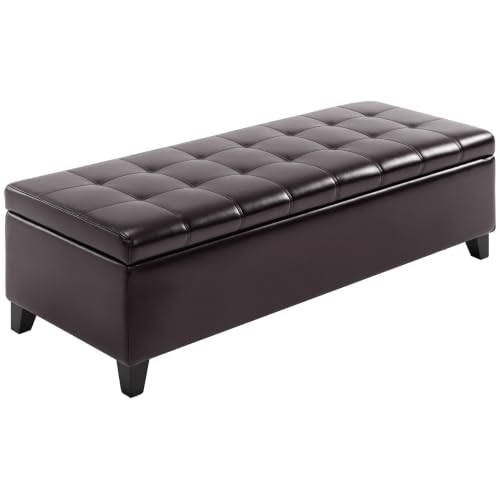
HOMCOM Storage Ottoman
The HOMCOM Storage Ottoman is a practical storage ottoman line built around hinged lids, roomy blanket-sized compartments, and easy-clean faux leather finishes. In prose terms it sits in the mid tier of its category: not a disposable flat-pack afterthought, and not a heirloom-priced statement either, but the sensible middle where most happy purchases live. Check price on Amazon for the current listing, and treat any listing photos as a guide to shape and finish rather than a promise about how the fabric will look in your light.
Best for: readers who want a recognisable, widely stocked design with plenty of owner feedback to browse before deciding. Not suited for: anyone who needs a very specific custom fabric or an exact colour match to an existing suite, where a made-to-order route serves better.
Strengths in daily use include a shape that suits its stated job, upholstery that handles ordinary family life, and proportions that work in a typical living room without overwhelming it. The honest trade-off is that widely sold designs are built to a price, so the foam and fabric are good rather than luxurious, and the piece rewards realistic expectations.

Songmics Storage Ottoman
The Songmics Storage Ottoman is a folding storage ottoman range popular for its collapsible frame, divided interior, and second life as a spare seat or side table. In prose terms it sits in the mid tier of its category: not a disposable flat-pack afterthought, and not a heirloom-priced statement either, but the sensible middle where most happy purchases live. Check price on Amazon for the current listing, and treat any listing photos as a guide to shape and finish rather than a promise about how the fabric will look in your light.
Best for: readers who want a recognisable, widely stocked design with plenty of owner feedback to browse before deciding. Not suited for: anyone who needs a very specific custom fabric or an exact colour match to an existing suite, where a made-to-order route serves better.
Strengths in daily use include a shape that suits its stated job, upholstery that handles ordinary family life, and proportions that work in a typical living room without overwhelming it. The honest trade-off is that widely sold designs are built to a price, so the foam and fabric are good rather than luxurious, and the piece rewards realistic expectations.
Who Should Buy It and Who Should Skip It
Longevity is mostly about honest use. An ottoman asked to be a footrest, an occasional seat, and a tray table will serve for years. One asked to be a ladder, a trampoline, and a pet bed will age fast. None of that means being precious; it means matching the piece to the life, and letting a sturdy design take the knocks it was built for.
Bedrooms take ottomans happily too. At the foot of a bed, an ottoman or bench catches the throw, holds tomorrow’s clothes, and gives you a seat for shoes. In a dressing corner it becomes the perch every routine needed. The same choosing rules apply, with extra weight on matching the bed’s height and the room’s softer palette.
For homes with toddlers, washable and forgiving beats beautiful and delicate every time. Snacks will be eaten on it, crayons will approach it, and it will be used as a launch pad no matter what the rules say. A sturdy, low, soft-edged ottoman is genuinely one of the safer pieces you can put in the middle of a family room, far kinder than a hard-edged coffee table at forehead height.
Legs and casters behave very differently on hard floors. An ottoman on casters is wonderfully easy to nudge closer or roll aside for vacuuming, but on wood, tile, or laminate it can also drift away mid-movie, skate when a child leans on it, or roll just enough to unbalance someone lowering themselves onto it as a perch. Fixed legs with broad feet stay planted and feel safer in busy households, though they are harder to slide and can scuff if dragged. On hard floors, add felt pads under fixed legs, choose locking casters where they are offered, and never leave a free-rolling ottoman where an older adult might grab it for support, because it will move exactly when they need it not to.
Setup, Care and Maintenance Essentials
Final Verdict
More Detail Worth Knowing Before You Decide
For homes with dogs, claw resistance and cleanability top the list. Tight weaves resist snagging, removable covers are worth celebrating, and darker mid-tone colours forgive the paw-print days. For homes with cats, a texture that does not invite scratching matters more than colour; smooth fabrics give claws less purchase and fewer threads to pull.
Reading nooks are built around the ottoman moment: chair, lamp, and somewhere perfect to put your feet. In a nook, comfort outranks everything, so a soft top at exactly the right height for your chair matters more than tray stability or extra seating. This is the one spot where buying purely for your own legs is entirely justified.
Round ottomans soften a room full of straight lines and are kind to shins in tight walkways, since there are no corners to catch. Rectangular ottomans stretch along a sofa or a chaise and give two people room to share. Square ottomans anchor a pair of chairs neatly. Cube ottomans tuck into corners and multiply well, two or three in a row reading as a bench when guests arrive.
Delivery and access deserve thirty seconds of thought. Measure your doorways, hallway turns, and any tight stair corners, and compare them with the packaged size where it is listed. Most ottomans pass easily, but oversized and storage designs can be surprisingly bulky, and discovering that on the doorstep helps nobody.
Assembly, where it exists, is usually limited to attaching legs. Even so, do it properly: tighten evenly, check for wobble on a hard floor rather than carpet, and re-check after the first week once everything has settled. Keep spare felt pads in a drawer; they are the cheapest comfort upgrade in the whole house.
A tray transforms an ottoman’s usefulness. A large, rimmed tray creates a stable island for drinks, remotes, and a vase, and lifts away when the piece goes back to footrest duty. Choose a tray with a little weight to it so it does not skate, and keep its footprint comfortably inside the ottoman’s top so the edge of a glass never hangs over the curve of the cushion.
In a large room, scale is the trap. A small ottoman in front of a generous sectional looks lost and feels mean underfoot, while an oversized piece can balance the visual weight of a big sofa and give the whole seating group a centre. When in doubt, mock up the footprint with painter’s tape on the floor and live with the outline for a day before ordering.
Longevity is mostly about honest use. An ottoman asked to be a footrest, an occasional seat, and a tray table will serve for years. One asked to be a ladder, a trampoline, and a pet bed will age fast. None of that means being precious; it means matching the piece to the life, and letting a sturdy design take the knocks it was built for.
Construction you cannot see still matters. A frame that feels rigid when you rock the piece side to side will stay quiet for years, while one that creaks and flexes on day one rarely improves. Dense foam keeps its shape and support; very soft, cheap foam feels lovely in the showroom and then pancakes into a permanent dip where heels land every evening.
In a small room, an ottoman earns its keep by replacing two pieces at once. A storage ottoman can swallow the throw blankets, game controllers, and chargers that otherwise colonise the sofa, letting you skip a side table or a storage basket. A lightweight ottoman can move from footrest to spare seat to bedside perch in a studio flat, which is exactly the flexibility small spaces demand.
Guests change the calculation. If your home regularly hosts, an ottoman wide and firm enough to serve as a real extra seat is worth prioritising, and a pair of smaller ottomans can be more flexible than one large piece, splitting to flank a chair or joining to form a shared footrest. Think about your last three gatherings and buy for the pattern you actually live.
The ottoman is the hardest-working piece in many living rooms precisely because it asks for so little. It does not dominate the layout, it does not demand a wall, and it quietly absorbs whatever the day needs from it: a footrest during a film, an extra seat when a friend drops by, a soft landing spot for a book and a cup of tea, or a bridge between a sofa and a chair that makes conversation easier.
Entryways are an underrated ottoman location. A compact, sturdy ottoman by the door gives everyone a seat for boots and laces, and a storage version swallows hats, gloves, and dog leads. Choose hard-wearing fabric there, because entryway furniture meets wet weather, grit, and bags in a way living-room pieces never do.
Colour strategy deserves a calm moment. Matching the ottoman exactly to the sofa creates a calm, chaise-like run of upholstery that lengthens the seating visually. Contrasting the ottoman, in a deeper tone or a pattern, makes it a deliberate accent and hides everyday marks more forgivingly. A middle path, same family of colour but a shade apart, gives definition without shouting.
For homes with toddlers, washable and forgiving beats beautiful and delicate every time. Snacks will be eaten on it, crayons will approach it, and it will be used as a launch pad no matter what the rules say. A sturdy, low, soft-edged ottoman is genuinely one of the safer pieces you can put in the middle of a family room, far kinder than a hard-edged coffee table at forehead height.
When you shop, sit on your own sofa first and take honest stock: how do you actually sit, sideways with feet up, upright with feet flat, or stretched full length? Your dominant posture tells you the size, height, and firmness you need far better than any showroom test on an unfamiliar sofa. Buy for the body and habits you have, not the ones in the catalogue photograph.
Care is mostly a rhythm rather than a chore. Vacuum upholstery weekly with a soft brush attachment so grit does not grind into the fibres. Blot spills immediately, working from the edge inward so the mark does not spread, and test any cleaner on a hidden patch first. Rotate and flip reversible cushions where the design allows, so the favourite spot does not wear faster than the rest.
Real leather develops character over the years and often outlasts fabric, but it asks for occasional conditioning and dislikes being parked in harsh direct sunlight. Velvet brings a rich, light-catching finish that photographs beautifully and feels wonderful underfoot, yet it shows pressure marks and needs gentle brushing to keep the pile lively. Linen-look fabrics breathe well and suit relaxed rooms, though they can crease and are slower to forgive a red-wine moment.
Bedrooms take ottomans happily too. At the foot of a bed, an ottoman or bench catches the throw, holds tomorrow’s clothes, and gives you a seat for shoes. In a dressing corner it becomes the perch every routine needed. The same choosing rules apply, with extra weight on matching the bed’s height and the room’s softer palette.
Upholstery choice shapes daily life more than colour does. Smooth woven fabrics wipe down easily and suit homes with pets that shed, because hair lifts off instead of weaving in. Deep textures and loose weaves feel luxurious and hide crumbs well, but they hold onto pet hair and need more frequent attention with a lint brush. Faux leather wipes clean in seconds and shrugs off spills, though it can feel cool in winter and warm in summer against bare legs.
Placement rewards a little experimentation. Start with the ottoman a comfortable leg-stretch from the sofa, then live with it for a week before deciding it belongs anywhere else. Most households find the piece migrates: closer for film nights, pushed aside for play on the floor, pulled up to an armchair for reading. That mobility is the point, and a piece that is too heavy or too precious to move loses half its value.
Seasonal flexibility is a hidden strength. In winter the ottoman holds the extra blanket within reach of the sofa; in summer it clears to open up the room and can carry a plant or a stack of art books as a soft display surface. A piece that adapts across the year rarely ends up in the category of furniture you regret.
Sunlight fades upholstery unevenly, and an ottoman parked half in a sunny patch can end up two-toned. If your room has strong sun, shift the piece occasionally or choose a fabric with a reputation for holding colour. Leather especially benefits from being kept out of the harshest midday light and away from radiators that dry it out.
A firm top and a soft top are different tools. A firm, flat-topped ottoman can hold a tray steady and double as a casual coffee table, which suits households that entertain with drinks and board games. A deeply cushioned, tufted top is a pure comfort piece: wonderful for heels and calves, hopeless for balancing a mug. Decide honestly which job matters more in your home, because very few designs do both jobs equally well.
Stitching tells the truth about care in manufacturing. Even seams, tight corners, and piping that runs true suggest a maker who sweated the details you cannot see either. Loose threads, puckered joins, and a base cloth stapled carelessly are warnings worth heeding, because upholstery faults almost never stay merely cosmetic.
Stitching tells the truth about care in manufacturing. Even seams, tight corners, and piping that runs true suggest a maker who sweated the details you cannot see either. Loose threads, puckered joins, and a base cloth stapled carelessly are warnings worth heeding, because upholstery faults almost never stay merely cosmetic.
Longevity is mostly about honest use. An ottoman asked to be a footrest, an occasional seat, and a tray table will serve for years. One asked to be a ladder, a trampoline, and a pet bed will age fast. None of that means being precious; it means matching the piece to the life, and letting a sturdy design take the knocks it was built for.
In a large room, scale is the trap. A small ottoman in front of a generous sectional looks lost and feels mean underfoot, while an oversized piece can balance the visual weight of a big sofa and give the whole seating group a centre. When in doubt, mock up the footprint with painter’s tape on the floor and live with the outline for a day before ordering.
Entryways are an underrated ottoman location. A compact, sturdy ottoman by the door gives everyone a seat for boots and laces, and a storage version swallows hats, gloves, and dog leads. Choose hard-wearing fabric there, because entryway furniture meets wet weather, grit, and bags in a way living-room pieces never do.
Colour strategy deserves a calm moment. Matching the ottoman exactly to the sofa creates a calm, chaise-like run of upholstery that lengthens the seating visually. Contrasting the ottoman, in a deeper tone or a pattern, makes it a deliberate accent and hides everyday marks more forgivingly. A middle path, same family of colour but a shade apart, gives definition without shouting.
The ottoman is the hardest-working piece in many living rooms precisely because it asks for so little. It does not dominate the layout, it does not demand a wall, and it quietly absorbs whatever the day needs from it: a footrest during a film, an extra seat when a friend drops by, a soft landing spot for a book and a cup of tea, or a bridge between a sofa and a chair that makes conversation easier.
For homes with dogs, claw resistance and cleanability top the list. Tight weaves resist snagging, removable covers are worth celebrating, and darker mid-tone colours forgive the paw-print days. For homes with cats, a texture that does not invite scratching matters more than colour; smooth fabrics give claws less purchase and fewer threads to pull.
Round ottomans soften a room full of straight lines and are kind to shins in tight walkways, since there are no corners to catch. Rectangular ottomans stretch along a sofa or a chaise and give two people room to share. Square ottomans anchor a pair of chairs neatly. Cube ottomans tuck into corners and multiply well, two or three in a row reading as a bench when guests arrive.
Reading nooks are built around the ottoman moment: chair, lamp, and somewhere perfect to put your feet. In a nook, comfort outranks everything, so a soft top at exactly the right height for your chair matters more than tray stability or extra seating. This is the one spot where buying purely for your own legs is entirely justified.
Bedrooms take ottomans happily too. At the foot of a bed, an ottoman or bench catches the throw, holds tomorrow’s clothes, and gives you a seat for shoes. In a dressing corner it becomes the perch every routine needed. The same choosing rules apply, with extra weight on matching the bed’s height and the room’s softer palette.
Assembly, where it exists, is usually limited to attaching legs. Even so, do it properly: tighten evenly, check for wobble on a hard floor rather than carpet, and re-check after the first week once everything has settled. Keep spare felt pads in a drawer; they are the cheapest comfort upgrade in the whole house.
A firm top and a soft top are different tools. A firm, flat-topped ottoman can hold a tray steady and double as a casual coffee table, which suits households that entertain with drinks and board games. A deeply cushioned, tufted top is a pure comfort piece: wonderful for heels and calves, hopeless for balancing a mug. Decide honestly which job matters more in your home, because very few designs do both jobs equally well.
For homes with toddlers, washable and forgiving beats beautiful and delicate every time. Snacks will be eaten on it, crayons will approach it, and it will be used as a launch pad no matter what the rules say. A sturdy, low, soft-edged ottoman is genuinely one of the safer pieces you can put in the middle of a family room, far kinder than a hard-edged coffee table at forehead height.
Upholstery choice shapes daily life more than colour does. Smooth woven fabrics wipe down easily and suit homes with pets that shed, because hair lifts off instead of weaving in. Deep textures and loose weaves feel luxurious and hide crumbs well, but they hold onto pet hair and need more frequent attention with a lint brush. Faux leather wipes clean in seconds and shrugs off spills, though it can feel cool in winter and warm in summer against bare legs.
Guests change the calculation. If your home regularly hosts, an ottoman wide and firm enough to serve as a real extra seat is worth prioritising, and a pair of smaller ottomans can be more flexible than one large piece, splitting to flank a chair or joining to form a shared footrest. Think about your last three gatherings and buy for the pattern you actually live.
Construction you cannot see still matters. A frame that feels rigid when you rock the piece side to side will stay quiet for years, while one that creaks and flexes on day one rarely improves. Dense foam keeps its shape and support; very soft, cheap foam feels lovely in the showroom and then pancakes into a permanent dip where heels land every evening.
Seasonal flexibility is a hidden strength. In winter the ottoman holds the extra blanket within reach of the sofa; in summer it clears to open up the room and can carry a plant or a stack of art books as a soft display surface. A piece that adapts across the year rarely ends up in the category of furniture you regret.
Care is mostly a rhythm rather than a chore. Vacuum upholstery weekly with a soft brush attachment so grit does not grind into the fibres. Blot spills immediately, working from the edge inward so the mark does not spread, and test any cleaner on a hidden patch first. Rotate and flip reversible cushions where the design allows, so the favourite spot does not wear faster than the rest.
Sunlight fades upholstery unevenly, and an ottoman parked half in a sunny patch can end up two-toned. If your room has strong sun, shift the piece occasionally or choose a fabric with a reputation for holding colour. Leather especially benefits from being kept out of the harshest midday light and away from radiators that dry it out.
A Second Look After the First Impression: Testing Ottoman Against Real Routines
This section exists to look again after the first impression has faded, because the qualities that sell a product in the first hour are rarely the ones that decide whether it is still liked in month three. It adds a layer that a feature list cannot give you, grounded in the living room furniture context this ottoman will actually live in. Where this guide names examples such as Christopher Knight Home Ottoman, HOMCOM Storage Ottoman, Songmics Storage Ottoman, use them as test cases for the checks below rather than as shortcuts past them.
One more angle is worth your time: the second-order costs. A ottoman changes what happens around it. It can demand a different cleaning product, a new storage habit, a moved piece of furniture, a rearranged cupboard or a standing arrangement with the people you live with. List those knock-on effects before you buy and decide whether you accept them as part of the deal. Sometimes the answer is an easy yes, and the ottoman earns its place by improving the whole routine around it. Sometimes the honest answer is that the supporting changes are the real project, and the purchase should wait until you are ready for them. Either answer is useful; the only bad outcome is discovering the knock-on effects by accident, one irritation at a time, after the decision can no longer be revisited.
It also helps to separate the problems a ottoman can solve from the problems it merely moves. If the underlying difficulty is space, the answer may be a smaller format or a different location rather than a more elaborate model. If the difficulty is time, look for the option that removes steps rather than the one that performs each step slightly better. If the difficulty is that several people want different things, a compromise design that everyone rates as good enough will usually outlast a specialist design that one person loves and everyone else avoids. Naming the real problem in one sentence, out loud, before you order, is a surprisingly powerful filter, and many shoppers find that the sentence itself points at a different ottoman than the one they started out researching.
Start with the unglamorous measurements. For a ottoman, the numbers that decide satisfaction are rarely the headline ones in a listing; they are doorway width, turning space on the stairs, floor clearance and the distance to the nearest table or lamp. Write the real dimensions of your space down, including the awkward constraints you normally work around without thinking, and hold every contender up against that sheet rather than against a showroom photograph. Then walk the route the ottoman will take on delivery day and during normal use. A choice that fits on paper but fights you every time it is moved, opened, cleaned or stored will lose its shine quickly, however strong its other qualities look in a comparison table.
Next, rehearse the week, not the ideal day. Picture the ottoman inside movie nights, reading sessions, guests staying longer than planned and children treating every edge as a climbing frame. Most disappointment comes from buying for the best-case scenario: the tidy version of the household, the motivated version of yourself, the weather or the guest list you hope for rather than the one you usually get. If the ottoman only makes sense when everything goes to plan, it is the wrong size, the wrong format or the wrong purchase for now. If it still looks useful on the tired, rushed, slightly chaotic version of the day, it has passed the most honest test there is, and the remaining questions are about detail rather than direction.
Pay close attention to the recurring friction points, because they compound. With a ottoman, owners tend to run into fabric marking, cushions softening unevenly and legs scratching the floor when the piece gets dragged instead of lifted. None of these is dramatic on its own, and that is exactly why they get underestimated at buying time. Ask how the design you are considering handles each one: can the wearing part be replaced, can the awkward part be reached without tools, does the job take two minutes or twenty. A ottoman that makes its own upkeep easy gets maintained; one that makes upkeep a project gets neglected, and neglected products perform badly in ways that then get blamed on the original purchase.
Frequently Asked Questions
What is the most important thing to check before buying an ottoman?
Height against your own sofa seat. If the top of the ottoman sits near seat height or a touch lower, your legs rest level and the piece feels right within minutes. A beautiful ottoman at the wrong height becomes a piece you walk around rather than use, so measure your seat, sit in your usual position, and choose the height that meets your feet where they naturally land.
Can children play inside a storage ottoman?
Never. A lidded storage ottoman is not a toy and not a hiding place. If the lid closes over a child inside, the child can be trapped in a dark, airless space and may be unable to push the lid open. Keep the compartment for blankets and household items, fill it so it is not an inviting empty space, explain the rule plainly to every child, and consider a non-storage design while children are very young.
Can I stand on an ottoman to reach something high?
No. An ottoman is a footrest and an occasional seat, not a step stool. The cushioned top shifts underfoot, the piece can slide or tip, and there is nothing to hold. Standing on one is a real fall risk for adults as well as children. Use a proper step ladder with a handhold for anything above easy reach, and keep the ottoman for the job it was built to do.
Are casters a good idea on an ottoman?
Casters make an ottoman easy to reposition, which is genuinely useful in flexible rooms. On hard floors, though, a caster ottoman can drift during use or roll when someone leans on it for support. Locking casters, a rug underneath, or fixed legs with felt pads are safer choices in homes with children or older adults. Test stability on your own floor surface before settling the question.
How do I clean an upholstered ottoman?
Vacuum weekly with a soft brush so grit does not grind into the fibres, and blot spills at once from the edge inward. Test any cleaner on a hidden area first and follow the maker’s care label for your specific fabric. Faux leather wipes clean most easily, velvet prefers gentle brushing, and leather benefits from occasional conditioning away from strong heat and sunlight.
Is a storage ottoman or a plain ottoman better?
It depends on your clutter. If blankets, controllers, and chargers colonise your sofa, storage earns its place daily. If your room is already calm and you mainly want comfort, a plain, well-padded ottoman usually feels better underfoot and removes the lid-safety question entirely. Households with very young children often start plain and add storage later.
Related Reading
Keep exploring with these guides from the same collection: ottoman reviews compared · the ottoman buying guide · ottoman pros and cons in full · is an ottoman worth it · how to choose an ottoman step by step · comfortable sofas that pair well with an ottoman · sofas for homes with kids · lounge chairs for the living room · swivel chairs for the living room.