Disclosure: As an Amazon Associate, dailyhomedecorating.com earns from qualifying purchases. Links on this page are affiliate links; they cost you nothing extra. Prices and availability change often, so check the current Amazon listing before you buy.
Short answer first: is an ottoman worth it? For households that lounge with their feet up every evening, is an ottoman worth it is barely a question, because the piece pays for itself in nightly comfort. Worth it if you stretch out daily, host often, or need hidden storage. Not worth it if you sit upright, rarely use your sofa, or have no clear floor space for it.
Key Takeaways: Match the ottoman height to your sofa seat so your legs rest level. Decide first between a soft comfort top and a firm tray-friendly top. Treat a lidded storage ottoman as adult-only space, never a toy or hiding place. Never stand on an ottoman. Check leg and caster stability on your actual floor before you commit.
Is an Ottoman Worth It? What You Actually Get
Construction you cannot see still matters. A frame that feels rigid when you rock the piece side to side will stay quiet for years, while one that creaks and flexes on day one rarely improves. Dense foam keeps its shape and support; very soft, cheap foam feels lovely in the showroom and then pancakes into a permanent dip where heels land every evening.
Sunlight fades upholstery unevenly, and an ottoman parked half in a sunny patch can end up two-toned. If your room has strong sun, shift the piece occasionally or choose a fabric with a reputation for holding colour. Leather especially benefits from being kept out of the harshest midday light and away from radiators that dry it out.
Assembly, where it exists, is usually limited to attaching legs. Even so, do it properly: tighten evenly, check for wobble on a hard floor rather than carpet, and re-check after the first week once everything has settled. Keep spare felt pads in a drawer; they are the cheapest comfort upgrade in the whole house.
Real leather develops character over the years and often outlasts fabric, but it asks for occasional conditioning and dislikes being parked in harsh direct sunlight. Velvet brings a rich, light-catching finish that photographs beautifully and feels wonderful underfoot, yet it shows pressure marks and needs gentle brushing to keep the pile lively. Linen-look fabrics breathe well and suit relaxed rooms, though they can crease and are slower to forgive a red-wine moment.
In this guide
The Real Costs Beyond Money
Safety warning that comes before everything else in this guide: a lidded storage ottoman is never a toy and never a hiding place. Children must never climb inside a storage ottoman, not for a game, not for hide and seek, and not even for a moment while an adult is nearby. If the lid closes over a child inside, the child can be trapped in a dark, airless space and may not be able to push the lid open from within. State this rule plainly to every child in the home, repeat it often, and treat the storage compartment as adult-only space for blankets, remotes, and linens. If a storage ottoman will live in a home with young children, choose a model whose lid cannot slam or latch, keep the compartment filled so there is no inviting empty cave, and consider a non-storage ottoman until the children are older.
Seasonal flexibility is a hidden strength. In winter the ottoman holds the extra blanket within reach of the sofa; in summer it clears to open up the room and can carry a plant or a stack of art books as a soft display surface. A piece that adapts across the year rarely ends up in the category of furniture you regret.
In a large room, scale is the trap. A small ottoman in front of a generous sectional looks lost and feels mean underfoot, while an oversized piece can balance the visual weight of a big sofa and give the whole seating group a centre. When in doubt, mock up the footprint with painter’s tape on the floor and live with the outline for a day before ordering.
Colour strategy deserves a calm moment. Matching the ottoman exactly to the sofa creates a calm, chaise-like run of upholstery that lengthens the seating visually. Contrasting the ottoman, in a deeper tone or a pattern, makes it a deliberate accent and hides everyday marks more forgivingly. A middle path, same family of colour but a shade apart, gives definition without shouting.
Stitching tells the truth about care in manufacturing. Even seams, tight corners, and piping that runs true suggest a maker who sweated the details you cannot see either. Loose threads, puckered joins, and a base cloth stapled carelessly are warnings worth heeding, because upholstery faults almost never stay merely cosmetic.
Who It Pays Off For
Height is the quiet detail that decides whether an ottoman feels wonderful or vaguely wrong. The top of the ottoman should sit at roughly the same height as your sofa seat, or a touch lower, so your legs rest close to level with your feet supported rather than dangling or propped at an awkward upward angle. If the ottoman towers above the seat cushion, your knees ride high and your lower back complains within the hour. If it sits far below the seat, your heels dig in and your calves take the strain. Sit on your sofa in your normal shoes-off lounging position before you order, picture where your feet naturally land, and choose a height that meets them there.
Longevity is mostly about honest use. An ottoman asked to be a footrest, an occasional seat, and a tray table will serve for years. One asked to be a ladder, a trampoline, and a pet bed will age fast. None of that means being precious; it means matching the piece to the life, and letting a sturdy design take the knocks it was built for.
A firm top and a soft top are different tools. A firm, flat-topped ottoman can hold a tray steady and double as a casual coffee table, which suits households that entertain with drinks and board games. A deeply cushioned, tufted top is a pure comfort piece: wonderful for heels and calves, hopeless for balancing a mug. Decide honestly which job matters more in your home, because very few designs do both jobs equally well.
For homes with dogs, claw resistance and cleanability top the list. Tight weaves resist snagging, removable covers are worth celebrating, and darker mid-tone colours forgive the paw-print days. For homes with cats, a texture that does not invite scratching matters more than colour; smooth fabrics give claws less purchase and fewer threads to pull.
Entryways are an underrated ottoman location. A compact, sturdy ottoman by the door gives everyone a seat for boots and laces, and a storage version swallows hats, gloves, and dog leads. Choose hard-wearing fabric there, because entryway furniture meets wet weather, grit, and bags in a way living-room pieces never do.
Who Should Skip It Without Regret
An ottoman is a footrest and an occasional perch, not a step stool. Standing on an ottoman to reach a shelf, change a bulb, or hang a picture is a genuine fall risk: the cushioned top shifts underfoot, the piece can tip or slide, and there is nothing to hold on to. Sit on it briefly to pull on shoes if the frame feels solid, but never stand on one, and never let children treat it as a climbing platform. For anything above comfortable reach, use a proper step ladder with a handhold and put the ottoman back to its real job under your feet.
Round ottomans soften a room full of straight lines and are kind to shins in tight walkways, since there are no corners to catch. Rectangular ottomans stretch along a sofa or a chaise and give two people room to share. Square ottomans anchor a pair of chairs neatly. Cube ottomans tuck into corners and multiply well, two or three in a row reading as a bench when guests arrive.
Upholstery choice shapes daily life more than colour does. Smooth woven fabrics wipe down easily and suit homes with pets that shed, because hair lifts off instead of weaving in. Deep textures and loose weaves feel luxurious and hide crumbs well, but they hold onto pet hair and need more frequent attention with a lint brush. Faux leather wipes clean in seconds and shrugs off spills, though it can feel cool in winter and warm in summer against bare legs.
Bedrooms take ottomans happily too. At the foot of a bed, an ottoman or bench catches the throw, holds tomorrow’s clothes, and gives you a seat for shoes. In a dressing corner it becomes the perch every routine needed. The same choosing rules apply, with extra weight on matching the bed’s height and the room’s softer palette.
Placement rewards a little experimentation. Start with the ottoman a comfortable leg-stretch from the sofa, then live with it for a week before deciding it belongs anywhere else. Most households find the piece migrates: closer for film nights, pushed aside for play on the floor, pulled up to an armchair for reading. That mobility is the point, and a piece that is too heavy or too precious to move loses half its value.
The Strengths and Trade-Offs of Owning One
Strengths:
- Versatility across footrest, seating, and surface roles.
- Soft edges that suit family rooms.
- Simple to move and restyle.
Trade-offs:
- Needs a tray for drinks.
- Storage lids need child-safety discipline.
- Quality varies sharply by tier.
The ottoman is the hardest-working piece in many living rooms precisely because it asks for so little. It does not dominate the layout, it does not demand a wall, and it quietly absorbs whatever the day needs from it: a footrest during a film, an extra seat when a friend drops by, a soft landing spot for a book and a cup of tea, or a bridge between a sofa and a chair that makes conversation easier.
Delivery and access deserve thirty seconds of thought. Measure your doorways, hallway turns, and any tight stair corners, and compare them with the packaged size where it is listed. Most ottomans pass easily, but oversized and storage designs can be surprisingly bulky, and discovering that on the doorstep helps nobody.
Alternatives to Consider First

Songmics Storage Ottoman
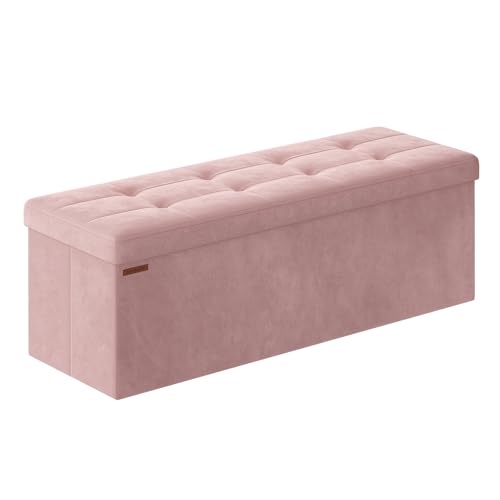
The Songmics Storage Ottoman is a folding storage ottoman range popular for its collapsible frame, divided interior, and second life as a spare seat or side table. In prose terms it sits in the mid tier of its category: not a disposable flat-pack afterthought, and not a heirloom-priced statement either, but the sensible middle where most happy purchases live. Check price on Amazon for the current listing, and treat any listing photos as a guide to shape and finish rather than a promise about how the fabric will look in your light.
Best for: readers who want a recognisable, widely stocked design with plenty of owner feedback to browse before deciding. Not suited for: anyone who needs a very specific custom fabric or an exact colour match to an existing suite, where a made-to-order route serves better.
Strengths in daily use include a shape that suits its stated job, upholstery that handles ordinary family life, and proportions that work in a typical living room without overwhelming it. The honest trade-off is that widely sold designs are built to a price, so the foam and fabric are good rather than luxurious, and the piece rewards realistic expectations.
SIMPLIHOME Ottoman
The SIMPLIHOME Ottoman is a traditionally crafted ottoman range with structured upholstery, storage options, and a reputation for solid frames. In prose terms it sits in the mid tier of its category: not a disposable flat-pack afterthought, and not a heirloom-priced statement either, but the sensible middle where most happy purchases live. Check price on Amazon for the current listing, and treat any listing photos as a guide to shape and finish rather than a promise about how the fabric will look in your light.
Best for: readers who want a recognisable, widely stocked design with plenty of owner feedback to browse before deciding. Not suited for: anyone who needs a very specific custom fabric or an exact colour match to an existing suite, where a made-to-order route serves better.
Strengths in daily use include a shape that suits its stated job, upholstery that handles ordinary family life, and proportions that work in a typical living room without overwhelming it. The honest trade-off is that widely sold designs are built to a price, so the foam and fabric are good rather than luxurious, and the piece rewards realistic expectations.
Care is mostly a rhythm rather than a chore. Vacuum upholstery weekly with a soft brush attachment so grit does not grind into the fibres. Blot spills immediately, working from the edge inward so the mark does not spread, and test any cleaner on a hidden patch first. Rotate and flip reversible cushions where the design allows, so the favourite spot does not wear faster than the rest.
When you shop, sit on your own sofa first and take honest stock: how do you actually sit, sideways with feet up, upright with feet flat, or stretched full length? Your dominant posture tells you the size, height, and firmness you need far better than any showroom test on an unfamiliar sofa. Buy for the body and habits you have, not the ones in the catalogue photograph.
Guests change the calculation. If your home regularly hosts, an ottoman wide and firm enough to serve as a real extra seat is worth prioritising, and a pair of smaller ottomans can be more flexible than one large piece, splitting to flank a chair or joining to form a shared footrest. Think about your last three gatherings and buy for the pattern you actually live.
How to Get the Most Value If You Buy
Legs and casters behave very differently on hard floors. An ottoman on casters is wonderfully easy to nudge closer or roll aside for vacuuming, but on wood, tile, or laminate it can also drift away mid-movie, skate when a child leans on it, or roll just enough to unbalance someone lowering themselves onto it as a perch. Fixed legs with broad feet stay planted and feel safer in busy households, though they are harder to slide and can scuff if dragged. On hard floors, add felt pads under fixed legs, choose locking casters where they are offered, and never leave a free-rolling ottoman where an older adult might grab it for support, because it will move exactly when they need it not to.
A tray transforms an ottoman’s usefulness. A large, rimmed tray creates a stable island for drinks, remotes, and a vase, and lifts away when the piece goes back to footrest duty. Choose a tray with a little weight to it so it does not skate, and keep its footprint comfortably inside the ottoman’s top so the edge of a glass never hangs over the curve of the cushion.
For homes with toddlers, washable and forgiving beats beautiful and delicate every time. Snacks will be eaten on it, crayons will approach it, and it will be used as a launch pad no matter what the rules say. A sturdy, low, soft-edged ottoman is genuinely one of the safer pieces you can put in the middle of a family room, far kinder than a hard-edged coffee table at forehead height.
In a small room, an ottoman earns its keep by replacing two pieces at once. A storage ottoman can swallow the throw blankets, game controllers, and chargers that otherwise colonise the sofa, letting you skip a side table or a storage basket. A lightweight ottoman can move from footrest to spare seat to bedside perch in a studio flat, which is exactly the flexibility small spaces demand.
Reading nooks are built around the ottoman moment: chair, lamp, and somewhere perfect to put your feet. In a nook, comfort outranks everything, so a soft top at exactly the right height for your chair matters more than tray stability or extra seating. This is the one spot where buying purely for your own legs is entirely justified.
The Decision Checklist
More Detail Worth Knowing Before You Decide
For homes with dogs, claw resistance and cleanability top the list. Tight weaves resist snagging, removable covers are worth celebrating, and darker mid-tone colours forgive the paw-print days. For homes with cats, a texture that does not invite scratching matters more than colour; smooth fabrics give claws less purchase and fewer threads to pull.
Reading nooks are built around the ottoman moment: chair, lamp, and somewhere perfect to put your feet. In a nook, comfort outranks everything, so a soft top at exactly the right height for your chair matters more than tray stability or extra seating. This is the one spot where buying purely for your own legs is entirely justified.
Round ottomans soften a room full of straight lines and are kind to shins in tight walkways, since there are no corners to catch. Rectangular ottomans stretch along a sofa or a chaise and give two people room to share. Square ottomans anchor a pair of chairs neatly. Cube ottomans tuck into corners and multiply well, two or three in a row reading as a bench when guests arrive.
Delivery and access deserve thirty seconds of thought. Measure your doorways, hallway turns, and any tight stair corners, and compare them with the packaged size where it is listed. Most ottomans pass easily, but oversized and storage designs can be surprisingly bulky, and discovering that on the doorstep helps nobody.
Assembly, where it exists, is usually limited to attaching legs. Even so, do it properly: tighten evenly, check for wobble on a hard floor rather than carpet, and re-check after the first week once everything has settled. Keep spare felt pads in a drawer; they are the cheapest comfort upgrade in the whole house.
A tray transforms an ottoman’s usefulness. A large, rimmed tray creates a stable island for drinks, remotes, and a vase, and lifts away when the piece goes back to footrest duty. Choose a tray with a little weight to it so it does not skate, and keep its footprint comfortably inside the ottoman’s top so the edge of a glass never hangs over the curve of the cushion.
In a large room, scale is the trap. A small ottoman in front of a generous sectional looks lost and feels mean underfoot, while an oversized piece can balance the visual weight of a big sofa and give the whole seating group a centre. When in doubt, mock up the footprint with painter’s tape on the floor and live with the outline for a day before ordering.
Longevity is mostly about honest use. An ottoman asked to be a footrest, an occasional seat, and a tray table will serve for years. One asked to be a ladder, a trampoline, and a pet bed will age fast. None of that means being precious; it means matching the piece to the life, and letting a sturdy design take the knocks it was built for.
Construction you cannot see still matters. A frame that feels rigid when you rock the piece side to side will stay quiet for years, while one that creaks and flexes on day one rarely improves. Dense foam keeps its shape and support; very soft, cheap foam feels lovely in the showroom and then pancakes into a permanent dip where heels land every evening.
In a small room, an ottoman earns its keep by replacing two pieces at once. A storage ottoman can swallow the throw blankets, game controllers, and chargers that otherwise colonise the sofa, letting you skip a side table or a storage basket. A lightweight ottoman can move from footrest to spare seat to bedside perch in a studio flat, which is exactly the flexibility small spaces demand.
Guests change the calculation. If your home regularly hosts, an ottoman wide and firm enough to serve as a real extra seat is worth prioritising, and a pair of smaller ottomans can be more flexible than one large piece, splitting to flank a chair or joining to form a shared footrest. Think about your last three gatherings and buy for the pattern you actually live.
The ottoman is the hardest-working piece in many living rooms precisely because it asks for so little. It does not dominate the layout, it does not demand a wall, and it quietly absorbs whatever the day needs from it: a footrest during a film, an extra seat when a friend drops by, a soft landing spot for a book and a cup of tea, or a bridge between a sofa and a chair that makes conversation easier.
Entryways are an underrated ottoman location. A compact, sturdy ottoman by the door gives everyone a seat for boots and laces, and a storage version swallows hats, gloves, and dog leads. Choose hard-wearing fabric there, because entryway furniture meets wet weather, grit, and bags in a way living-room pieces never do.
Colour strategy deserves a calm moment. Matching the ottoman exactly to the sofa creates a calm, chaise-like run of upholstery that lengthens the seating visually. Contrasting the ottoman, in a deeper tone or a pattern, makes it a deliberate accent and hides everyday marks more forgivingly. A middle path, same family of colour but a shade apart, gives definition without shouting.
For homes with toddlers, washable and forgiving beats beautiful and delicate every time. Snacks will be eaten on it, crayons will approach it, and it will be used as a launch pad no matter what the rules say. A sturdy, low, soft-edged ottoman is genuinely one of the safer pieces you can put in the middle of a family room, far kinder than a hard-edged coffee table at forehead height.
When you shop, sit on your own sofa first and take honest stock: how do you actually sit, sideways with feet up, upright with feet flat, or stretched full length? Your dominant posture tells you the size, height, and firmness you need far better than any showroom test on an unfamiliar sofa. Buy for the body and habits you have, not the ones in the catalogue photograph.
Care is mostly a rhythm rather than a chore. Vacuum upholstery weekly with a soft brush attachment so grit does not grind into the fibres. Blot spills immediately, working from the edge inward so the mark does not spread, and test any cleaner on a hidden patch first. Rotate and flip reversible cushions where the design allows, so the favourite spot does not wear faster than the rest.
Real leather develops character over the years and often outlasts fabric, but it asks for occasional conditioning and dislikes being parked in harsh direct sunlight. Velvet brings a rich, light-catching finish that photographs beautifully and feels wonderful underfoot, yet it shows pressure marks and needs gentle brushing to keep the pile lively. Linen-look fabrics breathe well and suit relaxed rooms, though they can crease and are slower to forgive a red-wine moment.
Bedrooms take ottomans happily too. At the foot of a bed, an ottoman or bench catches the throw, holds tomorrow’s clothes, and gives you a seat for shoes. In a dressing corner it becomes the perch every routine needed. The same choosing rules apply, with extra weight on matching the bed’s height and the room’s softer palette.
Upholstery choice shapes daily life more than colour does. Smooth woven fabrics wipe down easily and suit homes with pets that shed, because hair lifts off instead of weaving in. Deep textures and loose weaves feel luxurious and hide crumbs well, but they hold onto pet hair and need more frequent attention with a lint brush. Faux leather wipes clean in seconds and shrugs off spills, though it can feel cool in winter and warm in summer against bare legs.
Placement rewards a little experimentation. Start with the ottoman a comfortable leg-stretch from the sofa, then live with it for a week before deciding it belongs anywhere else. Most households find the piece migrates: closer for film nights, pushed aside for play on the floor, pulled up to an armchair for reading. That mobility is the point, and a piece that is too heavy or too precious to move loses half its value.
Seasonal flexibility is a hidden strength. In winter the ottoman holds the extra blanket within reach of the sofa; in summer it clears to open up the room and can carry a plant or a stack of art books as a soft display surface. A piece that adapts across the year rarely ends up in the category of furniture you regret.
Sunlight fades upholstery unevenly, and an ottoman parked half in a sunny patch can end up two-toned. If your room has strong sun, shift the piece occasionally or choose a fabric with a reputation for holding colour. Leather especially benefits from being kept out of the harshest midday light and away from radiators that dry it out.
A firm top and a soft top are different tools. A firm, flat-topped ottoman can hold a tray steady and double as a casual coffee table, which suits households that entertain with drinks and board games. A deeply cushioned, tufted top is a pure comfort piece: wonderful for heels and calves, hopeless for balancing a mug. Decide honestly which job matters more in your home, because very few designs do both jobs equally well.
Stitching tells the truth about care in manufacturing. Even seams, tight corners, and piping that runs true suggest a maker who sweated the details you cannot see either. Loose threads, puckered joins, and a base cloth stapled carelessly are warnings worth heeding, because upholstery faults almost never stay merely cosmetic.
Stitching tells the truth about care in manufacturing. Even seams, tight corners, and piping that runs true suggest a maker who sweated the details you cannot see either. Loose threads, puckered joins, and a base cloth stapled carelessly are warnings worth heeding, because upholstery faults almost never stay merely cosmetic.
Longevity is mostly about honest use. An ottoman asked to be a footrest, an occasional seat, and a tray table will serve for years. One asked to be a ladder, a trampoline, and a pet bed will age fast. None of that means being precious; it means matching the piece to the life, and letting a sturdy design take the knocks it was built for.
In a large room, scale is the trap. A small ottoman in front of a generous sectional looks lost and feels mean underfoot, while an oversized piece can balance the visual weight of a big sofa and give the whole seating group a centre. When in doubt, mock up the footprint with painter’s tape on the floor and live with the outline for a day before ordering.
Entryways are an underrated ottoman location. A compact, sturdy ottoman by the door gives everyone a seat for boots and laces, and a storage version swallows hats, gloves, and dog leads. Choose hard-wearing fabric there, because entryway furniture meets wet weather, grit, and bags in a way living-room pieces never do.
Colour strategy deserves a calm moment. Matching the ottoman exactly to the sofa creates a calm, chaise-like run of upholstery that lengthens the seating visually. Contrasting the ottoman, in a deeper tone or a pattern, makes it a deliberate accent and hides everyday marks more forgivingly. A middle path, same family of colour but a shade apart, gives definition without shouting.
The ottoman is the hardest-working piece in many living rooms precisely because it asks for so little. It does not dominate the layout, it does not demand a wall, and it quietly absorbs whatever the day needs from it: a footrest during a film, an extra seat when a friend drops by, a soft landing spot for a book and a cup of tea, or a bridge between a sofa and a chair that makes conversation easier.
For homes with dogs, claw resistance and cleanability top the list. Tight weaves resist snagging, removable covers are worth celebrating, and darker mid-tone colours forgive the paw-print days. For homes with cats, a texture that does not invite scratching matters more than colour; smooth fabrics give claws less purchase and fewer threads to pull.
Round ottomans soften a room full of straight lines and are kind to shins in tight walkways, since there are no corners to catch. Rectangular ottomans stretch along a sofa or a chaise and give two people room to share. Square ottomans anchor a pair of chairs neatly. Cube ottomans tuck into corners and multiply well, two or three in a row reading as a bench when guests arrive.
Reading nooks are built around the ottoman moment: chair, lamp, and somewhere perfect to put your feet. In a nook, comfort outranks everything, so a soft top at exactly the right height for your chair matters more than tray stability or extra seating. This is the one spot where buying purely for your own legs is entirely justified.
Bedrooms take ottomans happily too. At the foot of a bed, an ottoman or bench catches the throw, holds tomorrow’s clothes, and gives you a seat for shoes. In a dressing corner it becomes the perch every routine needed. The same choosing rules apply, with extra weight on matching the bed’s height and the room’s softer palette.
Assembly, where it exists, is usually limited to attaching legs. Even so, do it properly: tighten evenly, check for wobble on a hard floor rather than carpet, and re-check after the first week once everything has settled. Keep spare felt pads in a drawer; they are the cheapest comfort upgrade in the whole house.
A firm top and a soft top are different tools. A firm, flat-topped ottoman can hold a tray steady and double as a casual coffee table, which suits households that entertain with drinks and board games. A deeply cushioned, tufted top is a pure comfort piece: wonderful for heels and calves, hopeless for balancing a mug. Decide honestly which job matters more in your home, because very few designs do both jobs equally well.
For homes with toddlers, washable and forgiving beats beautiful and delicate every time. Snacks will be eaten on it, crayons will approach it, and it will be used as a launch pad no matter what the rules say. A sturdy, low, soft-edged ottoman is genuinely one of the safer pieces you can put in the middle of a family room, far kinder than a hard-edged coffee table at forehead height.
Upholstery choice shapes daily life more than colour does. Smooth woven fabrics wipe down easily and suit homes with pets that shed, because hair lifts off instead of weaving in. Deep textures and loose weaves feel luxurious and hide crumbs well, but they hold onto pet hair and need more frequent attention with a lint brush. Faux leather wipes clean in seconds and shrugs off spills, though it can feel cool in winter and warm in summer against bare legs.
Guests change the calculation. If your home regularly hosts, an ottoman wide and firm enough to serve as a real extra seat is worth prioritising, and a pair of smaller ottomans can be more flexible than one large piece, splitting to flank a chair or joining to form a shared footrest. Think about your last three gatherings and buy for the pattern you actually live.
Construction you cannot see still matters. A frame that feels rigid when you rock the piece side to side will stay quiet for years, while one that creaks and flexes on day one rarely improves. Dense foam keeps its shape and support; very soft, cheap foam feels lovely in the showroom and then pancakes into a permanent dip where heels land every evening.
Seasonal flexibility is a hidden strength. In winter the ottoman holds the extra blanket within reach of the sofa; in summer it clears to open up the room and can carry a plant or a stack of art books as a soft display surface. A piece that adapts across the year rarely ends up in the category of furniture you regret.
Care is mostly a rhythm rather than a chore. Vacuum upholstery weekly with a soft brush attachment so grit does not grind into the fibres. Blot spills immediately, working from the edge inward so the mark does not spread, and test any cleaner on a hidden patch first. Rotate and flip reversible cushions where the design allows, so the favourite spot does not wear faster than the rest.
Sunlight fades upholstery unevenly, and an ottoman parked half in a sunny patch can end up two-toned. If your room has strong sun, shift the piece occasionally or choose a fabric with a reputation for holding colour. Leather especially benefits from being kept out of the harshest midday light and away from radiators that dry it out.
In a small room, an ottoman earns its keep by replacing two pieces at once. A storage ottoman can swallow the throw blankets, game controllers, and chargers that otherwise colonise the sofa, letting you skip a side table or a storage basket. A lightweight ottoman can move from footrest to spare seat to bedside perch in a studio flat, which is exactly the flexibility small spaces demand.
Delivery and access deserve thirty seconds of thought. Measure your doorways, hallway turns, and any tight stair corners, and compare them with the packaged size where it is listed. Most ottomans pass easily, but oversized and storage designs can be surprisingly bulky, and discovering that on the doorstep helps nobody.
Real leather develops character over the years and often outlasts fabric, but it asks for occasional conditioning and dislikes being parked in harsh direct sunlight. Velvet brings a rich, light-catching finish that photographs beautifully and feels wonderful underfoot, yet it shows pressure marks and needs gentle brushing to keep the pile lively. Linen-look fabrics breathe well and suit relaxed rooms, though they can crease and are slower to forgive a red-wine moment.
A tray transforms an ottoman’s usefulness. A large, rimmed tray creates a stable island for drinks, remotes, and a vase, and lifts away when the piece goes back to footrest duty. Choose a tray with a little weight to it so it does not skate, and keep its footprint comfortably inside the ottoman’s top so the edge of a glass never hangs over the curve of the cushion.
The Break-Even Question in Real Life: When an Ottoman Pays Its Way
This section exists to ask the break-even question honestly, counting not just the purchase but the space, upkeep and attention the item will claim for as long as it is owned. It adds a layer that a feature list cannot give you, grounded in the living room furniture context this ottoman will actually live in. Where this guide names examples such as Songmics Storage Ottoman, SIMPLIHOME Ottoman, use them as test cases for the checks below rather than as shortcuts past them.
Think about who else has a vote. A ottoman is usually shared, moved, cleaned or complained about by more than one person, and the second user’s priorities are often the ones that surface after the return window closes. Check height, weight, reach, noise, heat, sharp edges or sheer visual presence, whichever apply, against the smallest, oldest or least enthusiastic person who will live with it. If you are buying for a household that includes children, pets, elderly relatives or lodgers, run the clumsy scenario too: the spill, the knock, the curious tug, the door left open. A robust ottoman choice survives other people; a fragile one only survives its buyer.
Consider the edge cases that sit just outside normal use, because a ottoman will meet all of them eventually. The unusually large load, the unusually small task, the day you are in a hurry, the day something else in the room is broken and this has to cover for it. Versatility is not about a long feature list; it is about behaving predictably when conditions are imperfect. Where a design offers settings, modes, attachments or configurations, ask what each one is actually for in your home, and be suspicious of flexibility you cannot attach to a real occasion. One well-judged configuration used weekly beats five clever ones used once, and the honest ottoman for your home is the one whose strengths line up with your most frequent edge case, not your rarest.
Build a simple decision checklist and score it in writing. Five lines are enough: fit in the space, fit with the routine, ease of cleaning or upkeep, quality of the parts that move or wear, and how the ottoman will be stored or will look when it is not the centre of attention. Score each contender quickly, then look only at the lowest scores, because purchases are usually ruined by their weakest point rather than saved by their strongest. If two options tie, choose the one whose weakness is cheapest or easiest to live with. This sounds mechanical, and it is meant to: a written checklist is the best defence against the very human habit of falling for the last photograph you looked at.
Finally, plan the first fortnight. Decide where the ottoman will live from day one, what it replaces, what accessory or companion it needs straight away and what small job you will use to learn its habits while returning it is still simple. Keep the packaging until that learning period is over, note anything that surprises you, and deal with a mismatch early rather than adapting yourself around a poor fit for years. The households that end up happiest with a ottoman are rarely the ones that researched longest; they are the ones that checked fit honestly, bought for the ordinary week, and paid attention during the first days instead of assuming the decision ended at checkout.
One more angle is worth your time: the second-order costs. A ottoman changes what happens around it. It can demand a different cleaning product, a new storage habit, a moved piece of furniture, a rearranged cupboard or a standing arrangement with the people you live with. List those knock-on effects before you buy and decide whether you accept them as part of the deal. Sometimes the answer is an easy yes, and the ottoman earns its place by improving the whole routine around it. Sometimes the honest answer is that the supporting changes are the real project, and the purchase should wait until you are ready for them. Either answer is useful; the only bad outcome is discovering the knock-on effects by accident, one irritation at a time, after the decision can no longer be revisited.
Frequently Asked Questions
Is an ottoman worth it for a small apartment?
Usually, yes, and small apartments are where the case is strongest. One piece replaces a footrest, a spare seat, and often a storage box or side table, and a storage model can hide the blankets and chargers that make small rooms look cluttered. Choose a size that leaves walkways clear, respect the storage lid rule around children, and the ottoman earns its footprint every day.
Is an ottoman worth it if I already have a coffee table?
It can be, if your feet currently end up on that coffee table anyway. An ottoman gives you the lounging comfort the table never will, and the table keeps its hard surface for drinks. Some households replace the table with a firm ottoman and a tray instead. The honest test is how you sit each evening: feet up nightly means the ottoman will be used constantly.
Are storage ottomans worth it with kids in the house?
The storage is genuinely useful for blankets and toys, but it comes with a non-negotiable rule: children must never climb inside, because a closed lid can trap a child. If you can enforce that rule, keep the compartment filled, and choose a lid that cannot latch, the storage earns its place. If your children are at the hiding-in-everything age, a plain ottoman is the wiser buy for now.
Is an expensive ottoman worth it over a budget one?
The gap shows up in foam density, fabric durability, and frame rigidity, which are exactly the things that decide year three. If the ottoman will be used daily for a decade, the mid and upper tiers usually repay their cost in comfort that lasts. For a guest room or a first apartment with a short horizon, a sensible budget model is the rational choice.
Can an ottoman replace a step stool as well?
No, and it should never be asked to. An ottoman is a footrest and occasional seat with a soft, shifting top; standing on one invites a slide, a tip, and a fall. A step ladder costs little, stores flat, and does the reaching job safely. Count the ottoman’s value on lounging, seating, and storage, and let the ladder handle everything above shoulder height.
How do I know an ottoman is worth it for me personally?
Run the evening test. Picture your last seven evenings on the sofa: if your feet were up on cushions, a table, or the sofa arm, an ottoman solves a nightly discomfort and is worth it. If you sit upright with feet on the floor and your room already works, it is a nice-to-have. The decision checklist in this guide turns that instinct into a clear answer.
Related Reading
Keep exploring with these guides from the same collection: an in-depth ottoman review · ottoman reviews compared · the ottoman buying guide · ottoman pros and cons in full · how to choose an ottoman step by step · comfortable sofas that pair well with an ottoman · sofas for homes with kids · lounge chairs for the living room · swivel chairs for the living room.