Disclosure: As an Amazon Associate, dailyhomedecorating.com earns from qualifying purchases. Links on this page are affiliate links; they cost you nothing extra. Prices and availability change often, so check the current Amazon listing before you buy.
If you are working out how to choose a kitchen shelf without wasting money on the wrong format, start with the pile, the wall and the way your household actually cooks. This guide walks through each decision in order: what a kitchen shelf needs to hold, which of the main formats fits that load, how to measure so the shelf fits first time, and how materials, fixings and safety shape the final choice. By the end you will have a short, honest specification you can shop against with confidence.
Key Takeaways
- Start from the real pile of items, not from a photograph of someone else’s kitchen.
- Format follows load: freestanding racks for bulk, floating shelves for light daily display, carts for flexible space.
- Measure width, height, depth and walkway before comparing any designs.
- Fix safety into the decision early: anti-tip anchoring for tall units and stud fixing for wall shelves.
What You Need to Know Before Comparing
The starting point for any kitchen shelf decision is not the shelf at all. It is the pile. Walk the kitchen with fresh eyes and name what actually needs a home: the stand mixer that lives on the counter because the cupboard is full, the spice jars stacked two deep so the cumin hides for months, the cookbooks leaning against the fruit bowl. A shelf bought for an imagined kitchen fails quietly, gathering the wrong things in the wrong places. A shelf bought for the real pile, item by item, tends to disappear into daily use within a week, which is the highest praise storage can earn.
Think in zones rather than in furniture. The prep zone wants knives, boards, oils and the spices you reach for mid-recipe. The cooking zone wants pans, lids and utensils close to the hob but clear of heat and steam. The serving zone wants plates, glasses and linens on the route to the table. A kitchen shelf earns its place when it completes a zone, shortening the path between task and tool. A shelf that mixes zones randomly becomes a prettier version of the junk drawer, and the household will treat it exactly that way.
Open shelving changes behaviour, for better and for worse. Visible storage is fast storage: no doors to open with floury hands, no dark cupboard corners. It is also honest storage, because clutter has nowhere to hide and dust settles where everyone can see it. Households that cook daily and tidy as they go usually thrive with open shelves. Households that prefer everything behind doors should be honest about that preference before buying, because the most beautiful open shelf still fails if the sight of everyday jars quietly irritates the people using the room.
Guests reveal how a shelf really works. Watch where a helpful visitor puts the clean plates, where they look for a glass, where they hesitate. Those hesitations mark the places your system is private rather than logical. A small amount of labelling, a consistent home for the everyday glasses, the mugs nearest the kettle, fixes most of it. You do not need a shelf that impresses guests. You need a shelf that a guest can use without a guided tour, because that is also the shelf your future tired self will use happily.
In this guide
How to Choose a Kitchen Shelf in 7 Steps
Step 1: Audit the Pile Honestly
List everything the shelf must hold, grouped by weight and frequency. Daily items, weekly items and seasonal items deserve different levels and often different formats entirely. Weigh the problem with your eyes: a shelf for twelve spice jars and a shelf for a mixer, a microwave and a month of tins are different products wearing the same name. This audit takes twenty minutes and prevents the most common failure in kitchen storage, which is buying a display solution for a warehousing problem.
Step 2: Choose the Format That Matches the Load
Freestanding baker’s racks carry the heavy, bulky end of kitchen life and can move rooms later. Wall-mounted shelves with visible brackets balance capacity and openness. Floating shelves hide their hardware and suit lighter, calmer loads. Rolling carts trade fixed capacity for flexibility. Match the format to the audit from step one, not to the room you wish you had, and be suspicious of any format that promises to do every job equally well.
Step 3: Measure the Space Three Ways
Measure the space empty, then imagine it loaded, then imagine it in use. The loaded view adds the height of jars and appliances. The in-use view adds hands, doors, lids and the cook’s elbows. Measure before you fall in love with a design. Record the width of the wall run or the gap the shelf must fill, the height from counter or floor to the lowest obstruction, and the depth your largest item truly needs once its lid, handle or cord is counted. Then measure the walkway that remains, because a shelf that steals elbow room from the person carrying a hot pan is a shelf the household will resent. Write the numbers down and shop with them open in front of you, not remembered approximately from the sofa.
Step 4: Decide Materials by Upkeep, Not Just Looks
Materials set both the look and the maintenance rhythm. Powder-coated or chrome-style metal wire sheds crumbs, wipes clean and suits working kitchens where spills are routine. Solid wood and wood-effect boards warm the room and carry display items gracefully, but they ask for coasters under wet bases and a gentler cleaning routine. Glass reads light and modern yet shows every fingerprint and water spot. None of these is the correct answer in the abstract. The correct answer is the material whose upkeep matches the household that will actually do the upkeep, on a tired weekday, not on a motivated Sunday. Steam, heat and water quietly decide where a shelf may live. Above a kettle or beside a hob, finishes age faster, labels peel and wooden boards can suffer. Near the sink, splashes test every edge and bracket. The safest placements keep shelves within easy reach of the work but outside the direct plume of steam and the splash arc of the tap. If the only available wall sits in a hard-working spot, choose the most wipeable, rust-resistant format you can, and accept a slightly more frequent wipe-down as part of the bargain.
Step 5: Plan the Fixing Before You Buy
Wall-mounted and floating shelves live or die by their fixings. As a principle, brackets should be fixed into wall studs or other solid structure wherever possible, and where that is not possible the anchor must genuinely suit the wall material, whether that is masonry, plasterboard or tile over board. A fixing that feels firm to a hand tug on day one can still creep under months of jar weight and door slams. Follow the shelf maker’s guidance for your wall type, check fixings again after the first loaded weeks, and never hang a loaded shelf over a cot, a child’s seat or a walkway pinch point. Anti-tip safety is non-negotiable for tall or freestanding shelving. Any tall unit, baker’s rack or narrow tower must be fixed back to the wall with the anti-tip hardware the maker supplies, or a suitable equivalent, before it is loaded. This matters in every home and it matters doubly where children visit or live, because children pull up, climb and tug without reading instructions. Treat the wall fixing as part of the product, not an optional extra, and if the supplied strap or bracket does not suit your wall, solve that problem first rather than skipping the step.
Step 6: Set the Budget by Tier and Priority
Think in entry, mid and premium tiers. Put the money into structure and fixings first, finish second. A modest rack fixed properly outperforms a beautiful shelf fixed badly every single day of its life, and the household will feel that difference in wobble, noise and confidence long after the finish has stopped being noticed.
Step 7: Trial the Arrangement for a Week
The first week with a new shelf should be treated as a trial, not a final arrangement. Load it, cook three or four real meals, and notice what your hands look for and fail to find. Almost every household rearranges at least two levels after that first week, moving the daily mugs down, exiling the fondue set upward, grouping the baking things that were scattered. Resist screwing display items into a fixed composition. Storage that cannot evolve becomes decoration, and decoration in a working kitchen slowly turns into an obstacle course. Adjust without embarrassment. The right final arrangement is the one your hands approve of during real cooking, not the one that looked tidiest on installation day.
Depth is the dimension buyers most often get wrong. Too shallow and jars overhang, which looks untidy and invites knocks. Too deep and the back row becomes a graveyard where duplicate purchases go to expire. For most everyday kitchen goods, a shelf that holds one row comfortably with a small margin beats a cavernous shelf that encourages stacking. If you must store deep items such as a food processor bowl or a stockpot, give those their own dedicated level rather than stretching every level to fit the bulkiest object you own.
Renters are not excluded from kitchen shelving, but the honest options differ. Freestanding racks and rolling carts ask nothing of the wall except an anti-tip fixing, and even that can sometimes be solved with the landlord’s written permission for two small holes, which many landlords grant when the alternative is a toppling risk. Over-door and clamp formats exist for light duties. What renters should avoid is the heavy floating shelf hung on hope and adhesive strips: adhesive mounting is for pictures and hooks, not for a row of filled jars above a hard floor.
Large kitchens have the opposite temptation: endless wall invites endless shelving, and the collection expands to fill it. A bigger room still benefits from zones, from restraint near the hob, and from leaving one stretch of wall deliberately empty so the room can breathe. In a large kitchen a freestanding rack often works better as a defined station, for baking, for coffee or for preserving, than as general overflow. A station has a theme, a boundary and a purpose, and it stays tidy because everything on it belongs to one job.
Gear for This Guide: Kitchen Shelf Picks by Tier

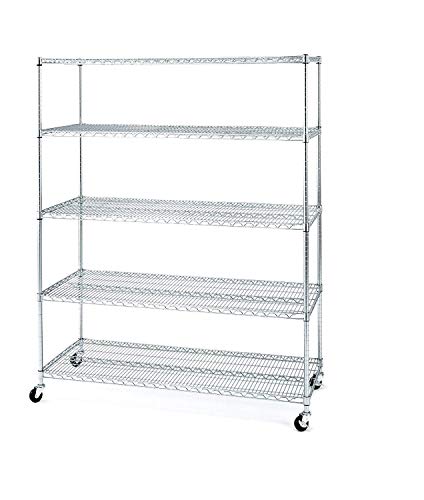
Seville Classics UltraDurable Baker’s Rack
Best for: freestanding baker’s rack. Not suited for: kitchens whose layout, wall or load fights this format’s basic way of working.
a wire-frame baker’s rack built around open shelving and a work surface feel, the kind of piece home bakers reach for when a stand mixer, flour bins and cooling trays all need one address. In prose terms it sits in the mid-to-premium tier of freestanding kitchen shelving. Treat it as a small pantry station: heavy jars low, trays and linens higher, and nothing perched where a bump could walk it off an edge. As the freestanding reference point in this guide, it shows what a rack format offers when the audit says bulk and appliances.
Sorbus Floating Shelves
Best for: floating wall shelves. Not suited for: kitchens whose layout, wall or load fights this format’s basic way of working.
a set of floating shelves in the accessible-to-mid tier, aimed at the display end of kitchen storage: spice jars you want visible, a small plant, mugs you actually like looking at. Floating designs hide their brackets, which is the whole visual point, and that hidden hardware is also why the fixing matters more, not less. Keep loads modest and everyday, anchor into solid structure wherever the wall allows, and let cabinets do the heavy lifting for bulk. As the floating reference point, it shows the lighter, display-led end of the decision, where fixing quality matters most.

Amazon Basics Kitchen Rolling Cart
Best for: rolling kitchen cart. Not suited for: kitchens whose layout, wall or load fights this format’s basic way of working.
a mobile cart in the accessible tier, useful precisely because it does not commit you to one wall forever. Rolling storage suits renters, small galley kitchens and anyone whose prep zone moves between stove, sink and table. Its honest trade-off is movement itself: a cart that rolls easily also needs a parking spot, a habit of locking or chocking it during heavy chopping, and a floor flat enough that it does not drift. As the flexible reference point, it suits households whose step-two answer was that the space itself keeps changing.

Whitmor Supreme Baker’s Rack
Best for: freestanding baker’s rack. Not suited for: kitchens whose layout, wall or load fights this format’s basic way of working.
a classic freestanding baker’s rack in the mid tier, the traditional answer to a kitchen with one bare wall and too many appliances. Racks in this family earn their keep as a landing zone: microwave or toaster oven at working height where the maker allows it, baskets below, cookbooks and serving pieces above. Check the current listing for the exact configuration, measure your wall run twice, and plan the anti-tip fixing before the rack is loaded, not after. As a second freestanding reference, it helps you compare rack layouts: where the work surface sits and how the levels divide.
Common Mistakes When Choosing a Kitchen Shelf
Decanting is optional, and honesty helps here too. Matching jars for flour, rice and pasta genuinely help: they stack neatly, show levels at a glance and turn a shelf into a calm visual rhythm. But decanting everything, including the odd packet used twice a year, creates washing, labelling and refilling chores that many households abandon by spring. A hybrid approach works well in real kitchens: decant the five or six staples you use weekly, keep occasional items in their original packaging in a basket, and let the shelf look lived-in rather than staged.
Returns and measurements are unglamorous and decisive. Before ordering, confirm the shelf’s footprint against your taped outline on the floor or wall, check that doors, drawers and appliance lids still open, and read the seller’s description of what is actually in the box, because some designs are sold as boards only, brackets only or frames without boards. Keep the packaging until the shelf is fixed and loaded for a few days. A surprising share of storage regret is simply a size that was almost right, discovered one day too late to exchange easily.
Noise is a small, real consideration. Wire shelves can rattle when a door slams or a heavy pan lands, metal tins chatter on metal boards, and glass jars ring against each other on a hard surface. Shelf liners, cork pads or simply grouping soft goods, linens, baskets and packets, between the hard items quietens a run considerably. If the kitchen sits beside a bedroom or a home-working corner, this five-minute softening is worth doing on day one rather than after a month of small irritations.
Two further mistakes deserve naming plainly. The first is storing the heaviest items highest because they are used least, which creates the worst lift in the kitchen. The second is buying a full matching set of shelves for every wall at once, before living with one run. Buy one run, live with it for a month, and let that experience specify the rest of the kitchen far better than enthusiasm can.
Pro Tips From Kitchens That Work
Baskets and bins are the compromise between open and closed storage. On an open shelf, a basket swallows the visually noisy things, packets, packets of packets, chargers and twist ties, while the calm items stay on display. Choose baskets that slide without snagging, that you can lift down one-handed, and that are sized to the shelf depth so they do not overhang. Label the end if the household shares cooking duties, because a basket system only works when everyone returns things to the same basket without a discussion.
Lighting is the upgrade nobody budgets for and everybody notices. A shelf run in a shadowed corner stays a shadowed corner however good the shelving is. Battery or plug-in strip lighting under a wall shelf transforms the counter below into usable prep space and makes labels readable without the main light blazing. Even without added lighting, simply keeping the tallest items toward the ends of a shelf, rather than in the middle where they block light from a window or pendant, keeps the whole run feeling brighter and more open.
A shelf should also respect the cook’s body. Heavy pans stored above shoulder height are an injury waiting for a tired evening. Deep shelves that force a lean over a hot hob are worse. Arrange so that the heaviest lifts happen close to the body, between hip and chest, and so that nothing essential hides behind something else at the back of a deep level. Left-handed and right-handed cooks arrange the same shelf differently, and both are right. If two people cook, arrange the shared essentials in the shared middle ground and give each cook one personal zone.
One last pro habit: photograph your shelf monthly for the first season. The photographs show drift, the slow migration of clutter back onto clear levels, far more clearly than memory does. A two-minute tidy guided by last month’s photograph keeps the system honest without turning storage into a second job.
Worked Examples: Three Buyers, Three Right Answers
The renter with a galley kitchen and no permission to drill deeply chose the rolling cart route, parking daily baking kit on a mobile unit that tucks beside the fridge and rolls to the counter for weekend projects. The family with a blank wall and a mountain of tins chose a freestanding rack, anchored to the wall, heavy jars low, and reclaimed an entire cupboard for pans. The keen cook with twelve beautiful spice jars and a tiled wall chose floating shelves, fixed into solid structure, and accepted that bulk storage stays in cupboards. Three different answers, all correct, because each began with the audit.
Seasonal rotation keeps a modest shelf feeling generous. The preserving jars, the holiday platters, the ice-cream maker and the picnic gear rarely all need prime space at once. A shelf arranged for the current season, with off-season pieces boxed in a cupboard, garage or loft, gives daily items the breathing room that makes a kitchen feel calm. Rotation day, twice a year, is also the natural moment to check fixings, wipe every level properly, discard the expired and the duplicated, and re-anchor anything that has developed the slightest wobble.
Finally, keep the purpose in view. A kitchen shelf is not a renovation and it is not a lifestyle statement. It is a tool for shortening the distance between ingredients, equipment and the person cooking. Judge every candidate, every arrangement and every accessory by that standard. Does this make dinner easier on an ordinary Tuesday? Does it make the room safer, calmer and quicker to clean? If the answer is yes, the shelf is doing its job, whatever it cost and whatever style it wears. If the answer is no, no finish or brand name will rescue it.
A Room-by-Room Fitting Walkthrough Before You Choose a Kitchen Shelf
Technique matters more with a kitchen shelf than most instructions admit, because the same product can feel clumsy or effortless depending on the order you do things in and the setup you repeat each time. Start by standardising your starting position: the kitchen shelf in the same place, at the same setting, height or configuration each time, so that any change in results tells you something about the job rather than about a forgotten adjustment. Keep a short note of what you adjusted on the kitchen shelf during the first month, even just a line on your phone, since those notes turn vague impressions into a setup you can repeat, share or troubleshoot months later. Read the manual’s warnings page for the kitchen shelf even if you read nothing else, because that page is a compressed list of every way the product has ever been misused, and it tells you exactly which of your own habits needs adjusting.
When something about the kitchen shelf disappoints, change one variable at a time — position, setting, timing, load, accessory or technique — and give the change a fair trial, because changing three things at once leaves you with a better or worse result and no idea why. Decide in advance what good enough looks like for the job the kitchen shelf does in your home, because chasing a flawless result usually costs more time than the flaw itself, and most households are happier with a reliable ninety percent they actually repeat. Plan the storage home for the kitchen shelf before it arrives, naming the exact cupboard, corner, shelf, hook or stretch of floor, because a product without a home migrates around the house and slowly becomes the clutter it was bought to reduce. Measure before anything else, and measure the kitchen shelf in its working state rather than its packed or folded state, because handles extend, lids open, cords trail, doors swing and users stand somewhere, and all of that belongs in the measurement.
Think about who else will use the kitchen shelf and what they will do differently: shorter reach, less patience, stronger habits, no interest in the manual, and a tendency to leave things wherever they were last set down. Slow down at the difficult part rather than speeding up, because most kitchen shelf tasks fail at the moment of impatience — the forced fit, the skipped check, the extra load — and a ten-second pause at that moment prevents most of the damage and most of the rework. Seasonal thinking helps more than expected: a kitchen shelf bought in one season will meet different light, humidity, mud, heat, guests and routines in another, so judge its size, storage and upkeep against the hardest season it will face. For troubleshooting, start with the boring causes first: power, water, fit, blockage, alignment, a full container, a loose connection or a setting changed by the last person who used the kitchen shelf, because boring causes account for most apparent failures.
Consider the cleaning rhythm honestly: a kitchen shelf that needs attention after every use suits a household that enjoys small rituals, and frustrates a household that wants to finish a job and walk away, so match the upkeep to the temperament, not the intention. Check the floor, wall, ground or surface the kitchen shelf will meet, since level, texture, moisture and finish decide more about everyday performance in food storage & organization settings than most shoppers expect when they are comparing listings on a screen. If you want a concrete listing check, take a name already shortlisted in this guide, such as Seville Classics UltraDurable Baker’s Rack, Sorbus Floating Shelves and Amazon Basics Kitchen Rolling Cart, and verify that exact kitchen shelf listing against the measurements and compatibility questions above, field by field, rather than trusting the headline description alone. Test the kitchen shelf in the first week under deliberately ordinary conditions rather than saving it for a special occasion, so that any problem surfaces while returning, exchanging or adjusting your setup is still simple.
If someone else in the household shares the kitchen shelf, agree the same basic sequence together, because two conflicting techniques — different settings, storage spots or cleaning habits — will make even a good product seem inconsistent from one use to the next. Watch for edge cases in your own home: the pet that investigates everything, the child who treats every new object as furniture, the guest who uses force where you use familiarity, and the weather, light or season that changes how a kitchen shelf behaves.
Frequently Asked Questions
How deep should a kitchen shelf be for jars and tins?
Deep enough for one comfortable row of your largest jars with a small margin at the front edge, and no deeper. Extra depth invites a hidden second row where duplicates expire quietly. If a few bulky items need more room, give them one dedicated deeper level or a freestanding rack rather than making every level deep. Measure the actual jars, including lids and labels that catch, rather than trusting a guess from memory.
Can a kitchen shelf work in a rented home?
Yes, if you choose formats that respect the tenancy. Freestanding racks and rolling carts need no wall work beyond an anti-tip fixing, and many landlords allow two small fixing holes when the reason is safety. Avoid heavy floating shelves on adhesive strips, which are not designed for loaded kitchen storage. Keep the packaging and any landlord agreement until you are sure the arrangement works in daily life.
Where should the heaviest kitchen items go on a shelf?
Low, always. Cans, full jars, bottles and cast iron belong on the lowest levels, close to the supports, where the structure is strongest and a slip means the shortest fall. Lighter, bulkier items such as linens, baskets and empty containers belong higher. This single habit improves safety, reduces wobble and makes the whole unit feel more solid, whatever format you chose.
How do I stop a kitchen shelf looking cluttered?
Group by zone, decant only the weekly staples, and give visual noise a basket to live in. Consistent containers calm a run of shelving more than any styling trick, and leaving a little empty space at the ends of each level stops the eye reading the shelf as full to bursting. Then hold the line with a weekly wipe-and-reset that takes minutes when it is done often.
Do floating shelves suit heavy kitchen storage?
Floating shelves suit light-to-moderate daily display: spice jars, glasses, mugs and small bowls, provided the brackets are fixed into solid structure or with anchors genuinely suited to the wall. They are not the right tool for bulk tins, cast iron or appliance storage. For heavy loads choose a bracketed wall shelf with fixings into studs, or a freestanding rack anchored against tipping, and keep the floating shelves for what they do beautifully.
When is a rolling cart better than a fixed shelf?
A cart wins when the kitchen’s work moves: small rentals, shared houses, bakers who need a project station, and cooks who rearrange seasonally. It also wins when wall fixing is impossible. A fixed shelf or rack wins when the load is heavy, permanent and used in one place every day. Many kitchens end up with both, a fixed home for bulk and a cart that flexes around it.
One more consideration that experienced cooks raise is sequencing: install and arrange the shelf around the way a recipe actually unfolds. Ingredients move from store to prep, prep to hob, hob to plate, plate to table, and washing up returns everything home. A shelf that sits naturally on that loop gets used without thought, while a shelf placed against the loop, however handsome, slowly becomes a museum of good intentions. Walk your favourite recipe through the room before finalising any position, and let the dish you cook most often have the loudest vote in where things live.
Consider also the humble question of labels. On a working shelf, a small label on a jar or a basket end is not fussiness; it is how a system survives other people’s help, tired evenings and the slow fading of memory about which white powder is which. Labels matter most for safety-adjacent lookalikes, flour versus bicarbonate, sugar versus salt, and for the household member who cooks least often and deserves a kitchen that explains itself. Keep them plain, consistent and easy to replace when a jar’s contents change.
Humidity deserves a final word in kitchens without strong extraction. Steam from daily cooking settles on cool surfaces, and shelves near that traffic benefit from wipeable finishes and a little air gap behind boards where the design allows. Store paper-packaged goods in sealed containers in such kitchens, keep the shelf out of the kettle’s direct plume, and add the shelf’s underside to the weekly wipe, because that is where cooking film quietly accumulates out of sight.
If the household includes anyone with limited reach, grip or mobility, let their needs set the prime zone without negotiation. Daily items at their comfortable height, nothing heavy above anyone’s shoulder, pull-down moments designed out rather than endured. A kitchen shelf is one of the easiest storage forms to make genuinely inclusive, because levels can be arranged person by person in a way fixed cupboards rarely allow. That adaptability is worth naming among the category’s real virtues.
Photographs of finished shelves, including the ones that sell the products, almost always show them a third emptier than real life allows. Forgive your own shelf its fuller reality. Working storage is allowed to look worked in, provided the zones read clearly, the walkway stays safe and the heavy things stay low. Judge the arrangement after a month of dinners, not on installation afternoon, and adjust it the way you would adjust a recipe: by taste, in small changes, until it suits the household at the table.
One more consideration that experienced cooks raise is sequencing: install and arrange the shelf around the way a recipe actually unfolds. Ingredients move from store to prep, prep to hob, hob to plate, plate to table, and washing up returns everything home. A shelf that sits naturally on that loop gets used without thought, while a shelf placed against the loop, however handsome, slowly becomes a museum of good intentions. Walk your favourite recipe through the room before finalising any position, and let the dish you cook most often have the loudest vote in where things live.
Consider also the humble question of labels. On a working shelf, a small label on a jar or a basket end is not fussiness; it is how a system survives other people’s help, tired evenings and the slow fading of memory about which white powder is which. Labels matter most for safety-adjacent lookalikes, flour versus bicarbonate, sugar versus salt, and for the household member who cooks least often and deserves a kitchen that explains itself. Keep them plain, consistent and easy to replace when a jar’s contents change.
Humidity deserves a final word in kitchens without strong extraction. Steam from daily cooking settles on cool surfaces, and shelves near that traffic benefit from wipeable finishes and a little air gap behind boards where the design allows. Store paper-packaged goods in sealed containers in such kitchens, keep the shelf out of the kettle’s direct plume, and add the shelf’s underside to the weekly wipe, because that is where cooking film quietly accumulates out of sight.
If the household includes anyone with limited reach, grip or mobility, let their needs set the prime zone without negotiation. Daily items at their comfortable height, nothing heavy above anyone’s shoulder, pull-down moments designed out rather than endured. A kitchen shelf is one of the easiest storage forms to make genuinely inclusive, because levels can be arranged person by person in a way fixed cupboards rarely allow. That adaptability is worth naming among the category’s real virtues.
Related Guides
Keep exploring with these related guides from this shelf cluster and from guides already live on the site:
our kitchen shelf buying guide
how to install a kitchen shelf safely
the honest kitchen shelf pros and cons