Disclosure: As an Amazon Associate, dailyhomedecorating.com earns from qualifying purchases. Links on this page are affiliate links; they cost you nothing extra. Prices and availability change often, so check the current Amazon listing before you buy.
Every gardener eventually weighs the garden hose pros and cons before replacing an old hose or adding a second one, and garden hose ownership is genuinely two-sided: few tools give so much daily convenience, and few punish careless buying and storage so patiently. This article lists the real advantages and the honest drawbacks in detail, explains what the trade-offs mean for different households, and closes with buying and care advice plus the safety basics: release the pressure before disconnecting, keep the hose off walkways so nobody trips, and drain it fully before freezing weather so ice cannot split it.
Key Takeaways
- The core pro is versatility: one hose waters beds, feeds sprinklers, washes cars and rinses patios.
- The core con is handling: weight, kinking and storage are daily frictions, not rare events.
- Durability is earned by material and fittings, and lost by sun, standing water and winter neglect.
- Most cons shrink dramatically with the right length, a reel and simple seasonal habits.
- Lightweight alternatives such as expandable hoses trade the traditional cons for different ones.
- All product mentions here are prose-only until listings are verified; no purchase links appear.
In this guide
Quick Verdict: Who a Garden Hose Suits, and Who It Does Not
A traditional garden hose suits anyone with beds, lawn, containers or outdoor cleaning to do and a faucet within a sensible route of them. It does not suit the gardener who needs water far from any faucet, where a different solution entirely may be needed, nor the buyer who wants a tool that stores in a shoebox and weighs nothing, who should look honestly at the expandable branch instead. Between those poles, the pros below explain why the hose remains the garden’s default water tool, and the cons explain why choosing and keeping one deserves more thought than it usually gets.
The Pros of a Garden Hose
Reach That Follows You Around the Garden
A hose turns one fixed faucet into water anywhere along its route: the far bed, the new tree, the car on the drive, the patio after a barbecue. That roaming reach is the fundamental pro, and no watering can, however beloved, scales to a whole garden the way a hose does. Reach also future-proofs the garden, because new beds and plantings simply join the route instead of demanding new infrastructure.
One Tool, Many Jobs
Watering is only the first job. The same hose feeds sprinklers and soaker lines, fills pools and buckets, rinses tools, boots and bikes, washes vehicles and sluices down hard surfaces. Attachments multiply the roles further, from gentle wands for seedlings to timers that automate deep watering. Few garden purchases spread their cost across so many weekly tasks, which is why a sound hose feels like infrastructure rather than an accessory.
Flow You Can Control
With a decent diameter and a good nozzle, a hose delivers everything from a mist to a jet under your thumb’s control, instantly adjustable in a way fixed irrigation rarely is. You water the thirsty shrub deeply, skim the tough lawn, and spare the seedlings, all in one pass. That responsive control is a genuine gardening skill multiplier, because the water goes where judgement says, in the amount judgement chooses.
Durability When You Buy Construction, Not Colour
A well-built hose with a reinforced jacket and brass fittings is a decade-scale purchase. It tolerates dragging, sun and seasons in a way that flimsy tools never do, and its common failures, washers and end fittings, are repairable at home. Longevity is the quiet pro that turns a higher shelf price into a lower cost per year, and it is available to any buyer who prioritises construction over novelty.
Repairable, Understandable, Standard
Hoses use standard threads, standard washers and simple repair fittings, so the system stays compatible across brands and years. A cut, a splice, a fresh washer: the fixes are within any home gardener’s ability and need no specialist. That standardisation also means nozzles, reels, timers and sprinklers from different makers cooperate, protecting your investment in accessories as hoses come and go.
Gentler, Cheaper Watering Than the Alternatives
Compared with running fixed irrigation or endlessly refilling cans, a hose is inexpensive to buy, free to install and flexible as the garden changes. It asks for no trenching, no wiring and no winterised pipework beyond its own draining. For renters and for gardens still evolving, that reversibility is a major pro: the whole system can move house in the boot of a car.
The Cons of a Garden Hose
Weight and Drag Are Real, Every Session
A long hose full of water is heavy, and dragging it around corners, across beds and back to storage is the physical tax every owner pays. Rubber and wide-bore hoses tax the most. Gardeners with limited strength, long routes or daily watering feel this con keenly, and it is the main reason lightweight designs sell. Ignoring it at purchase time does not remove it; it just schedules the resentment.
Kinking Interrupts Everything
Few garden frustrations match the flow dying mid-task because the hose folded at a bend behind you. Kinks concentrate at the faucet, at corners and in badly stored coils, and cheap, stiff hoses kink constantly in cool weather. Construction and technique reduce kinking a great deal, but no traditional hose is entirely immune, and the con must be managed rather than wished away.
Storage Eats Space and Punishes Laziness
A hose needs a home: a reel, a hanger or a pot, plus the discipline to use it. Without one, the hose becomes a sun-baked, twisted heap that trips people, looks dreadful and ages fast. Small patios feel this most, where the coil competes with furniture for the same square metres. Storage is not an accessory to hose ownership; it is half of it.
Leaks Gather at the Fittings
The weak points of any hose system are its ends. Washers flatten, threads collect grit, budget couplings crack or cross-thread, and the result is the familiar drip at the faucet that owners tolerate for entire seasons. Good fittings and fresh washers reduce leaks to rare events, but the maintenance, however small, never fully disappears from hose ownership.
Weather Is a Standing Threat
Sunlight ages every jacket, heat bakes a hose left pressurised, and one hard freeze with water inside can split a hose along its length. The hose lives outdoors by design, so weather management, shade, draining, winter storage, is a permanent background duty of ownership. Gardeners in harsh climates carry this con more heavily than those in mild ones.
A Bad Hose Makes Watering Itself Worse
Finally, the meta-con: because a hose mediates nearly all garden watering, a poor one degrades the whole hobby. Weak flow makes sprinklers sulk, harsh handling makes sessions shorter than plants need, and the friction quietly trains gardeners to water less than their garden wants. The con of a bad hose is therefore larger than the hose itself, which is precisely why the buying decision deserves care.
What the Trade-Offs Mean for You
Recommendations become useful when they are attached to real situations. A hose that delights a patio gardener can genuinely frustrate a lawn keeper, and both gardeners are right. The profiles in this section are drawn from the combinations that recur constantly: small spaces with daily pot watering, family gardens mixing lawn, beds and play, serious food gardens with deep and frequent watering, and multi-purpose households where the hose also washes cars and rinses hard surfaces. Find the closest match to your own routine, borrow its priorities, and adjust for your faucet position and storage reality. If none matches perfectly, combine the two nearest; most real gardens are hybrids. What matters is that the decision starts from your watering life and works outward to the product, never the other way around.
Different gardens ask very different things of a hose. Container gardeners on a patio need reach, lightness and tidy storage above all, because the watering is frequent, close and gentle. Vegetable gardeners need flow and patience-friendly handling, since beds drink deeply and soaker lines or careful root-level watering reward a hose that delivers volume without drama. Lawn keepers need a hose that plays well with sprinklers, holding its shape and flow across a long run without kinking at every turn. Households that wash cars, rinse muddy boots, fill paddling pools and hose down patios need versatility and fittings that swap quickly between nozzle, brush and spray gun. New gardeners often underestimate how much of the experience is handling: the drag across the lawn, the coil at the end, the weight on a hot day. Experienced gardeners choose for the worst regular task, not the best day: the longest route, the thirstiest bed, the sprinkler that must reach the far corner. If your hose handles that day gracefully, every ordinary day feels easy, and watering stays what it should be, the calmest job in the garden.
How a Garden Hose Compares With the Alternatives
Against an expandable hose, the traditional hose wins on toughness, flow and sprinkler duty, and loses on weight and storage size. Against a watering can, it wins on scale and speed and loses on precision for individual delicate plants, which is why most gardeners keep both. Against fixed irrigation, it wins on cost, flexibility and repairability, and loses on automation. The pattern in every comparison is the same: the traditional hose is the flexible generalist, and its cons are the price of that generality. Choose it when generality is what your garden actually needs.
The hose family has distinct branches, and picking the right branch matters more than picking within it. The traditional round hose is the generalist: constant diameter, predictable flow, compatible with every nozzle, reel and sprinkler ever made. The expandable hose is the specialist for lightness and storage, trading some toughness and pressure behaviour for a coil that fits in a bucket. The soaker hose is not really for carrying water to a nozzle at all; it is a slow irrigation line for beds and rows, happiest buried lightly under mulch. The coil hose serves patios, balconies and potting benches where the distance is short and the spring-back storage is the entire point. Stainless and metal-jacket designs promise chew and kink resistance for particular households. When you read any review, including this one, first ask which branch is being discussed, because praising an expandable hose for lightness or criticising it for not feeding a big sprinkler is only meaningful once the branch, and therefore the job, is clear.
How to Buy Smart
Choosing length well starts with a tape measure, not a guess. Stand at the faucet, walk your normal watering route to the farthest bed, tree or washing spot, and note the distance honestly, including the detours around the patio table and the corner of the shed. Buy for that route with modest slack. Too short is miserable in daily use: you end up stretching the hose, stressing both couplings and scuffing the jacket on edges, and you start leaving far plants thirsty because reaching them is a fight. Too long is a slower kind of mistake: the surplus lives in heavy loops that kink at the same tired spots, take longer to drain, and make a small storage corner feel impossible. If your property has two distinct zones, such as a front bed and a back vegetable patch on opposite sides of the house, two shorter hoses on two faucets, or one hose plus a portable reel you move between zones, usually beats a single marathon hose. Gardeners who expand beds year by year should also leave a little headroom, because the route you walk next spring is rarely shorter than the one you walk today.
Fittings are the small metal ends that decide whether a hose feels solid or leaks from day one. Solid brass couplings have earned their reputation: they resist corrosion, tolerate being tightened properly and survive years of seasonal on-and-off at the faucet. Thinner stamped-metal or plastic ends cost less but can cross-thread, crack in a freeze or deform when stepped on. Look closely at the female end that meets the faucet, because that joint carries a washer, and a fresh, correctly seated rubber washer solves more drips than any amount of tape or force. Hand-tight plus a small, sensible extra turn is the right technique; cranking with pliers chews washers and threads alike. Crush-resistant designs, with a chunkier collar you can grip even with wet or gloved hands, are worth seeking out if you connect and disconnect often, for example when the same faucet feeds a pressure washer or a second hose. Finally, store spare washers where you store the hose itself. A perished washer in July is a two-minute fix if the spares live in the same box, and a week of dripping if they live in a drawer you cannot find.
Price tiers in hoses are best understood as paying for time. Entry-tier hoses cost the least and, treated gently in a small garden, can give fair service, but they use thinner jackets and simpler fittings that show their limits under daily dragging, high use or harsh storage. Mid-tier hoses are where most households should live: reinforced construction, proper brass fittings and materials that stay flexible across seasons, at a price that still feels reasonable for a tool used weekly for years. Premium hoses charge for the best materials, the toughest fittings and handling that stays pleasant in cold weather and over long routes; for large gardens and heavy use, that premium is repaid in years and in daily ease. The false economy is buying entry-tier for a premium job and replacing it repeatedly. The opposite waste is buying premium toughness for a balcony. Match the tier to the workload honestly, check the current price on Amazon or at your retailer when you shop, and remember that a reel, a leader hose and spare washers are part of the true cost of a setup that lasts.
Setup and Care That Reduce the Cons
Storage decides how long a hose stays pleasant to use. Left in a heap on the ground, a hose collects twists, bakes in the sun, grows slippery with algae on the outside and becomes a tripping hazard across any path it crosses. A reel, a wall-mounted hanger or a simple storage pot gives the hose a consistent home where it coils the same way every time, drains as it winds and stays off the walkway. Before you store it, even for a week, straighten the hose, open the nozzle and let the water run out; a hose stored full is heavier, kinks more readily and gives algae and mosquitoes a standing invitation. Keep the storage spot shaded where you can, because ultraviolet light ages every hose material, and keep it close to the faucet, because a hose that is easy to put away actually gets put away. Indoors versus outdoors is less important than dry, shaded and off the ground. Gardeners with small patios should treat storage as part of the purchase decision itself: measure the corner, the pot or the reel footprint before choosing a long, heavy hose that will dominate the space it was bought to serve.
Almost every gardener has a relationship with kinks, and it is rarely a happy one. Kinks happen where a hose is forced around a tight radius while full and heavy, and they tend to recur at the same places because the hose develops a memory of how it is stored and pulled. Construction matters: reinforced jackets and flexible hybrid materials resist folding flat at a bend far better than thin, basic vinyl, especially in cool weather when materials stiffen. Technique matters just as much. Unroll the hose fully before turning the water on, walk it out along your route, and avoid pulling it around sharp masonry corners under tension. When you put it away, coil in generous loops, always in the same rotational direction, so you are not twisting against the hose’s natural set. A kink that appears in the same spot every session is diagnostic information: something in your route or storage is asking for a bend the hose cannot give, and changing the reel position, adding a guide at the corner or choosing a more flexible replacement will fix the cause rather than the symptom.
A few safety habits separate relaxed watering from the avoidable accidents. Always release the pressure before you unscrew anything: shut the faucet, then trigger the nozzle until the flow dies, because the pressure stored in a full hose is enough to make a loose fitting jump and spray hard. Keep the hose out of walking lines whenever it is out, and coil it away promptly when you finish, since a hose lying across a path, a step or a driveway edge is an easy trip for anyone not expecting it, and a nasty fall for someone carrying something. Drain the hose before freezing weather rather than after it, because water expands as it turns to ice and a full hose can split along its length or crack its fittings in a single hard night. Check the first water out of a sun-baked hose before it touches skin, since it can come out hot. And keep the whole operation away from outdoor electrical points and power tools: water and electricity share a garden peacefully only when you keep them deliberately apart.
Winterising a hose takes ten minutes and saves a purchase. Before the first hard freeze, disconnect the hose from the faucet, because a connected hose can trap water in the faucet itself and contribute to a burst pipe inside the wall, a far more expensive problem than any hose. Straighten the hose on a slope or walk its length, nozzle open, lifting it section by section so gravity empties it fully. Coil it loosely, bring it into a garage, shed or covered corner, and store it off the floor if mice or damp are concerns. While it is off, inspect the washers and couplings, replace any washer that has flattened, and note cracks or stiff sections that will become next spring’s leaks. Outdoor faucets themselves appreciate a cover in cold climates. In mild climates the ritual is lighter but still worthwhile: drain the hose, store it shaded and check it before the spring rush. Gardeners who skip this routine usually meet the consequences in March, standing in a garden centre queue with a split hose over one shoulder, paying peak-season prices for a replacement that a drained, sheltered hose would never have needed.
Many hose problems are repairable, and knowing that changes how you buy and when you replace. A drip at the faucet is usually a washer, replaced in a minute for pennies. A leak at a damaged end can often be fixed by cutting the hose cleanly behind the damage and fitting a repair coupling, a job that needs a sharp knife, a screwdriver and care to cut square. A mid-hose puncture from a thorn or a mower can be bridged with a splice mender in the same way. What repair cannot fix is a jacket that has gone stiff and cracked along its length, a hose that kinks at a dozen memory points, or a bulging section that signals internal failure; those are retirement signs, and a bulge in particular should be retired promptly rather than nursed. Keep one repair kit in the shed and you extend the useful life of a sound hose by seasons. This is also an argument for buying a hose with standard fittings and a cut-friendly construction in the first place: repairability is a feature, even if it never appears in the headline on the box.
Bottom Line
Weighed honestly, the pros of a garden hose are structural and the cons are manageable. Reach, versatility, control and repairable durability make it the default water tool of the home garden, while weight, kinking, storage and weather are frictions that good buying and simple habits reduce to background noise. The gardeners who regret a hose almost never regret owning one; they regret the specific hose they grabbed in a hurry. Measure the route, respect the fittings, plan the storage, keep the safety habits, and the balance of this article tips decisively in the hose’s favour for almost every household with a garden to water.
Planning the Route Like a Professional
Professionals who water for a living think in routes, and home gardeners benefit from stealing the habit. Walk your property and mark, mentally or on paper, the faucet, the zones in watering order, the corners where the hose must turn, and the obstacles it must not cross: thorn beds, sharp paving edges, driveways with traffic, steps where a hose becomes a hazard. Choose the storage point to serve the route’s start, not merely the wall with space on it. Notice where a hose guide at a corner would save the jacket a thousand abrasions, and where a second faucet or a splitter would shorten the whole system. Revisit the route when the garden changes, because new beds quietly lengthen it and last year’s perfect hose becomes this year’s short one. Ten minutes of route planning explains most of the difference between gardeners who fight their hose and gardeners who never think about it, and it costs nothing but attention.
A Season-by-Season Rhythm for Hose Owners
Spring is for inspection: reconnect the hose, seat a fresh washer, flush the line, and walk the route checking for winter damage and the drips that announce themselves immediately. Summer is for discipline: drain after hot days rather than leaving water baking inside, coil out of walkways during gatherings, and keep the hose shaded between sessions so the jacket ages slowly. Autumn is for decisions: repair the small faults while parts are easy to find, note whether the hose still matches a garden that has grown, and prepare the winter routine before the first forecast frost makes it urgent. Winter is for absence done properly: disconnected, drained, loosely coiled and under cover, with the faucet protected in cold climates. Gardeners who give the hose these four small appointments a year find that it simply never becomes a problem, which is the entire secret behind the hoses that last a decade. The rhythm also spreads the cost of ownership into minutes, instead of concentrating it into the one dramatic spring morning when a neglected hose fails in front of a queue of thirsty plants.
When a Second Hose Makes More Sense Than a Bigger One
Many hose problems are really one-hose problems. A property with beds at the front and vegetables at the back asks a single hose to be in two places, and the usual answer, one very long hose, creates the weight, kinking and storage burdens this article has described. Two modest hoses, one per zone or one per faucet, often water the same garden with less effort, less wear and better flow at each end. The second hose is also the natural home for specialisation: a soaker line that lives in the vegetable beds all season, an expandable hose that lives by the patio door, a short utility hose at a side faucet for buckets and bikes. Buying the second hose is also the moment to standardise fittings across the whole system, so every nozzle, timer and sprinkler fits everything. Judge the idea by your map, not by habit: if your watering naturally divides into two territories, your equipment probably should too, and the total cost is often lower than the single heroic hose it replaces.
The Supporting Cast: Reels, Timers and Small Parts
A hose reaches its potential only with its supporting cast in place. The reel or hanger is the foundation, turning storage from a heap into a system and protecting the jacket from sun, feet and wheels. The faucet timer is the quiet achiever, converting deep watering from a memory test into an appointment the garden keeps even when you are busy or away. Quick-connect fittings are the convenience layer, making attachment swaps one-handed and encouraging you to use the right nozzle for each job instead of the one already attached. The leader hose is the unsung specialist, absorbing the sharp bend at the wall so the main hose starts its life straight. And the humblest members, spare washers, a repair mender and a spare nozzle screen, are the difference between a fault fixed in a minute and a session abandoned. Budget for the cast when you budget for the hose: in total ownership terms they are not extras, they are the mechanism by which a decent hose becomes a good system.
Troubleshooting: Matching the Symptom to the Cause
Most hose faults announce themselves clearly once you know the dictionary. A drip at the faucet means the washer, until proven otherwise. A drip at the nozzle end means that coupling’s washer or a cross-threaded connection. Weak flow with healthy pressure means a tax somewhere: a kink, a clogged screen, a partly closed valve or a run that is simply long and narrow. A spray pattern that pulses often means air in the line or a sprinkler asking more than the run can give. A hose that will not lie flat was stored twisted and needs patient recoiling in the opposite discipline. A jacket that feels stiff and looks pale has been sun-aged and is entering retirement. A bulge anywhere means stop: retire that hose before pressure makes the decision for you. Working through symptoms in this order, cheapest and most likely first, solves the overwhelming majority of hose problems without buying anything, and it turns the remaining problems into clear, justified purchases rather than guesses.
Ergonomics: Making Watering Easier on the Body
Watering should not be the gardening job that hurts. Start with weight: drain the hose before dragging it any distance, because a full hose can weigh dramatically more than the same hose empty, and pull it in long straight runs rather than fighting it around corners under tension. A reel with a comfortable handle, or a wall hanger at waist height, removes the bending and wrestling from the start and end of every session. Wands deserve ergonomic respect too, since they let you water baskets and beds without reaching, stretching or holding a heavy pistol grip at arm’s length for minutes at a time. Grip the couplings with both hands when hands are cold or wet, choose fittings with wide collars you can turn without tools, and take the route that avoids lifting the hose over obstacles altogether. Gardeners with arthritis, recovering shoulders or simply long routes should treat these choices as the purchase itself, not as accessories, because the hose you can handle happily is the hose that actually gets used, and unused tools have no value at any price.
Why the Traditional Hose Endures
The garden hose has survived every attempt to replace it for a simple reason: it solves the whole problem with almost no infrastructure. Irrigation systems demand design, trenching and maintenance; watering cans demand labour; smart systems demand power, signals and subscriptions. A hose demands a faucet. That simplicity is also resilience: it works in a power cut, moves house in a car boot, adapts when beds move, and can be repaired with parts found in any hardware shop on earth. Its design has refined rather than changed, better jackets, better fittings, better storage, because the underlying idea was already right. When you weigh any modern alternative, including the expandable designs covered elsewhere in this cluster, the fair question is not whether it beats the hose at one trick, but whether it matches the hose across the whole job: reach, flow, toughness, repairability and indifference to infrastructure. Very few challengers do, which is why the traditional hose remains the default against which everything else is measured.
The Picks, Weighed for Pros and Cons
Four traditional models illustrate the balance argued above, each prose-only behind its pick slot, so weigh them as examples of the trade-offs rather than as links to follow.
Flexzilla HFZG550YW Garden Hose
The Flexzilla HFZG550YW is a flexible hybrid-polymer hose built around everyday handling. In this cluster it is treated as a prose-only pick: no purchase link is published until its listing has been verified, so judge it here on fit rather than on a button. Its natural home is with gardeners who coil and uncoil daily and want a hose that stays flexible in cool weather. Positioned in the premium tier, it asks you to pay for construction and handling rather than for novelty, and it earns that position when its strengths line up with your longest route and your heaviest regular task. Its pros and cons follow directly from its design brief, which is exactly what this article has argued you should expect, and reward, in any hose.
Best for: gardeners who coil and uncoil daily and want a hose that stays flexible in cool weather. Not suited for: buyers whose main need is the exact opposite of its design, for example the lightest possible carry when this is a heavy-duty hose, or maximum toughness when this is a lightweight one. Strengths in daily use are consistent handling, fittings that feel secure at the faucet and behaviour you can predict from the first week. The honest trade-off is that no hose wins everywhere: weight, flexibility, toughness and storage bulk pull against each other, and this model simply chooses its side of that argument clearly. Check price on Amazon listings and retailer pages at the time you shop, compare the exact length and diameter you need, and confirm the fitting style matches your faucet and accessories before ordering.
Continental Premium Garden Hose
The Continental Premium is a traditional rubber hose in the classic workhorse mould. In this cluster it is treated as a prose-only pick: no purchase link is published until its listing has been verified, so judge it here on fit rather than on a button. Its natural home is with gardeners with long routes, rough ground and no patience for delicate equipment. Positioned in the premium tier, it asks you to pay for construction and handling rather than for novelty, and it earns that position when its strengths line up with your longest route and your heaviest regular task. Its pros and cons follow directly from its design brief, which is exactly what this article has argued you should expect, and reward, in any hose.
Best for: gardeners with long routes, rough ground and no patience for delicate equipment. Not suited for: buyers whose main need is the exact opposite of its design, for example the lightest possible carry when this is a heavy-duty hose, or maximum toughness when this is a lightweight one. Strengths in daily use are consistent handling, fittings that feel secure at the faucet and behaviour you can predict from the first week. The honest trade-off is that no hose wins everywhere: weight, flexibility, toughness and storage bulk pull against each other, and this model simply chooses its side of that argument clearly. Check price on Amazon listings and retailer pages at the time you shop, compare the exact length and diameter you need, and confirm the fitting style matches your faucet and accessories before ordering.

Teknor Apex Zero-G Garden Hose
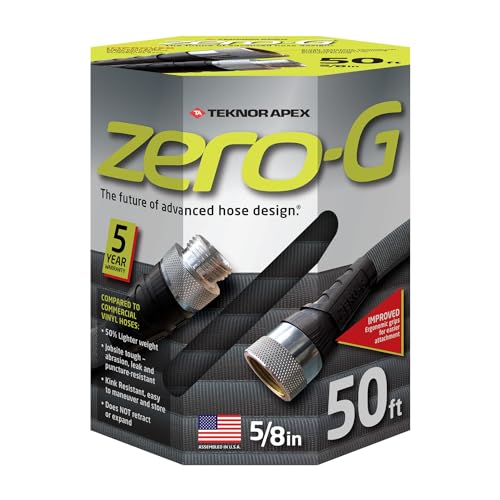
The Teknor Apex Zero-G is a lightweight hose designed to feel far easier to carry than a conventional rubber hose. In this cluster it is treated as a prose-only pick: no purchase link is published until its listing has been verified, so judge it here on fit rather than on a button. Its natural home is with gardeners who value light weight for frequent, shorter watering sessions. Positioned in the mid tier, it asks you to pay for construction and handling rather than for novelty, and it earns that position when its strengths line up with your longest route and your heaviest regular task. Its pros and cons follow directly from its design brief, which is exactly what this article has argued you should expect, and reward, in any hose.
Best for: gardeners who value light weight for frequent, shorter watering sessions. Not suited for: buyers whose main need is the exact opposite of its design, for example the lightest possible carry when this is a heavy-duty hose, or maximum toughness when this is a lightweight one. Strengths in daily use are consistent handling, fittings that feel secure at the faucet and behaviour you can predict from the first week. The honest trade-off is that no hose wins everywhere: weight, flexibility, toughness and storage bulk pull against each other, and this model simply chooses its side of that argument clearly. Check price on Amazon listings and retailer pages at the time you shop, compare the exact length and diameter you need, and confirm the fitting style matches your faucet and accessories before ordering.

Gilmour Flexogen Garden Hose
The Gilmour Flexogen is a reinforced all-purpose hose aimed at steady, general garden duty. In this cluster it is treated as a prose-only pick: no purchase link is published until its listing has been verified, so judge it here on fit rather than on a button. Its natural home is with households wanting one dependable hose for beds, lawn and patio work. Positioned in the mid tier, it asks you to pay for construction and handling rather than for novelty, and it earns that position when its strengths line up with your longest route and your heaviest regular task. Its pros and cons follow directly from its design brief, which is exactly what this article has argued you should expect, and reward, in any hose.
Best for: households wanting one dependable hose for beds, lawn and patio work. Not suited for: buyers whose main need is the exact opposite of its design, for example the lightest possible carry when this is a heavy-duty hose, or maximum toughness when this is a lightweight one. Strengths in daily use are consistent handling, fittings that feel secure at the faucet and behaviour you can predict from the first week. The honest trade-off is that no hose wins everywhere: weight, flexibility, toughness and storage bulk pull against each other, and this model simply chooses its side of that argument clearly. Check price on Amazon listings and retailer pages at the time you shop, compare the exact length and diameter you need, and confirm the fitting style matches your faucet and accessories before ordering.
Living With the Trade-Offs: A Week-by-Week Reality Check for a Garden Hose
A pros-and-cons list is a snapshot, but living with a garden hose is a film, and this section follows the trade-offs across the first weeks when novelty fades and routine takes over. In week one, most owners notice the headline advantage of a garden hose constantly, because every use is a comparison with whatever came before it, while the headline drawback feels minor simply because it is still new. Read the manual’s warnings page for the garden hose even if you read nothing else, because that page is a compressed list of every way the product has ever been misused, and it tells you exactly which of your own habits needs adjusting. Think about who else will use the garden hose and what they will do differently: shorter reach, less patience, stronger habits, no interest in the manual, and a tendency to leave things wherever they were last set down.
Use a simple decision checklist at the end: the garden hose fits the measured space, suits the real frequency of the job, matches the household’s cleaning temperament, has obtainable parts, and has a named storage home — five yeses make a confident order. If you already own a garden hose, run the same week-by-week check backwards and note which drawback you have genuinely stopped noticing and which one still earns a small sigh, because that sigh is the most honest review you will ever read. Share the checklist result with anyone who shares the space, since a garden hose chosen by one person and resented by another rarely survives, however sensible the purchase looked on paper. Measure before anything else, and measure the garden hose in its working state rather than its packed or folded state, because handles extend, lids open, cords trail, doors swing and users stand somewhere, and all of that belongs in the measurement.
One-time costs forgive easily, so a garden hose that is slow to assemble, heavy to position once, or demanding on its first deep clean can still be the right long-term choice if daily use afterwards is effortless. Look at replacement parts and consumables for the garden hose while you are still comparing, confirming that the pieces most likely to wear, clog, tear, fade or get lost can actually be obtained without replacing the whole product. Keep the packaging of a larger garden hose until those first ordinary tests are done, flattened if space is tight, because re-boxing an awkward shape from scratch is the hidden difficulty inside many otherwise straightforward returns. Seasonal thinking helps more than expected: a garden hose bought in one season will meet different light, humidity, mud, heat, guests and routines in another, so judge its size, storage and upkeep against the hardest season it will face.
For troubleshooting, start with the boring causes first: power, water, fit, blockage, alignment, a full container, a loose connection or a setting changed by the last person who used the garden hose, because boring causes account for most apparent failures. Photograph your setup once the garden hose is working well — the position, settings, arrangement or layout you settled on — so that after a move, a deep clean or a seasonal break you can recreate the arrangement that worked instead of rediscovering it. Check the floor, wall, ground or surface the garden hose will meet, since level, texture, moisture and finish decide more about everyday performance in garden & lawn settings than most shoppers expect when they are comparing listings on a screen. Test the garden hose in the first week under deliberately ordinary conditions rather than saving it for a special occasion, so that any problem surfaces while returning, exchanging or adjusting your setup is still simple.
Consider the cleaning rhythm honestly: a garden hose that needs attention after every use suits a household that enjoys small rituals, and frustrates a household that wants to finish a job and walk away, so match the upkeep to the temperament, not the intention. Per-use costs forgive nothing, so weigh any drawback that appears every time you reach for the garden hose — noise, wobble, awkward controls, slow setup, difficult emptying or cleaning — far more heavily than its position on a balanced list suggests.
Frequently Asked Questions
What is the biggest advantage of a traditional garden hose?
Versatility backed by reach. One hose, fed from one faucet, waters beds and containers, runs sprinklers and soaker lines, fills buckets and pools, and rinses patios and vehicles, with flow you control at the nozzle. No other single garden purchase covers so many weekly jobs, which is why a well-chosen hose feels like infrastructure rather than an accessory and repays its cost across years of varied use.
What is the most common complaint about garden hoses?
Kinking, followed closely by weight. Kinks form at the faucet bend, at corners and in coils stored twisted, and they interrupt flow at the worst moments. Reinforced, flexible construction reduces kinking, as does unrolling the hose fully and coiling it in large, consistent loops. Weight is managed by honest length choice: buy the route you measured, not a surplus you will drag around for a decade.
Do garden hoses leak a lot?
They leak at their fittings, not usually along their length, and most fitting leaks are washer problems. A flattened, cracked or gritty washer inside the faucet coupling causes the classic drip, and replacing it takes a minute. Solid brass couplings, clean threads and hand-tight connections with a small extra turn keep a sound hose essentially leak-free, with washers refreshed as a tiny seasonal chore.
How long should a good garden hose last?
A well-built hose that is drained, shaded and stored properly should serve for many seasons, often outlasting several cheap hoses bought in sequence. Lifespan depends on material, climate and handling: sun exposure, standing water, being driven over and winter freezing all shorten it. The practical test is condition, not age: stiffness, surface cracking, bulges or repeated leaks at several points signal retirement.
Are the cons of a garden hose worse in a small garden?
Different rather than worse. Small gardens suffer the storage con most, because a coil competes for scarce patio space, but they escape the weight and long-route cons almost entirely. A compact traditional hose on a small reel, or an expandable hose for gentle duty, fits small spaces well. The key is matching the hose to the space honestly instead of buying a long, heavy model out of habit.
Can I reduce the drawbacks without buying a new hose?
Usually, yes. A reel or hanger fixes storage and much of the kinking, fresh washers fix most drips, a leader hose eases the sharp bend at the faucet, and draining before winter prevents the most destructive damage of all. If the jacket itself has gone stiff, cracked or bulging, replacement is the honest answer, but many unhappy hose owners are one accessory and one habit away from contentment.
Related Guides
garden hose buying guide garden hose reviews: reading owner patterns garden hose vs expandable garden hose is a garden hose worth it garden hose reels that keep storage tidy garden hose nozzles for every spray job oscillating sprinklers for even lawn coverage expandable garden hose pros and cons


