Disclosure: As an Amazon Associate, dailyhomedecorating.com earns from qualifying purchases. Links on this page are affiliate links; they cost you nothing extra. Prices and availability change often, so check the current Amazon listing before you buy.
This food thermos pros and cons assessment refuses to pick a side before it has argued both. A food thermos is a genuinely useful object with genuinely annoying traits, and the households that love theirs are simply the ones whose lunches match its strengths and whose habits forgive its weaknesses. What follows lays out the pros as strongly as honest experience allows, then the cons with the same energy, and finishes by translating both lists into the only question that matters: given your food, your eater and your mornings, which list is longer where it counts? If you are weighing food thermos pros and cons before buying, argue with both halves — that is what they are for.
Key Takeaways
- Pros in one line: real hot or cold food anywhere, durable steel, years of service.
- Cons in one line: a daily ritual, real weight, steam-softened textures, gaskets that need care.
- The pros are about the food; the cons are about the habits. Know which side your household lives on.
- Best for: soup, stew and yoghurt people. Not suited for: crisp food and microwave routines.
Quick verdict. The pros win for lunch-packing households whose food is wet, hearty or chill-sensitive. The cons win for ambient lunches, crisp textures and anyone who knows the preheating ritual would last exactly one week in their kitchen.
In this guide
The Pros
Pro: Hot Food Without Power
The headline virtue is real. A preheated jar filled with hot soup or stew delivers a properly hot lunch hours later with no microwave, no socket and no queue. For site workers, drivers, students and anyone eating away from a kitchen, this is not a convenience but a capability nothing else in the lunch drawer offers.
Pro: Cold Food That Stays Cold
The same insulation works in reverse, keeping yoghurt thick, fruit crisp and salads refreshing through warm mornings. Cold reliability is arguably the stronger pro, because cold food forgives partial fills and shorter windows, making the jar dependable even in less disciplined hands.
Pro: Built to Last for Years
A stainless vacuum jar has no electronics, no coatings to peel on the inside and no moving parts beyond its lid. Dropped, it dents rather than shatters. In a kitchen category full of disposable and semi-disposable plastic, a buy-once object that serves daily for years is a genuine economic and environmental pro.
Pro: One Jar, Many Meals
Soup, stew, curry, chilli, porridge, pasta, yoghurt, fruit, overnight oats — the repertoire spans breakfast, lunch, seasons and eaters. Few single-purpose-looking tools turn out to be this general, and generality is what turns a purchase into infrastructure.
Pro: Eats and Cleans Like a Bowl
The wide mouth is a daily pleasure disguised as a specification: food ladles in, a spoon eats naturally, and a brush scrubs the whole interior without excavation. Compared with narrow drinks flasks pressed into food service, a proper food jar is simply civilised.
Pro: Ends the Sad Packed Lunch
The softest pro may be the strongest. A packed lunch that arrives as intended gets eaten, enjoyed and repeated — which means fewer bought lunches, less food waste at home, and children whose lunchboxes come back empty. Morale is a feature.
The Cons
Con: The Ritual Is Mandatory
Preheat for hot, pre-chill for cold, fill fully, seal on a clean rim. Skip the ritual and the jar’s performance collapses toward that of an ordinary tub — which means the product you are really buying includes two minutes of discipline every single morning, forever.
Con: Steam Is the Enemy of Crunch
An insulated jar is a sealed, steamy environment. Crispy coatings soften, crunchy toppings surrender, and anything whose identity is texture contrast arrives diminished. The category is honest about favouring the saucy and the smooth, but buyers of fried and crisp lunches learn it the disappointing way.
Con: Weight and Bulk Are Real
Steel, vacuum walls and wide mouths add up. In a child’s bag or a minimalist commuter tote, a jar is the heaviest, bulkiest resident, and an oversized tier bought in optimism becomes the reason the jar starts staying home.
Con: Gaskets Need Care and Eventually Replacement
The seal that makes the jar work also absorbs odours, hides residue and ages. It must be removed, washed and dried deliberately, and one day replaced. Households that treat the jar as wash-and-forget will, within months, own a jar that smells faintly of every lunch it has carried.
Con: It Cannot Reheat Anything
A steel jar must never enter a microwave, and it adds no heat of its own. Food packed at the wrong temperature stays at the wrong temperature. For eaters whose routine assumes a reheat, the jar is not a worse option — it is simply the wrong tool.
Con: Portions Are Fixed by the Jar
Capacity is a commitment. Appetites vary by day; the jar does not. Too-small tiers leave big eaters hungry, too-large tiers cool small portions, and the sizing decision made once in a shop echoes at every lunch that follows.
What the Trade-Offs Mean for You
For the soup-and-stew household, the pros land on your daily food and the cons land on habits you probably already keep; the balance is not close. For the site worker, weight is a shrug and hot food is morale — pros, decisively. For the parent, the trade-off is your morning ritual against your child’s eaten lunch, a trade most parents take gladly once the size is right. For the crisp-lunch devotee and the microwave-privileged, the cons are not minor print but descriptions of your actual lunch, and the honest verdict flips: skip the jar, buy the bento or the tub, and spend the difference on ingredients.
Context: The Jar Against Its Alternatives
Against a plastic tub, the jar wins temperature and durability, loses weight and microwavability. Against a bento box, it wins hot food outright and loses variety and crispness outright. Against an insulated bag with an ice pack, it wins hot food and compactness, and roughly ties on cold. No column sweeps the table, which is precisely why the pros-and-cons format suits this category: the right answer is a profile match, not a trophy.
Thermos Stainless King Food Jar
As a reference point on the pro side of the ledger, this design is the long-running family-size benchmark, a wide-mouth stainless vacuum jar sold in a generous capacity tier with a folding spoon stored in the lid on many versions. Its trade-offs are the category’s trade-offs in miniature — ritual, weight and steam — weighed against the category’s rewards, and its long popularity suggests that for its intended eater, the balance lands firmly pro.

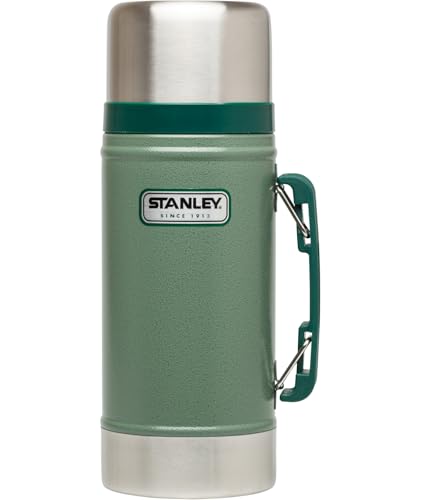
Stanley Classic Legendary Food Jar
As a reference point on the pro side of the ledger, this design is the rugged work-site classic, a heavy-gauge stainless jar with a chunky lid that doubles as a small bowl and a handle built for gloved hands on many versions. Its trade-offs are the category’s trade-offs in miniature — ritual, weight and steam — weighed against the category’s rewards, and its long popularity suggests that for its intended eater, the balance lands firmly pro.
How to Buy Smart
Buy the size a real portion fills. Insist on a removable gasket and check that a replacement is obtainable. Run the sink leak test in the first week. Choose the mouth for your food list, not for the photograph. And check price on Amazon for two or three shortlisted designs rather than marrying the first badge you see — in a category this mature, fit differences dwarf price differences.
Setup and Care That Reduce the Cons
Food safety with any insulated jar is qualitative common sense rather than a numbers game. Preheat the jar with hot water before filling it with hot food, so the steel gives its warmth to the meal instead of taking warmth from it. Fill hot food steaming hot, seal promptly, and eat it while it is still properly hot rather than after a long, lukewarm wait; perishable food should not sit at room temperature for long stretches, and leftovers that have cooled into the in-between zone are safer discarded than saved. Chill cold foods thoroughly before packing them into a pre-chilled jar. Wash the gasket, lid threads and mouth after every use, let every part dry fully before reassembly, and retire a jar whose seal smells stale even after washing, because trapped residue in a gasket is where odours and bacteria quietly live.
Care is simple but not optional. Wash the jar the same day you use it, because dried soup film in the threads is far harder to shift than a fresh rinse. Most stainless bodies prefer hand washing even when a listing suggests otherwise, since harsh dishwasher cycles dull powder coatings and stress vacuum seals over time. A soft bottle brush reaches the shoulder of wide-mouth jars, a paste of baking soda lifts tea and tomato staining, and a periodic soak with warm water and a little white vinegar clears lingering smells. Dry upside down with the lid off, store with the lid loose so air circulates, and check the silicone gasket monthly for cracks, flattening or mould spots hiding in its fold.
Most cons shrink under good habits: the ritual becomes automatic, the gasket stays sweet, textures are managed by packing toppings separately, and weight is managed by honest sizing. The cons that remain — no reheating, no crunch — are physics, and the mature response is to choose the jar for the lunches where physics is on your side.
Bottom Line
The pros are about food and the cons are about habits, and households know their habits better than any reviewer can. If your lunches are saucy, hearty or chill-sensitive and your mornings can hold a two-minute ritual, the pros win and keep winning for years. If not, the cons have done you a service by saying so before the purchase rather than after.
The Pros, Extended: Evidence From the Lunch Hour
Arguments settle pros and cons better than adjectives, so consider the pros at the moment they actually occur. The hot-food pro occurs at noon on a February site, when a stew that left the house at dawn is steaming in a cab with no kitchen for a mile — there is no competing product in the bag that could have done that. The cold pro occurs at a school lunch table in June, when yoghurt packed at breakfast is still properly cold while every ambient snack around it has gone tired. The durability pro occurs in year three, unphotogenically, when the same jar is simply still there. The versatility pro occurs across a single week in one household: porridge on Monday, soup on Wednesday, fruit salad on Friday, one object. Pros that can be pointed at in a diary like this are not marketing; they are the accumulated texture of owning the thing.
The Cons, Extended: Where They Bite Hardest
The cons bite at predictable coordinates too. The ritual con bites on the worst morning of the month — the overslept, rushed one — which is of course the morning a bought lunch beckons strongest, so the jar’s discipline is tested exactly when discipline is scarcest. The steam con bites the first time a new owner packs something crisp with confidence, and the disappointment is out of proportion because the food was good when it went in. The weight con bites on the school run, in the bag of the smallest eater, where every extra item is audited by small shoulders. And the gasket con bites in month four, as a smell, announcing a washing habit that was always slightly theoretical. Naming where the cons bite is not an argument against the jar; it is a map that lets a buyer pre-decide — toppings packed separately, jar sized for the child, ritual attached to the kettle’s boil — so the bites land on a plan rather than on a surprise.
Head-to-Head: The Trade-Offs in One Place
Set the lists against each other and a pattern emerges that neither list shows alone. Every pro is about the food at the moment of eating; every con is about the hours before and after — the packing, the carrying, the washing. That is the category’s whole character: a food thermos taxes the margins of the day to reward its middle. Households whose margins are slack — unhurried mornings, a sink routine, a bag with room — experience the jar as nearly all pro. Households whose margins are already spent experience the same jar as nearly all con, and both households are reporting the truth. This is why pros-and-cons lists that end in a universal verdict are lying politely; the honest output of the format is a mirror, and the reader’s own margins are the verdict.
Scoring the Lists for Common Households
For the organised batch-cooking family, score it roughly six pros felt weekly against two cons felt mildly: buy with confidence. For the site worker, the hot-food pro alone outweighs the cons column, because its alternative is a cold lunch in a cold place: buy the rugged tier. For the parent of a hot-lunch child, the pros win if the lid passes the child’s hands in a shop test and lose if it does not — that single test is the household’s whole ballgame. For the minimalist commuter with a sandwich habit and a good office microwave, the cons win cleanly, and the correct purchase is no purchase. For the undecided household in the middle, the tiebreaker is the summer test: if cold lunches — yoghurt, fruit, salads — are genuinely weekly in warm months, the jar earns year-round keep and the pros take it; if not, wait until a real hot-lunch routine exists, and let this list keep until then.
Pros and Cons by Food Type: The Practical Matrix
Abstract lists sharpen when they are forced through a menu. Soup: pros sweep — hot, contained, spoon-friendly — with the single con that delicate garnishes should travel separately. Stew and curry: pros again, with a staining-and-odour asterisk that good gasket care answers. Pasta: a split decision, glorious when saucy and packed full, tired when dry and loose. Rice dishes: the same split, tilted by sauce and density. Yoghurt and cold desserts: pros sweep in the other direction, cold being the jar’s most forgiving mode. Salads: a cautious pro for undressed leaves and grains, a firm con for anything dressed or crisp. Fried and crunchy food: cons sweep, and no ritual rescues them. Breakfast porridge and overnight oats: pros at both temperatures, which is why breakfast may be the jar’s most underrated shift. A buyer who runs their real menu down this matrix will know their verdict before any scoring system is consulted.
Pros and Cons by Eater: Children, Workers, Students
For children, add two pros — food arriving as intended gets eaten, and a personal jar makes lunch feel owned — and two cons with teeth: weight audited by small shoulders, and lids that must surrender to small hands. For site and outdoor workers, the hot-food pro inflates to headline size while the weight con deflates to irrelevance, the most lopsided scoring in this entire piece. For students, budget and looks enter both columns honestly: a jar is a real purchase on a student budget, and a design they are proud to carry gets carried. For desk workers, the columns narrow to manners — quiet lids, clean lines, no leaks near electronics — and the pros win on polish rather than power. The same object, four different arguments: pros-and-cons analysis that ignores the eater is arithmetic without numbers.
The Long View: How the Balance Shifts Over Years
Score the lists at different ownership ages and they move. In month one, the cons lead on points — ritual unfamiliar, size calibrating, textures surprising. By month six, in a well-matched household, the pros have taken a commanding lead: the ritual is invisible, the size is known, the menu has self-selected toward the foods the jar flatters. By year three, the ledger is dominated by a single pro — the jar is still there, still working, having outlasted several generations of plastic rivals — and a single con, the gasket’s slow ageing, which a replacement seal resets like a clock. Mismatched households show the opposite trajectory, cons compounding as the jar migrates cupboard-ward. The practical moral: judge a food thermos not by its first week but by its likely fiftieth, and buy the size, seal and finish that the fiftieth week will thank you for.
Mitigations: Shrinking the Cons You Cannot Avoid
Several cons accept partial pardons. The ritual con shrinks when the preheat is welded to an existing habit — the kettle’s boil is the classic anchor — until it stops feeling like a step at all. The steam con shrinks with a companion pot for toppings and a menu that leans saucy by design rather than by accident. The weight con shrinks when the jar is sized to the eater instead of to optimism. The odour con shrinks with the gasket routine described in this cluster’s care sections, and nearly vanishes when a spare seal rotates with the working one. Only two cons refuse mitigation — no reheating, no crunch — and they are not really cons so much as the category’s borders. A buyer who mitigates the four and respects the two has, in effect, custom-built the pros list for their own kitchen.
Food Thermos Pros and Cons: The Weighted Summary
Unweighted lists pretend every pro and con matters equally, and they do not. Weighted by how often each is actually felt, the ledger for a typical lunch-packing household reads like this. Felt daily, on the pro side: food arriving at its intended temperature, and the small noon pleasure that follows. Felt daily, on the con side: two minutes of ritual and a deliberate wash. Felt weekly, pro: money not spent on replacement lunches, and leftovers living a second, dignified life. Felt weekly, con: the bag space and weight, noticed mostly on the fullest days. Felt monthly, pro: the jar simply still being there, unbroken and unstained, while plastic contemporaries warp and retire. Felt monthly, con: the gasket’s deep-clean appointment. Felt rarely, pro: the heroic days — the site in February, the picnic in July — where the jar does what nothing else in the house could. Felt rarely, con: the crisp lunch that should never have been packed, remembered fondly as a lesson. Weighted honestly, the pros are a salary and the cons are a small tax — for the household whose food and mornings match. For the household whose do not, the weights invert, and the same list reads as a warning. Both readings are correct; that is the entire philosophy of this article in one paragraph.
The Environmental and Economic Balance Sheet
Two ledgers deserve a joint hearing. Economically, the jar’s case is a slow win: one durable purchase displacing a stream of disposables and a share of bought lunches, with a gasket as its only recurring cost — provided, always, that it is used, since an unused jar is pure cost in every currency. Environmentally, the same shape holds: steel and longevity on the credit side, the footprint of manufacture on the debit side, amortised by years of daily service into a genuinely favourable balance — again provided the service happens. The two ledgers share their condition so completely that they can be summarised together: this is a product whose goodness, financial and environmental alike, is not bought at the till but earned at the lunch table, week after week. Buyers who understand that will size honestly and build the ritual; buyers who want the credit without the service should leave the jar on the shelf, where at least it costs the planet nothing.
Final Scoring for the Undecided
For readers who want this article to end with something countable, score your own household from one to five on each line and total honestly. Hot or cold-sensitive lunches packed weekly: score the frequency. Microwave access at the destination: score its absence, since absence favours the jar. Morning slack for a two-minute ritual: score the slack. A named eater with a measurable portion: score the certainty. Tolerance for washing a gasket properly: score the tolerance. A total in the high teens or above describes a household the pros are waiting for; a total in single figures describes one the cons have already claimed; and the wide middle describes the trial-week households, who should borrow the habit before buying the object, exactly as this cluster’s worth-it article advises. Numbers cannot choose for you — but they can stop you pretending the choice is unclear when your own answers have already made it.
The Menu Verdict: Pros and Cons, Lunch by Lunch
A menu is the fastest way to feel what a week of jar lunches actually looks like, so here is one built from the foods this category flatters. Monday: a lentil and tomato soup, packed at a simmer, with the bread travelling outside the jar where bread belongs. Tuesday: overnight oats from the chilled jar, eaten at a desk with fruit added fresh. Wednesday: a chicken curry with rice stirred through its sauce, the jar filled completely so the rice rides in warmth rather than in air. Thursday: yoghurt, berries and a separate small pot of granola, the crunch preserved by geography. Friday: the week’s leftover stew, reheated properly, packed proudly — the lunch that makes the whole system feel clever. The weekend jar rests, gets its deep wash, and dries with its lid off. Notice what the menu never asks of the jar: nothing crisp, nothing dry, nothing reheated. A menu written inside the category’s strengths is the quiet secret behind every satisfied owner this cluster has described.
Score the menu and the article’s lists stop being abstract. Monday’s soup: pro, unopposed. Tuesday’s oats: pro, in the cold direction. Wednesday’s curry rice: pro, with the gasket-wash con noted in the margin. Thursday’s yoghurt: pro, with the separate-pot con accepted as the price of crunch. Friday’s leftover stew: the week’s strongest pro, because it retires waste and a bought lunch simultaneously. Five lunches, four clean pros and one asterisk — that is what the balance looks like when it is served rather than argued, and a household whose week resembles this menu has its answer.
Pros and Cons on the Road
Travel widens the jar’s brief in ways worth a section of their own. On trains and in cars, a sealed jar is the rare hot meal that asks for no facilities and leaves no smell crime scene behind it, provided the rim was wiped and the seal respected. On walking days and site visits, the jar’s meal is the difference between a planned lunch and whatever a petrol station offers. For parents, travel is where the cold mode earns a second income: yoghurt and fruit held properly chilled through a long drive end the service-station sugar negotiation before it starts. The travel cautions are the usual ones, sharpened: test the seal at home before trusting it to a moving bag, pack the jar upright where the vehicle allows, and treat journey food with the same temperature discipline as work food — hot means properly hot at packing, cold means properly chilled, and a very long day is a reason to eat earlier rather than to hope harder.
Travel moves two items between columns. The leak con, theoretical at a desk, becomes practical in a moving bag and must be answered with the sink test and rim discipline. The hot-food pro, pleasant at work, becomes close to heroic where no kitchen exists. Net effect for travelling households: the columns grow more extreme in both directions, which means the fit decision matters more, not less — a well-matched jar is worth more on the road, and a mismatched one is forgiven less.
The Honest Middle: Cons That Are Really Instructions
Re-read the cons list with fresh eyes and a pattern surfaces: half of it is written in the grammar of warnings but reads, on inspection, like a manual. The ritual con is an instruction to preheat. The gasket con is an instruction to wash the seal. The sizing con is an instruction to measure a portion. The leak con is an instruction to wipe a rim. Only the steam con and the no-reheating con are true properties, immune to behaviour. This reframing is not a sales trick — the instructions still cost time and attention, and households unwilling to follow them should weigh the cons at full strength. But it explains the category’s polarised reputation better than any other observation in this article: owners who followed the instructions report the pros, owners who never received them report the cons, and both are describing the same jar accurately.
Bottom Line, Restated for the Record
For the record, then, in the plainest form this article can manage. The pros: real temperature, real durability, real economy, real pleasure at noon. The cons: a real ritual, real weight, real limits around steam and reheating. The pros belong to the food; the cons belong to the routine; and the choice belongs, as it always did, to the household that knows its own food and its own routine better than any list can. Argue with both columns, run your own menu through them, and the bottom line will write itself — which is the only kind of bottom line worth trusting.
Pros and Cons for the Lunch You Have Not Packed Yet
Most assessments stop at the household’s current menu, but jars are bought for years and menus evolve, so weigh the lists against the lunches on your horizon. The child whose tastes are widening will meet the jar’s repertoire halfway within a school year. The worker changing jobs may inherit a site, a commute or a canteen that rewrites both columns overnight. The cook whose batch-cooking habit is growing will find the pros compounding quietly in the background. None of this argues for buying on speculation — the cons punish unused jars too reliably for that — but it does argue for choosing, among the jars that fit today’s lunches, the one whose strengths also face tomorrow’s. Versatility is the pro that hedges the future, and it is why the classic patterns, broad-mouthed and unpretentious, so often anchor a household’s first purchase.
What Owners Would Tell the Lists’ Authors
Let the last evidence come from the imagined testimony of owners, the people who have lived both columns. They would move one con up the page — the lid wrestling match after a very hot pack deserves more prominence than reviewers give it — and one pro up beside it: the jar’s talent for making an ordinary Tuesday lunch feel provided for. They would annotate the weight con with a footnote about bags, since the same jar is nothing in a van and everything in a six-year-old’s rucksack. They would insist the gasket appear in the title of any honest assessment, pros and cons alike, because it is the part their satisfaction actually tracked. And they would close, almost unanimously, with the observation this article reached by argument: that they stopped thinking in pros and cons within a month, because the jar had either become infrastructure or become cupboard — and infrastructure has no cons column, only a maintenance schedule.
The Lists, Condensed to a Pocket Card
For the reader who wants the whole assessment on an index card: Pros — hot food without power, cold food without a fridge, steel that outlasts trends, one jar for breakfast and lunch in every season, lunches that come home eaten. Cons — two minutes of ritual each morning, a gasket that must be washed like it matters, steam that softens crunch, weight that small shoulders notice, and a hard rule against the microwave. Carry the card to the shop. Hold it against your eater, your menu and your mornings. If the left column reads like your life and the right column reads like a fair price, you have finished deliberating — the remaining work is sizing, sealing and soup.
Pros and Cons in Soup Weather and Salad Weather
The seasons reweight the lists one final time. In soup weather the hot-food pro swells until it casts shade over the whole cons column: weight feels lighter when the alternative is a cold lunch, the ritual feels shorter when the kettle is already on for tea, and even the gasket’s washing is forgiven by a household eating well. In salad weather the ledger relaxes rather than reverses — the cold pro is quieter than the hot one but more forgiving, asking less ritual, tolerating fuller diaries and half-filled jars, and the cons shrink to the weight and the wash. A household scoring the lists in only one season is reading half the book; the jar lives in both, and so, in the end, does its owner.
This is also why second-hand verdicts about food thermoses sound so contradictory across the calendar. The February evangelist and the August sceptic may own the same jar and both be reporting honestly; they are simply reading different seasonal editions of the same ledger. A buyer who understands this stops asking whether the category is good and starts asking the only question this article has ever really posed: in which seasons, for which lunches, carried by which eater, will this jar’s pros be the ones my household feels?
The Cons, Given Their Final Fair Hearing
Before the verdict, let the cons speak once more at full strength, because an assessment that rushes its ending has not earned it. The ritual will be skipped on the worst mornings, and those mornings’ lunches will be ordinary. The gasket will, one day, smell of a forgotten Friday and demand its soak. The jar will be too heavy on the day the bag is fullest, too small on the day appetite is largest, and useless — completely, structurally useless — on the day only a microwave could save lunch. All of that is true, and none of it is hidden anywhere in this cluster’s pages. The pros were weighed in the same open air. What remains is not persuasion but arithmetic, and the arithmetic belongs to the reader’s kitchen, where it always did.
Pros and Cons: The Assessment in One Breath
If the whole assessment had to survive in a single breath, it would go like this. A food thermos gives a household hot food without power and cold food without a fridge, in steel that outlasts the trends around it, at the price of a two-minute morning ritual, a gasket that must be washed like a part rather than an afterthought, a little honest weight, and a firm refusal to crisp or reheat anything. Every clause of that sentence has been argued at length in the sections above, and every clause is a fair trade or a fair warning depending entirely on the kitchen reading it. That dependence is not the assessment failing to conclude; it is the assessment’s conclusion, arrived at honestly and offered without decoration.
So the lists close where they opened: arguing both sides as strongly as the evidence allows, and trusting the reader’s lunch — the real one, packed on real mornings for a real eater — to cast the deciding vote. It is the only vote in this category that has ever counted.
A Final Word From Both Columns
Columns in assessments like this one are usually made to fight, but the honest ending is a negotiation. The pros offer temperature, durability and the daily pleasure of a lunch that arrives as intended. The cons ask, in exchange, for two minutes, a washed gasket, an honestly sized bag and a menu that respects steam. Households that sign that bargain tend to keep it for years, renewing it each morning without ceremony. Households that decline it lose nothing but a purchase they would have resented. Either signature is a success for the format, because a pros-and-cons list has done its work not when it crowns a winner but when a reader can say, with evidence, which side of the bargain their own kitchen stands on.
That is the standard this article set itself at the outset — argue both sides at full strength, translate them through eaters, foods and seasons, and leave the verdict where it belongs. The lists are complete, the weights are yours, and lunch, as ever, will have the final word.
Filed Under Lunch
Every assessment in this cluster eventually files itself under the same heading, and this one is no exception: lunch. Not the idea of lunch, not the photograph of lunch, but the specific, recurring, occasionally rainy lunch that a specific eater opens at a specific hour. The pros were written by that lunch’s best days and the cons by its worst, and the balance between them is not a fact about a product but a fact about a household’s fit with one. Readers who have followed the argument this far no longer need the lists summarised; they need only to picture tomorrow’s lunch, honestly, and notice which column it lands in.
Picture it with the jar full and the ritual kept, and then picture it without the jar at all. The distance between those two pictures — in temperature, in pleasure, in money unspent and food uneaten — is the true pros-and-cons table, drawn to your household’s exact scale. Everything in these pages was scaffolding for that one act of imagination. The scaffolding can come down now; the picture remains.
There is a reason this category inspires such durable loyalty among the households it fits, and the pros-and-cons format, for all its balance, should not be allowed to flatten it. A tool that feeds people well, far from kitchens, in all weathers, for years on end, earns a kind of gratitude that specifications cannot invoice. The cons documented here are real, and they will be paid by every owner in minutes, grams and washes — but they are paid gladly, at noon, in the currency of a lunch that arrives as it was meant to. Assessments can weigh that exchange; only eaters can feel its exchange rate, and the eaters, season after season, keep renewing the bargain.
So let the record close with the bargain stated cleanly one last time: the jar asks for discipline and gives back lunch. Households that find that trade fair will find this article’s pros prophetic and its cons trivial. Households that do not will find the reverse, and will have been saved a purchase by the same pages. Both outcomes are the format working exactly as intended.
whether a food thermos is worth it
how to choose a food thermos step by step
the in-depth food thermos review
practical storage baskets for the pantry shelf
vacuum storage bags for bulky kitchen linens
water coolers sized for camping trips
sports water coolers for kids’ teams
The Everyday Balance Sheet for a Food Thermos: Gains, Costs and Frictions
Advantages and disadvantages read differently once an item is in daily use, so this section weighs the food thermos the way a household experiences it over months rather than minutes. It focuses on the frictions, workarounds and quiet benefits that decide whether the balance stays positive.
Start With Your Space and Your Routine
If the listing offers accessories for the food thermos, decide which ones solve a problem you already have, and set aside the ones that only solve problems the listing itself invented. If you shop with someone else, agree the must-haves together before looking, so that the food thermos you choose is a shared decision rather than one person’s compromise discovered later. Beware of choosing a food thermos for a rare occasion, such as a large gathering once a year, if that choice makes everyday use worse for the other fifty-one weeks. If the food thermos needs assembly, read the instruction preview if one is offered, count the steps honestly against the time you have, and check whether a second pair of hands is recommended.
A fair pros-and-cons judgement needs a time horizon, so weigh the food thermos twice: once for the first month, when convenience and appearance dominate, and once for the second year, when durability and upkeep decide whether it was a good buy. Think about who else will use the food thermos, how often, and in what way, because a choice that suits one person perfectly can frustrate everyone else in the household. Apply the same checks to each shortlisted example, whether that is the Thermos Stainless King Food Jar; the Stanley Classic Legendary Food Jar, because consistent testing is what makes the differences between models visible. Decide in advance which single feature you would refuse to compromise on, and let that one priority settle ties between otherwise similar food thermos choices.
Finally, judge the food thermos against the life you actually lead this year, not the tidier or more ambitious life in the listing photographs, and the choice will usually make itself. Ask how the food thermos will be cleaned on an ordinary week, with the products and time you actually have, not with a special routine you are unlikely to keep up. The best food thermos for a rented home may differ from the best for an owned one, because fixings, marks and alterations carry different consequences in each case. A good test is the two-week question: imagine the food thermos after a fortnight of ordinary use, with no special effort from you, and ask whether you would still choose it.
When Small Problems Appear
Measure the space where the food thermos will live, including the clearance needed to use it, move around it and clean behind or beneath it, and keep those numbers beside you while you compare options. Consider who in the household gains from the food thermos and who absorbs its costs in space, noise, cleaning or upkeep, since a lopsided balance is a common source of quiet dissatisfaction. When you compare delivery options for a food thermos, factor in where the item will be left and who will move it to its final spot, since the last few metres are where damage and strained backs happen. Where the food thermos has moving parts, work them through their full range during your first checks, listening and feeling for roughness that a photograph cannot show.
Set the assembled food thermos up fully before deciding it is wrong for the space, since partly built or badly positioned pieces often look worse than they will once finished and levelled. Compare how each option handles the in-between moments, such as being half full, partly open, moved aside or used in a hurry, because daily life happens mostly in those moments. If a part of the food thermos can be replaced, refreshed or re-covered separately, that option can extend its useful life well beyond the point where a sealed design would be thrown out. Photograph the food thermos as delivered, before assembly or first use, so that any later question about condition, parts or finish can be answered from evidence rather than memory.
Consider the busiest version of the day, not the calmest one, and ask whether the food thermos still works when people are hurrying, carrying things or sharing the same space. The strongest argument for a food thermos is usually a boring one, such as suiting the space exactly or being easy to keep clean, while the strongest argument against it is often an everyday friction rather than a dramatic flaw.
A Short Decision Checklist
- How the food thermos will be cleaned in an ordinary week
- Assembly needs, tools required and whether help is needed
- Who will use the food thermos most, and any limits they have
- Packaging kept until the food thermos has passed its first trial in place
- The main job the food thermos must do, written in one sentence
- The one feature you will not compromise on
- Delivery path, from the door to the final position
- What your current arrangement does badly that the food thermos must fix
Taken together, these checks take only a little time, yet they answer the questions that decide whether the food thermos suits your home, your household and your routine, and they do so before money changes hands rather than after.
Frequently Asked Questions
What is the biggest pro of a food thermos?
Temperature independence: hot or cold food, hours later, with no power. Everything else — durability, economy, morale — builds on that single capability.
What is the biggest con?
The mandatory ritual. Performance depends on preheating, filling fully and packing at temperature, every time — households that will not keep the ritual should not buy the jar.
Do food thermoses make food soggy?
They soften crisp and crunchy elements because the sealed jar traps steam. Saucy, smooth and hearty foods are unaffected or improved; pack crunchy toppings separately to add at eating time.
Are the cons the same for kids’ jars?
Mostly, with weight and lid-opening promoted to headline issues. A child who cannot open the jar or will not carry its weight experiences the cons more than the pros.
Can good habits really cancel most cons?
Most, yes: ritual, washing and sizing habits neutralise the performance, odour and disappointment cons. The physics cons — no reheating, no crunch — remain, and should steer the purchase, not surprise it.
Is a food thermos still worth it if I only use it for cold food?
Often, yes. Cold use is the most forgiving mode, and a jar carrying yoghurt and fruit daily through the warm months delivers its pros with the fewest cons attached.


