Disclosure: As an Amazon Associate, dailyhomedecorating.com earns from qualifying purchases. Links on this page are affiliate links; they cost you nothing extra. Prices and availability change often, so check the current Amazon listing before you buy.
This food thermos review takes a clear position: instead of skimming a shelf of near-identical steel jars, it puts the food thermos as a class under the microscope — how vacuum insulation actually behaves with real soup, how lids and gaskets age, and where the whole category quietly cuts corners. One benchmark design carries the detailed assessment, the classic wide-mouth stainless food jar that most packed lunches actually rely on, with named alternatives appearing only where a comparison genuinely sharpens the verdict. If you have ever opened a jar at noon to find pasta that is merely warm and faintly metallic, this review is written for that disappointment, and for avoiding it.
Key Takeaways
- Verdict: a good food thermos earns its place for soups, stews and hot leftovers; it is a poor substitute for a microwave you actually have access to.
- Best for: commuters, school lunches, site workers and soup lovers. Not suited for: crispy food, carbonated drinks, or all-day banquets.
- Heat retention is decided more by preheating, fill level and food type than by brand badges.
- The gasket is the part that fails first — judge a jar by how easily its seal removes, washes and replaces.
Short verdict. Buy a food thermos for wet, hearty food eaten within a normal school or work morning and it will quietly change how you lunch. Buy one expecting a portable oven that keeps a small portion piping hot from dawn to dusk and you will be shopping again by winter.
In this guide
Food Thermos Review: What a Food Thermos Is and Where It Fits
A food thermos is a double-walled, vacuum-insulated container built for meals rather than drinks. The vacuum between its steel walls slows heat transfer dramatically, which is why the same basic design can cradle hot soup through a cold commute and keep fruit salad properly chilled through a warm afternoon. Compared with a drinks bottle, a food jar trades height for width: a broad mouth you can fill from a saucepan, eat from with a spoon, and scrub clean without a specialist brush. That single design decision — width — explains almost everything about how the category performs, because a wide mouth is easier to live with but gives heat a larger lid area to escape through.
The category divides into three broad families. Classic wide-mouth jars are the all-rounders, sized for an adult main course and built around a screw lid that often hides a folding spoon. Slim commuter jars sacrifice some capacity for a bag-friendly profile and a lid engineered to seal with a quarter turn. Kids’ jars shrink the format, lighten the body and add colours and characters, accepting a shorter holding window because a school morning is shorter than a site shift. None of these families is better in the abstract; each is a different answer to the question of who is eating, where, and how long after packing.
Where does a food thermos fit in a kitchen that already owns lunch boxes, bento trays and a microwave? It fits precisely where those tools fail: food that must travel hot or cold without power, without spills, and without reheating. It is the packed-lunch equivalent of a good coat — unglamorous, used constantly, and missed immediately when it underperforms. In the Food Storage and Organization corner of a home it earns a permanent shelf spot, because it replaces disposable tubs for soup, porridge, curry, yoghurt and fruit alike, and because one good jar outlasts a drawer of stained plastic.
Design, Build and Setup
Build quality in this category announces itself in the hand. A well-made jar has a smooth, even rim with no sharp lip to catch a spoon or a lip, threads that engage without grit or cross-threading, and a base that sits flat and resists denting when it meets a tiled floor. The steel should feel substantial rather than tinny, the exterior finish — brushed, powder-coated or classic hammertone — should be free of bubbles and thin patches, and the lid should close with a confident, cushioned stop as the gasket compresses, not a hard plastic clack. None of this requires laboratory testing; a minute of handling tells you more than a page of marketing.
The lid is the engineering heart of the jar. Better designs use a silicone gasket that can be pried out with a fingertip for washing, a pressure-release detail or a venting button on jars meant to be opened after hot contents have built up a vacuum, and an inner lid surface that does not trap food in decorative grooves. Some lids double as a small serving bowl, which sounds like a gimmick until you are eating stew on a train with nowhere to put the lid down. Folding spoons stored in the lid are genuinely useful for children and for desk lunches, though committed soup eaters will still prefer a full-size spoon from the cutlery drawer.
Setup, such as it is, means learning the preheating ritual described throughout this review and choosing the right fill. There is no assembly, no charging and no app — the entire setup is a kettle of hot water, five patient minutes, and food packed at a proper temperature. Treat that ritual as part of the product and the category makes sense; skip it and even the finest jar performs like a cheap one.
The Benchmark: Thermos Stainless King Food Jar
As the reference point for this review, consider the long-running family-size benchmark, a wide-mouth stainless vacuum jar sold in a generous capacity tier with a folding spoon stored in the lid on many versions. It represents the classic pattern at its most developed: a wide mouth that accepts a ladle, a lid engineered for daily sealing rather than occasional picnics, and a body sized for a real main course rather than a snack. In everyday terms it is the jar against which slimmer, smaller or cheaper designs should be measured — not because it wins every category, but because it defines the compromises the others are trading against.
Performance in Real Use
Soups and Stews: The Home Fixture
Soup is the food thermos’s home fixture, and the class performs accordingly. A jar preheated and filled to the brim with soup at a rolling simmer will still be a satisfying, steaming lunch several hours later, because a full jar of liquid food is a large thermal mass with nowhere for its heat to hide. Stews behave nearly as well, their sauce protecting chunks of meat and vegetable from the cooling that exposed surfaces suffer. The failures happen at the margins: a half-filled jar, soup packed merely warm rather than hot, or a lid opened twice for a peek and a stir. Each of those is a user variable, not a product flaw, which is why honest reviews of the same jar range from delighted to furious.
Texture matters too. A soup that goes in silky comes out silky; the jar neither cooks nor degrades it further in any dramatic way, though delicate green vegetables will soften and darken if they sit hot for a full morning, and pasta continues to drink broth and swell. Pack noodles separately where you can, or accept the softer, heartier texture as part of the format — many people quietly prefer it.
Pasta, Rice and Saucy Mains
Pasta and rice dishes are the second great use case, and the more demanding one. Dense, saucy food holds heat well; dry, airy food does not, because the air pockets between grains and shapes are tiny cooling channels. A tightly packed rice bowl or a saucy pasta, filled hot and full, arrives in good shape. A loose portion of plain pasta arrives tired. The fix is technique: sauce generously, pack firmly, fill the jar completely even if that means adding a little extra sauce or a smaller jar for a smaller portion. Dairy-based sauces deserve a note of caution — they are the foods to be most disciplined about, eaten while properly hot rather than after a long lukewarm afternoon, exactly as the safety guidance in this review advises.
Cold Food: Yoghurt, Fruit and Salads
Cold performance is the category’s underrated half. A pre-chilled jar keeps yoghurt thick and properly cold, fruit salad crisp rather than sweating, and pasta salad refreshing through a warm morning. The same vacuum that slows heat escaping slows heat arriving, and cold food is more forgiving of a partially filled jar because there is no steam pressure working on the seal. For school lunches especially, the cold use case may justify the purchase alone: a child who will not touch a warm, tired yoghurt tube will eat chilled yoghurt from a jar that feels like a treat. Granola and crunchy toppings travel best in the lid or a separate small pot, added at eating time so the contrast survives.
Leaks, Bags and Real-World Knocks
A food thermos lives in bags, and bags tip over. A well-sealed jar, closed firmly on a clean thread, travels through a commute on its side without incident; a jar closed over a smear of sauce on the rim will eventually weep, and the fault lies with the smear. Wipe the rim before sealing, every time. Knocks are handled well by steel bodies, which dent rather than crack, though a hard drop can compromise a vacuum — a jar that suddenly feels warm to the touch outside, or whose contents cool suspiciously fast, may have lost its vacuum and become an expensive ordinary tub. Treat that diagnostic as the category’s built-in health check.
Strengths and Trade-Offs
Strengths
- Real food, properly hot or cold, with no microwave queue, no power point and no compromise container.
- Steel durability and reusability that retire a drawer of stained, warped plastic tubs.
- A wide mouth that fills from the pan, eats like a bowl and cleans without specialist tools.
Trade-offs
- Performance depends on ritual — preheating, filling fully and packing food at the right temperature.
- Wide mouths and steel bodies weigh more than plastic tubs, and capacity is modest for large appetites.
- Gaskets absorb odours and need deliberate washing and eventual replacement.
How It Compares
Against a standard plastic lunch tub, the food thermos wins on temperature and loses on weight and microwave convenience — a tub can go straight into the office microwave, a steel jar never can. Against a bento box, the comparison is about food type: bentos organise variety beautifully but keep nothing hot, while the jar does one hot thing superbly and variety poorly. Against its own siblings, the differences are of degree and design rather than kind.

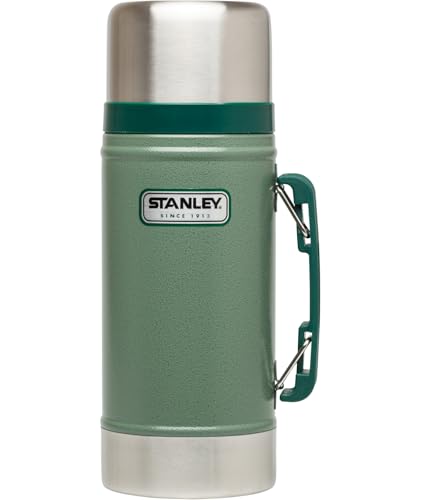
Stanley Classic Legendary Food Jar
Consider the rugged work-site classic, a heavy-gauge stainless jar with a chunky lid that doubles as a small bowl and a handle built for gloved hands on many versions. Set beside the benchmark jar, its appeal is specific rather than general: it trades some of the classic pattern’s all-round balance for a strength a particular user will feel every day, whether that is toughness, tidiness in a bag, or a lid their hands simply prefer. That is the honest shape of choice in this category — not a champion and a field of losers, but a set of well-made jars emphasising different virtues.
Hydro Flask Insulated Food Jar
Consider the colourful modern option, a powder-coated stainless jar with a leak-resistant insulated lid, sized in smaller personal tiers for desk lunches and kids’ bags. Set beside the benchmark jar, its appeal is specific rather than general: it trades some of the classic pattern’s all-round balance for a strength a particular user will feel every day, whether that is toughness, tidiness in a bag, or a lid their hands simply prefer. That is the honest shape of choice in this category — not a champion and a field of losers, but a set of well-made jars emphasising different virtues.
Zojirushi Stainless Steel Food Jar
Consider the refined commuter pick, a slim stainless jar with a tight-sealing lid, a wide mouth for easy filling, and a reputation for gentle, even temperature holding. Set beside the benchmark jar, its appeal is specific rather than general: it trades some of the classic pattern’s all-round balance for a strength a particular user will feel every day, whether that is toughness, tidiness in a bag, or a lid their hands simply prefer. That is the honest shape of choice in this category — not a champion and a field of losers, but a set of well-made jars emphasising different virtues.
The comparison table in your head should therefore have three columns — your food, your journey, your eater — and the jar that wins is the one whose compromises land where you do not mind them. A site worker minds weight less than a five-year-old does; a soup lover minds mouth width more than a yoghurt eater does.
Who Should Buy It and Who Should Skip It
Buy a food thermos if your household packs lunches more than occasionally, if soup, stew, curry or porridge feature in those lunches, if a child needs food kept properly cold, or if your workplace microwave queue has ever eaten your entire break. Buy one if you batch-cook and want tomorrow’s portion to travel like it was made this morning. The checklist is short: choose the capacity tier that matches a real portion in your house, confirm the gasket removes for washing, and confirm the mouth accepts your ladle and your brush.
Skip it if your lunches are sandwiches and salads that never needed temperature help, if you always have and prefer a microwave, or if the food you love is crisp — insulation traps steam, and steam is the enemy of crunch. Skip the largest tiers if the eater is small; an oversized jar underfilled is the single most common reason these products disappoint, and it is a sizing error, not a product error.
Setup, Care and Maintenance Essentials
Food safety with any insulated jar is qualitative common sense rather than a numbers game. Preheat the jar with hot water before filling it with hot food, so the steel gives its warmth to the meal instead of taking warmth from it. Fill hot food steaming hot, seal promptly, and eat it while it is still properly hot rather than after a long, lukewarm wait; perishable food should not sit at room temperature for long stretches, and leftovers that have cooled into the in-between zone are safer discarded than saved. Chill cold foods thoroughly before packing them into a pre-chilled jar. Wash the gasket, lid threads and mouth after every use, let every part dry fully before reassembly, and retire a jar whose seal smells stale even after washing, because trapped residue in a gasket is where odours and bacteria quietly live.
Care is simple but not optional. Wash the jar the same day you use it, because dried soup film in the threads is far harder to shift than a fresh rinse. Most stainless bodies prefer hand washing even when a listing suggests otherwise, since harsh dishwasher cycles dull powder coatings and stress vacuum seals over time. A soft bottle brush reaches the shoulder of wide-mouth jars, a paste of baking soda lifts tea and tomato staining, and a periodic soak with warm water and a little white vinegar clears lingering smells. Dry upside down with the lid off, store with the lid loose so air circulates, and check the silicone gasket monthly for cracks, flattening or mould spots hiding in its fold.
Final Verdict
The food thermos is one of the rare kitchen products whose value compounds quietly: no settings, no subscriptions, just hot soup on cold days and cold yoghurt on warm ones, year after year. Judged as a class, it deserves its place in any lunch-packing home, provided the buyer respects its rituals and sizes it honestly. The rest of this cluster puts the same questions in other forms — the buying guide for choosing, the pros and cons for balance, and the worth-it verdict for the undecided.
A Week With the Benchmark Jar: Day-by-Day Notes
Monday was soup, a tomato and lentil pot made the night before and reheated to a proper simmer at seven in the morning. The jar was preheated while the kettle boiled for tea, filled to the brim, and opened at half past twelve on a desk. The soup was hot in the way that matters — not scalding, not apologetic, but steaming gently and tasting like itself. The spoon from the drawer did the work; the jar’s wide mouth meant eating felt like eating from a bowl rather than mining from a tube. The gasket came out that evening with a thumbnail, washed in seconds, and the jar dried on the rack with its lid off. Nothing about the day was remarkable, which is precisely the point: the benchmark jar’s best trick is making hot lunch unremarkable.
Tuesday tested the discipline rather than the jar. Porridge, packed in a hurry, went in warm rather than hot and the jar was only three-quarters filled because the pot ran short. By eleven it was pleasant rather than steaming — edible, comforting, but a clear step down, and a useful reminder that this category grades the user as much as the product. Wednesday corrected the lesson: the same porridge, packed at a simmer into a preheated, fully filled jar, was still properly hot at noon. Two days, one jar, opposite reviews — anyone who has read conflicting owner opinions of the same food thermos has now seen why they exist.
Thursday was the cold test, yoghurt with berries packed into a jar chilled under the tap and then filled straight from the fridge. At lunch the yoghurt was thick and cold, the berries firm, the whole thing tasting like breakfast rather than like a compromise. Friday was the bag test: a beef stew, the jar laid on its side in a tote among notebooks for a two-bus commute. The rim had been wiped before closing, the gasket seated with care, and the notebooks arrived dry. The weekend brought the cleaning verdict: five days of tomato, oats, dairy and stew had left the steel bright after ordinary washing, and only the gasket needed a baking-soda soak to smell like nothing again. A week is not a year, but it is long enough for a jar’s habits — and its owner’s — to show their true shape.
Materials and Construction in Detail
The body of a serious food thermos is stainless steel in two walls with the air between them removed. That vacuum is the whole technology, and it is binary: intact, the jar performs; punctured by a hard drop onto a corner, the jar becomes ordinary. You can diagnose a lost vacuum without instruments — the outside of a healthy jar stays neutral while its contents are hot, while a compromised jar warms noticeably in the hand. The inner wall should be smooth and free of seams that trap food; the outer wall’s finish is a choice between brushed steel that hides a working life, powder coating that adds grip and colour at some risk of chips, and classic enamel-style coatings that shrug off knocks and look at home on a site or a boat.
The lid assembly rewards close reading. Beneath the visible cap sits the gasket, almost always silicone, which does the actual sealing against the rim. Better jars let that gasket be removed without tools, because a seal that cannot be washed behind will eventually smell. The rim itself should be rolled or smoothly finished, since it meets both the gasket and the eater’s lip. Threads should be coarse enough to engage confidently with cold or gloved hands and fine enough to pull the gasket down evenly. None of these details photograph well, which is why they are underrepresented in marketing and overrepresented in long-term owner satisfaction.
Temperature Behaviour, Food by Food
Broth-based soups are the category’s best travellers, holding a satisfying heat the longest because liquid stores and distributes warmth evenly. Cream soups follow closely, with the food-safety caveat that dairy-rich food deserves the strictest discipline about being eaten properly hot rather than grazed lukewarm. Chunky stews perform well when the sauce covers the pieces; exposed chunks above the liquid line cool first, which is why filling to the brim matters. Rice dishes hold heat in proportion to their density and sauce; plain dry rice is the weakest hot performer in the repertoire, and a spoonful of sauce or stock worked through it makes a measurable difference to both temperature and pleasure.
Cold foods rank differently. Yoghurt and overnight oats are near-perfect travellers, dense and forgiving. Fruit salad stays bright for a morning, though cut banana and apple brown on their own schedule regardless of the jar. Leafy salads should never be packed dressed in any container, jar included; undressed leaves over a chilled base layer, dressing added at eating, is the workable pattern. Ice-cream-adjacent desserts are a short-journey treat rather than a lunch strategy. The through-line is that the jar preserves the state you pack; it rewards food that starts in a good state and forgives very little sloppiness about starting temperatures.
Sizing the Benchmark Against Real Appetites
The benchmark class sits in the generous tier because its job is an adult main course, and the week’s testing confirmed the logic: full portions filled it, and full jars performed. The same week exposed the tier’s limits. For a child’s lunch the benchmark is simply too much jar — too heavy, too wide for small hands, and destined to be half-filled, which punishes its performance exactly where a child needs reliability. For a modest desk portion it is more container than lunch. The lesson generalises beyond this one design: capacity is not a luxury feature or a marketing number but the fit between a specific eater’s portion and a specific jar, and the benchmark’s excellence is conditional on that fit being right. Judge every design in this cluster’s other articles by the same conditional standard.
The Ritual, Reviewed as Part of the Product
Any honest review of a food thermos must review the morning ritual as if it were a component in the box, because in use it is one. The ritual has four movements: boil, preheat, fill, seal. Boiling the kettle happens anyway in most kitchens, which is the ritual’s first mercy. Preheating asks for the hot water to sit in the jar while the food heats — five unhurried minutes that overlap entirely with making tea, packing a bag or finding a lid for something else. Filling asks for food at a genuine simmer and a jar filled to the brim, which is a portion decision as much as a temperature one. Sealing asks for a wiped rim and a firm, unforced close. Total added attention: perhaps two minutes. Total effect: the difference between the reviews that praise this category and the reviews that pan it. A benchmark jar does not make the ritual optional; it makes it pleasant, with a mouth that fills without funnels and a lid that closes without a fight, and that ergonomic kindness is a legitimate part of its score.
Pre-chilling deserves its own paragraph because cold users skip it even more often than hot users skip preheating. A jar stored in a warm cupboard starts a cold lunch by spending its insulation budget cooling its own inner wall. Cold water from the tap, a few minutes in the fridge, or simply storing the jar with its lid off in a cool place all blunt that tax. The benchmark handled both rituals without fuss, its wide mouth accepting ice water and hot water with equal indifference, and its gasket showing no sign of the thermal mood swings after a week of alternating duties. Versatility between modes is easy to claim and surprisingly easy to get wrong in lid design; here, it is simply right.
Eating From the Jar: Ergonomics at Noon
Reviews dwell on transport and neglect the meal, so let the record show what lunch itself is like from the benchmark design. The mouth is wide enough that a spoon works at natural angles, scraping the shoulder clean without the wrist gymnastics narrow jars demand. The rim is smooth against the lip for the drinkers of broth, a small grace soup people notice. The body, filled with hot food, stays comfortable to hold or sits stably on a desk without a coaster of paperwork. The lid, set down inner-side-up, makes a tidy rest for the spoon between bites. None of this is specification-sheet material, and all of it is why owners describe a good jar with affection rather than mere approval. A container you eat from daily should be judged partly as tableware, and as tableware the classic pattern is quietly excellent.
The same ergonomics expose the design’s honest limits. A wide jar is a two-handed lunch in a crowded train seat. Its generous portion is a commitment on a low-appetite day. And its very bowl-like quality tempts owners to graze slowly, lid off, while the remaining food cools — the jar preserves temperature best unopened, and the reviewer who ate in two sittings measured the difference in a noticeably cooler second act. Eat decisively; the jar rewards it.
Long-Term Ownership: Seals, Spares and Services
A review written at a week can only project ownership, but the projection rests on checkable facts. The gasket removes without tools and seats without ambiguity — the strongest single predictor of a jar smelling fresh in year two. Replacement seals for long-running designs in this class are a normal, findable purchase rather than an archaeological quest, which matters because the gasket is a consumable wearing a permanent part’s clothing. The steel body has no coating inside to fail, no electronics to orphan, and no hinge to fatigue. The exterior finish will record its life honestly; brushed and classic finishes record it as patina, bright coatings as chips, and the buyer chooses which autobiography they prefer. Projected verdict: the benchmark pattern is one of the few kitchen products whose five-year cost of ownership is genuinely close to its purchase price, provided the owner treats the gasket as the service item it is.
Review Scores by Category
Scored as a class benchmark rather than a lone product, the pattern rates as follows in prose. Heat keeping for full, wet, properly packed food: excellent within a normal morning, and honestly ordinary beyond it. Cold keeping: excellent with fewer conditions attached. Ease of filling, eating and cleaning: the best in the category, because width is kindness. Portability: the weakest suit, bulk being the tax width levies. Durability and ownership: excellent, gasket permitting. Value: strong at the mid tier, where the pattern’s maturity means you are paying for steel and seal rather than for novelty. A buyer whose priorities invert that order — portability first, capacity last — should not argue with the scores but with the shortlist, and the slim designs in this cluster’s roundup exist precisely for them.
Breakfast, the Benchmark’s Second Shift
Porridge and overnight oats give the classic jar a second daily shift that many owners discover late. Hot porridge packed at a simmer after preheating arrives at a desk or a school gate genuinely hot, its texture loosened pleasantly rather than set, especially when a splash of milk is stirred through at packing. Overnight oats reverse the trick: assembled in a pre-chilled jar the night before, they are grabbed from the fridge in the morning and eaten cold at leisure, the jar’s insulation protecting them from a warm commute. Both uses expose the same sizing truth as lunch — breakfast portions are smaller than main-course portions, and a benchmark jar half-filled with porridge underperforms a smaller jar filled honestly — which is why multi-jar households so often pair a classic like this with a smaller sibling rather than with a second classic.
What This Review Could Not Test, and Why It Matters Less Than It Sounds
A candid review names its blind spots. This assessment cannot compress years of gasket ageing into a week, cannot drop-test a jar onto every surface a life will offer, and cannot speak for the eater whose hands — arthritic, very small, or gloved in winter — will judge the lid differently. Those limits are real, and the review has handled them by leaning on the category’s accumulated owner experience for ageing, on construction reading for durability, and on the cluster’s other articles for the eaters this benchmark does not suit. What the week of daily use does establish firmly is the pattern’s character: forgiving of food, demanding of ritual, excellent at the table, and honest in the wash. Character, in a product used twice a day for years, is most of the purchase.
The Benchmark Menu: A Week of Lunches, Scored
A menu is the fastest way to feel what a week of jar lunches actually looks like, so here is one built from the foods this category flatters. Monday: a lentil and tomato soup, packed at a simmer, with the bread travelling outside the jar where bread belongs. Tuesday: overnight oats from the chilled jar, eaten at a desk with fruit added fresh. Wednesday: a chicken curry with rice stirred through its sauce, the jar filled completely so the rice rides in warmth rather than in air. Thursday: yoghurt, berries and a separate small pot of granola, the crunch preserved by geography. Friday: the week’s leftover stew, reheated properly, packed proudly — the lunch that makes the whole system feel clever. The weekend jar rests, gets its deep wash, and dries with its lid off. Notice what the menu never asks of the jar: nothing crisp, nothing dry, nothing reheated. A menu written inside the category’s strengths is the quiet secret behind every satisfied owner this cluster has described.
Scored against the benchmark, the menu’s week ran exactly as the design promises: the wet, dense, full lunches excelled, the cold lunch charmed, and the only discipline required was the packer’s. That is the review’s whole argument in edible form — this pattern’s ceiling is set by the menu’s fit, and its floor is set by the ritual, and both are in the owner’s hands.
Travel and Days Out With the Benchmark Jar
Travel widens the jar’s brief in ways worth a section of their own. On trains and in cars, a sealed jar is the rare hot meal that asks for no facilities and leaves no smell crime scene behind it, provided the rim was wiped and the seal respected. On walking days and site visits, the jar’s meal is the difference between a planned lunch and whatever a petrol station offers. For parents, travel is where the cold mode earns a second income: yoghurt and fruit held properly chilled through a long drive end the service-station sugar negotiation before it starts. The travel cautions are the usual ones, sharpened: test the seal at home before trusting it to a moving bag, pack the jar upright where the vehicle allows, and treat journey food with the same temperature discipline as work food — hot means properly hot at packing, cold means properly chilled, and a very long day is a reason to eat earlier rather than to hope harder.
Care Diary: What a Month of Washing Teaches
Project the benchmark’s first month of evenings and a rhythm emerges that this review wants on the record. The daily wash is a rinse, a brush, a gasket lifted and rinsed beneath, thirty seconds of actual attention. The weekly wash adds the baking-soda soak that keeps tomato and spice from taking up residence. The monthly moment is inspection: gasket flexed and eyed for cracks, threads wiped and checked for grit, base examined for the dent that might one day matter. None of this is onerous, and all of it is the difference between the jar that smells of nothing in month six and the jar that smells of its biography. The benchmark design cooperates with every stage — parts separate by hand, surfaces admit a brush, nothing hides — and a review that scored cleanability as a minor feature would be misreporting the ownership experience, in which cleaning is the most frequent interaction of all.
The Review’s Final Word on Value
Value in this category is a ratio between mornings and years: the small daily cost of the ritual, divided by the long service of the steel. The benchmark pattern keeps both sides of that ratio healthy — its ritual is as short as the category allows, its construction as long-lived — and so its value case does not depend on any single feature surviving scrutiny. It depends on the accumulation of unremarkable, satisfactory lunches, which is the least marketable and most honest case a review can make. Buy it for an eater it fits, run its ritual without resentment, and it will repay the arrangement quietly, at noon, for a very long time.
Soup Weather: The Benchmark’s Home Season
There is a week in every cold season when this category stops being a lunch accessory and becomes a small act of self-respect: rain at the bus stop, a site wrapped in wind, a classroom radiator doing its inadequate best. In that week the benchmark jar’s virtues line up in a row — the full portion, the wide mouth, the lid that opens without drama to a lunch that is genuinely, steamingly hot. Reviewers can measure many things, but the memory of that week is what owners are actually describing when they recommend the pattern to a colleague, and it is why this review, for all its caveats about ritual and sizing, lands where it lands. Some products are bought. This one, in soup weather, is relied upon.
The reliance is worth one qualification, offered in the review’s final paragraphs so it cannot be missed: reliance is earned per morning, not stored from last winter. The jar that performed in February will perform next February only if its gasket was washed, dried and stored loose through the summer, its threads kept clean, its body kept from the one bad drop. Maintenance is the subscription this category charges, payable in minutes — and the benchmark, to its credit, makes every payment as small as the physics allows.
A Closing Note on Expectations
Set expectations where this review has set them — a full jar, a kept ritual, a normal morning — and the benchmark pattern does not merely meet them but makes them feel modest, because a hot lunch reliably delivered stops registering as an event and starts registering as a standard. That quiet normalisation is the strongest evidence a reviewer can offer: products that become standards are the ones households reorder their mornings around without noticing. The food thermos, judged as a class through its benchmark, has earned exactly that status in the kitchens it fits.
food thermos pros and cons in full
how to choose a food thermos step by step
whether a food thermos is worth it
practical storage baskets for the pantry shelf
vacuum storage bags for bulky kitchen linens
water coolers sized for camping trips
sports water coolers for kids’ teams
A Closer Look: What to Inspect on a Food Thermos Before You Commit
Listings present a food thermos at its best, so this section slows the assessment down and looks at the evidence an individual model offers: its construction, its finish, its listing detail and the checks you can run before and just after it arrives. The aim is a verdict based on inspection rather than impression.
Start With Your Space and Your Routine
Where the food thermos has a surface you will set things on, lean on, or load, consider the heaviest realistic load in your household rather than the lightest display load in the photos. Beware of choosing a food thermos for a rare occasion, such as a large gathering once a year, if that choice makes everyday use worse for the other fifty-one weeks. Consider the busiest version of the day, not the calmest one, and ask whether the food thermos still works when people are hurrying, carrying things or sharing the same space. Where the food thermos has moving parts, work them through their full range during your first checks, listening and feeling for roughness that a photograph cannot show.
A single food thermos can be well made and still wrong for your home, so keep two verdicts separate as you assess it: the quality verdict and the fit-for-your-life verdict. When something about the food thermos starts to annoy you, note whether the cause is the product itself, its position, or the way it is being used, since each cause has a different and usually cheaper fix. Apply the same checks to each shortlisted example, whether that is the Zojirushi Stainless Steel Food Jar; the Stanley Classic Legendary Food Jar; the Hydro Flask Insulated Food Jar, because consistent testing is what makes the differences between models visible. Compare how each option handles the in-between moments, such as being half full, partly open, moved aside or used in a hurry, because daily life happens mostly in those moments.
Take a photograph of the space before you order and mark the intended position of the food thermos on it, then revisit that photo whenever a listing tempts you toward a larger or different style. Start by writing down the job the food thermos has to do in your home, in one plain sentence, before you look at another listing, because a clear job statement turns a long shortlist into a short one. Households with children or pets put different demands on a food thermos than the listing photographs suggest, so judge edges, stability and cleanability against your real household, not a styled one. Keep the fittings, spare parts and instructions that come with the food thermos together in one labelled place, because the part you need in a year is always the one that was put somewhere safe.
When Small Problems Appear
Small problems are easiest to solve in order: check position first, then adjustment, then cleaning, and only then conclude that the food thermos itself is at fault. Consistency is the detail to hunt for in a food thermos: consistent gaps, even finish, matching parts and smooth actions usually indicate care in manufacture that shows up later as reliability. Ask how the food thermos will be cleaned on an ordinary week, with the products and time you actually have, not with a special routine you are unlikely to keep up. Do not let a single impressive feature distract you from a basic mismatch in size, capacity or care needs, since basics decide satisfaction long after features stop being novel.
Photograph the food thermos as delivered, before assembly or first use, so that any later question about condition, parts or finish can be answered from evidence rather than memory. Seasonal checks suit most Food Storage & Organization items well, so tie a quick inspection of the food thermos to a job you already do, such as changing clocks or clearing gutters. Storage is part of ownership, so decide now where the food thermos, its accessories and its seasonal extras will go when they are not in use, and measure that space too. If a part of the food thermos can be replaced, refreshed or re-covered separately, that option can extend its useful life well beyond the point where a sealed design would be thrown out.
Equally, list what your old food thermos did well, because replacements sometimes quietly lose a virtue you relied on, such as a size, a shape or a simplicity the new model has redesigned away.
A Short Decision Checklist
- Delivery path, from the door to the final position
- What your current arrangement does well that the food thermos must not lose
- Packaging kept until the food thermos has passed its first trial in place
- Where the food thermos and its accessories will be stored when not in use
- Who will use the food thermos most, and any limits they have
- The material and finish, matched to light, moisture and wear in its spot
- The one feature you will not compromise on
- The main job the food thermos must do, written in one sentence
Taken together, these checks take only a little time, yet they answer the questions that decide whether the food thermos suits your home, your household and your routine, and they do so before money changes hands rather than after.
Frequently Asked Questions
Can you put a food thermos in the microwave?
No. A stainless vacuum jar must never go in a microwave. Reheat food in a separate microwave-safe container, or pack the food properly hot in the morning so no reheating is needed at all.
Why was my soup only lukewarm by lunch?
The usual causes are a skipped preheat, a half-filled jar, or food packed warm rather than hot. Preheat with hot water, fill the jar fully with food at a proper simmer, and seal promptly — the difference is dramatic.
Is a food thermos safe for children’s lunches?
Yes, with the usual food-safety discipline: pack hot food steaming hot or cold food properly chilled, and teach children to discard perishable leftovers that have sat lukewarm rather than bringing them home for later.
How do I stop my jar smelling of yesterday’s curry?
Remove and wash the gasket separately, soak the jar with warm water and baking soda, and dry it fully with the lid off. Odours live in the seal far more than in the steel.
Can a food thermos keep food cold as well as hot?
Yes. Pre-chill the jar, pack food straight from the fridge, and it will hold a proper chill through a school or work morning. Cold use is often the most reliable half of the product.
What size should I buy first?
Match the jar to a real portion: a smaller personal tier for a child or a side dish, a generous tier for an adult main course. An honestly sized, fully filled jar outperforms a large, half-empty one every time.


