Disclosure: As an Amazon Associate, dailyhomedecorating.com earns from qualifying purchases. Links on this page are affiliate links; they cost you nothing extra. Prices and availability change often, so check the current Amazon listing before you buy.
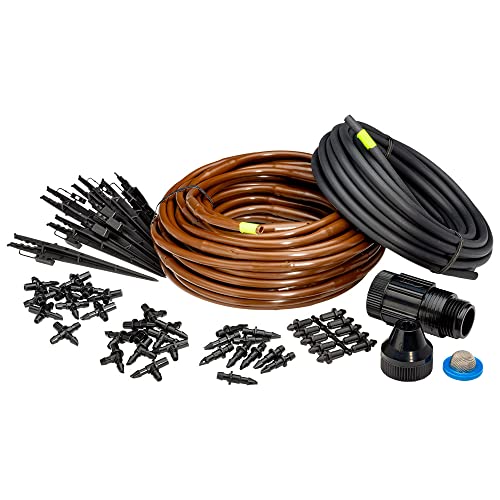
Good drip irrigation kit reviews should help you choose between real kit styles, not just repeat box contents back to you, so this roundup reviews the six kit approaches home gardeners actually buy, explains what each does best in real beds, borders and pots, and shows you how to weigh the evidence for your own garden. A drip irrigation kit is a long-lived piece of garden infrastructure, closer to a fence than to a gadget, and the right question is never which kit is best in the abstract. It is which kit’s strengths match your beds, your water, your climate and your patience, and which kit’s weaknesses you are genuinely equipped to manage. The reviews below are prose-only, with no links or prices, so you can shortlist by fit and then check current listings for exact contents.
Key Takeaways
- Emitter kits are the generalists; drip-line kits win dense, uniform beds; container kits win patios; timer-led kits win busy households.
- Parts ecosystem and spares availability predict long-term satisfaction better than any single feature.
- Every style needs the same foundations: backflow prevention, filtration and pressure regulation suited to drip at the tap.
- Reviews written after one weekend are weather reports; reviews after a season, including a clog, a leak and a holiday, are climate.
- Never drink from irrigation lines, and treat fertiliser injection as a job for proper equipment with backflow protection, or not at all.
In this guide
Drip Irrigation Kit Reviews: The Six Styles, Reviewed

Rain Bird Drip Irrigation Kit — The Generalist Benchmark
Best for: Mixed gardens that will grow over several seasons. Not suited for: Minimalists who want the fewest possible parts. Tier: Mid. Reviewed as a format, this is the kit style against which others are measured: mainline and emitters, a deep bench of compatible fittings, and spares you can still buy when a spade finds a line in year three. In beds it is calm and methodical; in borders it adapts plant by plant; around pots it works, though specialists below do pots with more grace. Its weakness is the generalist’s weakness: nothing is the absolute best at anything, and assembly on a big layout is a real afternoon. Its strength is that it never paints you into a corner, and gardens, which change, reward that more than any specification.

DIG Drip Irrigation Kit — The Tuner’s Kit
Best for: Raised beds, grid planting and gardeners who refine. Not suited for: Anyone who wants to install once and never think again. Tier: Mid. The DIG style leans into components: more ways to branch, cap, adjust and reconfigure, which raised-bed growers feel as freedom and neat freaks feel as a very tidy kind of fun. Reviewed across a season, its layouts tend to end up the most precisely matched to their planting, because the kit invites adjustment and its owners accept the invitation. The trade-off is cognitive: more options mean more decisions, and a gardener who finds decisions tiring will leave much of this kit’s value in the box.

Rainpoint Drip Irrigation Kit — The Automation-Led Kit
Best for: Households whose watering must run itself. Not suited for: Gardeners who prefer a tap and their own judgement each day. Tier: Mid. This style is reviewed from the controller outward: when scheduling is the pain point, a timer experience that is clear, forgiving and easy to pause for rain changes whether a system gets used at full value. The irrigation hardware beneath does the same work as its peers, so the buying question becomes whether the control layer matches your life: travel, shift work, forgetfulness, a garden at a second property. Its weakness is the mirror of its strength: electronics add batteries, setup and eventual replacement to a system whose other parts are nearly immortal, so keep the manual and expect the timer, not the tubing, to be the component you revisit.

Orbit Drip Irrigation Kit — The Familiar First Kit
Best for: First systems and straightforward rectangular layouts. Not suited for: Large multi-zone designs from day one. Tier: Entry to mid. Orbit’s style benefits from familiarity: gardeners who have handled its timers and manifolds on hose watering already speak its language, and first installations tend to go gently because of it. Reviewed honestly, it is a beginning more than a destination for ambitious gardens, but beginnings matter, and a first kit that gets installed beats a grander kit that stays in its box until autumn. Choose it for a defined first zone, learn the subject on it, and expand within its ecosystem or graduate knowingly.
Raindrip Drip Irrigation Kit — The Container Specialist
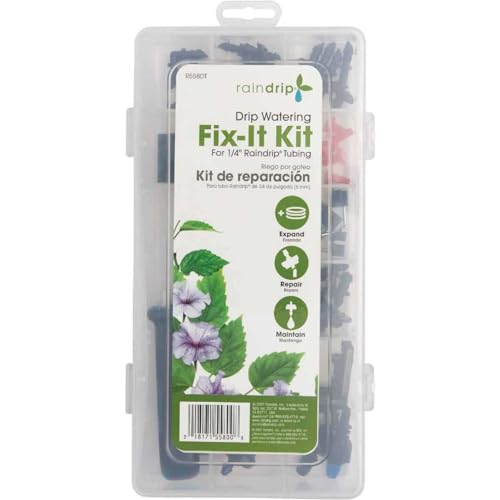
Best for: Patios, balconies, planters and grouped pots. Not suited for: Long in-ground rows. Tier: Entry to mid. Pots are a distinct discipline, feeder lines, small stakes, short frequent programmes, and this style is built for it. Reviewed on a real patio, its virtue is disappearance: the daily can round evaporates, pots stop oscillating between dust and flood, and small spaces stay tidy because the plumbing is scaled to them. Its limits appear when owners try to stretch it across a whole garden, where bed-scale mainline layouts do the heavy work better. Within its brief, it is the easiest recommendation in this roundup.

Flantor Drip Irrigation Kit — The Entry-Tier Teacher
Best for: A first small bed, renters, and anyone learning drip principles cheaply in effort terms. Not suited for: Gardeners building a permanent, whole-garden system in one step. Tier: Entry. The honest review of an entry-tier kit is that its curriculum is its value: one bed, one season, every lesson the format teaches, emitter placement, clogging, programme setting, the filter’s importance, learned at small scale where mistakes are cheap. Some owners then expand it; many graduate to a deeper parts ecosystem, and both outcomes are successes. Check its head assembly contents with particular care, adding filtration or regulation if they are not included, because the lessons should be about gardening, not about avoidable equipment gaps.
How to Read Drip Kit Reviews Like an Owner
Reviews of drip kits, including this one, become far more useful when you know what evidence to weight. Weight duration first: a verdict formed after a full season, with heat, growth, a clog or two and a holiday inside it, is worth a shelf of first-weekend impressions, because drip’s virtues are cumulative and its vices are slow. Weight specificity second: a reviewer who tells you their bed sizes, water source, planting style and climate is giving you the coordinates to translate their experience into yours, while a verdict floating free of any garden could have been written about anything. Weight failure reporting third: a review with no failures in it is marketing, because every real system leaks once and clogs once, and the useful information is how the failure announced itself and how long the fix took.
Discount, gently, two common distortions. The first is blaming a kit for a layout: far-end dryness, drowned pots and soggy corners are usually architecture and zoning speaking, and the same gardener with the same habits will reproduce them in any brand. The second is praising a kit for a gardener: the calm, even garden in a glowing review often belongs to an owner who sketches, filters, walks and adjusts, and their results will follow them to whichever kit they buy next. None of this makes reviews useless; it makes them evidence about combinations, gardener plus garden plus kit, which is exactly the combination you are shopping for. Our own single-format deep dive, the drip irrigation kit review, is written to that standard, and the category framework sits in the drip irrigation kit buying guide.
Side-by-Side: What Actually Differs Between Kit Styles
| Style | Strongest at | Watch out for | Ideal first zone |
|---|---|---|---|
| Generalist emitter kit | Adaptability, expansion, spares | Assembly time on big layouts | Mixed vegetable beds |
| Component-rich kit | Precision tuning, raised beds | Decision overload | Grid-planted raised beds |
| Automation-led kit | Scheduling, absence, busy lives | Timer is the mortal part | The beds you forget most |
| Familiar first kit | Gentle learning curve | Outgrowing it if plans are grand | One rectangular bed near the tap |
| Container kit | Pots, patios, small spaces | Stretching it beyond its brief | The whole patio, grouped by thirst |
| Entry-tier kit | Cheap lessons, small beds | Head assembly gaps; expansion limits | A single learning bed |
Read the watch-out column as a shopping list for your questions, not as disqualifications. Every style’s weakness is manageable by the gardener it suits, and every style’s strength is wasted on the gardener it does not. That is the whole logic of a roundup like this: six honest tools, six different hands.
Performance Themes Across All the Reviews
Evenness Is a Layout Achievement, Not a Brand Feature
Across every style reviewed, the gardens with the most even watering shared habits, not badges: sensible run lengths, zones matched to thirst and elevation, emitters chosen for the ground they served, including pressure-compensating types where slopes demanded them, and owners who checked soil at the far ends of lines rather than assuming. Kits enable evenness; layouts deliver it. When you read a review praising or damning a kit’s evenness, translate it accordingly and spend your own effort where it pays: on the sketch.
Clogging Is a Water Story Before It Is a Kit Story
Every style clogs under the same conditions: no filter, a neglected filter, sediment-heavy water, or stored rainwater handled casually. Every style resists clogging under the opposite conditions. This is liberating news, because it means the clogging chapter of your ownership is largely written by you. Fit the filter, clean it on rhythm, flush lines at fitting and at season’s turn, and the reviews’ scariest theme becomes a footnote in yours. Rain-fed gardeners should read rain barrels for gardening alongside any kit review, because source and system are one subject.
Timers Decide Whether Reviews Stay Positive
The sharpest divide in long-term reviews is not between brands but between owners whose systems run on timers and owners whose systems run on intentions. Timer households report the holiday survival, the dawn consistency and the calm beds; manual households report a good system they use less than they meant to, which over seasons reads like a mediocre system. If this roundup pushes you toward any single decision, it is this: whichever style you choose, budget the timer into the same purchase and set it up the same weekend, while installation energy lasts.
Winter Separates Climates, Not Kits
Cold-climate reviews carry a chapter warm-climate reviews never write: draining, opening ends, storing the timer and delicate head parts, and the spring audit for anything ice still managed to split. The kits do not differ much here; the owners’ routines do. If your winters freeze, judge every style by how gracefully it drains and how available its replacement parts are in spring, and treat the close-down as part of the product you are buying.
Verdicts by Gardener
The Vegetable Grower
Shortlist the generalist and the component-rich styles. Your beds reward precision and punish watering gaps at exactly crop scale, and your layout will change with rotations, so plugs, spares and reconfigurable branches are your love language. Add the timer without debate; your busiest garden weeks and your busiest life weeks are the same weeks. See also the best drip irrigation system for raised beds if your vegetables live in raised beds, as so many now do.
The Patio and Container Gardener
Shortlist the container specialist, and let the generalists go with goodwill. Your decisive factors are feeder-line quality, stakes that hold emitters in pots through bumps and weather, and programmes short and frequent enough for compost in a pot. Group pots by size and sun exposure, give them their own schedule, and your review, written a season from now, will be the glowing kind.
The Traveller and the Busy Household
Shortlist the automation-led style, but audit its irrigation hardware against your sketch as rigorously as any other kit, because a brilliant timer watering a badly planned layout is still a badly planned layout. Test programmes for weeks before the first big trip, set the rain delay, label the zones for whoever holds the fort, and your absence performance will match the best reviews in this roundup.
The Learner and the Renter
Shortlist the entry-tier teacher or a modest familiar first kit, aimed at one bed. Your goal this season is evidence about your own habits: whether you filter, walk, adjust and enjoy. That evidence, honestly gathered, makes your next purchase, if any, obvious, and if the answer turns out to be that hand watering suits your life, you will have learned it at the smallest possible scale. The balanced ledger in drip irrigation kit pros and cons is written for exactly your decision.
Setup and Care Notes That Recur in Every Positive Review
Read enough long-term reviews and the same liturgy appears. Sketch and measure before buying. Fit backflow prevention, filtration and regulation suited to drip, in the maker’s order, at the tap. Flush lines before emitters go in. Punch carefully, stake thoroughly, test section by section. Walk the system while it runs, trowel in hand, and check soil where roots are rather than where water lands. Keep spares in a box that lives with the system. Adjust programmes as plants and weather change. Drain and store before freezing weather. Never drink from the lines, and if fertiliser injection ever enters your plans, use proper equipment with backflow protection and follow its rules exactly. No positive review in this roundup’s research contradicts a word of that, and no negative review failed to skip some of it. The full installation liturgy is in how to install a drip irrigation kit.
Reading Drip Irrigation Kit Reviews Against Your Own Space and Routine
A single review session can flatter or condemn a drip irrigation kit unfairly, so this section slows the judgement down and looks at what only repeated, ordinary use tends to reveal. Run the drip irrigation kit through your least favourite version of its job first, not the easiest demonstration: the awkward corner, the rushed weekday timing, the fuller load, the lower light, or whatever condition in your routine makes this category work hardest. Look at replacement parts and consumables for the drip irrigation kit while you are still comparing, confirming that the pieces most likely to wear, clog, tear, fade or get lost can actually be obtained without replacing the whole product. Check the floor, wall, ground or surface the drip irrigation kit will meet, since level, texture, moisture and finish decide more about everyday performance in garden & lawn settings than most shoppers expect when they are comparing listings on a screen.
Decide in advance what good enough looks like for the job the drip irrigation kit does in your home, because chasing a flawless result usually costs more time than the flaw itself, and most households are happier with a reliable ninety percent they actually repeat. A well-judged drip irrigation kit explains itself to that second person without a lecture, with controls, grips, openings or adjustments that make sense on contact, and that intuitiveness is worth recording because guests, partners and teenagers will all test it. Finally, remember that the best drip irrigation kit for your home is the one whose size, habits and upkeep disappear into your routine, leaving only the result behind — a cleaner surface, a better-lit seat, a tidier shelf, an easier job — week after ordinary week. Share the checklist result with anyone who shares the space, since a drip irrigation kit chosen by one person and resented by another rarely survives, however sensible the purchase looked on paper.
Plan the storage home for the drip irrigation kit before it arrives, naming the exact cupboard, corner, shelf, hook or stretch of floor, because a product without a home migrates around the house and slowly becomes the clutter it was bought to reduce. If a problem with the drip irrigation kit repeats in the same spot or the same stage of the job, treat the pattern as the clue — patterns point to setup, surface or technique, while random problems point more often to the individual unit. Keep the packaging of a larger drip irrigation kit until those first ordinary tests are done, flattened if space is tight, because re-boxing an awkward shape from scratch is the hidden difficulty inside many otherwise straightforward returns. Test the drip irrigation kit in the first week under deliberately ordinary conditions rather than saving it for a special occasion, so that any problem surfaces while returning, exchanging or adjusting your setup is still simple.
Think about who else will use the drip irrigation kit and what they will do differently: shorter reach, less patience, stronger habits, no interest in the manual, and a tendency to leave things wherever they were last set down. When something about the drip irrigation kit disappoints, change one variable at a time — position, setting, timing, load, accessory or technique — and give the change a fair trial, because changing three things at once leaves you with a better or worse result and no idea why. Use a simple decision checklist at the end: the drip irrigation kit fits the measured space, suits the real frequency of the job, matches the household’s cleaning temperament, has obtainable parts, and has a named storage home — five yeses make a confident order. Measure before anything else, and measure the drip irrigation kit in its working state rather than its packed or folded state, because handles extend, lids open, cords trail, doors swing and users stand somewhere, and all of that belongs in the measurement.
If you want a concrete listing check, take a name already shortlisted in this guide, such as Rain Bird Drip Irrigation Kit, DIG Drip Irrigation Kit and Rainpoint Drip Irrigation Kit, and verify that exact drip irrigation kit listing against the measurements and compatibility questions above, field by field, rather than trusting the headline description alone. Pay attention to the second and third use rather than the first, because the first use of a drip irrigation kit measures your learning curve while the later uses measure the product itself, and confusing those two is the commonest reviewing mistake. For troubleshooting, start with the boring causes first: power, water, fit, blockage, alignment, a full container, a loose connection or a setting changed by the last person who used the drip irrigation kit, because boring causes account for most apparent failures. Keep a short note of what you adjusted on the drip irrigation kit during the first month, even just a line on your phone, since those notes turn vague impressions into a setup you can repeat, share or troubleshoot months later.
Photograph your setup once the drip irrigation kit is working well — the position, settings, arrangement or layout you settled on — so that after a move, a deep clean or a seasonal break you can recreate the arrangement that worked instead of rediscovering it. Notice the small recovery moments: how the drip irrigation kit behaves when you pause mid-task, change your mind, need to move it, clean it sooner than planned, or hand it to someone in the household who has never used it before. Seasonal thinking helps more than expected: a drip irrigation kit bought in one season will meet different light, humidity, mud, heat, guests and routines in another, so judge its size, storage and upkeep against the hardest season it will face. Finish the longer check by looking at wear points rather than features: the hinge, seam, edge, wheel, latch, surface or joint on a drip irrigation kit that moves, flexes or gets handled most is where its second year is decided, whatever its first week felt like.
Frequently Asked Questions
Which kit style is best for a complete beginner?
The familiar first kit or the entry-tier teacher, aimed at one defined bed, because the learning curve is the product at this stage. Beginners succeed by procedure: measure, fit the head assembly properly, flush, punch carefully, test as they go, and observe soil for the first weeks. A modest kit installed completely teaches more, and satisfies more, than an ambitious kit half installed.
Are expensive kits actually better, or just bigger?
Higher tiers earn their place when they buy a deeper parts ecosystem, better timers, or emitter types your ground genuinely needs, such as pressure-compensating drippers on slopes. They do not earn it through part counts alone, which can pad a box with the cheapest pieces. Compare contents by category against your sketch, and let your garden, not the tier ladder, decide.
How many seasons should a drip kit last?
The tubing and fittings of a decent kit should serve for many seasons with small repairs, while timers and other electronic parts are the components most likely to need replacement first. Longevity depends on winter care in freezing climates, filtration discipline, and protection from strimmers, spades and sun where lines run exposed. Owners who treat the system as repairable infrastructure routinely report the longest service.
Can I mix kit brands in one system?
Sometimes, where tubing sizes and fitting styles genuinely match, but mixing families casually is how slow leaks and pop-offs enter a layout. The safer pattern is to build within one ecosystem and expand within it, which is why parts availability features so heavily in these reviews. If you inherit a mixed system, standardise gradually as sections need repair rather than forcing connections that almost fit.
What do reviewers most often get wrong about drip kits?
They judge too early and attribute too much to the badge. Drip reveals itself over a season, and its outcomes belong to the combination of kit, layout, water and owner habits. A review that reports its garden, its failures and its fixes is giving you transferable evidence; a verdict without those is giving you a mood. Read for the former, including in this roundup, and your own review a year from now will be worth reading too.
Is a drip kit better than a sprinkler for a whole garden?
For beds, borders, rows and pots, the reviews say yes, on precision, foliage dryness and automation. For lawns and open ground, sprinklers remain the right tool, as lawn sprinklers and water timers covers. Most complete gardens end up hybrid, with each method where it belongs and a hose, see the best garden hoses, handling the odd jobs in between.
Second Look: Living With Each Style for a Season
The Generalist, Three Months On
Three months into a generalist emitter system, the dominant feeling is unremarkability, which is praise. Watering has left the mental to-do list. The system’s personality shows in small flexibilities exercised without thought: a branch added for the new bed in an hour, an emitter doubled where the courgette announced its ambitions, a plug where the peas finished. Owners in this phase stop describing the kit and start describing the garden, the surest sign in these reviews that infrastructure is doing its job. The residual irritations are the format’s own: a weeping fitting reseated in a minute, a filter cleaned on the calendar’s nudge, and the standing wish that the first weekend’s sketch had been even more honest about distances.
The Tuner’s Kit, Three Months On
Owners of the component-rich style report a different pleasure: convergence. Their layouts in month three visibly fit their planting in a way month one’s did not, because the kit kept inviting one more adjustment and they kept accepting. Raised beds in particular read like diagrams, in the best way. The risk at this stage is tinkering past the point of benefit, adjusting programmes on a whim and losing the baseline that made results interpretable. The wisest tuners adopt a rule worth stealing: change one thing, observe a week, write it on the map. Their reviews glow because their method, not just their merchandise, is sound.
The Automation-Led Kit, Three Months On
By month three, automation-led owners have usually tested the system’s real promise at least once: a trip, a heatwave during a work crunch, a fortnight where the garden simply was not thought about. Passing that test changes the owner’s relationship with the whole garden; planting gets bolder, because the watering safety net is proven rather than hoped. The corresponding duty is battery and programme hygiene: a timer is a small computer living outdoors, and it asks for the respect of fresh power, a rain delay used rather than admired, and a programme reviewed when seasons turn. Owners who give it that respect write the most relaxed reviews in this entire roundup.
The Container Kit, Three Months On
Patio owners report the most dramatic before-and-after of any style, because their baseline chore was the most relentless. Pots that once demanded a daily round now ask for a weekly glance, and the glance is mostly admiration. The month-three lessons are physical: lines rerouted behind pots where feet cannot catch them, stakes upgraded where a cat conducts nightly inspections, the smallest pots moved into the shade group where their programme fits. Once those lessons land, container systems become the most stable layouts in the garden, because pots, unlike borders, rarely redesign themselves.
Criteria That Matter, Scored in Words
Rather than stars, which tell you nothing, this roundup scores the styles on the criteria owners actually discuss. For ease of first installation, the familiar and container styles lead, the generalist sits comfortably in the middle, and the component-rich style asks most of a beginner while repaying a confident one. For expandability, the generalist and component-rich styles lead clearly, because their ecosystems are the deepest. For precision, tuned emitter layouts and well-matched drip line share the crown. For absence-proofing, the automation-led style leads, provided its programmes were tested before they were trusted. For repairability, every style scores well in principle, and the differentiator is local: which ecosystem’s spares can you actually obtain quickly when a line parts on a Sunday. For small-space tidiness, the container style wins outright. No style wins everything, which is the roundup’s point rendered as a table of words: your criteria ranking, honestly ordered, selects your kit more reliably than any overall crown.
Reliability, Spares and the Sunday Test
Every kit in this roundup passes its first month; reliability is a question about the twenty-fourth. The parts that age are predictable: tubing embrittled where it bakes unshaded, emitters carrying mineral history, timer electronics that have weathered one storm too many, and any fitting that was forced rather than fitted. The systems that age gracefully share a trait their reviews mention almost in passing: their owners could get parts. A coupler on a Sunday, emitters in the same family at the local store or from the maker’s range, a replacement timer that speaks to the existing manifold. This is the Sunday test, and it deserves a place in your buying decision beside every other criterion, because a system you cannot repair until a delivery arrives is a system your garden experiences as broken at the worst moment, which is always a hot spell.
Spares strategy is the other half of reliability, and it is cheap in every sense that matters here. The owners whose reviews read calmly in year three keep the same small box: plugs, emitters in their working styles, couplers, a length of each tubing they run, and the punch. They also keep knowledge: a labelled manifold, a map in the shed, programmes written down. When something fails, and something eventually does, their repair is measured in minutes and their review of the kit stays warm, because the kit plus the box plus the map is the real product they bought. Judge the styles above by whether they make that box easy to build, and you will have judged them the way their longest-serving owners do.
The Value Question Across the Roundup
Value threads through every review here, and the pattern is consistent enough to state as a finding. Entry tiers deliver value as education and as single-bed service. Mid tiers deliver the roundup’s best value for whole gardens, because their ecosystems, timers and emitter ranges cover real needs without ornamental spending. Higher spending delivers value only when aimed at a named need: automation that matches a travelling life, pressure compensation that matches a slope, control that matches multiple zones. Unaimed spending, on part counts and features without a garden problem attached, delivers a fuller box and the same watering. Gardeners deciding between tiers should therefore shop from a list of their own problems, written from their own sketch, and let each candidate kit answer the list item by item. The kit that answers your list at the lowest tier is your best value, and it is frequently not the kit a generic ranking would crown. For the pure value argument, argued at length, see is a drip irrigation kit worth it, and for choosing step by step, how to choose a drip irrigation kit.
Hand-watering tools keep their place in every garden in this roundup, and the reviews are unanimous that drip does not retire them. Seedlings still meet a can, new planting still meets a hose, and foliar jobs still meet a sprayer, as garden sprayers for targeted care and the best watering cans describe. A drip kit carries the routine; the classics carry the exceptions, and a garden equipped for both is the garden these reviews, taken together, are really recommending.
What the Long-Term Reviews Agree On
Step back from individual styles and the long-term reviews converge on a small set of agreements strong enough to build a purchase on. First, drip works: across brands, gardens and climates, owners who installed properly and maintained lightly report steadier plants and reclaimed time, year after year. Second, the head assembly is sacred: backflow prevention, filtration and drip-appropriate regulation appear in every durable system and are missing or neglected in a striking share of the disappointed ones. Third, zoning by thirst beats zoning by convenience in every garden large enough for the distinction to exist. Fourth, the timer is not an accessory but the mechanism by which drip’s promise is actually delivered, and households that skip it report a diluted version of everyone else’s satisfaction. Fifth, the garden outgrows the first layout, always, and the kits remembered fondly are the ones whose ecosystems made growing painless.
The disagreements are equally instructive because they are so patterned. Owners argue about emitter styles because their planting differs. They argue about smart control because their lives differ. They argue about whether installation was easy because their gardens, and their Saturdays, differ. A reader who maps those disagreements onto their own circumstances can extract a personal verdict from other people’s reviews with surprising precision, which is the real skill this roundup hopes to teach. Products are general; gardens are specific; reviews are bridges between the two, and a bridge is only useful if you know both banks.
One Garden, Six Kits: A Thought Experiment
Imagine the same garden, two raised beds, a herb patch, a border with a young tree, and a patio of pots, equipped six times, once with each style in this roundup. The generalist serves everything well and the tree superbly as its emitter ring grows. The tuner’s kit produces the most elegant raised beds of the six and a herb patch watered like a diagram. The automation-led kit produces the calmest household, its garden surviving a month of travel that would have tested the others’ owners rather than their hardware. The familiar first kit gets installed fastest and teaches its owner the subject with the least friction, then either expands or is honourably succeeded. The container kit produces a patio of unreasonable lushness while its beds, stretched beyond its brief, are merely content. The entry-tier kit waters one bed beautifully and educates its owner into knowing exactly which of the other five to buy next, which, for a first season, is a complete success. Six gardens, six different happiest outcomes, one conclusion: fit is the whole game, and your sketch is the referee.
Closing Judgement From the Roundup
If this roundup were forced to give one kit to a stranger with an average garden and no further information, it would give the generalist, because averages reward adaptability and punish specialisation. But you are not a stranger to your own garden, and the entire exercise above exists so that you do not have to buy like one. You know whether your garden is beds or pots, whether your life needs automation or merely permits it, whether your hands enjoy tuning or prefer simplicity, and whether this purchase is a first lesson or a permanent installation. Answer those four things honestly and the roundup’s six reviews collapse into one clear name, the way a well-run system’s many emitters collapse into one calm garden. Then install it with the liturgy every positive review shares, protect the household water at the tap, keep the spares box stocked and the map current, and write your own review in the only venue that finally matters: next season’s plants.
Companion reads for the decision ahead: garden hose nozzles for the jobs drip leaves behind for the hand-watering kit that remains, and the cluster’s own choosing and installing guides, which turn this roundup’s verdicts into a measured sketch and a working system respectively. The reviews will still be here when you return with a season of your own evidence, and by then you will read them the way their best authors wrote them: as one gardener’s map, offered to another, of ground that turns out to be shared.
What a Year of Ownership Does to These Reviews
Reviews change as ownership lengthens, and a roundup that ignored that would mislead you about every style in it. In the first month, owners review the installation: the generalist feels abundant, the tuner’s kit feels clever, the container kit feels miraculous on a patio that no longer needs a daily can. In the sixth month, owners review the maintenance: filters, programmes, the leak behind the beans, and here the familiar first kit’s simplicity glows while any style whose spares proved hard to find begins to darken in its owners’ telling. In the second year, owners review the ecosystem and the company they keep: whether parts were there on the Sunday, whether the layout grew gracefully into the new bed, whether the timer’s replacement, when its turn came, was a shrug or a saga. A wise buyer reads reviews from all three ages and weights the third most heavily, because the third is the review of the product you will actually own for most of its life: not the box, not the weekend, but the infrastructure and its support.
That is also why this roundup refuses to crown a single winner and call the work done. The styles genuinely partition the world of gardens between them, and the partition lines are drawn by planting, by household and by temperament, not by quality. Your task as a reader is cartography: find your garden on the map these reviews draw, and the name written in that territory is your answer. Every section above, the criteria in words, the Sunday test, the thought experiment of one garden equipped six ways, exists to help you draw that map accurately. Do it honestly and the review you write with your own plants next year will agree with the one you chose by, which is the only endorsement any of these kits has ever really needed.
Evidence From the Field: Patterns Too Consistent to Ignore
Across the gardens behind these reviews, a few patterns repeat with a consistency that deserves its own section, because patterns are what reviews are for. Gardens that mulch over their lines report fewer temperature swings in soil moisture, fewer baked and brittle lines, and calmer plants in heatwaves, regardless of kit. Gardens fed from stored rainwater report the highest satisfaction of any group and the strictest filter discipline, in that order of causation: the discipline is what the satisfaction costs. Gardens where one person holds all the knowledge report the most anxiety during that person’s absences, and the cheapest fix in this entire roundup, a labelled manifold and a written programme card, is also the most postponed. Gardens that expanded within one ecosystem report almost no buyer’s remorse about their original kit, even when the original kit was modest, while gardens that mixed families casually report a low, constant friction that colours their reviews of everything. And gardens that started with a single zone and expanded on evidence report, nearly unanimously, that they would do it exactly that way again. If your own decision is still open after six reviews and a comparison table, let those five patterns decide it: mulch, filter, document, stay in one family, and start where the thirst is greatest.
How These Reviews Handle Safety and Water Quality
A roundup that recommends systems connected to household water carries a duty to review the safety layer with the same seriousness as the watering layer, so let it be stated once, completely, for all six styles. Every system reviewed here should be installed with a backflow preventer between the household supply and the irrigation lines, so that water from the garden can never be drawn back toward the water a family drinks. That duty becomes critical, not merely routine, if fertiliser or any other treatment is ever injected through the system: injection belongs only to purpose-made equipment, installed and used exactly as its maker directs and as local rules require, with backflow protection confirmed in place. Irrigation water itself, in every style and every garden, is non-potable: no drinking from lines, no filling bottles from emitters, no exceptions for children, guests or thirsty gardeners who should know better. Reviewers who omit these points are leaving the most important specification out of the review, and buyers should treat any kit, installer or guide that waves them away as having failed a test more important than flow or fittings. With that layer in place, the rest of this roundup’s judgements stand as written: six honest styles, six kinds of garden, and a map you can trust because it includes the hazards as well as the borders.
A Buyer’s Vocabulary for Reading Any Review
Finish this roundup with the vocabulary that makes all future reviews, of any kit, legible at a glance. When a reviewer says a system is forgiving, they mean its fittings reseat, its mistakes plug cleanly and its programmes tolerate a busy owner. When they say a kit feels cheap, they usually mean its connections inspire no confidence at the moment of seating, which predicts leaks better than any material description. When they praise a garden as calm on a system, they are reporting even moisture across weeks, the compound interest of consistency. When they complain a kit is thirsty work, they mean its zones were wrong or its filter was neglected, translated through frustration into a verdict on a box. Learn to translate and the whole literature of drip reviews opens up: every verdict decomposes into layout, water, control and care, and you can rebuild from those parts a judgement fitted to your own garden, which no reviewer, however honest, can build for you. That rebuilding is the skill this roundup has really been teaching, underneath the six names and the comparison table, and it will serve you for every garden purchase that follows this one, because all of them, in the end, are the same question wearing different packaging: what happens when this object meets my ground, my weather and my habits, for years.
The Roundup’s One-Paragraph Answer
For readers who arrived at the end still wanting a single name, here it is, with its conditions attached like a label. Choose the generalist emitter kit if your garden is mixed and growing, the component-rich kit if your beds are raised and your hands like tuning, the automation-led kit if your life is the thirstiest thing you own, the familiar kit if this is your first system and confidence is the scarce resource, the container kit if your garden lives in pots, and the entry-tier kit if this season is for learning. Every one of those choices, installed with filtration, backflow protection and honest zones, and maintained with a walking habit, will water a garden well for years. The reviews differ because gardens differ, and the moment that stops sounding like a dodge and starts sounding like the truth is the moment you have become the kind of buyer these pages were written for: one whose sketch outranks every ranking, including this one.
Postscript: The Review I Would Write About Your Garden
If these reviews have done their work, you can now predict, with uncomfortable accuracy, the review your own garden would generate under each style. The beds would praise the generalist’s patience and the tuner’s precision in the same breath and mean both. The pots would vote for the specialist and describe the generalists as well-meaning visitors. The slope would file its minority report in favour of pressure compensation, and the tap, if taps could speak, would ask only for its filter, its regulator and its backflow preventer to be treated as the foundation they are. The gardener in the review, you, would come out as the decisive variable in every paragraph, which is the conclusion this entire roundup has been approaching from six directions. Products are reviewed in catalogues. Gardens are reviewed by their plants, in growth, across seasons, and the kits above are simply the six most common ways of earning a good one. Choose the way that fits the ground you actually stand on, and the review, when your plants write it, will take care of itself.