Disclosure: As an Amazon Associate, dailyhomedecorating.com earns from qualifying purchases. Links on this page are affiliate links; they cost you nothing extra. Prices and availability change often, so check the current Amazon listing before you buy.
Welcome to the kitchen drawer organizer buying guide that starts where shopping actually starts: with your drawer, your tools and your habits, in that order. Most buying guides rank products; this one first teaches you how to judge them, because in this category the best organizer is simply the one whose size, type and material match a specific drawer in a specific kitchen. The named designs used as reference points throughout, the madesmart Classic Silverware Tray, the Joseph Joseph DrawerStore, the OXO Good Grips Expandable Utensil Organizer, the BambooWorx Bamboo Drawer Organizer and the Homemaid Living Bamboo Silverware Organizer, are presented in prose and qualitative tiers, with markers where verified links will sit at publishing.
By the end you will know the main types, the questions that actually decide between them, which design suits which household profile, and the mistakes that send organizers back to the shop. If you are still deciding whether the category itself is for you, start with is a kitchen drawer organizer worth it; if you want the hands-on verdicts after reading this, continue to our kitchen drawer organizer review and the wider kitchen drawer organizer reviews.
Key Takeaways
- Fit is the first specification: interior width, depth and closed height decide everything.
- Fixed trays suit standard drawers; expandable designs suit in-between drawers; modular systems suit eccentric collections.
- Plastic wins on washing, bamboo on weight and feel, dividers on flexibility.
- Plan sheathed knife storage as part of the purchase, not as an afterthought.
- Buy for one drawer, prove it, then extend the system drawer by drawer.
What a Kitchen Drawer Organizer Does and the Main Types
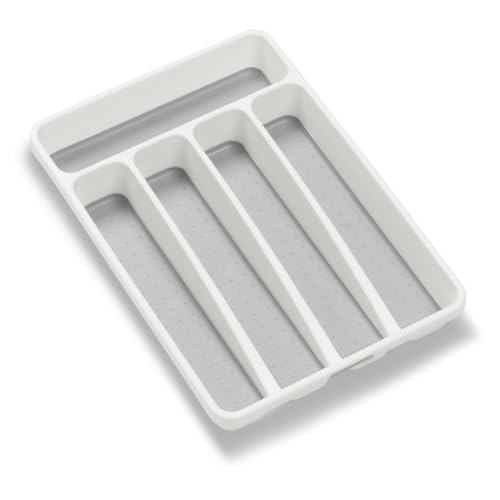
The fixed moulded tray is the classic: one piece, a set of compartments shaped for cutlery and common utensils, dropped into the drawer in seconds. It is the fastest route from chaos to order and the easiest to clean, because the whole thing lifts out. Its weakness is rigidity. If your collection includes long carving tools, oddly shaped gadgets or simply more forks than the mould expects, a fixed tray forces your tools to fit its opinion of a kitchen rather than yours.
Expandable trays answer the sizing problem by sliding wider or longer to meet the drawer walls, which also stops the tray migrating every time the drawer opens. Designs like the OXO Good Grips Expandable Utensil Organizer and the BambooWorx Bamboo Drawer Organizer build their whole appeal around that adjustability, and for the many drawers that fall between standard sizes they are often the difference between a tray that looks installed and one that looks borrowed. Check that the expanding sections lock or at least hold their setting under a load of cutlery.
Compact and space-doubling designs, the territory of the Joseph Joseph DrawerStore, stack or angle compartments so a small drawer holds a full cutlery set without spreading sideways. They reward small kitchens and anyone whose drawer count is limited, though the cleverness means individual slots can be snug for chunky handles. Two-tier inserts take the stacking idea further, with an upper tray that slides to reveal a second layer beneath, effectively doubling a deep drawer; they suit deep drawers and disciplined households that will actually keep the layers sorted.
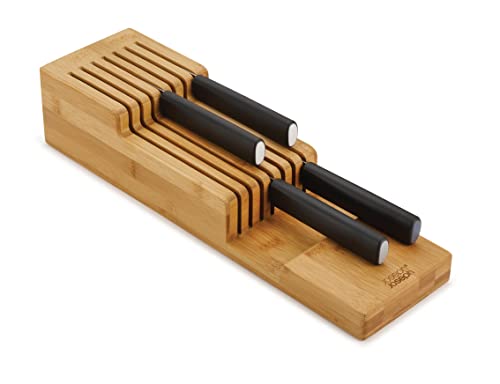
Modular inserts and spring or peg dividers complete the family. Bought piece by piece, they let a drawer hold cutlery at one end, long tools along one side and a small in-drawer knife block at the other, all in one tailored layout. In-drawer knife blocks deserve a special mention: a slotted block that lives inside the drawer keeps blades sheathed, separated and off the counter, and turns a loose knife drawer, which nobody should tolerate, into a safe, deliberate storage place. The types are not rivals so much as answers to different drawers, and the rest of this article is about matching the answer to yours.
In this guide
Kitchen Drawer Organizer Buying Guide: Top Picks at a Glance
Five reference designs, five different answers. Badges describe the job each does best; tiers are qualitative, and every pick here is prose-only in this draft.
| Design | Badge | Tier | Best for | Not suited for |
|---|---|---|---|---|
| madesmart Classic Silverware Tray | Best Simple Fixed Tray | Entry | Standard drawers, conventional cutlery sets | In-between drawer sizes |
| Joseph Joseph DrawerStore | Best for Small Drawers | Mid | Compact kitchens, full sets in little space | Chunky-handled cutlery |
| OXO Good Grips Expandable Utensil Organizer | Best Expandable | Mid | Drawers between standard sizes | Very deep drawers needing tiers |
| BambooWorx Bamboo Drawer Organizer | Best Bamboo Expandable | Premium-leaning | Cooks who want weight and natural material | Soak-it-and-forget-it cleaning habits |
| Homemaid Living Bamboo Silverware Organizer | Best Bamboo Silverware Tray | Mid-to-premium | Cutlery drawers that double as presentation | Drawers needing utensil-length sections |
How Well Will It Fit Your Drawer?
Fit outranks every other question in this guide, so it comes first and in detail. You need the drawer’s interior width and depth and the clear height when closed, measured inside the box. A tray that fits width and depth but stands too tall will foul the frame above a shallow drawer every time it closes, and a tray that fits loosely will travel, rattle and slowly mix its own contents. Treat your three measurements as a filter that products must pass before any other virtue counts.
Drawers between standard sizes are the norm, not the exception, which is why expandable designs exist and why they dominate sensible shortlists. An organizer that widens to meet both walls uses the full drawer and stays where you put it. For drawers that match a standard size exactly, a fixed tray is simpler and easier to wash. For drawers that match nothing, modular inserts stop being a compromise and become the correct engineering. Measure honestly, and the market sorts itself into a short list before you read a single review.
Height deserves its own paragraph because it is the measurement shoppers skip. Load your tallest regular tools, the ladle with the hooked handle, the tongs that spring open, and check the closed clearance in the drawer they will live in. Some households discover their deepest drawer is the only honest home for tall tools and reorganize around that fact. Others choose lower-profile trays to keep the shallow drawer by the stove in service. Either way, the discovery should happen with a tape measure, not with a delivered box.
How Much Capacity Do You Honestly Need?
Capacity in this category is a trap dressed as a virtue. The organizer that holds the most is rarely the best, because a drawer organized around everything you own is organized around your clutter. Count the working set instead: the cutlery and tools used weekly or more. That set, plus one deliberately slack compartment for future arrivals, is the capacity to buy. Everything else needs a different home, and finding it one is part of the project rather than a failure of it.
Household size matters, but less than people assume. A household of six does not need six times the compartments of a single cook; it needs enough place settings in the cutlery section and serving pieces sized for family meals. Entertaining households should plan one generous section for serving spoons and forks, the pieces that multiply at holidays, while small households gain more from compact designs that leave drawer room for other jobs. Buy capacity for your calendar’s ordinary weeks, and let parties borrow from cupboards.
Which Material Suits Your Kitchen?
Plastic is the pragmatic default: light, smooth, fully washable, and content to be lifted out, scrubbed and returned without ceremony. In a hardworking cutlery drawer beside the dishwasher, that washability is worth more than any aesthetic argument. Judge plastic by rigidity; a tray that flexes under a load of cutlery will annoy you for years, while a stiffly moulded one disappears into the routine exactly as it should.
Bamboo is the material of feel: heavier, warmer, quieter, and stable in the drawer without liners or feet. It suits households that open the drawer and appreciate seeing a natural material, and its weight genuinely helps with heavy cutlery sets. Its care contract is simple but real: wipe spills promptly, never soak, dry after cleaning. Households that know they will not honour that contract should buy plastic and be happy, because an organizer resented for its care routine is an organizer on its way out.
Modular dividers and mesh designs serve the kitchens the moulds forgot: mixed collections, odd drawers, crumb-heavy baking drawers. Dividers trade instant order for tailored order, rewarding ten minutes of planning with a layout no factory could have guessed. Mesh rinses fast and lets debris fall through, at the price of slim handles occasionally slipping and a little more noise. None of these materials is the best; each is the best somewhere, and this guide’s job is to help you name your somewhere.
How Will You Store Knives and Sharps?
Decide this before checkout, because knife storage shapes the whole layout. The safe structures are an in-drawer knife block whose slots sheath every blade, individual guards on knives kept in a tray section, or a dedicated protected run within a modular layout. In each case the rules are the same: blades separated, tips toward the back of the drawer, handles forward, the drawer itself beyond children’s casual reach, and the arrangement permanent enough to become muscle memory.
If your shortlist cannot accommodate your knives safely, the shortlist is wrong, however well it handles spoons. Some households solve this by giving knives their own drawer entirely, organized with a block, while cutlery and tools live elsewhere; in smaller kitchens a combined drawer with a proper block section works well. What never works is the traditional loose pile, and any buying decision that quietly preserves it has failed at the most important line in this guide.
How to Prioritise by Use Case
The Busy Family Kitchen
Prioritise washability, capacity for full place settings and a layout a child can read. A sturdy plastic fixed or expandable tray in the main drawer, daily items at the front, and a protected knife section out of reach covers ninety percent of family life. Durability beats elegance here, every time.
The Small Apartment Kitchen
Prioritise footprint. Compact stacking designs that house a full set in one shallow drawer free the remaining drawers for everything else a small kitchen must swallow. Measure height with special care, because small kitchens often pair few drawers with shallow ones.
The Serious Home Cook
Prioritise flexibility and length. Long tools, odd tools and a real knife collection point to modular dividers plus an in-drawer block, in the deepest drawer you can give them. Your layout will look less like a catalogue and work better than one.
The Design-Led Kitchen
Prioritise material and stillness. Bamboo organizers that sit planted and look like furniture reward the eye every time the drawer opens, and their care routine is a fair price if you will honestly pay it. Keep one washable plastic tray for the messiest drawer as a pragmatic concession.
The Picks in Detail

madesmart Classic Silverware Tray — Best Simple Fixed Tray
The madesmart Classic Silverware Tray is the category’s plain-spoken baseline: moulded cutlery compartments in washable plastic, in the entry tier. Best for: standard drawers and conventional sets, and first-time organizers who want the system working tonight. Not suited for: in-between drawers or long, eccentric collections. Strengths: simplicity, easy cleaning, no setup. Trade-offs: a fixed opinion about your kitchen, and no answer for odd sizes.
Joseph Joseph DrawerStore — Best for Small Drawers
The Joseph Joseph DrawerStore earns its badge by geometry, stacking and angling cutlery so a full set fits where flat trays cannot, in the mid tier. Best for: small kitchens and few-drawer flats. Not suited for: chunky-handled cutlery that needs generous slots. Strengths: remarkable capacity per inch, tidy presentation. Trade-offs: snug compartments and a layout you must learn for a week.

OXO Good Grips Expandable Utensil Organizer — Best Expandable
The OXO Good Grips Expandable Utensil Organizer expands to meet the drawer walls, which solves fit and sliding in one move, in the mid tier. Best for: the many drawers between standard sizes, and utensil drawers as much as cutlery. Not suited for: deep drawers that really need tiers. Strengths: adaptable fit, stays planted, utensil-friendly sections. Trade-offs: moving parts to set once and check occasionally.
BambooWorx Bamboo Drawer Organizer — Best Bamboo Expandable
The BambooWorx Bamboo Drawer Organizer combines bamboo’s planted weight with expandable fit, in the premium-leaning tier. Best for: cooks who want natural material and a tray that never travels. Not suited for: households that clean by soaking. Strengths: stability, warmth, adjustable width. Trade-offs: wipe-and-dry care, and bamboo’s dislike of standing water.
Homemaid Living Bamboo Silverware Organizer — Best Bamboo Silverware Tray
The Homemaid Living Bamboo Silverware Organizer focuses on the cutlery drawer itself, in bamboo, in the mid-to-premium tier. Best for: households whose silverware drawer is opened by everyone, including guests, and should look the part. Not suited for: drawers that must also swallow long utensils. Strengths: presentation, weight, calm in daily use. Trade-offs: a silverware-first layout and bamboo’s care contract.
Zoning the Drawer: Put Things Where the Work Happens
A good drawer layout follows the work, not the alphabet. The cutlery used at every meal belongs in the drawer nearest the table-setting route, ideally close to the dishwasher or sink so unloading takes seconds. Cooking tools belong near the stove, baking tools near the worktop where you roll and mix, and the long tail of occasional gadgets can live further from the action without costing you anything. Before choosing compartments, stand in your kitchen and act out a normal meal; the movements you make are the blueprint the organizer has to serve.
Within one drawer, the front is prime land and the back is storage. Daily forks, knives and spoons sit at the front where a half-open drawer still reaches them. Serving spoons, tongs and the tools used mid-cooking sit in the middle. The back row is for the second tier: the extra ladle, the spare peeler, the tools you want findable but not prominent. Trays that ignore this gradient, spreading daily items across the full depth, make every reach a full drawer pull and a small daily tax on your patience.
Leave one compartment deliberately underfilled. Every kitchen acquires a new tool now and then, and an organizer packed to perfection on day one has nowhere for the new arrival to go except on top of everything else, which is how clutter restarts. A little slack is not wasted space; it is the margin that keeps the system alive. Similarly, resist organizing drawers you rarely open with the same intensity as the main cutlery drawer. Effort follows frequency, and a calm cooktop drawer matters more than a perfect gadget drawer.
If two people cook differently, agree the zones together before buying. Most drawer arguments are not about tidiness but about two incompatible maps of the kitchen, and an organizer locks one map in moulded plastic. A short conversation about where the tongs live saves a year of quiet rearrangement. Where you cannot agree, modular dividers earn their keep, because the layout can evolve without a new purchase every time habits change.
First Setup and Care Essentials
Set up properly on day one and care stays easy. Empty the drawer completely, vacuum the corners, wipe the base and let it dry before the organizer goes in, because crumbs sealed under a tray become a permanent archaeological layer. A simple liner or non-slip mat under the tray stops sliding and catches the worst of the debris, and it lifts out for shaking in seconds. Load the organizer outside the drawer if it is a fixed tray, so you can judge the layout on the counter before committing it to the dark.
Weekly care is a thirty-second habit: when the drawer is open anyway, tip loose crumbs from the tray into the bin and give sticky spots a wipe. Monthly, or whenever the drawer starts to smell faintly of old cooking, lift the whole organizer out, wash it in warm soapy water if it is plastic, or wipe and dry it carefully if it is bamboo, and clean the drawer base beneath. Cutlery drawers live close to food preparation, so treat them with the same hygiene instinct as a chopping board, not like a cupboard that can be forgotten for a year.
Bamboo asks for the gentlest routine: no soaking, no dishwasher, and prompt drying after wiping, with food-safe oil only if the maker suggests it and the surface starts to look dry. Plastic trays tolerate more, though very hot water and harsh scouring can dull or warp thin examples over time. Adjustable dividers need their joints and springs checked occasionally, because a divider that has slipped is quietly reorganizing your drawer without permission. Whatever the material, a five-minute reset each month keeps the system you bought instead of the drift you did not.
Use the monthly lift-out as an audit. Anything that has not been touched since the last clean is a candidate for the charity box, the backup drawer or the bin, and every removal makes the remaining system work better. Organizers fail less often from bad design than from slow accumulation, and the household that edits ruthlessly keeps a modest tray feeling generous while the household that edits never makes even a large one feel cramped.
Mistakes to Avoid When Organizing a Kitchen Drawer
The most common mistake is buying before measuring, and it is not close. Drawers vary more than catalogues admit, and a tray chosen by eye from a product photo is a gamble dressed as a purchase. The second mistake is organizing for the kitchen you wish you had: compartments for the juicer attachments and fondue forks of an imaginary life, while the four tools you use daily fight for one slot. Organize the real kitchen, with its real habits, and let aspirational gadgets earn their place later if they ever do.
Overfilling ranks third. An organizer is a rationing system, and a compartment holding three layers of spoons has stopped organizing anything. If a section overflows, the answer is to move the overflow elsewhere or let something go, not to press harder. Fourth comes the sliding tray: a fixed tray in a wider drawer that travels every time the drawer opens, mixing its contents and chipping the drawer sides. Non-slip feet, a liner, or an expandable design that meets the walls ends the travel for good.
Fifth, the knife drawer of doom: loose blades kept ‘carefully’ among the spoons, which is careful right up until the evening it is not. Sheathe blades, use an in-drawer block, or give knives their own protected section, and keep that drawer away from children’s hands. Sixth, buying five matching organizers for five different drawers before testing one. Drawers differ in size and job; prove the system in the main cutlery drawer first, learn what your household actually likes, and only then extend it.
The last mistake is treating the organizer as the finish line. It is the starting line. The households whose drawers still look good a year later are not the ones who bought best; they are the ones who reset the drawer monthly, edit what creeps in, and keep the rule that everything in the drawer has a named home. Buy thoughtfully, by all means, but budget a little ongoing attention as part of the price, because that attention, not the tray, is what you are really living with.
Knife and Sharp-Item Safety Inside a Drawer
Loose knives in a drawer are the one storage habit this category exists to end. Reaching into a drawer and finding a blade by touch is how kitchen cuts happen, and an organizer only helps if the sharp tools get a genuinely protected home. The sound options are an in-drawer knife block with slots that sheath each blade, individual blade guards or sheaths on knives stored in a tray, or a dedicated knife drawer section where blades sit separated and cannot slide against each other or against your fingers.
Orientation matters as much as separation. Store knives with tips pointing toward the back of the drawer and handles toward you, so the first thing your hand meets is a handle, never an edge. Keep the knife section in the same place permanently; safety depends on muscle memory, and a blade that migrates around the drawer is nearly as risky as a loose one. Peelers, mandoline blades, skewers and graters with exposed teeth belong in the same protected category: sheathed, separated, and always in their known place.
Households with children need one further step: sharps belong in a drawer children cannot casually open, ideally a higher drawer or one fitted with a simple latch, and never in the low drawer a child can pull open at standing height. Teach the rule early that the knife drawer is an adults-only drawer, and keep it consistent even when guests are cooking. An organizer makes this easier, not optional: a defined, sheathed, out-of-reach place for every blade is the standard to hold, whatever tray or block you choose.
Finally, carry knives to and from the drawer one at a time, blade down and announced if someone is beside you, and never drop a knife into a tray from a height. When you wash up, dry knives and return them to their slots rather than leaving them in a draining rack where the next person reaches blindly. These are small disciplines, but they are the difference between an organized drawer and a merely tidy-looking one, and no purchase substitutes for them.
Questions to Ask Before You Check Out
Does this design’s footprint, or its expansion range, actually cover my three measurements, with a little grace rather than a forced fit? Does it leave the closed height my tallest tools need? Can I lift it out, loaded, in one piece for cleaning? Does it give my knives a sheathed, separated home, or pair honestly with a block or guards that do? And does its layout match the drawer job I wrote down, cutlery, cooking tools or baking, rather than a generic kitchen in a photograph? Five questions, and a design that answers all five is very unlikely to disappoint you.
Ask one more question about the seller’s presentation rather than the product: are the claims qualitative and checkable, or are they built on numbers you cannot verify and superlatives nobody measured? This guide deliberately avoids prices, scores and invented specifications, because in this category the honest evidence is dimensional and behavioural. A retailer who tells you the expansion range, the material and the care routine plainly is selling you a product; one who sells only adjectives is selling you a hope. Buy the product.
Finally, decide your returns posture before the box arrives. Fit failures are the category’s commonest disappointment, and they are nobody’s fault when measurements were honestly taken and honestly published but the drawer had a quirk, a runner intrusion, a frame lip, that neither side could see. Keep the packaging until the loaded drawer has closed sweetly for a week. That small discipline converts the worst case from a loss into an exchange, and it makes shoppers braver about choosing the right design rather than the safest-looking one.
Drawer Types in Real Kitchens
The standard cutlery drawer, medium width, shallow, near the dishwasher, is the category’s home turf, and nearly every design in this guide serves it. The deep drawer, often under a worktop, is a different country: it rewards tiers and tall dividers and punishes flat trays, which leave its depth as buried storage. The narrow drawer beside the oven rewards compact and front-to-back layouts. The wide, shallow drawer under a hob is prime cooking-tool territory and wants length above all. Naming your drawer’s type is a shortcut to its right organizer, because each type has a known temperament.
Rental kitchens add one more type: the temporary drawer, which should receive only portable, expandable and freestanding solutions that will serve again in the next home. Fitted and cut-to-size anything is a donation to the landlord. Households expecting to move should weight portability as a first-class feature, equal to fit, because an organizer that travels keeps paying its way across kitchens while a fitted one pays once and stays behind. The same portability logic governs storage elsewhere in a rental, from vacuum storage bags for seasonal overflow to over-the-door shoe organizers that need no fixings.
Reading Product Listings Like a Skeptic
Listings in this category are long on adjectives and short on the numbers that matter, so read them forensically. Hunt for the footprint or the expansion range and compare it with your three measurements; if dimensions are absent or vague, treat the design as unmeasured and therefore unproven, however beautiful the photography. Look for the material named plainly, the care routine stated honestly, and photographs that show the organizer loaded in a real drawer rather than floating in a studio void.
Treat superlatives as noise and specifics as signal. A listing that tells you how the tray lifts out, how the sections lock, or how the corners are finished is describing a product; one that promises a transformed life is describing your hopes back to you. Check also what the listing does not claim: a silverware tray that never shows a long utensil is telling you its boundary, and believing it is the beginning of buying well. Skepticism here is not cynicism; it is how a shopper protects a purchase that has to be right the first time.
Finally, remember what this guide has deliberately not given you: prices, scores and star-based verdicts. Those numbers move, inflate and mislead, and in a category governed by fit they were never the deciding evidence anyway. Your measurements, your drawer’s job and your household’s habits are the review data that matters, and they are all available to you free, tonight, with a tape measure and ten honest minutes.
Accessories That Complete the Purchase
A liner is the first companion worth planning: cut to the drawer’s base, it stops travel, silences rattle, catches crumbs before they reach the wood, and lifts out for a shake in a way the drawer itself never will. Choose a low-profile liner for shallow drawers so it does not steal the height your tallest handles need, and replace it when it curls or holds odours. It is the cheapest item in this guide and the one owners most often name, afterwards, as the difference between a tray that sits in a drawer and a system that feels built into it.
Blade protection is the second companion, and it is not optional if knives share the drawer. An in-drawer block with sheathing slots suits a serious set; individual guards suit a few knives inside a wider layout. Either way, budget the attention at purchase time, because knife storage decided as an afterthought tends to be knife storage done badly, loose and hopeful. The block or guards should be chosen with the organizer, in the same measuring session, so the sections reserved for blades are planned rather than improvised around whatever space the spoons left behind.
A small set of spare dividers is the third companion for modular and expandable systems, bought while the range is current and kept in a cupboard against the day a new tool earns a place. Households that hold spares adjust in five minutes; households that do not, improvise with the new tool laid across everything else, and improvisation is how systems quietly die. None of these companions is glamorous, and together they cost less attention than one wrong organizer. Plan them in the same basket, literally or mentally, and the purchase arrives complete.
Fitting the Organizer on Delivery Day
When the box arrives, resist the urge to load it at the kitchen table and carry it in triumph. Work at the drawer: base cleaned and dry, liner cut and laid, organizer set in empty first and the drawer cycled slowly a dozen times to catch any scrape, rub or reluctant close while the fix is still easy. Only then load it, on the counter if it lifts out whole, and return it to a drawer whose behaviour you have already verified empty. Ten unhurried minutes at this stage prevent the slow, silent damage of a tray grinding against a frame for a year.
Live with the first layout for a full week before moving anything, then make exactly one adjustment pass based on evidence: the tool your hand missed twice moves forward, the compartment nobody opens gives up its space, the slack section absorbs the newcomer you forgot in the audit. Photograph the settled layout. That photograph, kept on a phone, is the reset map after holidays, house guests and every other cheerful disruption, and it turns the monthly clean from a re-design into a restoration.
How the Qualitative Tiers Differ in Practice
Entry-tier trays, the plain moulded plastic designs, buy you the system itself: compartments, legibility and washability, with no adjustability and no material romance. For a first drawer or a standard size, that is frequently the complete answer, and experienced organizers often start here deliberately, because the lessons a household learns from a simple tray transfer to every later purchase. The tier’s real risk is not quality but fit: with no expansion to forgive an in-between drawer, the tape measure carries the whole purchase.
Mid-tier designs buy problem-solving: expansion ranges that meet odd walls, compact stacking that defeats small footprints, utensil sections shaped for real cooking tools. This is where most kitchens should expect to land, because most drawers have one specific problem and these designs exist to solve exactly one each. Read mid-tier listings by naming your drawer’s problem first and checking the design against it, rather than by comparing feature lists against each other.
Premium-leaning designs buy feel and permanence: bamboo’s weight and warmth, heavier construction, a drawer that presents like furniture. The functional gains over the mid tier are real but modest; the experiential gain is the product, and it is legitimate. Kitchens are lived in, and a drawer opened thirty times a day is allowed to be pleasant. Buy this tier when the mid tier has solved your fit problem and you are choosing, knowingly, to pay in care and commitment for a material you will enjoy touching every morning.
Sustainability in this category is mostly about buying once. A sturdy tray that fits properly and suits your habits will serve for many years, while a flimsy bargain replaced three times costs more in every currency that matters. Bamboo appeals to households avoiding plastic, plastic appeals to households prioritizing hygiene and longevity in a wet zone, and both arguments are respectable; the least sustainable option is the ill-fitting organizer of any material that ends up in landfill by spring. Fit and honesty about habits are environmental decisions as much as shopping ones.
If you are organizing as a gift or for a house-share, choose forgiveness over precision. Expandable trays forgive unknown drawer sizes, modular inserts forgive unknown collections, and a fixed tray forgives nothing at all. Include the measuring step in the gift itself, a note offering to help fit it on a quiet afternoon, because an organizer installed together becomes a shared system, while one handed over in a box often becomes a resident of the cupboard under the sink. The best kitchen gifts are the ones that quietly make Tuesday evenings easier.
Labelling sounds excessive until a household shares cooking. Small labels on divider sections end the daily micro-argument about where the serving spoons live, help guests and babysitters put things back correctly, and make a new system survive its first busy weekend. Labels matter most in modular layouts, where the plan exists only in one person’s head until it is written down. Keep them discreet, inside the drawer rather than on its face, and treat them as training wheels: once the layout is habit, the labels have done their job whether they stay or go.
Think seasonally about drawer contents. The tools of summer salads and barbecues, tongs, skewers and corn holders, swap places with the tools of winter roasts and baking as the year turns, and a drawer organized once for January will quietly fight you in July. A twice-yearly rotation, front sections for the season in hand, deeper storage for the season out of it, keeps the working drawer lean all year. Skewers, being sharp, stay sheathed and in their protected section in every season, stored pointing safely to the back and out of children’s reach.
Utensil crocks on the counter and organizers in the drawer are partners, not rivals. The crock suits the handful of tools you grab mid-cooking with wet or floury hands, spatula, spoon, tongs, whisk, while the drawer holds everything else in sorted calm. Households that try to force every tool into the drawer end up opening it twenty times a meal; households that crock everything run out of counter. Decide the crock’s short guest list deliberately, organize the drawer for the rest, and the two systems stop competing and start cooperating.
Second-hand and inherited cutlery complicate compartments. Older sets often include serving pieces, butter knives and long-handled items that modern moulded trays never anticipated, and forcing them into standard slots bends both the tools and your patience. Modular dividers or an expandable tray with a long open section absorb heirloom oddities gracefully. Measure the longest piece you genuinely use before choosing, and let that honest measurement, not the standard set in the product photo, set the length you need.
Putting the Shortlist to Work: A First-Month Reality Check for Your Kitchen drawer organizer
A buying guide can rank features, but a kitchen drawer organizer only proves itself once it is living in your food storage & organization routine. The first month is the honest test period: the novelty fades, the daily habits settle in, and the small mismatches between a listing photo and your room become impossible to ignore. Use the weeks after delivery as a structured trial rather than a victory lap. Keep the packaging until you have lived with the kitchen drawer organizer through ordinary weekdays and one busy weekend, because the two situations stress very different qualities. What follows is a practical way to judge whether the model you chose is genuinely right, and what to adjust while adjusting is still easy.
Week One: Fit, Clearance and the Walk-Past Test
Start with movement. Walk the routes you actually use — carrying laundry, a tray, a vacuum, or shopping bags — and notice whether the kitchen drawer organizer narrows any of them. Open every door, drawer, lid or panel to its full travel and check it against walls, skirting and neighbouring furniture. Sit or stand where you will normally use it and look at it from that height, not from the doorway: proportions that looked balanced in a listing can feel top-heavy or lost once your eye level changes. If something feels awkward now, it will not improve with familiarity; small placement changes made in week one are far easier than returns made in month three.
Weeks Two to Four: Load It the Way You Really Live
Most kitchen drawer organizer disappointments come from a gap between the staged use in photographs and the untidy reality of a working home. So load it honestly. Put the heavy, awkward, everyday items in first, not the photogenic ones, and leave it that way for a fortnight. Watch for the early warning signs that matter: flexing, wobbling, sticking, fading, lingering odours, or parts that need constant re-adjusting. Note which features you reach for daily and which you have not touched at all, because that pattern tells you what to prioritise — and what to ignore — if you ever buy a second one for another room.
Before the trial month ends, run through this short decision checklist for your kitchen drawer organizer:
- Photograph the kitchen drawer organizer in place from the doorway and from your usual seat, and judge the proportions from the pictures rather than from memory.
- Check every fixing, joint and moving part once by hand, and tighten or adjust anything that has settled after the first days of use.
- Move one item you use every day to the most reachable position, and one rarely used item to the least reachable, then see whether the layout still makes sense.
- Clean the kitchen drawer organizer once using only the method the maker recommends, and note how long it honestly takes you.
- Write down the single change you would make if you bought again — size, finish, layout or configuration — while the reasoning is still fresh.
Photograph your room at the time of day you will use the kitchen drawer organizer most, and compare candidates against that light rather than against bright midday photographs. Small households should weight compactness and easy storage more heavily, while large households should weight durability and simple operation, because the failure modes differ. If the kitchen drawer organizer will serve children or older relatives, test the key actions with the weakest grip and the shortest reach in the house in mind. Leave a little capacity unused — in size, storage or power — because a kitchen drawer organizer run permanently at its limit ages faster and annoys sooner than one with headroom. Notice which parts are replaceable and which are not; a kitchen drawer organizer whose wear parts can be swapped cheaply often outlasts a sealed design twice its price in spirit, if not in years. Consider the kitchen drawer organizer from the perspective of the person who cleans around it, because designs that trap dust, block access or demand special products quietly tax every week of ownership. Think about noise, light and heat as neighbours of the kitchen drawer organizer, not afterthoughts, since a choice that performs well but disturbs the room around it rarely stays popular for long.
If the kitchen drawer organizer passes the month with only minor grumbles, you have bought well, and the remaining niggles are usually arrangement problems rather than product problems. If it fails on fit or on daily friction, act while the return window is open instead of hoping the irritation will fade. Either way, the trial turns a hopeful purchase into a known quantity, and that knowledge is what makes the next food storage & organization decision faster and calmer.
Frequently Asked Questions
What size kitchen drawer organizer do I need?
The size your drawer’s interior dictates. Measure the inside width, inside depth and clear closed height, then choose a tray whose footprint sits within those numbers or an expandable design whose range covers them. Ignore the drawer front’s dimensions, which flatter the truth. If your measurements fall between standard trays, expandable or modular designs are the intended answer rather than a compromise.
Which is better, a fixed tray or an expandable organizer?
Fixed trays are simpler and easier to wash, and they win in drawers that match standard sizes. Expandable organizers win in the more common real-world case of a drawer between sizes, because they meet the walls, use the full width and stop sliding. Modular dividers beat both when the collection is long, odd or mixed. The drawer and the contents decide; there is no universal winner.
Are bamboo drawer organizers hygienic?
Yes, with ordinary care. Bamboo should be wiped clean and dried rather than soaked or put through a dishwasher, and spills are best dealt with promptly. In a cutlery drawer that routine is enough for daily hygiene, and bamboo’s weight and stillness are real benefits. Households that prefer to scrub and soak without thinking will be happier with plastic, which tolerates that treatment indefinitely.
How do I stop a drawer organizer from sliding around?
The reliable fixes are a non-slip liner or mat under the tray, non-slip feet where fitted, or an expandable design that meets both drawer walls and holds itself in place. Sliding is not a minor annoyance; a travelling tray mixes its contents and chips the drawer, so solve it at setup rather than living with it. A liner also muffles cutlery rattle and protects the drawer base.
Do I need a separate organizer for knives?
You need protected knife storage, which can be an in-drawer knife block inside a larger layout, blade guards within a tray section, or a dedicated knife drawer. What you cannot safely do is keep knives loose among other tools. Choose whichever protected structure your drawer’s size and your collection support, store tips to the back and handles forward, and keep the drawer out of children’s easy reach.
How many organizers should I buy to start?
One, for the drawer you open most. A single proven drawer teaches you your real habits, your material preference and your sizing instincts, and it makes every later purchase faster and more accurate. Extend drawer by drawer, choosing each type for that drawer’s job. Symmetry is a weak reason to buy five of anything in a kitchen where no two drawers do the same work.