Disclosure: As an Amazon Associate, dailyhomedecorating.com earns from qualifying purchases. Links on this page are affiliate links; they cost you nothing extra. Prices and availability change often, so check the current Amazon listing before you buy.
Most kitchen drawer organizer reviews pages rank a pile of near-identical trays and call the ranking research. This one takes the field apart instead: five reference designs that between them cover the real decisions in the category, the fixed tray, the compact stacker, the expandable all-rounder and two bamboo approaches, each reviewed against the drawers and households it actually serves. The models are the madesmart Classic Silverware Tray, the Joseph Joseph DrawerStore, the OXO Good Grips Expandable Utensil Organizer, the BambooWorx Bamboo Drawer Organizer and the Homemaid Living Bamboo Silverware Organizer, presented in prose and qualitative tiers, with no prices, scores or invented specifications anywhere in the roundup.
Read it as a matching exercise. Your drawer has a size, a job and a household attached to it, and exactly one or two of these designs will fit that combination while the others, however good, will not. The sections below review each design in turn, compare them in one table, and finish with setup, care and the safety rules that apply whichever you choose. For the deeper single-category analysis, our kitchen drawer organizer review goes further, and the kitchen drawer organizer buying guide supplies the shopping framework.
Key Takeaways
- No overall winner: each design in this roundup is the right answer for a different drawer.
- Fixed trays win on simplicity, expandable designs on fit, compact designs on footprint, bamboo on feel and stability.
- Measure interior width, depth and closed height before letting any review influence you.
- Knife storage must be sheathed and separated in whichever design you choose.
- The monthly two-minute reset separates owners who stay happy from owners who do not.
Measure First: The Drawer Decides Everything
Every kitchen drawer organizer succeeds or fails on three measurements taken before you spend anything: the inside width of the drawer, the inside depth from front to back, and the clear height once the drawer is closed. Measure the interior, not the drawer front, because side walls, runners and the box construction all eat into the space a catalogue photo pretends is yours. A tape measure and two minutes now prevent the most common disappointment in this whole category, which is a beautiful tray that fits on paper and jams in practice.
Height is the measurement people skip, and it is the one that bites. Tall utensil handles, ladles with hooked ends and the raised rims of some trays can catch on the cabinet frame above a shallow drawer, so close the drawer slowly with your tallest tools inside before committing to a layout. Leave a little breathing room rather than chasing a perfect paper fit: drawers flex, liners add thickness, and a tray that needs force to close will be resented every single day it stays in the kitchen.
Write the numbers down and keep them with you when you compare models, because product pages describe the tray, not your drawer. If your drawer sits between standard sizes, an expandable design that widens to meet the walls is usually the honest answer, while a fixed tray in a too-wide drawer will skate around and rattle. If your drawer is narrower than most trays, modular inserts you arrange yourself beat any single moulded piece. The drawer is the fixed fact of this purchase; the organizer is the variable, and shopping in that order is what separates a calm result from a returns parcel.
While the drawer is empty for measuring, look honestly at what actually lives in it. Most utensil drawers hold a working set used daily, a second tier used weekly, and a sediment of gadgets bought for one recipe and never touched again. An organizer sized for everything you own, including the sediment, will be bigger and more crowded than the one sized for what you genuinely reach for. Measuring is therefore also an editing exercise: measure the drawer, then measure your habits, and let the smaller of the two guide the purchase.
In this guide
Kitchen Drawer Organizer Reviews: Five Designs, Five Different Answers

madesmart Classic Silverware Tray — reviewed: the honest baseline, entry tier
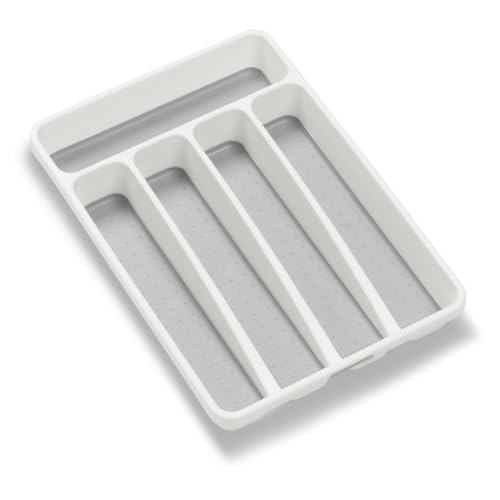
The madesmart Classic Silverware Tray opens the roundup because it defines the category’s floor: a moulded plastic cutlery tray that does the basic job without moving parts, setup or ceremony. In daily use its virtues are the quiet kind, a quick wash, a light lift-out, compartments that a child can read. Its limits are equally plain: it assumes a standard drawer and a conventional set, and it has no answer for kitchens that deviate from either. Reviewed as what it is, a first system for a standard drawer, it is easy to recommend; reviewed as a universal answer, it is not one, and neither is anything else here.
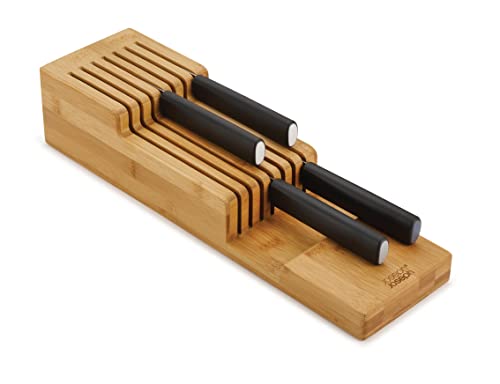
Joseph Joseph DrawerStore — reviewed: the space economist, mid tier
The Joseph Joseph DrawerStore is the design reviewers reach for when the drawer is small and the household is not. Its angled, stacked compartments house a full cutlery set in a footprint that flat trays cannot approach, and living with it teaches a household a new, efficient choreography within a week or two. The conditions are real: chunky handles sit snugly, and the compact slots reward households that return things precisely. For the small kitchens it targets, those are fair terms, and its capacity per inch leads this roundup outright.

OXO Good Grips Expandable Utensil Organizer — reviewed: the fit problem, solved, mid tier
The OXO Good Grips Expandable Utensil Organizer earns the roundup’s most practical praise: it fits the drawers that actually exist. By expanding to meet the walls it claims the full width, ends tray travel, and adapts when you move house or reorganize. Its utensil-friendly sections make it the most versatile design here, as happy with cooking tools as with cutlery. The moving sections ask for a set-once care and an occasional check, a small tariff for solving the category’s commonest failure. If one design in this list suits the widest range of real kitchens, it is this one.
BambooWorx Bamboo Drawer Organizer — reviewed: bamboo with adjustability, premium-leaning tier
The BambooWorx Bamboo Drawer Organizer combines the two virtues small kitchens and design-led kitchens each want: expandable fit and bamboo’s planted, quiet presence. In use it feels less like an accessory and more like part of the cabinetry, and heavy cutlery sets sit in it with particular calm. Its care contract is the familiar bamboo one, wipe and dry, never soak, and households should sign it knowingly. Reviewed against its promise, it delivers fully; it simply asks its owners to meet it halfway on cleaning.
Homemaid Living Bamboo Silverware Organizer — reviewed: the silverware specialist, mid-to-premium tier
The Homemaid Living Bamboo Silverware Organizer closes the roundup as the specialist: a bamboo tray devoted to the silverware drawer, with a presentation that flatters the cutlery it holds. Sociable kitchens, where guests open the drawer to help set the table, feel its benefit most. Its specialism bounds it: long utensils need another home, and bamboo’s care rules apply. As a silverware drawer, though, it is the design in this group most likely to be complimented by someone who was not shopping for compliments.
How the Five Compare
| Design | Type | Tier | Choose it for | Think twice if |
|---|---|---|---|---|
| madesmart Classic Silverware Tray | Fixed plastic tray | Entry | A standard drawer and a first system | Your drawer is between sizes |
| Joseph Joseph DrawerStore | Compact stacking | Mid | Small drawers, full sets | Your cutlery handles are chunky |
| OXO Good Grips Expandable Utensil Organizer | Expandable | Mid | In-between drawers, mixed tools | Your drawer needs tiers, not width |
| BambooWorx Bamboo Drawer Organizer | Expandable bamboo | Premium-leaning | Stability plus natural material | You clean by soaking |
| Homemaid Living Bamboo Silverware Organizer | Bamboo silverware tray | Mid-to-premium | A cutlery drawer that should look the part | The drawer must hold long utensils too |
Two patterns emerge from the table. First, the adjustable designs cover the widest ground, because fit is the category’s governing problem. Second, every design’s weakness is the shadow of its strength: compactness is snugness, specialism is narrowness, simplicity is rigidity. Choosing well means deciding which shadow your kitchen can live with, and that is a question about your household, not about the products. The fuller balance sheet lives in our kitchen drawer organizer pros and cons.
Plastic, Bamboo and Dividers: What Each Material Really Does
Plastic trays are the workhorses of this category: light, smooth, easy to lift out and wash, and forgiving of the spills and crumbs a utensil drawer collects. A well-moulded plastic tray shrugs off tomato sauce, coffee grounds and the sticky ring a honey dipper leaves behind, and it goes back into the drawer without ceremony. The trade-off is feel. Plastic can look purely functional, and thin examples flex when you lift them loaded, so judge a plastic tray by its rigidity in the hand rather than by its photograph.
Bamboo brings warmth and weight that many kitchens prefer, and a bamboo organizer sits still in the drawer instead of skating, which heavier cutlery appreciates. It suits households that like natural materials on show when the drawer opens. Bamboo asks a little more care in return: wipe spills promptly, dry it rather than leaving it to soak, and keep it out of standing water so the slats and joins stay true. Treated kindly, bamboo ages gracefully; treated like plastic, it can stain and swell at the edges.
Adjustable dividers and modular inserts take the opposite approach to a moulded tray: instead of fixed compartments, you get pieces that partition the drawer where your own tools demand. They are the natural answer for odd drawer sizes, mixed collections of long and short tools, and anyone whose utensil set does not match the standard fork-knife-spoon grid. The cost of that freedom is discipline, because a badly planned divider layout simply builds a custom-made mess. Sketch the layout on paper first, live with it mentally for a day, then commit.
Metal mesh and wire designs sit between the two camps: airy, quick to rinse, and good for drawers where crumbs are a constant, since debris falls through instead of collecting in corners. They can, however, let slim handles slip through gaps and can feel noisy when cutlery is dropped in. Whichever material you lean toward, match it to the drawer’s job. A hardworking cutlery drawer near the dishwasher rewards washable plastic or bamboo; a baking-tools drawer full of whisks and spatulas often suits flexible dividers better than any fixed tray.
Zoning the Drawer: Put Things Where the Work Happens
A good drawer layout follows the work, not the alphabet. The cutlery used at every meal belongs in the drawer nearest the table-setting route, ideally close to the dishwasher or sink so unloading takes seconds. Cooking tools belong near the stove, baking tools near the worktop where you roll and mix, and the long tail of occasional gadgets can live further from the action without costing you anything. Before choosing compartments, stand in your kitchen and act out a normal meal; the movements you make are the blueprint the organizer has to serve.
Within one drawer, the front is prime land and the back is storage. Daily forks, knives and spoons sit at the front where a half-open drawer still reaches them. Serving spoons, tongs and the tools used mid-cooking sit in the middle. The back row is for the second tier: the extra ladle, the spare peeler, the tools you want findable but not prominent. Trays that ignore this gradient, spreading daily items across the full depth, make every reach a full drawer pull and a small daily tax on your patience.
Leave one compartment deliberately underfilled. Every kitchen acquires a new tool now and then, and an organizer packed to perfection on day one has nowhere for the new arrival to go except on top of everything else, which is how clutter restarts. A little slack is not wasted space; it is the margin that keeps the system alive. Similarly, resist organizing drawers you rarely open with the same intensity as the main cutlery drawer. Effort follows frequency, and a calm cooktop drawer matters more than a perfect gadget drawer.
If two people cook differently, agree the zones together before buying. Most drawer arguments are not about tidiness but about two incompatible maps of the kitchen, and an organizer locks one map in moulded plastic. A short conversation about where the tongs live saves a year of quiet rearrangement. Where you cannot agree, modular dividers earn their keep, because the layout can evolve without a new purchase every time habits change.
Storing Knives and Sharps Safely in a Drawer
Loose knives in a drawer are the one storage habit this category exists to end. Reaching into a drawer and finding a blade by touch is how kitchen cuts happen, and an organizer only helps if the sharp tools get a genuinely protected home. The sound options are an in-drawer knife block with slots that sheath each blade, individual blade guards or sheaths on knives stored in a tray, or a dedicated knife drawer section where blades sit separated and cannot slide against each other or against your fingers.
Orientation matters as much as separation. Store knives with tips pointing toward the back of the drawer and handles toward you, so the first thing your hand meets is a handle, never an edge. Keep the knife section in the same place permanently; safety depends on muscle memory, and a blade that migrates around the drawer is nearly as risky as a loose one. Peelers, mandoline blades, skewers and graters with exposed teeth belong in the same protected category: sheathed, separated, and always in their known place.
Households with children need one further step: sharps belong in a drawer children cannot casually open, ideally a higher drawer or one fitted with a simple latch, and never in the low drawer a child can pull open at standing height. Teach the rule early that the knife drawer is an adults-only drawer, and keep it consistent even when guests are cooking. An organizer makes this easier, not optional: a defined, sheathed, out-of-reach place for every blade is the standard to hold, whatever tray or block you choose.
Finally, carry knives to and from the drawer one at a time, blade down and announced if someone is beside you, and never drop a knife into a tray from a height. When you wash up, dry knives and return them to their slots rather than leaving them in a draining rack where the next person reaches blindly. These are small disciplines, but they are the difference between an organized drawer and a merely tidy-looking one, and no purchase substitutes for them.
Strengths and Trade-Offs Across the Roundup
Strengths
- Every common drawer problem, size, footprint, mixed tools, presentation, has a designed answer.
- All five designs make knife storage safer when paired with a block or guards.
- Adjustable designs forgive measuring errors that fixed trays punish.
Trade-offs
- No design escapes its material’s care contract or its type’s geometry.
- The category rewards measuring and editing; it returns nothing to guesswork.
- Deep and eccentric drawers still need modular systems beyond this roundup’s scope.
That last trade-off deserves emphasis: households with deep drawers or truly eccentric collections should treat this roundup as background and shop the modular divider family instead, building a layout no factory tray attempts. Knowing when a roundup does not contain your answer is part of reading reviews well, and the honesty costs these five designs nothing with the households they do suit.
Who Each Review Serves: A Buyer Shortlist
Standard drawer, first organizer, minimal fuss: start and very possibly finish with the fixed plastic tray. Small kitchen, few drawers, full household: the compact stacker is your headline act. Drawer between sizes, or a renter who will move: the expandable all-rounder, in plastic for washing or bamboo for feel. Silverware drawer in a sociable, design-aware kitchen: the bamboo specialist. Everyone else, the deep-drawer and heirloom-collection households, should take the modular road described in how to choose a kitchen drawer organizer.
Notice what the shortlist never asks: which design is most popular, or which one a stranger’s kitchen preferred. Popularity in this category mostly measures how common standard drawers are. Your shortlist should be built from three measurements and one honest paragraph about your habits, and any review, including this one, is only useful insofar as it helps you apply those facts to named designs.
Keeping the Drawer Fresh After the First Week
Set up properly on day one and care stays easy. Empty the drawer completely, vacuum the corners, wipe the base and let it dry before the organizer goes in, because crumbs sealed under a tray become a permanent archaeological layer. A simple liner or non-slip mat under the tray stops sliding and catches the worst of the debris, and it lifts out for shaking in seconds. Load the organizer outside the drawer if it is a fixed tray, so you can judge the layout on the counter before committing it to the dark.
Weekly care is a thirty-second habit: when the drawer is open anyway, tip loose crumbs from the tray into the bin and give sticky spots a wipe. Monthly, or whenever the drawer starts to smell faintly of old cooking, lift the whole organizer out, wash it in warm soapy water if it is plastic, or wipe and dry it carefully if it is bamboo, and clean the drawer base beneath. Cutlery drawers live close to food preparation, so treat them with the same hygiene instinct as a chopping board, not like a cupboard that can be forgotten for a year.
Bamboo asks for the gentlest routine: no soaking, no dishwasher, and prompt drying after wiping, with food-safe oil only if the maker suggests it and the surface starts to look dry. Plastic trays tolerate more, though very hot water and harsh scouring can dull or warp thin examples over time. Adjustable dividers need their joints and springs checked occasionally, because a divider that has slipped is quietly reorganizing your drawer without permission. Whatever the material, a five-minute reset each month keeps the system you bought instead of the drift you did not.
Use the monthly lift-out as an audit. Anything that has not been touched since the last clean is a candidate for the charity box, the backup drawer or the bin, and every removal makes the remaining system work better. Organizers fail less often from bad design than from slow accumulation, and the household that edits ruthlessly keeps a modest tray feeling generous while the household that edits never makes even a large one feel cramped.
Where Drawer Projects Usually Go Wrong
The most common mistake is buying before measuring, and it is not close. Drawers vary more than catalogues admit, and a tray chosen by eye from a product photo is a gamble dressed as a purchase. The second mistake is organizing for the kitchen you wish you had: compartments for the juicer attachments and fondue forks of an imaginary life, while the four tools you use daily fight for one slot. Organize the real kitchen, with its real habits, and let aspirational gadgets earn their place later if they ever do.
Overfilling ranks third. An organizer is a rationing system, and a compartment holding three layers of spoons has stopped organizing anything. If a section overflows, the answer is to move the overflow elsewhere or let something go, not to press harder. Fourth comes the sliding tray: a fixed tray in a wider drawer that travels every time the drawer opens, mixing its contents and chipping the drawer sides. Non-slip feet, a liner, or an expandable design that meets the walls ends the travel for good.
Fifth, the knife drawer of doom: loose blades kept ‘carefully’ among the spoons, which is careful right up until the evening it is not. Sheathe blades, use an in-drawer block, or give knives their own protected section, and keep that drawer away from children’s hands. Sixth, buying five matching organizers for five different drawers before testing one. Drawers differ in size and job; prove the system in the main cutlery drawer first, learn what your household actually likes, and only then extend it.
The last mistake is treating the organizer as the finish line. It is the starting line. The households whose drawers still look good a year later are not the ones who bought best; they are the ones who reset the drawer monthly, edit what creeps in, and keep the rule that everything in the drawer has a named home. Buy thoughtfully, by all means, but budget a little ongoing attention as part of the price, because that attention, not the tray, is what you are really living with.
Fixed Trays, Expandable Trays and Modular Systems
Modular inserts and spring or peg dividers complete the family. Bought piece by piece, they let a drawer hold cutlery at one end, long tools along one side and a small in-drawer knife block at the other, all in one tailored layout. In-drawer knife blocks deserve a special mention: a slotted block that lives inside the drawer keeps blades sheathed, separated and off the counter, and turns a loose knife drawer, which nobody should tolerate, into a safe, deliberate storage place. The types are not rivals so much as answers to different drawers, and the rest of this article is about matching the answer to yours.
The fixed moulded tray is the classic: one piece, a set of compartments shaped for cutlery and common utensils, dropped into the drawer in seconds. It is the fastest route from chaos to order and the easiest to clean, because the whole thing lifts out. Its weakness is rigidity. If your collection includes long carving tools, oddly shaped gadgets or simply more forks than the mould expects, a fixed tray forces your tools to fit its opinion of a kitchen rather than yours.
Expandable trays answer the sizing problem by sliding wider or longer to meet the drawer walls, which also stops the tray migrating every time the drawer opens. Designs like the OXO Good Grips Expandable Utensil Organizer and the BambooWorx Bamboo Drawer Organizer build their whole appeal around that adjustability, and for the many drawers that fall between standard sizes they are often the difference between a tray that looks installed and one that looks borrowed. Check that the expanding sections lock or at least hold their setting under a load of cutlery.
Compact and space-doubling designs, the territory of the Joseph Joseph DrawerStore, stack or angle compartments so a small drawer holds a full cutlery set without spreading sideways. They reward small kitchens and anyone whose drawer count is limited, though the cleverness means individual slots can be snug for chunky handles. Two-tier inserts take the stacking idea further, with an upper tray that slides to reveal a second layer beneath, effectively doubling a deep drawer; they suit deep drawers and disciplined households that will actually keep the layers sorted.
How This Roundup Judged the Field
Each design here was judged on the work a drawer actually does: the half-awake morning reach, the one-pass dishwasher unload, the mid-recipe search, and the monthly lift-out clean. Fit came first, because a design that cannot fit your drawer has no other virtues available to you. Behaviour came second: does it travel, rattle, trap crumbs, forgive a tired unloader? Material and presentation came third, honestly weighted but never allowed to outrank the first two. Any roundup that reverses that order is reviewing photographs, and photographs never have to find a peeler at speed.
No scores are awarded, deliberately. A number would pretend that the gap between these designs is uniform across kitchens, when in truth each design is excellent in its drawer and mediocre outside it. What a roundup can honestly give you is the map: which design answers which problem, what each concedes, and what to measure before you let any of them into your kitchen. The rest of the judgement is yours, and with a tape measure in hand it is not a hard one to make.
Ownership Notes by Design Family
Fixed trays age the most gracefully of any family, because there is nothing in them to loosen, slip or mis-set; their owners’ only recurring task is the wash. Expandable designs ask a moment’s attention at each monthly clean, a glance at the moving sections to confirm they still hold their setting, and repay it by surviving house moves and drawer changes that retire fixed trays. Compact stackers reward precise households and gently punish approximate ones, a personality match worth recognizing before purchase rather than after.
Bamboo across both its appearances here asks for the same small loyalty, prompt wiping and honest drying, and gives back the calmest drawer in the house in exchange. Owners who build the wipe into the monthly reset never think about it again. Owners who wanted plastic’s indifference should buy plastic’s indifference; this roundup’s recurring moral is that the right organizer is the one whose demands you will meet without resentment, because resentment, not wear, is what ends most drawer systems.
A Final Word on Reading Reviews, Including This One
Reviews are most useful at the moment they tell you something about your own kitchen rather than about a product. If a sentence in this roundup made you think of your drawer’s runners, your partner’s unloading habits or the knife that currently lives loose under the tongs, it did its work. Collect those recognitions, add your three measurements, and the shortlist writes itself. Ignore any review, here or elsewhere, that asks you to admire a ranking without once asking how deep your drawer is.
And when the organizer is in and the first month has passed, consider leaving the next shopper a favour no ranking can provide: an honest account of fit, of what the design did with your real drawer and your real habits. The category improves one such account at a time, and the kitchens reading after yours will be grateful for specifics in exactly the way you were, standing where you stood, tape measure in hand.
One Pattern Across All Five Reviews
Read the five reviews together and a pattern surfaces that no single review shows: the designs households keep are the ones whose demands match the household’s existing rhythms, the wipe that happens anyway, the precise return that a careful family already practises, the expansion that forgives a renter’s next kitchen. Satisfaction in this category is less about the object than about the fit between the object’s small demands and a life already being lived. Choose the design whose demands you already meet on your tired days, and the reviews above suggest you will still be pleased when the novelty is a year old.
How to Use This Roundup at the Kitchen Table
Print nothing; bring a tape measure and this shortlist’s logic to the drawer itself. Measure the interior three ways, say aloud what the drawer’s job is, and name the one problem you most want solved, size, space, tools or looks. The roundup then does its work in about a minute, because each design here was reviewed as the answer to one of those problems and is indifferent to the others. What remains is the care question, bamboo’s wipe or plastic’s wash, and that one your household can answer from its own sink habits without any reviewer’s help.
If the exercise produces no name, that is information too: your drawer is probably deep, angled or eccentric, and its answer lives in the modular divider family rather than in any tray roundup. Take the measurements you just made to that family with confidence, because the measuring, not the shortlist, was always the valuable part of the afternoon. Reviews end; a well-measured drawer keeps answering questions for years. The measuring habit transfers, too: it is the same discipline that makes vacuum storage bags for seasonal overflow and other fitted storage behave in the rooms beyond the kitchen.
The Shortlist, Revisited After the Arguments
After the arguments, the shortlist stands, but it reads differently: not as five products competing, but as five answers waiting for their questions. Ask which drawer problem you actually have, size, footprint, mixed tools, presentation or simple standard order, and the roundup collapses to one or two names without any ranking at all. That collapse is the sign the reviews have done their job. A roundup you still cannot act on after reading has entertained you; one that sends you to a tape measure has served you.
If two designs survive the collapse, choose by the care contract and the failure mode you prefer. Every design fails somehow, snug slots, a wipe-don’t-soak rule, a layout imposed on odd tools, and the mature purchase is the one whose failure you have met in advance and accepted. Owners rarely regret the organizer whose weaknesses they chose; they regret the one whose weaknesses surprised them, which is why these reviews have stated the weaknesses in the same size type as the strengths.
What Owners Argue About, and What the Arguments Teach
Owner arguments in this category cluster on three questions, and each cluster is a free lesson. The first is bamboo versus plastic, which is never really about material science; it is about whether a household experiences care routines as pleasure or as tax. Both camps are right about their own kitchens, and the argument only becomes useful when it forces a new buyer to answer the care question honestly before choosing, rather than discovering their camp after the purchase.
The second argument is capacity: whether an organizer that holds less but shows everything beats one that holds more in layers. Small households defend layers, large households defend visibility, and both are describing their unloading speed at the end of a long day. The lesson is that capacity claims cannot be compared across households, only within one, which is why this roundup reports designs by the problem they solve instead of by how much they swallow.
The third argument is the oldest: whether any of this matters, whether a drawer is just a drawer. It is usually settled by a visit. People who cook for a week in an organized kitchen and then return to a jumbled one stop arguing, in one direction or the other, and people unmoved by both were never the audience. Reviews exist for the persuadable middle, and the middle, in our reading of the arguments, mostly needs permission to measure a drawer and take the answer seriously.
Renters and anyone in a temporary kitchen should organize with one eye on the exit. Freestanding trays and expandable inserts move with you, adapt to the next kitchen’s drawers, and leave no screw holes or cut-to-size liners behind, which makes them the sensible default until you own the cabinets. Bamboo and plastic trays both travel well; fitted custom dividers, however beautiful, are a gift to the next tenant. If you expect to move within a couple of years, weight portability as heavily as fit, and keep the packaging of anything expandable until you are sure it suits the current drawers.
Drawer liners are the quiet supporting act. A cushioned non-slip liner stops a tray migrating, muffles the rattle of cutlery, protects the drawer base from scratches and spills, and lifts out for cleaning in a way the drawer itself never will. Choose a liner you can cut cleanly to size, avoid thick spongy types that steal precious height from shallow drawers, and replace it when it starts to curl or hold odours. It is a small purchase that makes a modest organizer feel fitted and a good organizer feel built in.
Finally, judge success by mornings, not by photographs. A drawer that looks stunning in a listing photo but slows breakfast is a failure wearing good lighting. The real test is the half-asleep reach for a teaspoon that lands exactly where the hand expects, the guest who can set the table without asking, and the cook who finds the peeler mid-recipe without breaking rhythm. When a drawer passes those tests for a month, the system is right, whatever it cost and whatever it is made of, and your remaining job is simply to defend it against slow, well-meaning drift.
Deep drawers deserve their own strategy. A deep drawer tempts you to treat it like a small cupboard, piling tools until the bottom layer is archaeology, but depth used well is a gift: two-tier inserts turn one deep drawer into two shallow ones, each fully visible, and tall dividers can stand utensils in grouped bundles so nothing lies buried. The test of a deep drawer is whether you can name everything in it without opening it. If you cannot, the drawer is storing things rather than organizing them, and a tiered insert or a ruthless edit is the fix, not a bigger tray.
Narrow drawers, the kind older kitchens hide beside the oven, punish standard trays and reward compact designs. A slim expandable tray run front-to-back, or a compact stacked cutlery case, can turn a drawer most households surrender to batteries and string into a disciplined home for knives or for the full cutlery set of a small household. Measure a narrow drawer with extra care, because its runners and frame often intrude more than in a standard drawer, and a tray that fits the box on paper may still foul the mechanism in practice.
The junk drawer deserves an honest paragraph. Almost every kitchen keeps one drawer of tape, string, batteries, takeaway menus and mystery keys, and an organizer will not civilize it by compartments alone, because its contents share no single job. The workable approach is a small modular insert that gives the true regulars, scissors, tape and a pen, fixed homes, plus a standing rule that the drawer gets emptied and re-judged twice a year. Some households instead abolish the junk drawer entirely once the real drawers are organized, and report that the chaos simply had nowhere left to live.
After the Boxes Are Gone: Long-Term Ownership Notes From Kitchen drawer organizer Reviews
Most kitchen drawer organizer coverage stops at unboxing, yet almost everything that decides owner satisfaction happens afterwards. The first evening tells you about finish and first impressions; the third month tells you about durability, upkeep and whether the design still suits the way your household actually behaves. This section looks at the ownership phase in detail — the settling-in period, the first signs of wear worth watching for, and the small habits that separate owners who stay pleased from owners who start browsing replacements. If you are weighing madesmart Classic Silverware Tray, Joseph Joseph DrawerStore or any similar design, treat the points below as the questions a good long-term review should answer.
The Settling-In Period: What Changes in the First Weeks
New materials and mechanisms relax. Fabrics soften, joints settle, finishes lose their showroom sharpness, and moving parts either bed in smoothly or start to complain. With a kitchen drawer organizer, use the first fortnight deliberately: operate everything daily, check fixings once after the first week, and keep a mental note of any sound, wobble or resistance that was not there on day one. Changes that stabilise after a small adjustment are normal settling; changes that keep progressing are early warnings, and they are far easier to raise with a seller while the purchase is recent.
Wear Worth Watching, and Wear Worth Ignoring
Not all wear is failure. Honest materials in the food storage & organization category develop a patina — slight softening of edges, gentle colour shifts where hands and light fall — and most owners come to like it. The wear that matters is functional: looseness that returns after tightening, surfaces that mark from ordinary use rather than accidents, parts that need persuading, and finishes that fail at edges and corners first. Check those high-contact zones on any kitchen drawer organizer you already own, and look for honest close-up photographs of exactly those zones when you judge a replacement.
A simple ownership routine keeps a kitchen drawer organizer performing the way the early reviews promised:
- Once a month, spend two minutes checking fixings, feet, seals or moving parts — whichever your kitchen drawer organizer relies on — and correct small changes before they compound.
- Clean little and often with the mildest method that works, rather than rarely and aggressively, and always test any new cleaner on a hidden patch first.
- Rotate, rest or reposition the kitchen drawer organizer if one side takes all the light, heat or traffic, so wear spreads evenly instead of concentrating.
- Keep the manual, spare parts and any touch-up materials together in one labelled place; the day you need them is never the day you want to search.
- Photograph the kitchen drawer organizer once a year from the same spot; comparing pictures is the most reliable way to notice slow change you would otherwise miss.
Keep the receipt, delivery note and a photograph of the label together, because warranty conversations go smoothly when dates and model details are at hand. If two people in the household disagree about the kitchen drawer organizer, let the person who will use or maintain it most have the deciding vote on practical questions. Beware of buying for the household you hope to become; the kitchen drawer organizer that serves the household you already are will be used this week, not someday. A tape measure, a spirit level and ten patient minutes prevent more kitchen drawer organizer regrets than any amount of comparison shopping after the fact. When a listing is vague about a dimension, material or included part that matters to you, treat the vagueness itself as information and look for a clearer seller.
Ownership rewards attention in small doses. A kitchen drawer organizer that is checked monthly and cleaned gently will usually outlast a neglected premium model, and it will certainly stay pleasanter to live with. Judge any review — including the detailed assessments earlier in this guide — by whether it helps you through this long middle phase of ownership, because that phase, not the unboxing, is where the money is really spent.
Frequently Asked Questions
Which kitchen drawer organizer gets the best reviews overall?
Expandable designs tend to collect the happiest owners, because they solve the fit problem that defeats fixed trays in real kitchens, but ‘best reviewed’ mostly reflects how common each drawer type is. The right question is which design suits your drawer’s measurements and job: fixed trays for standard drawers, compact stackers for small ones, expandable designs for in-between sizes, bamboo where feel and stability matter most.
Are bamboo drawer organizers reviewed as well as plastic ones?
Yes, by owners who accept their care routine. Bamboo designs are praised for weight, stability and appearance, and criticized when households soak them or expect dishwasher tolerance. Plastic designs are praised for washing and lightness and criticized when thin examples flex. The reviews of both materials say the same thing in the end: match the material to the cleaning habits you actually have.
What should I check before trusting any drawer organizer review?
Check whether the review discusses fit against real drawer measurements, because a review that never mentions interior width, depth and closed height is reviewing a photograph. Check also whether it names who should skip the product, and whether it covers cleaning and knife storage. Reviews that only praise, or that rank without reference to drawer types, are marketing wearing a review’s clothes.
Can one organizer really work for both cutlery and utensils?
Some can. Expandable utensil organizers with longer sections handle mixed loads well, and modular systems are built for exactly that combination. Pure silverware trays, fixed or bamboo, are specialists and should not be forced into mixed duty. Decide the drawer’s main job first, then choose a design whose compartments were drawn for that job, with sharps sheathed in their own protected section either way.
How do I store knives alongside an organizer safely?
Add an in-drawer knife block with sheathing slots, or fit blade guards and give knives a dedicated section of the layout. Keep tips toward the back of the drawer and handles forward, never change the knife section’s place, and use a drawer children cannot casually open. Every design in this roundup can host safe knife storage; none of them makes loose knife storage acceptable.
When should I choose modular dividers instead of a tray?
When the drawer is deep, unusually sized, or home to a long and eccentric collection, heirlooms, serving pieces and odd tools that no mould anticipates. Modular dividers take a planning session to arrange, but they produce a layout fitted to your actual tools rather than to a factory’s idea of them. Many serious cooks end with a hybrid: a tray for cutlery, dividers for the tool drawer.
Related Reading
- our in-depth kitchen drawer organizer review
- how to choose a kitchen drawer organizer step by step
- whether a kitchen drawer organizer is worth it
- our kitchen drawer organizer buying guide
- kitchen drawer organizer pros and cons in full
- makeup organizers for a calmer bathroom counter
- under-bed storage ideas for small homes