Disclosure: As an Amazon Associate, dailyhomedecorating.com earns from qualifying purchases. Links on this page are affiliate links; they cost you nothing extra. Prices and availability change often, so check the current Amazon listing before you buy.
Shopping this category means reading a lot of deck box reviews, so we wrote the comparative set we would want: the main designs from established makers, judged side by side on the things that decide ownership, interior room, lid hardware, weather behaviour, upkeep and safety. Each pick below is presented in prose with its own slot, because listings, sizes and finishes change; what does not change is which design suits which patio. Read the verdicts, shortlist two, then confirm interior dimensions against your own measured cushion stack before you order.
Key Takeaways
- Best for most patios: a mid-to-large double-wall resin design with a strut-assisted, lockable lid.
- Best-looking: furniture-styled resin or real wood, with wood asking for seasonal oiling.
- Biggest cushion sets and toughest sites point to the high-volume and heavy-duty designs.
- Value-tier boxes make sense for first purchases and rentals when placed and loaded sensibly.
- Every design in this roundup obeys the same safety rules around children, lids and chemicals.
In this guide
Deck Box Reviews: How the Main Designs Differ
Spread the category out and the designs separate along four lines. Construction first: double-wall resin panels feel dense and resist flex, thin single-wall panels drum and bend, wood feels solid and heavy, metal feels harder still. Hardware second: gas struts transform daily use on big lids, while plain hinges reward smaller boxes opened less often. Volume third: headline capacity flatters, interior dimensions decide, and wide openings matter as much as raw size when the load is a sofa’s worth of cushions. Intent fourth: some boxes are styled as furniture for visible patios, others are plainly storage and happier at the side of the house. The reviews below score each design against the job it claims to do.
The Reviews: Six Designs Compared
Each review ends with who should buy and who should skip, because the wrong household makes a good box look bad.

Keter Marvel Plus Deck Box — Best Overall
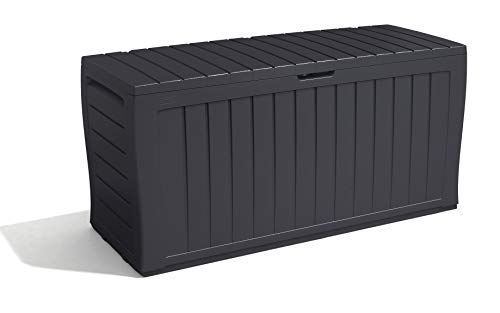
The Marvel Plus is the kind of mid-to-large resin box that suits the majority of patios, which is why it anchors this guide. Its moulded panels carry a wood-effect finish that sits comfortably beside both timber decking and modern composite boards, and the construction feels noticeably sturdier than the thinnest single-wall boxes when you press on the sides or lean on the closed lid. In everyday use it swallows a full set of sofa and chair cushions with room left for a folded throw, and the lid opens wide enough that you are not threading cushions through a narrow slot.
Best for: households whose needs match the badge above and who want a proven design from an established outdoor-storage maker. Not suited for: anyone expecting verified specifications beyond what the maker publishes, or planning to store hazardous chemicals without a lock and a separate, child-safe arrangement. Check price on Amazon for the current listing, and confirm the interior dimensions against your own cushion stack before ordering.

Keter Westwood Deck Box — Best for a Finished Look
The Westwood is the choice when the box will sit in full view and needs to earn its place visually. Its panel styling is more furniture-like than most resin designs, with a richer wood-look texture and a profile that reads as a garden bench or sideboard rather than a storage tub. Owners typically use it on visible patios and beside outdoor sofas, where a purely utilitarian box would look like clutter. The interior is generous for cushion sets from a standard seating group, and the lid has the solid, damped feel that makes daily opening and closing pleasant rather than a chore.
Best for: households whose needs match the badge above and who want a proven design from an established outdoor-storage maker. Not suited for: anyone expecting verified specifications beyond what the maker publishes, or planning to store hazardous chemicals without a lock and a separate, child-safe arrangement. Check price on Amazon for the current listing, and confirm the interior dimensions against your own cushion stack before ordering.

Suncast Large Resin Deck Box — Best for Big Cushion Sets
Suncast’s large resin boxes are the workhorses of this category: plain in styling, serious about volume. If your problem is a deep-seating set with thick back cushions, or a household that adds pool gear, outdoor games and furniture covers to the same box, this is the direction to look. The wide opening and tall interior accept bulky items that narrower boxes reject, and the resin construction keeps the whole thing light enough to move when empty despite its size. It is less of a looker than the furniture-styled designs, so it suits side-of-house and less prominent placements best.
Best for: households whose needs match the badge above and who want a proven design from an established outdoor-storage maker. Not suited for: anyone expecting verified specifications beyond what the maker publishes, or planning to store hazardous chemicals without a lock and a separate, child-safe arrangement. Check price on Amazon for the current listing, and confirm the interior dimensions against your own cushion stack before ordering.

Lifetime Heavy-Duty Deck Box — Best for Rough Exposure
Lifetime builds its outdoor storage with a heavier hand than most, and its deck boxes follow the same pattern: thick panels, a lid that feels genuinely structural, and hardware chosen for years of outdoor life rather than a single season. This is the pick for exposed decks, windy sites and households that are hard on equipment. The styling is functional rather than decorative, and assembly is a more involved job than the snap-together designs, but the result is a box that shrugs off knocks, weather and enthusiastic loading. For a buy-once placement in a tough spot, it is the safest bet in this list.
Best for: households whose needs match the badge above and who want a proven design from an established outdoor-storage maker. Not suited for: anyone expecting verified specifications beyond what the maker publishes, or planning to store hazardous chemicals without a lock and a separate, child-safe arrangement. Check price on Amazon for the current listing, and confirm the interior dimensions against your own cushion stack before ordering.
YITAHOME Resin Deck Box — Best Value Tier
YITAHOME has become a familiar name in resin outdoor storage by offering straightforward boxes at the value end of the range, and for many households that is exactly the right trade. You get the essentials: weather-shedding panels, a lockable lid on many designs, and sizes that cover cushion storage for typical chair and sofa sets. The panels and hardware are lighter than the premium names, so this is a box to place thoughtfully, load sensibly and not treat as seating furniture unless the maker explicitly designs it for that. As a first deck box, or for a rental property, it makes a great deal of sense.
Best for: households whose needs match the badge above and who want a proven design from an established outdoor-storage maker. Not suited for: anyone expecting verified specifications beyond what the maker publishes, or planning to store hazardous chemicals without a lock and a separate, child-safe arrangement. Check price on Amazon for the current listing, and confirm the interior dimensions against your own cushion stack before ordering.
EAST OAK Resin Deck Box — Best Compact-to-Mid Option
EAST OAK’s resin boxes suit smaller patios, balconies with outdoor access and households whose storage list is modest: a couple of cushions, a hose, some tools and the barbecue accessories. The designs are tidy, the assembly is among the simpler jobs in the category, and the footprint respects tight spaces where a full-size box would crowd the furniture it serves. Like other value-tier resin, it rewards gentle treatment of the lid and hinges. If your cushion stack is small and your deck is smaller, this tier is where your money works hardest.
Best for: households whose needs match the badge above and who want a proven design from an established outdoor-storage maker. Not suited for: anyone expecting verified specifications beyond what the maker publishes, or planning to store hazardous chemicals without a lock and a separate, child-safe arrangement. Check price on Amazon for the current listing, and confirm the interior dimensions against your own cushion stack before ordering.
How Much Capacity Do You Actually Need?
Capacity is the specification that decides whether a deck box solves your problem or simply moves it outdoors. Manufacturers describe capacity in gallons, and the useful way to think about those numbers is by what you own rather than by the figure itself. Compact boxes at the small end of the range suit a pair of chair cushions, a folded throw, a watering can and a few hand tools. Mid-size boxes handle a full set of seat and back cushions for a sofa and two chairs, or a family collection of pool towels, floats and games. The largest boxes swallow deep-seating cushion sets, multiple outdoor blankets, a folded hose, sports equipment and seasonal items with room to spare.
Measure before you shop. Stack the cushions you plan to store in the arrangement you would use inside the box, then measure the stack’s length, width and height. Cushions compress a little but not much, and a box that is two inches too short in any dimension is a box that will not close. Pay particular attention to interior dimensions rather than exterior ones, because thick double-wall resin panels can take several inches off the inside. If your longest cushion is close to the box’s interior length, go up a size; a slightly larger box that closes easily beats a perfect-size box you have to force shut every evening.
Also think in seasons. In summer the box holds cushions and pool gear. In winter it may need to hold those same cushions plus furniture covers, a folded outdoor rug and planters you are protecting from frost. Buying for your biggest season, not your average week, prevents the familiar overflow pile that ends up back in the garage. And remember that a box filled to the brim is a box you cannot organise: leaving a little headroom lets you lift items out without unpacking the whole contents onto the deck.
Head to Head: What a Season of Use Teaches
Across designs, the same pattern emerges by the end of a season. Owners praise the boxes that made the evening cushion round effortless, which is a hardware verdict: struts, wide openings and even-closing lids. They curse boxes bought a size too small, whatever the brand, because a lid forced shut over cushions gaps, leaks and strains its hinges. They report that placement decided their weather results more than material did: level boxes in draining spots stayed dry inside, while better boxes in puddle lines disappointed. And they consistently say the box changed their habits, decks stayed clear because the storage was finally in the right place.
Cushion Households
For cushion storage specifically, the furniture-styled and large resin designs lead, because the job is volume plus gentle daily handling. Thick back cushions need height as much as floor area, so check the interior height against your thickest cushion stood as you will store it.
Pool Households
Poolside, ventilation and lockability reorder the field. Any design you choose must pair with separate locked chemical storage, and the box itself must sit where it cannot help a child climb toward the pool barrier. Within those rules, the easy-clean resin designs win, since chlorinated drips and wet towels punish fussy finishes.
Garden and Tool Households
Gardeners should weight interior organisation over raw volume: a mid-size box with an upright tool caddy outperforms a cavern that swallows trowels into darkness. Heavy-duty and metal designs earn their keep at exposed or front-of-house sites where knocks and curiosity are facts of life.
Resin, Wood and Metal: Choosing a Material
Most deck boxes sold today are resin, and for good reason. Modern resin panels are moulded with wood-look textures, resist rain and sun without painting or sealing, and shrug off the splashes and damp cushions that would stain or rot timber. Resin will not rust, peel or attract insects, and a quick wash restores it each spring. Its weaknesses are that very thin single-wall panels can flex or crack under point loads, that dark colours can fade over years of hard sun, and that a resin box rarely looks as rich as real wood up close. Double-wall construction, where the maker offers it, is the version to prefer for lids you may sit on and for boxes that will live in full weather.
Wooden deck boxes, usually cedar, teak or acacia, bring genuine furniture character and pair naturally with wooden decks and traditional gardens. They are heavier, which helps them stay put in wind, and a well-made wooden lid feels solid in a way resin rarely matches. The trade-off is maintenance: wood needs periodic cleaning and oiling or sealing to resist grey weathering and moisture, joints can loosen over seasons, and a neglected wooden box in a wet climate will eventually split or soften. Choose wood when appearance leads and you are willing to care for it like the furniture it is.
Metal boxes, typically galvanised steel or aluminium, are the security and durability specialists. They resist chewing pests, will not crack in frost and are the hardest for an opportunistic thief to open quietly. They can, however, dent, run hot in direct sun, and feel industrial beside soft furnishings. For most patios, resin is the balanced default, wood is the aesthetic choice and metal is the high-security or high-exposure choice. Whichever you pick, check that the lid overlaps the body like a roof shingle, shedding water outward, because that single design detail matters more to dry contents than the material itself.
Weather Resistance: Keeping Contents Dry
A deck box lives outside in all weathers, so its real job is not storage but shelter. Water gets in through three routes: straight down through the lid seam, sideways in wind-driven rain, and up from below when a deck floods or a box sits in a puddle. Good designs answer all three. The lid should overlap the sides generously and close onto a smooth, even rim. The base should raise contents slightly off the floor of the box, and the box itself should sit on a surface that drains rather than pools.
Be honest about the difference between weather-resistant and waterproof. Most deck boxes are weather-resistant: they keep contents dry in ordinary rain when the lid is properly closed, but driving storms, a lid left ajar, or snow melting against a seam can still let moisture in. If you store fabric cushions, add a second layer of protection by slipping them into large storage bags or choosing cushions with removable, washable covers, and lift the box onto small feet or a level paver base in spots where water collects. Ventilation matters too: a box sealed perfectly tight in hot sun can grow musty, which is why many designs include subtle vents. A faint musty smell on opening is your signal to air the contents on the next dry day.
Sun is the slower enemy. Ultraviolet light fades colours and gradually embrittles plastics, so a box placed in partial shade will usually outlast the same box in relentless full sun. If your only spot is sunny, lighter colours show fading less and run cooler inside, which your cushions and any stored plastics will appreciate. In snowy climates, brush heavy snow off the lid rather than letting it sit for weeks, and never pry at a frozen-shut lid with a tool, which is how rims crack. Let a weak winter sun or a bucket of lukewarm water free it instead.
Lids, Hinges and Gas Struts
You will open this lid thousands of times, so its hardware quietly decides whether you love or resent the box. The simplest lids hinge at the back and rely on their own weight to stay closed. Better designs add gas struts, the same kind of supports that hold up a car hatch, which lift the lid with light finger pressure, hold it open while you load both arms full of cushions, and lower it slowly instead of letting it slam. If you will open the box daily, or if anyone in the household has limited hand or shoulder strength, struts are worth prioritising.
Hinges vary from simple moulded pivots to metal hardware. Moulded hinges keep costs down and cannot rust, but a metal hinge with a replaceable pin generally survives more seasons of heavy lids. Whatever the design, the safety rules from earlier in this guide apply every time: keep fingers away from the hinge line and rim, never let children operate a heavy lid unsupervised, and treat a failing strut as a repair, not a nuisance. A lid that will not stay open on its own can fall without warning.
Check also how the lid behaves in wind. A wide, light lid on an exposed deck can catch a gust while open, straining hinges, so position the box so its back is toward the prevailing wind where you can. Many lids include a hasp or moulded loop for a padlock. Even a modest padlock changes the box from an invitation into a deterrent, and it is close to essential if you store pool chemicals, fertiliser or tools in a household with children, because the lock is what turns your storage rule into a physical barrier.
Safety First: Children, Lids and What Goes Inside
This section matters more than any capacity figure, so read it before the box is even assembled. A deck box is a storage product for adults. It is not a toy, not a playhouse, not a hiding place and not a piece of climbing furniture, and children should never be allowed to get inside one. A child who climbs into a deck box can become trapped if the lid falls or is closed, and a closed or latched lid creates a serious suffocation risk because the interior is not ventilated for a person. Make the rule absolute and repeat it often: children never climb inside a deck box, never hide in one during games, and never use one as a toy chest, a fort or a step.
Lids deserve the same respect. A large resin or wooden lid is heavier than it looks, and a lid that drops can pinch or strike small fingers and hands. Designs with gas struts or slow-close hinges reduce that risk by holding the lid open and lowering it gently, but no hinge makes a lid harmless. Teach children to keep hands clear of the hinge line and the rim, open and close the lid yourself when children are nearby, and check the struts or hinges every season. A strut that no longer holds the lid fully open should be treated as a fault, not a quirk, because a lid that drifts down on its own is exactly the lid that catches a hand.
Placement is a safety decision too. Set the box on a flat, stable, level surface where all four corners sit firmly, never on a slope, on loose gravel that shifts, or half on and half off a step. A box that rocks can tip when a child leans on it, and children should never climb or stand on the lid, even on models described as doubling as seating for adults. Seating guidance, where a maker offers it, describes a seated adult, not a standing child, and jumping or standing on any lid risks cracking the panel or tipping the whole box.
Finally, think hard about what you store. Pool chemicals, fertilisers, pesticides, fuels and sharp garden tools are exactly the things many households want out of sight in a deck box, and exactly the things that must be kept away from children. If you store pool chemicals or fertiliser in a deck box, use a lockable model, keep the lock fastened, store chemicals in their original sealed containers, never mix chemical storage with toys or cushions in the same compartment, and wash your hands after handling containers. The safest pattern in a home with young children is simple: one box for soft, harmless items like cushions and outdoor toys that children may fetch under supervision, and a separate locked box, ideally in a less accessible spot, for chemicals and tools. No storage convenience is worth blurring that line.
How to Use These Reviews to Decide
Shortlist by job, not by badge. Write down your largest load, your placement spot and your non-negotiables, lockable, seating-approved, furniture looks, then measure your cushion stack and eliminate every design whose interior fails it. Of the survivors, choose the lid hardware you will enjoy daily, because you will meet the lid ten times for every time you think about the panels. Finally, read the current listing for your chosen design in full, confirm the interior dimensions and the maker’s seating and locking guidance, and only then order. That sequence, job, measurements, hardware, listing, is the difference between the owners who praise their box for years and the owners writing the frustrated reviews.
Placement: Where a Deck Box Should Live
The best spot for a deck box balances four things: closeness to what it stores, shelter from the worst weather, a flat and stable footing, and a position that does not invite climbing or block movement. Against a house wall under an eave is the classic choice, because the wall cuts wind-driven rain, the eave sheds the heaviest downpours, and cushions travel only a few steps between furniture and box. On an open deck, place the box with its back to the prevailing wind so the lid seam faces away from driving rain.
The footing rule is absolute: the box must sit on a flat, level, stable surface with all four corners supported. On decking, check the boards beneath are sound and not springy. On a patio, a slab that rocks should be re-bedded or the box moved, because a rocking box twists its panels, misaligns its lid and can tip when leaned on. On grass or gravel, build a simple level base of pavers first; a box sunk unevenly into soil will collect water underneath and its floor will sit in damp all winter. Leave a small gap behind the box for air circulation so the wall and the box both dry after rain.
Think about daily movement too. The lid needs clearance to open fully without striking a railing, a wall light or low branches, and you need standing room in front to load cushions without stepping backward off a step. Keep the box out of the main walking line between door and garden, away from the top of stairs, and not beneath a gutter overflow. In households with children, avoid placing the box beside fences, railings or other furniture in a way that turns it into a step up to somewhere dangerous, and never position it where a child could climb from the lid onto a railing or into a pool area. A deck box should make the outdoor space calmer, not add a climbing frame to it.
Organising Inside the Box
A deck box fails quietly when it becomes a single dark cavity where everything is buried under everything else. The fix is to organise by frequency and by household member. Items used daily, such as the cushions for your main seating, belong on top or at the front. Weekly items, like outdoor games or the good throws, go beneath or behind. Seasonal items live at the bottom. If your cushions have a set order, store them in reverse: the first cushion you place on the furniture goes into the box last, so unloading runs in the order you actually dress the seats.
Simple dividers transform a big box. A couple of inexpensive open bins inside can separate small items, sunscreen, candles, furniture glides and the remote for outdoor lights, from the soft bulk of cushions. Pool households do well with a mesh bag for wet toys hung inside the lid zone, so damp items drip and air rather than souring the cushions below. Gardeners can stand hand tools upright in a caddy at one end, handles up, so nothing sharp hides under fabric. Anything chemical, including pool treatments and fertiliser, does not belong loose among soft goods at all: it goes in a separate locked box or a locked section, in original containers, away from children, exactly as the safety section of this guide insists.
Label by habit rather than by label-maker. After a month you will know your own system, but guests and family members putting cushions away in a hurry will not, and most deck box mess is created by helpful people in a rush. A simple rule everyone can follow, such as cushions standing upright like books rather than stacked flat, keeps the interior predictable. Every few weeks, lift everything out, shake out the base, and let the box stand open on a dry morning. Five minutes of airing prevents the musty smell that otherwise migrates permanently into cushion foam.
Can a Deck Box Double as Seating?
Many deck boxes are marketed as occasional extra seating, and a well-built one with a reinforced lid genuinely can seat an adult at a garden gathering. Treat that as a bonus, not a purpose. A lid designed for seating will say so in the maker’s guidance; a lid that is not should never be sat on, because resin panels that flex under a seated load eventually crack at the hinge line or rim. Even on seating designs, the rules are firm: seated adults only, no standing, no jumping, and children never climb on the lid at all. A child standing on a lid is at height, on a surface that can shift, above a hard deck, and that combination has no safe version.
If extra seating is a real need, a storage bench designed from the start as a bench, with a lower, wider profile and a lid engineered for the load, is the better purchase, with the deck box kept purely for storage. If you do use a seating-approved box, place a cushion on the lid for comfort, keep the total load centred, and check the lid each season for hairline cracks around the hinges. The moment a lid shows cracking or unusual flex, retire it from seating duty permanently and use it for storage only.
Care Notes Across the Range
Every design in this roundup shares the same light care regime, with wood adding its seasonal oiling. Wash, dry, check hardware, replace tired struts, air the contents. The reviews differ in materials, but the ownership contract does not, and the households that keep it are the ones whose boxes still seal, open and look respectable years later.
Cleaning and Seasonal Care
Deck boxes ask for very little care, which is precisely why the little they need gets forgotten until something smells or sticks. Once a season, empty the box completely, sweep or vacuum out the grit and leaves that collect in the corners, and wash interior and exterior surfaces with warm water and a mild household detergent, using a soft brush on textured resin grain where dirt lodges. Rinse, then leave the lid open until everything is fully dry before reloading, because closing a damp box seals in the exact moisture you just removed.
Check the hardware at the same time. Tighten any screws that have worked loose, confirm hinges move freely, and test that gas struts still lift and hold the lid without drifting down. A strut that sags is a safety item, not a cosmetic one: replace it rather than propping the lid with a stick, which is an accident arranging itself. Lubricate metal hinges lightly if the maker allows it, and inspect the lid rim for cracks or warping that would let rain past the seal. On wooden boxes, this seasonal check is when you wash, let the timber dry fully, and renew oil or sealant where water no longer beads.
Before winter, decide what truly needs to stay outside. Cushions live longer if they spend the coldest months in a dry indoor space, with the box reserved for hard goods, or at minimum raised inside the box on a slatted board so air moves beneath them. Brush snow loads off the lid, keep the area around the base clear so meltwater drains, and resist using the box as a winter workbench for paint tins and tools, which stain and dent lids. Ten unhurried minutes each season is the whole maintenance contract, and it is what separates a box that lasts a decade from one that looks tired in three years.
Common Mistakes to Avoid
The most common deck box mistake is buying by exterior size and discovering the interior is smaller, so measure your cushion stack and compare it with interior dimensions, not the headline figure. The second is placing the box wherever it fits rather than where it works: on a slope, in a puddle line, or so far from the furniture that nobody bothers to use it, after which cushions live on the chairs all winter and fade. A box that is not beside the seating it serves is furniture, not storage.
Third, owners overload the lid. Sitting on a lid designed as seating is fine for adults; standing on it, stacking planters on it, or letting children climb and jump on it is how lids crack and boxes tip. Fourth, chemicals and soft goods get mixed. Pool treatments, fertiliser and fuel stored loose beside cushions stain fabric, create odours that never leave foam, and put hazardous items within a child’s reach the moment the lid is lifted. Keep them separate and locked away from children, full stop.
Fifth, the lid gets treated casually. Letting a heavy lid slam wears hinges, cracks rims and endangers fingers, and a worn gas strut that no longer holds the lid open is often ignored until the lid falls on someone. Sixth, owners forget the contents entirely for a season, opening the box in spring to mildew because damp cushions were sealed in during autumn. Air the box, dry the contents, and check in monthly. Almost every deck box disappointment traces back to one of these six habits, and every one of them is free to fix.
What Goes Wrong in Year Two (and How to Prevent It)
Deck boxes rarely fail in their first season; the honeymoon is easy. Year two is where the patterns set in, and nearly every year-two problem is preventable. The first is the tired strut: a lid that once stayed open now drifts, gets propped with a stick, and eventually falls on someone. The prevention is the seasonal strut check and prompt replacement, treating the strut as the wear part it is. The second is the musty interior, born of one autumn evening when damp cushions went in wet and the lid stayed shut until spring. The prevention is the dry-contents rule and a monthly airing, five minutes with the lid open on a dry morning.
The third is the burial interior, where the box has become a dark cavity of good intentions and the wanted item is always at the bottom. The prevention is organisational, set on day one and defended monthly: frequency order, a bin for small things, tools upright in a caddy. The fourth is the wandering placement, where the box has migrated onto a slope or into the puddle line during a garden reshuffle and now leaks and rocks. The prevention is remembering that placement was a decision, and re-making it properly after any move. None of these fixes costs money. All of them are the difference between the owners who replace a box in year three and the owners who cannot remember when they bought theirs.
What Ownership Really Costs Beyond the Purchase
The purchase is the smallest part of owning a deck box. The real costs are measured in space, minutes and attention. Space first: a large box takes a meaningful slice of a small deck, and that footprint is gone in every season, including the ones where the box stands half empty. Minutes second: cushions only stay good if someone carries them out and back, and a box placed awkwardly quietly trains the household to stop bothering, after which the cushions fade on the chairs and the box stores air. Attention third: a seasonal wash, a hinge check and a strut test are small jobs, but they are the difference between a ten-year box and a three-year box.
Set against that, the returns are equally concrete. Cushions protected from rain and sun last seasons longer than cushions left out, and cushion sets are the expensive part of outdoor seating. A deck kept clear of piles looks bigger and gets used more. Guests can be seated without a preliminary excavation of the garage. The honest calculation is not whether a deck box is impressive but whether your household will use it weekly; a modest box used daily returns more than a premium box used twice a year.
Questions Worth Asking Before You Commit
Whatever form of guide you are reading, a handful of questions separate a considered purchase from a hopeful one, and they are worth asking out loud before any deck box is ordered. Have I measured the load, or am I guessing from the look of the cushions? Am I comparing interior dimensions, or headline numbers designed to flatter? Does the lid suit the way we will actually live, opened daily by tired people with full arms, supervised around children, locked when it should be? Is the placement real, a flat, level, draining spot I have stood on and measured, or a vague intention to find room later?
Ask also about the household, because the household is half the product. Will everyone follow the same putting-away system, or will the box become one person’s chore and everyone else’s mystery? Are the safety rules agreed and understood, children never inside the box, never climbing on the lid, chemicals kept locked and separate, before the box arrives to be tested by curious hands? And is this the right layer of storage for our problem, or are we asking a chest to do a shed’s work and setting it up to disappoint?
None of these questions needs a perfect answer, but each deserves an honest one. A deck box bought with the measurements done, the spot chosen, the lid judged and the rules agreed is a purchase that almost always lands well, in any of the forms this series covers: guide, review, verdict or balance sheet. A deck box bought on a photograph and a hope is a coin toss. The questions take ten minutes. Ask them, and the coin lands on your side nearly every time.
After the Boxes Are Gone: Long-Term Ownership Notes From Deck box Reviews
Most deck box coverage stops at unboxing, yet almost everything that decides owner satisfaction happens afterwards. The first evening tells you about finish and first impressions; the third month tells you about durability, upkeep and whether the design still suits the way your household actually behaves. This section looks at the ownership phase in detail — the settling-in period, the first signs of wear worth watching for, and the small habits that separate owners who stay pleased from owners who start browsing replacements. If you are weighing Keter Marvel Plus, Keter Westwood or any similar design, treat the points below as the questions a good long-term review should answer.
The Settling-In Period: What Changes in the First Weeks
New materials and mechanisms relax. Fabrics soften, joints settle, finishes lose their showroom sharpness, and moving parts either bed in smoothly or start to complain. With a deck box, use the first fortnight deliberately: operate everything daily, check fixings once after the first week, and keep a mental note of any sound, wobble or resistance that was not there on day one. Changes that stabilise after a small adjustment are normal settling; changes that keep progressing are early warnings, and they are far easier to raise with a seller while the purchase is recent.
Wear Worth Watching, and Wear Worth Ignoring
Not all wear is failure. Honest materials in the patio & outdoor living category develop a patina — slight softening of edges, gentle colour shifts where hands and light fall — and most owners come to like it. The wear that matters is functional: looseness that returns after tightening, surfaces that mark from ordinary use rather than accidents, parts that need persuading, and finishes that fail at edges and corners first. Check those high-contact zones on any deck box you already own, and look for honest close-up photographs of exactly those zones when you judge a replacement.
Look at the edges and undersides when you judge build quality, because those are the places makers save money first and the places owners discover last. Ask how the deck box behaves on your worst floor, wall or surface rather than your best one, since homes are uneven and listings are photographed in perfect rooms. Keep the receipt, delivery note and a photograph of the label together, because warranty conversations go smoothly when dates and model details are at hand. If two people in the household disagree about the deck box, let the person who will use or maintain it most have the deciding vote on practical questions.
Ownership rewards attention in small doses. A deck box that is checked monthly and cleaned gently will usually outlast a neglected premium model, and it will certainly stay pleasanter to live with. Judge any review — including the detailed assessments earlier in this guide — by whether it helps you through this long middle phase of ownership, because that phase, not the unboxing, is where the money is really spent.
Frequently Asked Questions
How did you choose which deck boxes to include in these reviews?
We concentrated on established outdoor-storage makers with a track record in resin, wood and metal boxes, and on the designs households actually buy for cushion, pool and garden storage. Each entry is presented in prose with a pick slot, so you can open the current listing, confirm interior dimensions against your own cushion stack, and compare like with like. Where a specification matters, we describe it in general terms rather than printing figures that change between listings.
Which deck box is best for most people?
For most patios, a mid-to-large double-wall resin box from an established maker, with a lockable, strut-assisted lid, is the safest recommendation in these reviews. It balances capacity, weather behaviour, upkeep and looks better than any specialist design. Move to wood when appearance leads and you will maintain it, to metal when security or exposure dominates, and to a compact design only when your cushion stack is genuinely small.
What is the difference between the deck box review and these deck box reviews?
Our single-design review takes one mainstream deck box apart in depth: build, hardware, weather behaviour and a season of daily use. These reviews are the comparative companion, setting the main designs side by side by use case so you can shortlist. Reading both gives you the category judgement and the specific choice, and the buying guide in this series turns the choice into measurements and checks.
Do any of these deck boxes work as extra seating?
Some designs have lids their makers rate for seating, and those can perch a seated adult at a gathering. The rule set is strict: seated adults only, no standing, no jumping, and children never climb or stand on any lid, rated or not. If seating is a primary need rather than a bonus, a purpose-built storage bench will serve you better than any dual-purpose box in this roundup.
Which deck box handles pool storage best?
A ventilated, lockable resin box placed near but not in the splash zone handles towels, floats and toys beautifully. The critical judgement is what does not go in it: pool chemicals belong in a separate locked container in their original packaging, away from children and away from the towels and toys in this box. Also site any poolside box so it cannot be climbed toward the pool fence, because to a child a box beside a barrier is a step.
How do I avoid buying the wrong size?
Stack your cushions as they will sit in the box, measure the stack, and compare it with interior, not exterior, dimensions. Add headroom for winter extras like furniture covers if the box works year-round. If your stack sits close to a design’s limit, choose the next size up; a lid that closes without force seals better and lasts longer. It is the single most repeated lesson across every set of owner reviews in this category.
Related Guides and Next Steps
Keep planning your outdoor storage and patio setup with these companion guides from our team: