Disclosure: As an Amazon Associate, dailyhomedecorating.com earns from qualifying purchases. Links on this page are affiliate links; they cost you nothing extra. Prices and availability change often, so check the current Amazon listing before you buy.
Short answer first: is a deck box worth it? For a household that uses its outdoor seating weekly, protects cushions worth protecting and has a flat spot beside that seating, yes, comfortably, and the value shows up within the first season. For a household that rarely sits outside, whose cushions already live happily indoors, or whose only placement is a distant slope, no, and the money serves better elsewhere. This guide works through what you actually get, what ownership really costs beyond money, the households it pays off for and the ones it does not, so you can place yourself honestly before you buy.
Key Takeaways
- Worth it if: weekly patio use, real cushions to protect, a level spot beside the seating.
- Not worth it if: rare use, happy indoor storage already, or no sensible placement exists.
- The return is cushion life plus daily convenience, not the box itself.
- Real costs are footprint, the carry habit and ten seasonal minutes of care.
- Safety duties come with it: children never inside, never on the lid, chemicals locked separately.
In this guide
Is a Deck Box Worth It? What You Actually Get
What you get is not a box; it is three services. The first is protection. Cushions left outside age in fast-forward: sun fades and weakens fabric while repeated soaking works mildew into foam, and a quality cushion set is usually the priciest soft purchase on the patio. A box that keeps those cushions dry and shaded stretches their life by seasons, and that single return can outweigh the box itself. The second service is readiness: seating that can be dressed or cleared in two minutes gets used spontaneously, for morning coffee and unplanned evenings, in a way seating buried under its own clutter does not. The third is order: one cavity that swallows throws, games, towels, tools and toys makes the whole outdoor space look and feel larger.
There are secondary returns too. A box beside the seating ends the nightly negotiation about whether the cushions really need to go in. It gives guests a clear deck and, on seating-approved designs, an extra perch. It gives renters and movers a storage asset that travels. And it quietly protects other things: furniture covers stored dry last longer, outdoor games stop shedding pieces across the lawn, and the garage reclaims the corner the cushions used to occupy badly.
What Ownership Really Costs Beyond the Purchase
The purchase is the smallest part of owning a deck box. The real costs are measured in space, minutes and attention. Space first: a large box takes a meaningful slice of a small deck, and that footprint is gone in every season, including the ones where the box stands half empty. Minutes second: cushions only stay good if someone carries them out and back, and a box placed awkwardly quietly trains the household to stop bothering, after which the cushions fade on the chairs and the box stores air. Attention third: a seasonal wash, a hinge check and a strut test are small jobs, but they are the difference between a ten-year box and a three-year box.
Set against that, the returns are equally concrete. Cushions protected from rain and sun last seasons longer than cushions left out, and cushion sets are the expensive part of outdoor seating. A deck kept clear of piles looks bigger and gets used more. Guests can be seated without a preliminary excavation of the garage. The honest calculation is not whether a deck box is impressive but whether your household will use it weekly; a modest box used daily returns more than a premium box used twice a year.
Who It Pays Off For
The Weekly Patio Household
If your deck or patio hosts coffee, meals or evenings most weeks, the box pays off fastest and most completely. The carry habit is short because the box is close, the cushions are protected between frequent uses, and the readiness effect multiplies the value of the furniture you already own. This household should buy with confidence and spend its care on size and lid hardware rather than on the smallest possible footprint.
The Pool Family
Pool households gain the corralling of towels, floats and toys plus a drying home for damp gear, a daily transformation of the pool deck. The payoff is conditional on the safety pattern this guide repeats deliberately: chemicals in a separate locked container away from children, the box sited so it cannot be climbed toward the pool barrier, lids supervised, and children never inside the box or on its lid. With that architecture, pool families rank among the most satisfied owners.
The Gardener Beside the Beds
A box at the garden’s edge, holding tools upright in a caddy, gloves, twine and the watering kit, saves the shed trek a dozen times a week in season. Gardeners use their boxes as working furniture, open constantly, and benefit most from sturdy hinges and an interior organised from day one. For this household the box often becomes the most-touched storage they own.
Who Should Skip It
The Rare User
If the patio hosts a handful of occasions a year, cushions can live indoors and come out for events, and a large outdoor chest will mostly store air while eating footprint in every season. A pair of good furniture covers serves this household better and asks nothing of anyone.
The Household Without a Spot
No flat, level, reasonably sheltered placement near the seating means no working deck box, whatever the budget. A box on a slope or fifty steps away will be bypassed, and bypassed storage is worse than none because it adds guilt to clutter. Fix the spot first, with a small levelled paver base if needed, or skip the purchase honestly.
The Shed Job in Disguise
If the real storage problem is furniture, machinery and bulk, a chest will disappoint at any quality. That household needs a shed, and buying a deck box instead postpones the real solution while spending part of its budget.
The Balance: Strengths and Trade-Offs of Owning One
- Strength: Cushion life extended by seasons, protecting the priciest soft goods on the patio.
- Strength: Two-minute readiness that measurably increases how often the space gets used.
- Strength: Near-zero upkeep on resin designs, and full reversibility for renters and movers.
- Trade-off: A permanent footprint that small spaces feel all year.
- Trade-off: A daily habit is required; the box cannot carry cushions by itself.
- Trade-off: Firm safety duties in family homes around lids, climbing and chemical storage.
Safety First: Children, Lids and What Goes Inside
This section matters more than any capacity figure, so read it before the box is even assembled. A deck box is a storage product for adults. It is not a toy, not a playhouse, not a hiding place and not a piece of climbing furniture, and children should never be allowed to get inside one. A child who climbs into a deck box can become trapped if the lid falls or is closed, and a closed or latched lid creates a serious suffocation risk because the interior is not ventilated for a person. Make the rule absolute and repeat it often: children never climb inside a deck box, never hide in one during games, and never use one as a toy chest, a fort or a step.
Lids deserve the same respect. A large resin or wooden lid is heavier than it looks, and a lid that drops can pinch or strike small fingers and hands. Designs with gas struts or slow-close hinges reduce that risk by holding the lid open and lowering it gently, but no hinge makes a lid harmless. Teach children to keep hands clear of the hinge line and the rim, open and close the lid yourself when children are nearby, and check the struts or hinges every season. A strut that no longer holds the lid fully open should be treated as a fault, not a quirk, because a lid that drifts down on its own is exactly the lid that catches a hand.
Placement is a safety decision too. Set the box on a flat, stable, level surface where all four corners sit firmly, never on a slope, on loose gravel that shifts, or half on and half off a step. A box that rocks can tip when a child leans on it, and children should never climb or stand on the lid, even on models described as doubling as seating for adults. Seating guidance, where a maker offers it, describes a seated adult, not a standing child, and jumping or standing on any lid risks cracking the panel or tipping the whole box.
Finally, think hard about what you store. Pool chemicals, fertilisers, pesticides, fuels and sharp garden tools are exactly the things many households want out of sight in a deck box, and exactly the things that must be kept away from children. If you store pool chemicals or fertiliser in a deck box, use a lockable model, keep the lock fastened, store chemicals in their original sealed containers, never mix chemical storage with toys or cushions in the same compartment, and wash your hands after handling containers. The safest pattern in a home with young children is simple: one box for soft, harmless items like cushions and outdoor toys that children may fetch under supervision, and a separate locked box, ideally in a less accessible spot, for chemicals and tools. No storage convenience is worth blurring that line.
Alternatives to Consider
Alternatives Worth Considering
A deck box is not the only answer to outdoor clutter, and for some homes it is not the best one. A small garden shed holds far more, including furniture itself, but costs more space, more assembly and usually a firmer base, and it changes the look of a garden in a way a low box does not. A storage bench gives less volume but adds real seating and suits small patios where every item must do two jobs. Indoor storage, in a garage, basement or spare room, protects cushions best of all in winter, at the price of a daily carry that many households abandon by midsummer.
Cushion storage bags used indoors, furniture covers left on the furniture, and a simple wall-mounted rack in a garage each solve part of the problem. Covers in particular pair well with a modest box: covers handle the everyday weather, the box handles the items with no home. The right answer for most homes is layered, and a deck box earns its place as the layer closest to the furniture, not as the whole system.
How to Get the Most Value If You Buy
Value is decided after purchase by four habits. Place the box level and close, because convenience is the product. Organise the interior by frequency on day one, before the burial pattern sets in. Keep the seasonal care rhythm, wash, dry, check hinges and struts, so the box seals and opens like new for years. And enforce the household rules without exception, children out of the box, off the lid, lock fastened, chemicals elsewhere, because a single safety failure outweighs a decade of convenience. Owners who do these four things are the ones who describe the box, years later, as the best money they spent on the patio.
Organising Inside the Box
A deck box fails quietly when it becomes a single dark cavity where everything is buried under everything else. The fix is to organise by frequency and by household member. Items used daily, such as the cushions for your main seating, belong on top or at the front. Weekly items, like outdoor games or the good throws, go beneath or behind. Seasonal items live at the bottom. If your cushions have a set order, store them in reverse: the first cushion you place on the furniture goes into the box last, so unloading runs in the order you actually dress the seats.
Simple dividers transform a big box. A couple of inexpensive open bins inside can separate small items, sunscreen, candles, furniture glides and the remote for outdoor lights, from the soft bulk of cushions. Pool households do well with a mesh bag for wet toys hung inside the lid zone, so damp items drip and air rather than souring the cushions below. Gardeners can stand hand tools upright in a caddy at one end, handles up, so nothing sharp hides under fabric. Anything chemical, including pool treatments and fertiliser, does not belong loose among soft goods at all: it goes in a separate locked box or a locked section, in original containers, away from children, exactly as the safety section of this guide insists.
Label by habit rather than by label-maker. After a month you will know your own system, but guests and family members putting cushions away in a hurry will not, and most deck box mess is created by helpful people in a rush. A simple rule everyone can follow, such as cushions standing upright like books rather than stacked flat, keeps the interior predictable. Every few weeks, lift everything out, shake out the base, and let the box stand open on a dry morning. Five minutes of airing prevents the musty smell that otherwise migrates permanently into cushion foam.
Cleaning and Seasonal Care
Deck boxes ask for very little care, which is precisely why the little they need gets forgotten until something smells or sticks. Once a season, empty the box completely, sweep or vacuum out the grit and leaves that collect in the corners, and wash interior and exterior surfaces with warm water and a mild household detergent, using a soft brush on textured resin grain where dirt lodges. Rinse, then leave the lid open until everything is fully dry before reloading, because closing a damp box seals in the exact moisture you just removed.
Check the hardware at the same time. Tighten any screws that have worked loose, confirm hinges move freely, and test that gas struts still lift and hold the lid without drifting down. A strut that sags is a safety item, not a cosmetic one: replace it rather than propping the lid with a stick, which is an accident arranging itself. Lubricate metal hinges lightly if the maker allows it, and inspect the lid rim for cracks or warping that would let rain past the seal. On wooden boxes, this seasonal check is when you wash, let the timber dry fully, and renew oil or sealant where water no longer beads.
Before winter, decide what truly needs to stay outside. Cushions live longer if they spend the coldest months in a dry indoor space, with the box reserved for hard goods, or at minimum raised inside the box on a slatted board so air moves beneath them. Brush snow loads off the lid, keep the area around the base clear so meltwater drains, and resist using the box as a winter workbench for paint tins and tools, which stain and dent lids. Ten unhurried minutes each season is the whole maintenance contract, and it is what separates a box that lasts a decade from one that looks tired in three years.
The Decision Checklist
Answer honestly, yes or no. Do we use the outdoor seating most weeks in season? Are our cushions worth protecting for more seasons? Is there a flat, level spot beside the seating? Will we actually carry cushions out and back? Can we enforce the safety rules with children, every time? Is our storage problem cushions-and-clutter rather than furniture-and-machinery? Four or more yes answers: buy, and buy the right size. Two or three: consider a compact box or a storage bench as the halfway step. Fewer: covers and indoor storage will serve you better, and this guide has saved you a footprint.
Common Mistakes to Avoid
The most common deck box mistake is buying by exterior size and discovering the interior is smaller, so measure your cushion stack and compare it with interior dimensions, not the headline figure. The second is placing the box wherever it fits rather than where it works: on a slope, in a puddle line, or so far from the furniture that nobody bothers to use it, after which cushions live on the chairs all winter and fade. A box that is not beside the seating it serves is furniture, not storage.
Third, owners overload the lid. Sitting on a lid designed as seating is fine for adults; standing on it, stacking planters on it, or letting children climb and jump on it is how lids crack and boxes tip. Fourth, chemicals and soft goods get mixed. Pool treatments, fertiliser and fuel stored loose beside cushions stain fabric, create odours that never leave foam, and put hazardous items within a child’s reach the moment the lid is lifted. Keep them separate and locked away from children, full stop.
Fifth, the lid gets treated casually. Letting a heavy lid slam wears hinges, cracks rims and endangers fingers, and a worn gas strut that no longer holds the lid open is often ignored until the lid falls on someone. Sixth, owners forget the contents entirely for a season, opening the box in spring to mildew because damp cushions were sealed in during autumn. Air the box, dry the contents, and check in monthly. Almost every deck box disappointment traces back to one of these six habits, and every one of them is free to fix.
How Much Capacity Do You Actually Need?
Capacity is the specification that decides whether a deck box solves your problem or simply moves it outdoors. Manufacturers describe capacity in gallons, and the useful way to think about those numbers is by what you own rather than by the figure itself. Compact boxes at the small end of the range suit a pair of chair cushions, a folded throw, a watering can and a few hand tools. Mid-size boxes handle a full set of seat and back cushions for a sofa and two chairs, or a family collection of pool towels, floats and games. The largest boxes swallow deep-seating cushion sets, multiple outdoor blankets, a folded hose, sports equipment and seasonal items with room to spare.
Measure before you shop. Stack the cushions you plan to store in the arrangement you would use inside the box, then measure the stack’s length, width and height. Cushions compress a little but not much, and a box that is two inches too short in any dimension is a box that will not close. Pay particular attention to interior dimensions rather than exterior ones, because thick double-wall resin panels can take several inches off the inside. If your longest cushion is close to the box’s interior length, go up a size; a slightly larger box that closes easily beats a perfect-size box you have to force shut every evening.
Also think in seasons. In summer the box holds cushions and pool gear. In winter it may need to hold those same cushions plus furniture covers, a folded outdoor rug and planters you are protecting from frost. Buying for your biggest season, not your average week, prevents the familiar overflow pile that ends up back in the garage. And remember that a box filled to the brim is a box you cannot organise: leaving a little headroom lets you lift items out without unpacking the whole contents onto the deck.
Resin, Wood and Metal: Choosing a Material
Most deck boxes sold today are resin, and for good reason. Modern resin panels are moulded with wood-look textures, resist rain and sun without painting or sealing, and shrug off the splashes and damp cushions that would stain or rot timber. Resin will not rust, peel or attract insects, and a quick wash restores it each spring. Its weaknesses are that very thin single-wall panels can flex or crack under point loads, that dark colours can fade over years of hard sun, and that a resin box rarely looks as rich as real wood up close. Double-wall construction, where the maker offers it, is the version to prefer for lids you may sit on and for boxes that will live in full weather.
Wooden deck boxes, usually cedar, teak or acacia, bring genuine furniture character and pair naturally with wooden decks and traditional gardens. They are heavier, which helps them stay put in wind, and a well-made wooden lid feels solid in a way resin rarely matches. The trade-off is maintenance: wood needs periodic cleaning and oiling or sealing to resist grey weathering and moisture, joints can loosen over seasons, and a neglected wooden box in a wet climate will eventually split or soften. Choose wood when appearance leads and you are willing to care for it like the furniture it is.
Metal boxes, typically galvanised steel or aluminium, are the security and durability specialists. They resist chewing pests, will not crack in frost and are the hardest for an opportunistic thief to open quietly. They can, however, dent, run hot in direct sun, and feel industrial beside soft furnishings. For most patios, resin is the balanced default, wood is the aesthetic choice and metal is the high-security or high-exposure choice. Whichever you pick, check that the lid overlaps the body like a roof shingle, shedding water outward, because that single design detail matters more to dry contents than the material itself.
Lids, Hinges and Gas Struts
You will open this lid thousands of times, so its hardware quietly decides whether you love or resent the box. The simplest lids hinge at the back and rely on their own weight to stay closed. Better designs add gas struts, the same kind of supports that hold up a car hatch, which lift the lid with light finger pressure, hold it open while you load both arms full of cushions, and lower it slowly instead of letting it slam. If you will open the box daily, or if anyone in the household has limited hand or shoulder strength, struts are worth prioritising.
Hinges vary from simple moulded pivots to metal hardware. Moulded hinges keep costs down and cannot rust, but a metal hinge with a replaceable pin generally survives more seasons of heavy lids. Whatever the design, the safety rules from earlier in this guide apply every time: keep fingers away from the hinge line and rim, never let children operate a heavy lid unsupervised, and treat a failing strut as a repair, not a nuisance. A lid that will not stay open on its own can fall without warning.
Check also how the lid behaves in wind. A wide, light lid on an exposed deck can catch a gust while open, straining hinges, so position the box so its back is toward the prevailing wind where you can. Many lids include a hasp or moulded loop for a padlock. Even a modest padlock changes the box from an invitation into a deterrent, and it is close to essential if you store pool chemicals, fertiliser or tools in a household with children, because the lock is what turns your storage rule into a physical barrier.
Placement: Where a Deck Box Should Live
The best spot for a deck box balances four things: closeness to what it stores, shelter from the worst weather, a flat and stable footing, and a position that does not invite climbing or block movement. Against a house wall under an eave is the classic choice, because the wall cuts wind-driven rain, the eave sheds the heaviest downpours, and cushions travel only a few steps between furniture and box. On an open deck, place the box with its back to the prevailing wind so the lid seam faces away from driving rain.
The footing rule is absolute: the box must sit on a flat, level, stable surface with all four corners supported. On decking, check the boards beneath are sound and not springy. On a patio, a slab that rocks should be re-bedded or the box moved, because a rocking box twists its panels, misaligns its lid and can tip when leaned on. On grass or gravel, build a simple level base of pavers first; a box sunk unevenly into soil will collect water underneath and its floor will sit in damp all winter. Leave a small gap behind the box for air circulation so the wall and the box both dry after rain.
Think about daily movement too. The lid needs clearance to open fully without striking a railing, a wall light or low branches, and you need standing room in front to load cushions without stepping backward off a step. Keep the box out of the main walking line between door and garden, away from the top of stairs, and not beneath a gutter overflow. In households with children, avoid placing the box beside fences, railings or other furniture in a way that turns it into a step up to somewhere dangerous, and never position it where a child could climb from the lid onto a railing or into a pool area. A deck box should make the outdoor space calmer, not add a climbing frame to it.
Reading a Listing Like an Owner
Listings are written to sell, but owners read them differently, and learning the owner’s reading is a shortcut to a good purchase. Start with interior dimensions and ignore the headline capacity until you have them; the interior is the space you own, and it must swallow your measured cushion stack in every direction. Look next for the lid: overlap, hasp or lock provision, and struts named plainly if they are fitted. A listing vague about its lid is telling you something about its lid.
Read the assembly description for honesty. Designs that say panels interlock and name a realistic assembly time are describing the job you will actually do; designs silent on assembly often involve more fasteners and more patience. Check the maker’s own guidance on seating before assuming any lid is a seat, and on locking before assuming any hasp fits a real padlock. Look for care instructions: a maker who tells you how to wash the box and check its hardware expects the box to be owned for years, and that expectation is itself information.
Finally, read the questions-and-answers and the critical end of owner feedback for patterns rather than verdicts. Single complaints are weather; repeated complaints about the same hinge, the same strut or the same sizing surprise are climate. If many owners say the box is smaller than expected, believe them and size up. If many praise the lid after a year of daily use, that is the strongest signal in the whole listing, because lids are where deck boxes live or die.
A Season-by-Season Way to Use the Box
The households that love their deck boxes tend to run them on a seasonal rhythm, and borrowing that rhythm is an easy win. In spring, the box gets its wash and hardware check, winter contents come out, and the cushion system is set up for the season ahead. Through summer, the box works daily: cushions in and out, pool gear corralled, a quick airing on dry mornings whenever you think of it, and a glance inside after any serious storm. The habit load is minutes a week, and it is what keeps the interior sweet and the hardware honest.
Autumn is the decision season. As use declines, wash and fully dry the cushions before their long rest, decide which items winter indoors and which stay out, and give the box its second wash and check of the year, struts and hinges especially, before the cold arrives. In winter, the box holds hard goods, stands clear of meltwater, gets its snow brushed off rather than borne for weeks, and opens occasionally on dry days so nothing festers unseen. Run that rhythm and the box never becomes the spring surprise, mouldy, stiff-lidded and full of regrets, that gives the category its few bad stories.
Deck Boxes for Renters and Small Spaces
Renters and small-space households get a particular version of the deck box question, because footprint is scarce and permanence is limited. The good news is that a deck box is one of the most renter-friendly storage products made: it needs no fixings, no foundations and no permission-worthy alterations, it assembles and disassembles without trace, and it leaves with you when you go. Choose designs that come apart as cleanly as they went together, keep the carton if storage space allows, and photograph the assembled box before a move so reassembly is a memory rather than a puzzle.
On a small balcony or compact patio, think vertically and honestly. A tall compact box against the wall uses air instead of floor, and a footprint measured before purchase prevents the classic squeeze where the box fits and the chairs no longer do. Accept the discipline a small box imposes: it holds the daily essentials, and the seasonal extras live indoors. That discipline is not a compromise so much as the product working as intended, keeping the small space clear enough to actually sit in, which is the entire point of having it.
What Goes Wrong in Year Two (and How to Prevent It)
Deck boxes rarely fail in their first season; the honeymoon is easy. Year two is where the patterns set in, and nearly every year-two problem is preventable. The first is the tired strut: a lid that once stayed open now drifts, gets propped with a stick, and eventually falls on someone. The prevention is the seasonal strut check and prompt replacement, treating the strut as the wear part it is. The second is the musty interior, born of one autumn evening when damp cushions went in wet and the lid stayed shut until spring. The prevention is the dry-contents rule and a monthly airing, five minutes with the lid open on a dry morning.
The third is the burial interior, where the box has become a dark cavity of good intentions and the wanted item is always at the bottom. The prevention is organisational, set on day one and defended monthly: frequency order, a bin for small things, tools upright in a caddy. The fourth is the wandering placement, where the box has migrated onto a slope or into the puddle line during a garden reshuffle and now leaks and rocks. The prevention is remembering that placement was a decision, and re-making it properly after any move. None of these fixes costs money. All of them are the difference between the owners who replace a box in year three and the owners who cannot remember when they bought theirs.
Questions Worth Asking Before You Commit
Whatever form of guide you are reading, a handful of questions separate a considered purchase from a hopeful one, and they are worth asking out loud before any deck box is ordered. Have I measured the load, or am I guessing from the look of the cushions? Am I comparing interior dimensions, or headline numbers designed to flatter? Does the lid suit the way we will actually live, opened daily by tired people with full arms, supervised around children, locked when it should be? Is the placement real, a flat, level, draining spot I have stood on and measured, or a vague intention to find room later?
Ask also about the household, because the household is half the product. Will everyone follow the same putting-away system, or will the box become one person’s chore and everyone else’s mystery? Are the safety rules agreed and understood, children never inside the box, never climbing on the lid, chemicals kept locked and separate, before the box arrives to be tested by curious hands? And is this the right layer of storage for our problem, or are we asking a chest to do a shed’s work and setting it up to disappoint?
None of these questions needs a perfect answer, but each deserves an honest one. A deck box bought with the measurements done, the spot chosen, the lid judged and the rules agreed is a purchase that almost always lands well, in any of the forms this series covers: guide, review, verdict or balance sheet. A deck box bought on a photograph and a hope is a coin toss. The questions take ten minutes. Ask them, and the coin lands on your side nearly every time.
Matching the Box to Your Outdoor Style
A deck box is a large object in a designed space, and treating its looks as an afterthought is how handsome patios acquire an eyesore. The matching principles are simple. Echo the dominant material language: wood-look resin in warm tones sits naturally with timber decking and traditional furniture, while smooth, pale or charcoal designs suit composite boards, rendered walls and modern frames. Match the box’s visual weight to its setting: a long, low box reads as a bench or sideboard and can anchor a seating group, while a tall compact box reads as a cabinet and belongs against a wall.
Colour deserves one practical note beyond taste. Dark boxes look smart and show dust and pollen more, and their interiors run hotter in sun, which cushions and stored plastics feel. Light boxes run cooler and show mud more. Neither is wrong; choose with your climate and your cleaning temperament in mind. Finally, let the box’s placement do aesthetic work: aligned with the furniture it serves, lid line level with a bench or table edge where possible, it reads as part of the set. Dropped at an angle in leftover space, the same box reads as clutter with a lid.
If You Buy: Three Sensible Starting Points
For households whose checklist landed on buy, these three proven designs, presented in prose with pick slots, cover the mainstream, the maximum-volume and the heavy-duty paths.

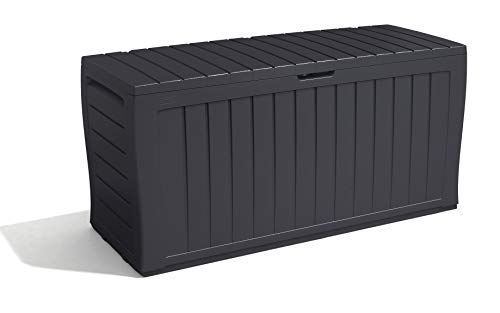
Keter Marvel Plus Deck Box
The balanced mainstream choice: sturdy-feeling moulded resin panels with a wood-effect finish, room for a full sofa-and-chairs cushion set, and an everyday-friendly lid. It is the design we would hand to most households in this guide’s situation and say start here.
Check price on Amazon for the current listing, and confirm interior dimensions against your own measured cushion stack before ordering. In a family home, pair any of these with a fastened lock and the safety rules set out in this guide.

Suncast Large Resin Deck Box
The volume choice for deep-seating cushion sets and households adding pool gear, games and furniture covers to the same box. Plain styling, a wide opening and a tall interior that accepts bulky loads narrower designs reject; happiest in a side-of-house or less prominent spot.
Check price on Amazon for the current listing, and confirm interior dimensions against your own measured cushion stack before ordering. In a family home, pair any of these with a fastened lock and the safety rules set out in this guide.

Lifetime Heavy-Duty Deck Box
The toughness choice for exposed, windy or hard-used sites: thick panels, a structural-feeling lid and hardware chosen for years outdoors. Assembly takes more patience than the snap-together designs, and the return is a box that shrugs off knocks and weather alike.
Check price on Amazon for the current listing, and confirm interior dimensions against your own measured cushion stack before ordering. In a family home, pair any of these with a fastened lock and the safety rules set out in this guide.
The Break-Even Question: When a Deck box Earns Its Space, and When It Honestly Does Not
Worth it is a personal verdict dressed as a product question. The same deck box can be money well spent for one household and an expensive ornament for another, and the difference is almost never quality — it is frequency of use, fit with the space, and what it replaces. This section gives you a break-even way of thinking about the deck box: a simple accounting of cost per use, space per benefit, and effort per result, plus the honest signs that your household should skip it, borrow it, or buy the simpler version instead. Run your own numbers through it before you decide.
The Arithmetic That Actually Matters
Start with cost per use. Take the full cost of owning the deck box — purchase, any consumables, any accessories you genuinely need, and the space it occupies valued honestly — and divide it by a realistic count of uses in its first two years. Realistic is the key word: count the uses your calendar supports, not the uses your intentions promise in January. Then compare that figure with the alternatives you would actually use — hiring, borrowing, a service, or the simpler item you already own. A deck box that wins that comparison on your real schedule is worth it almost regardless of its badge; one that only wins on an imagined schedule is not.
Before you buy the deck box, answer these five questions out loud or on paper:
- How many times did I genuinely need this in the last three months — not wished for it, needed it?
- What exactly does it replace, retire or stop me paying for, starting in its first month?
- Where does it live when idle, measured and checked, and what currently in that spot gets moved?
- Who else in the household will use it without being asked, and who will maintain it?
- If it stopped working in a year, would I replace it immediately, manage without, or feel quietly relieved?
Photograph your room at the time of day you will use the deck box most, and compare candidates against that light rather than against bright midday photographs. Small households should weight compactness and easy storage more heavily, while large households should weight durability and simple operation, because the failure modes differ.
The last question is the sharpest: immediate replacement means the deck box has become infrastructure in your home, and purchases like that are almost always worth it. Quiet relief means the opposite, however good the reviews were. Decide with your own arithmetic and your own answers, and whichever way the verdict falls you will have bought — or saved — with your eyes open, which is the only definition of value that survives contact with real life.
Frequently Asked Questions
Is a deck box worth it for a small patio?
It can be, if the size is honest. A compact box that holds your two chair cushions, a hose and hand tools earns its footprint daily on a small patio, while a full-size box can crowd out the living space it was meant to serve. Measure the footprint as carefully as the capacity, consider a storage bench if seating is also short, and remember the test: worth it means used weekly, and small patios punish anything that is not.
How long until a deck box pays for itself?
Think in seasons rather than months. The return is measured in cushion life: a set protected from rain and sun lasts noticeably longer than a set left out, and cushion sets are the expensive part of outdoor seating. Add the daily convenience and a clearer deck, and most weekly users feel the value within the first season. Households that use the patio a few times a year should be honest that the same money may serve them better elsewhere.
Is a deck box worth it if I already have a garage?
For many households, yes, because distance is the enemy. Cushions stored in a garage fifty steps away tend to stay on the chairs when everyone is tired, which is exactly when weather arrives. A box beside the seating gets used nightly. The common pattern is both: the box for the daily, in-season items, the garage for winter storage and the bulky extras. If your garage is genuinely adjacent to the deck, the case weakens, and your habits should decide.
Are expensive deck boxes worth it over value ones?
The premium buys thicker panels, better hardware, struts that last and styling that sits happily in view. For a box opened daily in a prominent spot, those differences are felt constantly and the upgrade usually justifies itself. For a first box, a rental or a hidden side-of-house spot, a value design placed level and treated gently delivers most of the benefit. What never justifies itself is the wrong size at any price, so measurements outrank badges in this decision.
Is a deck box worth it for pool owners?
Usually yes, with the safety architecture done properly. Towels, floats and toys corralled beside the pool transform the daily tidy, and a ventilated box lets damp gear air instead of souring. But pool chemicals must live in a separate locked container away from children, never in the family box, and the box must be sited where it cannot be climbed toward the pool barrier. With those rules in place, pool households are among the happiest deck box owners.
What if I buy one and it is not worth it for us?
The risk is low because the product is movable and the secondary uses are many: garden tools, sports gear, delivery shelter by a door, winter storage for hard goods. A resin box also holds resale appeal locally since it is light to collect. The realistic failure mode is not the box but the fit, wrong size or wrong spot, which is why this guide pushes measurement and placement before purchase. Buy the right size for a real spot and the not-worth-it outcome is rare.
Related Guides and Next Steps
Keep planning your outdoor storage and patio setup with these companion guides from our team: