Disclosure: As an Amazon Associate, dailyhomedecorating.com earns from qualifying purchases. Links on this page are affiliate links; they cost you nothing extra. Prices and availability change often, so check the current Amazon listing before you buy.
If your cushions live on the chairs through every rainstorm, this deck box buying guide is written for you. A deck box is a simple product with a disproportionate effect: it decides whether your outdoor seating is ready in two minutes or twenty, whether cushions last two seasons or six, and whether the deck looks like a place to sit or a place where things are kept. This guide covers the types, the sizes, the materials and the hardware that matter, walks through proven designs worth your attention, and finishes with placement, safety and care, so the box you buy is the box you would buy again.
Key Takeaways
- Measure your cushion stack and buy against interior dimensions, sizing up when it is close.
- Resin suits most patios; wood is the furniture look with upkeep; metal is the security choice.
- Lid hardware decides daily happiness: gas struts and sound hinges beat headline capacity.
- Children must never climb inside a deck box or play in one; keep lids, locks and chemicals managed.
- Place the box on a flat, level, stable surface beside the seating it serves.
In this guide
Deck Box Buying Guide: What a Deck Box Does and the Main Types
At its core a deck box is a weather-shedding chest that lives where its contents are used. That single fact explains its advantage over the garage: storage that is ten steps away gets used, and storage that is fifty steps away gets bypassed on tired evenings, which is when rain arrives. Everything else about the category follows from the outdoor setting: materials that ignore weather, lids that shed water, hardware that survives seasons, and sizes matched to the bulky, awkward shapes of outdoor life.
Resin Deck Boxes
Resin designs dominate the market because they balance weather resistance, weight, appearance and upkeep better than any rival. Moulded panels imitate wood grain convincingly at conversational distance, the boxes are light enough to reposition when empty, and care amounts to soap and water. They range from compact cubes for a pair of cushions to long, sofa-scale chests, and the better ones use double-wall panels and strut-assisted lids. For most households this is the default category, and the picks later in this guide reflect that.
Wooden Deck Boxes
Wooden boxes in cedar, teak or acacia are chosen with the eyes. They read as furniture, age gracefully when maintained, and their weight keeps them planted in wind. They ask for periodic cleaning and oiling, cost more care over their life, and dislike being left in standing damp. Buy wood when the box will be a visible part of a traditional deck or garden room and you enjoy maintaining timber, not when you want to forget the box exists.
Metal Deck Boxes
Steel and aluminium boxes are the specialists for security and abuse. They resist pests, frost and forced entry better than resin or wood, and suit front-of-house placements, allotments and exposed sites. They can dent, they run hot in sun, and their looks are industrial. Where theft or very rough weather is the main worry, metal moves from niche to sensible first choice.
Compact and Dual-Purpose Designs
Small boxes serve balconies, porches and single-chair households, holding a cushion pair, a hose and hand tools. Dual-purpose designs add a seating-approved lid, turning storage into an extra place to sit. Both are legitimate, but be honest about volume: compact boxes fill faster than buyers expect, and seating lids obey strict rules, seated adults only, never standing, never children climbing.
Top Picks at a Glance
The six designs below are proven starting points from established outdoor-storage makers, presented in prose with a slot for each pick so you can compare current listings side by side. Treat the badges as use-case guidance rather than rankings, and always confirm interior dimensions against your own measured cushion stack before ordering.
Work through the picks in the order that matches your patio: overall versatility first, then looks, volume, toughness and value.

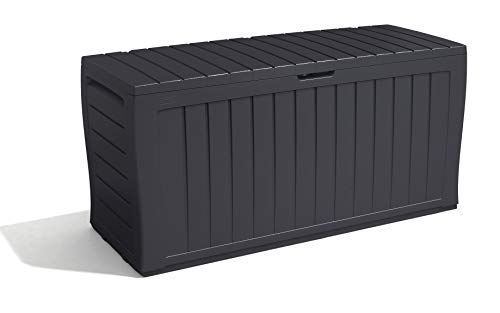
Keter Marvel Plus Deck Box — Best Overall
The Marvel Plus is the kind of mid-to-large resin box that suits the majority of patios, which is why it anchors this guide. Its moulded panels carry a wood-effect finish that sits comfortably beside both timber decking and modern composite boards, and the construction feels noticeably sturdier than the thinnest single-wall boxes when you press on the sides or lean on the closed lid. In everyday use it swallows a full set of sofa and chair cushions with room left for a folded throw, and the lid opens wide enough that you are not threading cushions through a narrow slot.
Best for: households whose needs match the badge above and who want a proven design from an established outdoor-storage maker. Not suited for: anyone expecting verified specifications beyond what the maker publishes, or planning to store hazardous chemicals without a lock and a separate, child-safe arrangement. Check price on Amazon for the current listing, and confirm the interior dimensions against your own cushion stack before ordering.

Keter Westwood Deck Box — Best for a Finished Look
The Westwood is the choice when the box will sit in full view and needs to earn its place visually. Its panel styling is more furniture-like than most resin designs, with a richer wood-look texture and a profile that reads as a garden bench or sideboard rather than a storage tub. Owners typically use it on visible patios and beside outdoor sofas, where a purely utilitarian box would look like clutter. The interior is generous for cushion sets from a standard seating group, and the lid has the solid, damped feel that makes daily opening and closing pleasant rather than a chore.
Best for: households whose needs match the badge above and who want a proven design from an established outdoor-storage maker. Not suited for: anyone expecting verified specifications beyond what the maker publishes, or planning to store hazardous chemicals without a lock and a separate, child-safe arrangement. Check price on Amazon for the current listing, and confirm the interior dimensions against your own cushion stack before ordering.

Suncast Large Resin Deck Box — Best for Big Cushion Sets
Suncast’s large resin boxes are the workhorses of this category: plain in styling, serious about volume. If your problem is a deep-seating set with thick back cushions, or a household that adds pool gear, outdoor games and furniture covers to the same box, this is the direction to look. The wide opening and tall interior accept bulky items that narrower boxes reject, and the resin construction keeps the whole thing light enough to move when empty despite its size. It is less of a looker than the furniture-styled designs, so it suits side-of-house and less prominent placements best.
Best for: households whose needs match the badge above and who want a proven design from an established outdoor-storage maker. Not suited for: anyone expecting verified specifications beyond what the maker publishes, or planning to store hazardous chemicals without a lock and a separate, child-safe arrangement. Check price on Amazon for the current listing, and confirm the interior dimensions against your own cushion stack before ordering.

Lifetime Heavy-Duty Deck Box — Best for Rough Exposure
Lifetime builds its outdoor storage with a heavier hand than most, and its deck boxes follow the same pattern: thick panels, a lid that feels genuinely structural, and hardware chosen for years of outdoor life rather than a single season. This is the pick for exposed decks, windy sites and households that are hard on equipment. The styling is functional rather than decorative, and assembly is a more involved job than the snap-together designs, but the result is a box that shrugs off knocks, weather and enthusiastic loading. For a buy-once placement in a tough spot, it is the safest bet in this list.
Best for: households whose needs match the badge above and who want a proven design from an established outdoor-storage maker. Not suited for: anyone expecting verified specifications beyond what the maker publishes, or planning to store hazardous chemicals without a lock and a separate, child-safe arrangement. Check price on Amazon for the current listing, and confirm the interior dimensions against your own cushion stack before ordering.
YITAHOME Resin Deck Box — Best Value Tier
YITAHOME has become a familiar name in resin outdoor storage by offering straightforward boxes at the value end of the range, and for many households that is exactly the right trade. You get the essentials: weather-shedding panels, a lockable lid on many designs, and sizes that cover cushion storage for typical chair and sofa sets. The panels and hardware are lighter than the premium names, so this is a box to place thoughtfully, load sensibly and not treat as seating furniture unless the maker explicitly designs it for that. As a first deck box, or for a rental property, it makes a great deal of sense.
Best for: households whose needs match the badge above and who want a proven design from an established outdoor-storage maker. Not suited for: anyone expecting verified specifications beyond what the maker publishes, or planning to store hazardous chemicals without a lock and a separate, child-safe arrangement. Check price on Amazon for the current listing, and confirm the interior dimensions against your own cushion stack before ordering.
EAST OAK Resin Deck Box — Best Compact-to-Mid Option
EAST OAK’s resin boxes suit smaller patios, balconies with outdoor access and households whose storage list is modest: a couple of cushions, a hose, some tools and the barbecue accessories. The designs are tidy, the assembly is among the simpler jobs in the category, and the footprint respects tight spaces where a full-size box would crowd the furniture it serves. Like other value-tier resin, it rewards gentle treatment of the lid and hinges. If your cushion stack is small and your deck is smaller, this tier is where your money works hardest.
Best for: households whose needs match the badge above and who want a proven design from an established outdoor-storage maker. Not suited for: anyone expecting verified specifications beyond what the maker publishes, or planning to store hazardous chemicals without a lock and a separate, child-safe arrangement. Check price on Amazon for the current listing, and confirm the interior dimensions against your own cushion stack before ordering.
How Much Capacity Do You Actually Need?
Capacity is the specification that decides whether a deck box solves your problem or simply moves it outdoors. Manufacturers describe capacity in gallons, and the useful way to think about those numbers is by what you own rather than by the figure itself. Compact boxes at the small end of the range suit a pair of chair cushions, a folded throw, a watering can and a few hand tools. Mid-size boxes handle a full set of seat and back cushions for a sofa and two chairs, or a family collection of pool towels, floats and games. The largest boxes swallow deep-seating cushion sets, multiple outdoor blankets, a folded hose, sports equipment and seasonal items with room to spare.
Measure before you shop. Stack the cushions you plan to store in the arrangement you would use inside the box, then measure the stack’s length, width and height. Cushions compress a little but not much, and a box that is two inches too short in any dimension is a box that will not close. Pay particular attention to interior dimensions rather than exterior ones, because thick double-wall resin panels can take several inches off the inside. If your longest cushion is close to the box’s interior length, go up a size; a slightly larger box that closes easily beats a perfect-size box you have to force shut every evening.
Also think in seasons. In summer the box holds cushions and pool gear. In winter it may need to hold those same cushions plus furniture covers, a folded outdoor rug and planters you are protecting from frost. Buying for your biggest season, not your average week, prevents the familiar overflow pile that ends up back in the garage. And remember that a box filled to the brim is a box you cannot organise: leaving a little headroom lets you lift items out without unpacking the whole contents onto the deck.
Resin, Wood and Metal: Choosing a Material
Most deck boxes sold today are resin, and for good reason. Modern resin panels are moulded with wood-look textures, resist rain and sun without painting or sealing, and shrug off the splashes and damp cushions that would stain or rot timber. Resin will not rust, peel or attract insects, and a quick wash restores it each spring. Its weaknesses are that very thin single-wall panels can flex or crack under point loads, that dark colours can fade over years of hard sun, and that a resin box rarely looks as rich as real wood up close. Double-wall construction, where the maker offers it, is the version to prefer for lids you may sit on and for boxes that will live in full weather.
Wooden deck boxes, usually cedar, teak or acacia, bring genuine furniture character and pair naturally with wooden decks and traditional gardens. They are heavier, which helps them stay put in wind, and a well-made wooden lid feels solid in a way resin rarely matches. The trade-off is maintenance: wood needs periodic cleaning and oiling or sealing to resist grey weathering and moisture, joints can loosen over seasons, and a neglected wooden box in a wet climate will eventually split or soften. Choose wood when appearance leads and you are willing to care for it like the furniture it is.
Metal boxes, typically galvanised steel or aluminium, are the security and durability specialists. They resist chewing pests, will not crack in frost and are the hardest for an opportunistic thief to open quietly. They can, however, dent, run hot in direct sun, and feel industrial beside soft furnishings. For most patios, resin is the balanced default, wood is the aesthetic choice and metal is the high-security or high-exposure choice. Whichever you pick, check that the lid overlaps the body like a roof shingle, shedding water outward, because that single design detail matters more to dry contents than the material itself.
Weather Resistance: Keeping Contents Dry
A deck box lives outside in all weathers, so its real job is not storage but shelter. Water gets in through three routes: straight down through the lid seam, sideways in wind-driven rain, and up from below when a deck floods or a box sits in a puddle. Good designs answer all three. The lid should overlap the sides generously and close onto a smooth, even rim. The base should raise contents slightly off the floor of the box, and the box itself should sit on a surface that drains rather than pools.
Be honest about the difference between weather-resistant and waterproof. Most deck boxes are weather-resistant: they keep contents dry in ordinary rain when the lid is properly closed, but driving storms, a lid left ajar, or snow melting against a seam can still let moisture in. If you store fabric cushions, add a second layer of protection by slipping them into large storage bags or choosing cushions with removable, washable covers, and lift the box onto small feet or a level paver base in spots where water collects. Ventilation matters too: a box sealed perfectly tight in hot sun can grow musty, which is why many designs include subtle vents. A faint musty smell on opening is your signal to air the contents on the next dry day.
Sun is the slower enemy. Ultraviolet light fades colours and gradually embrittles plastics, so a box placed in partial shade will usually outlast the same box in relentless full sun. If your only spot is sunny, lighter colours show fading less and run cooler inside, which your cushions and any stored plastics will appreciate. In snowy climates, brush heavy snow off the lid rather than letting it sit for weeks, and never pry at a frozen-shut lid with a tool, which is how rims crack. Let a weak winter sun or a bucket of lukewarm water free it instead.
Lids, Hinges and Gas Struts
You will open this lid thousands of times, so its hardware quietly decides whether you love or resent the box. The simplest lids hinge at the back and rely on their own weight to stay closed. Better designs add gas struts, the same kind of supports that hold up a car hatch, which lift the lid with light finger pressure, hold it open while you load both arms full of cushions, and lower it slowly instead of letting it slam. If you will open the box daily, or if anyone in the household has limited hand or shoulder strength, struts are worth prioritising.
Hinges vary from simple moulded pivots to metal hardware. Moulded hinges keep costs down and cannot rust, but a metal hinge with a replaceable pin generally survives more seasons of heavy lids. Whatever the design, the safety rules from earlier in this guide apply every time: keep fingers away from the hinge line and rim, never let children operate a heavy lid unsupervised, and treat a failing strut as a repair, not a nuisance. A lid that will not stay open on its own can fall without warning.
Check also how the lid behaves in wind. A wide, light lid on an exposed deck can catch a gust while open, straining hinges, so position the box so its back is toward the prevailing wind where you can. Many lids include a hasp or moulded loop for a padlock. Even a modest padlock changes the box from an invitation into a deterrent, and it is close to essential if you store pool chemicals, fertiliser or tools in a household with children, because the lock is what turns your storage rule into a physical barrier.
Safety First: Children, Lids and What Goes Inside
This section matters more than any capacity figure, so read it before the box is even assembled. A deck box is a storage product for adults. It is not a toy, not a playhouse, not a hiding place and not a piece of climbing furniture, and children should never be allowed to get inside one. A child who climbs into a deck box can become trapped if the lid falls or is closed, and a closed or latched lid creates a serious suffocation risk because the interior is not ventilated for a person. Make the rule absolute and repeat it often: children never climb inside a deck box, never hide in one during games, and never use one as a toy chest, a fort or a step.
Lids deserve the same respect. A large resin or wooden lid is heavier than it looks, and a lid that drops can pinch or strike small fingers and hands. Designs with gas struts or slow-close hinges reduce that risk by holding the lid open and lowering it gently, but no hinge makes a lid harmless. Teach children to keep hands clear of the hinge line and the rim, open and close the lid yourself when children are nearby, and check the struts or hinges every season. A strut that no longer holds the lid fully open should be treated as a fault, not a quirk, because a lid that drifts down on its own is exactly the lid that catches a hand.
Placement is a safety decision too. Set the box on a flat, stable, level surface where all four corners sit firmly, never on a slope, on loose gravel that shifts, or half on and half off a step. A box that rocks can tip when a child leans on it, and children should never climb or stand on the lid, even on models described as doubling as seating for adults. Seating guidance, where a maker offers it, describes a seated adult, not a standing child, and jumping or standing on any lid risks cracking the panel or tipping the whole box.
Finally, think hard about what you store. Pool chemicals, fertilisers, pesticides, fuels and sharp garden tools are exactly the things many households want out of sight in a deck box, and exactly the things that must be kept away from children. If you store pool chemicals or fertiliser in a deck box, use a lockable model, keep the lock fastened, store chemicals in their original sealed containers, never mix chemical storage with toys or cushions in the same compartment, and wash your hands after handling containers. The safest pattern in a home with young children is simple: one box for soft, harmless items like cushions and outdoor toys that children may fetch under supervision, and a separate locked box, ideally in a less accessible spot, for chemicals and tools. No storage convenience is worth blurring that line.
Placement: Where a Deck Box Should Live
The best spot for a deck box balances four things: closeness to what it stores, shelter from the worst weather, a flat and stable footing, and a position that does not invite climbing or block movement. Against a house wall under an eave is the classic choice, because the wall cuts wind-driven rain, the eave sheds the heaviest downpours, and cushions travel only a few steps between furniture and box. On an open deck, place the box with its back to the prevailing wind so the lid seam faces away from driving rain.
The footing rule is absolute: the box must sit on a flat, level, stable surface with all four corners supported. On decking, check the boards beneath are sound and not springy. On a patio, a slab that rocks should be re-bedded or the box moved, because a rocking box twists its panels, misaligns its lid and can tip when leaned on. On grass or gravel, build a simple level base of pavers first; a box sunk unevenly into soil will collect water underneath and its floor will sit in damp all winter. Leave a small gap behind the box for air circulation so the wall and the box both dry after rain.
Think about daily movement too. The lid needs clearance to open fully without striking a railing, a wall light or low branches, and you need standing room in front to load cushions without stepping backward off a step. Keep the box out of the main walking line between door and garden, away from the top of stairs, and not beneath a gutter overflow. In households with children, avoid placing the box beside fences, railings or other furniture in a way that turns it into a step up to somewhere dangerous, and never position it where a child could climb from the lid onto a railing or into a pool area. A deck box should make the outdoor space calmer, not add a climbing frame to it.
How to Prioritise by Use Case
The cushion household should spend its money on interior volume and a lid that opens wide, because the daily ritual is loading bulky soft items quickly before rain. The pool household should prioritise ventilation, a lockable lid and a placement plan that keeps chemicals separate and children safe, as the poolside section of this guide explains. The gardener should look for a box that stands tools upright without swallowing them, ideally with a smaller companion caddy inside, and a finish that shrugs off muddy boots and wet gloves.
The small-space household should measure the footprint as carefully as the capacity, choose the tallest compact design the space allows, and accept a two-box future if the collection grows. The entertainer, finally, should think about the lid: a seating-approved lid on a sturdy box adds a genuinely useful perch at gatherings, provided the household rules about standing and climbing are enforced without exception.
Deck Boxes by the Pool
Poolside is where deck boxes work hardest and where their safety duties are heaviest. The useful contents are towels, floats, pool toys, goggles and a cover reel’s accessories, all of which benefit from a ventilated box near the water where they can drip and dry rather than mildew in a garage. Choose a light interior colour if you can, keep the box out of the splash zone’s worst of it, and rinse salt or chlorinated water off the exterior during your seasonal wash so fittings are not attacked over time.
The non-negotiable poolside rule concerns chemicals. Chlorine, shock treatments, algaecides and test chemicals must never sit loose in the same box as the towels and toys children reach for, and must never be reachable by a child who lifts the lid. Store pool chemicals in a separate, locked, ventilated container in their original packaging, away from children and away from the play flow of the pool area, and wash hands after handling them. Likewise, site the deck box itself so it cannot serve as a climbing step toward the pool fence or gate: a box beside a fence is a ladder to a child, and pool barriers only work if nothing climbable stands beside them.
Organising Inside the Box
A deck box fails quietly when it becomes a single dark cavity where everything is buried under everything else. The fix is to organise by frequency and by household member. Items used daily, such as the cushions for your main seating, belong on top or at the front. Weekly items, like outdoor games or the good throws, go beneath or behind. Seasonal items live at the bottom. If your cushions have a set order, store them in reverse: the first cushion you place on the furniture goes into the box last, so unloading runs in the order you actually dress the seats.
Simple dividers transform a big box. A couple of inexpensive open bins inside can separate small items, sunscreen, candles, furniture glides and the remote for outdoor lights, from the soft bulk of cushions. Pool households do well with a mesh bag for wet toys hung inside the lid zone, so damp items drip and air rather than souring the cushions below. Gardeners can stand hand tools upright in a caddy at one end, handles up, so nothing sharp hides under fabric. Anything chemical, including pool treatments and fertiliser, does not belong loose among soft goods at all: it goes in a separate locked box or a locked section, in original containers, away from children, exactly as the safety section of this guide insists.
Label by habit rather than by label-maker. After a month you will know your own system, but guests and family members putting cushions away in a hurry will not, and most deck box mess is created by helpful people in a rush. A simple rule everyone can follow, such as cushions standing upright like books rather than stacked flat, keeps the interior predictable. Every few weeks, lift everything out, shake out the base, and let the box stand open on a dry morning. Five minutes of airing prevents the musty smell that otherwise migrates permanently into cushion foam.
First Setup and Care Essentials
Assemble the box where it will live or on the nearest flat, stable surface, following the full guidance in the assembly section of this guide. Before the first load, run the lid through ten open-and-close cycles, check the seal line all round, and set your organising system while the box is empty rather than improvising around a full one. After the first heavy rain, open the box and check inside: a dry interior confirms your placement and lid are doing their jobs, and a damp corner tells you early, while adjustments are easy, that the box needs levelling or a more sheltered spot.
Assembly: What Putting One Together Really Involves
Resin deck boxes are famous for tool-light assembly, and the reputation is mostly earned. Panels typically arrive flat, with a floor, two ends, front and back walls, a lid, hinge hardware and, on strut models, a pair of gas struts. The panels connect with interlocking tabs and screws at key points, and many designs can be assembled by one person in well under an hour once the parts are laid out. Wooden boxes arrive as pre-drilled panels and take longer, with more fasteners, while metal boxes involve the most hardware and the most patience.
The mistakes that make assembly miserable are nearly all made before the first panel is joined. Assemble on a flat, stable surface, not on the lawn and not on a sloped deck, because panels that start out of square stay out of square, and a twisted body means a lid that never seals evenly. Lay every part out, count the hardware against the parts list, and keep screws in a bowl rather than loose on decking where they vanish between boards. Read the sequence fully before starting: several popular designs must have the floor fitted before the walls reach full height, and reversing a step usually means unclipping panels that were designed to clip once.
Fit the lid and its hardware last, and fit gas struts with the lid supported open by a second person or a sturdy prop, never by your head or one raised arm. If a strut needs compressing to reach its mounting point, follow the maker’s method exactly rather than forcing it, because a strut under pressure that slips can snap the lid down. When assembly is done, test the lid ten times, check that it closes evenly on all four sides, sit the empty box in its final position and confirm it does not rock. Only then load it, lightest and least-used items first, so you learn its organisation before it is full.
Cleaning and Seasonal Care
Deck boxes ask for very little care, which is precisely why the little they need gets forgotten until something smells or sticks. Once a season, empty the box completely, sweep or vacuum out the grit and leaves that collect in the corners, and wash interior and exterior surfaces with warm water and a mild household detergent, using a soft brush on textured resin grain where dirt lodges. Rinse, then leave the lid open until everything is fully dry before reloading, because closing a damp box seals in the exact moisture you just removed.
Check the hardware at the same time. Tighten any screws that have worked loose, confirm hinges move freely, and test that gas struts still lift and hold the lid without drifting down. A strut that sags is a safety item, not a cosmetic one: replace it rather than propping the lid with a stick, which is an accident arranging itself. Lubricate metal hinges lightly if the maker allows it, and inspect the lid rim for cracks or warping that would let rain past the seal. On wooden boxes, this seasonal check is when you wash, let the timber dry fully, and renew oil or sealant where water no longer beads.
Before winter, decide what truly needs to stay outside. Cushions live longer if they spend the coldest months in a dry indoor space, with the box reserved for hard goods, or at minimum raised inside the box on a slatted board so air moves beneath them. Brush snow loads off the lid, keep the area around the base clear so meltwater drains, and resist using the box as a winter workbench for paint tins and tools, which stain and dent lids. Ten unhurried minutes each season is the whole maintenance contract, and it is what separates a box that lasts a decade from one that looks tired in three years.
Common Mistakes to Avoid
The most common deck box mistake is buying by exterior size and discovering the interior is smaller, so measure your cushion stack and compare it with interior dimensions, not the headline figure. The second is placing the box wherever it fits rather than where it works: on a slope, in a puddle line, or so far from the furniture that nobody bothers to use it, after which cushions live on the chairs all winter and fade. A box that is not beside the seating it serves is furniture, not storage.
Third, owners overload the lid. Sitting on a lid designed as seating is fine for adults; standing on it, stacking planters on it, or letting children climb and jump on it is how lids crack and boxes tip. Fourth, chemicals and soft goods get mixed. Pool treatments, fertiliser and fuel stored loose beside cushions stain fabric, create odours that never leave foam, and put hazardous items within a child’s reach the moment the lid is lifted. Keep them separate and locked away from children, full stop.
Fifth, the lid gets treated casually. Letting a heavy lid slam wears hinges, cracks rims and endangers fingers, and a worn gas strut that no longer holds the lid open is often ignored until the lid falls on someone. Sixth, owners forget the contents entirely for a season, opening the box in spring to mildew because damp cushions were sealed in during autumn. Air the box, dry the contents, and check in monthly. Almost every deck box disappointment traces back to one of these six habits, and every one of them is free to fix.
Matching the Box to Your Outdoor Style
A deck box is a large object in a designed space, and treating its looks as an afterthought is how handsome patios acquire an eyesore. The matching principles are simple. Echo the dominant material language: wood-look resin in warm tones sits naturally with timber decking and traditional furniture, while smooth, pale or charcoal designs suit composite boards, rendered walls and modern frames. Match the box’s visual weight to its setting: a long, low box reads as a bench or sideboard and can anchor a seating group, while a tall compact box reads as a cabinet and belongs against a wall.
Colour deserves one practical note beyond taste. Dark boxes look smart and show dust and pollen more, and their interiors run hotter in sun, which cushions and stored plastics feel. Light boxes run cooler and show mud more. Neither is wrong; choose with your climate and your cleaning temperament in mind. Finally, let the box’s placement do aesthetic work: aligned with the furniture it serves, lid line level with a bench or table edge where possible, it reads as part of the set. Dropped at an angle in leftover space, the same box reads as clutter with a lid.
Putting the Shortlist to Work: A First-Month Reality Check for Your Deck box
A buying guide can rank features, but a deck box only proves itself once it is living in your patio & outdoor living routine. The first month is the honest test period: the novelty fades, the daily habits settle in, and the small mismatches between a listing photo and your room become impossible to ignore. Use the weeks after delivery as a structured trial rather than a victory lap. Keep the packaging until you have lived with the deck box through ordinary weekdays and one busy weekend, because the two situations stress very different qualities. What follows is a practical way to judge whether the model you chose is genuinely right, and what to adjust while adjusting is still easy.
Week One: Fit, Clearance and the Walk-Past Test
Start with movement. Walk the routes you actually use — carrying laundry, a tray, a vacuum, or shopping bags — and notice whether the deck box narrows any of them. Open every door, drawer, lid or panel to its full travel and check it against walls, skirting and neighbouring furniture. Sit or stand where you will normally use it and look at it from that height, not from the doorway: proportions that looked balanced in a listing can feel top-heavy or lost once your eye level changes. If something feels awkward now, it will not improve with familiarity; small placement changes made in week one are far easier than returns made in month three.
Weeks Two to Four: Load It the Way You Really Live
Most deck box disappointments come from a gap between the staged use in photographs and the untidy reality of a working home. So load it honestly. Put the heavy, awkward, everyday items in first, not the photogenic ones, and leave it that way for a fortnight. Watch for the early warning signs that matter: flexing, wobbling, sticking, fading, lingering odours, or parts that need constant re-adjusting. Note which features you reach for daily and which you have not touched at all, because that pattern tells you what to prioritise — and what to ignore — if you ever buy a second one for another room.
Before the trial month ends, run through this short decision checklist for your deck box:
- Photograph the deck box in place from the doorway and from your usual seat, and judge the proportions from the pictures rather than from memory.
- Check every fixing, joint and moving part once by hand, and tighten or adjust anything that has settled after the first days of use.
- Move one item you use every day to the most reachable position, and one rarely used item to the least reachable, then see whether the layout still makes sense.
- Clean the deck box once using only the method the maker recommends, and note how long it honestly takes you.
- Write down the single change you would make if you bought again — size, finish, layout or configuration — while the reasoning is still fresh.
Ask how the deck box behaves on your worst floor, wall or surface rather than your best one, since homes are uneven and listings are photographed in perfect rooms.
If the deck box passes the month with only minor grumbles, you have bought well, and the remaining niggles are usually arrangement problems rather than product problems. If it fails on fit or on daily friction, act while the return window is open instead of hoping the irritation will fade. Either way, the trial turns a hopeful purchase into a known quantity, and that knowledge is what makes the next patio & outdoor living decision faster and calmer.
Frequently Asked Questions
What size deck box do I need for sofa cushions?
Measure your cushions stacked exactly as they will sit inside the box, then match that stack against the maker’s interior dimensions, not the exterior ones. A full sofa and chair set usually needs one of the larger designs, while a pair of chairs fits a compact box. When your stack is close to the limit, size up: a lid that closes without force keeps rain out and hinges alive, and the spare room makes daily loading far less of a wrestling match.
Are resin deck boxes really weatherproof?
They are weather-resistant rather than absolutely waterproof. A well-designed resin box with an overlapping lid keeps contents dry in normal rain, but wind-driven storms, a lid left ajar or standing water can still let moisture in. For fabric cushions, add storage bags as a second layer, site the box where water drains away, and air the contents on dry days. Treated that way, resin boxes protect cushions reliably through most climates and seasons.
Can I leave a deck box outside all winter?
Yes, most resin, metal and hardwood boxes are built for year-round outdoor life. Prepare by washing and fully drying the box and contents, checking hinges and struts, and brushing off heavy snow rather than letting it sit for weeks. Cushions themselves live longer if they spend the coldest months indoors, but the box can stay in place holding hard goods. Never pry open a frozen lid with a tool, which is how rims crack; let mild sun free it.
Is it safe for children to use a deck box as a toy chest?
No. A deck box is not a toy chest and children should never climb inside one, hide in one or play in one. A closed or latched lid can trap a child and creates a suffocation risk, and heavy lids can fall on small hands. Keep the rule absolute, use a lockable model in family homes, supervise lid use, and store a child’s outdoor toys in a separate open or lightweight container designed for that purpose instead.
Can I store pool chemicals in a deck box?
Only with strict precautions, and never mixed with items children use. If pool chemicals or fertiliser go in a deck box, the box must be lockable and kept locked, chemicals must stay in their original sealed containers, and cushions, towels and toys must live elsewhere. In most family homes the better answer is a separate small locked container for chemicals, positioned away from children and away from anything climbable near a pool fence.
Do deck boxes need much maintenance?
Very little: an empty-out, wash and dry once a season, a check of hinges, screws and gas struts, and a quick look at the lid rim for cracks or warping. Wooden boxes add periodic oiling or sealing. Ten minutes a season is the whole contract, and it is what keeps a box sealing properly, opening safely and looking respectable for years instead of becoming a musty, stiff-lidded nuisance.
Related Guides and Next Steps
Keep planning your outdoor storage and patio setup with these companion guides from our team: