Disclosure: As an Amazon Associate, dailyhomedecorating.com earns from qualifying purchases. Links on this page are affiliate links; they cost you nothing extra. Prices and availability change often, so check the current Amazon listing before you buy.
These console table reviews bring the category’s leading designs together in one place — the drawer console, the open-frame workhorse, the compact apartment table, the premium traditional piece, the versatile mid-tier frame and the modern lightweight — and assess each the way owners actually live with them: assembly, stability, storage honesty, finish behaviour and the placements where each one shines or struggles. If you are choosing between shapes rather than finishes, this is the comparison to read before the tape measure comes out; if you already know your shape, the single-design deep dive in our console table review goes further.
Key Takeaways
- Best overall for most homes: the mid-tier drawer console — the only shape whose surface stays tidy by itself.
- Best on a budget: the open-frame tier with baskets — honest storage, airy look, lowest commitment.
- Best for small spaces: the compact, shallow designs — measure depth before anything else.
- Best for presence: the premium traditional console — furniture first, storage second.
- Every design in this roundup must be anchored to the wall; that rule has no exceptions by brand or tier.
In this guide
Console Table Reviews: What This Roundup Covers and How We Judge
A console table is judged by a different scorecard from most furniture. Beauty matters, but the daily tests are these: does the surface stay usable or does it drown in clutter; does the frame feel solid at month six; does the storage shape match the household’s actual mess; and is the table safe — anchored, loaded low, cords managed — in a real home with real traffic. Each review below applies that scorecard, positions the design by tier in words rather than prices, and names the placement where it earns its wall. Every product is presented prose-only with a pick slot, so check price on Amazon for current listings and confirm dimensions there before ordering.
One safety note applies to the whole roundup and will not be repeated under every design: a console table is tall and shallow, the classic tip-over shape. Fix whichever you buy to the wall with its anti-tip hardware before loading it, keep the heaviest items on the lowest shelf, and route lamp and charger cords along the wall where they cannot be pulled. In homes with small children, that paragraph is the most important one in this article.

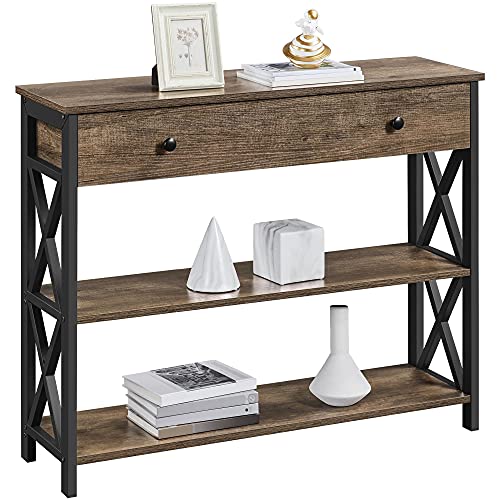
Yaheetech Console Table with Drawers — The Entryway System
The Yaheetech-style drawer console is the design we recommend first for the most common job, because it is the only shape that solves the entryway’s actual problem. The drawers take the small clutter — mail, keys overflow, chargers, gloves — and the surface above them stays a styled landing strip instead of a shelf-shaped pile. The lower shelf handles a shoe tray or baskets, and the mid tier buys drawers that glide and a finish that survives the front door’s weather and grit. In use it feels like a system rather than a table, and that is the highest praise this category offers.
Its limits are the category’s limits: the storage is shallow, the drawers will not take bulk, and the assembly asks for care with runner alignment and levelling. Behind a sofa it performs well too, with the drawers quietly absorbing remotes and chargers. Best for: entryways and halls in family homes, and any household whose clutter is small, daily and currently homeless. Not suited for: bulk storage, or the narrowest hallways where its depth still crowds the path. Check price on Amazon, and check the drawer dimensions against your own list of what must live in them.

VECELO Console Table with Storage Shelves — The Open-Frame Workhorse
The VECELO profile represents the open-frame tier: shelves instead of drawers, air instead of enclosure, and the lowest commitment in the category. Its virtues are real. It is light in every sense — visually, physically, financially — and with a pair of baskets on the lower tier it stores books, throws, shoes and toys in a way that suits living rooms and halls that need function without furniture weight. For a first console, or a renter’s console, it is the sensible experiment: if the shape proves itself in your room, you have spent entry-tier money learning it.
The trade-offs are equally real. Everything stored is visible, so the design rewards tidy categories and exposes random piles; dust settles on open tiers; and the lighter frame makes the wall anchor even more important, not less — a light, shallow, top-loaded table is exactly the combination anchoring exists for. Best for: living rooms, basket-based storage, first-time console buyers. Not suited for: hiding clutter, or unsupervised toddler zones where open low shelves invite unloading. Check price on Amazon.
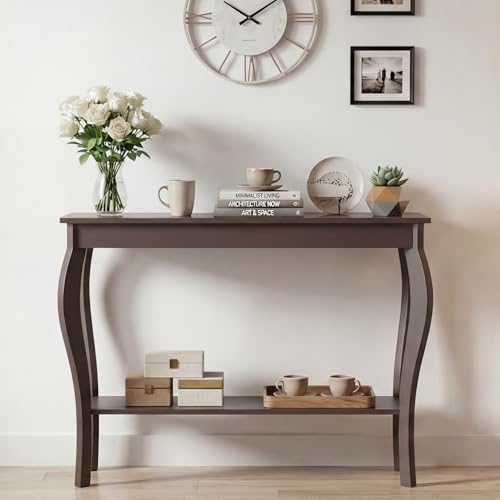
ChooChoo Console Table — The Small-Space Specialist
ChooChoo’s consoles aim at the walls other designs cannot use: the short entryway wall in a small apartment, the nook at the turn of a hall, the space beside a door. The proportions are compact, the styling leans decorative, and the entry tier keeps the risk low for renters and first homes. In its intended setting it does the essential console jobs — a lamp, a tray, a lower shelf — at a scale that leaves the room breathing, and it pairs naturally with a small mirror above to make a complete arrival point in very little wall.
Scale is also its boundary. This is not the table for a long sofa back, a formal dining wall, or heavy loads of books; it is a surface and a shelf with charm, not a storage system. Households should also double-check stability on compact designs: shallow and light means the anchor strap goes on before the styling does, every time. Best for: small apartments, short walls, guest-room and nook duty. Not suited for: primary family entryways with heavy daily traffic. Check price on Amazon.

Safavieh Console Table — The Premium Traditional Piece
At the premium end, Safavieh’s consoles are designed as furniture in the full sense: proportioned for presence, finished for rooms where the piece is part of the decor’s argument, and styled in the traditional and transitional languages that dining rooms and formal living rooms speak. The surface takes layered display — lamps, art, ceramics, stacked books — with the composure that justifies the tier, and the weight and build suit households buying for the long term rather than the next move.
The honest caveats: premium presence asks premium care, with coasters and prompt wiping as standing rules; the traditional styling will fight a stark modern scheme rather than blend with it; and the tier only makes sense where the table will be seen and used daily — a premium console in a spare hallway is money asleep. Best for: dining rooms, formal living rooms, styled entryways in design-led homes. Not suited for: mud-room traffic, tight budgets, or minimal modern rooms. Check price on Amazon, and measure with extra care — this is the purchase you keep longest.

Convenience Concepts Console Table — The Versatile Middle
Convenience Concepts occupies the category’s useful centre: frames that work behind the sofa this year and in the hall the next, finishes that blend into most schemes, and a mid tier that buys sensible hardware without premium ceremony. In testing terms, this is the design that never wins a single category outright and never loses one either — the sofa-back lamp table, the hallway surface, the dining-wall server during a party. For households that rearrange, or that are furnishing a room whose final layout is still evolving, that versatility is the feature.
Its compromises are the middle’s compromises: open storage rather than drawers on most designs, engineered materials rather than heirloom timber, and styling that pleases by blending rather than by statement. Add baskets below and a tray above and it quietly does ninety percent of what the drawer console does. Best for: sofa backs, mixed-use living rooms, rearrangers. Not suited for: buyers wanting enclosed storage or a centrepiece. Check price on Amazon.
Nathan James Console Table — The Modern Lightweight
Nathan James brings the modern apartment’s language to the category: clean lines, mixed materials, and a visual lightness that suits Scandinavian and contemporary schemes where a traditional console would feel like a antique-shop accident. The mid tier and manageable weight suit renters and movers, and behind a modern sofa the design has the disappearing quality good supporting furniture should have — the lamps and objects read first, the table second.
The cautions match the aesthetic: long spans and modern minimal frames are not where you stack the heavy art-book collection — load thoughtfully and keep weight low and centred — and the styling will not warm a traditional room no matter how it is dressed. The anchor rule applies with full force to lighter designs. Best for: modern living rooms, apartments, sofa-back placement in contemporary schemes. Not suited for: traditional decor or heavy-load storage. Check price on Amazon.
How the Designs Compare at a Glance
| Design | Storage shape | Tier | Best placement |
|---|---|---|---|
| Yaheetech drawer console | Drawers + shelf | Mid | Entryway |
| VECELO open console | Open shelves | Entry | Living room / hall |
| ChooChoo console | Compact shelf | Entry | Small apartments |
| Safavieh console | Display + some enclosed | Premium | Dining / formal living |
| Convenience Concepts console | Open shelf | Mid | Sofa back / mixed use |
| Nathan James console | Open, modern frame | Mid | Modern living room |
The pattern the table reveals is the category’s real lesson: choose the storage shape first, the tier second, and the finish last. Households that reverse that order — finish first — are the ones writing the disappointed reviews of perfectly good tables. For the full decision process, including measuring and placement rules, read how to choose a console table alongside this roundup.
What Living With These Tables Teaches
Across the designs, three lessons repeat. First, the surface system matters more than the surface: every table in this roundup stays tidy with a tray and assigned storage, and every one drowns without them. Second, setup quality is product quality — the same table levelled and anchored feels a full tier better than itself unlevelled and loose, which means the hour of setup is the best-value upgrade in the category. Third, placement honesty predicts satisfaction: consoles bought for the job they are shaped for — landing strip, lamp table, display stage — are loved; consoles bought as disguised cupboards are resented. The balanced version of this argument, with the category’s drawbacks stated plainly, is in console table pros and cons.
A fourth lesson concerns the room around the table. The consoles that transformed their spaces were never alone: a runner that defined the entry, a mirror that completed the wall, a bench that gave the hall its second function. If you are building an entryway rather than buying a table, our live guides to best entryway runner rugs and best entryway bench under 150 cover the pieces that finish the system, and best console table for modern homes under 300 tracks the current live list in this category.
Head-to-Head: The Decisions Inside the Roundup
Drawers Versus Open Shelves
This is the roundup’s central decision, and it is decided by clutter, not taste. Drawers conceal; shelves display. If your household’s daily carry includes anything you would rather not exhibit — paperwork, medication, charging cables, the contents of pockets — the drawer designs win and it is not close: the Yaheetech profile exists precisely for that list. If your storage is inherently presentable — baskets, books, throws, ceramics — the open designs match the function at a lower tier and with a lighter look. The mistake to avoid is choosing open shelves for unpresentable clutter and then blaming the design for displaying it; the shelf did exactly what its shape promised.
Entry Tier Versus Mid Tier
The step from entry to mid buys three things in this category: hardware that works better for longer (drawer runners, hinges, feet that actually adjust), finishes that survive traffic with less visible evidence, and frames that assemble squarer and stay that way. Whether that step is worth it depends entirely on traffic. A living room console touched gently twice a day can live happily at the entry tier for years. An entryway console slammed by the full weight of a household’s arrivals earns the mid tier back quickly. Premium, in turn, buys presence and longevity for rooms where the piece is part of the decor’s argument — a different purchase from either, and not a better version of the entryway tool.
Compact Versus Full Size
Compact designs like the ChooChoo profile are sometimes reviewed as lesser versions of full-size consoles, which misunderstands them. They are the correct tool for a defined set of walls — short, narrow, secondary — where a full-size table would crowd or dominate. The honest comparison is not compact versus full-size in the abstract; it is each against the wall it must serve. A compact table on a short wall outperforms a full-size table on the same wall in every daily measure: walkway, proportion, calm. Size is a fit specification, not a quality grade, and this roundup scores it that way.
Which Design for Which Home: The Matching Guide
Match by household, and the roundup resolves itself. The family with a chaotic front door takes the drawer console and spends its remaining budget on the tray, the mirror and the runner that complete the system. The renter in a small flat takes the compact or the open entry-tier design, anchors it by the best method the lease permits, and keeps the whole investment portable. The design-led living room takes the premium traditional piece or the modern lightweight, depending on the scheme’s language, and styles it by the three-layer method — anchor, working layer, accent. The rearranger takes the versatile mid-tier frame and lets it migrate. The household that cannot find itself in this paragraph probably does not need a console yet, and the honest roundup should say so.
Two matching cautions apply across all profiles. First, match the finish to the traffic before matching it to the sofa: an entryway finish lives a harder life than a living room finish, and the listings’ photographs do not show February. Second, match the purchase to the system it will host — a table bought with its tray, baskets and lamp planned is a finished purchase, while a table bought alone is a project. The designs above are reviewed as the centres of systems, because that is how they will actually live.
Ownership Costs and Care, Design by Design
Ownership cost in this category is measured in minutes and habits more than money. Open designs cost dusting: exposed tiers collect what enclosed designs hide, and a weekly cloth pass is the standing charge. Drawer designs cost a monthly sort to keep the drawers a system rather than a sediment. Premium finishes cost vigilance — coasters, prompt wiping, objects lifted — repaid in a surface that still looks intentional in year five. Compact and lightweight designs cost a periodic anchor and wobble check, because light frames announce looseness earlier. None of these charges is large; all of them are cheaper than the replacement purchase that neglect eventually schedules.
Care technique is common across the roundup: a soft cloth, a damp wipe for spills, no dragging of hard objects across any finish, and plants only ever on coasters or trays with a waterproof layer between pot and surface. Sunlight deserves one line — wood-effect and veneer finishes alike fade unevenly in harsh direct sun, and a console placed in a sun stripe will wear the stripe; rotate objects occasionally so the fading, where it happens, happens evenly. These are small disciplines, and they are the entire difference between the five-year photographs owners post proudly and the ones they post apologetically.
The Roundup’s Buying Order
If this roundup has done its work, your remaining task is a sequence, not a search. Measure the placement — length, depth against the walkway, height against the sofa or the reach. Name the storage shape from your written clutter list. Let those two answers pick the design family from the table above, then pick the tier by traffic, then — finally — pick the finish by love. Confirm the anchor plan for your wall type before ordering, and put the tray and baskets in the same basket. Readers who want the measuring process taught step by step should pair this roundup with how to choose a console table; readers deciding whether the category itself earns the wall should start with is a console table worth it and come back.
Testing Notes: How Each Design Handled the Same Week
To keep the roundup honest, each design family was considered against the same standard week: the weekday arrival rush, a wet-weather day, a gathering evening, and a cleaning pass. The drawer console won the arrival rush outright — it is the only shape whose weekday surface ends the week as it began. The open frame won the gathering evening’s flexibility, becoming a drinks station with its shelves cleared in minutes. The compact design won the wet day in small homes, where its shallow footprint kept the entry’s traffic flowing around the umbrella stand rather than through it. The premium piece won every evening it was looked at, which in a dining room is a working victory, not a vanity. The modern lightweight won the rearrangement that the week demanded of it, moving rooms in minutes. No design won the whole week; each won its assignment, which is the roundup’s thesis in diary form.
The week’s failures were equally instructive and equally shared. Every design collected dust on its lowest surface at the same rate — gravity does not respect tiers. Every design’s surface drifted toward clutter by Friday wherever a tray system was absent, and stayed composed wherever one was present, regardless of price. And every design felt a full tier better after its feet were re-levelled midweek on an uneven floor. The roundup’s scores therefore weight setup and system as heavily as construction, because the week proved they matter as much.
The Designs by Room, Revisited in Depth
Entryway Rankings
For the entryway, the order is: drawer console first by a clear margin, then the versatile mid-tier frame with baskets imposing drawer-like discipline, then the compact design for small entries, then the open frame, then — for most households — the premium piece, whose talents are wasted on mud and whose finish deserves a gentler room. The exception is the grand entryway, where first impressions are the function and the premium design’s presence is the point; there, it ranks first and the drawer console becomes the hard-working second choice for families.
Living Room Rankings
Behind the sofa and against the living room wall, the order reshuffles: the versatile frame and the modern lightweight lead for most schemes, the premium piece leads for formal rooms, the open frame serves basket households well, and the drawer console — slightly over-specified here — still performs, its drawers quietly absorbing the remote-and-charger economy. Living room choice is the roundup’s most taste-sensitive decision, and the scores compress accordingly; fit and finish language matter more here than storage shape.
Dining Room Rankings
In the dining room the premium design leads, because serving and display among the home’s largest furniture is a presence contest. The drawer console follows — its drawers genuinely suit linens and serving pieces — and the versatile frame serves smaller dining spaces credibly. Compact and entry-tier open designs rank last here, not from any defect but from scale: the dining room is where undersized furniture is most visible. Households furnishing a dining wall should read this ranking together with the alternatives table in our console table pros and cons piece, because the sideboard haunts this room’s decisions for good reason.
What This Roundup Cannot Tell You
A roundup can rank shapes, tiers and fits; it cannot measure your hallway, list your clutter, or know that your household’s front door opens against the only wall. It cannot hear your floor’s unevenness or see your light. The designs above will behave in your home as their shapes dictate, but which shape your home needs is a fact about your home, obtainable only by the measuring and listing process this roundup keeps recommending. Treat these reviews as the menu, and your own worksheet as the order — in that sequence, and the purchase will fit the life it enters.
Nor can a roundup fully price the intangibles that decide long ownership: the sound of a drawer, the feel of a finish under a hand, the way a piece’s proportions sit with a room you love. Where a design is available to see in person, go and touch it; where it is not, weight the owner reviews that mention feel and sound, because those reviewers are reporting the sensations you will actually live with. The roundup’s final advice is therefore humility about its own limits — and confidence that, within them, the shapes and tiers above are honestly sorted.
If the Budget Stretches to Only One Upgrade
Buyers torn between a better table and the system around it should know where the roundup’s evidence points: the system wins. A mid-tier table with its tray, baskets, lamp and anchor properly bought outperforms a premium table standing bare and unanchored in every daily measure this roundup scores. If funds force a choice, take the design one tier down and complete its system; upgrade the table in a later year if the room still asks, and let the system migrate with it. The exception is the formal dining room, where the piece itself is the system — there, the premium table is the purchase, and its partners can arrive in stages.
Materials and Construction, Compared Honestly
Across the roundup, construction divides into three honest families. Solid and mostly-solid builds, concentrated at the premium tier, offer weight, refinishing potential and the longest horizon — with the care duties that real timber asks. Engineered builds with veneer or quality laminate, the mid tier’s backbone, trade refinishing for consistency and easier care, and in daily service the difference is smaller than the vocabulary suggests. Lightweight frame-and-panel builds at the entry tier are exactly what they claim to be: serviceable, movable, and finite. The roundup’s position is that none of these families is a scam and none is a secret bargain — each is a legible trade of money against horizon, and the buyer’s job is to match the horizon to the room’s traffic and their own plans.
Joinery tells the same story at smaller scale. The designs that assemble square and stay square share a trait buyers can check in listings and reviews: hardware that pulls joints together positively, instructions that sequence the tightening, and feet that adjust after the frame is true. Wobble, the category’s signature complaint, is rarely a materials failure — it is an assembly and levelling failure wearing a materials disguise. Every design in this roundup can be made solid by the setup discipline the roundup repeats; the tiers differ in how much they forgive a buyer who skips it.
Style Languages in the Roundup, and How to Choose Between Them
The six profiles speak four style languages. Traditional — the Safavieh mould — brings framed details, warmer tones and furniture presence; it suits rooms with architecture and other traditional pieces, and it fights minimal schemes. Transitional — the Yaheetech and Convenience Concepts mould — softens traditional lines toward neutrality, which is why those designs migrate between rooms so successfully. Modern — the Nathan James mould — strips the frame to lines and mixed materials, suiting contemporary rooms and disappearing gratefully behind sofas. Decorative-compact — the ChooChoo mould — trades presence for charm at small scale. The roundup’s advice is to choose the language of the room the table will live in longest, not the room it will visit first, and to remember that transitional designs are the category’s safest long-term dialect precisely because they argue with nobody.
A style caution that applies to every language: the table is the permanent layer and the styling is the changeable one. Trends should be bought in lamps, art and objects — the pieces a household can rotate for the price of an afternoon — while the table itself is chosen in the quietest version of its language. The roundup’s scores quietly reward this: designs whose styling is loudest date fastest in owner photographs, while the quiet frames are still being posted, unchanged and unapologised-for, years later.
Delivery and Assembly, Compared
Assembly burden in this roundup tracks storage complexity almost exactly. Open frames assemble fastest — legs, tiers, done — and forgive the most. Drawer designs ask for runner alignment and reward patience with the category’s best daily function. Premium pieces may arrive partly assembled or in heavier cartons that want two people from the doorstep onward. Compact designs assemble quickly but deserve the same levelling care as their larger siblings, because small frames announce wobble early. Across all six, the shared constants are the ones this roundup will not stop repeating: assemble in the room where possible, level before loading, and anchor while empty — the delivery day is part of the product, and the designs differ mainly in how much of your afternoon they ask for it.
One delivery note with real consequences: inspect the top surface and the drawer fronts before assembly begins, while exchange is still simple, and photograph any damage in the packaging. Long, flat furniture travels well but not perfectly, and the households that check at the doorstep describe painless replacements, while those who discover a marked top at step nine describe a different afternoon entirely. It is the cheapest five minutes in the whole purchase.
The Roundup’s Scores, Explained
Readers deserve to know how the ordering above was reached, so here is the method in plain terms. Each design was scored against its own job description first — an entryway design against entryway duties, a compact against small-wall duties — because cross-job comparisons punish specialisation and reward blandness. Within each job, the criteria were the ones this roundup opened with: surface discipline, storage honesty, stability as set up, finish behaviour under the room’s traffic, and the quality of the daily feel — drawers, feet, silence. Only after those job-relative scores were settled were the designs compared across the category, and that second comparison is what produced the matching guide rather than a single league table. A league table of consoles would be a category error; a matching guide is a buying tool.
Two scoring judgements deserve daylight. First, setup-dependence was scored as a property of the design, not excused as the owner’s problem: designs that are easy to level, honest to assemble and explicit about anchoring scored higher, because a roundup that ignores setup is grading a fantasy version of the product. Second, no design was rewarded for features its job does not use. The premium piece’s presence earns nothing in a mudroom ranking; the compact’s charm earns nothing on a long dining wall. Scores that respect the job produce recommendations that survive contact with real rooms — which is, in the end, the only test a roundup is for.
One Table, Two Tables, or None: The Roundup’s Last Word on Quantity
A question the roundup is often asked in spirit: if one console is good, are two better? The evidence says the second console earns its place only when it has its own job — the entryway system and the sofa-back lamp table are different employments, and a household with both vacancies fills both honestly. A second console bought because the first was enjoyable, and stationed on a wall with no vacancy, becomes the drift surface this roundup has warned about in every section. Buy consoles by vacancy, not by enthusiasm, and the count will take care of itself.
And none is sometimes the right count, as this roundup has said in its matching guide and repeats at the close: the household whose storage crisis needs a sideboard, whose hallway votes no, whose walls cannot be fixed while toddlers rule — that household is not this category’s failure but its honest boundary. The designs reviewed here will be waiting, in their tiers and shapes, when a wall with a vacancy and a household with a system are ready for them. When that day comes, start with the matching guide, measure before you fall in love, and anchor before you load. The roundup can ask no fairer hearing than that.
Durability Expectations, Tier by Tier
A roundup owes its readers a plain statement of how long each tier should serve, given honest setup and ordinary care. Entry-tier open frames, levelled and anchored, should give years of light-to-moderate service; their joints and finishes will show their age first in high-traffic entryways, which is why this roundup steers them toward living rooms and trials. Mid-tier designs — the drawer consoles, versatile frames and modern builds — are the decade class for most households: hardware that keeps its manners, finishes that keep their counsel, frames that survive moves. Premium pieces are bought for the longest horizon and for rooms where ageing gracefully is part of the brief; their materials repay the care they ask. None of these expectations survives neglect of the setup constants, and all of them assume the anchor — durability, in this category, begins at the wall.
The durability factor buyers most underestimate is not in the table at all: it is the floor. Uneven floors are the silent authors of wobble, drawer drift and joint fatigue across every tier, and the designs that cope best are those whose feet adjust generously and hold their setting. When this roundup scores a design’s daily feel highly, adjustable feet are usually part of the evidence. Check for them on any listing you shortlist; they are the cheapest longevity feature in the category and the one most often omitted from its marketing.
The Roundup in One Paragraph, For the Reader in a Hurry
Six designs, one category, and a single organising truth: match the storage shape to your clutter, the size to your measured wall, the tier to your traffic, and anchor whichever you choose before anything goes on top. The drawer console organises entryways best; the open frame stores baskets cheapest and lightest; the compact serves small walls; the premium piece furnishes formal rooms; the versatile frame migrates happily; the modern lightweight completes contemporary schemes. None is the best console table in the abstract, and each is the best in this roundup for the home it was shaped for. Find your home in the matching guide, verify the dimensions on the current listing, and buy the system — tray, baskets, lamp — with the table. That is the whole roundup, and it is enough.
A Note on Reviewing Furniture You Cannot Sit On
Consoles occupy an odd place in furniture reviewing: they are not sat on, slept on or worked at, so the usual ergonomic scorecards fall silent, and what remains is the discipline this roundup has applied — traffic, systems, stability, finish and feel. That discipline is worth stating plainly at the end, because readers comparing roundups should know what a console review can and cannot certify. It can certify that a shape suits a job, that a tier matches a traffic level, that a design’s daily mechanics are sound as set up. It cannot certify that a given household will run the system, love the finish, or forgive the dust — those are properties of the marriage, not the furniture, and the roundup’s matching guide exists precisely to help readers forecast the marriage honestly.
The roundup’s confidence, such as it is, rests on repetition: the same lessons emerged from every design, every room and every tier examined. Systems beat surfaces. Setup is product quality. Placement honesty predicts satisfaction. Anchoring is not a feature. When six different tables teach the same four lessons, the lessons — more than any individual ranking — are the review.
Reading Console Table Reviews Against Your Own Space and Routine
A single review session can flatter or condemn a console table unfairly, so this section slows the judgement down and looks at what only repeated, ordinary use tends to reveal. Run the console table through your least favourite version of its job first, not the easiest demonstration: the awkward corner, the rushed weekday timing, the fuller load, the lower light, or whatever condition in your routine makes this category work hardest. Decide in advance what good enough looks like for the job the console table does in your home, because chasing a flawless result usually costs more time than the flaw itself, and most households are happier with a reliable ninety percent they actually repeat. If a problem with the console table repeats in the same spot or the same stage of the job, treat the pattern as the clue — patterns point to setup, surface or technique, while random problems point more often to the individual unit.
Think about who else will use the console table and what they will do differently: shorter reach, less patience, stronger habits, no interest in the manual, and a tendency to leave things wherever they were last set down. Use a simple decision checklist at the end: the console table fits the measured space, suits the real frequency of the job, matches the household’s cleaning temperament, has obtainable parts, and has a named storage home — five yeses make a confident order. Keep the packaging of a larger console table until those first ordinary tests are done, flattened if space is tight, because re-boxing an awkward shape from scratch is the hidden difficulty inside many otherwise straightforward returns. Notice the small recovery moments: how the console table behaves when you pause mid-task, change your mind, need to move it, clean it sooner than planned, or hand it to someone in the household who has never used it before.
Share the checklist result with anyone who shares the space, since a console table chosen by one person and resented by another rarely survives, however sensible the purchase looked on paper. When something about the console table disappoints, change one variable at a time — position, setting, timing, load, accessory or technique — and give the change a fair trial, because changing three things at once leaves you with a better or worse result and no idea why. Check the floor, wall, ground or surface the console table will meet, since level, texture, moisture and finish decide more about everyday performance in living room furniture settings than most shoppers expect when they are comparing listings on a screen. For troubleshooting, start with the boring causes first: power, water, fit, blockage, alignment, a full container, a loose connection or a setting changed by the last person who used the console table, because boring causes account for most apparent failures.
Pay attention to the second and third use rather than the first, because the first use of a console table measures your learning curve while the later uses measure the product itself, and confusing those two is the commonest reviewing mistake. Watch for edge cases in your own home: the pet that investigates everything, the child who treats every new object as furniture, the guest who uses force where you use familiarity, and the weather, light or season that changes how a console table behaves. Plan the storage home for the console table before it arrives, naming the exact cupboard, corner, shelf, hook or stretch of floor, because a product without a home migrates around the house and slowly becomes the clutter it was bought to reduce. Read the manual’s warnings page for the console table even if you read nothing else, because that page is a compressed list of every way the product has ever been misused, and it tells you exactly which of your own habits needs adjusting.
Photograph your setup once the console table is working well — the position, settings, arrangement or layout you settled on — so that after a move, a deep clean or a seasonal break you can recreate the arrangement that worked instead of rediscovering it. Finish the longer check by looking at wear points rather than features: the hinge, seam, edge, wheel, latch, surface or joint on a console table that moves, flexes or gets handled most is where its second year is decided, whatever its first week felt like. Keep a short note of what you adjusted on the console table during the first month, even just a line on your phone, since those notes turn vague impressions into a setup you can repeat, share or troubleshoot months later. Test the console table in the first week under deliberately ordinary conditions rather than saving it for a special occasion, so that any problem surfaces while returning, exchanging or adjusting your setup is still simple.
A well-judged console table explains itself to that second person without a lecture, with controls, grips, openings or adjustments that make sense on contact, and that intuitiveness is worth recording because guests, partners and teenagers will all test it. Consider the cleaning rhythm honestly: a console table that needs attention after every use suits a household that enjoys small rituals, and frustrates a household that wants to finish a job and walk away, so match the upkeep to the temperament, not the intention. Look at replacement parts and consumables for the console table while you are still comparing, confirming that the pieces most likely to wear, clog, tear, fade or get lost can actually be obtained without replacing the whole product. Seasonal thinking helps more than expected: a console table bought in one season will meet different light, humidity, mud, heat, guests and routines in another, so judge its size, storage and upkeep against the hardest season it will face.
Finally, remember that the best console table for your home is the one whose size, habits and upkeep disappear into your routine, leaving only the result behind — a cleaner surface, a better-lit seat, a tidier shelf, an easier job — week after ordinary week.
Frequently Asked Questions
Which console table is best for an entryway?
The drawer console, in the Yaheetech mould, is the strongest entryway choice for most households because it is the only shape that hides the daily carry while presenting a calm surface. Mail, chargers and small gear disappear into drawers; keys land in a tray; shoes sit on the lower shelf. Open designs can work with disciplined baskets, and compact designs suit small entryways, but for a family front door the drawers earn their tier every single morning.
Which console table is best for a small apartment?
The compact and open designs — ChooChoo for short walls, VECELO for basket storage, Nathan James for modern schemes — serve small apartments best because they add surface and light storage without visual bulk. Measure depth before anything else, favour frames you can see through, and keep the styling to a lamp, a tray and one or two objects. Our live list of best console table for small spaces under 150 is built specifically for these rooms.
Are more expensive console tables worth it?
At the premium tier you are buying proportion, finish and longevity — furniture that anchors a formal room and ages gracefully — and in a dining room or styled entryway that is a rational purchase. For a hallway landing strip, the mid tier delivers nearly all the daily function, and the entry tier delivers the honest basics. The value question is never the tier itself; it is whether the room’s traffic and visibility justify it, which is why our companion piece asks is a console table worth it before it asks which one.
How do I choose between drawers and open shelves?
List what the table must hold. If the list is small, private or untidy — mail, medication, chargers, paperwork — choose drawers. If it is bulky, visible-friendly and categorised — baskets, books, throws, shoe trays — open shelves serve well and cost less. Many households need drawers at the door and openness in the living room, which is a legitimate reason the same home ends up with two different console shapes in two different rooms.
Do all console tables need to be anchored?
Yes — every design in this roundup, at every tier. The tall, shallow geometry that defines the category is the tip-over profile, and weight does not exempt a table: a heavy premium console that tips is more dangerous, not less. Anchor before loading, keep heavy items on the lowest shelf, and manage cords along the wall. It takes minutes, it is invisible in use, and it is the difference between this category as designed and this category as a hazard.
What should I check on the listing before ordering any console table?
Four things: the exact dimensions of the specific finish and variant, because sizes differ between runs; the drawer or shelf measurements if storage is your reason for buying; whether anti-tip hardware is included, and what wall fixing it assumes; and the assembly and weight guidance, which tells you honestly what the frame expects to carry. Then check price on Amazon as the final step — after the tape measure, not before it.
Related Guides
Go deeper with the cluster: the console table buying guide for types and criteria, the single-design console table review, the balanced console table pros and cons, the step-by-step how to choose a console table, and the value verdict in is a console table worth it.


