Disclosure: As an Amazon Associate, dailyhomedecorating.com earns from qualifying purchases. Links on this page are affiliate links; they cost you nothing extra. Prices and availability change often, so check the current Amazon listing before you buy.
Learning how to choose a console table is mostly learning how to measure honestly and decide in the right order. The order matters because the category punishes reversed priorities: buyers who fall for a finish first and measure later end up with a beautiful table that blocks the hallway, towers over the sofa, or stores nothing they own. This guide reverses the process into steps — job, space, dimensions, storage shape, material, safety, then style — with the reasoning for each, the mistakes that ambush each step, and worked examples of three households choosing well.
Key Takeaways
- Decide the job before the style: entryway landing strip, sofa-back lamp table, hallway surface or dining display lead to different tables.
- Measure three dimensions against three fixed points: length against the wall or sofa, depth against the walkway, height against the sofa back.
- Choose the storage shape from a written list of what the table must hold — drawers for small and private, shelves for baskets and display.
- Anchoring is a step in choosing, not an afterthought: confirm your wall type and fixing before you fall for a design.
- Check the current Amazon listing for exact dimensions of the variant you want; sizes differ between finishes.
In this guide
What You Need to Know Before Comparing
A console table is a long, narrow, shallow table that stands against a wall or behind a sofa. Everything about choosing one flows from those three adjectives. Long means it relates to a wall or a sofa, so proportion is a measurement, not a vibe. Narrow and shallow mean it fits where other furniture cannot — and that it tips more easily than other furniture, so stability is engineered by you, at setup, with a wall anchor. Shallow also means its storage is a surface and a gesture unless drawers are involved. Buyers who internalise those three facts before opening a single listing choose well almost automatically.
It also helps to know the category’s four working types. The entryway console is a landing system, ideally with drawers. The sofa table is a lamp-and-books surface whose height answers to the sofa. The hallway console is the shallowest of all, living inside a walkway’s margins. The storage console encloses its contents behind drawers or doors for dining and living rooms. Most products blend these types, but naming your primary type first is what turns a catalogue of hundreds into a shortlist of five. The full type tour, with reference designs, is in our console table buying guide.
How to Choose a Console Table in 7 Steps
Step 1: Name the Job in One Sentence
Write it down: this table will catch the household’s keys and mail; this table will hold two lamps behind the sofa; this table will give the dining wall a serving surface. The sentence sounds obvious and eliminates most of the catalogue instantly. A landing strip needs drawers and a forgiving finish. A lamp table needs height discipline and cord sense. A serving surface needs presence and a finish that tolerates heat rings being prevented by trivets. Households that skip this step buy the table that photographed best and then spend a year being mildly annoyed by it.
Step 2: Measure the Space, Not the Hope
Measure the wall length available, the walkway depth at its narrowest point including skirting boards and door trim, and the height of the sofa back if the table goes behind seating. Measure door swing for entryways — a drawer console whose drawer meets the door is a cupboard with a grudge. Then do the physical test: walk the path carrying something bulky, a laundry basket or a suitcase, and notice where your body expects the space to be. The numbers and the walk together are the space. Write them down; every later step answers to them.
Step 3: Set the Dimensions From the Measurements
Length: behind a sofa, span most of the sofa’s length; against a wall, fill roughly two-thirds of the section for a composed look. Depth: the shallowest that still holds your lamp base and tray while leaving the walkway genuinely clear — if the walk test felt tight, go shallower or reconsider the placement entirely. Height: at or just below the sofa back for sofa placement; comfortable standing reach for entryways; near dining-table height if serving is the job. These are relationships, not magic numbers, and they are why two homes can correctly choose completely different tables from the same page of listings.
Step 4: Choose the Storage Shape From a Written List
List what the table must hold on the household’s worst day — the full daily carry, not the tidy version. Small, private or untidy items (mail, chargers, medication, paperwork) mean drawers. Categorised, visible-friendly items (baskets, books, throws, shoe trays) mean open shelves work and cost less. Dining-room concealment means doors. Then verify against the listing’s drawer and shelf measurements, because a drawer that cannot take your household’s actual envelopes and gear is decoration. This step, done honestly, is the difference between the owners who praise their console and the owners who call it a pretty shelf.
Step 5: Match Material and Finish to the Traffic
Entryways meet weather: choose sealed, matte, forgiving finishes that hide grit and shrug off damp gloves. Living rooms allow richer finishes and, at the premium tier, the solid materials that age into patina. Glass lightens small spaces and demands coaster discipline forever. Metal-and-wood modern frames suit contemporary rooms and lighter loads. Whatever the material, plan the surface’s protection from day one: a tray as the hard-object zone, coasters under plants and cups, objects lifted rather than dragged. The finish you choose is really the maintenance routine you are volunteering for.
Step 6: Plan the Safety Setup Before You Order
This step is not optional and it is not last-minute. Confirm your wall type — stud, masonry, plasterboard — and that you can fix an anti-tip strap or bracket into it, or order the correct furniture anchor kit with the table. A console table is tall and shallow: it must be fixed to the wall before it is loaded, in every home, and in homes with small children this is the most important specification of the purchase. Plan also to load the heaviest items on the lowest shelf, and to route lamp and charger cords along the wall so nothing dangles within a child’s or pet’s pulling reach. If your walls and lease genuinely forbid any fixing and small children live in the home, the correct choice is lower, deeper furniture for now.
Step 7: Choose Style Last, Within the Shortlist That Fits
Only now — job named, space measured, storage shaped, safety planned — does style get its vote, and by now the shortlist is small enough that style can be chosen by love rather than by hope. Within the fitting designs, prefer the quieter, simpler lines if the table must serve for years across room changes, and let lamps, art and objects carry the fashionable layer, because those are cheap to change. Check the current Amazon listing for the exact dimensions and hardware of the specific finish you are ordering, check price on Amazon as the final act, and order the anchor kit in the same basket if the table does not include one.
Gear for This Guide
Four reference designs cover the shortlists this process produces. They are presented prose-only, by tier, as shapes to compare against your measurements rather than as universal answers.

Yaheetech Console Table with Drawers — The Entryway Shortlist
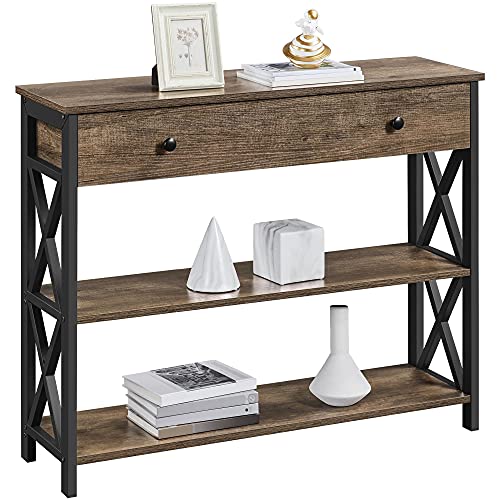
The mid-tier drawer console is where Step 4 lands for most entryways: drawers for the daily carry, a shelf for shoes and baskets, a finish that tolerates the front door. Best for: family entryways and halls with a landing-strip job. Not suited for: the narrowest walkways. Check price on Amazon after your measurements agree.

VECELO Console Table with Storage Shelves — The Open, Entry-Tier Shortlist
The open-frame design is the low-commitment way to test the category in a living room or hall, with baskets supplying the storage discipline. Best for: first consoles, renters, basket-based storage. Not suited for: hiding clutter. Check price on Amazon.
ChooChoo Console Table — The Small-Space Shortlist
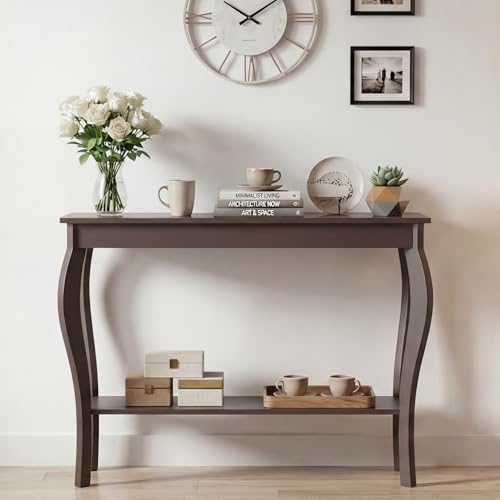
Compact proportions for the short walls and small apartments that Step 2’s measurements describe. Best for: nooks, small entryways, guest rooms. Not suited for: heavy traffic or long spans. Anchor it with the same seriousness as any design here. Check price on Amazon.
Nathan James Console Table — The Modern Shortlist
Clean-lined and light, for contemporary rooms where the table should support the scheme rather than star in it. Best for: modern living rooms and sofa backs. Not suited for: traditional rooms or heavy book loads. Check price on Amazon.
Common Mistakes
Buying by photograph tops the list — the table that glows in a styled listing may be the wrong depth for your hall and the wrong height for your sofa, and no finish survives being the wrong size. Second: forgetting door swing and drawer clearance, discovered at assembly. Third: treating the anchor as optional because the table felt steady empty; steadiness empty is not the test that matters. Fourth: loading the top with the heaviest objects — dense books and boxes belong on the lowest shelf. Fifth: expecting storage the shape cannot give, then blaming the table for being a table. Sixth: choosing the bottom tier for the highest-traffic job in the house, and paying twice. Every one of these mistakes is a skipped step in this guide, which is the kindest thing that can be said about them: they are all preventable.
Pro Tips
Tape the table’s footprint on the floor with painter’s tape and live with the outline for two days before ordering — walk past it, open doors against it, carry laundry through it. Photograph your wall and hold the listing photo beside it at the same scale to judge proportion. Write the drawer list before the drawer purchase. Order the tray and baskets with the table so the system starts complete. And when the table arrives, anchor it before the first object goes on top, while the habit is fresh and the wall is clear. Small rituals, large differences.
Worked Examples
The family entryway: two adults, two children, a dog, and a kitchen counter buried under arrivals. Step 1 names the landing strip. Step 2 finds a wall long enough for a full-size console and a walkway that stays clear. Step 4’s list — mail, chargers, leads, gloves, permission slips — demands drawers, so the shortlist is drawer consoles in the mid tier, with a shoe tray below and a runner in front; the household completes the system with hooks and our live picks for best hallway rugs. Verdict: the Yaheetech-shaped design, anchored before the school run tests it.
The floating sofa: a living room arranged around a rug, the sofa’s back exposed to the dining area, evening light too harsh from the ceiling alone. Step 1 names the lamp table. Step 3 sets the height at the sofa back and the length at most of the sofa’s span. Storage is a basket of throws, so open mid-tier frames lead the shortlist — the Convenience Concepts and Nathan James shapes — with cord routing planned along the skirting. Verdict: an open frame, lamps at both ends, and a room that finally looks finished from the doorway.
The small rental: one short wall by the door, a lease that discourages drilling, no children in the home. Step 2’s measurements are tight, so depth rules the shortlist and compact designs lead it — the ChooChoo shape — with a removable rated anchor solution checked against the lease, a mirror above to complete the arrival point, and styling kept to a lamp and a tray. Verdict: the compact console, honestly anchored by the best permitted method, doing a small job completely. The wider shortlist for such rooms lives in best console table for small spaces under 150.
The Measuring Worksheet: Numbers to Collect Before Browsing
Choosing well in this category is mostly arithmetic done early. Collect these numbers before you open a listing, and write them where you will actually see them while shopping. One: the full length of the wall section or sofa the table will serve. Two: the walkway width at its narrowest point, measured at floor level including skirting boards and door trim — the measurement most buyers take at eye level and get wrong. Three: the depth you can spend, which is the walkway number minus the width a person carrying a laundry basket genuinely needs. Four: sofa back height, floor to top of the back cushions, if the table goes behind seating. Five: the door swing arc and the direction drawers would open, for entryway placements.
Six: the footprint of the largest resident object — the lamp base, the basket, the shoe tray — because a shelf that cannot take your basket is a shelf in name only. Seven: your wall construction and the stud positions along the placement, because the anchor plan is part of the purchase. Eight: the worst-day clutter list, counted in items and sorted into small-and-private versus bulky-and-displayable. With those eight numbers in hand, listings stop being a gallery and become a filter: most designs eliminate themselves, and the two or three survivors can be compared on the legitimate grounds of hardware, finish and affection.
Questions to Ask of Every Listing
Interrogate each surviving listing with the same five questions. What are the exact dimensions of this specific variant — not the family’s range? If it has drawers, what are the interior measurements, and do they swallow the envelopes, chargers and gear on your list? Is anti-tip hardware included, and what wall type does it assume? Do the feet adjust, and what does the assembly sequence demand — because a long frame assembled out of order is a wobble built in at birth? And what does the listing honestly say about the surface: sealed, lacquered, laminate — and therefore what care routine are you volunteering for?
Then read the owner reviews with a searcher’s eye for four words: wobble, anchor, drawer, level. Complaints in this category cluster on those four, and the pattern within them is instructive — most wobble complaints describe tables that were never levelled, most stability complaints describe tables never anchored, and most drawer complaints describe runners misaligned at assembly. In other words, the reviews largely grade the setup, not the furniture. That is good news for the careful buyer: the failure modes are in your control, and the steps in this guide are exactly the controls.
Choosing for Children, Pets and Busy Homes
Households with small children should treat the safety step as the first filter, not the sixth step. The table must be anchored before it is loaded — full stop — and the strongest choice is a design whose manufacturer supplies proper anti-tip hardware and whose weight sits low. Drawers beat open shelves in toddler territory, because open low shelves are an engraved invitation to unload, and drawer latches can be added where fingers explore. Keep the top’s styling out of the temptation economy: nothing on the surface should be precious, breakable or interesting enough to climb for, and cords run along the wall as a rule without exceptions.
Pets write their own specifications. Dogs claim the lower shelf’s territory with beds and toy baskets, which open designs accommodate gracefully. Cats will treat any console as a viewing platform; the defences are the anchor, a surface kept too organised to be a launchpad, and plants chosen and placed with feline curiosity in mind. Busy homes of every composition share one requirement: the system must be easier than the mess. If the tray is where hands already go, if the drawer opens one-handed, if the basket is where the scarf naturally falls — the furniture will stay tidy because tidiness is the path of least resistance. Choose for the household’s actual habits, never for the habits the household aspires to.
When the Answer Is a Different Piece of Furniture
An honest choosing guide must sometimes conclude: not this. If your worksheet shows a storage need measured in cubic feet rather than in trays and baskets, choose the sideboard and let the console go. If your hallway’s numbers leave a squeezed path at every depth the category offers, choose the runner, the mirror and the wall hooks, and spend the console money where a room can use it. If your need is a work surface, choose the desk; if it is a television home, choose the media unit. Each of those conclusions is this guide succeeding, not failing — the goal was never to sell a console table, it was to put the right furniture against your wall.
There is also a timing answer that is sometimes correct: not yet. A household about to move, renovate or welcome a baby might rationally defer a purchase whose placement and safety plan will change within the year. The category is patient; the listings will be there, and the worksheet you have filled in will still be true when the right moment arrives. Choosing well includes choosing when.
A Final Pre-Order Ritual
Before you pay, run the ritual that experienced buyers in this category swear by. Tape the footprint on the floor and live with it for two days — walk it, vacuum around it, open every door against it. Hold your phone at the doorway with the listing photograph beside the real wall and judge the proportion honestly. Read your clutter list aloud against the chosen design’s drawers and shelves, item by item. Confirm the anchor hardware and your wall fixing one last time. Then order the table, the tray and the baskets together, so the system arrives complete and the first day sets the pattern the next five years will follow.
Choosing by Room: Four Mini-Guides
The Entryway, in Detail
Choose for the worst morning, not the average one. The entryway console must absorb the household at full cargo and full hurry: drawers sized for the real list, a finish that forgives weather, a lower shelf that takes the shoe tray your household actually uses. Measure with the door open and the household’s bags in hand. Style it with the mirror that makes the last look possible and the lamp that makes winter arrivals human. This is the room where mid tier earns its keep and where the anchor disappears into the wall behind the household’s most-used furniture.
Behind the Sofa, in Detail
Choose by the sofa’s numbers: height at or just below the back, length spanning most of its width, depth modest because the sofa itself guards the table from traffic. Storage is secondary here — a shelf for throws and books suffices — and cord planning is primary, because two lamps behind a sofa means two cords that must vanish along the skirting rather than drape. Open and modern frames shine in this placement; drawer models work too, quietly absorbing the living room’s small clutter. Judge the result from the doorway, which is where this placement is seen from.
The Hallway, in Detail
Choose by subtraction: the hallway keeps what the walkway does not need. Start from the narrowest measurement and be willing to conclude that the correct console for this hall is none — a conclusion the guide respects, because a hallway that flows is worth more than a hallway furnished against its will. Where the numbers allow, choose the shallowest honest design, anchor it with extra care because corridor furniture is brushed daily, and style it for the glance of a person passing: one lamp, one artwork, nothing that snags a sleeve or a strap.
The Dining Room, in Detail
Choose for company: the dining console serves at gatherings and displays between them, so presence and surface behaviour lead. Substantial designs and better finishes justify themselves here, drawers suit linens and serving pieces, and the surface must tolerate the serving life — trivets and coasters as standing policy. Measure against the dining table’s height for serving harmony and against the wall’s length for proportion among the home’s largest furniture. This is the placement where the premium tier stops being indulgence and becomes specification.
The Style Layer: Making the Functional Choice Beautiful
Once the functional shortlist exists, style is chosen by relationship rather than by catalogue. Relate the table to the room’s existing lines: a room of soft, traditional furniture wants a console with some curve or framed detail; a room of clean modern lines wants the frame that disappears. Relate the finish to the room’s light as much as to its palette — dark rooms need lift, bright rooms can carry depth. And relate the styling to the household’s real objects: the table that displays your actual books, your actual plant, your grandmother’s actual bowl will always out-style the table arranged from a listing’s imagination.
When two finalists divide you, choose the quieter one. Furniture at this scale is a supporting actor in every room it enters, and supporting actors are cast for reliability, not for stealing scenes. The lamp, the art and the objects can rotate with your taste for decades; the table’s job is to make each rotation look intentional. Buyers who choose quiet tables and loud accessories report the longest satisfaction in this category, because they have put the permanence and the fashion in the right pieces.
Delivery Day: From Box to Anchored in the Right Order
The choosing process ends with a sequence, and the sequence protects every earlier decision. Assemble in the room, on a blanket, tightening in the manufacturer’s order. Level before loading — drawers and doors are the instruments that report an unlevel frame, so give them a true frame to report on. Anchor while empty. Load low to high: shelf cargo first, drawers second, surface last, with the heaviest items at the bottom and against the wall. Route cords along the wall before the styling goes on, because cords arranged afterwards never arrange as well. Then photograph the result from the doorway — the view the choice was made for — and let the household live with it for a week before adjusting anything but the wobble.
Keep the instructions and spare hardware in the table’s own drawer or the household file, labelled. The console you chose this carefully will move — to another wall, another room, another home — and the paper is what makes the move a half-hour instead of a research project. Choosing well, in the end, is a habit that extends past the purchase: measure honestly, decide in order, set up completely, and keep the evidence. Do those four things and the table against your wall will feel less like a purchase and more like a feature of the house that was always there.
Choosing the Finish and Hardware as One Decision
Buyers often choose the table and then discover its hardware; the two are one decision. Drawer pulls, hinges and feet determine how the piece feels in the hand every day, and finishes determine how it forgives the household’s traffic — together they are the table’s daily personality. When comparing finalists, ask which one’s hardware you would rather operate a thousand times, because you will. Ask which finish you would rather wipe, dust and defend with coasters, because you will do that too. The catalogue photograph shows the wedding; hardware and finish are the marriage.
Coordinating with a room’s existing hardware is a quiet tiebreaker worth using. A console whose pulls echo the room’s door handles or lamp metals looks chosen rather than landed, and the effect costs nothing when it is considered at the shortlist stage. The same is true of wood tones: an exact match is unnecessary and usually impossible, but a deliberate relationship — clearly darker, clearly lighter, or honestly different in material — reads as design, while a near-miss reads as accident. Choose the relationship on purpose.
A Word on Timing: Sales, Seasons and Stock
Choosing well includes choosing when, within reason. Furniture buying has its rhythms — new ranges arrive, older finishes are cleared, and the patient buyer who has already done the worksheet can act quickly when the right design’s moment comes. The worksheet is what makes patience useful: without it, a fleeting opportunity produces a panic purchase in the wrong depth; with it, you know your numbers, your storage shape and your anchor plan, and a good price on the right table is simply a reward for preparation. Set a watch on the two or three finalists that survived your steps, check the current listings as seasons turn, and let the decision you have already made wait for its moment — but do not let the moment make the decision.
The opposite discipline matters too: when the right table is available and the need is daily, waiting for a marginally better moment has its own cost, paid in months of entryway chaos. The households in this guide’s worked examples did not regret buying when the fit was right; they regretted the months spent stepping over the problem. Choose in order, buy when it fits, and let the seasons keep their sales.
The Confidence Check: Knowing You Have Chosen Well
A good choice in this category has a recognisable feeling, and it is worth naming so you can recognise it before you pay. You can state the job in one sentence. You can recite the three dimensions and what they were measured against. You can list what the drawers or shelves will hold, item by item, and what they will not. You know your wall type, your stud, and your anchor plan. And you like the look of the thing — last, legitimately, because every functional question has already been answered in its favour. If any of those sentences is missing, the missing one is your next step, and the guide above is organised so you can walk straight to it.
If all five are present, stop researching. Further comparison at that point does not improve the choice; it only taxes it. Order the table with its tray and baskets, schedule the assembly hour, and go and stand in the doorway of the room it will change — the room is about to get the piece it has been asking for, in the only language rooms have: the daily evidence of everything that used to land in the wrong place.
Choosing With a Partner, a Family or a Committee
Most console purchases are negotiated, and the negotiation goes better with the worksheet as referee. When two people want different tables, the disagreement is almost never about the tables — it is about which job, which room or which clutter list is real, and the steps of this guide surface that disagreement in a form that can be settled. Measure together. Write the clutter list together; the partner who does not carry the household’s arrivals will learn something from it, and the partner who does will feel the purchase become shared. Where taste alone divides two finalists that both fit, both work and both anchor — let taste decide, cheerfully, because at that point taste is the only criterion left and it is a legitimate one.
Households choosing with children in the picture should let the safety step chair the meeting. The anchor plan, the low loading, the cord route and the nothing-precious-on-top rule are not one partner’s fussiness; they are the category’s operating instructions, and agreeing them before the purchase prevents the table’s first week from becoming an argument about a wobbling, unanchored temptation at toddler height. Committees that settle safety first find the rest of the choosing strangely easy — the shortlist shortens itself around the designs that take the duties seriously.
The One-Page Version of This Entire Guide
For the reader who has reached this point and wants the whole method on an index card, here it is. Name the job in one sentence. Measure the wall, the walkway and the sofa back; tape the footprint and live with it for two days. List the clutter; let the list choose drawers or shelves. Match the finish to the traffic, not the photograph. Confirm the wall, the stud and the anchor before ordering; load low and route cords along the wall when it arrives. Choose the style last, from the shortlist that survived, and choose the quieter design. That paragraph, honestly executed, will choose a better console table than a month of unmethodical browsing — because the method is the expertise, and it now fits on a card you can carry to the shop.
Keep the card. It works, with small translations, for the sideboard, the bench and the bookcase too — because choosing furniture well is one skill wearing different tape measures. The console table merely teaches it fastest, being the category where the wrong depth is felt at every passing, the wrong storage at every arrival, and the right choice at every single day thereafter.
Troubleshooting a Choice That Went Wrong
Even careful choosers occasionally land a table that disappoints, and the guide should end by troubleshooting honestly, because most wrong choices in this category are more fixable than they feel. The table wobbles: re-level the feet on the actual floor, in the actual position, and re-check the frame’s fixings in sequence — most wobble is a floor confession, not a furniture failure. The drawers disappoint: audit what is in them against the list they were bought for; half of all drawer disappointment is a system problem — too much, wrongly sorted — and a monthly five-minute sort plus one divider often cures it. The surface clutters: the tray was skipped or outgrown; restore the zones before blaming the table.
The hallway feels tight: first remove everything stored around the table rather than on it — the console is often blamed for its entourage — and re-walk the path. If the squeeze persists, the honest fix is relocation, and the category’s portability becomes the consolation: a console that crowds a hall frequently completes a bedroom or a dining wall. The finish marks: institute the tray and coaster policy late rather than never, touch up what the material allows, and let the table’s working patina be what it is — a record of a household, which no guest has ever once judged as harshly as its owner feared.
The Guide in One Paragraph, For the Reader in a Hurry
Name the job, measure the wall, the walkway and the sofa back, list the clutter and let it choose drawers or shelves, match the finish to the traffic, plan the wall anchor before you order, load the finished table low with its cords along the wall, and pick the style last from whatever survived — quieter over louder, system over object, tape measure over photograph. Do those things in that order and the console table you choose will be the one you would choose again in five years, which is the only definition of choosing well that this guide has ever used.
One Last Distinction: Choosing Versus Shopping
It is worth ending on the difference between choosing and shopping, because this guide is firmly about the first and the internet is firmly organised around the second. Shopping is browsing with a budget; it begins with products and hopes the fit follows. Choosing begins with the job, the room and the list, and lets products apply for the position — most are rejected by the worksheet before their photographs are even seen. The two activities feel similar from the outside and produce opposite results: shopping produces the table that photographed best, choosing produces the table that works best, and the five-year photographs of the two purchases are distinguishable at a glance. Everything in this guide — the steps, the worksheet, the rituals, the worked examples — exists to keep you on the choosing side of that line.
The encouraging news is that choosing is not slower than shopping; it is merely earlier. The measuring takes an hour, the list takes ten minutes, the footprint test takes two days of doing nothing but walking past tape. In exchange, the browsing that follows is short, calm and nearly incapable of going wrong. That exchange — a little method up front for a lot of certainty later — is the best bargain in this entire category, and it does not even require a table.
A Room-by-Room Fitting Walkthrough Before You Choose a Console Table
Technique matters more with a console table than most instructions admit, because the same product can feel clumsy or effortless depending on the order you do things in and the setup you repeat each time. Start by standardising your starting position: the console table in the same place, at the same setting, height or configuration each time, so that any change in results tells you something about the job rather than about a forgotten adjustment. Look at replacement parts and consumables for the console table while you are still comparing, confirming that the pieces most likely to wear, clog, tear, fade or get lost can actually be obtained without replacing the whole product. Build a tiny finishing ritual: a quick inspection of the result, a wipe, empty, coil, cover or reset of the console table as appropriate, and a note of anything that felt different, so the next session starts from a known state instead of a mystery.
Decide in advance what good enough looks like for the job the console table does in your home, because chasing a flawless result usually costs more time than the flaw itself, and most households are happier with a reliable ninety percent they actually repeat. Slow down at the difficult part rather than speeding up, because most console table tasks fail at the moment of impatience — the forced fit, the skipped check, the extra load — and a ten-second pause at that moment prevents most of the damage and most of the rework. If someone else in the household shares the console table, agree the same basic sequence together, because two conflicting techniques — different settings, storage spots or cleaning habits — will make even a good product seem inconsistent from one use to the next. If you want a concrete listing check, take a name already shortlisted in this guide, such as Yaheetech Console Table with Drawers, VECELO Console Table with Storage Shelves and ChooChoo Console Table, and verify that exact console table listing against the measurements and compatibility questions above, field by field, rather than trusting the headline description alone.
Finally, remember that the best console table for your home is the one whose size, habits and upkeep disappear into your routine, leaving only the result behind — a cleaner surface, a better-lit seat, a tidier shelf, an easier job — week after ordinary week. Keep a short note of what you adjusted on the console table during the first month, even just a line on your phone, since those notes turn vague impressions into a setup you can repeat, share or troubleshoot months later. Measure before anything else, and measure the console table in its working state rather than its packed or folded state, because handles extend, lids open, cords trail, doors swing and users stand somewhere, and all of that belongs in the measurement. Check the floor, wall, ground or surface the console table will meet, since level, texture, moisture and finish decide more about everyday performance in living room furniture settings than most shoppers expect when they are comparing listings on a screen.
When something about the console table disappoints, change one variable at a time — position, setting, timing, load, accessory or technique — and give the change a fair trial, because changing three things at once leaves you with a better or worse result and no idea why. Keep the packaging of a larger console table until those first ordinary tests are done, flattened if space is tight, because re-boxing an awkward shape from scratch is the hidden difficulty inside many otherwise straightforward returns. If a problem with the console table repeats in the same spot or the same stage of the job, treat the pattern as the clue — patterns point to setup, surface or technique, while random problems point more often to the individual unit. Photograph your setup once the console table is working well — the position, settings, arrangement or layout you settled on — so that after a move, a deep clean or a seasonal break you can recreate the arrangement that worked instead of rediscovering it.
Test the console table in the first week under deliberately ordinary conditions rather than saving it for a special occasion, so that any problem surfaces while returning, exchanging or adjusting your setup is still simple. Work in one direction and finish each zone completely before moving on, since a console table used in scattered passes tends to leave the edges, corners and transitions half-done, and those leftovers are usually what people later blame on the product. Watch for edge cases in your own home: the pet that investigates everything, the child who treats every new object as furniture, the guest who uses force where you use familiarity, and the weather, light or season that changes how a console table behaves. Seasonal thinking helps more than expected: a console table bought in one season will meet different light, humidity, mud, heat, guests and routines in another, so judge its size, storage and upkeep against the hardest season it will face.
Plan the storage home for the console table before it arrives, naming the exact cupboard, corner, shelf, hook or stretch of floor, because a product without a home migrates around the house and slowly becomes the clutter it was bought to reduce.
Frequently Asked Questions
What size console table should I buy?
The size your measurements dictate, in relationship to three fixed points: length against the wall section or the sofa’s span (most of the sofa, roughly two-thirds of a wall), depth against the walkway (the shallowest that holds your lamp and tray while leaving the path genuinely clear), and height against the sofa back (at or just below it) or against standing reach in an entryway. There is no universal right size — there is the size that fits your room’s three relationships, which is why measuring precedes browsing in this guide.
How do I know if I need drawers?
Write down everything the table must hold on your household’s worst day. If the list contains anything small, private or untidy — mail, medication, chargers, paperwork, the contents of pockets — you need at least one drawer, because open shelves display whatever they hold. If the list is baskets, books, throws and shoe trays, open shelves serve well at a lower tier. The list, not the photograph, decides; households that skip the list are the ones whose consoles look cluttered by the second week.
Where should a console table go in my home?
Wherever a wall or a sofa back meets a daily need: the entryway for arrivals, behind a floating sofa for lamps and completion, a wide hallway for light and display, a dining wall for serving and storage. The placement to avoid is any spot where the table narrows a walkway into a squeeze — circulation always outranks decoration. If you are choosing between placements, start with the entryway; it is the position where the category changes daily life the most.
What wall fixing does a console table need?
An anti-tip strap or bracket fixed into a stud or with the correct anchor for your wall type, installed before the table is loaded. Most consoles include a strap; if yours does not, a furniture anchor kit belongs in the same order. Keep the heaviest items on the lowest shelf and cords along the wall as part of the same safety setup. In homes with small children, treat this step as the purchase’s most important specification — ahead of finish, ahead of storage, ahead of style.
Can I use a console table in a hallway that is quite narrow?
Only if the numbers honestly allow it: after subtracting the table’s depth, the path must still carry a person with a laundry basket without turning, brushing or catching. Measure at the narrowest point including skirting and trim, tape the footprint on the floor, and live with the outline for two days. If the test fails, give the hallway its finish from a runner and wall art instead — best entryway runner rugs covers the zero-footprint option — and put the console where it will be loved rather than bumped.
What is the best material for a console table?
The material that matches your traffic and your maintenance appetite. Solid wood at the premium tier ages best and suits formal rooms. Engineered wood with a sealed, matte finish is the practical centre for entryways and family halls. Metal-and-wood frames suit modern rooms and lighter loads. Glass lightens small spaces at the cost of constant fingerprints. In every material, the behaviours matter more than the label: coasters under plants, objects lifted not dragged, and a tray where hard objects land.
Related Guides
Put the steps in context with the console table buying guide, test your shortlist against the scored console table reviews and the deep-dive console table review, weigh the category itself in console table pros and cons and is a console table worth it, and finish the entryway wall with best wall mirror for modern homes under 200.


