Disclosure: As an Amazon Associate, dailyhomedecorating.com earns from qualifying purchases. Links on this page are affiliate links; they cost you nothing extra. Prices and availability change often, so check the current Amazon listing before you buy.
This console table buying guide is for the moment every hallway, entryway and living room eventually reaches: the keys land on the kitchen counter, the mail piles up on the dining table, and the wall behind the sofa sits empty while the room still feels unfinished. A console table solves all three problems with one narrow footprint, which is exactly why it is also easy to buy badly. Too deep and it blocks the walkway. Too tall and it towers over the sofa back. Too light and it wobbles every time someone drops a bag on it. This guide works through the types, the measurements that actually matter, and the safety steps that are not optional, so the table you choose fits the wall, the room and the way your household really moves through it.
Key Takeaways
- Decide the job first: entryway landing strip, sofa-back surface, hallway display, or hidden storage — each job points to a different design.
- Depth is the measurement that decides comfort: most halls and sofa backs want a shallow table that leaves the walkway completely clear.
- Anchor every console table to the wall with the anti-tip hardware before anything goes on top — tall, narrow furniture is the classic tip-over shape.
- Drawers beat open shelves for entryway clutter; open shelves suit display and baskets in living rooms.
- Check the current Amazon listing for dimensions and hardware before you buy, because sizes vary between finishes and production runs.
In this guide
Console Table Buying Guide: What a Console Table Does and the Main Types
A console table is a long, narrow table designed to stand against a wall or behind a sofa rather than in the middle of a room. That single design decision — shallow depth, generous length, height matched to a sofa back or a comfortable standing reach — explains everything it does well. It creates a landing surface where none existed, it gives lamps and artwork a stage, and it adds storage in the strip of floor that most rooms waste. Because it never sits in the centre of a space, it improves how a room works without asking the room to give anything up.
The category has quietly split into several distinct types, and choosing the type matters more than choosing the finish. The sections below walk through the four designs that cover almost every home, plus the placement each one suits. If you already know your placement, you can move straight to the criteria sections, and if you want the balanced case for and against owning one at all, our companion piece on console table pros and cons lays it out honestly.
The Entryway Console Table
The entryway version is the hardest-working piece of furniture in many homes. Its job is to catch everything a person carries through the door — keys, wallet, mail, sunglasses, the dog lead, a bag that needs to leave again in the morning — and to hold it invisibly until it is needed again. That job rewards drawers, a lower shelf for shoes or a basket, and a finish that shrugs off wet gloves and gritty soles. A mirror or a small lamp above it turns the landing strip into a genuine last-look station, and a runner in front of it protects the floor from the traffic it attracts. If your entryway is the goal, the step-by-step companion how to choose a console table walks the measuring process in detail.
The Sofa Table
Placed behind a sofa, the console becomes a sofa table: a surface for lamps that flank the seating, a shelf for the book you are reading, and a visual bridge that stops the back of a floating sofa from looking like the back of a sofa. Height is the critical dimension here. The top should sit at or just below the top of the sofa back, so lamps read as part of the seating arrangement rather than perched behind it. Length matters too — a table that spans most of the sofa’s width looks deliberate, while a short table centred behind a long sofa tends to look lost. Open designs work well here because the sofa itself hides the lower half.
The Hallway Console Table
Hallways are the narrowest placement and the least forgiving. A hallway console must leave a genuinely clear walking path, which pushes you toward the shallowest depths in the category and toward wall-anchored stability, because a table in a corridor gets brushed by shoulders, bags and vacuum cleaners every day. In return it gives a dead passage a purpose: a place for a lamp that makes the hall feel like a room, for framed prints, and for the small tray that keeps hallway clutter from migrating. Measure the hall at its narrowest point, including skirting boards, before you fall for any particular design.
The Storage Console With Drawers or Cabinets
The fourth type trades the airy open frame for enclosed storage: drawers, cupboard doors, or both. This is the right answer when the console’s real job is hiding things — board games, chargers and cables, table linens, the household’s accumulation of batteries and tape measures. Enclosed designs are heavier and more substantial visually, which suits dining rooms and living rooms that need the piece to hold its own against other furniture. They are also the most stable type once anchored, because their weight sits low. The trade-off is price tier and effort: more material, more hardware, and more assembly than an open frame.
Top Picks at a Glance
The six designs below are the reference points this guide returns to. They are presented prose-only, positioned by tier in words rather than by price, so you can compare the shapes and jobs they suit. Check price on Amazon for any design that fits your measurements, and confirm the listed dimensions against your own tape measure before ordering.
| Pick | Badge | Best for | Tier |
|---|---|---|---|
| Yaheetech Console Table with Drawers | Best for Entryways | Keys, mail and daily clutter that needs drawers | Mid |
| VECELO Console Table with Storage Shelves | Best Budget Shape | Open shelving and baskets in halls and living rooms | Entry |
| ChooChoo Console Table | Best for Small Spaces | Narrow apartments and short walls | Entry |
| Safavieh Console Table | Best Traditional Look | Formal living rooms and styled display | Premium |
| Convenience Concepts Console Table | Best Versatile Frame | Sofa backs and mixed-use rooms | Mid |
| Nathan James Console Table | Best Modern Lines | Contemporary rooms that want a light visual footprint | Mid |
How Wide, Long and Deep Should a Console Table Be?
Length first. A console table should relate to whatever it stands against: behind a sofa, aim for a table that spans a good share of the sofa’s length; against a wall, a table that fills roughly two-thirds of the wall section looks composed, while one that fills almost all of it can feel like a sideboard and one that fills a third looks like an afterthought. In entryways, length is limited by door swing and by the space coats and bags need, so measure with the door fully open, not closed.
Depth is the dimension that decides whether the table helps or obstructs. The whole point of the category is shallowness: the table should hold a lamp base, a tray and a stack of books without pushing into the room’s circulation. Walk the path past your intended spot carrying a laundry basket or a suitcase — that everyday test tells you more than any product photo. If the path feels tight on paper, it will feel worse in February with coats on. Shallow tables also concentrate the tip-over risk, which is why the anchoring section later in this guide is mandatory reading, not fine print.
Height completes the fit. Behind a sofa, match or sit just below the sofa back. In an entryway, a surface at comfortable standing height lets you set things down without bending and lets a mirror hang at a useful level above it. Against a dining room wall, console height near the dining table’s height makes the piece usable as a serving surface during gatherings. There is no single correct height — there is only the height that matches the job — which is why the listings you compare should be sorted by your measured need, not by appearance.
Which Material and Finish Should You Choose?
Solid wood is the premium tier’s backbone: it is heavy in the good way, it ages gracefully, and it can be refinished when life marks it. That weight also helps stability, though it never replaces wall anchoring. At the mid tier, engineered wood with a good veneer or a durable laminate delivers most of the look with easier care, and metal-frame designs with wood-effect tops are lighter to move and suit modern rooms. Glass tops lighten a small space visually but show every fingerprint and demand coasters as a way of life.
Finish decides how the table survives your household. Entryway tables meet wet umbrellas, gritty shoes and keys thrown from a short distance; a matte, textured finish hides that life far better than a high-gloss one. Living room display tables can carry richer finishes because their traffic is gentler. Whatever you choose, check how the listing describes the surface — sealed, lacquered, or raw — and plan coasters and a tray for the spots that will take daily punishment. A shallow tray on top is the cheapest insurance any console table can have: it corrals keys and mail, and it protects the finish from both.
How Much Storage Do You Actually Need?
Count what the table must hold on your worst day, not your tidiest. For an entryway, list the items that currently land on the nearest surface; if the list includes anything you would rather not see — paperwork, chargers, medication, the dog’s medication, gift cards — you need at least one drawer. Open lower shelves are honest storage: they suit baskets, shoe trays, books and folded throws, all things that look fine visible. A two-tier open table with a pair of baskets often outperforms a drawer table for families, because baskets can be carried to where the sorting happens.
Be honest about display ambitions too. A console bought for styling — lamps, a plant, stacked art books, a ceramic bowl — needs surface, not storage, and an open design keeps the arrangement light. A console bought to fix clutter needs enclosure. Many households need both in different rooms, which is why the profiles in the next section separate the jobs instead of pretending one table does everything. Readers weighing whether the purchase earns its floor space at all will find the full argument in is a console table worth it.
Will It Be Stable? The Safety Section That Is Not Optional
A console table is tall relative to its depth, and that geometry is precisely the shape furniture safety guidance warns about. The rule for this category is absolute: fix the table to the wall with the anti-tip strap or bracket supplied, or with a suitable furniture anchor, before you put a single object on it. This matters most in homes with small children, who pull up on furniture and climb toward interesting objects, but it matters everywhere — a shallow table loaded with books on top and bumped by a vacuum cleaner can walk and tip without any child involved.
Three habits complete the safety picture. First, keep heavy items low: the heaviest books, storage boxes and anything dense belong on the bottom shelf or in low drawers, never stacked on the top surface of an unsecured — or even a secured — table. Second, manage cords: a lamp or a charging cable draped off the back of a console is an invitation for a child or a pet to pull, so route cords along the wall, use cord covers where they cross open floor, and keep loops out of reach. Third, recheck the anchor after any move, and teach children that the table is not a step, a seat or a climbing frame. These steps take minutes and they are the difference between furniture that serves the home and furniture that endangers it.
How to Prioritise by Use Case
The busy entryway household should prioritise drawers, a wipeable finish and a lower shelf that fits a shoe tray, in that order. Style comes fourth, because this table will be judged every single day by whether the morning exit is calm. A design like the Yaheetech drawer console below is the reference shape for this profile. Pair the table with a runner that can take mud — our live guide to best hallway rugs covers the flat-weave options that survive it — and the entry becomes a system rather than a pile.
The sofa-back decorator should prioritise height match and length, then lamp scale. Your surface will carry two lamps, a plant and reading material, so an open mid-tier frame in the Convenience Concepts mould is the reference. Storage is a bonus here, not the point; a lower shelf for a basket of throws is plenty. If the sofa floats in the middle of the room, this table is also what makes the arrangement look finished from the doorway.
The small-apartment renter should prioritise the shallowest depth that still holds a lamp, a light visual footprint, and a design that can move rooms when you do. The ChooChoo and Nathan James profiles below are the reference points. Renters should also note that anti-tip anchoring does not have to mean drilling: several anchor systems use stud-finding brackets or adhesive-rated straps for suitable loads, and where a lease forbids fixings entirely, the honest answer is a lower, deeper piece of furniture instead — safety is not the place to improvise.
The display-focused household — the one styling a dining room wall or a long living room — can prioritise presence: a substantial premium piece like the Safavieh profile, with the surface depth for layered objects and the finish to carry them. Here the table is furniture first and storage second, and the buying questions shift to proportion, material honesty and how the piece will age.
The Six Reference Designs in Detail

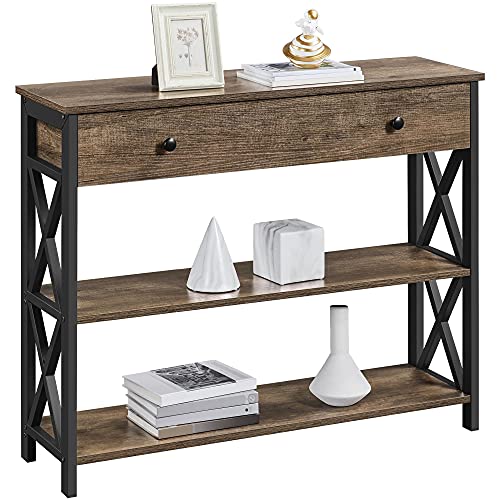
Yaheetech Console Table with Drawers — Best for: Entryway Landing Duty
This is the shape to picture when the job is the front door. Drawers swallow the small clutter that makes entryways look chaotic, the surface takes a tray and a lamp, and the lower shelf handles shoes or a basket. It sits in the mid tier, which buys sturdier hardware and a better finish than the entry tier without premium pricing. Best for: households whose entryway currently exports its clutter to the kitchen. Not suited for: very narrow halls where even a shallow drawer unit crowds the path, or anyone wanting a formal, fine-furniture look. Check price on Amazon and confirm the drawer dimensions suit what you actually store — drawer depth is the spec that disappoints when it is guessed.

VECELO Console Table with Storage Shelves — Best for: Open, Basket-Friendly Storage
The VECELO profile is the open-frame workhorse: tiers of shelving that accept baskets, books and folded textiles, in the entry tier that makes it a low-risk first console. Its openness is its honesty — everything stored is visible, so it rewards tidy categories and punishes random piles. Best for: living rooms and halls where storage means baskets and books, and for anyone testing whether a console suits the room before committing to a premium piece. Not suited for: hiding clutter, or for homes where a toddler will treat open low shelves as a unloading exercise — in that case choose drawers and anchor carefully. Check price on Amazon.
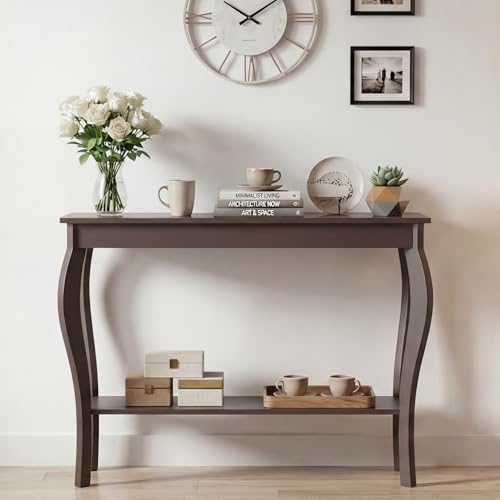
ChooChoo Console Table — Best for: Small Spaces and Short Walls
ChooChoo’s console designs lean compact and decorative, with the narrow proportions that short walls and small apartments need. The tier is entry, the assembly is typically straightforward, and the visual weight is light enough for a rental hallway. Best for: small-space households, first apartments, and anyone furnishing a nook rather than a grand entry. Not suited for: heavy loads, formal rooms, or use as a media unit — it is a surface and a shelf, not a cabinet. As with every shallow table in this guide, anchor it to the wall before styling it. Check price on Amazon.

Safavieh Console Table — Best for: Traditional Rooms and Styled Display
Safavieh occupies the premium tier of this category, and the difference shows in proportion and finish: these are consoles designed as furniture, for rooms where the piece will be looked at as much as used. Traditional and transitional styling dominates, with the surface presence for lamps, art and layered objects. Best for: dining rooms, formal living rooms and entryways that make a first impression. Not suited for: tight budgets, mud-room duty, or households that will resent caring for a better finish. Check price on Amazon, and measure twice — premium pieces are the ones you keep longest, so the fit has to be right.

Convenience Concepts Console Table — Best for: Versatile, Mixed-Use Rooms
Convenience Concepts builds the category’s versatile middle: frames that work behind a sofa this year and in a hallway the next, in finishes that blend rather than shout. The mid tier buys sensible hardware and designs that assemble without drama. Best for: sofa backs, mixed-use living rooms, and households that rearrange. Not suited for: buyers wanting solid-wood heirloom weight, or enclosed storage for serious clutter. The open lower shelf takes a basket pair neatly, which quietly doubles its usefulness. Check price on Amazon.
Nathan James Console Table — Best for: Modern Lines on a Mid-Tier Budget
Nathan James brings a modern, lighter visual language to the category — clean lines, mixed materials, and proportions aimed at contemporary apartments and living rooms. It sits in the mid tier and suits rooms where a traditional console would feel heavy. Best for: modern and Scandinavian-leaning rooms, renters who move, and sofa-back placement where the table should disappear into the scheme. Not suited for: traditional decor, or for loads of heavy books along a long span. Anchor it, style it lightly, and let the lines do the work. Check price on Amazon.
First Setup and Care Essentials
Setup begins before assembly: clear the spot, find the wall studs or confirm the anchor type your wall needs, and keep the anti-tip kit out of the parts bag rather than in a drawer for later. Assemble the table where it will live if the doorway is tight, level it on its adjustable feet or with shims if your floor runs out, and fix the anchor while the table is still empty — anchoring an empty table is easier and it sets the habit that the table is never used unanchored. Only then add the lower shelf load first, heaviest items lowest, and style the top last.
Care is mostly prevention. Dust with a soft cloth, lift objects rather than dragging them across the finish, and use coasters under plants and vases without exception — a single plant saucer leak can mark a wood-effect top permanently. Keep the table out of harsh direct sun where you can, tighten any wobble the moment it appears rather than living with it, and re-check the wall anchor every time the table is moved for cleaning or redecorating. A console table asks very little; what it asks, it asks consistently.
Mistakes to Avoid
The first mistake is buying by photograph instead of by tape measure — depth and height errors account for most returns in this category. The second is skipping the wall anchor because the table feels steady on the showroom floor of your hallway; steadiness empty is not steadiness loaded and bumped. The third is loading the top with the heaviest objects — a stack of atlases belongs on the bottom shelf. The fourth is ignoring door swing and drawer clearance: a drawer that cannot open past a door frame is a drawer you do not have. The fifth is treating the entryway console as a dumping licence — a table with a tray, a drawer system and a weekly two-minute reset stays tidy; a table without a system becomes a shelf-shaped pile. Our hands-on companion, the console table review, shows how these mistakes show up in a real room over time.
Console Tables Beyond the Hall: Dining Rooms, Bedrooms and Workspaces
The entryway and the sofa back get the attention, but a well-chosen console quietly serves three other rooms. In the dining room it becomes the serving station: a surface for dishes and drinks that keeps the table itself clear for people, and — in drawer or cabinet form — the home for linens, candles and the serving pieces that otherwise live in kitchen cupboards they do not fit. Dining placement rewards the more substantial designs, because the piece stands in company with the largest furniture in the home and must hold its own visually.
In a bedroom, a console works as a dressing surface or a low-key media alternative: a place for a lamp, a tray for jewellery and watches, and books that should not live on the floor. The bedroom rewards quieter finishes and softer styling, and it punishes clutter exactly as the entryway does — the same tray-and-container system applies. In a workspace corner, a console can serve as a printer stand or a supply surface beside a desk, though it should not be mistaken for a desk itself: the depth and leg room are wrong for sustained sitting work. Knowing these secondary uses matters at buying time, because a table chosen with a second career in mind — versatile proportions, a finish that blends — keeps earning its place when rooms change around it.
How to Read a Listing Like an Experienced Buyer
Product listings in this category reward a particular reading order. Start with the dimensions of the exact variant — not the range in the headline, because finishes and sizes within one listing can differ. Next, find the storage measurements: drawer interior depth and width if drawers are your reason for buying, shelf spacing if baskets are. Then look for the assembly and hardware notes: whether anti-tip hardware is included, what wall fixing it assumes, and whether the feet adjust for levelling. Those three lines tell you more about your first month with the table than the entire styled photograph gallery.
Read the material description with a translator’s ear. Solid wood means what it says. Wood veneer over engineered board is a legitimate mid-tier construction with a real wood surface. Wood-effect finish or laminate means a printed or coated surface — often very durable, never refinable, and best judged by how the listing describes its care. Weight guidance, where given, is a ceiling for evenly distributed load, not an invitation to stack the dense things on top — in this category the heaviest items always live on the lowest shelf regardless. Finally, read the questions-and-answers and the most critical reviews for the words wobble, anchor, drawer and level; in this category, owner complaints cluster on exactly those four, and they are the four your setup discipline controls.
Styling the Surface: A Working Method
Styling is where a console purchase either becomes a room’s highlight or its horizontal attic, and the method is simpler than the inspiration photos suggest. Work in three layers. The anchor layer is height: a lamp, a mirror or artwork above, something that lifts the eye and justifies the table’s place on the wall. The middle layer is the working layer: the tray, the bowl, the basket system that handles the household’s real traffic — this layer is styled by being contained, not by being decorative. The accent layer is one or two objects with meaning or texture: a plant, a stack of two books, a ceramic piece. Three layers, each doing one job.
Two rules keep the method working. First, leave a third of the surface visibly empty; emptiness is what makes the arrangement read as chosen rather than accumulated. Second, style for the sightline that actually sees the table — the doorway view in an entryway, the view from the seating in a living room — rather than for the close-up photograph. A console styled by this method takes ten minutes to arrange and two minutes a week to maintain, and it survives contact with real household life, which the museum-style arrangements in listing photos do not.
Your Measurement Worksheet
Before opening a single listing, collect these numbers on paper. Wall or sofa length available, in full. Walkway width at the narrowest point, minus the depth you are willing to spend. Sofa back height, if applicable. Door swing arc for entryways, including which way drawers would open against it. The largest object the table must hold — a lamp base diameter, a basket’s footprint, a shoe tray’s length. Your wall type and stud locations where the anchor will go. And the household list from the storage step: everything the table must contain on its worst day.
That worksheet is the buying guide in miniature. Every criterion section above exists to produce one of its numbers, and every mistake in the mistakes section is a worksheet left incomplete. Buyers who fill it in find the shortlist writes itself — usually two or three designs — and the final choice can be made on the legitimate grounds of which one they simply like looking at. That is what buying well feels like in this category: the measurements do the worrying, and you get to do the choosing.
Finishes and Colour: Choosing for Light and Longevity
Colour choice in this category is a lighting decision disguised as a taste decision. A dark console against a dark wall in a north-facing hall disappears into gloom and takes the room’s welcome with it; the same table in a sunlit living room reads as grounding and rich. Light finishes bounce what light a hallway has and keep small spaces breathing, but they testify to every scuff at a busy front door. The practical rule is to choose the finish family by the room’s light first — light rooms can carry depth, dark rooms need lift — and only then by the scheme’s palette.
Longevity argues for the middle of every finish range. The very distressed and the very glossy are both fashion positions, and both date; a calm matte or satin in a natural tone is the finish that survives a decade of surrounding change, because sofas, rugs and wall colours will all rotate around this piece. If your heart wants the dramatic finish, satisfy it with the objects on top — a bold lamp, a vivid artwork — which can be changed in an afternoon, rather than with the table itself, which cannot.
One more finish consideration is repairability. A surface that can be touched up — real wood that accepts a wax stick, a matte paint that accepts a careful dab — forgives the accidents of a working hallway. A surface that cannot be repaired, only replaced, should be bought with open eyes and defended with trays and coasters from the first day. Ask which kind you are buying before the first key lands on it, not after the first ring mark.
Delivery, Assembly Day and the First Week
Plan the delivery day like a small project. Clear the placement and the path to it, keep the anti-tip hardware and a stud finder with the tools rather than in the parts bag, and assemble in the room if doorways are tight — a long console built in the garage and carried through a narrow hall is a comedy you can skip. Work on a blanket or the flattened box to protect both floor and finish, tighten fixings in the sequence the instructions give rather than fully at each step, and level the feet before the drawers go in, because drawer behaviour is the first place an unlevel frame confesses.
Anchor while the table is empty and the wall is clear — five minutes then, a rearrangement later. Load in the order this guide has repeated because it works: heaviest items lowest, drawers next, the styled surface last. Then live with the table for a week before judging the styling; the household’s real traffic will rearrange your vignette into its working shape, and that working shape, tidied, is the arrangement to keep. The first week’s only scheduled task is a two-minute reset and a wobble check — feet, fixings, anchor — after the frame has settled into the floor’s reality.
Keep the paperwork. The assembly instructions, the hardware list and the warranty note belong in one of the table’s own drawers or a household file, because the day you move the table — and this category always moves eventually — you will want the anchor hardware identified and the fixing sequence known. Owners who keep the paper describe moves as non-events; owners who do not describe them as archaeology.
Pairing the Console With the Rest of the Room
A console table succeeds as part of an ensemble. Its classic partners are the mirror or artwork above it, the lamp upon it, the runner beneath the arrangement’s traffic, and — in entryways — the bench and hooks that complete the arrival system. Buy or plan them as one composition even if they arrive in stages: the mirror’s width should relate to the table’s length, the lamp’s height to the mirror’s centre, the runner’s length to the doorway’s swing. Our live guides to the partners — best entryway bench under 150 for the seating, best hallway rugs for the floor — are written to compose with the tables in this guide.
Scale discipline binds the ensemble. A substantial table wants a substantial mirror and lamps with presence; a compact table wants lighter partners and air around them. When in doubt, fewer and larger beats many and small, on the wall as on the surface. And let one element be the quiet one: if the table is the statement, the mirror should be simple; if the artwork is the statement, the table should disappear beneath it. Rooms feel designed when their pieces take turns, and the console — the most obliging piece in the house — is usually happiest taking the supporting role and playing it perfectly.
A Note on Second-Hand and Vintage Consoles
The second-hand market deserves a paragraph in any honest buying guide, because console tables — simple, durable, endlessly available — are among the best used-furniture buys. A solid older piece can deliver premium-tier material at an entry-tier outlay, and the category’s simplicity means condition is easy to judge: check the frame for wobble, the drawers for glide, the top for rings and veneer lift, and the legs for repairs. What a used table will not come with is its anti-tip hardware, so the anchor kit becomes a deliberate separate purchase — budget it into the comparison and fit it before the table is loaded, exactly as with a new piece.
Vintage consoles bring one more consideration: proportions from other eras. Older pieces can be taller, deeper or narrower than the modern category, which is either a perfect fit for an unusual wall or a quiet mismatch with a modern sofa back. Measure a vintage candidate against the same worksheet as a new one; the worksheet does not care about the table’s age, and neither should you. Judged by fit, condition and an anchor plan, a second-hand console can be the smartest purchase in this entire guide.
A Pre-Purchase Measurement and Compatibility Audit for Your Console Table
Use this audit in the final ten minutes before you order a console table, because that is when most buying-guide advice stops being abstract and starts being a tape measure, a doorway and a return label you would rather not need. Write down three numbers for the console table you are considering: the footprint where it will sit or be stored, the largest dimension it reaches in normal use, and the clearance it needs so doors, drawers, lids, handles or moving parts can work without catching. Compatibility is the second audit, and for a console table it means checking what it must work alongside: the surfaces, fittings, power or water access, storage and other pieces already in your living room furniture setup that the new purchase has to cooperate with every day. Check the floor, wall, ground or surface the console table will meet, since level, texture, moisture and finish decide more about everyday performance in living room furniture settings than most shoppers expect when they are comparing listings on a screen.
When something about the console table disappoints, change one variable at a time — position, setting, timing, load, accessory or technique — and give the change a fair trial, because changing three things at once leaves you with a better or worse result and no idea why. Keep the packaging of a larger console table until those first ordinary tests are done, flattened if space is tight, because re-boxing an awkward shape from scratch is the hidden difficulty inside many otherwise straightforward returns. Photograph your setup once the console table is working well — the position, settings, arrangement or layout you settled on — so that after a move, a deep clean or a seasonal break you can recreate the arrangement that worked instead of rediscovering it. Seasonal thinking helps more than expected: a console table bought in one season will meet different light, humidity, mud, heat, guests and routines in another, so judge its size, storage and upkeep against the hardest season it will face.
If a problem with the console table repeats in the same spot or the same stage of the job, treat the pattern as the clue — patterns point to setup, surface or technique, while random problems point more often to the individual unit. If a listing for a console table leaves one of those compatibility questions unanswered, treat the gap itself as information and look for the answer in the manual, the dimension diagram or the question section rather than assuming the generous interpretation. Think about who else will use the console table and what they will do differently: shorter reach, less patience, stronger habits, no interest in the manual, and a tendency to leave things wherever they were last set down. Keep a short note of what you adjusted on the console table during the first month, even just a line on your phone, since those notes turn vague impressions into a setup you can repeat, share or troubleshoot months later.
Measure before anything else, and measure the console table in its working state rather than its packed or folded state, because handles extend, lids open, cords trail, doors swing and users stand somewhere, and all of that belongs in the measurement. Watch for edge cases in your own home: the pet that investigates everything, the child who treats every new object as furniture, the guest who uses force where you use familiarity, and the weather, light or season that changes how a console table behaves. Use a simple decision checklist at the end: the console table fits the measured space, suits the real frequency of the job, matches the household’s cleaning temperament, has obtainable parts, and has a named storage home — five yeses make a confident order. Shortlist discipline helps here: keep two console table options that pass the audit and let one fail on paper, because comparing a clear pass against a clear fail teaches you more about your real priorities than comparing three near-identical maybes.
Then measure the route, not just the destination, since a console table that fits its final spot perfectly can still fail at a narrow hallway, a tight turn, a low doorway or a cupboard mouth that is smaller than the space behind it. Test the console table in the first week under deliberately ordinary conditions rather than saving it for a special occasion, so that any problem surfaces while returning, exchanging or adjusting your setup is still simple. If you want a concrete listing check, take a name already shortlisted in this guide, such as Yaheetech Console Table with Drawers, VECELO Console Table with Storage Shelves and ChooChoo Console Table, and verify that exact console table listing against the measurements and compatibility questions above, field by field, rather than trusting the headline description alone. Consider the cleaning rhythm honestly: a console table that needs attention after every use suits a household that enjoys small rituals, and frustrates a household that wants to finish a job and walk away, so match the upkeep to the temperament, not the intention.
Look at replacement parts and consumables for the console table while you are still comparing, confirming that the pieces most likely to wear, clog, tear, fade or get lost can actually be obtained without replacing the whole product. For troubleshooting, start with the boring causes first: power, water, fit, blockage, alignment, a full container, a loose connection or a setting changed by the last person who used the console table, because boring causes account for most apparent failures. Plan the storage home for the console table before it arrives, naming the exact cupboard, corner, shelf, hook or stretch of floor, because a product without a home migrates around the house and slowly becomes the clutter it was bought to reduce.
Frequently Asked Questions
What is the difference between a console table and a sofa table?
In practice, almost nothing — a sofa table is a console table placed behind a sofa. The product is the same category: long, narrow and shallow. Placement changes the priorities, not the furniture. Behind a sofa, height relative to the sofa back and lamp placement lead the decision. Against a wall or in an entryway, storage and finish durability matter more. Buy the dimensions and features your placement needs and ignore the label on the listing.
How much walking space should a console table leave in a hallway?
Enough that the path still feels like a path when you carry something bulky through it. As a working rule, if placing the table leaves you turning sideways, brushing the wall, or catching bag straps on its corners, it is too deep for that hall regardless of how it looks. Measure at the narrowest point, include skirting boards and door trim in the measurement, and remember that a hallway table will be brushed daily — another reason the wall anchor is non-negotiable in corridors.
Does a console table really need to be anchored to the wall?
Yes. A console table is tall and shallow, which is the geometry most prone to tipping, and anchoring takes minutes with the strap or bracket supplied or a furniture anchor kit. Anchor before loading the table, keep heavy items on the lowest shelf, and keep lamp and charger cords routed along the wall so nothing invites a pull. In homes with small children this is the single most important step in the whole purchase — ahead of style, ahead of storage, ahead of everything.
Can a console table work as a desk or a media unit?
As an occasional laptop perch or a writing surface, a sturdy console can serve in a pinch, but it is not a desk: the depth is wrong for sustained work and there is no leg room designed in. As a media unit it depends on the design — open consoles lack the enclosed, ventilated storage components want, and screens usually sit too high on a console-height surface. Choose the furniture designed for the job for daily use, and let the console do what it is shaped for. For the television wall specifically, a dedicated stand or media console is the better tool.
What should I put on a console table?
Start with function, then style. A lamp for light where the room lacks it, a tray or bowl that catches keys and mail, and then one or two considered objects — a plant, a stack of books, a piece of ceramic — rather than a crowd of small things. Leave breathing room: a console styled at two-thirds full looks intentional, while one covered edge to edge looks like storage that escaped. In entryways, add a mirror above for last looks and light; our live picks for best wall mirror for modern homes under 200 pair well with the tables in this guide.
How do I keep an entryway console table tidy?
Give every category a container and every container a limit: a tray for keys, a drawer or basket for mail awaiting action, a hook or lower basket for the dog’s things. When a container overflows, the system — not the table — needs a decision, usually a bin and five minutes. A weekly reset while you are already tidying the hall keeps it permanent. The households whose entryways stay calm are not tidier people; they are people whose furniture makes the tidy action the easy action.
Related Guides
Continue with the rest of the console table cluster: the balanced console table pros and cons, our hands-on console table review and the wider console table reviews roundup, the step-by-step how to choose a console table, and the value verdict in is a console table worth it. For live product lists by room and budget, see best console table for small spaces under 150 and best console table for modern homes under 300, and complete the entryway with best entryway bench under 150 and best entryway runner rugs.


