Disclosure: As an Amazon Associate, dailyhomedecorating.com earns from qualifying purchases. Links on this page are affiliate links; they cost you nothing extra. Prices and availability change often, so check the current Amazon listing before you buy.
This cereal dispenser buying guide exists because the category looks simpler than it is. Every model promises fresher cereal and tidier mornings, yet the difference between a dispenser that becomes a beloved breakfast station and one that ends up in the back of a cupboard comes down to a handful of decisions: how many cereals your household really keeps open, where the unit will live, which mechanism suits your cereals, and whether the seal is genuinely doing its job. Work through those decisions in order and the right model almost chooses itself. Rush them, and you will own a clear plastic reminder that good intentions are not the same as a good fit. This guide walks through the types, the criteria that actually matter, and a shortlist of real models worth considering, with honest notes on who each one suits and who should walk past it.
Key Takeaways
- Match the chamber count to the number of cereals your household genuinely keeps open at once — one, two or three covers almost every home.
- The seal matters more than the styling: a lid with a supple gasket keeps cereal crisp through the second half of the box, where boxes fail.
- Measure bowls and shelf height before ordering; bowl clearance under the outlet is the fit detail most often missed.
- Knob dispensers meter repeatable portions and suit children and flakes-and-loops households; pour-style containers suit cupboard storage and granola.
- Refill at the empty point, wash and dry fully, then refill — that single habit prevents almost every complaint owners ever have.
- Read cereal dispenser pros and cons in full alongside this guide if you are still deciding whether the category itself fits your kitchen.
In this guide
What a Cereal Dispenser Does and the Main Types
At heart, a cereal dispenser does three things a box does badly: it seals dry food away from kitchen air, it shows you how much is left, and it serves a controlled portion through a small outlet instead of a wide, tearing bag mouth. Everything else — the stands, the knobs, the matching sets — is styling around those three functions. Understanding the main types is really about understanding which of the three functions each design emphasises, because no single model maximises all of them at once.
Countertop Gravity Dispensers
The classic design stands on the counter, holds cereal in a clear chamber above an outlet, and meters servings with a knob or lever. It emphasises the serving moment above all else: bowl underneath, turn, done. These are the models that create the breakfast-station effect children love and busy adults quietly rely on. Their costs are a permanent counter footprint and a mechanism that expects cereal to flow freely, which most flakes, loops and puffs do. If your kitchen has the counter space and your mornings are a production line, this is the default type to beat.
Wall-Mounted Dispensers
Wall-mounted units trade the counter footprint for a fixed installation, usually in a pantry or on a kitchen wall near the breakfast zone. They suit small kitchens where every square of worktop is contested, and homes that want several dry goods — cereal, granola, snacks — lined up in a permanent row. The commitment is real: you are drilling, levelling and choosing a spot you will live with, and refilling happens in place, often with a step up. Households that entertain the idea should be sure the chosen wall is genuinely on the morning path, because a dispenser installed in the wrong room is furniture, not a tool.
Pour-Style Airtight Dispensers
Pour-style models are really airtight canisters with engineered spouts, and they emphasise the seal and the cupboard. There is no metering mechanism, so the portion is in your hands, but the push-button lids on the best of them close with a conviction no box fold can match. They stack into existing canister sets, travel from cupboard to table gracefully, and handle awkward contents — chunky granola, muesli with dried fruit, fragile flakes — that can bridge in a gravity outlet. If your cereals live behind a door and your complaint is staleness rather than serving chaos, start here.
Rotating and Carousel Designs
A smaller family of designs puts several smaller chambers on a rotating base, trading capacity for theatre and compact variety. They suit snack stations, small households that like choice in small quantities, and counters where a tall unit will not fit under the cabinets. The honest limitation is refill frequency: small chambers empty quickly in a family, and each emptying is a wash-and-refill cycle. Treat carousel designs as variety tools for light users rather than infrastructure for a cereal-heavy home, and they will delight rather than disappoint.
The single biggest job of any dispenser is keeping air away from cereal between breakfasts. An opened box, even one folded shut with care, breathes every time the cupboard door moves, and staleness is mostly a story of air and moisture trading places with the crispness baked into the flakes. A dispenser with a proper lid and a gasket interrupts that trade. The cereal you pour on day ten comes from a chamber that has been opened for seconds at a time, through a small outlet, rather than a wide box mouth left gaping during a long pour. No home dispenser is a laboratory vacuum, and none will keep cereal crisp forever, but the difference between a sealed chamber and a tired cardboard fold is easy to taste in the second half of a box, which is exactly where most households quietly lose interest and let cereal die in the cupboard.
Cereal Dispenser Buying Guide: Top Picks at a Glance
The shortlist below is deliberately short. These are real, widely sold models that between them cover the main shapes of household: the two-cereal family, the variety household, the cupboard-and-canister home, the single-cereal minimalist and the big-pantry family. Prices move constantly in this category, so treat every model as a check price on Amazon decision rather than a fixed number, and judge by fit first and tier second. Each pick is presented prose-only here pending final verification, with its tier stated in words so you can place it honestly.
| Model | Badge | Tier | Best for |
|---|---|---|---|
| Zevro Dual Dry Food Dispenser | Best for Two-Cereal Households | mid-range | A twin-canister countertop dispenser for households that keep two everyday cereals in rotation, with separate knobs, clear fill-level walls and a breakfast-station feel. |
| Honey-Can-Do Triple Cereal Dispenser | Best for Variety | premium-leaning | A three-canister dispenser for larger or variety-loving households, trading a wider footprint for three sealed, visible cereal choices in one station. |
| OXO Good Grips POP Cereal Dispenser | Best Airtight Pour-Style Pick | mid-range | A pour-style, push-button-seal dispenser for cupboard storage and tidy matching-canister looks, without a fixed portion mechanism. |
| Shazo Cereal Dispenser | Best Simple Single Dispenser | entry-level | A simple single-chamber dispenser for one-cereal households, small kitchens and first-time buyers who want the core benefits without a big footprint. |
| Conworld Cereal Dispenser | Best for Pantry Shelves | entry-to-mid-range | A larger single-chamber dispenser for pantry shelves and family counters, built around capacity, fewer refills and a calmer morning routine. |
How Much Capacity Do You Need?
Capacity questions sound technical but are really questions about your household’s week. A single person eating one cereal most mornings needs a chamber that holds a standard box without forcing it, because a dispenser that swallows only two-thirds of a box creates a worse problem than it solves: a leftover third rattling around in a half-open box. A family needs either one generous chamber per staple cereal or the honesty to admit that two or three dispensers will live on the counter. Refill frequency is the hidden variable. Every refill is a small chore involving the chamber, the new box and a few minutes of counter space, and a dispenser that needs it every third day will slowly be abandoned by a busy household. Match chamber size to the interval you can sustain, which for most homes means a refill roughly once a week or less, aligned with the normal shop.
A useful test before you look at any dimensions: watch your household for one week and count how many boxes are open simultaneously and how fast each one falls. That count, not the showroom photograph, is your capacity brief. Buyers consistently over-purchase chambers and under-purchase chamber size, ending with an impressive station where one canister is always empty and another is always overfilled from a box that did not quite fit. One generous chamber that swallows a full standard box beats two cramped ones that each strand a third of a box in the cupboard. Families should also think in refills per week: if the maths says a chamber needs filling more than about once a week, go a size up or accept that the routine will fray.
Which Dispensing Mechanism Fits Your Household?
Most countertop dispensers work by gravity and a metering chamber. Cereal rests in the clear canister, a turn of the knob or a press of the lever moves a measured amount into the outlet, and the bowl waits underneath. The elegance of the system is that it has almost nothing to power, programme or repair. Its weakness is equally physical: the mechanism assumes cereal flows like a dry granular material, which flakes, loops and puffs mostly do, right up until a crushed layer at the bottom of the chamber starts behaving like rubble. Understanding that one fact explains most dispenser behaviour, good and bad. Keep the chamber reasonably full, give it an occasional gentle shake when you refill, and the flow stays honest. Let it run to dust and crumbs for weeks, and any design will eventually hesitate, grind or deliver a sad half-portion of fragments.
Portion behaviour changes the moment cereal comes out of a dispenser instead of a box. A free pour is governed by mood, hunger and the angle of a tired wrist, and it reliably overshoots. A knob-style dispenser meters each turn, so a bowl fills in repeatable increments and people quickly learn how many turns make their normal breakfast. That repeatability matters in three directions at once: children serve themselves without flooding the bowl, households watching sugar intake get a serving they can actually reproduce, and the box lasts the number of days the shopping plan assumed it would. Nobody needs to weigh breakfast, and this is not about restriction for its own sake. It is about removing the small daily randomness that makes one box vanish by Wednesday while the next survives to Sunday, and about giving younger eaters a serving tool sized to their judgement rather than to the width of a box opening.
The mechanism question is also a cereal question. Fine, uniform pieces — loops, puffs, small crisp rice — flow through any knob dispenser happily. Large flakes behave well in most, but very wide or clustered products, especially granola with sticky fruit, can bridge across an outlet and need a shake. Households built around those cereals often do better with a pour-style container and a good seal, accepting a freehand portion in exchange for never fighting the mechanism. There is no universal winner; there is only the match between what your family eats and how a chamber empties. If you are between designs, choose based on your most-eaten cereal, not your most aspirational one.
How Important Is the Seal, Really?
It is the whole ballgame for freshness, and the least photogenic part of any listing, which is why it gets under-examined. When you handle a dispenser, work the lid. It should seat with soft, even resistance all the way around, not click at one corner and gap at another. Press the gasket if there is one; it should feel supple, not hard or shiny with age. On pour-style models, the button mechanism should pop the seal open decisively and close it with the same decisiveness. Remember what the seal is fighting: not a single opening, but the accumulated humidity of a working kitchen — kettle steam, dishwasher vapour, the warm breath of an oven door. A mediocre seal loses that fight slowly, which is worse than losing it fast, because the cereal declines so gradually that nobody blames the hardware.
Nearly every home dispenser is built from clear food-grade plastic, and the arguments about that material are worth having plainly. Plastic keeps the weight low, the price sane and the chamber transparent, which the whole visibility benefit depends on. Its weaknesses are that it can scratch with abrasive cleaning, absorb strong odours if stored badly, and crack if dropped onto tile when full. The practical response is boring and effective: wash with soft sponges, keep the dispenser for dry goods only, and place it where a full chamber is not being carried around the kitchen daily. Lids and gaskets deserve more attention than the chamber walls. A supple gasket that still springs back when pressed will out-seal a rigid lid on a fancier body, so when you shop, press the seal, work the knob, and judge the moving parts. Dispensers fail at their mechanisms and seals, not at their walls.
How to Prioritise by Use Case
Consider the weekday family of four, two adults leaving early, two children who can dress themselves but cannot be trusted with a full box and a small bowl. For this household the dispenser is not a storage upgrade; it is a staffing solution. The children serve themselves at a station stocked the night before, the adults stop being the cereal bottleneck, and the one open box problem disappears because the chamber holds the supply. A dual or triple unit fits this home best, because choice is the thing children argue about and pre-loading two or three agreed cereals removes the argument’s raw material. The seal keeps the second half of each supply fresh through the school week, and the visible levels let the adults add cereal to the shopping list before the crisis. This is the profile for whom the category was effectively designed, and the fit is close to total.
Now consider the single-person household, one cereal, eaten most mornings, bought on a weekly shop. The freshness case still holds, because a box opened by one person lasts long enough for the fold-top’s failures to matter, and the second week of a box is exactly when solo eaters drift toward toast and waste the rest. A single modest dispenser solves that, and its visibility benefit shrinks but does not vanish: one person still forgets what is in the cupboard. The portion benefit matters least here, since an adult pouring for one quickly calibrates. The honest recommendation for this profile is the simple end of the market, one chamber, no station-building, placed where the morning actually happens. Anything larger buys capacity and variety this household will never use, and the unused second chamber of an ambitious unit becomes a tiny monument to over-buying.
A third profile hides inside many homes: the household whose cereal problem is not breakfast at all, but grazing. Dry cereal doubles as a snack, eaten by the handful in front of the television, and the box lives a hard life of constant opening by many hands, some of them not freshly washed, all of them widening the bag’s tear. A dispenser disciplines this pattern without banning it. The knob makes snacking a deliberate small act, keeps hands out of the shared supply, and the closed chamber survives the living-room phase of its life far better than a box does. For this household, placement is the decision: a dispenser stationed where snacking legitimately happens, stocked with the cereal everyone actually grazes on, converts a hygiene niggle and a freshness leak into a tidy house rule. It is an unfashionable use case and, in the right home, the most valuable one.
If your profile is none of these — a holiday let, a small office, a dorm room — the same logic still applies: count the eaters, count the cereals, measure the space, and let those three numbers pick the type. Our companion piece on how to choose a cereal dispenser step by step turns this into a literal sequence of steps if you prefer to work that way.
The Shortlist in Detail

Zevro Dual Dry Food Dispenser — Best for Two-Cereal Households
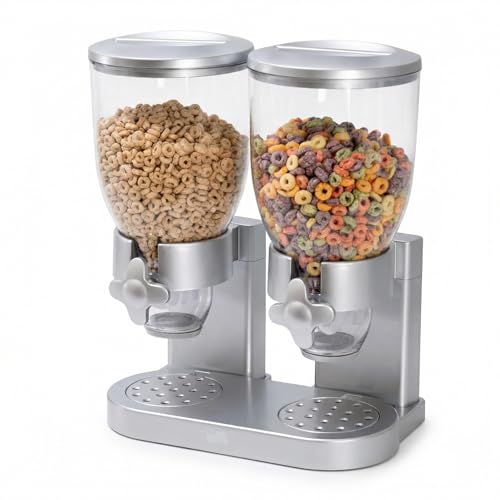
The Zevro Dual Dry Food Dispenser is the model most people picture when they first imagine this category: two clear canisters side by side on a shared stand, each with its own dispensing knob, so two everyday cereals can live on the counter without two open boxes competing for the same shelf. The dual layout suits households where one person reaches for a hearty flake and another wants something lighter, and the portion-style knob gives each bowl a more consistent serving than a free pour from a tall box. The clear walls make the fill level obvious at a glance, which quietly prevents the empty-box surprise on a busy morning. It is a countertop piece, so it asks for a permanent footprint, and in return it behaves like a small breakfast station. Treat it as the balanced, family-first option: not the smallest, not the fanciest, but the one whose shape matches how most kitchens actually run.
Best for: households matching the badge above who want a mid-range option judged on fit rather than flash. Not suited for: buyers whose space, cereal types or chamber count point the other way — the sections above will tell you honestly if that is you. Check price on Amazon when you have narrowed it to one or two, and re-measure your space before you commit.
Honey-Can-Do Triple Cereal Dispenser — Best for Variety
The Honey-Can-Do Triple Cereal Dispenser stretches the same idea to three canisters, and that third chamber changes the household maths more than you might expect. Three options cover the classic spread of a family kitchen: a plain staple, a sweeter favourite and a healthier rotation, all visible, all sealed away from the open air of a folded box top. The wider stand needs honest counter or pantry-shelf space, so measure before you fall for the variety. In use, the appeal is rhythm: nobody opens three boxes, nobody leaves three tops unsealed, and the morning line moves faster because each person turns a knob instead of hunting through a cupboard. It is the pick for bigger households, shared houses and anyone who hosts grandchildren or guests often enough that breakfast choice is a small daily event rather than a solo routine.
Best for: households matching the badge above who want a premium-leaning option judged on fit rather than flash. Not suited for: buyers whose space, cereal types or chamber count point the other way — the sections above will tell you honestly if that is you. Check price on Amazon when you have narrowed it to one or two, and re-measure your space before you commit.

OXO Good Grips POP Cereal Dispenser — Best Airtight Pour-Style Pick
The OXO Good Grips POP Cereal Dispenser takes a different route from knob-and-paddle machines: it is a pour-style container built around the POP line’s push-button airtight seal, with a shaped spout designed to aim cereal into a bowl instead of scattering it across the counter. That makes it the natural choice for people who like the tidy look of matching canisters, who store cereal inside a cupboard rather than on display, or who want one container that also handles granola and other dry goods gracefully. There is no fixed portion mechanism, so serving size stays in your hands, which some households prefer. The seal is the headline: press to close, press to open, and the lid’s gasket does the quiet work of keeping air out between breakfasts. It is less of a breakfast station and more of a well-mannered storage jar with a genuinely better pour.
Best for: households matching the badge above who want a mid-range option judged on fit rather than flash. Not suited for: buyers whose space, cereal types or chamber count point the other way — the sections above will tell you honestly if that is you. Check price on Amazon when you have narrowed it to one or two, and re-measure your space before you commit.

Shazo Cereal Dispenser — Best Simple Single Dispenser
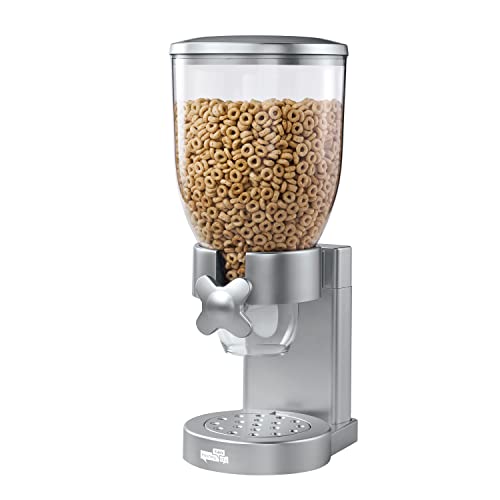
The Shazo Cereal Dispenser represents the straightforward single-chamber end of the market: one clear container, one dispensing action, no extra chambers or ceremony. For a one-cereal household, a small flat, a student kitchen or an office corner, that simplicity is the entire point. A single dispenser is easier to place, easier to refill and easier to keep clean than a multi-canister station, and it still delivers the core benefits of the category: a proper seal, a visible fill level and a controlled pour that beats shaking a box over a bowl. Buyers who eat the same cereal most mornings, or who want to test whether dispenser life suits them before committing counter space to a larger unit, will find this the lowest-friction starting point. It also works well as a second dispenser dedicated to granola, oats or a child’s favourite, kept apart from the main household supply.
Best for: households matching the badge above who want a entry-level option judged on fit rather than flash. Not suited for: buyers whose space, cereal types or chamber count point the other way — the sections above will tell you honestly if that is you. Check price on Amazon when you have narrowed it to one or two, and re-measure your space before you commit.
Conworld Cereal Dispenser — Best for Pantry Shelves
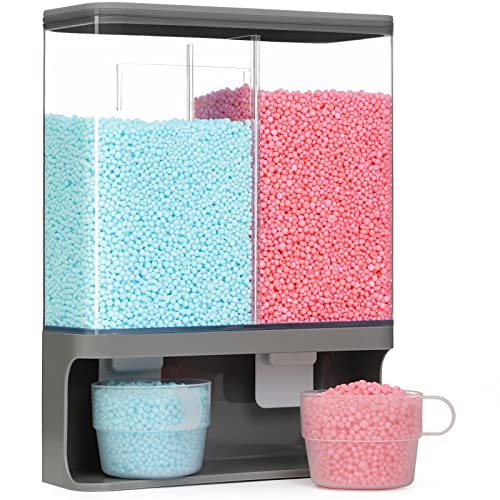
The Conworld Cereal Dispenser sits in the practical middle of the category: a single generous chamber with a dispensing mechanism, aimed at pantry shelves and family counters where one shared cereal does most of the work. Its appeal is capacity and calm. A bigger chamber means fewer refills, which matters when the household cereal disappears at weekend speed, and the dispensing action keeps handfuls and direct-from-box snacking out of the equation, so the contents stay cleaner as well as fresher. It suits buyers who have already decided the category works for them and now want fewer, larger, less fussy hardware. As with every dispenser, check the height against your shelf spacing and the bowl clearance under the outlet before ordering, because a dispenser that almost fits a pantry shelf is a daily irritation rather than a convenience.
Best for: households matching the badge above who want a entry-to-mid-range option judged on fit rather than flash. Not suited for: buyers whose space, cereal types or chamber count point the other way — the sections above will tell you honestly if that is you. Check price on Amazon when you have narrowed it to one or two, and re-measure your space before you commit.
First Setup and Care Essentials
The refill is the dispenser’s only real chore, and doing it well takes less time than resenting it. Work at a clear counter with the empty chamber, the new box and a bowl or jug for the last fragments. Empty the old crumbs into the bowl for that morning’s serving rather than binning them, wash and dry the chamber if it is due, then pour the new cereal in a slow stream, pausing once to let it settle so the chamber takes the full box without a mound above the rim. Seat the lid firmly, work the knob once to confirm the flow, and note the level with your eyes; that glance is your shopping forecast for the week. The whole operation, done at the empty point rather than mid-week in a panic, takes a few unhurried minutes. Households that fold refills into the weekly shop unpacking find the chore disappears into an existing routine entirely.
Cleaning a dispenser is a short job done rarely, or a miserable job done once. The correct rhythm is to wash the chamber at refill boundaries: when a canister runs empty, before new cereal goes in, rinse or wash the parts the manufacturer allows, dry everything completely, and only then refill. Moisture is the enemy twice over, because a damp chamber both stales the new batch and encourages residue to cling. Between refills, a dry wipe of the outlet and knob keeps sugar dust from building into a sticky film. The mistake to avoid is topping up indefinitely, layering fresh cereal over the ageing fragments at the bottom until the bottom becomes archaeology. First in, first out is the rule that keeps both flavour and hygiene honest: finish the chamber, wash it, dry it, refill it. Ten unhurried minutes at the natural empty point replaces the deep scrub that neglected dispensers eventually demand.
Where a dispenser lives decides whether it gets used. The ideal spot has three properties: it is on the path between waking and eating, it has the vertical clearance the bowl needs under the outlet, and it does not fight the kettle, toaster or coffee maker for the same square of counter. Pantry shelves tempt tidy minds, but a dispenser buried behind other jars becomes a storage container with delusions; the dispensing advantage only exists when the bowl can slide underneath without moving anything else. Measure your bowls, not the manufacturer’s photograph. Measure shelf height with the lid’s removal in mind, because a chamber you cannot lift out or open in place will be refilled awkwardly over a sink. And think about light: a sunny windowsill spot will warm the chamber daily, which cereal does not enjoy. Cool, shaded, reachable and boring is the correct specification for placement.
Mistakes to Avoid
The classic buying mistakes in this category are all versions of shopping for the photograph instead of the household. Buying three chambers for a one-cereal home. Buying a tall station for a kitchen whose cabinets hang low. Buying a gravity dispenser for a granola household and then blaming the outlet. Skipping the bowl measurement and discovering the family bowls only fit at an angle, dripping milk-adjacent chaos across the counter every morning. And the subtlest mistake: buying the dispenser as a storage object, placing it in a deep pantry, and never building the serving habit that is the entire point. Avoid those five and the category almost cannot disappoint you. For the balanced downside list, read the honest cereal dispenser pros and cons before you order.
It is worth being fair to the humble cereal box before replacing it. The box is free, recyclable, labelled with everything a shopper needs, and shaped by a century of shelf logic. Its failures are specific rather than total: the inner bag tears unevenly, the fold-top never reseals with conviction, the pour widens as the bag loosens, and the box hides its contents until they are nearly gone. A dispenser is not an argument that boxes are terrible. It is an answer to those four specific failures, bought once and used daily. That framing matters because it tells you who should not buy one. If your household finishes a box within days of opening it, rotates brands too fast for any chamber to keep up, or stores cereal in a cupboard where a dispenser physically cannot stand, the box’s failures never have time to bite, and the dispenser becomes an ornament. Buy against the failures you actually have.
More Detail Worth Knowing Before You Decide
For children, a dispenser quietly redraws the map of breakfast independence. A box demands two hands, a steady tilt and the judgement to stop, and it punishes mistakes with a counter full of loops. A dispenser at the right height asks for one turn and a bowl held underneath, which a young child can master on the first morning and feel proud of by the third. That independence is worth more than the saved cleanup: it moves breakfast from a task done to children toward a routine they own. There are honest caveats. The dispenser must sit where a child can reach the knob but not climb for it, the bowl clearance must suit the bowls your family actually uses, and sticky fingers will find the outlet, so a weekly wipe belongs in the routine. Chosen and placed well, though, few cheap kitchen objects buy as much morning calm.
Breakfast mess rarely comes from one dramatic spill. It accumulates: the dust shaken out of a box, the three loops that bounce off the bowl rim, the sugar film near the cupboard, the handful taken straight from the box by someone passing. A dispenser attacks that accumulation at its source by giving cereal one narrow, predictable exit. The pour, if you can even call it that, travels a few centimetres in a controlled stream instead of arcing from a tilting box. Counters stay cleaner, the floor under the breakfast spot stops crunching, and the cereal itself stays inside a closed system rather than shedding dust every time it moves. The benefit sounds small until you multiply it by two or three breakfasts a day, every day, across a school year. Small frictions and small messes are exactly the kind that compound, and compounding is where a simple dispenser earns its keep.
A clear chamber changes shopping behaviour in a way nobody mentions in the product description. When the cereal level is visible from across the kitchen, the household brain tracks it without effort: you see the supply dropping on Tuesday, it joins the shopping list on Wednesday, and nobody faces an empty box on Thursday morning. Compare that with the opaque box, whose contents are a rumour until the day the pour produces dust and disappointment. Visibility also disciplines variety. A household can see, literally, how fast each cereal is moving, which one the family has quietly gone off, and which one needs finishing before a new box is opened. Pantries organised around visible levels waste less food, because food is forgotten in the dark far more often than it is thrown away in the open. It is a modest, unglamorous advantage, and over a year it is one of the largest ones a dispenser offers.
A dispenser has almost no way to die dramatically, which is a point in its favour. There are no motors, elements or electronics in the mainstream designs; the moving parts are a knob, a paddle or impeller, a lid and a gasket. Longevity therefore comes down to how those few parts tolerate repetition and washing. Knobs that feel positive rather than vague, paddles that turn without scraping, and lids that seat with a definite soft resistance are the signs of a unit that will still feel right in year three. The realistic enemies are drops, dishwasher heat applied to parts never meant for it, and gasket fatigue. Treat the gasket as the consumable it is: if a maker offers replacements, that is a mark of seriousness. A dispenser should be judged the way you judge a good can opener, not a phone: by whether its one mechanical gesture still works smoothly after thousands of repetitions.
The value case for a dispenser is built from small savings that repeat. Less cereal thrown away stale at the bottom of forgotten boxes. Fewer emergency purchases because the level was visible in time. Fewer duplicate boxes bought because nobody knew one was already open. None of these will transform a household budget, and honesty demands saying so. What they do is shave a persistent small waste off a purchase the household makes every single week, and they pair that saving with daily conveniences that have nothing to do with money: calmer mornings, independent children, cleaner counters. Judged purely as an investment, a dispenser is modest. Judged as a tool that touches a daily routine twice a day and makes it slightly better each time, it belongs to the category of cheap objects with outsized contact hours, and contact hours are how kitchen tools actually justify themselves.
Breakfast is the most time-pressured meal in most homes, and its frictions are wildly disproportionate to its complexity. Nobody is poaching anything at seven in the morning; the entire operation is cereal, milk, fruit, coffee, bags, shoes, and yet it frays tempers like a dinner service. Anything that removes a step, a search or a spill from that compressed window has a value out of proportion to its size. A dispenser removes the hunt for the box, the fight with the bag, the over-pour and the cleanup, four small removals stacked into one gesture. It also front-loads the work to a calm moment, the refill, instead of the rushed one. That is the deepest reason the category persists: it is not really about cereal storage at all. It is about moving effort from the worst ten minutes of the day to almost any other ten minutes, and households feel that trade immediately.
The honest comparison set for a dispenser is not other dispensers; it is the other things a household might do instead. Airtight canisters with scoop or pour lids solve the freshness problem and stack beautifully, but they restore the two-handed pour and its randomness. Bag clips and careful folding cost almost nothing and solve almost nothing beyond the first day. Keeping cereal in its box inside a sealed plastic tub is a compromise some tidy households swear by, and it works, at the price of an extra layer between hand and breakfast. Vacuum-sealed bulk storage serves the stockpiling household, not the daily one. Each alternative optimises something: canisters optimise shelf looks, clips optimise cost, tubs optimise tidiness. A dispenser is the only option that optimises the serving moment itself, which is why the decision should start from a simple question: is your pain at the point of storage, or at the point of pouring on a weekday morning?
Although cereal is the headline act, a dispenser’s chamber is really a general dry-goods tool, and many households quietly reassign theirs. Granola, muesli and oats behave beautifully. Trail mix and mixed nuts suit a snack station. Dry pet food is a genuinely popular second career, because the portion knob disciplines the enthusiastic scoop that overfeeds small animals, and the seal keeps kibble aroma inside the chamber instead of perfuming the utility room. Rice and lentils flow well through wider outlets but can jam narrow ones, so test a small batch before committing a chamber. This versatility matters to the value question: a dispenser bought for a cereal phase the children later outgrow is not necessarily headed for the charity box. It can migrate to snacks, baking goods or pet supplies and keep earning its shelf space in a second role, which is more than can be said for most single-purpose kitchen gadgets.
Before You Order: A Practical Fit and Listing Check for the Cereal Dispenser
Most of the groundwork for choosing a cereal dispenser is covered above, so this section turns to the stage where orders are actually placed: verifying fit, reading listings critically and checking the practical details that photographs tend to hide. Work through it with your measurements and your shortlist in front of you.
Start With Your Space and Your Routine
When you compare delivery options for a cereal dispenser, factor in where the item will be left and who will move it to its final spot, since the last few metres are where damage and strained backs happen. Households with children or pets put different demands on a cereal dispenser than the listing photographs suggest, so judge edges, stability and cleanability against your real household, not a styled one. Look for the detail photographs in the listing, not just the wide shots, and zoom in on edges, joints, fasteners, controls and finishes, which is where build quality usually shows itself first. Where the cereal dispenser has a surface you will set things on, lean on, or load, consider the heaviest realistic load in your household rather than the lightest display load in the photos.
A useful buying habit is to read the questions other shoppers have asked about the cereal dispenser, because those questions often expose the exact ambiguities the main description glosses over. The best cereal dispenser for a rented home may differ from the best for an owned one, because fixings, marks and alterations carry different consequences in each case. Apply the same checks to each shortlisted example, whether that is the OXO Good Grips POP Cereal Dispenser; the Honey-Can-Do Triple Cereal Dispenser; the Shazo Cereal Dispenser, because consistent testing is what makes the differences between models visible. Guests notice different things than owners do, so if the cereal dispenser will be used by visitors, test it from a fresh user’s point of view, without the habits you have already built around it.
When Small Problems Appear
Read the listing for what it does not say as carefully as for what it does, because missing information about materials, assembly or care is itself a useful signal when you compare cereal dispenser options. Beware of choosing a cereal dispenser for a rare occasion, such as a large gathering once a year, if that choice makes everyday use worse for the other fifty-one weeks. If a part of the cereal dispenser can be replaced, refreshed or re-covered separately, that option can extend its useful life well beyond the point where a sealed design would be thrown out. Write down the three tasks you will do most often with the cereal dispenser and score each shortlisted option against those tasks alone, ignoring features you are unlikely to touch.
If the cereal dispenser needs assembly, read the instruction preview if one is offered, count the steps honestly against the time you have, and check whether a second pair of hands is recommended. When specifications are given for the cereal dispenser, compare like with like across listings, since sellers measure and describe the same things differently and headline numbers are rarely the whole story. Think about the end of the cereal dispenser’s life with you as well, including whether it could move to another room, be passed on, or be stored without damage when your needs change. Start by writing down the job the cereal dispenser has to do in your home, in one plain sentence, before you look at another listing, because a clear job statement turns a long shortlist into a short one.
Storage is part of ownership, so decide now where the cereal dispenser, its accessories and its seasonal extras will go when they are not in use, and measure that space too.
A Short Decision Checklist
- How the cereal dispenser will be cleaned in an ordinary week
- Delivery path, from the door to the final position
- Packaging kept until the cereal dispenser has passed its first trial in place
- Where the cereal dispenser and its accessories will be stored when not in use
- The material and finish, matched to light, moisture and wear in its spot
- What your current arrangement does badly that the cereal dispenser must fix
- The measured space, including clearance to use and clean around the cereal dispenser
- Assembly needs, tools required and whether help is needed
Taken together, these checks take only a little time, yet they answer the questions that decide whether the cereal dispenser suits your home, your household and your routine, and they do so before money changes hands rather than after.
Frequently Asked Questions
How long does cereal stay fresh in a dispenser?
Noticeably longer than in a folded box, because the chamber opens briefly through a small outlet and seals properly between uses. The second half of a box is where the difference shows: flakes that would have gone soft in a gaping bag stay crisp when the lid’s gasket is doing its job. No dispenser stops time entirely, so buy sizes your household finishes in a reasonable rhythm and always refill a clean, fully dry chamber.
Can I put other foods in a cereal dispenser?
Yes, and many households do. Granola, muesli, oats, trail mix and dry pet food all work well. Fine powders such as flour do not belong in knob dispensers, and sticky clustered mixes can bridge in gravity outlets, so test a small amount of any new food before filling a whole chamber with it.
How do I stop a dispenser clogging?
Keep the chamber reasonably full, rotate it gently before serving, and clear the crumb layer at every wash instead of letting fragments pack at the bottom. Very large flakes and chunky granola may simply suit a pour-style container better. Most hesitations are physics, not faults, and the fixes in the clogging section above handle nearly all of them.
Is a dispenser easy for children to use?
Knob models are among the easiest kitchen tools for a child to master: bowl underneath, one turn, done. The portion is repeatable, which stops the flooded-bowl problem, and the independence genuinely speeds up family mornings. Place the unit where the child can reach the knob safely without climbing, and expect to wipe the outlet weekly.
What size dispenser should a family buy?
Start from the box you buy most: the chamber should swallow a full standard box so no orphan third is left in the cupboard. Then count how many cereals are open at once and match chamber numbers to that count. If the refill maths says more than about once a week per chamber, go larger or add a chamber.
Are dispensers hard to clean?
No, provided you clean at the natural empty point. Wash the parts the maker allows, dry everything completely — a damp chamber stales the next batch — and refill. Ten unhurried minutes at refill time replaces the deep scrub that a neglected, endlessly topped-up dispenser eventually demands.
Related Reading
- cereal dispenser pros and cons in full
- our in-depth cereal dispenser review
- cereal dispenser reviews compared side by side
- how to choose a cereal dispenser step by step
- whether a cereal dispenser is worth it for you
- best storage baskets for the rest of the pantry
- how vacuum storage bags handle the bulky overflow
- closet organiser shelves for overflow dry goods
- storage ottomans that hide kitchen clutter in plain sight


