Disclosure: As an Amazon Associate, dailyhomedecorating.com earns from qualifying purchases. Links on this page are affiliate links; they cost you nothing extra. Prices and availability change often, so check the current Amazon listing before you buy.
Comparing bookshelf reviews is harder than it should be, because the category hides its real differences behind identical photographs: six shelves, some books, a plant, a bright room. These bookshelf reviews take the opposite approach. Each model below is assessed on the things that decide ownership satisfaction — construction geometry, assembly honesty, load behaviour, and fit for a specific kind of household — and each is given a clear job rather than a vague ranking. A bookshelf that is perfect for a studio flat’s paperbacks is the wrong answer for a family’s hardcover library, and any roundup that will not say so is decoration, not advice.
One note on method and honesty before the models. Prices in this category move too often for any figure printed here to survive the week, so each review positions its model by tier — entry, mid, or premium — and directs you to check price on Amazon at the moment of purchase. Specifications that manufacturers revise quietly, such as board composition and included hardware, are flagged for confirmation on the current listing. What does not change between production runs is design intent, and design intent is what these reviews judge.
Key Takeaways
- There is no single best bookshelf in this roundup; there are six good answers to six different briefs, and the reviews name the brief each time.
- Construction predicts satisfaction: short spans, adequate board thickness, bracing, and closely spaced shelf pins separate the keepers from the returns.
- Assembly experiences range from ten tool-free minutes to a two-person afternoon; the reviews state which is which before you commit.
- Every tall unit in this roundup needs its wall anchor fitted. The reviews treat an included, sensible anti-tip kit as a scoring point, not a footnote.
- Buy a quarter larger than today’s collection. The most common regret in this category is not quality — it is capacity, eighteen months later.
In this guide
How These Bookshelf Reviews Were Assessed
Each model was judged against the same five tests. First, structure: sight along every shelf under a full, uneven load and push the frame sideways, before and after anchoring — a bookshelf should feel like part of the building once its strap is on. Second, assembly: count the fixings, read the instructions as a tired person at 9 p.m. would, and note whether the frame can be squared before it is tightened. Third, adjustability in practice: pin spacing, shelf count, and whether the tallest book you own and the shortest both find a sensible home. Fourth, finish and edges under daily abuse — wiping, knocks, books slid in and out a few hundred times. Fifth, the household fit: who lives with this piece happily, and who returns it within the month.
The field below spans the category’s main tribes: the steel-framed open shelf, the traditional backed bookcase, the tool-free light-duty frame, the low children’s unit, the ladder, and the braced industrial. If your brief is still unformed, the criteria in the bookshelf buying guide will shape it; if your brief is a single model examined at maximum depth, see the in-depth bookshelf review. Readers furnishing a child’s room or a rental will find their sections below deliberately blunt.
The Reviews

VASAGLE 6-Tier Bookshelf — The All-Rounder
The brief: one shelf for a living room that reads, displays, and hosts — the most common brief in the category, and the one this model answers most completely.
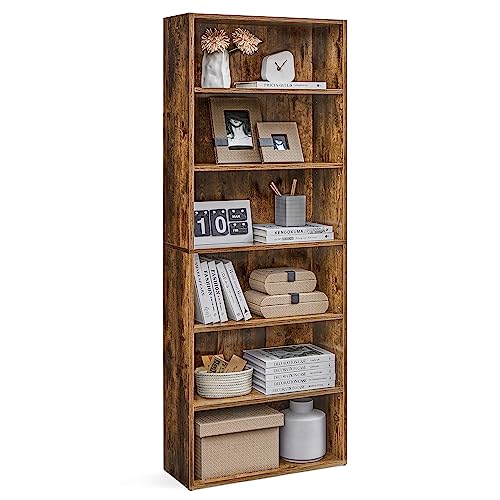
The VASAGLE’s steel frame and wood-look boards strike the balance most households are shopping for even when they cannot articulate it: enough shelves to separate books from display, spans short enough to keep boards honest under mixed loads, and an open structure that does not close down a modest room. Six levels sound like a specification; in use they become a system — reference and heavy hardcovers low, reading rotation at hand height, paperbacks above, and the top given to plants and the objects that benefit from being seen against the ceiling line. Adjustable feet level it on real floors, and once anchored it has the planted, silent feel that separates furniture from equipment.
Assembly is a conventional bolt-together job: clear sequencing, an unhurried hour, no exotic tools. The criticisms are the class’s criticisms — the open back wants bookends at row ends, the boards rather than the frame set the ultimate load ceiling, and the industrial styling, while broadly compatible, will not flatter a determinedly traditional room. None of these is a surprise, and that is precisely the recommendation: this is the category’s centre, executed without drama. Households that want one purchase to make and forget should start here. Check price on Amazon and confirm the current bracing and board specification before ordering.
A longer note on living with it, since the default recommendation carries the most responsibility: the VASAGLE’s shelves rearrange gracefully, which sounds minor and is not — the pin spacing accepts the tall-short-tall choreography of a real collection, and the frame tolerates the twice-yearly unload-and-reload of cleaning without loosening into creaks. Its finish wipes clean and hides scuffs in its texture, and the open sides make it the easiest unit in this roundup to dust around. If a household can only read one review in this article, this is the model whose review to read — and then to argue with, if the brief points elsewhere.
Best for: living rooms, mixed collections, first serious bookshelf. Not suited for: formal traditional rooms, archival collections.

Sauder 5-Shelf Bookcase — The Traditionalist
The brief: a home library or study that should look like furniture, keep dust off the collection, and swallow tall formats without negotiation.
Sauder’s five-shelf design is the enclosed branch of the family done properly. The full back panel transforms the frame’s stiffness — there is a solidity when you pull a book from a tight row that open frames work harder to match — and it keeps rows tidy from every angle, which matters in rooms where the shelf is seen from the side or behind. The adjustable shelves are the working heart of the piece: pin spacing accommodates binders, art books, and ordinary hardcovers in sensible combinations, and the enclosed sides mean no book ever slides out the back into the wall void, a small misery familiar to every open-frame owner.
The costs are weight, assembly time, and presence. This is a slower build — cam locks in quantity, a second pair of hands genuinely useful at the standing-up moment — and a heavier, more committed object once placed; it does not get casually moved for a party. It also claims its wall more assertively than an open frame, which small rooms feel. In exchange, the study or library that hosts it looks finished in a way open shelving rarely achieves, and the collection behind its panel gathers dust at a fraction of the open rate. The long-running argument between the two branches is dissected in bookcase vs bookshelf; households that have already chosen enclosure should simply choose this. Check price on Amazon for the current finishes.
Best for: studies, home libraries, tall formats, dust-sensitive collections. Not suited for: frequent movers, very small rooms.
Furinno Turn-N-Tube 5-Tier Bookshelf — The Light-Duty Honest Broker
The brief: a dorm, a first rental, a spare room — anywhere a shelf is needed now, cheaply in tier terms, without tools, deposits, or long-term commitment.
The Turn-N-Tube’s party trick is genuine: the shelves connect with threaded tubes that twist together by hand, so the unit stands within minutes of opening the box, with no Allen key archaeology and no leftover screws to wonder about. It is light enough to carry under one arm, which makes it the only model in this roundup that a person can move house with in a hatchback alongside everything else they own. For paperbacks, a games console’s worth of accessories, plants, and display, it performs its brief cheerfully and without pretension.
The reviewer’s duty is the boundary, stated plainly: the boards and tube joints are light-duty. A full row of hardcovers is beyond the design’s intent, and treating it as a library shelf produces the bowed, wobbling outcomes that unfairly colour the whole category’s reputation. Anchoring still applies — light does not mean exempt from gravity — and the plastic-tube aesthetic reads as temporary, because it is. None of this diminishes the product; it defines it. Bought for a season of life rather than a decade, the Furinno is the most honest money in this roundup. Check price on Amazon.
It also deserves credit for a virtue the heavier models cannot claim: it is the only shelf here that a household can experiment with. Unsure whether a bookshelf belongs on that wall at all? The Furinno answers the question for a season at entry-tier commitment, and if the answer is yes, it retires gracefully to a spare room or a child’s den when the permanent frame arrives. As a pilot purchase, it has no rival in the field.
Best for: students, renters, temporary setups, light loads. Not suited for: hardcover libraries, climbing households, long-term family service.

IRIS USA 3-Shelf Wide Bookshelf — The Children’s Specialist
The brief: a nursery or child’s bedroom where the reader is under four feet tall and the books are read twenty times each.
Every dimension of the IRIS unit serves its small reader. The low, wide stance puts every shelf within a toddler’s reach, which is not a convenience but the entire educational point: children choose books they can see and reach, and a shelf a child can use unaided gets used daily. The moulded construction rounds away the sharp corners that adult furniture takes for granted, and the surfaces wipe clean after the incidents that children’s furniture exists to survive. The shelves are sized for picture books and small storage bins, and the whole piece can be re-purposed — toys, then games, then craft supplies — as the child grows through it.
Adult expectations must be checked at the door: this is not a small version of a library shelf, and it will flex under loads it was never meant to carry. It also anchors like everything else in this roundup — low centre of gravity reduces risk, it does not repeal it. Within its brief, though, it is the easiest recommendation in this article: the right furniture at child height changes reading behaviour more than any number of bedtime intentions. Pair it with a small chair and a lamp and you have built a reading corner; the seating options in chairs sized for young readers and small spaces complete the set. Check price on Amazon for colours.
Best for: nurseries, playrooms, early readers. Not suited for: adult collections, display-led rooms.
Nathan James Theo Ladder Bookcase — The Stylist
The brief: a corner, bedroom, or entryway that needs beauty and light storage more than it needs capacity.
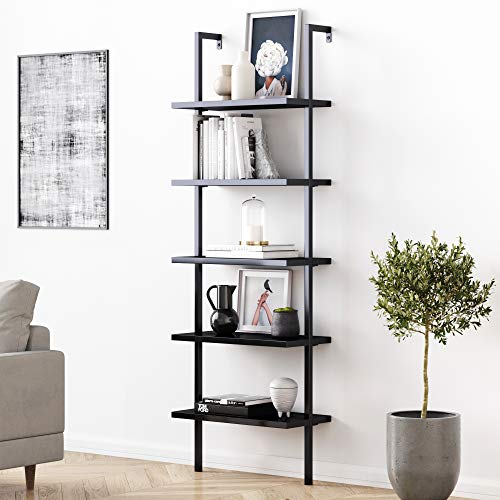
The Theo leans. That single design decision — a ladder profile resting against the wall, shelves deep at the base and shallow at the top — gives it a silhouette no straight frame can match, and in photograph after photograph it earns its place. In person it earns it too, provided the brief is honest: this is display furniture with book storage in a supporting role. The deep base shelf takes a proper row of hardcovers or a storage basket; the middle shelves mix paperbacks with framed prints and ceramics; the top shelf is for the plant, the small speaker, the object you want at eye level. Curated this way, it looks like a magazine page and functions like one.
The constraints are structural facts, not flaws: shallow upper shelves refuse oversized volumes, total capacity is a fraction of a standard frame’s, and the lean makes wall fixing an absolute condition of use — an unanchored ladder shelf is a ladder, and ladders fall. Assembly is straightforward, the finish options suit modern and transitional rooms, and the footprint is among the smallest in this roundup. Buyers whose collections are mostly objects with a bookish accent will be delighted; buyers with three metres of hardcovers should walk past it to the VASAGLE or the Sauder without a backward glance. Check price on Amazon.
Best for: display corners, bedrooms, entryways, décor-led rooms. Not suited for: bulk storage, oversized formats, unanchorable walls.

Tribesigns 5-Tier Industrial Bookcase — The Braced Workhorse
The brief: a study, loft, or plant-and-book wall where the open frame’s usual weakness — sideways sway — is the specific thing the buyer refuses to accept.
Tribesigns builds its five-tier around a heavier steel frame with X-bracing across the back, and the bracing is the review: it converts the open rectangle into triangulated structure, and the difference is immediately feelable in the sideways-push test that sets lesser frames swaying. The shelves run deep enough for storage baskets, board games, and larger volumes alongside book rows, and the whole piece has a planted, workshop-honest character that suits lofts, studies, and modern farmhouse rooms. Plant people should note the combination particularly — open sides, strong shelves, and light from three directions make this the roundup’s best greenhouse-that-holds-books.
It remains an open design, with the dust and exposure that implies, and its industrial voice is loud: in a quiet traditional room it will argue with the furniture. The boards, as ever, set the load ceiling rather than the frame, so the heaviest rows still belong low. But for buyers whose hesitation about the whole category is structural confidence, this model is the direct answer, and its bracing should be the feature you demand — here or in whichever frame you choose. The two-sided summary of the type is in bookshelf pros and cons. Check price on Amazon.
One situational note from the assessment: of the six models, this is the one that best tolerates being placed away from a wall’s full support — in a loft corner, against a partial wall, at the end of a run — because its bracing does work the other open frames delegate to the anchor alone. The anchor is still mandatory; but the Tribesigns is the frame whose unanchored moment during assembly feels least like a warning, and that underlying stiffness is what owners are actually paying for.
Best for: lofts, studies, plant walls, structural sceptics. Not suited for: formal rooms, dust-averse bedrooms.
The Field at a Glance
| Model | Type | Tier | Assembly | Choose it for |
|---|---|---|---|---|
| VASAGLE 6-Tier | Open steel frame | Mid | Standard bolts, about an hour | The all-round living-room answer |
| Sauder 5-Shelf | Backed bookcase | Mid | Cam locks, two-person moments | Libraries, studies, tall formats |
| Furinno Turn-N-Tube | Tool-free tube frame | Entry | By hand, minutes | Rentals, dorms, light loads |
| IRIS USA 3-Shelf | Low moulded | Entry | Simple, quick | Children’s rooms |
| Nathan James Theo | Ladder | Mid | Standard, plus wall fixing | Display and small footprints |
| Tribesigns 5-Tier | Braced industrial | Mid | Standard bolts | Stiffness and deep shelves |
Read the table by brief, not by row order: the models are arranged by the sequence of the reviews, not by merit, because merit in this category is a function of the household asking. The next section converts briefs into choices.
Head-to-Head: The Comparisons Buyers Actually Make
VASAGLE 6-Tier vs Tribesigns 5-Tier
The two steel frames are the roundup’s closest contest, and the separation is philosophical. The VASAGLE optimises for levels and lightness — more shelves, a gentler presence, the safer choice in a room that is not sure it wants industrial furniture. The Tribesigns optimises for stiffness and depth — fewer, deeper shelves, X-bracing you can feel, and a workshop character that commits the room to its style. Under identical mixed loads both behave well; under a sideways shove the Tribesigns is calmer; in a small bright room the VASAGLE disappears more gracefully. Choose by the room’s tolerance for the industrial voice, and by whether your storage runs to many small things or fewer large ones.
Sauder 5-Shelf vs Every Open Frame Here
This is the category’s fork in the road, and it is decided by two questions. Do you want to see everything you own on these shelves, styled and browsable — or do you want the collection kept, protected, and visually quiet? And how much dust does your home generate, and how much do you mind wiping it? Open frames win the first question’s display half and lose its dust half every time; the Sauder inverts both. There is no specification that overrides the answers, which is why this roundup refuses to crown one branch. The households that agonise longest are usually the ones that need both — and end up, sensibly, with an open frame in the living room and the Sauder in the study.
Nathan James Theo vs a Standard Frame
Buyers cross-shop the ladder against standard frames because both are “a bookshelf for that corner,” and the comparison exposes the brief. If the corner’s job is a curated vignette — plant, prints, a dozen loved books — the Theo does it with a flair no rectangle matches. If the corner’s job is to absorb a metre and a half of shelving need, the standard frame does it at roughly double the capacity and the ladder becomes an expensive ornament standing in front of an unsolved problem. Neither product fails this comparison; briefs do. Write the corner’s job down in one sentence before choosing, and the sentence chooses for you.
Reading the Tier System Honestly
These reviews position models by tier rather than price because the tier, honestly read, tells you what you are actually buying. The entry tier buys materials economy: thinner boards, simpler fixings, lighter frames — and, used within its design intent, perfectly respectable service for light loads and shorter horizons. The mid tier buys construction: frame stiffness, board substance, adjustability, and hardware that survives re-tightening and re-assembly. The premium tier buys joinery, solid materials, and furniture presence — real goods, but goods whose absence the mid tier’s buyers will rarely feel.
The trap is expecting one tier to perform another’s job. An entry-tier shelf loaded like a mid-tier one generates the sag-and-wobble folklore that haunts this category; a premium shelf bought for a one-year tenancy wastes its virtues on a calendar. The roundup’s models sit where they sit deliberately: Furinno and IRIS own the entry tier for light and children’s duty respectively, and the other four contest the mid tier from different directions. Nothing in this article requires the premium tier, because the mid tier, honestly constructed, already delivers the decade of service most households are buying. Spend the difference on books.
What None of These Six Will Do
Roundups owe readers the category’s shared limits. None of these models is archival storage: valuable, old, or light-sensitive books belong behind glass or doors, on shaded walls, in stable humidity — conditions open shelving does not provide. None is a substitute for built-in joinery where a wall demands an exact fit; freestanding frames leave gaps at top and sides that only pelmets and planning disguise. None will survive being treated as a ladder, a seat, or a climbing frame — they are storage furniture with a safety system, and the safety system assumes the anchor is fitted and the loads are sane. And none will make a non-reading household into readers by itself; the shelf enables the habit, it does not install it. Within those honest boundaries, all six perform. Outside them, no bookshelf at any tier will save the brief.
Choosing by Room and Household
The family living room should default to the VASAGLE for open display or the Sauder where dust and formality argue for enclosure — and should treat the choice as the room’s anchor decision, since seating, rug, and lighting will arrange themselves around it. Coordinate the floor with rugs that ground a living room and the seating with the reading-corner logic in the reviews above.
The small flat should measure twice and choose between the ladder’s tiny footprint and a tall standard frame’s capacity, with the Tribesigns as the answer when the flat doubles as a workspace and the shelf must feel like architecture. Compact-format alternatives are gathered in bookcases chosen for small spaces.
The child’s room has the easiest decision in this article: the IRIS, low and reachable, anchored regardless. The harder decision is the second shelf — the one in the parents’ room or the living room where the family’s shared books live — and there the family-living-room advice applies.
The rental should weigh the Furinno’s painless logistics against the tenancy’s length: under two years, light-duty wins; beyond that, a mid-tier frame’s service justifies its moving cost, provided the lease permits the anchor fixing. Ask the landlord before the shelf arrives, not after the hole exists.
The study and the collector should buy construction first — Sauder for enclosure, Tribesigns for braced openness — and size for the collection plus half. The value reasoning is laid out in is a bookshelf worth it, and the traditional end of the market in bookcases styled for modern homes.
What the Assessment Weighted Most
Review methods should declare their biases, so here are this roundup’s. Stiffness was weighted above almost everything, because it is the quality owners feel daily and the one that cannot be retrofitted — a shelf either sways or it does not, forever. Adjustability came second, because collections are unruly and fixed gaps waste the space households bought the shelf to gain. Assembly honesty came third: not speed, but whether the instructions and hardware let an ordinary tired person produce a square frame on the first attempt. Finish and styling were weighted last and least — not because they do not matter, but because they are the qualities a buyer can judge perfectly well from a photograph, and a review earns its keep on the qualities a photograph hides. Readers who weight the criteria differently should still find their model here; they will simply arrive at a different row of the table, which is what a field of honest alternatives is for.
Styling Notes for Each Type
The reviews judged construction; this section judges the finished picture, because a bookshelf’s second job is looking like it belongs. The open steel frames — VASAGLE and Tribesigns — style best with rhythm: runs of books broken by horizontal stacks, one repeated material (baskets, ceramics, or timber boxes) appearing on several shelves to tie the grid together, and the largest objects low. The Sauder styles like furniture: symmetrical groupings, breathing room on the top shelf, and respect for its formality — it forgives clutter least and rewards editing most. The ladder styles itself if you let the graduation work: heavy and large at the base, light and small at the top, one trailing plant over the top edge. The IRIS needs no styling at all beyond a small person’s enthusiasm, which it will receive. The Furinno, frankly temporary, looks best treated as such — bright, light, unpretentious — rather than dressed up as something it is not.
Two styling rules apply across all six. Leave roughly a third of the shelf length empty; a shelf at full capacity reads as storage, a shelf at two-thirds reads as a library, and the difference is entirely the air. And light the shelves if the room allows it — a lamp on a middle shelf, a picture light above a backed case — because books under warm light are the single most reliable route to a room that feels finished after dark. The seating that faces the finished wall matters as much; a shelf admired from a good chair is a shelf doing its full job, which is why the reading-corner pairings recur throughout this cluster.
Delivery, Returns, and the Practical Print
Furniture bought online lives or dies on logistics, so the practical notes belong in the reviews. All six models ship flat, which keeps delivery simple and the boxes carryable by one person in most cases — the Sauder’s box is the heaviest and deserves a second pair of hands from the doorstep. Inspect panels and hardware before assembly, not during: a damaged board discovered at step nine is a week of delay, while the same board photographed at unboxing is a routine replacement part. Keep the packaging until the unit is standing, square, and anchored; returns of assembled furniture are miserable for everyone, and most issues in this category announce themselves in the first hour.
Read the warranty and parts policy with the same care as the dimensions. The manufacturers represented here differ in how gracefully they handle a missing cam lock or a board damaged in transit, and a ready spare-parts channel is worth real money across a decade of ownership — pins get lost in every house move, and the brand that mails you a replacement bag is the brand whose shelf is still standing in fifteen years. Finally, measure your doorways and stair turns against the longest panel, not the assembled unit: flat-pack forgives much, but not a panel longer than the turn in a Victorian staircase. The households in the best bookshelves roundup for every room learned these lessons so you do not have to.
What Ownership Actually Involves
Across all six models, the ownership rhythm is the same liturgy at different scales. Assembly day ends with anchoring — the step-by-step, including stud-finding and strap tension, is in how to install a bookshelf — and loading follows the gravity rules: heaviest low and centred, fixed shelves carrying the densest rows, top shelves kept light. Monthly, a two-minute surface dust. Twice a year, a full unload and wipe that doubles as an inspection: boards sighted for bow, fixings re-tightened, anchor tension checked, feet re-levelled. That is the entire maintenance budget of the category, and the models differ only in how forgiving they are when the rhythm slips — the braced and backed designs forgive most, the light-duty design least.
The other ownership constant is rearrangement. Every household re-shelves within the first month and re-purposes at least one shelf within the first year; the models with the most flexible pin spacing absorb these changes without complaint, which is why adjustability scored so heavily in the assessment method. A bookshelf is not finished when it is assembled. It is finished, briefly, every time it is loaded — and then life resumes editing it.
Matching Finishes Across the Field
Because several households will combine two models from this roundup — an open frame in the living room, the Sauder in the study, the IRIS in the nursery — finish coordination deserves a reviewer’s paragraph. The honest headline is that cross-brand matching is approximate at best: one manufacturer’s walnut is another’s espresso, and printed grains differ in pattern as well as tone. The workable strategy is coordination by temperature and contrast rather than by name. Put warm-toned pieces in warm rooms and let different models differ in depth; a light oak ladder and a deep-toned backed case read as a deliberate pairing, while two almost-matching mid-browns from different brands read as an error.
Within a single brand family, matching is reliable, which is the practical argument for growing a library wall inside one manufacturer’s range. Between rooms, exact matching matters far less than households fear — doorways forgive what open plans do not. And black steel, shared by several frames in this field, is the great coordinator: it pairs with nearly every board finish and lets two different open frames coexist in one room without a tonal argument. When in doubt, order the finish sample or judge from the listing’s least-styled photograph; the lifestyle images are lit to flatter, and the flat product shot is the honest one.
The Second-Hand Verdict on These Types
Because bookshelves live long, the used market is a legitimate rival to this entire roundup, and the reviews would be incomplete without grading it. Backed bookcases and steel frames travel best through second lives: their construction survives disassembly, their failure modes — bow, rack, split fixing points — are visible at inspection, and a sound used example of either type is often the best value in the category. Ladders travel adequately if the wall fixings come with them. Light-duty tube frames travel worst, not because they are poorly made but because their fixings and boards have the least margin for a second assembly and a second household’s loads; buy those new, where their low tier makes the new price painless anyway.
Inspect any used shelf as these reviews inspected the new ones: sight along each board for bow, push for rack, check that shelf pins and spare fixings exist, and confirm the anti-tip hardware is present or replaceable. Smell the compartments — damp storage writes itself into board and is nearly impossible to evict. A used shelf that passes is a bargain with a proven service record; one that fails is someone else’s disposal problem priced as furniture. Walk away from the second kind without negotiation.
Growing From One Shelf to a Library Wall
Many households in this roundup’s audience will buy a second unit within a few years, so the reviews close with the growth question: which of these models scales gracefully? The standard frames scale best. A second VASAGLE beside the first reads as one library wall, tops aligned by the adjustable feet, and a third completes the architecture; the same logic serves the Tribesigns in a larger, more industrial room. The Sauder scales with more formality and more commitment — two backed cases flanking a desk or a fireplace make the classic library elevation, and the pair will anchor a study for as long as the household keeps one.
The specialists scale differently. Ladders do not multiply well — two leaning shelves side by side look like a shop display — so the Theo should be bought as a singleton and loved as one. The Furinno multiplies cheaply and temporarily, which is a legitimate strategy for a household in flux: a wall of light-duty shelving for a two-year chapter, replaced by permanent frames when life settles. The IRIS graduates rather than multiplies, handing its room down to a standard frame as the reader grows. The planning principle across all of them is the one this cluster repeats: buy within a product family whose finishes and heights match across sizes, place the first unit at one end of its eventual run, and leave the expansion direction free of radiators and door swings. The full planning treatment is in planning a whole wall of shelving.
How the Rankings Shift for Renters and Parents
Two audiences should re-weight this roundup’s conclusions. Renters should promote the Furinno two places and interrogate every other model’s anchor arrangements against their lease: a mid-tier frame is a fine rental purchase only where one discreet fixing is permitted, and a deposit is a terrible price for a bookshelf. Where fixings are banned outright, the honest shortlist is low, wide, and bottom-loaded — and the IRIS’s design language, scaled up, is the pattern to imitate. Parents should promote the IRIS for the child’s room without hesitation, and apply a climbing test to every other room’s choice: anchored, heavy-low, nothing tempting and breakable at the top. Neither audience is an edge case; between them they are most of the market, and the category serves both well precisely when the brief is stated as plainly as this section states it.
The Verdict Across the Field
If this roundup must name names: the VASAGLE 6-Tier is the default recommendation for the largest number of households, because the common brief — a living room that reads and displays — is exactly its brief. The Sauder is the connoisseur’s choice where enclosure serves the collection, the Tribesigns the engineer’s choice where stiffness is the demand, the Theo the stylist’s, the IRIS the parent’s, and the Furinno the pragmatist’s. A roundup that pretends one of these defeats the others misunderstands furniture. What unites the six is that each is honest about its brief — and the buyer’s corresponding duty is to be honest about theirs. Measure the wall, measure the books, name the household, and the correct row of the table selects itself.
A final word on timing. Bookshelves are not seasonal purchases, and there is no clever week of the year that changes the fundamentals — the right time to buy is when the wall is measured, the anchor plan is settled, and the collection has outgrown its piles. Buy then, buy the construction your brief demands, and let the reviews above retire gracefully into the background of a room that works.
After the Boxes Are Gone: Long-Term Ownership Notes From Bookshelf Reviews
Most bookshelf coverage stops at unboxing, yet almost everything that decides owner satisfaction happens afterwards. The first evening tells you about finish and first impressions; the third month tells you about durability, upkeep and whether the design still suits the way your household actually behaves. This section looks at the ownership phase in detail — the settling-in period, the first signs of wear worth watching for, and the small habits that separate owners who stay pleased from owners who start browsing replacements. If you are weighing VASAGLE 6-Tier Bookshelf, Sauder 5-Shelf Bookcase or any similar design, treat the points below as the questions a good long-term review should answer.
The Settling-In Period: What Changes in the First Weeks
New materials and mechanisms relax. Fabrics soften, joints settle, finishes lose their showroom sharpness, and moving parts either bed in smoothly or start to complain. With a bookshelf, use the first fortnight deliberately: operate everything daily, check fixings once after the first week, and keep a mental note of any sound, wobble or resistance that was not there on day one. Changes that stabilise after a small adjustment are normal settling; changes that keep progressing are early warnings, and they are far easier to raise with a seller while the purchase is recent.
Wear Worth Watching, and Wear Worth Ignoring
Not all wear is failure. Honest materials in the living room furniture category develop a patina — slight softening of edges, gentle colour shifts where hands and light fall — and most owners come to like it. The wear that matters is functional: looseness that returns after tightening, surfaces that mark from ordinary use rather than accidents, parts that need persuading, and finishes that fail at edges and corners first. Check those high-contact zones on any bookshelf you already own, and look for honest close-up photographs of exactly those zones when you judge a replacement.
A simple ownership routine keeps a bookshelf performing the way the early reviews promised:
- Once a month, spend two minutes checking fixings, feet, seals or moving parts — whichever your bookshelf relies on — and correct small changes before they compound.
- Clean little and often with the mildest method that works, rather than rarely and aggressively, and always test any new cleaner on a hidden patch first.
- Rotate, rest or reposition the bookshelf if one side takes all the light, heat or traffic, so wear spreads evenly instead of concentrating.
- Keep the manual, spare parts and any touch-up materials together in one labelled place; the day you need them is never the day you want to search.
- Photograph the bookshelf once a year from the same spot; comparing pictures is the most reliable way to notice slow change you would otherwise miss.
If two people in the household disagree about the bookshelf, let the person who will use or maintain it most have the deciding vote on practical questions. Beware of buying for the household you hope to become; the bookshelf that serves the household you already are will be used this week, not someday. A tape measure, a spirit level and ten patient minutes prevent more bookshelf regrets than any amount of comparison shopping after the fact. When a listing is vague about a dimension, material or included part that matters to you, treat the vagueness itself as information and look for a clearer seller. Photograph your room at the time of day you will use the bookshelf most, and compare candidates against that light rather than against bright midday photographs. Small households should weight compactness and easy storage more heavily, while large households should weight durability and simple operation, because the failure modes differ. If the bookshelf will serve children or older relatives, test the key actions with the weakest grip and the shortest reach in the house in mind. Leave a little capacity unused — in size, storage or power — because a bookshelf run permanently at its limit ages faster and annoys sooner than one with headroom. Notice which parts are replaceable and which are not; a bookshelf whose wear parts can be swapped cheaply often outlasts a sealed design twice its price in spirit, if not in years. Consider the bookshelf from the perspective of the person who cleans around it, because designs that trap dust, block access or demand special products quietly tax every week of ownership. Think about noise, light and heat as neighbours of the bookshelf, not afterthoughts, since a choice that performs well but disturbs the room around it rarely stays popular for long. Remember that guests experience your bookshelf without instructions, so anything that needs explaining, warning or demonstrating is worth simplifying before it is worth defending. Plan for the bookshelf to be moved at least twice in its life — for cleaning, redecorating or a change of room — and favour designs that forgive being shifted, tilted or carried. Look at the edges and undersides when you judge build quality, because those are the places makers save money first and the places owners discover last. Ask how the bookshelf behaves on your worst floor, wall or surface rather than your best one, since homes are uneven and listings are photographed in perfect rooms. Keep the receipt, delivery note and a photograph of the label together, because warranty conversations go smoothly when dates and model details are at hand.
Ownership rewards attention in small doses. A bookshelf that is checked monthly and cleaned gently will usually outlast a neglected premium model, and it will certainly stay pleasanter to live with. Judge any review — including the detailed assessments earlier in this guide — by whether it helps you through this long middle phase of ownership, because that phase, not the unboxing, is where the money is really spent.
Frequently Asked Questions
Which bookshelf in this roundup is best for a small apartment?
It depends on whether your constraint is floor space or storage need. For pure footprint, the Nathan James Theo ladder occupies the least floor and keeps a room feeling open. For capacity per square foot, a tall standard frame such as the VASAGLE stores far more on a similar strip of wall. Renters in small spaces should also weigh the Furinno’s moving ease. Measure your wall and your collection; the arithmetic, not the aesthetics, should choose.
Are any of these bookshelves suitable for a full hardcover library?
The Sauder and the Tribesigns are the roundup’s serious load-bearers, and the VASAGLE handles a mixed library comfortably when loaded with the heavy rows low. The Furinno is explicitly light-duty and should not be given a hardcover library; the IRIS is a children’s unit; the Theo is display-first. In every case the manufacturer’s per-shelf limit for the specific model governs, and dense sets should be split across shelves.
How difficult is assembly across these models?
The Furinno assembles by hand in minutes. The open steel frames — VASAGLE and Tribesigns — are standard bolt-together jobs of about an hour. The Theo is similarly straightforward, plus the mandatory wall fixing. The Sauder is the longest build, with many cam-lock fixings and a moment where a second person is genuinely needed. None requires more than basic household tools, and all reward the discipline of squaring the frame before final tightening.
Do all of these bookshelves need to be anchored to the wall?
Every tall unit does, without exception — the anchor is part of the product’s safety system, not an accessory. The low IRIS unit should also be anchored in a child’s room, because children climb furniture that adults consider unclimbable. Anchoring means fixing to a stud or a properly rated wall fixing, not merely into plasterboard. If your lease forbids fixings entirely, choose low and wide formats and load them bottom-heavy.
Which model is best for a child’s bedroom?
The IRIS USA 3-Shelf, by design: low enough for a toddler to use unaided, rounded, wipeable, and sized for picture books. The deeper point is that child-height access changes reading behaviour — children browse what they can reach. Keep tempting objects off any higher shelves elsewhere in the home, anchor everything, and expect the unit to be re-purposed for toys and games as the reader grows.
How do I choose between the open frames and the backed Sauder?
Decide on visibility and dust. Open frames display everything, gather dust on everything, feel lighter in the room, and move house more easily. The backed bookcase hides and protects, reads as formal furniture, and stiffens the whole structure with its panel. Specifications will not separate them further than that single question does — which is why so many households end up with one of each, in different rooms.
Related Guides
Continue within this cluster: the single bookshelf reviewed in depth, the bookshelf buying guide, bookshelf pros and cons, and the best bookshelves in one roundup.


