Disclosure: As an Amazon Associate, dailyhomedecorating.com earns from qualifying purchases. Links on this page are affiliate links; they cost you nothing extra. Prices and availability change often, so check the current Amazon listing before you buy.
Every purchase is a trade, and window fan pros and cons deserve a more honest hearing than they usually get. Marketing lists the pros; the angriest complaints list the cons; neither tells you which of them will actually matter in your home, with your windows, in your climate. This article gives both sides their full weight — the genuine, lived advantages that make owners loyal to these simple machines, and the genuine limitations that no brand, tier or clever feature list can remove — then translates the balance into guidance for different households, so the verdict you reach is yours rather than ours.
The quick verdict: the pros are about value, simplicity and evenings transformed; the cons are about physics, weather and windows. A window fan suits households whose nights cool down, whose windows are double-hung, and who will run the fan as a habit rather than an event. It does not suit households needing true cooling in hot-night climates, homes whose windows crank outward, or anyone unwilling to accept that a fan in a window is neither weatherproof nor a locked window. Everything below is the evidence for that verdict, argued fairly from both sides.
Key Takeaways
- The biggest pro is disproportionate comfort for very modest money and effort: real air exchange, installed in minutes, run for pennies of effort.
- The biggest con is absolute: a window fan cannot cool air, so hot nights defeat it completely.
- Reversibility is the quiet superpower — one appliance importing the evening and exporting cooking smells and stale air.
- The window trade-offs are real: the window leaves service, rain must be kept out by you, and the opening is not secure while the fan sits in it.
- Most remaining cons — noise, insects, dust — are installation problems in disguise and shrink with a snug, sealed fit.
Window Fan Pros and Cons: The Pros
Pro: Real Air Exchange, Not Recirculation
Most fans move a room’s own air around and call it cooling. A window fan does something categorically better: it swaps the room’s air for the outdoors’. On any evening when outside is cooler than inside — which, in most climates, is most evenings of the warm season — that swap is genuine cooling delivered by the simplest possible mechanism. The room does not just feel different; its air is different, fresher and cooler in measurable fact. This single advantage is the reason the category exists and the reason owners defend it. A pedestal fan can make a hot room tolerable; a window fan, on the right evening, can make it actually cool, and no amount of recirculation at any price achieves that.
Pro: Two Appliances in One — Intake and Exhaust
Reversibility doubles the product. The same unit that imports the night also exports the day: cooking smells after a fry-up, steam after a shower in a bathroom with no extractor, the stale fug of a home office at the end of a working day, paint fumes, pet odours, the general closeness of a house that has been shut against the heat. Each of those jobs would otherwise want its own solution, several of them involving tradespeople. A reversible window fan handles all of them with a switch. Owners consistently report that the exhaust half of the fan’s life — the half they did not buy it for — becomes the half they would not give up.
Pro: Trivial Cost and Effort Compared With Cooling
Set a window fan beside the alternatives and the arithmetic is lopsided. It costs a fraction of any air conditioner to buy, installs in minutes with no tools, no brackets, no drainage and no professional help, and runs at a small fraction of an air conditioner’s appetite. It asks for no floor space, stores flat in a cupboard all winter, and moves house with renters as easily as a suitcase. None of this makes it a substitute for air conditioning in a heatwave; it makes it the obvious first purchase, the tool that covers the long run of ordinary warm weather so cheaply that the expensive tool can rest until it is truly needed.
Pro: Sleep-Friendly in a Way Air Conditioning Is Not
A window fan on its low setting produces the steadiest sound in the cooling world, and steady sound is a sleep aid: it masks the irregular noises — the passing car, the neighbour’s dog, the house’s own creaks — that are what actually wake people. It cools the sleeper directly with moving night air rather than chilling the whole room to a uniform frigidity, and a thermostat prevents the small-hours over-chill that makes air-conditioned bedrooms feel like hotel rooms. Many owners run their fans on mild nights they could manage without, purely for the sound and the moving air. That is a pro no specification sheet captures.
Pro: It Rests Your Air Conditioning and Your Conscience
In homes that have air conditioning, a window fan still earns its window. Shoulder seasons are full of days too warm for a sealed house and too mild for the compressor; the fan covers them. Evenings after a hot day can be flushed with outside air instead of refrigerated air. The result is fewer compressor hours, lower running effort across the season, and a house that smells like the outdoors sometimes instead of like a sealed system always. Owners who track such things report the fan paying for itself in avoided air-conditioning hours within a season or two, though the honest claim is simpler: it gives the expensive machine days off, and the house is more pleasant for it.
Pro: No Installation, No Permission, No Trace
The window fan is the renter’s cooling appliance and the listed building’s friend. It needs no holes, no brackets, no landlord negotiation and no electrician; it leaves the window exactly as it found it; and when the tenancy or the season ends it comes out in two minutes. The same quality serves owners who are simply unsure: a window fan is a reversible decision in every sense, cheap to try and easy to undo, which cannot be said of any fitted alternative. In a market of permanent commitments, an effective appliance that commits you to nothing is a genuine and underrated pro.
In this guide
The Cons
Con: It Cannot Cool Air — Hot Nights Defeat It
The limitation that defines the category. A window fan’s entire method is exchange, so when the night refuses to cool — heatwaves, humid spells, tropical climates — the fan imports air as hot as the air it replaces and the room stays hot, now with added noise. No tier, brand or feature changes this. Households in hot-night climates who buy a window fan as their only defence will be miserable exactly when they most need relief, and they will blame a product that never claimed otherwise in its honest descriptions. The con is not that the fan fails; it is that its success is conditional on weather it does not control.
Con: One Fan Moves a Modest Amount of Air
A single window fan is a room-scale tool. Expectations of whole-house transformation from one unit lead to the category’s most disappointed reviews. Real whole-house effect requires arrangement — a second fan in push-pull, open windows, hours of running — and even then the effect is a slow flush, not a transformation. Buyers must either scale their expectations to one room done well, or scale their setup to two fans and a deliberate airflow path. The fan is honest about its output; the con appears when the household’s hopes are not.
Con: The Window Is Out of Service, and Not Secure
While a fan is installed, its window cannot open for a breeze, cannot serve as an escape route, and — the point too many reviews soften — is not a secure window. A fan held by a lowered sash yields to a determined push far more easily than a locked window does. Ground-floor households, and anyone leaving the home empty, must treat this seriously: remove fans and lock up when away, consider a sash block, and think twice about fan-filled windows in vulnerable spots. It is a manageable con, but it is a real one, and managing it is the owner’s job.
Con: Weather Is Your Problem
A window fan is not weatherproof. Rain driven at the window reaches motors and controls; a storm can push water through the grille onto the sill and floor. The owner’s routine must include the weather: fan off and window closed, or fan removed, whenever rain threatens. Owners who build the habit lose nothing; owners who do not eventually lose a fan, and possibly a windowsill’s paint, to a single wet night. Fitted extraction and air conditioning do not ask this of anyone, and the difference is a fair entry on the con side of the ledger.
Con: Window Compatibility Is Narrower Than Buyers Assume
The standard twin fan fits one window type well — the double-hung — and the housing stock of the world contains multitudes of sliders, casements and odd antiques that it does not fit. Casement windows that crank outward generally exclude the format entirely. Every season, fans are returned by buyers who measured nothing and assumed everything. The con is partly the product’s, for a format standardised on one window type, and partly the market’s, for listings that whisper the limitation. Either way, the burden of checking lands on the buyer before purchase, not after delivery.
Con: Noise, Insects and Dust Ride Along
A window fan is an open door, controlled. Air comes through it — and with the air, on badly sealed installs, come insects toward your lit room, street dust that mats the grilles, and the sound of the fan itself, which on high settings in a rattly frame is nobody’s lullaby. Each of these has a mitigation — bug screens, sealed panels, foam tape, the low setting — and mitigations are the point: the cons are manageable but they are managed by you, through installation care and cleaning habits, rather than engineered away. Households wanting a sealed, silent, maintenance-free solution are describing a different appliance at a different price.
What the Trade-Offs Mean for You
For the bedroom-focused household in a temperate climate, the balance is not close: the pros land every single night, and the cons are a weather habit and a cleaning habit. For the heat-belt household, the central con — no cooling on hot nights — outweighs every pro during the weeks that matter most, and the fan should be bought, if at all, as a shoulder-season supplement to real cooling. For the renter, the no-installation pro is decisive and the security con is managed by removing the fan when out. For the workshop owner, the calculus flips again: noise and weather matter little, exhaust power matters entirely, and the sturdier end of the market turns most cons irrelevant. The trade-offs do not change; your household’s weights do.
A useful way to decide is to count nights. Honestly estimate how many nights a season your home is uncomfortably warm while the outdoors is cooler — those are the fan’s winning nights, and in most temperate homes they number in the dozens. Then estimate the nights when both are hot: those belong to air conditioning or endurance. If the first number dwarfs the second, the pros win. If the second is your whole summer, believe it, and spend accordingly. Readers who want the short version of this arithmetic will find it in our verdict on whether a window fan is worth it.
| Alternative | Beats a window fan on | Loses to a window fan on |
|---|---|---|
| Air conditioning | True cooling in any weather | Cost, running effort, installation, freshness of air |
| Ceiling or pedestal fan | Works in any room, no window needed | Only recirculates warm air; no exchange, no exhaust |
| Fitted extractor | Weatherproof, secure, permanent exhaust | One direction, one room, needs installation |
How to Buy Smart
More window fans disappoint over fit than over airflow. A twin window fan is built for a double-hung window: the lower sash rises, the fan sits in the opening, expandable side panels close the gaps at the edges, and the sash comes down to rest on top of the unit and hold it in place. Measure the width of your opening before anything else, and check the fan’s stated window range against your measurement rather than against a guess. A fan stretched to the very end of its panel range seals poorly and rattles; a fan comfortably inside its range sits tight and quiet.
Sliding windows and casement windows are the awkward cases. A horizontal slider can sometimes take a fan mounted sideways if the manufacturer allows it, but many twin fans are not rated for that orientation, and a unit wedged insecurely is a unit that can fall. Casement windows that crank outward usually cannot host a conventional window fan at all, which is why they have their own category of solutions. Being honest about your window type at the buying stage saves a return later. If your windows are unusual, that is not a reason to give up on moving air — it is a reason to pick the fan style that matches the opening you actually have.
Then weight the decision by your dominant con. If noise is your fear, buy the calmest low setting and budget ten minutes for foam tape. If insects are your fear, buy the model with a proper bug screen and seal the panels like you mean it. If security is your fear, buy for the upstairs windows and keep ground-floor glass locked, or do not buy at all — that is also a smart outcome of a pros-and-cons article. The full step-by-step method lives in how to choose a window fan, and model-by-model assessments live in our window fan reviews.
Setup and Care That Reduce the Cons
Start with the rule that outranks all others: never run a fan with a damaged cord or plug. A cord that is frayed, pinched by the window sash, cracked at the plug or repaired with tape is a fire and shock risk, and no evening of cooler air is worth it. Route the cord so the sash never closes on it, keep it clear of the fan’s own blades and moving parts, and if the cord is damaged, the fan is retired or professionally repaired — those are the only two honest options. Plug directly into a wall outlet where you can, and treat a fan that trips a breaker, smells hot or buzzes electrically as a fan to unplug, not to monitor.
Weather is the second hard rule. A window fan is not weatherproof. Rain driven against the window can reach the motor and the controls, and a storm can push water straight through the grille into the room. The habit to build is simple: when rain threatens, switch off, and either remove the fan and close the window or at minimum close the window against it if your installation allows. Many owners learn this once, from a wet windowsill and a fan that never sounded right again. Build the habit before the lesson instead.
Guard the blades and respect them. The grilles on a window fan are there because fingers, paws and curious small hands explore. Keep grilles intact and properly seated, never run the fan with a grille removed, and position cords and controls so children and pets are not drawn to play around the unit. A window fan sits exactly at the height where a toddler on a bed or a cat on a sill can reach it, so a quick look at who shares the room with the fan is part of installing it responsibly.
Cleaning is safety’s quieter half. Dust caked on blades and grilles cuts airflow, adds noise and makes the motor work harder than it should. Unplug the fan, wipe blades and grilles with a damp cloth, let everything dry fully before running it again, and check the cord and plug while you are there. At the end of the season, clean the fan before storage, coil the cord loosely, and store the unit somewhere dry. A fan that is cleaned twice a year and stored dry will outlast a neglected one by years, and it will move noticeably more air the whole time.
Noise, Sleep and Living With the Fan
Every window fan makes noise; the question is what kind. On its lowest setting a decent twin fan settles into a steady wash of sound that many sleepers actively like, because it masks the irregular noises — traffic, neighbours, a dog two gardens away — that actually wake people. Higher settings add motor hum and the chop of air through the grille, and a poorly fitted fan adds the worst sound of all: a rattle, where the unit vibrates against the sash or its own loose panels buzz in sympathy. Most noise complaints traced back to installation end at the rattle, and most rattles end with foam tape and a snugger fit.
For a bedroom, judge a fan by its lowest setting, not its highest. The top speed is for the first hour of the evening, flushing the day’s heat out while you are still up. The low speed is the one that runs all night, and it is the one you will live with. A fan whose low setting is still intrusive will end up switched off at two in the morning, and a switched-off fan moves no air at all. Controls matter here too: a thermostat that cycles the fan off once the room reaches your chosen temperature saves you from waking cold, and a remote saves you from getting up — small things that decide whether the fan becomes a habit or a nuisance.
Placement can soften noise more than specification sheets suggest. A fan pulling air in from a window away from the bed, with the stream crossing the room, feels quieter than the same fan in the window beside the pillow, even at the same setting. In a push-pull pair, put the quieter fan in the bedroom and let the louder one work from a hallway, bathroom or landing window where its voice matters less. And give any new fan two or three nights before judging it: the first night you hear it, the third night you mostly hear through it, which is exactly how steady background sound is supposed to work.
Picks That Balance the Pros and Cons

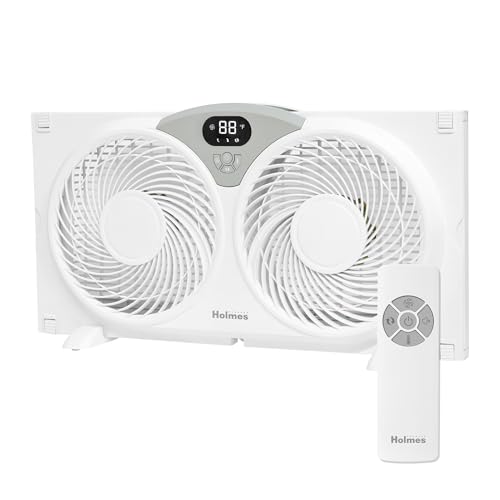
Holmes Twin Window Fan
In short: a long-running twin-blade design with straightforward controls and a thermostat on many versions. What follows is an honest prose assessment — positioning is qualitative, in the entry-to-premium range of the category, and final verification of this pick is pending, so treat it as guidance to compare against the current listing rather than a lab verdict.
For households whose balance sheet lands positive, the Holmes twin is the low-regret way to act on it: reversible, thermostat versions, standard fit. It embodies the category’s pros — exchange, simplicity, value — with the category-average cons and no surprises in either column.
Best for: households whose pros clearly outweigh the cons. Not suited for: households still undecided — read the cons again first.

Comfort Zone Twin Window Fan
In short: a reversible twin design with expandable side panels and a removable bug screen on many versions. What follows is an honest prose assessment — positioning is qualitative, in the entry-to-premium range of the category, and final verification of this pick is pending, so treat it as guidance to compare against the current listing rather than a lab verdict.
The Comfort Zone answers the insect and value cons directly, with its bug screen and entry-minded positioning, at the price of the manual-reversing con. It is the pick for buyers whose con list is topped by bugs and budget rather than by convenience.
Best for: buyers whose main cons are insects and cost. Not suited for: buyers whose main con is overnight inconvenience.

Bionaire Twin Window Fan
In short: a twin design known for a remote control and a programmable thermostat on many versions. What follows is an honest prose assessment — positioning is qualitative, in the entry-to-premium range of the category, and final verification of this pick is pending, so treat it as guidance to compare against the current listing rather than a lab verdict.
The Bionaire answers the attention con: thermostat and remote on many versions shrink the routine the cons demand, which is why it suits households that want the pros with the least daily management.
Best for: households that want the pros with minimal routine. Not suited for: households happy to manage a manual fan and save the difference.
Bottom Line
Window fan pros and cons reduce to a sentence: the pros are everything about ordinary warm evenings, and the cons are everything about extraordinary heat, weather and windows. Households whose summers are mostly ordinary evenings should buy with confidence, fit carefully, and build the small habits — direction, sealing, storm closure, cleaning — that keep the cons in their minor place. Households whose summers are extraordinary should hear this article’s honesty as a kindness and put their money where the physics is. Both decisions are wins, because both are informed.
More Practical Notes From Real Use
Renters have particular reasons to like window fans: they install without tools, leave no holes, and move out with you. The cautions are equally specific. Check that your lease allows items in windows if your building is strict about appearances, keep the unit secure so it cannot fall outward, and be extra careful with older windows whose sashes no longer hold position firmly — a sash that slips can damage the fan and itself. A strip of foam and a simple sash lock or block of wood cut to length, holding the sash from inside, solves most wobbly-window worries cheaply.
Children change the safety calculation in ways worth stating plainly. Beyond keeping fingers from grilles, remember that a window occupied by a fan is a window a child may treat as openable, climbable or interesting in ways a closed window is not. Install fans in children’s rooms only where the unit is secure, the cord is entirely out of reach, and the grille cannot be pulled free by determined small hands. If any of those cannot be guaranteed, put the fan in a hallway or landing window and let the moving air reach the child’s room through the doorway instead.
Dust tells you the truth about direction. After a few weeks, look at where dust and fluff collect around your fan and its window. Heavy build-up on the room side of an intake fan means it is faithfully importing your street’s dust along with its air — a finer screen or a different window may serve better. Build-up patterns also reveal leaks: dust streaks at the panel edges mark the gaps where air is sneaking past the fan instead of through it, doing none of the work and letting in insects besides. A minute with foam tape at those streaks is maintenance with a visible payoff.
There is a right way to retire a fan for the winter. Clean it first, while the season’s dust is still easy to remove, check the cord along its whole length, and run it for a minute to confirm all is well before it goes away — discovering a fault in spring is better than discovering it during the first hot night, but discovering it in autumn is better still. Store it upright, dry, with its panels and any remote kept together. Owners who do this get years of service from unremarkable fans; owners who shove a dirty fan into a damp garage each October tend to buy replacements and blame the brand.
Consider the shoulder-season mornings, the ones nobody writes reviews about. The house has cooled overnight, the fan has done its quiet work, and the decision is simply when to close up. Owners who develop the instinct — windows shut and curtains drawn on the sunny side before the day warms — find the night’s coolth lasting into the afternoon. It is the cheapest comfort in the whole system, bought with thirty seconds of attention, and it is why experienced owners talk about their fan as part of a routine rather than as a gadget. The appliance is simple; the practice around it is the actual product.
A word about older houses, whose windows tell stories. Sashes that have been painted shut, frames a quarter-inch out of square, openings that match no modern standard — these are the installs that need patience rather than force. Foam is the older house’s best friend, filling the irregular gaps that rigid panels cannot. A fan seated with care in a crooked old window works beautifully; a fan forced into one works loudly and briefly. If your home is old, budget an extra quarter hour for the fitting and expect to spend it happily, because the same thick walls that complicate the install hold the night’s cool wonderfully once it is inside.
Guests notice window fans, which makes them a small test of household confidence. The fan that hums steadily and keeps its room pleasant is invisible in the best way; the fan that rattles in a loose frame announces itself all night. If your spare room hosts the people you love most, it deserves the snug install and the low setting you would want yourself. This is not really about hospitality. It is about the fact that a window fan’s quality is mostly installation quality, and the guest room is simply where that truth gets an audience.
There is an underrated pleasure in the first evening of the season when the fan goes in. It marks a household decision: the warm months will be met with moving air, open windows at dusk and a house that breathes, rather than sealed against the weather from May to September. Owners describe a genuine lift to the evening — the smell of outside returning, the day’s heat leaving on a visible current. Practical people are allowed their rituals, and this one happens to lower the temperature of the bedroom at the same time.
Think about the fan’s relationship with curtains and blinds, because they are teammates. Daytime solar gain through glass is the heat the fan must evict at dusk; every hour a sunny window spends shaded is heat that never enters the ledger. Light-coloured curtains on the sun side, closed through the bright hours, can matter as much as the fan’s own strength. Conversely, the window holding the fan wants its curtain managed — tied back or shortened — so fabric never drifts toward the intake. Small choreography, nightly payoff.
Power cuts and storms teach the same lesson from opposite ends. When the electricity fails on a hot night, the household with a ventilation habit — windows that open, a sense of which side catches air — copes measurably better than the household sealed around a dead air conditioner. And when the storm arrives, the fan owner’s practiced closure routine is simply part of how the house is buttoned up. Resilience is too grand a word for a window fan, but habits of air and weather are a real, quiet asset that comes free with owning one thoughtfully.
Do not overlook the fan’s value in the in-between rooms: the landing that roasts, the box room that stores the day’s heat and radiates it into the nursery wall, the hallway whose stillness makes the whole flat feel close. Sometimes the highest-value placement is not the room you sit in but the reservoir of heat beside it. A few evenings of experiment — fan here, fan there, hand on the wall at bedtime — teach a home’s thermal geography better than any diagram, and the knowledge stays useful long after the fan itself is replaced.
Pets have opinions about window fans, and they are mostly positive: a cat will claim the intake stream’s path within the hour, and dogs gravitate to the cooled room with unerring instinct. The owner’s duties are the grille, the cord and the sill — a fan is not a cat perch, however it may be marketed by the cat. Keep the unit secure against the weight of an animal leaning into the breeze, keep cords entirely out of chewing range, and everyone in the household gets to enjoy the moving air on their own terms.
If you work night shifts, the window fan calculus inverts in an interesting way. You sleep through the day, when intake would import heat, so your fan’s shift is exhaust and preparation: flush the room in the cool early morning before you sleep, then close the house down dark and quiet. A fan with a timer earns special respect in this household, running the dawn flush and stopping itself. It is a reminder that every rule in this cluster assumes a conventional day, and the method — exchange when outside is kinder — survives the inversion intact.
Sound cuts both ways in shared housing. Your fan’s steady hum may be your sleep aid and your flatmate’s grievance if the window is shared or the wall is thin. The courtesies are simple: the calm low setting after midnight, the snug fit that prevents the rattle nobody can sleep through, and the honesty to move the fan to another window if the arrangement genuinely disturbs. Most fan noise disputes are installation disputes wearing a disguise, and they end the evening somebody adds foam tape and reseats the unit properly.
The second-hand market in window fans is active every spring, and it is a rational place to shop if you inspect like an owner rather than a bargain hunter. Check the cord along its whole length — a damaged cord ends the negotiation, full stop. Run every speed and both directions, listen for the uneven note that means a tired bearing, and confirm the panels and any remote are present. A sound used fan at a friendly price is the worth-it argument in its purest form; a damaged one is not a bargain at any price, because the repair it needs is called replacement.
Window fans and houseplants coexist happily, with one caution: a direct, constant blast will dry and batter delicate foliage, so place the green things at the edge of the stream rather than in its throat. The gentler truth is that most indoor plants prefer the exchanged, moving air of a ventilated room to the sealed stillness of a shut one, and the room’s human occupants are not so different. Arrange the stream for the sleepers first, the sitters second and the plants third, and the whole population of the room tends to thrive.
Travel changes the fan’s duties to none at all. The rule for an empty house is absolute: fans out, windows locked, because a fan-filled window is not a secure window and an unattended appliance should not run for an absent audience. The two minutes this takes is the cheapest insurance in the whole ownership proposition. Put the fan’s removal on the same checklist as the thermostat and the bins, and the homecoming version of the routine — fan in, dusk flush, first cool night back — becomes its own small pleasure.
Finally, a note on patience as a specification. Window fans work on the timescale of evenings, not minutes, and nearly every disappointed owner judged on the wrong clock: twenty minutes after switching on, in a room whose walls had stored a full day of sun. Warm fabric, warm plaster and warm furniture all re-radiate into your newly exchanged air for the first stretch, and the fan must cool the room’s contents as well as its air. Give the system an evening before you grade it. Judged on its own timescale, the modest fan in the window is a far more capable appliance than the stopwatch ever suggests.
Humidity deserves one more pass, because it decides whole regions. Where summer nights are cool but damp, the fan still wins — moving air on skin does its evaporative work even when the thermometer barely moves, and exchanging indoor air for outdoor air at the same temperature can still freshen a close room. Where nights are both hot and saturated, the honest verdict flips, and no arrangement of fans substitutes for cooling or dehumidifying. Knowing which of those climates is yours, from experience rather than hope, is the ground every other decision in this cluster stands on.
There is a simple experiment that predicts a fan’s success in your home before you spend anything. On the next warm evening, open a window on the shady side and another across the home, and notice whether a natural current forms and whether the bedroom feels kinder by bedtime. If the house breathes willingly on its own, a window fan will multiply that willingness on calm nights and impose it on still ones. If no arrangement of open windows ever produces a current, expect the fan to work harder for smaller gains, and weight your decision accordingly.
Maintenance has a rhythm worth writing on the calendar rather than trusting to memory: a wipe of blades and grilles when the fan goes in, another in high summer, a proper clean before storage, and a cord inspection at every one of those moments. Each session takes minutes. Together they are the difference between a fan that serves for years at full effect and one that fades into noise and dust by its second season. Appliances this simple do not ask for much; the ones that fail early are almost always the ones that received even less.
And a last practical kindness: label your fan’s remote, spare screen and panels as a set, and store them together in the same box or bag. The off-season scatters small parts with remarkable efficiency, and the first hot night of the year is a poor time to discover that the bug screen is in the attic and the remote is in a drawer of unsorted intentions. Ownership of a simple appliance is mostly the management of small things, done slightly ahead of need.
A detail new owners often miss: the direction labels on twin fans assume you are standing inside the room looking at the fan. Intake means air arriving into the room you are in, exhaust means air leaving it. It sounds too basic to mention, yet a remarkable share of disappointing first evenings turn out to be a fan faithfully blowing the day’s warm air inward, or pulling cool air in on one side of the house with every other window shut tight. Check the direction with a tissue held at the grille — it takes five seconds and settles the question beyond argument.
Living With the Trade-Offs: How the Window fan Balance Plays Out Over a Season
A pros and cons list is a snapshot, but a window fan is a long-term housemate. Advantages that look decisive on paper can shrink once the seasons turn, and drawbacks that seem minor in a showroom can grow teeth in February or during a busy holiday week. The fairest way to weigh a window fan is to follow one full season of ordinary use and ask how each side of the ledger behaves when the weather, the light and the household routine all change. This section does exactly that, so the balance you act on reflects lived experience rather than first impressions.
When the Advantages Grow — and When They Fade
The strengths of a good window fan tend to compound quietly. A design that saves steps, stores more, or cleans easily gives that benefit back every single day, and over a season those small repayments add up to the real value of the purchase. By contrast, advantages based on novelty — an unusual finish, a fashionable shape, a feature you showed to guests twice — fade within weeks. When you re-read any pros list, sort each point into one of those two families: daily-compounding benefits deserve heavy weight, while novelty benefits deserve almost none, however attractive they looked at the point of ordering.
Keep the receipt, delivery note and a photograph of the label together, because warranty conversations go smoothly when dates and model details are at hand. If two people in the household disagree about the window fan, let the person who will use or maintain it most have the deciding vote on practical questions. Beware of buying for the household you hope to become; the window fan that serves the household you already are will be used this week, not someday. A tape measure, a spirit level and ten patient minutes prevent more window fan regrets than any amount of comparison shopping after the fact.
Judged across a season, most window fan choices become clearer, not harder. The right model is rarely the one with the longest pros list; it is the one whose drawbacks land in the moments you can tolerate and whose strengths land in the moments you repeat every day. Hold any candidate up against your own calendar before you commit, and the pros and cons stop being abstract and start being a forecast you can trust.
Frequently Asked Questions
What is the biggest disadvantage of a window fan?
It cannot cool air. A window fan exchanges indoor air for outdoor air, so on nights when the outdoors stays hot, it has nothing useful to import and the room remains hot. Every other con — weather vigilance, window security, fit limits, modest airflow from a single unit — is manageable with habits and arrangement. The cooling limit is physics, and it is the one to weigh against your climate before buying.
What is the biggest advantage of a window fan?
Disproportionate effect for the cost and effort: genuine air exchange that cools rooms on the many evenings when outside air is cooler, installed in minutes with no tools, reversible to exhaust smells and steam, and cheap to run and store. For renters it adds the rare virtue of leaving no trace. Owners typically find the fan covers most of the warm season, reserving expensive cooling for the few nights that truly need it.
Are window fans a security risk?
They reduce a window’s security while installed: the opening is held by the sash rather than locked, and a fan can be pushed in more easily than a locked window. Manage it honestly — prefer upper-floor windows for overnight running, remove fans and lock up when travelling, and consider a simple sash block for extra hold. For most households the risk is acceptable and manageable, but it should be a conscious decision rather than an afterthought.
Do window fans use a lot of electricity?
No — they are among the lightest-running appliances in the home, drawing a small fraction of what any air conditioner uses, because moving air is far cheaper than refrigerating it. Exact draw varies by model and speed, and this article avoids invented figures, but the category’s reputation for thrift is well earned. The practical consequence: running a fan all night is a trivial decision, while running cooling all night is a budget line.
Do window fans let in bugs and dust?
They can, and the defence is installation. A snug fit with panels fully extended, a bug screen in place, and foam sealing at the edges keeps insects out on intake at dusk, when the risk is highest. Dust will collect on grilles and blades over the season — that is the fan filtering your air informally — and a wipe-down a few times a season restores airflow. A badly fitted fan leaks both air and insects; a well-fitted one largely solves both.
Can a window fan damage the window or wall?
Not when installed as designed: the unit rests in the opening and the sash rests on it, with no fixings. Care is still warranted — do not force panels, do not let the sash slam onto the housing, and keep rain out, because water through the grille can mark sills and walls. Remove the fan before closing the window against a storm if your install requires it. Treated sensibly, the window ends the season exactly as it began it.
Related Reading
This balance sheet is part of our window fan cluster. See also our in-depth window fan review for the companion view on this topic. See also our roundup of window fan reviews for the companion view on this topic. See also our window fan buying guide for the companion view on this topic. See also our honest answer to is a window fan worth it for the companion view on this topic. See also our step-by-step guide on how to choose a window fan for the companion view on this topic. For models already covered on this site, read the best window fans for a bedroom. For models already covered on this site, read window fans for casement windows. For models already covered on this site, read thermostat window fans. For models already covered on this site, read high-capacity window fans. For models already covered on this site, read window vent fans for a kitchen.