Disclosure: As an Amazon Associate, dailyhomedecorating.com earns from qualifying purchases. Links on this page are affiliate links; they cost you nothing extra. Prices and availability change often, so check the current Amazon listing before you buy.
Reading window fan reviews can leave you more confused than you started, because window fan reviews tend to argue about the wrong things. One praises a fan for power, another damns the same fan for noise, a third never mentions the window it was fitted into — and the window, the direction and the hour of day explain most of the disagreement. This roundup takes a different approach: it reviews the main designs on the market against the jobs households actually give them, states plainly what each is and is not good for, and explains the criteria behind every judgement so you can re-run the comparison against your own rooms.
The short version: the modern twin window fan is a mature, well-understood product, and the leading designs are more alike than their marketing suggests. Differences that matter are fit range, the calm of the lowest setting, and whether a thermostat and remote will manage the fan through the night. Differences that barely matter are top-speed bragging rights and styling. If your evenings cool and your windows are double-hung, almost any reputable twin fan will please you; the reviews below are about matching the details to your household, not about finding a single winner for everyone.
Key Takeaways
- Judge every window fan first on fit for your measured window, second on its lowest, sleep-worthy setting, third on controls.
- Reversible airflow is the feature that separates a window fan from a box fan wedged in a frame — insist on it for bedroom and living-room duty.
- Thermostats and remotes sound like luxuries and behave like necessities once the fan runs all night.
- No review can repeal physics: on hot nights every fan in this roundup imports hot air, and honest reviews say so.
- Installation quality — snug panels, sealed gaps, sash seated squarely — decides noise more than brand does.
Window Fan Reviews: The Main Designs, Assessed
The market divides into three families. Twin fans dominate homes: two blades in a wide housing, reversible, made for double-hung windows. Single window fans are the older, sturdier pattern — one larger fan in a squarer housing, often aimed at exhaust duty in kitchens, garages and workshops. And there are the improvisers’ options that reviews should name honestly: box fans pressed into window service, which work after a fashion and seal badly. The six assessments below cover the names most households actually cross-shop, in prose form, with qualitative positioning rather than invented figures — because the honest differences between these products are about fit, controls and character, not decimal points.

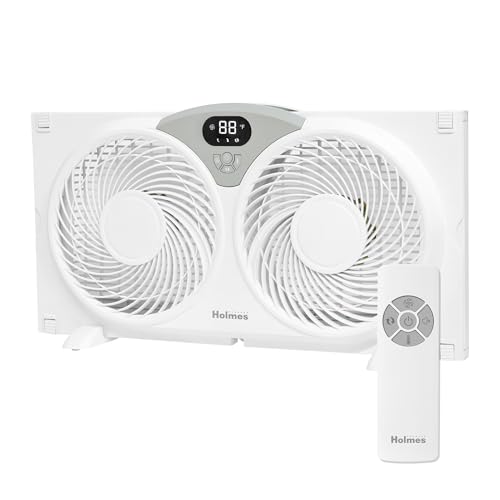
Holmes Twin Window Fan
In short: a long-running twin-blade design with straightforward controls and a thermostat on many versions. What follows is an honest prose assessment — positioning is qualitative, in the entry-to-premium range of the category, and final verification of this pick is pending, so treat it as guidance to compare against the current listing rather than a lab verdict.
If the category has a default recommendation, this is close to it. The Holmes twin does nothing exotic and most things competently: reversible airflow, a thermostat on many versions, panels that fit the standard run of double-hung windows, and a low setting calm enough for bedrooms. Owners tend to keep these for years, which in a category of light plastic appliances is its own review.
Criticisms are real but minor. The build will not impress anyone expecting heft, and features vary across versions, so the remote you saw in one listing may not exist on another. Read the specific model’s control list before ordering. As the sensible centre of the market, it is the fan against which the others below are measured.
Best for: most households buying a first twin fan for a bedroom or living room. Not suited for: buyers who want a remote included without checking the exact version.

Bionaire Twin Window Fan
In short: a twin design known for a remote control and a programmable thermostat on many versions. What follows is an honest prose assessment — positioning is qualitative, in the entry-to-premium range of the category, and final verification of this pick is pending, so treat it as guidance to compare against the current listing rather than a lab verdict.
The Bionaire twin is the convenience pick. Its thermostat and remote, on the versions so equipped, make it the fan most likely to still be running — correctly, quietly, at the right temperature — at three in the morning. Electronically reversible airflow removes the last chore from switching between the evening intake and a morning exhaust. For a main bedroom, that polish is worth real money-adjacent value in a category where the products otherwise cluster tightly.
The counterpoint is complexity: more electronics means more to go wrong over a long life, and the fan rewards owners who read the manual once. Households that want a dial, a direction and nothing else will find it more than they asked for. Households that want the fan to manage itself will find it exactly what they asked for.
Best for: main bedrooms and anyone who values set-and-forget overnight control. Not suited for: minimalists who want purely manual controls.

Comfort Zone Twin Window Fan
In short: a reversible twin design with expandable side panels and a removable bug screen on many versions. What follows is an honest prose assessment — positioning is qualitative, in the entry-to-premium range of the category, and final verification of this pick is pending, so treat it as guidance to compare against the current listing rather than a lab verdict.
Comfort Zone’s twin design is the value-minded reversible option, and its party pieces are practical: expandable panels, a removable bug screen and, on many versions, a fabric cover for the off-season or for sealing the unit against drafts when it sits idle in the window. The bug screen in particular is a small feature with outsized real-world value at dusk, when an intake fan sits in a lit window doing its best impression of a moth convention.
Reversing on many versions is manual — you turn the unit or flip it as the design directs — which is a genuine step down in convenience from electronic reversing, and worth knowing before you buy rather than after. In exchange, the design stays simple, light and easy to live with. For a spare room, a rental, or a second fan for push-pull duty, it makes a strong case.
Best for: second fans, spare rooms, rentals and value-focused buyers who like the bug screen. Not suited for: buyers who want to reverse direction from bed by remote.
Genesis Twin Window Fan
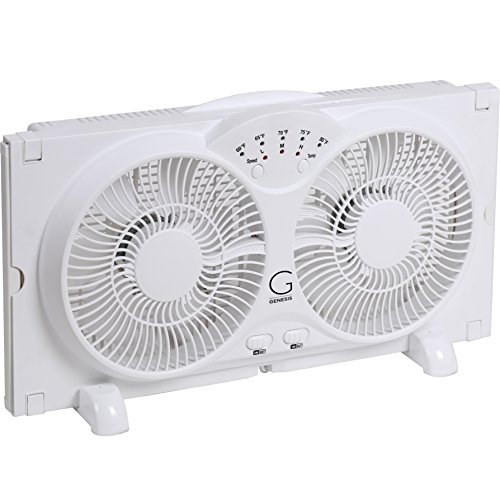
In short: a twin design with a built-in thermostat and a remote on many versions. What follows is an honest prose assessment — positioning is qualitative, in the entry-to-premium range of the category, and final verification of this pick is pending, so treat it as guidance to compare against the current listing rather than a lab verdict.
The Genesis twin sits in the same sensible territory as the category leaders: thermostat control, a remote on many versions, reversible airflow and a manner owners generally describe as easy to live with overnight. It rarely wins a headline comparison and rarely loses one either, which is a respectable place for an appliance to be. When its fit range matches a window the others stretch for, it becomes the obvious choice on the only criterion that cannot be compromised.
As with every brand here, verify the exact version’s features before ordering, because model years shuffle controls. Judged on the fundamentals — fit, low-setting calm, direction flexibility — it is a legitimate alternative rather than a compromise.
Best for: buyers whose window measurements favour its fit range. Not suited for: nobody in particular — it is a broadly suitable design, provided the window suits.

Lasko Window Fan
In short: a single-fan window design from a brand better known for box and tower fans. What follows is an honest prose assessment — positioning is qualitative, in the entry-to-premium range of the category, and final verification of this pick is pending, so treat it as guidance to compare against the current listing rather than a lab verdict.
Lasko’s name is built on box and tower fans, and its window offering takes a simpler, single-fan approach. That makes it a different tool from the twins: less about reversible finesse in a bedroom window, more about straightforward air movement where a squarer opening or a utility space suits it. Households with a suitable window and simple needs — move air, in this direction, now — will find the honesty of the format appealing.
What you give up is the twin format’s tailored fit for wide double-hung openings and, on many versions, the thermostat-and-remote overnight management the bedroom twins compete on. Choose it for the right window and the right job and it is a perfectly rational purchase; choose it expecting a bedroom twin’s manners and it will feel like the wrong appliance, because it is.
Best for: utility spaces and squarer windows wanting simple, sturdy airflow. Not suited for: light sleepers wanting a thermostat twin for the main bedroom.

Air King Window Fan
In short: a sturdier, more utilitarian window fan aimed at garages, workshops and whole-room exhaust duty. What follows is an honest prose assessment — positioning is qualitative, in the entry-to-premium range of the category, and final verification of this pick is pending, so treat it as guidance to compare against the current listing rather than a lab verdict.
Air King is the name that appears when the job stops being about bedrooms. Its window fans are built for garages, workshops, greenhouses and serious exhaust duty, with a sturdier character than the household twins and a single-minded focus on moving air in quantity. If your problem is a workshop full of dust and heat or a garage that bakes all day, this is the end of the market to shop in.
The trade-offs mirror the strengths: these are not the quietest or most feature-rich overnight companions, and their fit and mounting expectations suit utility openings better than a neat bedroom sash. Buying one for a nursery because it is powerful would be a category error. Buying one for a workshop because the twins felt flimsy is exactly right.
Best for: garages, workshops and whole-room exhaust jobs. Not suited for: bedrooms where the lowest, quietest setting is the whole point.
In this guide
How We Judge: The Criteria Behind These Reviews
Fit comes first, because a fan that does not fit your window has no other virtues. We weigh the stated size range against typical double-hung openings and the quality of the side panels and sealing. Second is the low setting — its steadiness and calm — because that is the setting that runs all night in real homes. Third is direction: true reversibility, and whether reversing is electronic or a manual chore. Fourth is self-management: thermostats, timers and remotes, the features that decide whether the fan works unattended. Build, warranty culture and the brand’s record of simply still existing next year round out the list. Top speed is deliberately last: every fan here is strong enough on high for its intended window, and the differences are the least important in the roundup.
What we do not do is repeat laboratory-style figures we cannot verify or score-style verdicts borrowed from listings. Airflow numbers in this category are measured inconsistently between brands, and a review that pretends otherwise misleads you with precision. The qualitative judgements above — calm or intrusive, snug or rattly, self-managing or needy — are the differences you will actually live with, and they are the ones worth a review’s honesty. Readers comparing specific room needs can also browse the best window fans for a bedroom and thermostat window fans for the live model coverage on this site.
The Category’s Strengths and Trade-Offs
Strengths
- The category is mature: leading twin designs are reliable, reversible and genuinely install in minutes.
- Real choice exists on controls, from dead-simple manual fans to thermostat-and-remote models that manage the night themselves.
- Utility options like the Air King extend the idea beyond bedrooms to workshops and garages.
- Every design here sips effort compared with mechanical cooling and stores flat in the off-season.
Trade-offs
- Feature lists vary within each brand’s range, so the version in the listing — not the brand’s reputation — decides what you get.
- No model escapes the category limits: hot nights, rain, non-double-hung windows and the security trade-off apply to all of them.
- Published airflow figures are not comparable across brands, making spec-sheet shopping a trap.
- Lightweight construction across the household end of the market means installation quality decides noise more than price does.
Two Fans Are Better Than One: Push-Pull Setups
If one fan is good, two fans arranged deliberately are noticeably better, and this is the single biggest upgrade available to window-fan owners. Put one fan on intake in the room you want coolest — usually the bedroom — and a second fan on exhaust in a window across the home, ideally upstairs or on the warm side. The intake fan pressurises its room slightly, the exhaust fan depressurises its end, and between them a real current forms that crosses the space in between. Air stops pooling in corners and dead-end rooms start to participate in the exchange.
A push-pull setup also fixes the most common single-fan frustration: the fan that seems to do nothing because the room is sealed too well. A lone exhaust fan in a closed room quickly runs out of air to push, and a lone intake fan in a closed room quickly runs out of places for air to go. The second fan — or even just a second open window on the far side of the home — gives the system somewhere to breathe. Before blaming a fan for weak performance, check the path. Nine times out of ten, the path, not the fan, is the problem.
You do not need two identical fans for this. A stronger unit doing exhaust duty on the hot side and a quieter twin fan on intake in the bedroom is a sensible pairing, because the bedroom fan is the one you sleep next to and the exhaust fan can be as plain as you like. What matters is that both run at the same time, in coordinated directions, with interior doors open enough for air to pass. Run them through the evening and into the night, then close up and draw curtains before the morning warms, and the house starts the day several degrees kinder than it otherwise would.
Renters and anyone in a single room can scale the idea down. One fan in the window on exhaust, with the room door open and a hallway or bathroom window cracked, creates a miniature version of the same circuit. Even a fan on intake with a transom or a second sash opened a crack above it outperforms a fan working against a sealed room. The principle never changes: moving air needs a way in and a way out, and the wider and straighter that path, the more a modest fan can accomplish.
Noise, Sleep and Living With the Fan
Every window fan makes noise; the question is what kind. On its lowest setting a decent twin fan settles into a steady wash of sound that many sleepers actively like, because it masks the irregular noises — traffic, neighbours, a dog two gardens away — that actually wake people. Higher settings add motor hum and the chop of air through the grille, and a poorly fitted fan adds the worst sound of all: a rattle, where the unit vibrates against the sash or its own loose panels buzz in sympathy. Most noise complaints traced back to installation end at the rattle, and most rattles end with foam tape and a snugger fit.
For a bedroom, judge a fan by its lowest setting, not its highest. The top speed is for the first hour of the evening, flushing the day’s heat out while you are still up. The low speed is the one that runs all night, and it is the one you will live with. A fan whose low setting is still intrusive will end up switched off at two in the morning, and a switched-off fan moves no air at all. Controls matter here too: a thermostat that cycles the fan off once the room reaches your chosen temperature saves you from waking cold, and a remote saves you from getting up — small things that decide whether the fan becomes a habit or a nuisance.
Placement can soften noise more than specification sheets suggest. A fan pulling air in from a window away from the bed, with the stream crossing the room, feels quieter than the same fan in the window beside the pillow, even at the same setting. In a push-pull pair, put the quieter fan in the bedroom and let the louder one work from a hallway, bathroom or landing window where its voice matters less. And give any new fan two or three nights before judging it: the first night you hear it, the third night you mostly hear through it, which is exactly how steady background sound is supposed to work.
Which Review Applies to You?
Main bedroom, double-hung window, sleeper who wakes easily: start with the thermostat twins — the Bionaire for maximum self-management, the Holmes as the all-round default, the Genesis where its fit suits better. Spare room, rental or second fan for a push-pull pair: the Comfort Zone’s value and bug screen make sense, and its manual reversing matters less on exhaust duty. Kitchen window over a steamy hob or a bathroom with no extractor: any of the twins on exhaust, chosen by fit. Garage or workshop: skip the bedroom twins entirely and look at the Air King end of the market. Casement or sliding windows: stop, measure, and read the fit guidance in this cluster before ordering anything, because the standard twin format may simply not be your answer.
Safety, Weather and Looking After the Fan
Start with the rule that outranks all others: never run a fan with a damaged cord or plug. A cord that is frayed, pinched by the window sash, cracked at the plug or repaired with tape is a fire and shock risk, and no evening of cooler air is worth it. Route the cord so the sash never closes on it, keep it clear of the fan’s own blades and moving parts, and if the cord is damaged, the fan is retired or professionally repaired — those are the only two honest options. Plug directly into a wall outlet where you can, and treat a fan that trips a breaker, smells hot or buzzes electrically as a fan to unplug, not to monitor.
Weather is the second hard rule. A window fan is not weatherproof. Rain driven against the window can reach the motor and the controls, and a storm can push water straight through the grille into the room. The habit to build is simple: when rain threatens, switch off, and either remove the fan and close the window or at minimum close the window against it if your installation allows. Many owners learn this once, from a wet windowsill and a fan that never sounded right again. Build the habit before the lesson instead.
Guard the blades and respect them. The grilles on a window fan are there because fingers, paws and curious small hands explore. Keep grilles intact and properly seated, never run the fan with a grille removed, and position cords and controls so children and pets are not drawn to play around the unit. A window fan sits exactly at the height where a toddler on a bed or a cat on a sill can reach it, so a quick look at who shares the room with the fan is part of installing it responsibly.
Cleaning is safety’s quieter half. Dust caked on blades and grilles cuts airflow, adds noise and makes the motor work harder than it should. Unplug the fan, wipe blades and grilles with a damp cloth, let everything dry fully before running it again, and check the cord and plug while you are there. At the end of the season, clean the fan before storage, coil the cord loosely, and store the unit somewhere dry. A fan that is cleaned twice a year and stored dry will outlast a neglected one by years, and it will move noticeably more air the whole time.
The Bottom Line on Window Fan Reviews
Strip away the marketing and the window fan market is a friendly one: a handful of sound designs, differentiated by fit, controls and temperament rather than by miracles. The reviews above point most households to a reversible twin with a thermostat, fitted snugly into a measured window, run in the right direction at the right hours. Get those unglamorous things right and the specific badge on the grille matters less than the habit you build around the fan. That is the real conclusion of every honest review in this category, including this one.
More Practical Notes From Real Use
Think about which rooms deserve the fan first. Bedrooms win, because sleep is where heat does its worst damage and where a steady night breeze pays you back the next morning. After that, the room where the household actually spends its evenings. Kitchens and bathrooms benefit from exhaust duty in short, deliberate bursts rather than permanent installation. A single fan moved between windows as needed is a perfectly respectable strategy, especially early on, while you learn your home’s air patterns — which windows catch the evening breeze, which rooms hold heat, and where a second fan would earn its keep if you add one later.
Humidity changes the verdict from day to day. Moving air feels cooler on skin partly through evaporation, so on a dry evening a modest breeze feels like a bigger win than the thermometer explains. On a muggy night, the same fan still helps — air exchange can pull in slightly drier outside air and movement still aids comfort — but expectations should shrink with the dew point. This is also why window fans pair so well with the shoulder seasons: spring and autumn air is often cool and comparatively dry, the exact conditions where simple air exchange does its best work for the least fuss.
If your home has an attic or a hot upstairs landing, exhaust placement there is disproportionately effective. Heat collects at the top of a house and radiates back down through ceilings long after sunset, which is why upstairs bedrooms stay stubborn on warm nights. A fan exhausting from the highest window you have, drawing replacement air from shaded lower windows, attacks the reservoir of heat itself rather than its symptoms. It is slow work — think in hours, not minutes — but it is the closest a window fan comes to whole-house effect, and it costs nothing beyond running the fan you already own.
Controls separate the fans people keep from the fans people tolerate. A thermostat sounds like a luxury until the first night it switches the fan off at the temperature you chose instead of chilling the room by four in the morning. A remote sounds trivial until the fan is in the window across the room and the bed is warm. Timer functions suit people who want the flush of evening air without an all-night run. None of these change how much air the fan moves at full speed; all of them change how well the fan fits a real household’s real routine, which is what decides whether it is still in the window in August.
Renters have particular reasons to like window fans: they install without tools, leave no holes, and move out with you. The cautions are equally specific. Check that your lease allows items in windows if your building is strict about appearances, keep the unit secure so it cannot fall outward, and be extra careful with older windows whose sashes no longer hold position firmly — a sash that slips can damage the fan and itself. A strip of foam and a simple sash lock or block of wood cut to length, holding the sash from inside, solves most wobbly-window worries cheaply.
Children change the safety calculation in ways worth stating plainly. Beyond keeping fingers from grilles, remember that a window occupied by a fan is a window a child may treat as openable, climbable or interesting in ways a closed window is not. Install fans in children’s rooms only where the unit is secure, the cord is entirely out of reach, and the grille cannot be pulled free by determined small hands. If any of those cannot be guaranteed, put the fan in a hallway or landing window and let the moving air reach the child’s room through the doorway instead.
Dust tells you the truth about direction. After a few weeks, look at where dust and fluff collect around your fan and its window. Heavy build-up on the room side of an intake fan means it is faithfully importing your street’s dust along with its air — a finer screen or a different window may serve better. Build-up patterns also reveal leaks: dust streaks at the panel edges mark the gaps where air is sneaking past the fan instead of through it, doing none of the work and letting in insects besides. A minute with foam tape at those streaks is maintenance with a visible payoff.
There is a right way to retire a fan for the winter. Clean it first, while the season’s dust is still easy to remove, check the cord along its whole length, and run it for a minute to confirm all is well before it goes away — discovering a fault in spring is better than discovering it during the first hot night, but discovering it in autumn is better still. Store it upright, dry, with its panels and any remote kept together. Owners who do this get years of service from unremarkable fans; owners who shove a dirty fan into a damp garage each October tend to buy replacements and blame the brand.
Consider the shoulder-season mornings, the ones nobody writes reviews about. The house has cooled overnight, the fan has done its quiet work, and the decision is simply when to close up. Owners who develop the instinct — windows shut and curtains drawn on the sunny side before the day warms — find the night’s coolth lasting into the afternoon. It is the cheapest comfort in the whole system, bought with thirty seconds of attention, and it is why experienced owners talk about their fan as part of a routine rather than as a gadget. The appliance is simple; the practice around it is the actual product.
A word about older houses, whose windows tell stories. Sashes that have been painted shut, frames a quarter-inch out of square, openings that match no modern standard — these are the installs that need patience rather than force. Foam is the older house’s best friend, filling the irregular gaps that rigid panels cannot. A fan seated with care in a crooked old window works beautifully; a fan forced into one works loudly and briefly. If your home is old, budget an extra quarter hour for the fitting and expect to spend it happily, because the same thick walls that complicate the install hold the night’s cool wonderfully once it is inside.
Guests notice window fans, which makes them a small test of household confidence. The fan that hums steadily and keeps its room pleasant is invisible in the best way; the fan that rattles in a loose frame announces itself all night. If your spare room hosts the people you love most, it deserves the snug install and the low setting you would want yourself. This is not really about hospitality. It is about the fact that a window fan’s quality is mostly installation quality, and the guest room is simply where that truth gets an audience.
There is an underrated pleasure in the first evening of the season when the fan goes in. It marks a household decision: the warm months will be met with moving air, open windows at dusk and a house that breathes, rather than sealed against the weather from May to September. Owners describe a genuine lift to the evening — the smell of outside returning, the day’s heat leaving on a visible current. Practical people are allowed their rituals, and this one happens to lower the temperature of the bedroom at the same time.
Think about the fan’s relationship with curtains and blinds, because they are teammates. Daytime solar gain through glass is the heat the fan must evict at dusk; every hour a sunny window spends shaded is heat that never enters the ledger. Light-coloured curtains on the sun side, closed through the bright hours, can matter as much as the fan’s own strength. Conversely, the window holding the fan wants its curtain managed — tied back or shortened — so fabric never drifts toward the intake. Small choreography, nightly payoff.
Power cuts and storms teach the same lesson from opposite ends. When the electricity fails on a hot night, the household with a ventilation habit — windows that open, a sense of which side catches air — copes measurably better than the household sealed around a dead air conditioner. And when the storm arrives, the fan owner’s practiced closure routine is simply part of how the house is buttoned up. Resilience is too grand a word for a window fan, but habits of air and weather are a real, quiet asset that comes free with owning one thoughtfully.
Do not overlook the fan’s value in the in-between rooms: the landing that roasts, the box room that stores the day’s heat and radiates it into the nursery wall, the hallway whose stillness makes the whole flat feel close. Sometimes the highest-value placement is not the room you sit in but the reservoir of heat beside it. A few evenings of experiment — fan here, fan there, hand on the wall at bedtime — teach a home’s thermal geography better than any diagram, and the knowledge stays useful long after the fan itself is replaced.
Pets have opinions about window fans, and they are mostly positive: a cat will claim the intake stream’s path within the hour, and dogs gravitate to the cooled room with unerring instinct. The owner’s duties are the grille, the cord and the sill — a fan is not a cat perch, however it may be marketed by the cat. Keep the unit secure against the weight of an animal leaning into the breeze, keep cords entirely out of chewing range, and everyone in the household gets to enjoy the moving air on their own terms.
If you work night shifts, the window fan calculus inverts in an interesting way. You sleep through the day, when intake would import heat, so your fan’s shift is exhaust and preparation: flush the room in the cool early morning before you sleep, then close the house down dark and quiet. A fan with a timer earns special respect in this household, running the dawn flush and stopping itself. It is a reminder that every rule in this cluster assumes a conventional day, and the method — exchange when outside is kinder — survives the inversion intact.
Sound cuts both ways in shared housing. Your fan’s steady hum may be your sleep aid and your flatmate’s grievance if the window is shared or the wall is thin. The courtesies are simple: the calm low setting after midnight, the snug fit that prevents the rattle nobody can sleep through, and the honesty to move the fan to another window if the arrangement genuinely disturbs. Most fan noise disputes are installation disputes wearing a disguise, and they end the evening somebody adds foam tape and reseats the unit properly.
The second-hand market in window fans is active every spring, and it is a rational place to shop if you inspect like an owner rather than a bargain hunter. Check the cord along its whole length — a damaged cord ends the negotiation, full stop. Run every speed and both directions, listen for the uneven note that means a tired bearing, and confirm the panels and any remote are present. A sound used fan at a friendly price is the worth-it argument in its purest form; a damaged one is not a bargain at any price, because the repair it needs is called replacement.
Window fans and houseplants coexist happily, with one caution: a direct, constant blast will dry and batter delicate foliage, so place the green things at the edge of the stream rather than in its throat. The gentler truth is that most indoor plants prefer the exchanged, moving air of a ventilated room to the sealed stillness of a shut one, and the room’s human occupants are not so different. Arrange the stream for the sleepers first, the sitters second and the plants third, and the whole population of the room tends to thrive.
Travel changes the fan’s duties to none at all. The rule for an empty house is absolute: fans out, windows locked, because a fan-filled window is not a secure window and an unattended appliance should not run for an absent audience. The two minutes this takes is the cheapest insurance in the whole ownership proposition. Put the fan’s removal on the same checklist as the thermostat and the bins, and the homecoming version of the routine — fan in, dusk flush, first cool night back — becomes its own small pleasure.
Finally, a note on patience as a specification. Window fans work on the timescale of evenings, not minutes, and nearly every disappointed owner judged on the wrong clock: twenty minutes after switching on, in a room whose walls had stored a full day of sun. Warm fabric, warm plaster and warm furniture all re-radiate into your newly exchanged air for the first stretch, and the fan must cool the room’s contents as well as its air. Give the system an evening before you grade it. Judged on its own timescale, the modest fan in the window is a far more capable appliance than the stopwatch ever suggests.
Humidity deserves one more pass, because it decides whole regions. Where summer nights are cool but damp, the fan still wins — moving air on skin does its evaporative work even when the thermometer barely moves, and exchanging indoor air for outdoor air at the same temperature can still freshen a close room. Where nights are both hot and saturated, the honest verdict flips, and no arrangement of fans substitutes for cooling or dehumidifying. Knowing which of those climates is yours, from experience rather than hope, is the ground every other decision in this cluster stands on.
After the Boxes Are Gone: Long-Term Ownership Notes From Window fan Reviews
Most window fan coverage stops at unboxing, yet almost everything that decides owner satisfaction happens afterwards. The first evening tells you about finish and first impressions; the third month tells you about durability, upkeep and whether the design still suits the way your household actually behaves. This section looks at the ownership phase in detail — the settling-in period, the first signs of wear worth watching for, and the small habits that separate owners who stay pleased from owners who start browsing replacements. If you are weighing Holmes Twin Window Fan, Bionaire Twin Window Fan or any similar design, treat the points below as the questions a good long-term review should answer.
The Settling-In Period: What Changes in the First Weeks
New materials and mechanisms relax. Fabrics soften, joints settle, finishes lose their showroom sharpness, and moving parts either bed in smoothly or start to complain. With a window fan, use the first fortnight deliberately: operate everything daily, check fixings once after the first week, and keep a mental note of any sound, wobble or resistance that was not there on day one. Changes that stabilise after a small adjustment are normal settling; changes that keep progressing are early warnings, and they are far easier to raise with a seller while the purchase is recent.
Wear Worth Watching, and Wear Worth Ignoring
Not all wear is failure. Honest materials in the seasonal & holiday category develop a patina — slight softening of edges, gentle colour shifts where hands and light fall — and most owners come to like it. The wear that matters is functional: looseness that returns after tightening, surfaces that mark from ordinary use rather than accidents, parts that need persuading, and finishes that fail at edges and corners first. Check those high-contact zones on any window fan you already own, and look for honest close-up photographs of exactly those zones when you judge a replacement.
Ask how the window fan behaves on your worst floor, wall or surface rather than your best one, since homes are uneven and listings are photographed in perfect rooms. Keep the receipt, delivery note and a photograph of the label together, because warranty conversations go smoothly when dates and model details are at hand. If two people in the household disagree about the window fan, let the person who will use or maintain it most have the deciding vote on practical questions. Beware of buying for the household you hope to become; the window fan that serves the household you already are will be used this week, not someday.
Ownership rewards attention in small doses. A window fan that is checked monthly and cleaned gently will usually outlast a neglected premium model, and it will certainly stay pleasanter to live with. Judge any review — including the detailed assessments earlier in this guide — by whether it helps you through this long middle phase of ownership, because that phase, not the unboxing, is where the money is really spent.
Frequently Asked Questions
Which window fan is best overall?
There is no single winner, but the sensible centre of the market is a reversible twin fan with a thermostat: the Holmes twin is the all-round default, the Bionaire twin adds the most polished remote-and-thermostat control, and the Genesis twin is a sound alternative where its fit range suits your window. Best overall always means best for your measured window and your nights, so confirm fit before brand.
Are expensive window fans worth it over basic ones?
The step up within this category buys controls and calm, not a different class of power. A thermostat that stops the room over-chilling, a remote you use from bed, and a low setting quiet enough to sleep beside are worth paying a little more for in a main bedroom. In a spare room or on exhaust duty, a basic reversible model does the same job for less fuss. Match the spend to the room’s importance.
Why do reviews of the same fan disagree so much?
Because the fan is only half the system. The window fit, the direction chosen, whether another window was open, the hour of day and the weather explain most disagreements between reviews. A fan praised in a snug window with a cross-draft and damned in a sealed room on a hot afternoon is the same fan both times. Judge reviews by whether they describe their setup; discount any that do not mention fit or direction.
Is a twin fan or a single window fan better?
Twins suit homes: they fit wide double-hung openings, seal better and usually reverse electronically or by design, covering intake and exhaust in one unit. Single window fans, especially sturdier utility models, suit garages, workshops and dedicated exhaust jobs where one strong stream in one direction is the whole requirement. The room decides. Bedrooms and living rooms point to twins; utility spaces point to singles.
How long do window fans last?
Years, with ordinary care: cleaned blades and grilles, a cord kept sound and unpinched, dry storage in the off-season and removal or window closure in storms. The failures that kill window fans early are usually water, neglect and damaged cords rather than worn-out motors. A fan cleaned twice a year and stored dry will typically outlast the household’s memory of what it cost.
Can I trust airflow numbers in product listings?
Treat them cautiously. Airflow is measured under different conditions by different brands, so figures are not directly comparable across listings, and a bigger number does not guarantee a cooler room. Fit, direction and airflow path in your actual home move the real outcome more. Use listings for fit range and feature lists, and use reviews — including this one — for the qualitative character of the fan.
Related Reading
These reviews sit inside a wider window fan cluster. See also our in-depth window fan review for the companion view on this topic. See also our window fan buying guide for the companion view on this topic. See also the full window fan pros and cons breakdown for the companion view on this topic. See also our honest answer to is a window fan worth it for the companion view on this topic. See also our step-by-step guide on how to choose a window fan for the companion view on this topic. For models already covered on this site, read the best window fans for a bedroom. For models already covered on this site, read window fans for casement windows. For models already covered on this site, read thermostat window fans. For models already covered on this site, read high-capacity window fans. For models already covered on this site, read window vent fans for a kitchen.