Disclosure: As an Amazon Associate, dailyhomedecorating.com earns from qualifying purchases. Links on this page are affiliate links; they cost you nothing extra. Prices and availability change often, so check the current Amazon listing before you buy.
A philips 3200 review has to answer the question that built this machine’s reputation: can a fully automatic espresso maker, operated with one finger by someone who has been awake for ninety seconds, produce coffee a household actually looks forward to? The Philips 3200 Series with LatteGo is the model’s answer, and it has become one of the defining machines of its class — a bean-to-cup system with a ceramic grinder, a touch display, five coffee varieties, and a milk system designed to be rinsed and stored in the refrigerator rather than scrubbed and feared. This review covers the two current 3200 listings — the standard EP3241/54 and the iced-coffee variant EP3241/74 — and then the Philips 3300 Series, the line’s successor, for buyers deciding whether the newer machine’s refinements are worth stepping up for.
All three listings were verified through the retailer’s own product data, with exact titles and official images confirmed, before a word was written. What follows is an owner’s-eye account of how these machines live on a counter: the morning routine, the milk system, the cleaning reality, the bean economics, and the households each variant suits.
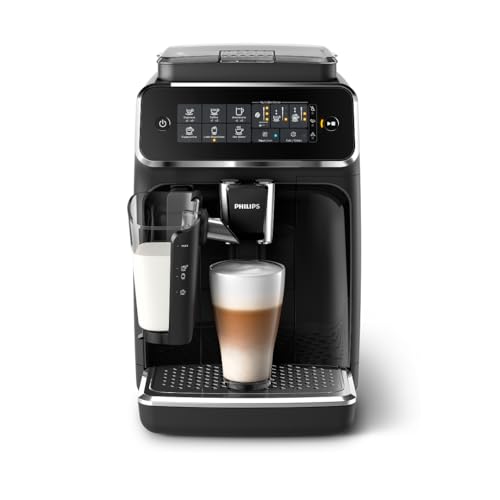
Philips 3200 Review: The Machine in One View
The 3200’s proposition is the removal of ritual without the removal of coffee. Beans go in the top, water goes in the tank, and the machine grinds, tamps, brews, and — in the LatteGo versions reviewed here — froths milk into the cup, with the whole performance driven from a touch display that a guest can operate without instruction. The My Coffee Choice controls let the household tune strength and volume per drink rather than accepting a factory’s idea of an espresso. The grinder is ceramic, which the maker favours for durability and for avoiding the burnt notes a overheated burr can introduce. An AquaClean filter in the tank stretches the interval between descaling, which is the maintenance task automatic-machine owners most reliably neglect. None of that is unique in isolation; the 3200’s achievement is assembling it into the class’s most approachable whole, at the moment when home espresso moved from hobbyists to everyone.
In this guide
Key Takeaways
- The 3200 Series is a fully automatic bean-to-cup machine: grind, brew, and milk from one touch-driven counter appliance.
- LatteGo is the headline system — a two-part milk carafe with no tubes, designed to rinse clean and store in the refrigerator door.
- Two listings differ mainly in drink programming: the EP3241/74 adds an iced coffee function to the standard EP3241/54’s five varieties.
- The ceramic grinder and AquaClean filter are the machine’s long-term ownership features, aimed at durability and descaling intervals.
- The Philips 3300 Series is the current successor, adding hot-and-iced presets and updated controls for buyers who prefer the newest line.
The Three Listings at a Glance
| Model | Listing identity | Drink story | Choose it when |
|---|---|---|---|
| Philips 3200 EP3241/54 | Standard LatteGo model | Five coffee varieties, hot drinks | The household drinks hot coffee and wants the classic 3200 |
| Philips 3200 EP3241/74 | Iced coffee variant | Five varieties plus iced coffee | Someone in the house drinks iced coffee through the year |
| Philips 3300 EP3341/50 | Successor series | Five hot and iced presets | You prefer the newest line and its updated interface |
The table’s important row is the middle one, because the two 3200 variants are the same machine wearing different programming, and households routinely agonise over a distinction that a single question resolves: does anyone here drink iced coffee often enough, across enough of the year, to want a dedicated function for it? If yes, the variant earns its place. If the household’s iced coffee is a three-week summer flirtation, the standard model plus a glass of ice covers it, and the money saved buys a great many beans.
How This Review Was Assembled
Each machine below was confirmed through the retailer’s product data — exact listing title, model number, and official image — before drafting. Drink counts, grinder material, and filter systems are stated as the listings state them. The lived-experience material — morning routines, cleaning rhythms, bean choices — is presented as the accumulated practical knowledge of this machine class rather than as laboratory measurement, and no hands-on testing programme is claimed. Prices are deliberately absent, per this site’s policy of sending readers to the live listing for a figure that will still be true when they arrive.

Philips 3200 Series LatteGo, EP3241/54: The Standard Machine
Badge: the class-defining automatic. The standard 3200 is the machine most households mean when they say the model name, and its design centres on the LatteGo carafe: two pieces, no hoses, no hidden milk pathways, snapping together to froth and coming apart to rinse under a tap in seconds. That single design decision shapes the machine’s entire ownership experience, because the historical failure mode of automatic milk systems was never the coffee — it was the sour tube nobody cleaned, discovered on a Saturday. LatteGo’s answer is to make the correct behaviour the easy behaviour, and then to let the carafe live in the refrigerator between uses.
Model: EP3241/54 per the listing. System: fully automatic espresso machine with LatteGo milk frother. Drinks: five coffee varieties per the listing. Grinder: 100 percent ceramic per the listing. Controls: intuitive touch display with My Coffee Choice. Filtration: AquaClean filter per the listing.
Strengths
- The milk system’s two-part, tubeless design makes daily cleaning a rinse rather than a project.
- Touch controls and per-drink adjustment make the machine genuinely guest-proof.
- Ceramic grinding and the AquaClean system are durability features that pay out across years.
Trade-offs
- Fully automatic espresso is a different drink from café espresso, and purists will taste the compromise in extraction control.
- The machine asks for counter depth and height clearance that small kitchens should measure first.
- Bean quality becomes the limiting factor quickly; the machine will faithfully express mediocre beans.
Live with the standard 3200 through a weekday morning and its virtues compound quietly. The first person up fills a cup without waking the house’s other occupants with a grinder’s separate scream and a portafilter’s clatter — the machine’s own grinding is brief and contained — and the second person’s different drink is a different touch rather than a negotiation. Milk drinks stop being weekend events. The machine’s rhythm of care is equally domestic: empty the drip tray and grounds container when it asks, rinse the LatteGo when the milk is done, top the beans and water as they fall. Households that keep that light rhythm find the 3200 less a machine than a utility, like the kettle it replaced, and that is the highest state an automatic appliance can reach.
Best for: households wanting real bean coffee and milk drinks without a hobby. Not suited for: espresso purists or very small counters. Check price on Amazon

Philips 3200 Series LatteGo with Iced Coffee, EP3241/74
Badge: the same machine, programmed for the cold glass. The iced variant shares the standard model’s platform — LatteGo, ceramic grinder, touch display, five coffee varieties — and adds a dedicated iced coffee function that adjusts the brewing for serving over ice. That function is the entire difference, and it is a real one: brewing for ice is a balance of strength and temperature, since a standard hot shot poured over ice dilutes as the ice melts, while a drink brewed with the dilution in mind lands closer to its intended flavour in the glass.
Model: EP3241/74 per the listing. System: fully automatic with LatteGo milk frother and iced coffee function. Drinks: five coffee varieties plus iced coffee per the listing. Grinder: ceramic. Controls: intuitive touch display.
Strengths
- A dedicated iced function removes the guesswork from the household’s cold drinks.
- Everything that makes the standard model liveable — LatteGo, touch controls, AquaClean — carries over intact.
- It future-proofs the counter for the household member whose iced habit is still growing.
Trade-offs
- A household that never drinks iced coffee is paying for programming it will never invoke.
- Cold drinks still need the household to keep ice, glasses, and milk in a rhythm the machine cannot manage for it.
- The variant’s availability and pricing vary more than the standard model’s, so the listing deserves a careful read.
The case for the variant is a household census, taken honestly. Count the iced coffees actually consumed in your home across a full year — not the July peak, the year — and let the count decide. In homes where one person’s mornings are iced in every month, the function stops being a feature and becomes the machine’s main job, and buying the standard model to save a step becomes the false economy. In homes where iced coffee is a heatwave improvisation, the standard model plus a strong shot over fresh ice is entirely respectable, and the variant’s premium is better spent on the bean subscription.
Best for: households with a genuine year-round iced coffee drinker. Not suited for: hot-drinks-only households. Check price on Amazon

Philips 3300 Series, EP3341/50: The Successor
Badge: the line’s next chapter. The 3300 Series succeeds the 3200 with the same LatteGo philosophy and an updated brief: five hot and iced coffee presets, a ceramic grinder, customisable strength and milk settings, hot water, and a 15-bar pump per its listing. It is the machine Philips currently leads with, and it exists in this review because a 3200 shopper in the present market is always, whether they know it or not, also a 3300 shopper.
Model: EP3341/50 per the listing. System: fully automatic with LatteGo milk system. Drinks: five hot and iced presets per the listing. Grinder: ceramic per the listing. Pressure: 15 bars per the listing. Customisation: coffee strength and milk settings per the listing.
Strengths
- Hot and iced presets are integrated from the start rather than added as a variant.
- It is the current line, with the longest support and accessory future ahead of it.
- The LatteGo system carries over, so the class’s best cleaning story continues.
Trade-offs
- As the newer line it typically occupies the higher shelf, and the 3200’s maturity often makes it the value play.
- Households with a settled 3200 routine gain refinement rather than transformation from the step up.
- Preset-led controls suit most users and frustrate the minority who wanted the older machine’s exact interface.
Frame the 3300 decision as new-versus-proven rather than as better-versus-worse. The 3200’s years in homes have mapped its quirks completely; the 3300 refines the formula and secures the longer future. A first-time buyer with no sunk routine should weigh the 3300’s integrated iced presets and current-line status seriously. A buyer who finds the 3200 at a favourable moment in its cycle is buying a known quantity whose ownership story is written in full, and that certainty has a value no specification table captures.
Best for: first-time buyers wanting the current line and integrated iced drinks. Not suited for: value hunters who find the 3200 well priced. Check price on Amazon
The LatteGo System, Examined on Its Own
Because the milk system decides this machine’s ownership experience more than any other component, it deserves an examination of its own. Traditional automatic milk systems draw milk through a tube from a separate container, froth it with steam, and leave a network of narrow passages coated in milk residue that must be flushed, soaked, and periodically deep-cleaned on pain of sour flavours and hygiene worries. LatteGo’s design abolishes the network: milk sits in a two-piece carafe that clips to the machine, frothing happens in the carafe’s own chamber, and the whole assembly comes apart into pieces that rinse clean under a tap and can go in the refrigerator, milk and all, between uses. The consequences compound across a year of mornings. Milk drinks get made on weekdays, because the cleanup tax that used to reserve them for weekends has been abolished. The machine’s flavour stays clean, because there is no hidden passage quietly seasoning every drink with yesterday. And the household’s least diligent member — every household has one, and machines must be designed for them — cannot easily defeat the system, because the correct cleaning action and the easy cleaning action are finally the same action. When this review calls LatteGo the headline, it is that alignment of ease and correctness being praised, not a novelty feature.
Beans, Water, and the Two Inputs That Decide the Cup
An automatic machine is a faithful amplifier, and its output is bounded by its inputs in a way new owners consistently underestimate. Beans first: the machine will express whatever it is fed with complete honesty, so fresh, well-roasted beans from a roaster whose dates you can read will transform the cup more than any setting on the display. Oily, dark-roasted beans deserve a caution — their surface oils coat grinder and brew unit over time and are the classic cause of an automatic machine’s slow decline into inconsistency — so households that love dark roasts should choose the least oily expression of that love they can find, and all households should avoid beans old enough to have gone quiet, because no pressure figure on a listing can resurrect them. Water second: the AquaClean filter exists because scale is the other slow assassin of automatic machines, and the filter’s discipline — replaced on the machine’s schedule — stretches descaling intervals and protects the flavour from a hard-water region’s mineral signature. Households in very hard water areas should treat the filter not as an accessory but as part of the machine’s price of admission. Get beans and water right and the 3200’s ceiling rises remarkably; neglect them and no machine in this class, at any price, will save the cup.
The Cleaning and Maintenance Rhythm, Honestly Stated
Automatic does not mean maintenance-free, and the honest rhythm for this machine class is light but non-negotiable. Daily, in a milk-drinking household: the LatteGo rinsed and refrigerated, the drip tray checked, the cup count enjoyed. Weekly: the grounds container emptied and rinsed, the drip tray washed rather than merely emptied, the brew area wiped of the coffee dust that migrates everywhere in a grinding appliance. Periodically: the brew group — the machine’s mechanical heart — removed, rinsed, and returned, a task this machine family is designed to make simple, and the water filter changed on its schedule. Seasonally: descaling when the machine calls for it, with the AquaClean discipline stretching that call’s interval considerably. None of this is skilled work, and all of it together amounts to perhaps a few minutes a week, but the minutes are the price of the machine’s consistency in year three. Households that pay them describe their machines as flawless. Households that do not describe the same machines as unreliable, and both are reporting accurately on the maintenance rather than the engineering.
Who Should Not Buy a Fully Automatic Machine
Fairness requires the counter-case, and it has three members. The espresso hobbyist, who wants to weigh doses, time extractions, and chase a roast’s changing moods across a week, will find any automatic machine a beautifully made cage; their money belongs in a semi-automatic setup and a separate grinder, where the variables are theirs to command. The very occasional coffee drinker — a cup on Sundays — will find the machine’s standing costs in beans, filters, and counter space hard to justify against a simple pour-over setup that asks nothing between uses. And the household that drinks only black coffee in volume, such as a home that brews a pot for a crowd each morning, may be better served by a good drip machine whose economics per cup are unbeatable. The 3200’s kingdom is the household in between: daily drinkers, milk drinkers, multiple drinkers with multiple preferences, who want café-adjacent coffee as a utility rather than as a project. That kingdom is large, and within it this machine’s reputation is earned.
Mistakes New Owners Make
The first is feeding the machine supermarket beans of unknown age and concluding that automatic espresso is inherently mediocre, when the machine has merely reported the beans accurately. The second is ignoring the water filter’s schedule until scale announces itself in temperature and flow problems that a filter change would have postponed for years. The third is treating the milk carafe’s refrigerator life as unlimited; milk is milk, with a food’s expiry, whatever vessel it sits in. The fourth is neglecting the brew group’s periodic rinse because the machine still works, right up until the accumulated residue makes the neglect visible in the cup. The fifth is buying the iced variant or the successor series for a feature list rather than for a drink the household actually drinks, a mistake this review’s census question exists to prevent. Each mistake is small, ordinary, and entirely avoidable, which is the usual shape of appliance regret.
Final Recommendation
Buy the standard Philips 3200 LatteGo if your household drinks hot coffee and milk drinks daily and wants them without ceremony — it remains the class’s most complete answer to that brief. Buy the iced variant if a genuine year-round iced drinker lives in the house. Buy the 3300 if you prefer the current line, want hot and iced presets integrated from the start, and value the longer support future. In every case, budget for good beans and the water filter alongside the machine, keep the LatteGo rinsed and the brew group rinsed, and the purchase will justify itself every morning it is used — which, for the households this machine suits, is all of them.
The Economics of the Counter: Machine Versus Café, Done Properly
The financial case for a machine like this is usually made sloppily, with a single division of machine price by café price, so let it be made properly here. The honest comparison is per cup, across a year, including everything. On the café side: the drink, the travel or delivery friction, and the tip culture of your country, multiplied by the household’s true weekly count, including the second drink nobody admits to. On the machine side: the appliance amortised across a conservative working life, the beans at your household’s chosen quality, the milk, the water filters on their schedule, the electricity, which is trivial, and the occasional service item in later years. Run that arithmetic for a two-drinker household with a daily milk drink each and the machine typically pays for itself in a span measured in months, after which the household is drinking at a per-cup cost dominated by the beans it chose — which means the quality of the home cup can rise at the same moment its cost falls, a combination few purchases offer. The arithmetic reverses for the household that drinks out rarely or drinks black drip coffee at home already, which is why this review keeps insisting on the census of actual drinks. A machine’s economics are not a property of the machine; they are a property of the household’s habits multiplied by the machine’s costs, and the 3200’s habits profile — daily, milky, multiple drinkers — is the one where the multiplication comes out most handsomely.
Counter Reality: Space, Noise, and the Morning Choreography
Before any household falls for the specification list, it should rehearse the machine’s physical life. These are substantial appliances that need a counter position with height clearance for the bean hopper’s lid, depth for the tank’s access, and proximity to a socket that does not require the machine to be dragged forward for every refill. Measure the intended spot, including the cabinet above it, because the difference between a machine that lives in place and a machine that is hauled out each morning is the difference between a utility and a chore. Noise deserves the same rehearsal: the grinder’s burst is brief and the brew cycle is a low mechanical murmur, but in a small flat with a sleeping baby or a shift-working partner, brief and low are relative terms, and the household should think honestly about its mornings. The choreography that emerges in real homes is worth describing because it is the product being bought: beans checked on Sundays, water topped with the evening dishes, the carafe rinsed as the last act of breakfast, the grounds container emptied when the machine asks rather than when it overflows. Households that adopt that choreography describe the machine as invisible. Households that fight it describe the same machine as needy. The machine does not change between those reports; the choreography is the variable, and it is chosen, not suffered.
Guests, Households, and the Social Life of an Automatic Machine
An under-reported virtue of the touch-driven automatic is what it does to hospitality. A guest in a home with a semi-automatic setup is an audience; a guest in a home with a 3200 is a user, because the display invites operation and the machine forgives inexperience completely. After-dinner coffee for six stops being a performance by the household’s one barista and becomes a queue at a friendly appliance, each person dialling their own drink while conversation continues. Households with teenagers discover the machine absorbs a whole category of café spending that previously leaked out of the family budget daily. Households with an early-rising member discover the machine’s quiet self-sufficiency protects the rest of the house’s sleep better than any kettle-and-grinder ritual. None of these social effects appears on a specification sheet, and all of them show up in owner satisfaction within the first month, which is why this review treats the machine as a household member rather than as a extraction device. Buy it for the drinks, certainly — but expect to keep it for the choreography.
Frequently Asked Questions
What drinks does the Philips 3200 actually make?
The listing describes five coffee varieties for the standard model, spanning the espresso family from straight shots through longer coffees to milk drinks made with the LatteGo system, each adjustable for strength and volume through the My Coffee Choice controls. The iced variant adds its dedicated iced coffee function, and the 3300 successor organises its offer as five hot and iced presets. The practical translation is that a household’s ordinary café menu — espresso, coffee, cappuccino-style and latte-style drinks — is covered from the touch display without accessories or technique.
How hard is the LatteGo system to keep clean, really?
It is the easiest milk system in its class to live with, because its design removes the problem rather than managing it. There are no tubes to flush or soak; the carafe is two pieces that separate, rinse under a tap in well under a minute, and store in the refrigerator with the milk inside. A deeper wash on a regular rhythm is still good practice, as with anything that holds food, but the daily burden — the burden that decides whether milk drinks happen on weekdays — is close to zero.
What beans should I use in a fully automatic machine?
Choose fresh beans from a roaster who prints dates, in a roast your household enjoys, and be wary of very oily dark roasts whose surface oils coat the grinder and brew unit over time. Medium roasts are the class’s traditional sweet spot for both flavour and machine health. Whatever you choose, buy in quantities the household will finish while the beans are still lively, store them sealed away from heat and light, and let the machine’s grinder — set once to your taste — do the rest.
How often will I need to descale with the AquaClean filter?
The AquaClean system’s purpose is to stretch that interval substantially by filtering the tank water as the machine uses it, and the machine tracks the filter’s life and prompts for its replacement. Households that keep the filter current descale rarely compared with unfiltered use; households that let the filter expire inherit the full descaling schedule of their local water’s hardness. Treat the filter as a consumable with a calendar, like the beans, and the machine’s maintenance stays in the light rhythm this review describes.
Is the 3300 worth it over the 3200?
For a first-time buyer, the 3300’s integrated hot and iced presets, updated controls, and current-line status make a strong case, particularly in a household that drinks both hot and iced coffee. For a buyer who finds the 3200 attractively priced, the older machine’s formula — the same LatteGo system, the same ceramic grinder philosophy — remains fully competitive, and its long record in homes is a form of evidence no new line can match on launch. Decide by the drinks your household actually makes and by the total cost on the day, not by the series number.
Can this machine replace my café habit?
For the daily drinks most people buy — lattes, cappuccinos, Americanos, iced coffees — a machine of this class, fed good beans, replaces the café convincingly enough that the savings arithmetic becomes dramatic across a year. What it does not replace is the café’s variety, its single-origin espresso pulled by a specialist, or its function as a place to be. Most households that buy one settle into a happy division: the machine owns the mornings, and the café becomes an occasional pleasure rather than a daily tax.
Long-Term Ownership: Years Two to Five
The second year of an automatic machine’s life is where its design philosophy is audited, and the 3200’s choices — ceramic grinder, removable brew group, filtered water — were all made for that audit. Ceramic burrs wear slowly and evenly, which is why the maker specifies them at this level; a machine whose grind stays consistent keeps its drinks consistent, and inconsistency is the complaint that ages automatics fastest in owners’ minds. The brew group’s removability matters more with each passing year, because the difference between a heart that can be rinsed under a tap and one that can only be wiped in place is the difference between a machine that stays sweet and one that slowly seasons itself with its own residue. Water filtration, maintained on schedule, keeps the internal pathways closer to their first-year condition than any descaling heroics can restore later. None of this guarantees a trouble-free decade — pumps, seals, and electronics live in the real world — but it stacks the probabilities, and it explains the pattern in owner reports where the same model is described as flawless by households with a rhythm and as fragile by households without one. If you buy this machine, you are also, whether you frame it that way or not, buying the rhythm. It costs a few minutes a week, and it is the entire secret.
Setting the Machine Up Well on Day One
The first hour with the machine sets habits that persist, so spend it deliberately. Position it finally rather than provisionally, with its clearances measured and its socket honest. Run the maker’s first-use rinses without impatience, fill the tank with filtered water if your supply is hard, and load beans you actually like rather than a sacrificial bag whose dullness will colour your first impression of the machine’s abilities. Then make the household’s standard drinks one at a time, adjusting strength and volume per drinker and noting the settings that please each person, because the display’s customisation only pays out if somebody does the small work of discovering preferences. Set the water hardness correctly in the machine’s settings if it asks — a step owners skip and scale exploits — and start the filter’s clock as the manual directs. Finally, decide the maintenance choreography while the machine is new and the household is enthusiastic: whose job the tray is, where the carafe lives, when the beans get checked. A machine inducted into a household with that much intention tends to stay a utility. A machine unboxed in a hurry tends to become a project, and the difference was never in the box.
Milk, Alternatives, and the Fridge Door
A word about what goes into the LatteGo, because households increasingly pour more than dairy into their carafes. Whole dairy milk remains the system’s home ground, frothing with the texture and stability the machine was tuned around. Alternative milks vary by brand and formulation in ways no machine can fully control: the barista editions of oat and soy drinks are engineered to behave under steam and generally perform respectably in automatic systems, while thinner nut milks tend to produce a lighter, shorter-lived foam that some drinkers enjoy and others regard as a compromise. The practical advice is empirical and cheap: try the household’s preferred alternative in a small quantity, judge the result in the cup rather than in the abstract, and remember that the carafe’s easy rinsing makes experimentation painless. Whatever the household pours, the refrigerator discipline is unchanged — the carafe can wait in the cold between morning and afternoon, but milk of any kind is a food with a lifespan, and the machine cannot repeal it. Treat the milk with the same freshness respect as the beans and the system’s performance will be the least of the household’s variables.
Troubleshooting the Ordinary Complaints
Most dissatisfaction with a machine of this class traces to a short list of ordinary causes, and a review earns its keep by listing them. Coffee tasting weak usually means the beans are stale, the strength setting has drifted to a household member’s preference, or the grinder setting needs a notch’s adjustment — in that order of likelihood. Coffee tasting bitter usually means very dark or oily beans, water hot with neglect, or a brew group overdue for its rinse. Milk frothing poorly usually means the milk is too warm to start, the carafe was assembled with a part slightly unseated, or the milk itself is a formulation that resists foaming. The machine asking for its tray or its water constantly usually means the household’s drink count has outgrown its emptying rhythm rather than any fault. And a machine that has slowly become louder or slower across months is usually telling a scale or residue story that the maintenance rhythm exists to prevent. Work the list before concluding anything about the machine, because in this class the list resolves the overwhelming majority of complaints, and the remainder — genuine faults — are what warranties and the maker’s service network are for.
The 3200 Among Its Rivals
Place the machine in its competitive field and its identity sharpens. Rival automatics compete on several axes: some offer larger drink menus, some offer sleeker industrial design, some offer a traditional milk wand for households that enjoy the craft, and some undercut on price with simpler systems. The 3200’s ground in that field is the combination of a genuinely easy milk system, an interface a stranger can use, and a maker’s scale that makes parts, filters, and service a settled question in most markets. A household comparing across brands should run every candidate through the same four questions this review has applied throughout: how does the milk system clean, really; what does the machine ask of me weekly; what do its consumables cost across a year; and whose drinks does its menu actually cover in my house. Machines separate quickly under those questions, and the 3200’s reputation rests on how rarely it is the machine eliminated by one of them.
A final consideration for the household on the fence between this machine and a cheaper drip setup: count the drinks that are not coffee. The teas made with its hot water, the hot chocolates built on its steamed milk, the afternoon iced coffee that used to mean a drive — an automatic machine quietly absorbs a whole beverage programme that a single-purpose brewer cannot, and households consistently undervalue that absorption when they shop by coffee alone. Add the programme to the census before deciding, and the fence often resolves itself.
Gifting the Machine, and Inheriting One
Automatic espresso machines have become a standard generous gift — for weddings, for parents, for a household’s first real kitchen — and the 3200’s guest-proof interface makes it the safest version of that gift, since the recipient does not need the giver’s expertise to operate it. The gift improves further when it arrives as a starter kit rather than as a bare box: a bag of good beans chosen for broad appeal, the first water filter if the model takes one, and the giver’s own maintenance rhythm written on a card in plain language. Households that inherit or receive a used machine should begin with a full cleaning cycle, a fresh filter, and beans of known freshness before judging it, because a used automatic’s flavour carries its previous household’s habits until those three things are reset. Judged after the reset, a well-kept 3200 has years of service to give its second household, which is perhaps the most practical testimony to the design’s durability this review can offer.
What the First Month Teaches
Owners of this machine class report a remarkably consistent first month, and previewing it may be the most useful service a review can perform. Week one is calibration: settings wander as each drinker finds a strength, the grinder is adjusted once and then left alone, and the machine feels like a delightful novelty whose every drink is an event. Week two is the first maintenance encounter — a tray to empty, a prompt to acknowledge — and the household either adopts its rhythm or begins the small procrastinations that compound. Week three is when the machine disappears into the household’s infrastructure, operated half-asleep, trusted completely, and noticed only when a guest compliments the coffee. Week four is when the economics land: the café receipt that is not in the budget, the beans that need reordering sooner than expected because the household is drinking better coffee more often, the realisation that the machine has quietly reorganised the morning. A household that reaches week four in that shape has bought correctly. The review’s final advice is therefore procedural rather than technical: choose the variant by the census of drinks, set the machine up with intention, keep the rhythm light and constant, and let the month do what it does.
And a genuinely last word about expectations, since this class of machine suffers more from inflated ones than from any engineering limit. A fully automatic will not reproduce the best shot you ever had in a specialist café, pulled by a person who does nothing else, from beans roasted that week for that grinder. What it reproduces, faithfully and daily, is a very good cup at the exact moment of wanting it, in your own kitchen, at a marginal cost that makes the second cup a pleasure rather than a decision. Households that buy it for that promise are delighted for years. Households that buy it for the café’s peak are disappointed by a machine that never claimed it. The 3200’s promise, stated plainly by its design, is the daily one — and on the evidence of its years in homes, it keeps that promise as well as anything in its class.
Accessories and Consumables Worth Planning For
The machine’s true starter kit extends slightly beyond its box, and planning for it prevents the small frustrations of the first fortnight. A second set of the household’s everyday cups in a size that fits the machine’s dispenser height avoids the morning discovery that a favourite mug is a centimetre too tall. A small container for beans beside the machine, sealed and opaque, keeps the rotation fresh if the hopper’s contents are supplemented often. The water filter supply — one installed, one in reserve — removes the only consumable whose absence degrades the machine silently. A soft brush for the grinder area and a cloth dedicated to the drip tray cost almost nothing and make the weekly rhythm pleasant rather than makeshift. None of this is required, and all of it together is the difference between a machine that is merely owned and a coffee station that is properly established, which is how the households that love these machines tend to describe their counters.
To close: the 3200 earned its position in this market the slow way, by being the machine households recommended to each other after a year rather than after a weekend. That kind of reputation cannot be launched; it can only be accumulated, one rinsed carafe and one good morning at a time. If your household’s census of drinks matches its design, the accumulation is very likely to continue in your kitchen.
A Note on Decaf, Half-Caf, and the Evening Cup
One household pattern deserves attention because automatics handle it with varying grace: the evening decaf. A bean-to-cup machine grinds what is in its hopper, so a household split between regular and decaf drinkers must plan the transition rather than improvise it — running the hopper down before a switch, or accepting a transitional cup or two as the grinder clears. Households with a nightly decaf ritual sometimes dedicate specific evenings to it, and households with a permanent split sometimes conclude that a small separate arrangement for decaf serves them better than constant hopper management. The machine itself is neutral in this negotiation; it will grind decaf beans with the same fidelity as any other, and a good decaf, freshly roasted, surprises most drinkers who last tried the category years ago. Plan the hopper, and the evening cup joins the morning one in the machine’s quiet competence.
Seasonal Drinks and the Machine’s Year
The machine’s calendar has its own pleasures, and owners tend to mark the year by them. Autumn brings the spiced drinks — a latte whose milk carries the household’s preferred warmth of cinnamon or cardamom, added by hand in the cup since the machine wisely leaves flavouring to the drinker. Winter is the machine’s peak season, when its hot drinks anchor dark mornings and its hot water serves the teas and cocoas of the household’s other members. Spring lightens the menu toward longer, brighter coffees. Summer belongs to the iced function where the household has it, and to the strong-shot-over-ice improvisation where it does not, with the refrigerator’s carafe earning its keep at every hour. None of this requires the machine to change; it requires only that the household notice its appliance has seasons, and a machine that participates in the year’s rhythm stops being equipment and becomes part of how the home keeps time.
Buyers still hesitating between the two 3200 listings can resolve the matter with a calendar rather than with a coin: mark, honestly, the weeks of the past year in which iced coffee was drunk in your home. Fewer than six weeks argues for the standard model; more than twelve argues for the variant; the territory between belongs to whichever listing is better priced on the day you buy, since either machine will serve a borderline household well.
Second Machines and Office Counters
A final destination for this machine deserves mention: the small office, the studio, the workshop kitchen, where a handful of people share a counter and a coffee budget. The 3200’s virtues translate directly — no training, no mess discipline required from colleagues of varying conscientiousness beyond the tray and the rinse, and a per-cup cost that makes the communal bean tin feel generous rather than rationed. The office’s one additional rule is a named owner of the rhythm: a machine maintained by everyone is maintained by no one, and the workplaces that love their automatics are the ones where a single person holds the filter calendar. Homes buying a second machine for a holiday property can apply the same logic in miniature, with the addition of a shutdown routine for empty weeks so the machine rests clean rather than merely off.
That named-owner principle, it turns out, is the summary of everything this review has said in its various sections. Beans, water, rhythm, census, choreography — each is a small ownership act, and the machine rewards the household that assigns them. Assign them on day one and the 3200 will repay the administration every single morning.
Water: The Ingredient the Machine Cannot Choose
Espresso is mostly water, and the 3200 will faithfully extract whatever the household’s tap provides, which makes water the one upgrade that improves every cup without touching the machine. Hard water is the series’ quiet enemy twice over — it dulls flavour with its minerals and it scales the boiler and lines that the descaling ritual exists to protect. Households on hard supplies should filter the tank’s water as a matter of routine, which stretches the interval between descalings and brightens the cup in the same act, and should treat the machine’s descaling prompt as a floor rather than a ceiling if their water is hard enough to fur a kettle visibly. Softened water has its own caveat, since water stripped of all minerals extracts flatly, and the household with a softener may find a proportion of untreated or filtered tap water restores the balance. None of this is the machine’s fault or its maker’s secret; it is the chemistry of the ingredient, and the owner who manages it owns the largest single variable in the cup.
Keep the machine’s drip tray and cup platform in the same weekly wipe-down as the milk container, because coffee oils and dried milk colonise those surfaces quietly and announce themselves in the cup before they announce themselves to the eye. It is a two-minute habit, and like most of the maintenance in this review, it protects the flavour first and the machine second.
Related Guides
another Philips appliance line, reviewed a grooming review from the same maker meal planning that pairs with home coffee temperatures for cooking the breakfast side air quality for the kitchen that brews daily quiet purifiers for open-plan kitchens when the kitchen machine will not perform