Disclosure: As an Amazon Associate, dailyhomedecorating.com earns from qualifying purchases. Links on this page are affiliate links; they cost you nothing extra. Prices and availability change often, so check the current Amazon listing before you buy.
The zojirushi vs tiger question is a family argument inside Japanese rice cooking itself. Both companies come from Osaka’s appliance tradition, both have made cookers for generations, and both believe a bowl of rice deserves engineering respect. Where they part company is temperament. Zojirushi builds the thoughtful perfectionist: sensors, fuzzy logic, programmes that soak and steam and adjust. Tiger builds the pragmatist: fewer electronics, a famous steaming tray that cooks the whole dinner at once, and a conventional model so simple it has thrived for decades with little more than a switch and a thermostat. Four verified machines — two from each maker — cover the argument, and the right answer depends less on brand loyalty than on how much thinking you want your cooker to do for you.
Consider the two households this comparison serves. The first cooks rice daily, notices texture, keeps a pot warm through the evening and wants brown rice and porridge to come out right without supervision; that household is Zojirushi’s natural constituency. The second cooks rice several times a week alongside vegetables and fish it would love to steam in the same pot, values a machine any family member can run, and would rather spend the difference on better rice itself; that household should read the Tiger sections first. Neither is a lesser way to cook. They are different allocations of money and attention, and this guide treats them that way throughout.
Key Takeaways
- Zojirushi’s Neuro Fuzzy and Micom models use computerised control to fine-tune each batch; Tiger splits its range between a Micom model with a steaming tray and a deliberately simple conventional cooker.
- Tiger’s Tacook tray is the standout practical idea in this comparison, steaming a side dish above the rice so both finish together.
- All four machines sit in the five-and-a-half uncooked-cup class, aimed at households of roughly three to six.
- Zojirushi holds the edge for keep-warm finesse, brown rice patience and menu depth; Tiger holds the edge for simplicity, one-pot meals and straightforward value.
- The conventional Tiger JNP-S10U is the pick for anyone who distrusts electronics in the kitchen and wants a cooker that just cooks.
- Texture preference still matters: Zojirushi aims for tender refinement, Tiger for a heartier everyday bite.
In this guide
Quick Verdict: The Four Cookers at a Glance
| Model | Brand | Capacity (uncooked) | Control style | Known for |
|---|---|---|---|---|
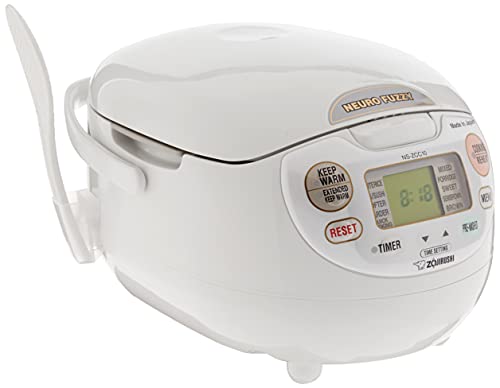
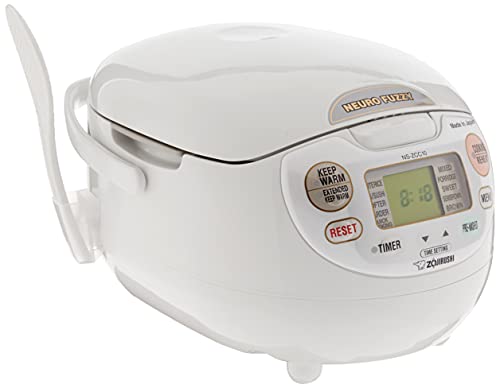
| Neuro Fuzzy NS-ZCC10 | Zojirushi | 5.5 cups | Neuro Fuzzy logic | Consistency and keep-warm quality |
| Micom NS-TSC10 | Zojirushi | 5.5 cups | Micom computerised | Menu breadth and steaming basket |
| JBV-A10U | Tiger | 5.5 cups | Micom computerised | Tacook synchronised steaming tray |
| JNP-S10U | Tiger | 5.5 cups | Conventional switch | Simplicity and durability |
The table hides the real story, which is that the two brands overlap in the middle and diverge at the edges. Tiger’s Micom JBV-A10U competes directly with Zojirushi’s Micom NS-TSC10 — similar capacity, similar computer control, similar ambitions — and the contest between those two is decided by details like the steaming system and control layout. But Tiger also fields the JNP-S10U, a conventional cooker with no Zojirushi equivalent in this line-up, while Zojirushi fields the Neuro Fuzzy, whose adaptive cooking has no Tiger counterpart here. Shoppers should therefore decide first which tier of technology they want, and only then which badge, because the tier changes daily life more than the logo does.
All four models are sold through their Amazon listings, linked in each review below, where the current bundle, plug type and included accessories can be checked before ordering. Each machine here was verified against catalogue data and carries its official product photograph beside its section. A rice cooker is bought rarely and used constantly, so the few minutes spent confirming the exact listing variant are among the best-value minutes in the whole purchase.
How Did We Judge These Two Japanese Brands?
Six yardsticks shaped the comparison. Cooking intelligence came first: whether the machine merely heats until a thermostat trips, or actively manages the soak, ramp and steam phases that decide texture. Second came the steaming question, because both brands offer a way to cook food above the rice and the implementations differ in ways that affect dinner. Third, keep-warm behaviour across an ordinary evening, since rice in these households rarely goes straight from pot to table for everyone at once. Fourth, capacity realism — how each five-and-a-half-cup pot handles a small two-cup batch and a full load. Fifth, the cleaning burden: lids, trays, condensation and pot coatings after a month of starch. Sixth, longevity signals: build feel, parts availability and the manufacturer’s track record of supporting older models.
Context matters for fairness. Tiger Corporation dates to nineteen twenty-three and built its name on vacuum flasks and rice cookers sold across Asia, where its no-nonsense machines anchor countless family kitchens; its design language favours the proven over the novel. Zojirushi, five years older, pursued the same categories with a research-led streak that produced fuzzy-logic cooking and a devoted export following. In Japan the two are simply the establishment, chosen by neighbouring households for generations without either being wrong. This comparison imports that healthy rivalry and asks which establishment style suits a modern kitchen elsewhere.
Zojirushi Neuro Fuzzy NS-ZCC10 — the Adaptive Perfectionist
Badge: Best for texture-focused daily rice
| Spec | Detail |
|---|---|
| Capacity | 5.5 cups uncooked, roughly 10 cups cooked |
| Control | Neuro Fuzzy logic, automatic keep-warm, delay timer |
| Inner pot | Nonstick pan shaped for even heat movement |
| Extras | Extended keep-warm, reheat cycle, retractable power cord |
The Neuro Fuzzy earns its name honestly. Its control system watches the cooking curve and corrects course the way an experienced cook does — a little more heat when the batch is large, a gentler ramp when the rice went in cold — so the finished pot tastes deliberate rather than lucky. Owners notice the effect most on ordinary days: the Tuesday batch measured carelessly still comes out tender and separate, and the Sunday batch measured precisely comes out identical. That repeatability is the product. Everything else about the machine, from the retractable cord to the unhurried styling, is engineered to stay out of the way of it.
Menus cover the Japanese home rotation — white, brown, sushi, porridge, mixed — and each behaves distinctly rather than cosmetically. Brown rice emerges with its chew intact but its rawness gone, given the long cycle it needs. Keep-warm performance remains the quiet benchmark in this comparison: hours later the rice is still supper, not a compromise. If your household’s rice pattern is cook once, eat across the evening, this machine’s patience is worth more than any rival’s extra programmes.
Strengths
- Adaptive control that rescues imperfect measuring and varied batches
- Evening-long keep-warm that keeps rice genuinely pleasant
- Understated operation that suits open-plan and quiet homes
Trade-offs
- No synchronised steaming tray system like Tiger’s Tacook
- Premium positioning within this four-model field
- Deliberate pace; there is no rapid rescue cycle
Best for: daily rice households who taste the difference consistency makes. / Not suited for: cooks wanting dinner steamed in the same pot by default.

Zojirushi Micom NS-TSC10 — the Programme Library
Badge: Best Zojirushi for variety cooks
| Spec | Detail |
|---|---|
| Capacity | 5.5 cups uncooked, 1.0 litre class |
| Control | Micom computerised cooking, LCD display, delay timer |
| Inner pot | Nonstick pan with grain-specific water markings |
| Extras | Steaming basket, Umami setting, slow-cook function |
If the Neuro Fuzzy is a specialist, the NS-TSC10 is a gifted generalist. Its programme list reaches beyond rice into slow cooking and steaming, and its Umami setting manipulates soak and steam timing to deepen the natural sweetness of the grain — a subtle effect that plain-rice eaters genuinely notice. The steaming basket rides inside the pot, so a portion of vegetables or a few dumplings can share the rice’s cycle, though the arrangement is less choreographed than Tiger’s dedicated tray system and works best for modest quantities.
The interface is the friendliest on the Zojirushi side: a clear LCD, a clock-style timer that encourages morning loading for evening rice, and completion signals that can be a melody or a plain beep. Slow cooking deserves its mention — soups and braises simmer unattended at a gentle bubble, effectively giving small households a second small hob. For a kitchen that cooks varied food in small batches, this breadth is the argument, and it is a strong one.
Strengths
- Umami programme and slow-cook mode widen the machine’s repertoire
- Steaming basket included for simple one-pot additions
- Clear display and timer that reward planned cooking
Trade-offs
- Steaming is an accessory here, not the choreographed system Tiger offers
- Default white-rice texture runs slightly softer than its sibling’s
- More settings to learn than Tiger’s conventional model demands
Best for: varied small-batch cooking where one appliance should multitask. / Not suited for: households wanting a switch-only cooker with nothing to learn.

Tiger JBV-A10U — the One-Pot Dinner Machine
Badge: Best for steamed meals with rice
| Spec | Detail |
|---|---|
| Capacity | 5.5 cups uncooked |
| Control | Micom computerised cooking with menu settings |
| Inner pot | Nonstick pot with Tacook steamer tray |
| Extras | Tacook synchronised cooking plate, keep-warm |
The JBV-A10U is built around an idea so practical it is strange more cookers do not copy it. The Tacook plate sits above the rice, holding vegetables, fish, sausages or dumplings in the steam the rice generates, and Tiger’s synchronised cooking programme times the cycle so the tray’s contents and the rice beneath finish together. Dinner becomes a single loading action: grains and water below, the rest above, one button, and forty-odd minutes later a complete meal with one pot to wash. For small households and tired weeknights, that choreography is worth more than another half-dozen rice programmes.
As a rice cooker pure and simple it is a capable Micom machine, producing a hearty, satisfying bowl with a touch more bite than Zojirushi’s style. Menus cover the expected ground — plain, quick, brown, porridge, mixed and a slow-cook option among them — presented without fuss. The tray does impose one discipline: strongly flavoured foods scent the rice below them, which is delightful with ginger chicken and less welcome with plain rice destined for sushi. Owners learn to pair flavours intentionally, and most come to treat that as a feature of the system rather than a flaw.
Strengths
- Tacook tray turns the cooker into a complete one-pot meal station
- Straightforward Micom menus without unnecessary complexity
- Hearty rice texture that suits sauced and mixed dishes
Trade-offs
- Tray flavours can perfume the rice beneath, for better or worse
- Keep-warm finesse trails the Zojirushi benchmark
- Less adaptive correction of measuring mistakes than fuzzy logic
Best for: small households wanting rice and a steamed main from one pot. / Not suited for: purists who want their plain rice entirely unflavoured.

Tiger JNP-S10U — the Deliberately Simple Classic
Badge: Best for switch-only simplicity
| Spec | Detail |
|---|---|
| Capacity | 5.5 cups uncooked |
| Control | Conventional automatic cooking with keep-warm up to 12 hours |
| Inner pot | Non-stick inner pot |
| Extras | Retractable power cord, spare-rice-paddle practicality |
The JNP-S10U is an argument made in aluminium and good sense: a rice cooker does not need a computer. Press the switch, the pot cooks until its thermostat judges the water absorbed, then it holds warm for up to twelve hours. That is the entire interface, and for a remarkable number of households across Asia it has been enough for decades. The black finish, the retractable cord and the unfussy lid all serve the same philosophy — an appliance that asks nothing, teaches nothing and simply produces rice, day after day, in kitchens that have other things to think about.
Honesty about limits belongs in this review. A conventional cooker cannot adjust for a cold kitchen, an old batch of rice or a careless measure the way fuzzy logic does, and brown rice asks for pre-soaking and lowered expectations. Small batches cook less evenly than in the computerised models. What the JNP offers instead is mechanical simplicity that ages gracefully: fewer components to fail, nothing to reprogramme after a power cut, and a learning curve measured in seconds for any guest, grandparent or teenager who encounters it. For a holiday home, a rental, a workplace kitchen or a technophobe’s counter, that profile is not a compromise — it is the correct specification.
Strengths
- Nothing to learn and almost nothing to go wrong
- Twelve-hour keep-warm covers a long, staggered day
- Proven conventional design with a long service tradition
Trade-offs
- No programmes for grains beyond basic white-rice cooking
- Texture varies more with measuring accuracy and conditions
- Brown rice needs soaking help and patience
Best for: simplicity seekers, second kitchens and shared spaces. / Not suited for: grain variety, brown-rice routines or texture perfectionism.
Which Brand Handles Steaming and One-Pot Meals Better?
Tiger wins this round on intention. The Tacook system was designed as a meal method, not an accessory: the plate’s depth holds a genuine portion, the synchronised programme accounts for the tray’s presence in its timing, and the recipe culture around the product treats rice-plus-tray as dinner. Zojirushi’s steaming basket on the Micom model works perfectly well for vegetables and small items, but it reads as a bonus rather than a system, and quantities are snack-scale beside Tiger’s dinner-scale plate. Households that regularly steam should weight this heavily; a cooker that produces the whole meal displaces a steamer, a saucepan and a good deal of washing up.
There are two cautions to carry alongside the praise. Flavour migration, already mentioned, is real: steam carries aromatics down as reliably as it carries heat up, so plan pairings rather than discovering them. And the tray occupies the pot’s headspace, which means the largest rice batches and the tray cannot always coexist; a full family load of rice leaves less room for ambitious steaming. Neither caution dents the conclusion for the households Tiger designed this for — one to four diners who want dinner from a single vessel — but they explain why the feature is a lifestyle choice rather than a universal upgrade.
What About Brown Rice, Porridge and Grain Variety?
Here the advantage swings back. Zojirushi’s computerised models treat brown rice as a first-class citizen, with a dedicated long cycle that hydrates the bran gradually and a porridge programme tuned to avoid the boil-over that plagues lesser machines. The Micom model’s slow-cook setting extends the repertoire to soups and braises. Tiger’s JBV-A10U covers brown and porridge respectably through its Micom menus, and its results satisfy most households; the conventional JNP, by contrast, should be understood as a white-rice machine that tolerates experiments rather than encourages them.
The practical dividing line is frequency. A household eating brown rice twice a month will be content with Tiger’s Micom or even a soaked batch in the conventional pot. A household eating it four times a week should buy the machine that finds it easy, and that is Zojirushi. Porridge tells a similar story at lower stakes: both computerised brands manage it, Zojirushi with a touch more refinement in texture, Tiger with the option of steaming a savoury accompaniment above it in the same run — a breakfast trick worth knowing about.
How Do You Cook Well in Either Brand, Day After Day?
Start with the measuring ritual, because conventional and computerised pots alike depend on it. Use the cup supplied with the machine, level it without packing, rinse the grains until the rinse water turns from milky to merely cloudy, and match the water to the line for the programme you selected rather than a generic mark. Then leave the finished rice alone for ten minutes before opening the lid; that rest lets moisture redistribute so the top layer and the base meet in the middle. Fluff by slicing and folding with the paddle, which separates grains without crushing them into paste.
Tacook cooking rewards a little choreography of its own. Choose tray foods that finish in roughly the rice’s cooking window — sliced vegetables, fish fillets, sausages, gyoza, marinated chicken pieces cut small — and season them with the rice in mind, because their juices and steam will visit the grains below. Delicate greens go in for a second short steam after the rice finishes rather than enduring the full cycle. On the Zojirushi side, the equivalent habit is basket discipline: modest quantities, sturdy vegetables, and an acceptance that the basket is a companion act rather than the headline. Both systems shine brightest on weeknights, when the alternative was a takeaway menu rather than a three-pan production.
Leftovers deserve a system too. Rice intended for tomorrow’s fried rice should be spread on a tray, cooled, and refrigerated in a shallow container; grains that dry slightly in the cold separate beautifully in a hot pan. Rice intended for reheating as-is wants a covered container and a spoonful of water at reheating time. Keep-warm modes on all four machines are for the span of a meal and an evening, not overnight storage, and the household that respects that boundary gets better texture and safer food from every brand equally.
How Do Keep-Warm and Cleaning Compare in Real Life?
Zojirushi’s keep-warm is the connoisseur’s choice: temperature and humidity managed so carefully that rice held for hours remains close to its fresh self, with a reheat cycle to polish the result. Tiger’s Micom holds rice perfectly acceptably across a family evening, and the conventional JNP’s twelve-hour hold is generous in span if simpler in finesse — rice at hour ten is warm and edible rather than indistinguishable from fresh, which for a workplace kitchen or a teenager’s late supper is precisely what is required. Judge by your pattern: grazing households gain from Zojirushi’s polish; scheduled households will never notice the difference.
Cleaning splits along mechanical lines. All four pots wash easily and all four lids collect starch film that a weekly wipe handles. The Tacook tray adds one more item to the sink, repaid by the pans it replaced. The conventional Tiger has the fewest nooks and dries fastest; the computerised models from both brands hide their complexity well but reward attention to the steam vent and lid gasket area, where residue quietly accumulates. In every case the inner pot’s coating is the component to protect: wooden or silicone tools, a soft sponge, no scouring, and the machine will outlast several changes of kitchen décor around it.
What Mistakes Do Shoppers Make With These Two Brands?
The first is assuming the brands are interchangeable because both are Japanese and long-established; the overlap is real in the Micom middle, but the Neuro Fuzzy’s adaptivity and the JNP’s simplicity exist at opposite poles that no single model spans. The second mistake is buying the Tacook for its novelty and never planning a tray meal, or dismissing it as a gimmick when it would have solved the household’s weeknight problem outright. Third, buyers underrate the conventional cooker for a main kitchen and overrate it for grain variety — it is a superb white-rice appliance and a limited everything-else appliance, and both halves matter. Fourth, shoppers forget that five-and-a-half-cup ratings describe uncooked rice; the cooked yield of about ten to eleven cups overwhelms small households that cook a full pot out of habit. Finally, many people compare only the purchase moment and ignore parts: replacement pots, lids and trays are stocked for these popular models, and confirming that on the listing is two minutes well spent.
How Should You Choose, Step by Step?
Begin by naming your steaming intention honestly. If rice plus a steamed main sounds like your Tuesday, the Tiger JBV-A10U moves to the front and stays there. If steaming sounds like a twice-a-year experiment, cross it off and compare the remaining three on cooking control. Next, name your grain pattern: white rice only, or brown and porridge in regular rotation? Variety points to Zojirushi’s pair; white-rice loyalty keeps every model in play, including the simple Tiger. Then name your operators: a household of confident cooks can enjoy any panel, while a household of mixed ages and guests benefits from either Zojirushi’s clarity or the JNP’s single switch. Finally, name your holding pattern — cook-and-eat households can ignore keep-warm refinements that grazing households should pay for gladly.
Notice what this sequence does: it spends your money on the behaviour you will actually repeat. The most common outcome is a shortlist of two — often the Zojirushi Micom against the Tiger Micom, the comparison’s true centre — and at that point the steaming tray against the Umami-and-slow-cook breadth becomes a lifestyle question rather than a technical one. There is no score sheet that answers it for you, and any guide claiming otherwise is selling certainty it does not possess. Both finalists will cook your rice well for years; choose the one whose extra talent matches your kitchen’s habits.
A Week of Dinners on Each Side
Run the same week through both camps. Monday’s planned chicken curry suits every machine, with timers doing the quiet work. Tuesday’s rushed evening is where paths split: the Tiger household loads rice and a Tacook tray of salmon and greens and eats a composed meal from one pot, while the Zojirushi household pairs its perfectly timed rice with something from the freezer and feels no hardship either. Wednesday’s sushi night belongs to Zojirushi’s texture. Thursday’s brown-rice bowl belongs to Zojirushi’s patience. Friday’s congee for a sniffling child is a draw — both computerised brands produce it gently, and the JNP household reaches for a saucepan without resentment, as their grandparents did.
The week’s lesson is that each brand’s signature strength appears about twice in an ordinary rotation. That frequency is the honest basis for choosing: whichever signature you would use twice a week is worth prioritising; whichever you would use twice a year is not, however impressive it reads. Households whose weeks are heavy on steamed one-pot dinners already know their answer, as do households heavy on brown rice and porridge. Everyone between those poles should buy the middle model of the brand whose texture they prefer and stop second-guessing.
Final Recommendation: Zojirushi or Tiger?
Choose Zojirushi if rice quality is the point of the purchase: the Neuro Fuzzy for adaptive consistency and keep-warm polish, the Micom NS-TSC10 when menu breadth, slow cooking and an Umami programme will be used. Choose Tiger if dinner logistics are the point: the JBV-A10U for its Tacook one-pot system, the JNP-S10U when the brief is a cooker that anyone can run and nothing can confuse. All four are honest machines from makers who have earned their longevity, and the worst outcome available here is a very good rice cooker that slightly mismatches your habits. For the rest of a comfortable home, our readers often continue to pillows matched to side sleepers, cooling sheets for warm sleepers and mattresses chosen for back pain, while a calm kitchen-adjacent corner benefits from blankets for the living room. Shoppers also weighing the Korean alternative should read zojirushi compared with cuckoo before deciding.
Head-to-Head Verdicts on the Criteria That Matter
Everyday white rice
Zojirushi’s adaptive models take the round for refinement and forgiveness; Tiger’s Micom produces a satisfying, slightly heartier bowl; the conventional JNP produces good rice when measured carefully and plainer rice when not. For a household that eats white rice daily and notices such things, the ranking is Zojirushi, Tiger Micom, Tiger conventional — with the honest caveat that good rice and careful water narrow every gap in this comparison.
Small batches and full loads
All four machines are five-and-a-half-cup designs, and all prefer the middle of their range. Two uncooked cups cook well in the computerised trio; the conventional pot is happiest at three cups and above, where its thermal mass behaves predictably. Full loads near capacity suit celebratory cooking in any of them, provided foaming grains like porridge oats are kept to the lower fill lines their manuals specify. Households of one or two who cook a single cup nightly should know that none of these is a true small cooker, and should either batch-cook and refrigerate portions or accept slightly less perfect small batches as the price of family capacity.
Timers and planned cooking
The two Zojirushi models and Tiger’s Micom all offer delay timing, and in practice the feature reorganises mornings: rice and water loaded after breakfast, a finishing time set, and dinner’s foundation ready when the cook walks in. The conventional JNP has no timer, which its owners solve the old way — cooking on arrival, since white rice in a conventional pot is not a long wait, or holding a cooked batch warm. If your household runs on schedules, the timer is not a luxury; if your household cooks when it arrives, its absence costs nothing.
Value over a decade
Judged across years rather than at checkout, value in this comparison is mostly about avoided replacement. A computerised model whose programmes match your cooking will serve a decade without provoking an upgrade itch; a mismatched flagship of features becomes a cupboard tenant. The JNP’s value case is different and equally real: minimal electronics, a proven mechanism, and a role it fills completely for white-rice households. Tiger’s Micom sits between, its tray system paying rent every time it replaces a second cooking vessel. Pick the model whose strengths you will exercise weekly and the arithmetic takes care of itself.
What Should You Verify on the Listing Before Buying?
Check the model’s exact suffix and capacity, because both brands sell near-identical cookers in several sizes and regional variants. Confirm the voltage matches your supply and that the plug suits your sockets without an adapter chain. Note which accessories are in the box — Tacook plate, steaming basket, paddle, measuring cup — since bundle contents vary by listing. Look at the stated keep-warm behaviour and the replacement-pot availability for that precise model number. Finally, compare the listed dimensions against your counter and cabinet clearance with the lid raised. These five checks, none of which takes a minute, prevent nearly every disappointment owners report with machines from either maker.
The Rice Itself: Habits That Matter More Than the Badge
Both brands’ owners converge on the same kitchen habits, because good rice is mostly grown and stored before it is cooked. Buy from a source with turnover, keep the grain sealed against moisture and pantry odours, and finish a bag within a few months of opening. Rinse with intent: several changes of water, gentle swishing, no crushing. Respect the difference between new-crop rice, which drinks less water, and older stock, which needs the full measure — when a trusted routine suddenly turns soft or firm, the harvest changed, not the machine. And use the cup that came in the box; cooker cups and pot markings are a matched system in both brands, and substituting a standard measuring cup quietly breaks every water line printed inside the pot.
Seasoning philosophy is the other shared ground. In both Japanese traditions behind these makers, plain rice is cooked unseasoned so it can accompany anything; salt, butter and aromatics belong to specific dishes rather than the default pot. Mixed rice — grains cooked with vegetables, mushrooms or chestnuts — is where the Micom models from both brands earn admiration, timing the additions so everything lands together. The conventional pot cooks mixed rice happily too, with the cook supplying the judgement the electronics would have. Learn your machine’s behaviour across five batches of the same rice before judging it; every cooker in this comparison has a personality that reveals itself over a week, not a single dinner.
Gifting, Second Homes and Shared Kitchens
Rice cookers from these two makers are classic housewarming and wedding gifts, and the right choice depends on the recipient’s kitchen rather than the giver’s enthusiasm. The JNP is the safest gift in the comparison: it cannot confuse anyone, fits a small counter, and will still be working when the couple’s décor has changed three times. The Tiger Micom suits a young household that cooks simply and would genuinely use the tray for weeknight dinners. Zojirushi’s models suit recipients who cook rice often enough to appreciate refinement — giving a Neuro Fuzzy to a household that eats rice monthly wastes its talents, while giving it to a daily-rice family is a decade-long kindness.
Shared and secondary spaces tilt the decision further toward simplicity. A workplace kitchen, a rental property, a holiday home or a student house punishes complicated appliances and rewards the cooker that survives strangers: that is JNP territory, with the Tiger Micom as the upgrade when the space’s regulars are known. Main kitchens in settled homes are where Zojirushi’s refinement pays its daily dividend. Thinking about where the machine will live, and who will meet it on a tired evening, settles the brand question more honestly than comparing programme counts ever will.
Footprint, Noise and Fitting the Cooker Into a Real Kitchen
All four machines occupy roughly the counter territory of a large kettle, but their manners differ. Zojirushi’s rounded bodies and retractable cords keep a counter looking tidy, and their soft completion melodies suit flats where the kitchen opens onto living space. Tiger’s designs are squarer and more utilitarian, the JNP in black reading as honest equipment rather than décor. Lid clearance is the measurement buyers forget: allow the full arc of the opening lid beneath wall cabinets, or plan a pull-forward habit that will quietly irritate someone daily. Steam needs somewhere to go as well; a cooker parked directly under a cabinet will mist its underside for years, so a few inches of open air above the vent is a genuine installation requirement, not fussiness.
Noise, such as it is, consists of gentle bubbling, occasional clicks and completion signals on the computerised models, and near silence from the conventional pot. In a studio flat where the cooker shares air with a desk or a bed, the quieter machines earn goodwill out of proportion to the decibels involved. Weight matters for households that store appliances away between uses — all four are manageable, the conventional model lightest in spirit if not dramatically on the scale — but the honest advice is to give any rice cooker a permanent home, because the one stored in a high cupboard is the one that stops being used.
What Owners of Each Brand Tend to Argue
Long-running owner debates are a useful map of real differences. Zojirushi loyalists argue that texture consistency is the whole point of a premium cooker and that everything else is garnish; Tiger loyalists answer that dinner is the point, and a cooker that produces the meal beats a cooker that perfects one component of it. Conventional-cooker defenders add that electronics are a failure mode scheduled for later, while fuzzy-logic owners reply that their machines have run daily for years without incident. Each camp is describing its own kitchen accurately, which is why the arguments never resolve — and why this guide keeps returning to habits rather than specifications as the deciding ground.
One debate deserves a direct answer: whether the price gap between the conventional Tiger and the adaptive Zojirushi buys anything real. It buys measurement forgiveness, grain programmes, timer sophistication and keep-warm refinement — four things a daily, varied, schedule-driven household uses constantly and a simple white-rice household uses rarely. The gap is neither a rip-off nor a bargain in the abstract. It is a menu of services, priced once, consumed daily or not at all depending on the kitchen that hosts the machine.
Reading the Menus: Which Programmes Actually Earn Their Place?
Programme lists inflate easily, so judge each entry by whether it changes time, temperature or both in a way a cook can taste. Brown rice programmes earn their place everywhere they appear, because the grain genuinely needs a longer, hotter hydration than white rice tolerates. Porridge programmes earn theirs by cycling heat to prevent the foam-over that makes stovetop porridge a supervision job. Zojirushi’s Umami setting earns its place by extending the soak and steam phases, a real change with a subtle but perceptible effect on plain rice. Tiger’s synchronised cooking programme earns its place by solving a timing problem no manual workaround handles as neatly.
Quick-cook programmes are the honest compromise of the category: they shorten the soak and compress the ramp, producing good rice faster at a small cost in refinement, and both brands’ Micom models offer one. Cake and novelty settings, where they appear in the wider ranges, are entertainment rather than infrastructure — pleasant to discover, irrelevant to the purchase. Slow-cook programmes sit between: genuinely useful in small households that lack a separate slow cooker, redundant in kitchens that already own one. Read a menu list with those filters and the apparent gap between brands narrows to the few programmes that correspond to your actual week, which is exactly the comparison that should decide the purchase.
Energy, Storage and the Small Print of Ownership
Rice cookers are modest energy users, drawing their power in a single cooking burst and then sipping during keep-warm; the meaningful running cost across a decade is replacement pots and the occasional gasket or lid part, not electricity. Storage of the machine itself follows one rule — a permanent counter station beats a cupboard for any appliance used more than twice a week — and storage of its accessories follows another: keep the paddle, cup and tray with the machine, because a Tacook plate in a distant drawer is a feature you no longer own. Both brands sell into this reality well, with compact bodies and cords that retract or wrap rather than trail.
The small print worth reading on delivery day is short. Register the warranty while the receipt is findable. Photograph the model and serial plate for your records. Run the first batch with plain water if the manual suggests it, to clear manufacturing residue, and season your expectations across the first week as the pot and your measuring hand calibrate to each other. None of this is brand-specific, and all of it separates owners who love their cookers from owners who merely own them.
Six Buyer Profiles, Six Clear Answers
The daily-rice perfectionist, cooking for a family that notices texture and grazes through the evening, should buy the Neuro Fuzzy and never look back; its adaptivity and holding quality were designed for exactly that table. The variety cook in a small flat, simmering soups on Sunday and steaming dumplings on Wednesday, belongs with the Zojirushi Micom and its programme library. The weeknight realist with two children and forty minutes belongs with the Tiger JBV-A10U, whose tray turns rice night into dinner night with one washing-up load. The minimalist, the landlord, the holiday-home owner and the technophobe all belong with the JNP-S10U, the cooker that asks nothing and delivers rice. The brown-rice devotee belongs with Zojirushi’s dedicated cycle and patience. The gift-buyer belongs with whichever profile describes the recipient — and with the JNP whenever the recipient is a mystery.
Notice that none of these answers required knowing which brand is “better” in the abstract, because the question dissolves once the household is described honestly. That is the real conclusion of the zojirushi vs tiger comparison: two excellent Osaka makers, four honest machines, and a decision that lives in your kitchen’s habits rather than in any specification table. Describe the habits first, and the cooker chooses itself.
Frequently Asked Questions
Are Zojirushi and Tiger rice cookers made in Japan?
Both are Japanese companies with long Osaka roots, and their ranges include models manufactured in Japan and models produced in their overseas factories depending on the line and market. What matters for a buyer is the specific model’s specification and warranty on its listing rather than assumptions from the brand name. Check the listing details for the exact unit you are ordering, and judge build and support by the model in front of you.
Does the Tacook tray really cook food through, or just warm it?
It cooks through, using the steam generated across the rice cycle, and Tiger’s synchronised programme is timed with the tray in place. Foods that suit steaming — fish, sliced chicken, sausages, firm vegetables, dumplings — emerge properly cooked when cut to sensible sizes. Dense items like whole chicken breasts or thick root vegetable chunks are poor candidates; slice them, or choose a different cooking method for that meal and let the cooker do what it does best.
Is a conventional cooker like the JNP a false economy?
Not for the household it suits. If your cooking is white rice, eaten promptly, in a kitchen where simplicity and durability outrank versatility, the conventional machine delivers years of service with almost nothing to fail. It becomes a false economy only when the buyer actually wanted brown-rice programmes, timers and texture control, and spends the following years working around their absence. The economy is in matching the machine to the brief, not in the price tier itself.
Which brand is better for a first rice cooker?
For a first cooker that will teach good habits, the Tiger JBV-A10U and Zojirushi NS-TSC10 are both friendly starting points, the Tiger adding meal-making encouragement and the Zojirushi adding programme depth. The JNP is the easiest first cooker of all but teaches the least, since it asks nothing of its owner. The Neuro Fuzzy suits a first-time buyer who already knows they care about texture and wants to skip the upgrade step entirely.
Can these cookers make rice for sushi properly?
Yes — sushi rice is primarily about the grain, the seasoning and the handling after cooking. Zojirushi’s dedicated sushi programme gives it a small head start in texture, producing the tender, cohesive result that seasons evenly when folded with vinegar dressing. Tiger’s Micom plain setting produces a fine base as well; avoid the Tacook tray for that batch, since stray flavours have no place in sushi rice, and fan the seasoned rice as tradition directs.
Do these cookers work well for one person?
They work, with a caveat about batch size. A single cup of rice in a five-and-a-half-cup pot sits shallow, and the computerised models handle that better than the conventional one, which prefers a deeper fill. Many solo cooks batch-cook three cups, eat one portion fresh and refrigerate two for fried rice and lunches, which plays to every machine’s strengths. If your cooking is exclusively single small batches, cookers in a smaller capacity class exist in both brands’ wider ranges and would serve you better than any model here.
Which brand handles jasmine and basmati better?
Both handle fragrant long grains well when the water is measured conservatively, since these varieties swell less predictably than short grain and punish excess water with softness. Zojirushi’s gentler programmes flatter basmati’s delicacy, while Tiger’s Micom produces a slightly firmer jasmine that suits stir-fried accompaniments. The conventional Tiger cooks both acceptably with careful measuring. Grain freshness and water discipline move the result more than the badge does, as with most questions in this comparison.
How long should one of these machines last?
With gentle treatment of the inner pot and a weekly wipe of lids and vents, both brands’ machines commonly serve for many years; the coating of the pot is usually the first component to tire, and replacements are available for these popular models. Conventional designs like the JNP have the fewest parts to age, while computerised models depend on electronics that both makers have proven across long production runs. Longevity follows care more than brand in this comparison.
Settled households rarely regret either badge; they regret only the mismatch between a machine’s talents and a kitchen’s routine. Read your own routine once more before ordering — how often rice appears, which grains, who cooks, who steams, who arrives home late to a warm pot — and let that honest inventory cast the deciding vote between Zojirushi’s refinement and Tiger’s practicality.
A final practical note for households replacing an elderly cooker rather than buying a first one: keep the old machine’s measuring cup out of the new kitchen drawer. Every mismatch story in this category begins with two similar cups and one distracted morning. Start the new cooker with its own cup, its own water lines and a week of patience while you learn its personality, and whichever brand you chose will reward the fresh start with the consistency these two makers built their names on.