Disclosure: As an Amazon Associate, dailyhomedecorating.com earns from qualifying purchases. Links on this page are affiliate links; they cost you nothing extra. Prices and availability change often, so check the current Amazon listing before you buy.
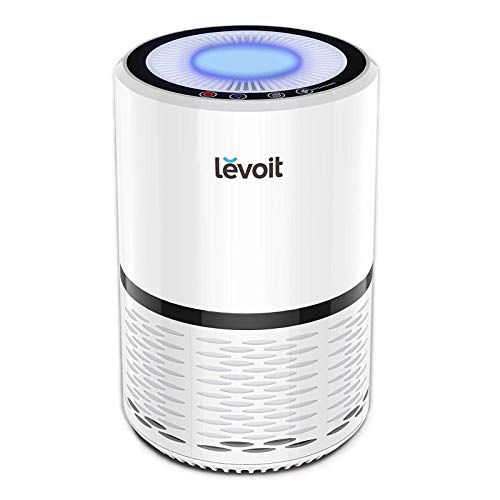
The desktop generation’s other survivor is the subject of this levoit lv h132 review: the LV-H132, an AHAM-verified desktop purifier whose distinguishing extra is an optional night light — a soft glow for the small hours — where its scented sibling, the LV-H128, keeps an aroma pad. The pair are the same honest idea in two sensory dialects: a verified personal-scale filter, plus one small kindness addressed to a sense other than smell’s filtration. The H132’s kindness is for the eyes at 3 a.m. — the nursery feed, the landing’s crossing, the nightstand’s geography — and this review arbitrates between the glow, the scent and the modern plainness of the Core Mini for the surfaces all three machines serve.
The night light, taken seriously
Darkness is a design material, and most purifiers treat it as an enemy — their LEDs glare, their displays demand dimming, their manners in a bedroom are a standing complaint in this cluster’s smart-machine reviews. The H132 treats darkness as a client: its optional light is there to be used, at the strength the small hours need, for the walk to the nursery or the glass of water, and to be switched off entirely when the room wants true dark. Optionality is the design’s intelligence. A glow that cannot be refused is a nuisance; a glow that can is a tool, and the households that keep the H132 by the bed are precise about the difference — the light earns its place on the nights it is wanted, which in a house with a baby, an elder, or a shift worker’s irregular hours is most nights. This review takes the glow as seriously as its sibling’s review took the scent, because both are the same argument: at personal scale, a purifier may serve one more sense than the air, provided it serves the air verifiably first.

Levoit LV-H132 — the glowing desktop
Best for the nightstand and nursery shelf that cross the small hours
The listing’s specification: desktop purification, AHAM verification, and the optional night light. Its parish is the personal surface — nightstand, nursery shelf, the landing’s dresser — and its shift is the night: the hours when a household moves carefully and a soft, local glow is worth more than a corridor’s full lighting. By day it is a small verified filter among others; by night it is the room’s lighthouse in miniature, and its owners’ loyalty is disproportionately nocturnal, as the season below records.
- Model: LV-H132
- Verification: AHAM VERIFIDE, per its listing
- Feature: optional night light
- Parish: desktop and nightstand scale
- Filtration: genuine replaceable filter
Strengths
- Verified delivery at desktop scale.
- A glow that can be refused — the tool, not the nuisance.
- The small hours’ kindest appliance in the range.
Trade-offs
- No sensor, no app, no scent.
- The parish is personal; whole rooms outrun it.
- True-dark sleepers will simply never use the extra.
Best for: nightstands, nurseries and landings with small-hours traffic. Not suited for: whole-bedroom governance — the Core 200S’s parish.

Levoit LV-H128 — the scented sibling
Best for the personal room that finishes itself with a signature
Reviewed in full beside this article: the same generation, the same verification, the aroma pad where this machine keeps its lamp. The choice between the siblings is the choice of which sense the machine may serve beyond the air — scent for the room that finishes itself deliberately, glow for the room that wakes in the night — and households with both briefs, in different rooms, routinely keep both machines, one per surface, without any sense of duplication. The desktop generation’s two luxuries were designed, whether by intention or by luck, to be complements rather than rivals.
- Model: LV-H128
- Verification: AHAM VERIFIDE, per its listing
- Feature: aroma pad for essential oils
- Parish: desktop and nightstand scale
- Filtration: genuine replaceable filter
Strengths
- The family’s only scented filtration.
- Verified, personal, greeted nightly.
- The desk’s finishing instrument.
Trade-offs
- No light for the small hours.
- Equally manual, equally personal.
- The scent is optional or it is nothing.
Best for: desks and dressed rooms. Not suited for: the 3 a.m. crossing — this review’s subject’s parish.

Levoit Core Mini-P — the modern plain standard
Best for unscented, unglowing personal air in the current design
The heir, reviewed in full in this cluster: the family’s current personal machine, quiet-mannered, cartridge-based, and innocent of both luxuries. For the nightstand of a true-dark sleeper it is arguably the correct machine of the three — its darkness manners are its design’s pride — and this review posts that redirect without reservation. The H132’s glow is an extra for households with small-hours traffic; where there is no traffic, there is no brief, and the Mini’s plainness wins on the merits.
- Model: Core Mini-P
- Coverage: up to 178 sq ft claimed
- Filtration: 3-in-1 cartridge with carbon
- Noise: 25 dB sleep mode, per its listing
- Extras: none — filtration only
Strengths
- The current design and its support.
- Darkness manners for the true-dark sleeper.
- The personal default, deservedly.
Trade-offs
- No glow for the crossing, no scent for the finish.
- No AHAM badge on its listing.
- Equally personal in scale.
Best for: the dark, quiet nightstand. Not suited for: the small-hours thoroughfare, which is the H132’s beat.
In this guide
A winter of small hours
December installs the H132 on a nursery landing, in a house whose baby has opinions at 2 and at 4. The machine’s double shift assembles itself: the filter governs the landing’s air — the nappy bin’s diplomacy, the carpet’s dust — while the glow, at its gentlest, turns the night’s crossings from expeditions into strolls. January’s record notes what the parents note: nobody has stubbed, fumbled or fully woken since the little lighthouse took its post, and the household’s sleep — the parents’ broken, precious sleep — is measurably less broken at its edges. February promotes the machine in the family’s internal rankings above appliances costing five times more, which is the H132’s whole case in one household vote: at the hour it serves, nothing else in the house is worth what it is worth.
Final word
The LV-H132 is the desktop generation’s glowing survivor: verified, small, manual, and possessed of the range’s kindest small-hours extra. Buy it for the nightstand or the landing that wakes in the night; buy its sibling for the room that wants a signature; buy the Mini for the room that wants darkness and quiet alone. The luxuries are small because the hours are small — and at 3 a.m., small is the size of everything that matters.
Glow, governed: the household rules
The light attracts a short code, as its sibling’s scent did. Keep the glow local — it lights the crossing, not the room, and a landing lit like a stage defeats it. Use the gentlest setting that serves; the small hours need geography, not daylight. Refuse it entirely for the true-dark sleeper’s side of the bed — the option is the design, and exercising the refusal is using the machine correctly. And let the glow’s shift end at morning: a night light burning at noon is a small domestic melancholy that the dial prevents in one touch. The code’s foundation is the sibling code’s: the extra is always optional, and the air never is.
The lighthouse principle
A lighthouse is not judged by its wattage but by the crossings it makes safe, and the H132 miniaturises the principle honestly: a small light, exactly placed, in service of a repeated journey. The journeys it serves are the household’s most vulnerable — barefoot, half-asleep, carrying a baby or a glass — and the machine’s dignity comes from taking them as seriously as the flagship reviews take the great room’s weather. Dignity at small scale is this desktop pair’s shared distinction: the H128 dignifies the finish of a room, the H132 dignifies its night traffic, and the modern line, for all its sensors, dignifies neither — it merely, competently, cleans. Competence is the floor. The survivors add the dignity, each in its dialect, and the review’s recommendation rests on the addition.
Dignity, audited
The review has praised the glow’s dignity, and its duty is the audit: the dignity is paid for in the modern currencies, exactly as its sibling’s charm was — no sensor for the cooking hour, no app for the sofa, no display for the room’s narrative. The H132’s owner governs by hand, and the nights the hand forgets are nights the parish runs ungoverned in a way the smart rungs would have caught. That is the honest debit, posted here as in the sibling’s review, with the same conclusion: the extra bought with open eyes is a kindness; the extra bought as a substitute for governance is a debt. The small hours make the distinction vivid — a lit crossing and an ungoverned room are both possible purchases, and only one of them is this machine used as designed.
The night light in practice: brightness, colour and the discipline of dim
The light is this machine’s whole personality, and its first lesson is that brightness is a decision, not a specification. The glow the H132 offers is a wayfinding light, not a reading light: enough to cross a room, find a door handle, check a sleeping child’s breathing shape in its cot, and no more. Owners who judge it against a lamp are disappointed; owners who judge it against the alternative — the phone torch’s glare, the ceiling light’s small violence at 3 a.m. — understand within one night what it is for. Its colour is warm rather than clinical, a choice that matters more than it sounds, because the small hours are when the eye is most offended by blue-white light and when a household’s other sleepers are most easily woken by a corridor lit like an office.
The discipline of dim has a second half: knowing when the light should be off entirely. The machine’s glow is optional in a way its sibling’s scent is not — a scented pad perfumes whether or not anyone wants it to, but a light can be extinguished, and the households that keep this machine happiest are the ones that treat the glow as a tool with shifts. On for the child’s unsettled years, the elder’s visit, the winter weeks when the house’s nights are longest and its crossings most frequent. Off for the day-sleeper’s blackout, the light-sensitive partner, the summer’s short darkness. A feature that can be wholly rested never becomes a tyranny, and this machine’s light, rested and deployed by turns, keeps its welcome for years.
Wayfinding as a design problem: landings, corridors and the geography of 3 a.m.
Every house has a night geography that its daytime plan conceals: the route from bedroom to bathroom, the landing where the stairs turn, the corridor past the children’s doors. These routes are travelled half-asleep, often by the household’s most vulnerable members, and they are lit — in most houses — by nothing at all or by switches that flood the whole route at once. A small machine with a glow, placed at the route’s hinge point, solves the geography in a way a lamp cannot, because it is already there, already on for its air, asking no one to find a switch with a full bladder and closed eyes. The landing is the classic parish: the machine purifies the house’s most travelled cubic metre of night air and lights the turn of the stairs with the same electricity.
Placement on the landing follows the route, not the socket. The glow should fall across the path’s decision points — the stair head, the bathroom door — rather than pooling decoratively in a corner, and the machine’s intake needs the same hand’s breadth of clearance the rest of this cluster’s placement advice prescribes. A landing machine also earns a specific maintenance note: landings are the house’s dust motorways, carrying the traffic of every room, and a filter there loads faster than the same machine’s would in a bedroom. Keepers on landings should expect the shorter end of the cartridge’s range and judge by the outlet’s evidence rather than the calendar.
The elder in the house: falls, dignity and a light that asks nothing
The most serious use of this small machine is the one its marketing never quite names. An elderly parent staying in the house — for a season, for a recovery, for good — faces the night geography as a genuine hazard: unfamiliar routes, a bladder’s urgency, pride that forbids waking anyone for help. A glowing machine on the landing or in the guest room answers the hazard without announcing it. It is not a medical device, makes no claim to be one, and this article will not dress it as one; it is a light that is already on, in the right place, that asks nothing of the person it serves — no switch, no app, no admission that help was needed. Dignity, in the small hours, is mostly the absence of such admissions, and a household that has placed the machine with that in mind has done a kind thing in the grammar of objects rather than speeches.
The same logic serves the recovering and the temporarily unsteady of any age — the post-operative weeks, the broken ankle, the new baby’s parent navigating by instinct — which is why this article counts the glow a household feature rather than an elder feature. Houses hold a rotating cast of the night-vulnerable, and a machine bought for one member’s season tends to be quietly re-deployed for the next. It is the strongest argument for the H132 over its scented sibling in any house that hosts: scent is a taste, and tastes differ per guest; a dim warm light on a dark landing is a kindness with no constituency against it.
Children and the dark: the machine as a transitional object
There is a season in many children’s lives when the dark itself is the problem — not monsters, precisely, but the room’s refusal to confirm its own contents. The standard answers are a plug-in night light, a door left ajar, a parent’s repeated attendance. A small purifier with a warm glow answers in a different register: it is a machine with a job, humming faintly, visibly working, and children of the relevant age often accept its company with a seriousness they deny to a mere lamp, because the machine is a presence rather than a decoration. Parents report the secondary benefit with some surprise — the child’s room air, in a house with a dog and a carpet, is genuinely better attended than it was — but the primary transaction is the glow’s steadiness: it does not flicker, does not time out, and does not require negotiation at bedtime.
The cautions are the ones this cluster applies to every nursery-adjacent claim. The machine stands on a surface a climbing child cannot pull down, its cord is routed out of the small hand’s world entirely, and its light is a comfort, not a treatment — a child whose fear of the dark is deepening rather than passing deserves a conversation with the family doctor, not a brighter appliance. Within those bounds, the H132 in a child’s room is a legitimate and often beloved posting, and it has the unusual property among children’s room objects of remaining useful when the season passes: the glow years end, the purifier continues, and the machine graduates to the landing without a murmur.
The day-sleeper’s objection, and the machine’s answer
Every glowing appliance has a natural enemy, and this one’s is the shift worker asleep at noon behind curtains, for whom any light-emitting device in the room is an intruder. The objection deserves respect rather than rebuttal, because day sleep is fragile sleep and its defenders are right about its terms. The H132’s answer is completeness of surrender: its light turns off entirely, not to a standby ember, and the machine in its dark mode is a plain, quiet, personal purifier indistinguishable in behaviour from its unlit rivals. A day-sleeper’s room is therefore a legitimate parish for this machine in a way it could never be for a device whose glow is constitutional — provided the household’s other members learn the discipline of not helpfully switching the light back on for the night crossings the sleeper is not making.
The harder case is the shared room, where one partner keeps nights and the other keeps days, and the machine must serve both from the same nightstand. There the honest verdict is that the glow belongs to the night-keeper’s hours only, toggled at the shift’s boundaries, and that a couple for whom even that negotiation is a friction too many should buy the unlit sibling or the Mini and put a separate, dumb, warm plug-in light on the landing instead. This article’s loyalty is to the fit, not the model: the H132’s light is a feature where it is wanted, a fully extinguishable guest where it is tolerated, and a reason to choose differently where it is resented.
Filters and the small machine’s appetite for landing dust
The cartridge question for this machine is the same as its sibling’s in kind and shorter in interval, for the geographic reason already given: wherever the H132 is posted — landing, child’s room, guest room — it tends to stand in travelled air. Expect the honest end of the maker’s estimated range rather than the optimistic end, and judge the cartridge by the evidence this cluster always cites: the outlet’s air losing its cleanness, the fan’s note at a familiar setting growing effortful, the room’s surfaces dusting sooner after a clean than they did in the cartridge’s youth. The change itself is the family’s standard minute-long operation, no tools, and the spent cartridge from a child’s room or a landing will show the keeper exactly what the machine has been eating — a grey felt of the house’s own traffic, which is the most persuasive argument for the machine’s existence that any review can offer.
Sourcing follows the household rule for this generation of Levoit machines: the maker’s own cartridge, matched by model name, from a listing that pictures the cartridge itself. The small machines attract compatible-labelled substitutes with particular energy because their cartridges look simple, and the substitutes’ failure mode is the category’s usual one — a frame a fraction off, a seal that passes air around the pleats, a machine thereafter filtering its own reputation rather than the room. A cartridge is the machine, for filtration purposes; the box around it is a fan and a light. Buy the machine, in effect, genuine, every time.
The H132 against its sibling and the Mini, at decision length
Three small machines compete for the same nightstand in this cluster’s reviews, and the choice among them is the decision most readers of this article are actually making, so it is set out here without hurry. The LV-H128 scents its current; the LV-H132 lights its corner; the Core Mini, the current model, does neither with the same deliberateness and instead offers the living supply chain, the present-day design language and the family’s ongoing attention. Filtration among the three, at personal scale, is close enough that no desk or nightstand will detect the difference; the decision is therefore about the extra each machine brings and the household that will receive it. Scent is a pleasure with a constituency and an opposition — partners divide over it, guests divide over it, and a scented machine in the wrong house becomes a dry-pad machine within a month, which is a fine outcome but a wasted premium of character. Light is a utility with almost no opposition when it is warm, dim and extinguishable, which is why this article has called the glow the safer gift and the more universal kindness.
The Mini’s counter-argument is time. It will be supported, stocked and warrantied on the schedule of a current product, and a household standardising its small machines on one cartridge family simplifies its keeping in a way the two elder siblings cannot match. The decision rule this article leaves is therefore: choose the Mini for infrastructure, the H128 for a scent ritual you already know you want, and the H132 for a house whose nights have crossings in them — children, elders, guests, the long corridor to the bathroom — where a light that is already on is worth more than any specification either rival can print. Houses know which of those they are, usually within one sentence of being asked.
Keeping the small machine: the quarterly ten minutes
Maintenance for the H132 is the lightest covenant in this cluster, and it is set out here as a single quarterly appointment so that owners can stop wondering whether they are behind. Unplug the machine and carry it to a wipeable surface. Vacuum the intake grille with the brush attachment, following the grille’s lines; landings and children’s rooms load this grille faster than any other surface the machine owns. Lift the cartridge by its tab, vacuum the bay and the cartridge’s outer face with the same gentle brush, and inspect the pleats’ colour against the memory of the last visit — the greying should be even, and a cartridge grey on one side only is telling you the machine has been breathing against a wall. Wipe the housing, including the light’s diffuser, whose film of household dust is the quiet thief of the glow’s warmth; a dusty diffuser reads colder and dimmer than the light behind it, and owners occasionally replace a cartridge to cure what a cloth would have fixed. Reassemble, set the light to the household’s current shift, and write the date wherever the household writes such dates.
Two prohibitions, carried over from the sibling’s protocol because the machines share a construction: no water inside the cabinet, and no rinsing of the cartridge, whose media dries unevenly and thereafter smells of the attempt. Add a third, particular to this model: no abrasive anything on the diffuser, whose surface is the light’s whole complexion. Ten minutes a quarter, three prohibitions, one cartridge a year or so — that is the entire treaty between this machine and its keeper, and its lightness is a genuine part of the recommendation, since a household’s scarcest resource is not money but maintained attention.
Power cuts, timers and the machine’s memory
Small machines live at the mercy of the house’s electrical weather, and a keeper is entitled to know how this one behaves when the power blinks. Like most of its generation, the H132 returns from an outage in the state its controls dictate rather than in a smart resume: a machine switched on at its panel comes back on, a machine that was off stays off, and any timer arrangement should be re-checked after a cut rather than assumed. The practical consequence is minor in a bedroom and worth one thought on a landing, where the machine’s whole night value is its being on at 3 a.m. without having been thought about since October. Households on unreliable supplies learn to glance at the glow as part of the evening’s rounds after any flicker — a two-second check that restores the machine’s one promise, which is presence.
The timer habit that suits this machine best is the inverse of the bedroom machines’ scheduling. A landing or child’s-room H132 is not a machine to be economised into part-time service; its parish is the hours when nobody is awake to govern it, and its draw at low speed is small enough that the honest economy is to leave it running and let the cartridge calendar, not the electricity, be the household’s accounting. Machines earn their keep by being present at the unglamorous hours. This one’s unglamorous hours are the whole point of it, and a keeper who timers it off at midnight has bought a light that is dark when the house is darkest.
Second-hand H132s: checking the light as well as the fan
The used market in this machine is brisk for the same reasons as its sibling’s — small, durable, giftable — and the checks add one model-specific item to the standard sequence this cluster recommends. Run the fan through its speeds first, listening hardest at the top, where a dropped machine confesses its bearings. Open the bay and price the unit as a shell with a spent cartridge, whatever the seller says about the installed one’s youth. Then the light: switch it on in as dark a space as the meeting allows, and look for the two failure modes of an ageing glow — unevenness, where one side of the diffuser outshines the other, and a colour that has drifted cold from the warm the model shipped with. Either is cosmetic rather than fatal, but both are worth money off, because the light is half the reason this model, rather than any other small purifier, is being bought at all.
A used machine that passes — even fan, honest light, clean bay — is one of the better second-hand buys in the small-appliance world, since its entire filtration life renews with a cartridge and its entire personality resides in components that either work or visibly do not. The new keeper’s first acts are the standard ones: fresh cartridge, the quarterly protocol performed once at length, the diffuser wiped, and the light’s shift decided by the house it has joined rather than the house it left.
One landing, one winter: the machine in a single house
Consider a house this review’s arguments were built from: a Victorian terrace with a turning stair, a grandmother installed in the back bedroom for the winter after a hip operation, and a six-year-old whose room is the small one off the landing. The H132 arrived in November, bought — the family is honest about this — for the grandmother, and placed on the landing between the two doors because the socket was there and the turn of the stair was there. By December it had acquired its full parish without a single discussion: the grandmother crossed to the bathroom at night without waking the house or using her phone’s torch; the six-year-old, whose door stood opposite, adopted the glow as the landing’s moon and stopped requiring the hallway light’s flood; and the machine’s cartridge, changed in the spring, came out grey with the traffic of the house’s most walked floor.
The grandmother went home in March, and the machine stayed — which is the detail this article has been predicting in its earlier sections, that a light deployed for one season’s vulnerability is retained for the house’s permanent geography. The landing is still crossed at night by everyone in the house, the child still sleeps with the door ajar to it, and the machine’s second cartridge is on the household’s ordinary calendar now, unremarkable as a boiler service. Nothing about the purchase was dramatic. A small machine stood in the right place, glowed warmly, cleaned the air it stood in, and was never once in anyone’s way — and a house that has had that experience understands, as no specification can teach, what the personal purifier’s elder generation was for.
When the glowing machine is the wrong purchase
The borders of the parish, stated as plainly as its centre. This is the wrong machine for a reader who needs whole-room purification in a large bedroom — the Core 200S’s ground, covered in its own review — and the wrong machine for a household whose air problem is a smoker, a stove or a serious damp history, all of which belong to full-size filtration with full-size carbon. It is the wrong machine for the light-absolutist, who wants a bedroom of perfect darkness and will resent even an extinguishable glow’s existence in the room; and it is the wrong machine for the delegator, who wants a sensor and an auto mode to make the decisions — the H132 is governed by hand and habit, and a reader who finds that sentence disappointing has been honestly warned away by it.
Within the borders, the case is the one the preceding sections have built: verified personal filtration, the warmest small light in the range, a maintenance treaty of ten minutes a quarter, and a talent for being present at the hours when presence is the whole service. The range’s cleverer machines govern air by day. This one keeps the house’s nights — crossings, childhoods, convalescences and all — and it is kept, by the households that understand it, for exactly that.
The glow, reconsidered: light as the household’s night staff
It is worth ending the substantive argument where the machine itself ends each day: with the observation that a house at night is a different institution from a house by day, staffed by whoever is awake and served by whatever was left on. Most appliances clock off with the household. The ones that remain on duty — the boiler’s pilot, the fridge’s hum, this small machine’s fan and glow — constitute the night staff, and they are judged by a single standard: whether the house’s most vulnerable hour finds them present and adequate. The H132 was, whether its designers framed it so or not, designed for the night staff’s roster. Its filtration is the day job it shares with its siblings; its light is the night duty that is its alone in the range.
That framing explains the loyalty the model commands out of proportion to its specifications, and it sets the terms on which this review recommends it. Buy it where a house’s nights have traffic in them — and be honest, when asking, about whose traffic and how often. Keep it lit through the seasons that need it and dark through the ones that do not. Feed it genuine cartridges, wipe its diffuser, and let it stand at the turn of the stairs doing the two quiet jobs it was built for. The questions below settle the practical residue; the links beyond them lead to the rest of the small-room range, among which this machine remains the one that understood, earliest and most simply, that a home’s air and a home’s darkness are both worth governing gently.
A note on hallways in rented homes
Renters meet a version of the landing problem with an extra constraint: the hallway’s sockets are few, the landlord’s rules forbid new fittings, and any solution must leave with the tenant. A self-contained machine that needs only a socket and a hand’s breadth of clearance is close to the ideal renter’s answer — it lights and cleans a corridor without touching a wall, a ceiling or a deposit. The cautions are the tenancy’s usual ones: the machine stands where it cannot be a trip hazard in a fire exit route, since a hallway in a shared house is a legal space as well as a domestic one, and its cord is taped or routed where feet will not find it in the dark it is meant to soften. In a house-share, it also acquires a small diplomatic dimension — the housemate whose door it glows outside should be consulted, because one person’s wayfinding is another’s light pollution at the crack under the door. Consulted and agreed, a landing machine in a rented house tends to become the house’s property in spirit within a month, whoever’s name is on the receipt.
The partner question: negotiating one glow between two sleepers
More of these machines are negotiated over than bought, because a bedroom machine’s light has two constituents and they rarely arrive with identical preferences. The negotiation, conducted well, has a known shape in the households that report success with it. Start with the light’s purpose stated in the concrete — the crossings, the child, the early shift’s dressing without the ceiling light — because a purpose can be weighed and a preference can only be opposed. Then the trials: a week with the glow on the partner’s terms (positioned so the machine’s body shadows the direct line to their side of the bed, which placement alone often settles), a week off, and the honest comparison of the two weeks’ sleep rather than the two positions’ principles. Machines are repositioned more easily than people are re-argued, and the nightstand’s geography — machine at the far end, glow toward the wall, the current aimed at the room rather than the bed — resolves a surprising share of cases that presented as fundamental disagreements.
Where the negotiation genuinely fails, the household has lost nothing by trying: the machine in its dark mode remains a competent personal purifier, the glow remains available for the guest room and the landing, and the couple has learned something true about their shared dark that a different purchase would have taught them at higher cost. This article’s counsel is only that the trial be a real one — a week, in the actual room, at the actual hours — because judgements about light made in a shop at noon are worth exactly what the shop’s lighting suggests.
Bathroom doors and bedroom thresholds: the in-between parishes
Between the landing and the bedroom lies a class of positions this machine serves better than any other in the range: the threshold spots — outside the bathroom door, at the ensuite’s entrance, on the dresser that faces the bed’s foot. These are the places a night crossing actually passes through, and a machine stationed at them does triple duty that neither a bedroom machine nor a landing machine can match alone. It lights the exact metre where feet meet floor in the dark. It draws the bathroom’s post-shower humidity-laden air — not into itself as a dehumidifier, which it is not, but past its intake as part of the room’s circulation, carrying the dust and fibres that damp air drops on every surface. And it stands guard, in the folk sense its owners actually report, over the boundary between the sleeping room and the house’s plumbing, whose night noises it masks with its hush at exactly the distance where masking works.
The threshold has one prohibition, and it is electrical rather than aesthetic: a machine belongs on the dry side of a bathroom door, never inside a small bathroom’s splash geography, and its cord never crosses a wet floor’s route. Kept dry-side, in the corridor’s or bedroom’s air, it is in its element. The owners who discover the threshold posting tend to describe it as the machine finally standing where it always meant to stand — which is, this article suspects, why so many of these small machines end their migrations there, between the bed and the bath, lit and listening, in the house’s most travelled dark.
A keeper’s card for the nightstand drawer
The whole treaty for this machine, compressed for the card its keepers actually keep, runs as follows. Place it where the night route turns, with a hand’s breadth at its intake and its glow falling across the path, not into the sleeper’s eyes. Run it through the night at its quiet speed; the cartridge, not the clock, is its economy. Vacuum the grille and bay every quarter, wipe the diffuser at the same sitting, and never let water or a rinsed cartridge near it. Change the cartridge on the outlet’s evidence — tired air, effortful fan, dust returning early — and buy the maker’s own, matched by name. Rest the light in the seasons that do not need it, and deploy it without ceremony in the ones that do: a child’s unsettled year, an elder’s visit, a recovery, a new house’s strange geography. That is the complete method. Everything else in this long review is commentary on it, and the machine, kept by the card, will keep the house’s nights in return for years.
A last word on the diffuser
If the glow ever seems colder than the machine’s first winter, wipe the diffuser before suspecting the light itself. Household film builds on it invisibly and shifts the colour the room receives; the quarterly wipe in this article’s protocol exists chiefly for this. A light restored by a cloth is a small parable of the machine’s whole maintenance philosophy: almost everything that dims it is on the surface, and almost everything on the surface yields to ten unhurried minutes.
And on guests who arrive after dark
A guest shown to a room where the small machine already glows does not need the lighting explained, which is the hospitality of it. Leave the machine on its quiet speed, the glow on, and a card by the bed if the house is complicated: guests forgive unfamiliar houses everything except having to ask where the bathroom is at 3 a.m., and the lit route answers before the question forms.
Frequently asked questions
How does the H132’s night light behave for a light-sensitive sleeper?
It is optional in the truest sense: the glow can be used as a soft orientation light or left off entirely while filtration continues, so a sleeper who needs darkness is not asked to trade clean air for it. Where it earns its place is the room of someone who wakes in the night — an older parent, a child between bedrooms, a guest in an unfamiliar layout — where a low glow prevents the fumble for a switch without lighting the room like a landing. Pair it with placement thought: at floor-adjacent height near the door’s swing, the light marks the safe path; beside the pillow, even a gentle glow sits in the sleeper’s eyeline and should stay off. The feature is a placement decision as much as a button.
What maintenance does an older H132 still deserve?
The same two habits its youth required, performed on a calendar because an ageing machine in a spare room is easy to forget entirely. Vacuum or wipe its intakes when the room is cleaned, so the small filter is not asked to breathe through a felt of dust, and hold to the filter rhythm even when the room is little used — a filter ages by the air that passes, and a guest room’s machine runs hardest precisely when guests stir it. Check the night light’s function when you change the filter; it is the feature most likely to be missed only when needed. A machine this simple has no app to confess neglect to anyone, so the household’s own routine is its only service record.
Can the night light be turned off completely?
Yes — optionality is the feature’s whole design, and the machine filters identically in true dark. Households split between a glow-keeper and a dark-sleeper place the H132 on the keeper’s side and exercise both settings nightly, which the record suggests is one of the more successful small diplomacies in the range.
LV-H132 or LV-H128?
Glow or scent — the generation’s two luxuries, divided between the siblings and reviewed in parallel. The nightstand with traffic takes the glow; the desk that finishes itself takes the scent; houses with both briefs keep both machines, one per surface, as the pick blocks described.
LV-H132 or Core Mini?
The heir is the current design with the better darkness manners and no extras; the H132 is the verified elder with the lamp. For a sleeper who wants the room truly dark and the air merely clean, the Mini is the honest recommendation of this review as of its own. For the crossing, the nursery and the landing, the glow is the brief and the H132 is its only instrument in the family.
Is it bright enough to read by?
It is a crossing light, not a reading light — geography, not daylight, in the code’s phrase. Readers should keep a proper lamp for the purpose and let the H132 do the job it was designed for: the safe, gentle negotiation of the small hours.
Is it big enough for a bedroom?
For the sleeper’s corner, as its siblings serve theirs. For the bedroom’s whole weather, the Core 200S’s review is the address, and this article’s redirects have posted the border in every section: the desktop parish is a surface, not a room.
What is this review’s one-line verdict?
The glowing desktop: verified, personal, and lit for the small hours — for the nightstand, the nursery and the landing that wake in the night. Every darker brief belongs to the Mini, and every scented one to its sibling.
Is the glow warm or cool?
Gentle is the listing’s register and the households’ report; the review adds only that the code’s gentlest-serving-setting rule matters more than the temperature — a dim warm light and a dim cool one both serve the crossing, and a bright one of either kind betrays it. Judge the machine by its lowest useful setting, as its owners do.
A note on elders and landings
The landing placement deserves its sentence: in a house with an elder, the H132’s post on the landing dresser is a fall-prevention instrument wearing a purifier’s clothes, and its filtration — the stairs’ dust, the bathroom’s border — is almost the secondary benefit. The review records the placement because the households that discovered it rank it among the machine’s highest uses.