Disclosure: As an Amazon Associate, dailyhomedecorating.com earns from qualifying purchases. Links on this page are affiliate links; they cost you nothing extra. Prices and availability change often, so check the current Amazon listing before you buy.
Anyone searching how to remove pet urine smells from a carpet has usually already discovered the trap: the stain washes out, the carpet looks clean, and three days later — or the first humid afternoon — the smell walks back into the room like it pays rent. That is because urine is not a stain problem with a smell attached; it is a chemistry problem wearing a stain’s clothes. What dries in carpet is a deposit of urea, salts and uric acid crystals that ordinary detergents barely touch, sitting not on the fibres but down in the backing and the padding beneath, re-dissolving into odour every time the air turns damp. The cure is equally chemical: enzyme cleaners whose bacteria produce enzymes that dismantle those deposits molecule by molecule, applied in the quantity and with the dwell time the chemistry actually requires. This article explains the deposit, the method — find every spot, saturate to the padding, give the enzymes their hours, extract and repeat without mercy — and reviews four verified enzyme products, each matched to a scale of problem, from the single accident to the room that needs its carpet machine-washed with shampoo.
What urine leaves behind, and why detergent fails it
Fresh urine is mostly water and urea, and a fresh accident blotted promptly and rinsed is a minor event. The trouble is time. As urine dries and ages, bacteria convert its urea to ammonia — the sharp smell of an old accident — and its uric acid forms crystals that bind tightly to fibres and backing, nearly insoluble in water and untouched by ordinary soap. Those crystals are hygroscopic: they pull moisture from humid air, re-wet, and release their smell again, which is the whole mystery of the odour that “comes back” on rainy days. The deposit also spreads beyond the visible stain: urine wicks outward through the carpet’s backing and into the pad, so the true map of an accident is a dinner plate where the surface showed a saucer. And the smell is a signal as well as a nuisance — to the pet, whose nose reads the spot as a designated place, an incompletely cleaned accident is an invitation addressed in its own language. Every element of the method follows from these facts: find the true extent, reach the padding, dismantle the crystals enzymatically rather than washing their surface, and remove the signal completely or expect a repeat performance.
In this guide
Step one: find every spot, including the ones you cannot see
Work at night or in a darkened room with a UV torch — a blacklight — moved slowly a few inches above the carpet. Urine deposits fluoresce a dull yellow-green under UV, and the tour is reliably educational: the known accident, two predecessors nobody confessed to, and a halo around the litter tray or the door that redefines the problem’s size. Mark each find with a coin or a sticky note. Treat the UV map as the minimum truth — very old or previously cleaned deposits may fluoresce weakly — and let the pet’s own habits extend it: corners, the carpet’s edge by the door, the spot level with the favourite chair. Cleaning only the visible stain while an unmarked archive surrounds it is the commonest reason a household concludes that “nothing works”, when in fact nothing was given the whole problem to work on.
Step two: prepare the ground
For a fresh accident: blot — never rub — with a stack of towels weighted down and left, replaced as they take up liquid, until they come away nearly dry; rubbing drives the deposit deeper and frays the pile. Rinse with plain cool water and blot again, twice. Hot water and steam are forbidden at this stage and for old stains alike: heat sets protein-based stains and can bond the deposit to the fibres, which is why the carpet machine’s hot cycle is the last resort of a later stage, never the first move. For dried, old deposits, begin by re-wetting the spot with plain water and blotting up what dissolves — the urea and salts surrender to water, and removing them first lets the enzyme product spend itself on the crystals rather than on the easy fraction. Vacuum the area dry-side first if it carries grit and hair, because enzymes work on contact and a layer of household debris is a layer between the chemistry and its target.
Step three: the enzyme treatment, done at full strength
Apply the enzyme cleaner to saturate, not to mist. The deposit lives in the backing and the pad, so the product must arrive there in the deposit’s own quantity — as a working rule, a spot that took a cup of urine takes at least a cup of cleaner, worked gently into the pile and through to the backing. Cover the treated area with a damp towel or a sheet of plastic to keep it moist, because the bacteria that produce the enzymes work while the area stays wet and stop when it dries; dwell time is measured in hours, and the makers’ directions — several hours to overnight for serious deposits — are chemistry, not caution. Keep pets and children off the treated area during the dwell. Then blot and extract: a wet vacuum or carpet machine pulling the spent solution out, followed by a plain-water rinse pass and a final extraction, because the dismantled residue should leave the carpet rather than dry back into it. Airflow — a fan aimed at the spot — finishes the drying, and the carpet is not judged until it is fully dry, since a damp carpet reports every smell at double strength.
Old or repeated deposits get a second full treatment without argument, and a third if the UV torch still finds fluorescence. Enzyme chemistry is thorough but not magical; it dismantles what it touches, in the time it is given, and a deep archive in the padding may need the product delivered more than once to reach its furthest molecules. Patience here is the entire difference between the households that cure the room and the households that buy a new rug to cover the evidence.
The four products, matched to the scale of the problem
All four picks are enzyme-based, because for urine deposits nothing else is a treatment rather than a perfume. They divide by delivery: a gallon concentrate-scale eliminator for the household with an ongoing situation, a spray for the single accident caught in the act, a machine shampoo for the whole-room reset, and a plant-based enzyme cleaner for the household that wants the chemistry without the conventional formulation. Each ASIN was confirmed through this site’s Amazon catalogue check on 2026-11-24, and the spec boxes carry the listings’ own facts.

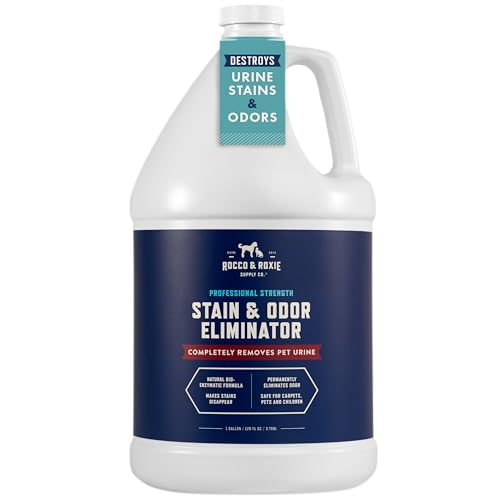
Rocco & Roxie Enzyme Stain & Odor Eliminator, 1 Gallon — the heavy-duty supply
Best for multiple spots, repeat offenders and whole-room treatments
Rocco & Roxie’s gallon is the format this method consumes: a bio-enzymatic urine destroyer, in its listing’s words, certified by the Carpet and Rug Institute as safe, made in the USA, and aimed at carpets, bedding, litter boxes, crates and cars — which is to say, at the whole geography of a pet household’s accidents. The gallon matters because saturation is the method, and a household working a UV map of six spots with a trigger spray runs out of product and resolve at spot three. Decanted into a spray bottle for small jobs and poured for the big saturations, it is the supply that lets the treatment be as generous as the chemistry demands.
- Format: 1-gallon bottle
- Action: bio-enzymatic, per its listing
- Certification: CRI Certified Safe, per its listing
- Surfaces: carpets, bedding, litter boxes, crates, cars
Strengths
- The volume matches the method — saturate without rationing.
- One product serves the carpet, the crate and the car seat’s emergency.
- The CRI certification speaks to carpet safety, the household’s legitimate worry.
Trade-offs
- A gallon is storage and commitment for a household with one small dog and one accident a year.
- Needs decanting into a sprayer for convenience on small spots.
- Like all enzyme products, it works on dwell time — it cannot be hurried.
Best for: multi-pet homes, puppies in training, and any UV map with more than two marks on it. Not suited for: the once-a-year accident, which the spray below serves better.

Resolve Urine Destroyer Enzyme Cleaner Spray — the accident responder
Best for the fresh accident and the single-spot household
Resolve’s entry is the trigger spray: an enzyme cleaner for carpet stains and odour control after accidents, per its listing, from a brand the cleaning aisle has carried for generations. Its virtue is readiness — a spray bottle that lives where the accidents happen, applied in the first minute, in the quantity a single event needs, without a decanting ceremony. For the household whose problem is occasional and caught fresh, it is the proportionate tool; the method’s saturation rule still applies, so a serious puddle gets a serious fraction of the bottle, and the spray’s convenience is no excuse for a homeopathic dose.
- Format: trigger spray bottle
- Action: enzyme cleaner, per its listing
- Brief: pet stains and odour control after accidents
- Surfaces: carpet, per its listing
Strengths
- Instant readiness — the bottle is in hand while the accident is still fresh.
- Proportionate for the occasional-accident household.
- A familiar brand’s distribution means it is replaceable anywhere, mid-crisis.
Trade-offs
- A spray bottle is the wrong economy for a room-wide archive of old deposits.
- Trigger fatigue is real across a six-spot UV map.
- Like the gallon, it obeys dwell time — the spray format tempts a spray-and-wipe shortcut that the chemistry does not honour.
Best for: fresh accidents, single-pet households, and keeping by the door for the muddy-season emergency. Not suited for: the inherited room with a year of deposits, which needs volume.
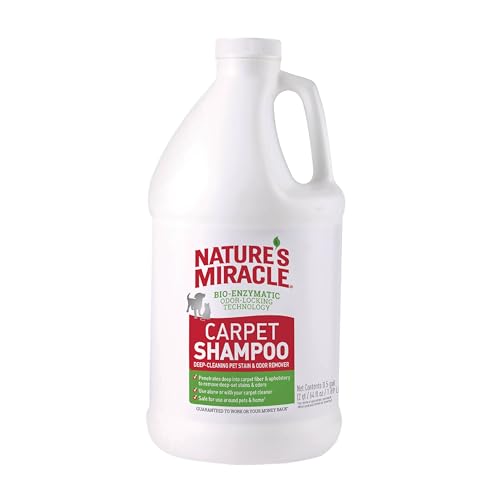
Nature’s Miracle Carpet Shampoo, 64 oz — the whole-room reset
Best for machine-cleaning an entire carpet after spot treatments
When the UV map stops looking like spots and starts looking like a territory, the answer changes scale: a bio-enzymatic carpet shampoo, in Nature’s Miracle’s 64-ounce format per its listing, made for water-based carpet cleaning machines and for carpet and upholstery, that removes and deodorises deep-set pet stains. The sequence matters — spot-treat the worst deposits with a saturating enzyme product first and let them dwell, then machine-shampoo the room, so the machine’s broad pass is finishing a treated problem rather than diluting an untreated one across a wider area. The shampoo’s own enzymes continue the chemistry through the machine’s work, and the extraction leaves the whole carpet at the same clean baseline, which is the only honest starting point for the no-return rule the household then enforces.
- Format: 64 oz shampoo
- Action: bio-enzymatic formula, per its listing
- Use: water-based carpet cleaning machines
- Surfaces: carpet and upholstery
Strengths
- Treats the room as one problem, ending the spot-by-spot campaign.
- Machine extraction removes residue at a volume no blotting matches.
- The enzymatic formula works during the clean rather than merely perfuming it.
Trade-offs
- Requires a carpet machine — owned, borrowed or hired — and a day of drying.
- A whole-room wet clean is a furniture-moving commitment.
- Still not a substitute for pre-treating the worst deposits at full saturation.
Best for: the room reset, the new-tenancy rescue, and the end of a house-training era. Not suited for: the single fresh accident, where it is a fleet brought to a bicycle’s errand.

Biokleen Bac Out Enzyme Cleaner — the plant-based option
Best for households that want enzyme chemistry in an eco formulation
Biokleen’s Bac Out is the enzyme cleaner for the household that reads labels: an enzymatic stain and odour eliminator with a lime scent, per its listing, positioned as eco-friendly and non-toxic, and aimed at dog and cat urine on carpet among its uses. Its live enzyme cultures are the same class of chemistry as the rest of this article — the formulation around them is the difference — and it has a long following in cloth-nappy and laundry work, which is relevant experience for protein deposits. The lime scent is the honest caveat: it is a scent, pleasant and plant-derived, and it fades, but a household pursuing a true neutral should let the treated area dry and air fully before judging the result underneath it.
- Action: enzyme cleaner, live-culture style per its brand
- Scent: lime, per its listing
- Positioning: eco-friendly, non-toxic, per its listing
- Brief: pet stains and odour on carpet and more
Strengths
- Full enzyme chemistry in the formulation style eco households prefer.
- A laundry pedigree that transfers honestly to carpet deposits.
- Useful beyond carpet — one bottle serves the pet household’s other fronts.
Trade-offs
- The lime scent, while it fades, complicates judging the result on day one.
- Bottle sizes suit spot work better than whole-room saturation campaigns.
- Live-culture products ask for their dwell time as strictly as any here.
Best for: eco-formulation households and multi-surface pet duty. Not suited for: the scent-averse purist mid-cure, or the room-scale reset.
When the problem is under the carpet: padding and subfloor
Some deposits outlive the carpet’s own cleanable depth. If a spot has been re-soaked for months — the corner a puppy used all winter — the pad beneath is a saturated sponge of the deposit, and no surface treatment reaches through the carpet to cure it in place. The honest escalation is surgical: pull the carpet back at that corner, cut out the affected pad section — it is inexpensive and sold by the roll — treat the subfloor beneath with the enzyme product and let it dry completely, since wood and concrete both hold the deposit in their surfaces, then fit fresh pad and relay the carpet. On a concrete floor, an odour-blocking primer over the treated area is the belt to the enzyme’s braces for a severe case. This is an hour’s work with a utility knife and a staple puller, and it is the step that separates the households who “tried everything” from the households whose room is actually cured: everything had been tried except reaching the reservoir.
Stopping the sequel: the pet side of the problem
A cured carpet in a house whose pet still lacks an alternative is a countdown. The cleaning removes the signal; the household must supply the reason not to re-send it. For dogs, that is the house-training basics refreshed without embarrassment — schedule, supervision, reward at the correct outdoor spot, and a vet check when a trained dog starts accidents, because urinary problems announce themselves exactly this way and are medical before they are behavioural. For cats, the litter arithmetic and placement — enough trays, in quiet places, cleaned at the rhythm cats demand — plus the same vet rule for a cat that abandons a previously accepted tray. Enzymatic completeness matters here beyond the human nose: a deposit the owner can no longer smell may still read clearly to the animal, which is why the UV torch, not the owner’s relief, signs off each spot. Clean for the pet’s nose, and the human’s is automatically satisfied.
What not to use, and why
Ammonia-based cleaners are the classic error: urine’s aged smell is substantially ammonia, and cleaning with it perfumes the spot, to the pet, in its own language. Bleach is a hazard in this chemistry — mixed with urine’s ammonia compounds it can produce dangerous fumes — and a fibre-damager besides. Vinegar, the folk favourite, neutralises some fresh odour and is a reasonable first aid on a hard floor, but on carpet deposits it does not touch the uric crystals and its own smell can read to some pets as an invitation. Steam applied before enzyme treatment sets the stain it meant to cure. And any fragranced “pet odour” powder sprinkled and vacuumed is a mask over a deposit, ground into the pile for the next humid day to resurrect. The shelf of things that do not work is long because the chemistry is specific: dismantle the crystals, or live with them.
Common mistakes in urine odour removal
Treating only the visible stain is the first, and the UV torch is its cure. Under-dosing is the second — a misting of enzyme cleaner over a deposit that reached the pad is a letter of intent, not a treatment. Third is impatience: wiping the product up in ten minutes when its chemistry needed the night. Fourth is heat before enzymes. Fifth is mixing products — layering a detergent or disinfectant over the enzyme cleaner, which can kill the very bacteria doing the work; enzyme products are used alone, on a rinsed surface, in their own time. Sixth is judging the result while the carpet is damp and either celebrating or despairing a day early. Each mistake is a shortcut the chemistry does not recognise, and the method above is simply the chemistry given its conditions.
Final word
Pet urine in carpet is not a mystery and not a life sentence; it is a deposit with a known composition, in a known place, vulnerable to a known chemistry. Find all of it, reach all of it, give the enzymes their hours, and verify with the torch and a dry carpet rather than with hope. The room that results smells of nothing — and, more importantly to the household’s future, it reads as nothing to the pet, whose opinion was the one that mattered all along.
Special cases: wool, stairs, rugs and rentals
Wool and delicate carpets
Wool is a protein fibre with a pet deposit’s own chemistry, and it punishes heat, alkalinity and enthusiasm. Use enzyme products whose labels bless wool, keep the water cool, blot rather than agitate, and test in a hidden corner for dye behaviour — wool’s dyes are the household’s heirloom risk. A valuable rug is a professional’s job and an insurance conversation, and the honest advice for the antique is to roll it up until the puppy is trained rather than to perfect one’s technique upon it.
Stairs and edges
Stair carpet holds deposits in its folds, where the tread meets the riser, and saturation there must be aimed rather than poured — a squeeze bottle or a watering-can rose delivers the product into the angle without flooding the staircase. Edges along skirting boards wick deposits under the carpet’s border, which is why the UV pass runs the room’s perimeter slowly: the corner by the door is the archive’s favourite shelf.
Rentals and the end-of-tenancy audit
A landlord’s nose and a UV torch are the tenancy’s final examiners, and pet deposits are a standard deduction argument. The defence is the full method, documented as done — products, dwell times, the pad section if it came to that — completed a week before the inspection so the carpet is judged dry and cured rather than damp and hopeful. Renters who run the method at the accident’s time rather than the lease’s end rarely meet the argument at all.
The long game: living with animals on carpet
Households that keep pets and carpet in long peace share a set of habits rather than a product. Accidents are treated the day they happen, at full saturation, without drama — the enzyme bottle lives where it can be reached in the first minute. The UV tour happens each season, briefly, the way other households check a smoke alarm. High-risk zones — the puppy’s room, the elderly cat’s corridor — carry washable rugs over the carpet, taking the exposure on a surface that goes in the machine. And the carpet machine, owned or reliably borrowable, makes the annual whole-room enzymatic shampoo a routine rather than a rescue. None of this is vigilance; it is the ordinary housekeeping of a mixed-species home, and it is cheaper in every currency than the alternative.
A worked example: the spare-room rescue
Consider the commonest real case in this article’s mailbag world: a spare room that hosted a foster cat for a winter, carpet down, door mostly closed, smell discovered in spring. The UV tour maps nine deposits, two of them old enough to have been shampooed twice by the previous effort. Saturday morning: furniture out, vacuum, the two worst corners’ carpet lifted — the pad beneath the older deposit is cut out and replaced, the concrete beneath treated and left to dry while the room’s spots get their first saturation, a full gallon worked through the map across the day, each spot covered and kept damp. Sunday: extraction of every spot, a second saturation for the three that still fluoresce, and the machine shampoo across the whole room as the baseline reset. The room dries under a fan until Tuesday. The following humid weekend is the examination, and the room passes — not because any single product was heroic, but because the deposit was found completely, reached completely, and given its chemistry completely. The foster programme, it should be said, resumed the next winter, with a washable rug over the spare room’s carpet and the enzyme gallon living in its cupboard: the method, once learned, changes the household’s arrangements more than its cleaning.
Frequently asked questions
Why does the urine smell come back on humid days?
Because of the uric acid crystals in the deposit. They are nearly insoluble, survive ordinary washing, and absorb moisture from humid air — re-wetting, they release their odour again. Enzyme cleaners are the cure precisely because they dismantle those crystals rather than rinsing their surface. A smell that returns with the weather is a deposit announcing that it was washed, not treated.
How much enzyme cleaner should I use on one spot?
Enough to saturate through the carpet to the backing and pad — as a working rule, at least the volume of the original accident, and for old deposits usually more, applied slowly so it penetrates rather than pools. Under-dosing is the commonest failure of the whole method. Keep the area damp under a towel or plastic for the dwell the maker specifies, typically hours to overnight for a serious spot.
Can I use a steam cleaner or hot water?
Not before the enzyme treatment — heat sets protein stains and can bond the deposit to the fibres. After the deposits have been enzymatically treated, extracted and verified, a machine clean with an enzymatic shampoo, as in the Nature’s Miracle stage of this article, is the right whole-room finish. Sequence is everything: enzymes first, machinery second.
Will a UV torch really find old urine?
Yes — urine deposits fluoresce under ultraviolet light, typically a dull yellow-green, and a darkened room and a slow pass a few inches above the carpet reveal spots that eyes and noses have normalised. Very old or repeatedly cleaned deposits can fluoresce faintly, so treat the torch’s map as the minimum and extend it by the pet’s known habits. It is the single most useful diagnostic in this article.
The smell is in the padding. Can I save the carpet?
Usually, yes. Pull the carpet back at the affected area, cut out and replace the saturated pad section — pad is cheap and sold by the roll — treat the subfloor with enzyme cleaner and let it dry fully, then relay the carpet and treat its back and face. The carpet itself can almost always be cured; it is the pad that acts as the deposit’s deep reservoir and the pad that is replaceable.
How do I stop my pet using the same spot again?
Clean to the pet’s standard, not yours — complete enzymatic removal verified by UV, since a deposit you cannot smell may still signal clearly to the animal. Then address the cause: house-training refresh and a vet check for new accidents in a trained dog; tray number, placement and cleanliness for a cat, with the same vet rule. Block or re-purpose the spot during the retraining weeks — feeding a dog at a former accident site is a classic and effective redefinition of the place.
Does vinegar or baking soda work on urine?
As first aid on a fresh accident, vinegar neutralises some odour and does no harm on most carpets; as a treatment for the deposit, neither it nor baking soda touches the uric acid crystals, which are the smell’s durable core. Soda sprinkled and vacuumed absorbs surface moisture and a little surface odour. Both belong to the category of things that make the room smell better tonight while the deposit waits for the weekend — use them knowingly, as a bridge to the enzyme treatment, never as its replacement.
How long does the enzyme cleaner need to sit?
As long as the maker’s directions say, kept damp the whole time — for a serious deposit that is typically several hours to overnight. The bacteria produce enzymes while the area stays wet; a spot allowed to dry in forty minutes has had forty minutes of chemistry regardless of what the bottle promised. Covering the treated area with a damp towel or plastic sheet is the practical trick that makes the long dwell possible.
My dog keeps returning to one spot even after cleaning. What is left?
Three suspects, in order: the deposit is not fully gone at the pet’s sensitivity — re-run the UV check and treat again, including the pad if the spot is old; the spot’s location itself has become habit, answered by feeding or playing there and by blocking access during retraining; and a medical cause, which a vet visit settles and which should never be last on the list when the behaviour is new. Work the three in that order and the spot almost always surrenders.
Is cat urine different from dog urine?
In concentration and consequence, yes: cat urine is more concentrated, its deposits are correspondingly stronger, and cats’ spraying adds a territorial secretion to vertical surfaces — skirting, chair legs, the carpet’s edge — that the UV tour should include. The chemistry of the cure is identical, but cat deposits usually need the full saturation and the repeat treatment taken as read, and a spraying cat is a behaviour-and-vet conversation beyond any cleaner’s remit.
Can enzyme cleaner damage or discolour carpet?
The reputable products are formulated and, in the Rocco & Roxie case, certified for carpet safety — but any wet treatment deserves the hidden-corner test on a carpet whose dyes you do not know, especially wool and older synthetics. The commoner damage comes from the household, not the bottle: aggressive scrubbing that frays the pile, and heat applied in impatience. Blot, saturate, wait, extract — the method’s gentleness is part of its design.
How do I treat urine on upholstery or a mattress?
By the same chemistry with a depth adjustment: blot exhaustively, saturate with the enzyme product to the deposit’s depth — a mattress may need the product applied in two passes as the first soaks down — keep it damp for the dwell, and extract with a wet vacuum, then dry with airflow for a full day before remaking the bed. The Biokleen and Rocco & Roxie listings both cover soft furnishings beyond carpet. A mattress protector fitted afterward is the cheapest sentence in this entire article’s world.
When is it time to replace the carpet instead?
When the deposits are years deep across a whole room, the pad is saturated end to end, and two full enzymatic campaigns — spot saturation plus machine shampoo — leave the UV map lit and the humid-day smell standing. At that point the remaining deposit lives in the carpet’s backing itself, and replacement, with the subfloor treated and primed before the new carpet lands, is the honest cure. It is a rarer endpoint than the industry suggests; most rooms surrender to the method long before it.
Should I hire a professional instead?
For a valuable carpet, a whole-house archive, or a deposit that has defeated two honest campaigns of your own, yes — professionals bring extraction power, stronger enzymatic and oxidising treatments, and the pad-and-subfloor surgery as routine work. Hire for the method, and ask what it is before booking: the professional who describes saturation, dwell and extraction is selling this article with better machinery; the one who promises a scented shampoo is selling the problem a new perfume.
Does the smell affect anything besides comfort?
A chronically urine-soiled room is a hygiene problem as well as an odour — the deposit is a bacterial culture in the floor’s textiles — and it is a property problem at sale or tenancy end, where pet odour is among the most penalised conditions a nose can report. There is also the pet’s own loop: the smell instructs the animal to continue. The method’s thoroughness is therefore not fastidiousness; it is the household closing a chemical, financial and behavioural account at once.
How do I protect the carpet while a puppy is training?
Layer the defence: a washable rug or a waterproof-backed mat over the highest-risk area, the enzyme spray within arm’s reach of it, and the puppy’s world kept small and supervised so accidents happen on the defended ground. Expect the campaign to last the training season and plan the room’s deep enzymatic shampoo for the week the training is declared finished — a graduation clean that resets the carpet to a baseline the now-trained dog has no chemical reason to revisit.
Can I mix enzyme cleaner with my carpet shampoo?
Only where a product is made for it — the Nature’s Miracle shampoo in this article is an enzymatic formula designed for machines, which is the correct way to combine the two. Adding a spot enzyme product to a generic shampoo tank dilutes both and can upset the machine’s chemistry; the method’s order — spot enzymes at full strength first, machine shampoo second — exists precisely to keep each product at its working concentration.
What if I cannot find the spot by smell?
Trust the torch and the map of the pet’s life: deposits hide under furniture, along the skirting, and in the corner the animal visits when the household is out. Work the UV pass slowly at floor level in a fully dark room, mark generously, and treat the marks plus a margin — the deposit’s true border is wider than its glow. If the room still smells with a clean map, the reservoir is below: the pad test at the worst corner will settle it.
How long until the room smells normal again?
A single treated accident: by the time the carpet is fully dry, usually a day. An old archive given the full method: the improvement is immediate, the cure is verified over the following week, and the humid-day test a fortnight later is the honest graduation. A room whose pad was replaced and subfloor treated follows the same clock once the work is done — the chemistry is fast; it is the finding and the reaching that take the time.
Are enzyme cleaners safe around pets and children?
The products in this article are made for pet households and are used as their labels direct: treat the area, keep pets and children off it while it dwells and dries — partly for their sake and partly so the chemistry is not tracked away — and return the room to service when the carpet is dry and rinsed or extracted as directed. Store the bottles as you would any cleaning product. The greater household hazard in this territory is the improvised alternative — bleach mixtures and ammonia — which the article has already struck from the list.
What is the difference between the four products here?
Delivery and scale, over the same enzymatic chemistry. Rocco & Roxie’s gallon is volume for saturation campaigns and multi-surface duty; Resolve’s spray is readiness for the fresh accident; Nature’s Miracle’s shampoo is the machine-driven whole-room reset; Biokleen’s Bac Out is the plant-based formulation for households that choose their chemistry by label as well as by effect. Most pet homes end up owning two: the spray for the minute it happens and the gallon or the shampoo for the season’s accounting.
Can I use these products on hardwood or tile?
Enzyme cleaners work on any surface the deposit sits on, and the listings here include hard-surface uses among them — but hard floors change the method: the deposit lives in grout lines, board gaps and the floor’s finish rather than in a pad, dwell times are shorter, and pooling liquid under boards is its own damage. Saturate the joints, keep the surface damp for the dwell, and mop out rather than extract. A sealed floor with a surface accident is a ten-minute version of this article; an unsealed wood floor with an old deposit is the professional’s territory again.
What should I do the moment an accident happens?
Blot with a weighted stack of towels until they come away nearly dry, rinse with cool water and blot again, then saturate with the enzyme spray and cover it to dwell while life continues. The first hour is worth a day of later work, because the deposit has not yet wicked to the pad or dried into crystals. Households that keep the spray where the accidents happen — not in a distant cupboard — are the ones whose carpets survive pet ownership unmarked.
Why does my carpet smell worse right after treating it?
Because the treatment re-wets the deposit, and a wet deposit broadcasts at full strength while the enzymes are still dismantling it — the smell’s last performance is its loudest. Judge nothing until the carpet is completely dry, and ventilate the room through the process so the released odour leaves rather than resettling. Owners warned of this in advance ride it out; owners surprised by it conclude the product failed at the exact moment it was working hardest.
How do I keep a treated room fresh while it cures?
Airflow is the whole answer: a fan moving the room’s air out an open window during and after treatment, the door open to the house’s circulation once the dwell is done, and no fragranced products layered over a curing carpet, since the household needs its own nose unmasked to judge the result. The room graduates when it smells of nothing on a closed-door morning — the test this article keeps returning to, because it is the one the deposit cannot cheat.
Is one treatment ever enough for an old stain?
Occasionally — a single old accident on a thin carpet over a sealed floor may surrender in one full saturation. The planning assumption should be two treatments for anything dried, dark under UV and older than a season, because the product must reach the deposit’s furthest reach through a wick of carpet and backing, and the second pass travels a path the first has wetted. Promising one pass and delivering two is the method’s normal arithmetic, not its failure.
What records should a renter keep?
The products used, the dates, the dwell times, and a phone photograph of the UV map before and after — a small file that converts an end-of-tenancy argument into a demonstration. Landlords meet many tenants who say the carpet was cleaned; the one who can show the map and the method is believed, and the deposit dispute usually ends there.
Does sunlight help?
For removable rugs, genuinely: a treated rug dried in strong sun gets ultraviolet’s mild sanitising and, more importantly, the fastest, driest airflow available, and odours leave with the moisture. Fixed carpet gets the window version — curtains open, the room aired — and the same principle at lower intensity. Sunlight is an adjunct to the chemistry, never the treatment, but as drying goes it has no equal in the house.
What about odour in the car after transporting a pet?
The same method in miniature — this site’s car odour guide covers the vehicle in full — with the enzyme spray doing for a car seat and boot carpet what it does at home. Cars concentrate the lesson: a small, hot, fabric-lined box either gets the deposit dismantled or becomes its permanent announcer, and the first humid traffic jam will conduct the audit.
How can I tell the pad needs replacing without lifting the whole carpet?
Lift one corner at the worst spot — carpet releases from its tack strip with a firm pull at the corner, and the evidence is immediate: a stained, darkened pad that smells at close range has confessed. A pad that is clean and neutral under a treated carpet means the reservoir was shallower than feared, and the corner presses back into place with a knee’s persuasion. The corner test costs ten minutes and settles the question the whole cure may hinge on.
Will these treatments void a carpet warranty?
Carpet warranties care chiefly about professional cleaning intervals and prohibited chemistry; enzyme products made and certified for carpet sit comfortably within them, while bleach and improvised mixtures are the usual offenders. Keep the products’ names in the household file with the cleaning dates — the same record that serves the tenancy audit serves the warranty one — and the paperwork of a careful household closes another account.
What is the most common reason the whole method “doesn’t work”?
An incomplete map. Households treat the two spots they know, cure them completely, and conclude the products failed because the room still smells — from the three spots they never found. The UV tour is the method’s foundation for exactly this reason, and it should be repeated after treatment, because a cured map is the only proof that the smell’s remaining source is depth rather than geography.
Can I prevent the smell soaking in with a carpet protector?
Scotchgard-style protectors buy minutes, not immunity — they slow the wick’s start on a fresh accident, which is genuinely useful in a puppy household, and they do nothing for a deposit already resident. Fit the protection, by all means, as the alarm that gives the blotting stage its chance; the enzyme bottle remains the actual insurance.
Should the pet stay elsewhere during a big treatment?
For the room-scale campaign, it simplifies everything: the animal cannot walk the wet chemistry across the house, cannot re-mark a curing spot out of anxiety at the furniture’s disappearance, and returns to a finished room whose signals have been fully erased rather than half-erased in its presence. A night or two with family or a boarder, timed with the treatment weekend, is pet care and cleaning strategy in the same decision.
What is the cheapest effective kit to assemble?
A UV torch, a stack of white towels you are willing to retire, one enzyme product sized to your map — the spray for a spot, the gallon for a territory — and access to a wet vacuum or a machine for extraction day. Everything else in this article is technique, which is free, and time, which is the real currency the deposit charges. Households that spend on the map and the saturation, and save on gadgets, cure rooms.
One last check: how do I verify the cure held?
Close the room for a warm day, then enter and take the first breath as the audit — followed by the UV pass for the record. Two clean audits a fortnight apart, one of them after humid weather, close the case; anything less is a progress report, and the method’s remaining steps should be applied to whichever evidence survives.
How do I treat a urine spot I only found weeks later?
Expect a slower job and plan for more than one treatment. Dried urine has had time to work down through the pile into the backing, and the crystals left behind must be rehydrated before an enzyme cleaner can break them down properly. Blot the area with plain cool water first, working from the outside in, then apply the enzyme product generously enough to reach the depth the original accident reached, cover it to keep it damp for the full contact time the label states, and blot rather than rinse it away. Let the spot dry completely before judging it, sniff it at floor level on a warm day, and repeat the treatment if a ghost of the smell remains. A second patient application succeeds far more often than one aggressive scrub, which mostly spreads the residue sideways.
When is a professional cleaner worth calling instead?
Call one when the problem has outgrown the surface you can reach. Repeated accidents in the same room, a smell that persists after two careful enzyme treatments, suspicion that urine has soaked through into the underlay or the floorboards, and large or valuable rugs, especially wool or antique pieces that may react unpredictably to household products, all belong with someone who can lift the carpet, treat or replace padding, and test fibres before committing to a chemical. Ask what method they use for urine specifically, since a general shampoo can set the smell rather than remove it, and keep pets away from the room until their products have dried. Professional treatment costs more than a bottle, but it is cheaper than replacing a carpet that home treatment was never equipped to save.
Related reading on this site
how to get weed smell out of your car
how to smoke in your room without smelling it