Disclosure: As an Amazon Associate, dailyhomedecorating.com earns from qualifying purchases. Links on this page are affiliate links; they cost you nothing extra. Prices and availability change often, so check the current Amazon listing before you buy.
Learning how to calibrate food thermometers is the least glamorous skill in cooking and one of the most consequential, because every temperature you have ever trusted — the chicken at its safe point, the steak at its blushing middle, the caramel at the edge of burning — was only as true as the instrument that reported it. A thermometer that reads five degrees high turns medium-rare into medium and a safe chicken into a doubtful one, silently, for months, while its owner blames recipes. Calibration is how you catch the lie: you place the thermometer in a medium whose temperature physics guarantees, read what it says, and adjust it — or adjust your trust in it — by the difference. This article teaches both household methods properly, the ice-point and the boiling-point, explains which thermometers can be adjusted and which can only be verified, and sets out the routine that keeps a kitchen’s temperatures honest.
Three verified instruments appear as the working examples, all confirmed through this site’s own Amazon Creators API check: the ThermoWorks Thermapen ONE, the reference instant-read of professional kitchens; the ThermoWorks ThermoPop 2, its smaller sibling; and the ThermoWorks Classic Thermapen, the long-serving original design. They are named because calibration advice differs sharply between a factory-sealed digital instrument and an adjustable dial thermometer, and these three let the article make the distinction concrete.
What calibration actually is — and what it is not
A thermometer’s job is to report a temperature; calibration is the act of comparing that report against a known truth and correcting the gap. The known truths available in a kitchen are phase changes, because physics fixes them: pure ice melting in pure water holds at the freezing point of water, and pure water boiling holds at its boiling point, each regardless of how much heat you apply. Everything else — the oven dial, another thermometer, the feel of a pan — is hearsay. Two honest qualifications belong at the front. First, the freezing point is the more reliable household standard because it does not move with altitude or weather, while the boiling point falls as altitude rises and shifts slightly with the day’s air pressure; the article gives the correction. Second, many modern digital thermometers cannot be adjusted by the user at all — they are calibrated at the factory and sealed — and for those, “calibration” in the kitchen means verification: measuring the error, and then either living with a known offset, or returning the instrument under warranty if the offset exceeds its specification. Both outcomes are successes. The failure is never having checked.
In this guide
The ice-point method: the household standard
Make the ice bath correctly, because a careless one is the most common reason this test “fails” good thermometers. Fill a tall glass or insulated mug completely with crushed ice — cubes work if crushed is unavailable, but the bath needs ice in every corner — then add cold water slowly until it reaches just below the ice’s surface, and stir. What you have built is a slurry in equilibrium: as long as solid ice and liquid water coexist and are mixed, the mixture sits at the freezing point, neither warming nor cooling. Let it stand a minute, stir again, and then insert the thermometer’s probe so the sensing tip sits fully in the slurry, surrounded by ice and water, touching neither the glass’s walls nor its bottom, and stir gently while it settles.
Read it at stability, not at first arrival. A fast instant-read settles in seconds; a dial thermometer may need the better part of a minute, and its needle should be watched until it stops travelling. The reading should be the freezing point of water — 0°C, 32°F — within the instrument’s stated accuracy. If it is not, the difference is your error: a thermometer reading 34°F in a proper ice bath reads two degrees high everywhere, at every temperature that matters, until it is adjusted or its offset is memorised. For an adjustable dial thermometer, the correction is mechanical and is described below. For a sealed digital, the correction is knowledge — and if the error exceeds the maker’s specification, it is a warranty conversation, because a quality instrument that has drifted beyond its spec has told you something about itself.
The boiling-point method: the second witness
Boiling water is the ice bath’s mirror: a rolling boil holds at water’s boiling point as long as it lasts, and a probe suspended in the water — in the body of it, not in the steam above and not resting on the pan’s hotter bottom — should read accordingly. The boiling method earns its place for two reasons. It tests the thermometer at the end of the scale where cooking actually happens, catching errors that grow with temperature in a way a single ice-point check cannot see. And it is the only practical check for the high ranges — the sugar and frying thermometers that never go near an ice bath in their working lives. Its complication is the correction: water’s boiling point falls by roughly a degree Fahrenheit for every five hundred feet of altitude, and drifts slightly with atmospheric pressure, so a household in Denver must expect a reading near 202°F at a rolling boil and should no more “correct” a thermometer that reports it than it should correct a barometer for the weather. Sea-level kitchens can take the familiar figure at face value; altitude kitchens should look up their local boiling point once, write it on the calibration log, and use it forever.
Adjusting the adjustable: dial thermometers and the nut beneath
The classic dial thermometer — the bimetallic probe in every kitchen drawer — is adjusted at the small hex nut where the stem meets the dial’s housing. The method is a small ceremony: build the ice bath, insert the probe, hold the nut firmly with pliers or the wrench some models sheath into their storage clip, and turn the dial itself until the needle points at the freezing point, keeping the stem in the slurry throughout so the reading you are setting against is live. Then verify — a second immersion, a settling, a needle where it should be — because a bimetallic strip that has been knocked out of truth once may wander again, and an instrument that will not hold its setting across two checks is telling you it wants replacing. Some digital models offer a calibration or trim function in their settings, and the manual’s procedure outranks any general description, including this one. And some thermometers, the sealed professional digits among them, offer nothing — by design, because their stability is the product — and the household’s whole duty toward them is the periodic verification that proves the design’s promise.
The three reference instruments, and what calibration means for each

ThermoWorks Thermapen ONE — the sealed professional standard
Best for cooks who want verification to be a formality
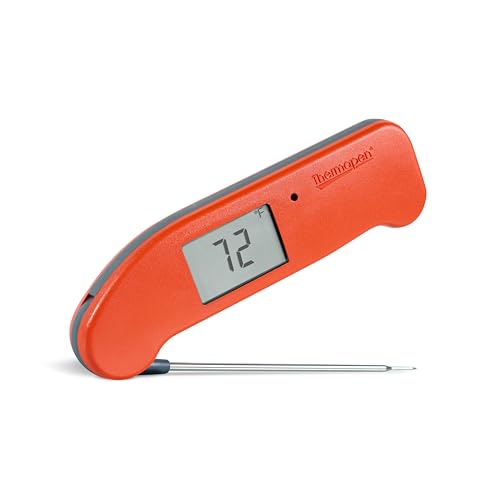
The Thermapen ONE is the instrument against which home thermometers are usually judged: a folding-probe instant-read whose listing names it the category’s most recommended, with a reading in about a second and an accuracy specification tight enough that a proper ice-bath check should land within a degree. It is factory-calibrated and not user-adjustable, which is the professional pattern — stability instead of knobs — and its calibration story in a home kitchen is the verification ritual: an ice bath every few months, a reading on the mark, a log entry, and the confidence that every temperature since the last check was true.
- Type: folding instant-read digital thermometer
- Calibration model: factory-sealed; verify, do not adjust
- Check method: ice point primary, boiling point as second witness
- Reference colour in listing: Cayenne Pepper Red
Strengths
- Speed and accuracy make the verification ritual a thirty-second job rather than a project.
- The sealed design removes the whole category of accidental misadjustment.
- Its specification gives the home check a pass mark to judge against.
Trade-offs
- If it ever does drift beyond specification, the remedy is the maker’s service, not a kitchen adjustment.
- It is priced as professional equipment, because it is.
- The folding probe’s speed spoils its owner for every slower instrument in the drawer.
Best for: serious home cooks and anyone whose cooking leans on exact temperatures. Not suited for: households that want a user-adjustable instrument on principle, or a drawer of cheap spares.
ThermoWorks ThermoPop 2 — the household’s second instrument
Best as the everyday thermometer that still deserves checking
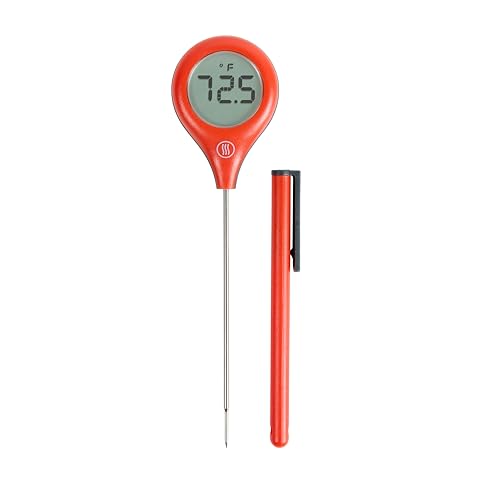
The ThermoPop 2 is the same maker’s value instrument — a compact, rotating-display instant-read that lives on a lanyard or in an apron pocket — and its role in this article is to make the point that calibration discipline is not a tax on expensive tools. A household’s most-used thermometer is the one whose drift does the most damage, and a two-second ice-bath check protects the ThermoPop’s readings exactly as it protects its big sibling’s. Its listing calls it the maker’s best-value instant-read, and the calibration routine is what keeps that value honest across years of drawer life.
- Type: compact instant-read digital thermometer
- Calibration model: factory-set; verify by ice point
- Display: rotating, for either hand and any angle
- Reference colour in listing: Cayenne Pepper Red
Strengths
- Small and quick enough that checking it is never a chore worth skipping.
- The rotating display removes the squinting that makes cooks rush a reading.
- Shares the maker’s calibration culture at a household price.
Trade-offs
- A step slower and less armoured than the flagship, as its price intends.
- Factory-set like its sibling — verification, not adjustment, is the home routine.
- Its pocket size makes it the thermometer most likely to be borrowed and not returned.
Best for: everyday cooking, grills and the second-instrument role in a two-thermometer kitchen. Not suited for: anyone needing the flagship’s speed and specification for high-volume work.
ThermoWorks Classic Thermapen — the long-serving original
Best for cooks who keep instruments for a decade
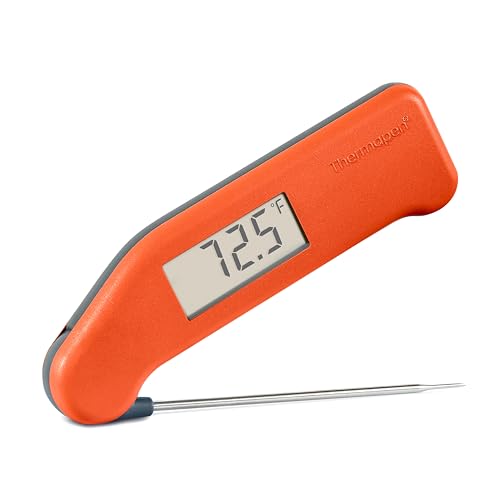
The Classic Thermapen is the design that built the maker’s reputation — highly rated across a long production life, a few seconds slower than the ONE, and present in more professional and home kitchens than any other serious thermometer. Its calibration relevance is longevity: an instrument owned for ten years will be checked dozens of times, dropped twice, and asked to testify at every important meal of a decade, and the Classic’s record is of holding its factory truth through all of it. The ice-bath ritual with a Classic in hand is the article’s whole philosophy in one gesture — trust, verified on a schedule.
- Type: folding instant-read digital thermometer, original design
- Calibration model: factory-sealed; verify periodically
- Check method: ice point, with boiling point for the high witness
- Reference colour in listing: Cayenne Pepper Red
Strengths
- A decade-scale track record of holding calibration through kitchen life.
- The folding format protects the probe that does the measuring.
- Its ubiquity means its behaviour is the category’s best-documented.
Trade-offs
- Slower than the current flagship by a few seconds a reading.
- Sealed against user adjustment, like the rest of the professional pattern.
- Owners tend to keep it long past the point where a second instrument would share the work.
Best for: buy-it-for-a-decade cooks and as the reference instrument of a serious home kitchen. Not suited for: cooks who want the fastest current specification, or user-adjustable designs.
The calibration routine: a schedule a kitchen can keep
Instruments drift from events, not just from time, so the schedule should be tied to both. Check a new thermometer on the day it arrives — the ice bath is its introduction to the household and its baseline for every later comparison. Check again after any drop onto a hard floor, any journey through the dishwasher (which no probe thermometer should survive being asked to repeat), any oven accident where the probe or its cable took heat beyond its rating, and any reading that contradicts the evidence of your eyes — a chicken that looks raw at a “safe” temperature is data, and it outranks the dial until the dial is re-verified. In quiet times, a standing rhythm of every few months suits a home kitchen; a log on the fridge door — date, ice reading, boiling reading if taken, action — turns the ritual into a record, and the record is what lets a small drift be seen arriving rather than discovered at a ruined roast. Professional kitchens check daily because their volumes justify it; the home’s version of the same professionalism is simply never letting a year pass unverified.
Where the sensing point is, and why readings go wrong without any drift
Half the “calibration” problems brought to this ritual are not drift at all but geometry. A probe measures the temperature at its sensing point — for most instant-reads, within the first portion of the tip — and a reading taken with the tip in the wrong stratum is a true report of the wrong place. The centre of a chicken breast is found by geometry, not by optimism: insert from the side, aim for the thickest part’s heart, and watch the reading fall as the tip approaches the cold centre and rise as it passes through, taking the lowest stable figure as the truth. Bone conducts the oven’s heat and lies; fat pockets insulate and lie the other way; a probe tip poking through into the pan’s air reads the pan. Sugar and frying thermometers have their own version — the bulb must swim in the syrup or oil, clear of the pan’s bottom, where the metal is hotter than the liquid it heats. A household that learns placement before it learns calibration will find, gratifyingly, that most of its instruments were honest all along.
How to choose a thermometer you can keep honest: the buying guide
Buy accuracy as a specification, not as a hope: a stated accuracy figure, tight enough for your cooking, from a maker who publishes one. Buy speed for the same reason calibration checks are painless — an instrument that settles in seconds gets verified; one that takes a minute gets believed. Decide the calibration model consciously: a user-adjustable dial suits households that enjoy maintaining their tools and will actually turn the nut; a sealed professional digital suits households that want the factory to carry that responsibility and will accept verification as their whole duty. Consider the probe’s range against your cooking — a thermometer whose ceiling sits below candy temperatures is not the household’s only instrument if caramels are in its future — and buy the second instrument before you need it, because two thermometers that agree are the cheapest calibration laboratory a kitchen can own, and two that disagree have just told you to build an ice bath.
Common calibration mistakes
The warm ice bath is the first: a few cubes floating in a glass of water is not an equilibrium mixture, and it will read several degrees high and convict innocent thermometers — the bath must be mostly ice, with water filling the gaps. The second is reading too early, before the probe and the bath have settled together, especially with slow dial instruments. Third is the boiling check done in steam or against the pan’s bottom rather than in the water’s body. Fourth is correcting a thermometer for altitude’s boiling point as if the instrument were wrong — the water is different up a mountain, not the thermometer. Fifth is adjusting a dial thermometer out of the bath, from memory of the reading, rather than with its stem in the slurry where the truth is live. Sixth, and most common of all, is the single lifetime check: the instrument verified on its first Christmas and believed, unexamined, for a decade of Sundays.
Final word
Calibration is a five-minute act of respect for every meal the thermometer will ever judge. Build the slurry properly, give the probe its settling time, write the result down, and repeat on a rhythm tied to drops and doubts as much as to dates. A kitchen that does this owns its temperatures; a kitchen that does not is borrowing them, at rates set by an instrument nobody has audited. The ice in your freezer is a laboratory standard that never expires. Use it.
The rest of the drawer: oven, probe and infrared instruments
Oven thermometers
The dial that hangs from the rack is the most lied-about instrument in the kitchen, and its calibration problem is different in kind: it measures the air where it hangs, in an oven whose temperature swings around its set point by design, so a single glance proves almost nothing. Verify it against a known instrument if you can — a probe on a cable, read over twenty minutes of a stabilised oven, gives an average the dial can be judged against — and otherwise judge it by pattern: an oven thermometer that agrees with the ice bath has earned provisional trust for its own range, and one that cannot be checked at all should be treated as a weather vane, useful for direction and useless for navigation. Most “oven calibration” problems are, on investigation, oven problems — hot spots and tired elements — that the thermometer was honestly reporting.
Leave-in probe thermometers
The wired probe that rides in the roast while its display sits outside the oven has two instruments to verify: the probe itself, by the ice bath with its connector kept dry, and the cable, whose kinks and door-crushed sections are the usual cause of readings that wander or freeze. Check the whole assembly as it is used — probe in the slurry, cable arranged as it would be through the oven door — because a probe that verifies on the counter and fails through a pinched cable has not been verified in any sense that protects a dinner. These are the instruments whose failure mode is the most expensive in the drawer, since they testify unattended for hours; give them the ice bath before every important roast, without exception, the way pilots walk around the aircraft.
Infrared thermometers
The laser-pointed gun cannot be calibrated by either household method in any simple way, because it does not measure a liquid’s temperature — it infers a surface’s temperature from its infrared emission, and the inference depends on the surface’s emissivity, which a pan of water, a steel sheet and a roast’s crust all set differently. Verify it instead against a contact thermometer on the same surface at the same moment, on a matte, dark surface where its assumptions hold best, and use it forever after for what it is: a superb instrument for pans, pizza steels, oil surfaces and griddles, and no instrument at all for the interior of anything. The cook who points it at a chicken and believes the skin has learned the one lesson infrared teaches every owner eventually.
Why the thresholds make calibration a safety matter, not a pedantry
Cooking’s important temperatures are thresholds, and thresholds are where small errors change categories. Poultry’s safe point, the custard’s setting point, the caramel’s stages, the chocolate’s tempering window, the reheated soup’s return to safety — each is a line, and an instrument off by five degrees stands on the wrong side of some of them while reporting the right side. The food-safety lines deserve the plainest statement: they are set with margins, and a verified thermometer keeps a household inside those margins without thought, while an unverified one spends the margins silently. This is the entire argument for the ritual’s existence, and it is why the article treats a two-degree error as information and a ten-degree error as an emergency in the drawer’s small world. Calibration is not about the perfect steak, though it improves steaks; it is about the chicken, the reheated stew and the baby’s bottle never depending on an instrument nobody has checked since it was unwrapped.
Care that prevents drift
Most drift is biography: the drop onto tile, the dishwasher’s heat and detergent, the probe left in a hot oven beyond its rating, the cable closed in the door a hundred times, the storage drawer where the tip takes the weight of the utensils above it. The care that prevents it is correspondingly plain. Hand-wash probes, keep electronics out of water the maker did not certify them for, respect the probe’s and cable’s temperature ceilings as hard limits rather than suggestions, store the instrument in its case or clip rather than loose in the drawer, and retire batteries before they leak rather than after. An instrument treated this way holds its truth for years, and its calibration checks become the pleasant formality they are in a professional kitchen — a signature on a log, not an investigation.
Altitude changes the boiling test — and only the boiling test
Water’s boiling point falls as altitude rises, roughly a degree Fahrenheit for every five hundred feet of elevation, which means the boiling-water check described earlier in this guide must be corrected before it is trusted anywhere above the lowlands. At five thousand feet, water boils near 203 degrees, and a thermometer that reads exactly that in a rolling boil is accurate — while one adjusted to read 212 there would be wrong by nine degrees everywhere it is used. The ice-point test has no such complication, which is one more reason this guide recommends it as the home standard: ice water is ice water at any elevation. If you do use the boiling method, look up your elevation’s expected boiling point first, write it on the card where you record your checks, and treat any boiling-point verification done without the correction as worse than none, because it manufactures the very drift it was meant to catch.
The two-thermometer cross-check, for cooks who own a drawerful
Most serious home kitchens own more than one thermometer, and that redundancy is a calibration instrument in its own right. Side by side in the same ice bath, two thermometers that agree within a degree corroborate each other; one that disagrees with two agreeing siblings has identified itself as the drifter without any reference standard at all. The method cannot catch a whole drawer drifting together, which is why it supplements rather than replaces the ice-point check — but as a thirty-second triage before an important cook, it is the fastest honest answer available. Professional kitchens formalise the same idea as a daily line check; the home version is simply to keep the thermometers together, compare them whenever two are already in hand, and retire the one that keeps telling a different story from the rest of the drawer.
Frequently asked questions
How often should I calibrate my food thermometer?
Verify a new instrument on arrival, after any drop, dishwasher cycle or overheating accident, whenever a reading contradicts what you can see, and otherwise every few months in a home kitchen. Keep a dated log; the pattern across checks is more informative than any single result.
Can all thermometers be adjusted at home?
No. Dial thermometers are usually adjustable at the nut beneath the dial, and some digitals offer a trim function described in their manuals. Sealed professional digitals — including the ThermoWorks instruments in this article — are factory-calibrated and not user-adjustable; for them, home calibration means verification, and an out-of-specification result is a warranty matter.
Why does my thermometer read boiling water incorrectly?
Check the method before the instrument: the probe must sit in the body of the water, not in the steam and not on the pan’s bottom. Then check your altitude — the boiling point falls by roughly a degree Fahrenheit per five hundred feet, so a correct thermometer at altitude reads well below the sea-level figure. Pressure changes move it slightly as well. An instrument that matches your local boiling point is calibrated, whatever the textbook number says.
What should an ice bath read, exactly?
A properly made slurry of ice and water in equilibrium sits at the freezing point of water, 0°C or 32°F, and a sound thermometer should read within its stated accuracy of that figure. If your bath is mostly water with a few cubes, it is not at equilibrium and will read high — rebuild it with ice as the majority before judging the instrument.
My thermometer is two degrees off. Should I replace it?
Not necessarily. A consistent two-degree error can be adjusted out of a dial thermometer, trimmed on digitals that allow it, or simply known and allowed for on a sealed instrument used for ordinary cooking — two degrees rarely decides a meal. Replace or service the instrument when the error exceeds its specification, when it wanders between checks, or when your cooking lives at exact thresholds, as sugar work does.
Is the ice-point or boiling-point method better?
The ice point is the more reliable household standard because it does not vary with altitude or weather. The boiling point is the valuable second witness — it tests the thermometer near cooking temperatures and is the practical check for high-range instruments. A thorough household uses the ice point as its routine and the boiling point, altitude-corrected, as the annual confirmation.
How do I calibrate a candy or deep-fry thermometer?
By the boiling point, altitude-corrected, because its working range lives far above the ice bath’s testimony. Clip it to a pan of water so the bulb swims clear of the bottom, bring the water to a rolling boil, and compare its reading with your local boiling point. A clip-on dial that disagrees can be adjusted at its nut like any dial; a disagreement in a sealed digital is an offset to record. Then trust it in oil and syrup exactly as far as that check, repeated each season, says you may.
Can I calibrate a thermometer in the oven?
Not against the oven’s own dial, which is itself an unverified instrument with a swing — you would be calibrating a witness against a rumour. An oven can serve as the stable environment for comparing two thermometers against each other, which tells you they agree without telling you they are right. Truth enters the kitchen through the phase changes — ice and boiling water — and every other method is a comparison looking for an anchor.
Why does my thermometer read differently in different parts of the same roast?
Because the roast does. A large joint is a landscape of temperatures — the surface near the heat, the centre lagging, the neighbourhood of the bone running hot — and a good probe reports whichever stratum its tip occupies. The cook’s task is to find the coldest point, the thermal centre, and let it testify for the whole. Disagreement between spots is not instrument error; it is the most useful information the instrument provides.
What is the sensing area of an instant-read probe?
On most quality instant-reads, the sensor sits within the first half-inch or so of the tip — the maker’s manual states it, and the dimple or step visible on many probes marks it. The whole sensing length must be inside the food’s thermal centre for a true reading; a tip barely breaking the surface reports the surface. Thin foods — burgers, fish fillets, chops — should be probed from the side so the sensing length lies along the centre plane.
How do professional kitchens handle calibration?
As a logged routine rather than an event: ice-point checks at the start of service or on a fixed weekly schedule, instruments labelled with their check dates, and any thermometer that fails its check removed from service the same day rather than marked for later. The home kitchen does not need the paperwork culture, but it benefits from stealing the two habits that do the work — a fixed rhythm, and immediate exile for an instrument that fails. A thermometer that has failed a check and stays in the drawer “for rough jobs” will eventually testify at an important meal, because drawers do not respect intentions.
Does altitude affect the ice-point method too?
No — and that is its great virtue. The freezing point of water is essentially indifferent to the air pressure changes of any altitude a kitchen sits at, so the ice bath testifies identically at the coast and in the mountains. Only the boiling point moves with altitude, which is why this article makes the ice point the household’s primary standard and the boiling point its corrected second witness.
My digital thermometer has no calibration function. Is that a defect?
It is a design philosophy, not a defect: the professional pattern seals the calibration at the factory and stakes the instrument’s reputation on holding it, in exchange for removing every way a user could accidentally un-calibrate it. Your duty in the exchange is verification — the periodic ice bath — and the maker’s duty is a specification the instrument actually meets and a warranty that answers when it does not. Judge the arrangement at the first check: a sealed instrument that reads true has kept its side of the bargain.
How long should I leave the probe in the ice bath?
Until the reading stops moving, plus a breath. A fast digital settles in a few seconds; a dial thermometer may take the better part of a minute as its bimetallic coil creeps to equilibrium with the slurry. Stirring gently while you wait speeds the meeting and prevents the probe from sitting in a locally warmed pocket of water beside the glass. A reading snatched early is the most common self-inflicted error in the whole ritual — the bath is patient, and the cook should borrow its temperament.
Can I use the ice bath to check a room thermometer or hygrometer?
The ice bath checks temperature only, and only for probes that can be immersed safely — a room thermometer’s sensor, if it can be placed in the slurry without harming the instrument, can be verified the same way. Humidity is a different quantity with its own household checks, and this site’s hygrometer coverage treats it separately. Do not immerse any instrument whose maker forbids it; a calibration that destroys the instrument has answered a question nobody asked.
What should I do if two of my thermometers disagree with each other?
Build the ice bath and let physics arbitrate — that is the entire reason the standard exists. Test both in the same slurry, at the same time, with both tips in the body of the mixture, and the bath will identify the honest instrument within a minute. If both miss the mark in different directions, you own no verified thermometer at all, which is valuable and slightly alarming knowledge: adjust the adjustable one to the bath, verify the sealed one’s error against its specification, and let the survivor become the kitchen’s reference until the other is serviced or replaced.
Is a cheap thermometer worth calibrating?
Yes, with expectations set by its specification. A budget dial that can be adjusted to the ice point will cook safely and honestly within its wider tolerance, and the ritual costs the same five minutes whatever the instrument cost. What a cheap thermometer usually cannot offer is stability — it will need checking more often, and it will fail its checks sooner — and the household that finds itself verifying monthly should read that as the instrument asking to be succeeded by a better one, at which point the ritual transfers to an instrument that repays it for years.
Why do restaurants and food businesses face stricter calibration rules?
Because their thermometers testify for strangers, at scale, under law. Food-safety codes in most jurisdictions require that food thermometers be accurate within a stated tolerance and calibrated by a recognised method — the ice point is the usual citation — at a frequency the business can document. A home cook borrows the same methods voluntarily, for the same reason the law imposes them commercially: the person eating cannot verify the temperature retrospectively, so the instrument’s honesty has to be established in advance, on a schedule, by someone who writes it down.
Can temperature probes lose accuracy from being stored in a hot place?
Electronics and bimetallic elements both dislike heat beyond their ratings, and a thermometer that lives above the stove or in a sun-baked drawer ages faster than one stored at room temperature — the drift shows up at the next ice bath as a moved reading or, worse, a wandering one. Store instruments in a drawer away from the oven’s heat path, in their cases where they have them. It is a small courtesy that a decade of accurate service repays.
What is the fastest way to sanity-check a thermometer before an important meal?
The sixty-second ice bath: crushed ice, water to just below the surface, a stir, the probe in the body of the slurry, a reading at stability. It is not a full calibration — it is a verification at one point — but it catches the failures that matter at a dinner party: the dropped instrument, the dying battery’s strange arithmetic, the dial knocked in the drawer. Cooks who make it a habit before roasts and holiday birds are practicing the whole philosophy of this article in its most compressed form.
Should I calibrate a brand-new thermometer?
Yes — verify it on arrival, before its first meal. The check establishes the baseline every later check will be compared against, it catches the rare instrument that left the factory or the delivery van in a bad state while returns are effortless, and it teaches the household its own ritual on a low-stakes day. A new thermometer that reads the ice bath true has introduced itself properly; one that does not has saved you from learning about it at a wedding cake.
How do I keep a calibration log without making it a burden?
A strip of masking tape on the inside of a cupboard door and a pencil: date, ice reading, done. The log’s value is comparative — this year’s reading against last year’s — and it needs no more ceremony than that to deliver it. Households that keep it find the ritual self-reinforcing, because a visible record of an instrument holding its truth across years is satisfying in a way that makes the next check easier to remember than the last.
What temperature should I trust if my thermometer cannot be adjusted and reads slightly off?
Trust the corrected figure: if the ice bath says the instrument reads two degrees high, subtract two from every reading it gives, and write the offset on its case so the correction survives your memory. A known, stable offset is a working instrument; an unknown one is a rumour with a display. Re-verify the offset at the usual rhythm, because the day it changes is the day the instrument stops being a corrected tool and becomes a failing one.
Does the type of ice matter for an ice bath?
Only in geometry: the bath needs ice in intimate contact with water everywhere, so crushed ice or small cubes build the most reliable slurry, while a few large cubes floating in a full glass leave warm strata the probe can find. If cubes are what you have, fill the glass to the brim with them, add water to just below the top, stir, and give the mixture a minute to reach equilibrium before the probe goes in. The physics forgives the cube’s size; it does not forgive a bath that is mostly water.
Why does my thermometer read correctly in ice water but wrongly in the oven?
Because the two checks testify about different things. The ice bath verifies the sensor at one point; the oven introduces the cable, the door seal, the probe’s placement and the oven’s own cycling between them and the truth. An instrument true at the ice point whose oven readings wander is usually reporting a pinched cable or a probe tip in the roast’s fat cap rather than its centre. Verify the assembly in its working configuration, as this article advises for leave-in probes, before convicting the sensor.
How accurate does a home thermometer really need to be?
Within a degree or two at the temperatures you cook at covers nearly everything a home kitchen asks: the difference between a safe chicken and a doubtful one, a set custard and a soup, sits comfortably outside a two-degree error honestly known. Sugar work, chocolate and competition barbecue tighten the requirement, and the cooks who practice them already own instruments specified for it. The household standard to hold is not laboratory precision but verified honesty — an instrument whose error is measured, small and stable beats a nominally finer one whose error is a rumour.
What should I do with a thermometer that fails its check and cannot be adjusted?
Decide by the size and stability of the failure. A small, stable error becomes a written offset and the instrument works on, honestly. A large error, or one that changes between checks, ends the instrument’s testimony: send it for service if its maker offers it and its value justifies the postage, and otherwise retire it from food duty entirely — not to the drawer of rough jobs, from which it will inevitably be promoted back, but out of the kitchen. A failed thermometer kept is a future meal’s problem already scheduled.
Can I calibrate a thermometer using my own body temperature?
No — you are not a standard. Healthy body temperature varies by person, by hour and by measurement site by more than the tolerance you are trying to verify, and a thermometer “corrected” against a forehead has been calibrated to a rumour. The phase changes of water are the household’s fixed points precisely because they do not have mornings and evenings. Keep the ice bath as the standard and let your body be a patient, never a reference.
How do I teach someone else in the household the routine?
By making it visible and short: the log on the cupboard door, the glass that lives with the ice, and a demonstration folded into an ordinary cooking evening rather than a lecture. The ritual survives in a household when it belongs to everyone who cooks, because thermometers get dropped by the person who did not know there was a ritual. Five minutes, twice a year, taught once — that is the whole curriculum, and it is cheaper than every alternative.
Does a thermometer need calibrating after its battery is changed?
A battery change should not disturb a digital instrument’s calibration, which lives in its sensor and its stored constants rather than in its power supply — but “should not” is exactly the class of claim the ice bath exists to test, and the check takes a minute. Treat the battery change as one of the ritual’s natural triggers, alongside drops and doubts, and the instrument’s biography stays fully documented at almost no cost.
What is the difference between accuracy and resolution on a thermometer?
Resolution is the fineness of the display — tenths of a degree — and accuracy is how close the displayed figure sits to the truth. A thermometer can display tenths while being wrong by degrees, a combination that lends false confidence and is common in cheap instruments. Calibration addresses accuracy; resolution is only the handwriting the accuracy is reported in. When choosing an instrument, the accuracy specification is the number to shop by, and the ice bath is how you confirm the shopkeeper’s claim.
How should I verify a thermometer I use for baby bottles or reheating food for vulnerable people?
With the strictest version of the routine: an ice-point check before the period of reliance begins, a second instrument agreeing, and no tolerance for an instrument whose error is a guess. Where the eater is an infant, an elderly person or anyone immunocompromised, the margins in the thresholds are there to be kept, not spent — and a verified thermometer is one of the cheapest safety devices in the house. If the instrument fails its check, replace it before the next bottle, not after a doubtful one.
What should I do if a dial thermometer keeps drifting out of adjustment?
Treat repeated drift as a symptom rather than a nuisance to keep correcting. A dial thermometer that needs its nut turned after every few uses may have a loosened mechanism, a stem that has been bent, or damage from being dropped or left inside a hot oven. Check the stem is straight, confirm the probe has not been used to pry or lever anything, and recalibrate once more in a proper ice bath. If it cannot hold that reading through a single day of normal cooking, retire it from safety-critical jobs such as poultry and reheated leftovers. An instrument you must argue with before every use will eventually be believed on the one occasion it should not be.
How should I store a food thermometer so it stays accurate?
Protect the probe and respect the electronics. Keep the sheath on whenever the thermometer is in a drawer, because the tip and sensing section are easily dulled or bent by cutlery, and a bent probe reads the wrong place as readily as a blunt one reads slowly. Keep digital models away from prolonged heat and steam when they are not measuring, follow the maker’s guidance before putting any part under running water or in a dishwasher, and store the thermometer somewhere it will not be dropped onto tiles week after week. Finally, keep a note of its last successful ice-point check with the thermometer itself, so the next cook can see at a glance whether it is due another one.
Related reading on this site
how to deep fry without a deep fryer