Disclosure: As an Amazon Associate, dailyhomedecorating.com earns from qualifying purchases. Links on this page are affiliate links; they cost you nothing extra. Prices and availability change often, so check the current Amazon listing before you buy.
The machine in this honeywell tp30wkn review occupies a specific and honourable niche in American homes: the mid-size basement dehumidifier, bought after the first musty summer, that then runs for a decade in a corner nobody visits for pleasure. The TP30WKN is Honeywell’s 30-pint-class entry in that category — a refrigerant dehumidifier with a built-in pump’s worth of practical touches in its better configurations, a washable filter, a humidistat you set and forget, and a design brief that says “utility room” in every line. It was never glamorous. It was, for a long stretch, one of the default answers when a hardware-store conversation turned to damp basements.
Two things must be said at the start, because they shape everything after. First, the 30-pint class is widely misunderstood: the pint rating describes water removal under laboratory conditions that no basement reproduces, and the honest way to size these machines is by space and dampness, not by the number on the box. Second, availability: when this review was researched through the site’s own Amazon Creators API lookup, the TP30WKN unit itself did not appear as a purchasable listing — its ecosystem did, including accessories made for it — while comparable current 30-pint machines did. So the TP30WKN is assessed fully here as a prose-only product, and the linked recommendations are the verified alternatives a buyer can actually order today: a Uhome 30-pint unit with continuous drainage, and a HUMSURE 30-pint-max unit with a hose and timer. Owners of the Honeywell will find the maintenance and troubleshooting guidance written for their machine; shoppers will find the decision mapped honestly.
Honeywell TP30WKN Review: the verdict in brief
As a machine, the TP30WKN is a sound example of its class: it pulls its rated moisture in a genuinely damp space, its controls are the simple set-and-forget kind a basement appliance should have, and its build is the sturdy, serviceable kind that kept Honeywell on basement floors for years. As a purchase today, the same advice applies as with any legacy appliance whose listing has gone quiet: owners should maintain and keep it, and buyers should put their money into a current model with a live warranty, choosing between the linked alternatives by drainage arrangement first and features second. In dehumidifiers, the drainage decision — bucket, hose or pump — matters more to daily satisfaction than any other specification, and this review returns to it often because experience says it should.
How a 30-pint refrigerant dehumidifier works
The TP30WKN is a compressor machine, mechanically a small refrigerator with a fan and an agenda. Room air is drawn across a cold evaporator coil; moisture in the air condenses on the coil the way it condenses on a cold drink; the now-drier air passes over the warm condenser coil, picks the heat back up, and returns to the room slightly warmer and much drier. The condensed water drips into a bucket, a hose connection, or — in pump-equipped variants — is pushed up and out to a sink or drain above the machine’s level. A humidistat watches the room and cycles the compressor to hold the humidity you set, and a washable mesh filter guards the coils from the basement’s dust, which is considerable and unglamorous.
Three consequences of that mechanism govern everything about owning one. The machine works best in warmth: refrigerant coils lose their grip as room temperature falls toward the fifties Fahrenheit, and frost management becomes the limiting factor in cold basements, which is why low-temperature performance is a specification worth reading rather than assuming. The machine produces heat as a by-product, which a summer basement tolerates and a small closed laundry room notices. And the machine’s real output in a real room is always below its laboratory rating — a 30-pint machine in a cool, moderately damp basement may deliver half its headline figure across a day, which is not a defect but the physics of the test standard, and is why sizing advice in this review is given in rooms and dampness rather than pints.
Sizing: what the 30-pint class is actually for
Think of the class as the answer for a single damp zone of a few hundred square feet: a finished or unfinished basement of modest size, a large laundry and utility area, a garage-adjacent storage space, a ground-floor flat with a condensation habit. Within that zone, dampness matters more than area: a wet basement — visible moisture, standing water after rain, a sump that runs — wants the class above or a drainage solution before it wants any dehumidifier, because no 30-pint machine outruns a water problem that has a source. A merely humid basement — the musty smell, the cardboard boxes softening, the tools filming with rust — is exactly this machine’s parish. Set the humidistat in the mid-forties to low-fifties percent relative humidity: low enough to discourage mould and protect stored goods, high enough that the compressor rests sometimes and the electricity bill stays sane. Chasing the thirties buys little protection and much running.
In this guide
Quick picks: the TP30WKN and the current alternatives
- Honeywell TP30WKN — the subject of this review, prose-only: the classic 30-pint basement machine, assessed in full below.
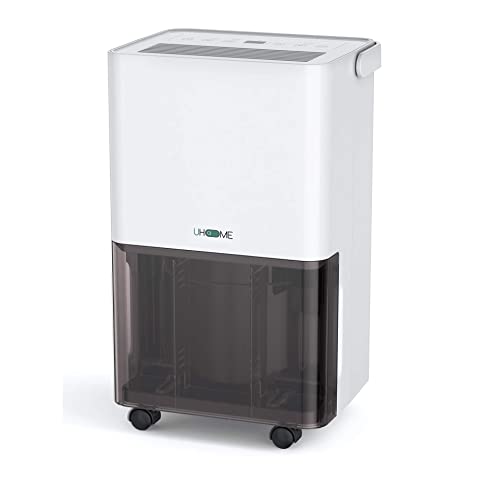
- Uhome 30 Pint Dehumidifier — a current 30-pint unit with humidity sensing, auto shut-off and a continuous drainage hose, the straightforward modern equivalent.
- HUMSURE 30 Pints Dehumidifier — a current alternative rated for larger coverage language, with drainage hose, automatic defrost and a 24-hour timer.
How these picks were chosen
The alternatives were selected to match the TP30WKN’s actual job rather than its badge: 30-pint-class refrigerant machines with continuous-drainage options, humidistats and defrost handling, verified through the site’s Creators API — exact titles and official images — before being linked. The Honeywell’s prose-only status is the result of that same verification, disclosed here rather than papered over: this site links only what it can confirm is listed, and the TP30WKN unit was not returned by the check, though accessories made for it were, which tells its own story about a model in its afterlife.
Honeywell TP30WKN — the classic, assessed
Best for existing owners and the second-hand market’s careful buyers
The TP30WKN’s design centres on the basement routine: a front-access bucket with a handle and a full-bucket shutoff and indicator, a hose connection for those who graduate from carrying water, a digital humidistat with a clear display, a timer for households that run it on a schedule, auto-restart after power cuts (a feature whose value is only understood by people whose basements lose power), and casters that acknowledge the machine will be moved for everything from cleaning to flood response. The filter is washable and the coils it protects are the machine’s life; the whole ownership proposition is a decade of this, quietly, in a corner.
- Type: refrigerant (compressor) dehumidifier, 30-pint class
- Controls: digital humidistat, timer, auto-restart
- Drainage: bucket with full shutoff; hose connection for continuous drainage
- Status in this review: prose-only — no verified purchasable unit listing found
Strengths
- The control set is complete without being clever: set the humidity, choose bucket or hose, and the machine manages itself.
- Auto-restart after outages is the feature that separates basement appliances from room appliances, and it is present.
- Build and parts philosophy are from the serviceable era — filters, buckets and hoses are simple, standard and findable.
Trade-offs
- Like every refrigerant machine, its capacity fades as the basement gets cold; unheated winter spaces are its weak season.
- Bucket life is measured in days in a wet summer — households that will not empty it should buy drainage, not capacity.
- As a legacy model, a new purchase today carries warranty and sourcing questions its current-production rivals do not.
Best for: owners maintaining a working unit, and careful used buyers who can test before paying. Not suited for: a buyer who needs a warranty-backed new machine this week — that buyer should take the alternatives below.

Uhome 30 Pint Dehumidifier — the modern equivalent
Best for basements with a floor drain or a hose route
The Uhome unit is what the 30-pint class looks like in current production: humidity sensing with auto shut-off, an activated carbon filter layer unusual in this class, a continuous drainage hose in the box, and a brief its listing expresses as fifteen hundred square feet of coverage — translate that, as always, into a single damp zone honestly served. For a household replacing a TP30WKN or buying the job fresh, this is the closest one-for-one modern answer, with the hose included rather than improvised.
- Type: refrigerant dehumidifier, 30-pint class
- Drainage: bucket plus continuous drainage hose included
- Controls: humidity sensor, auto shut-off
- Filter note: includes an activated carbon filter element
Strengths
- Continuous drainage out of the box ends the bucket routine for any basement with a floor drain or sump.
- Auto shut-off and humidity sensing give it the same set-and-forget character the Honeywell was valued for.
- The carbon filter element is a thoughtful touch for musty basements, where the air needs freshening as well as drying.
Trade-offs
- Coverage language is marketing dialect; size it by your damp zone, not by the number.
- Like all refrigerant units, cold-room performance is limited by frost physics, whatever the listing implies.
- A newer brand’s long-term parts ecosystem is less proven than Honeywell’s — the warranty matters, so buy through channels that honour it cleanly.
Best for: basement households with drainage available who want the TP30WKN’s job done by a current machine. Not suited for: very cold unheated spaces, where a low-temperature-rated model should be chosen deliberately.

HUMSURE 30 Pints Dehumidifier — the timer-and-defrost alternative
Best for scheduled running and larger claimed coverage
The HUMSURE entry competes on the practical extras: a drainage hose, automatic defrost for cooler rooms, and a 24-hour timer for households that prefer the machine to work to a schedule — drying the basement through the night-rate hours, or resting while the family is in the room above. Its listing speaks of twenty-five hundred square feet, which should be read the way this review reads all such figures: as a statement that the machine is aimed at generous spaces, not as a promise about yours.
- Type: refrigerant dehumidifier, 30-pint class
- Drainage: hose included for continuous drainage
- Controls: 24-hour timer, automatic defrost
- Brief: basement and large-room moisture control
Strengths
- Automatic defrost extends its useful season into cooler rooms where basic machines ice and idle.
- The timer suits households on time-of-use electricity pricing or with noise-sensitive hours.
- Hose drainage included, keeping the ownership routine to filter washing and the occasional inspection.
Trade-offs
- As with the Uhome, the brand’s decade-scale support record is unwritten; warranty handling is the safety net.
- Timer discipline cuts both ways — a machine scheduled off during a wet week is a machine not working.
- Maximum-pint naming follows the industry’s laboratory dialect; expect real-world delivery well below the headline in cool rooms.
Best for: households that want scheduled operation and cooler-room resilience in a current 30-pint machine. Not suited for: anyone who wants the longest-proven badge in the category and is willing to maintain a legacy unit instead.
Comparison table
| Model | Class | Drainage | Notable extra | Status |
|---|---|---|---|---|
| Honeywell TP30WKN | 30-pint refrigerant | Bucket + hose connection | Auto-restart after outages | Prose-only in this review |
| Uhome 30 Pint | 30-pint refrigerant | Bucket + hose included | Activated carbon filter element | Current, linked |
| HUMSURE 30 Pints | 30-pint refrigerant | Bucket + hose included | Auto defrost, 24-hour timer | Current, linked |
The drainage decision: bucket, hose or pump
Every dehumidifier review should be forced to spend its longest section here, because drainage — not pints — is what owners praise and curse five years in. The bucket is the default and the trap: in a wet July a 30-pint machine can fill its bucket daily, and a machine that sits full is a machine that is off, silently, while the basement re-humidifies around it. Households that choose the bucket should choose it knowingly — a basement visited daily for other reasons, a laundry routine that passes the machine — and should set the bucket where a spill is harmless, because a bucket carried up stairs eventually spills on stairs.
The hose is the grown-up answer wherever gravity offers a route: a floor drain, a sump pit, a laundry sink below the machine’s outlet. Continuous drainage converts the appliance from a chore into infrastructure, and it is the single strongest argument for the current alternatives in this review, both of which include the hose. Route it with a continuous fall, no sags where water can sit and grow things, and check the run each spring — a hose kinked by a stored paint can is the classic cause of the mysterious full bucket in a hose-drained setup. The pump, present in some variants of machines in this class, is for basements with no low drain at all: it pushes water up to a sink or out a window, at the cost of one more moving part and one more thing to listen to. The TP30WKN family spanned these arrangements across its configurations, and any used purchase should be checked for exactly which drainage the specific unit supports before money changes hands.
How to choose a 30-pint dehumidifier today: the buying guide
Walk the basement before opening a browser. Measure the damp zone honestly, note the lowest temperature the space reaches in winter, find the drain, and look at what the dryness is protecting — stored paper and photographs argue for the mid-forties; a workshop’s tools forgive the low fifties; a finished basement with a sofa wants the comfort of the high forties and no smell at all. Then buy, in this order: drainage first, because it decides whether the machine runs unattended; low-temperature behaviour second, if the space is unheated, because a frosted coil removes nothing; capacity third, stepping up a class if the zone is large or the damp is aggressive; and features last, because timers and displays have never dried anything. Price the electricity of continuous running into the decision without flinching — a dehumidifier is among the hungrier small appliances — and prefer the machine you will run at a steady, moderate duty over the bargain you will switch off to save money while the mould holds its own council in the dark.
Maintaining the TP30WKN and its kind: the routine that buys the decade
Wash the air filter monthly in season; a clogged filter starves the coils, invites frost, and taxes the compressor for nothing. Keep the machine’s clearance — a hand’s breadth at the sides, more at the intake — because basements accumulate stored life around any object that sits still. Twice a year, vacuum the coils gently through the grille and inspect the bucket and hose run for the biofilm that any standing-water system grows; a dilute rinse and a thorough dry keep both sweet. Check the float switch by lifting the bucket out and letting the machine discover it is “full” — the shutoff that fails is the one that floods. Before the wet season, run the machine for an afternoon and listen: the compressor’s note should be the one you remember, the fan free of new rattles, the condensate flowing where it should. That twenty-minute spring ritual, plus filter discipline, is the entire difference between the TP30WKNs that are still running and the ones that were replaced at year four.
Common mistakes in damp-basement drying
Buying pints instead of drainage is the first and largest. The second is sealing the machine into the wettest corner with no air circulation and expecting it to dry a whole basement through a closed door — dehumidifiers dry the air they can reach, and doors and distance are real. Third is setting the humidistat to its lowest and leaving it there: the machine runs without rest, the bill climbs, the room overshoots into static-and-cracked-wood territory, and the mould — which needed only the mid-forties to be discouraged — is no more discouraged than it needed to be. Fourth is ignoring the source: a dehumidifier asked to fight a leaking foundation, a missing gutter downspout or a dryer venting indoors is being asked to bail a boat with the hole unplugged, and it will lose expensively. Fifth is switching the machine off for winter in a basement that stays damp — cold reduces its efficiency, but a damp January still feeds mould at the margins, and a low setting beats a dark, wet rest.
Final recommendation
Keep the TP30WKN if you have it: maintain it on the routine above and it will hold a basement the way it has for years. Buy the job new and the choice is between the two current machines by drainage and temperament — the Uhome for the straightforward hose-drained basement, the HUMSURE where a timer and defrost resilience fit the household’s pattern. In all three cases the deeper advice is the same: fix the water source first, drain by hose if the house allows it, hold the forties, and let the machine be the boring, decade-long appliance this category exists to provide.
The TP30WKN class in real basements: four situations
The finished basement that smells like a cottage
A family room below grade, carpet over concrete, a sofa that has absorbed three summers of damp air. The fix is a season, not a weekend: the machine runs continuously at a mid-forties setting, the carpet and the sofa’s cushions give up their stored moisture across the first fortnight, and the smell retreats in the order it arrived — first the air, then the soft furnishings, last the cardboard and paper stored in the closet, some of which will never fully forgive and should be replaced with plastic bins. This is the scenario the 30-pint class was born for, and the household’s only real decisions are the hose route and the patience to let materials dry at their own pace.
The workshop where tools keep filming with rust
Rust is humidity with a grudge and a memory: once a tool’s surface has started, it continues at lower humidity than it began. A workshop basement wants the dry end of the recommended range and consistency above all — the machine that runs every day at a modest setting protects better than the machine run heroically after each wet week. Position matters here: the dehumidifier should share air with the tool storage, not sit exiled behind the furnace, and the filter should be washed on the workshop’s own calendar because sawdust loads it faster than household dust ever will.
The laundry room that never quite dries
An indoor laundry is a moisture factory — every wash loads the air, every dryer cycle that is not perfectly vented loads it again. The first check is the vent: a dryer exhausting indoors will defeat any dehumidifier in this class and deposit lint into the bargain. With the vent honest, a 30-pint machine in or beside the laundry holds the room comfortably, and the household notices the difference in the towels’ smell before it notices it on the hygrometer. Warm laundry air is also the refrigerant machine’s favourite working condition, the one scenario where real output approaches the laboratory’s promise.
The rental property between tenants
Landlords and caretakers are the class’s quiet power users: a vacant property in a humid summer grows mould at a pace that turns a cleaning bill into a remediation bill, and a dehumidifier on hose drainage, set in the high forties and checked monthly, is cheap insurance for the walls. Auto-restart matters here more than anywhere — a tripped breaker in an empty house should not mean a month of unchecked damp — and the machine should be the current-production kind with a warranty, because a rental’s appliance has no owner in residence to notice its first strange noise.
Cold basements and the frost line, in more detail
Every refrigerant dehumidifier carries an invisible line in its specifications: the room temperature below which its rated performance stops describing reality. The physics are unforgiving. Condensation requires the coil to sit below the dew point; as room air cools, the coil must run colder still, and the moisture arriving on it begins to freeze rather than drip. Defrost systems interrupt the cycle to melt the accumulation — the machine pauses its drying, warms its coil, and resumes — so a cold-room dehumidifier spends part of each hour maintaining itself rather than drying your basement. Better defrost logic, like the HUMSURE’s automatic system in this comparison, widens the workable range; it does not repeal it. Households with genuinely cold basements — unheated, northern, stone-walled — should either heat the space modestly, choose a machine explicitly rated for low temperatures, or consider a desiccant dehumidifier, whose chemistry works happily in the cold at the price of higher running costs and a different maintenance shape. The TP30WKN, like its class, is a fair-weather-to-mild-cold machine: excellent from late spring to late autumn in most homes, increasingly theatrical in a January cold-snap basement.
Energy: the honest arithmetic of dry air
A compressor dehumidifier is one of the few small appliances whose running cost deserves a paragraph in a review. In season, run continuously, a 30-pint machine consumes electricity at a rate comparable to a small refrigerator that never closes its door — noticeable on a bill, decisive in an off-grid or tightly budgeted household. Three habits keep the cost honest. Set the humidistat at the dry-enough number rather than the driest number, because the last few points of humidity are the most expensive water the machine will ever remove. Fix the sources — the venting dryer, the missing downspout, the unsealed sump — because water with a doorway is cheaper to exclude than to evaporate. And let the machine rest in the dry season if the basement genuinely dries: a hygrometer on the wall, read weekly, tells you when the machine is working and when it is merely employed. None of this argues against owning one. A mould remediation, a ruined archive of family photographs, or a finished basement’s flooring costs more than a decade of electricity; the arithmetic favours the machine in any basement that actually needs it, and the habits above simply keep the favour from being wasted.
Noise, vibration and living above a working basement
A compressor dehumidifier makes the sounds of its kind: a fan’s steady breath and a compressor’s lower hum, cycling on and off as the humidistat calls. In the basement itself this is background; the household that hears it is the one sleeping directly above a machine standing on a resonant floor. The fixes are humble and effective: stand the unit on a rubber mat or a square of dense foam rather than bare concrete against a joist, keep it off shared walls where a bedroom sits on the other side, and let the timer-equipped machines — the HUMSURE pattern — rest through the household’s quietest hours if the basement’s humidity allows a nightly pause. What should not be done is enclosing the machine in a closet or cabinet to muffle it: starved of air, it dries the inside of its cupboard heroically and the basement not at all, while its compressor works against its own heat. Noise complaints about this class are almost always placement complaints in disguise, and placement is free to change.
What the water in the bucket is telling you
The bucket is a diagnostic instrument nobody reads. A machine that suddenly fills faster than its habit is reporting a change in the house — a new leak, a failed gutter, a dryer vent slipped off its collar, a water heater beginning to weep — and the wise household investigates the change rather than merely emptying faster. Water that arrives cloudy or filmed speaks of a dirty filter and coils overdue for attention. A bucket that stays empty in a humid week is the opposite report: a machine iced up, a humidistat mis-set, a float switch stuck, or a compressor that has quietly retired. Owners of the TP30WKN and its kind who learn to read the bucket catch their homes’ small water stories while they are still small, which is an unadvertised benefit of the bucket routine that hose-drained households trade away — one more reason the hose households should walk the basement monthly and look at the walls, the sump and the corners with the same attention the bucket once forced.
Dehumidifier or air conditioner, dehumidifier or fan: the neighbouring tools
Three appliances get confused at the damp-basement counter. An air conditioner dries as a side effect of cooling, and in a finished basement used as summer living space it may be the right primary tool — but it will not run in a cool October basement that is still damp, because its thermostat is satisfied while the humidity is not. A fan moves air and evaporates surface moisture, which helps a dried room stay dry and does almost nothing to a humid one, since the water has nowhere to go. The dehumidifier is the only one of the three whose entire job is the water in the air, indifferent to the room’s temperature within its working range — which is why damp, cool, unoccupied spaces belong to it alone. Households sometimes buy two of the three in sequence, learning the distinctions by purchase; this review exists so the distinctions can be learned by reading instead.
Frequently asked questions
What does “30 pint” actually mean for the TP30WKN?
It is the amount of water the machine removes in twenty-four hours under standard laboratory conditions — warm, very humid air that no basement sustains. In a real, cooler basement expect substantially less across a day, which is normal for every machine in the class and is why sizing should be done by space, dampness and drainage rather than by the headline number.
Why is the TP30WKN not linked in this review?
Because this site links only listings verified through its own Amazon Creators API check, and that check returned the TP30WKN’s accessories but not a purchasable unit listing. The machine is therefore reviewed in full as a prose-only product, and the linked recommendations are verified current alternatives.
What humidity should I set in a basement?
Somewhere in the mid-forties to low-fifties percent relative humidity suits most basements: dry enough to discourage mould and protect stored goods, not so dry that the machine never rests. Finished basements used as living space sit most comfortably at the lower end of that range; storage and workshop spaces can ride at the upper end.
Bucket or hose drainage — which is better?
Hose, wherever the house offers a drain with a continuous fall from the machine. It converts the dehumidifier from a daily chore into an appliance that runs unattended for a season. The bucket suits spaces visited daily anyway, and households that choose it should expect to empty it frequently in wet weather.
Why does my dehumidifier ice up in a cold basement?
Refrigerant coils must run cold to condense water, and in a cold room the condensate can freeze on the coil faster than the defrost cycle clears it, at which point the machine is moving air over a block of ice and removing nothing. Machines with automatic defrost, like the HUMSURE in this review, manage the condition better; very cold spaces may need a model rated for low-temperature operation or a different drying strategy altogether.
Can a dehumidifier fix a musty basement smell?
It can hold the condition that causes it — sustained high humidity feeding mould and mildew in carpets, cardboard and soft materials — and a basement dried to the forties will usually lose its mustiness over a few weeks as materials dry out. It cannot remediate established mould growth in walls or belongings, which needs cleaning or removal at the source, ideally alongside the drying.
How long do dehumidifiers in this class last?
A well-kept refrigerant dehumidifier commonly serves the better part of a decade, and the TP30WKN’s generation built its reputation on exactly that span. Life is governed by the compressor and by the cleanliness of the coils it depends on — which is to say, by the filter routine. The failure pattern is usually gradual: longer runs for the same result, a new note in the sound, frost that the defrost no longer clears. Households that notice the drift early can often recover performance with a thorough coil cleaning; households that notice it late are shopping, and should shop the current-production end of this comparison.
Can I use the water the dehumidifier collects?
For the toilet cistern, the mop bucket or the garden’s non-edible plants, yes — it is condensed water, low in minerals, and households have used it so for generations. Not for drinking, cooking or the pets’ bowl: the water has passed over coils and sat in a bucket that are nobody’s idea of food-grade, and it can carry whatever the basement air and the machine’s surfaces contributed. This site’s dedicated explainer on dehumidifier water works through the question in full.
Where in the basement should the machine stand?
Centrally in the damp zone, with clearance on all sides, near the drain if it is hose-drained, and away from the corner where water enters — a dehumidifier manages air, and asking it to also be the first responder to a leak misplaces it. In a long basement, the middle third serves the whole better than either end; in a divided basement, the machine belongs in the damper half with the connecting door open, or the household owns a two-room problem that one machine will solve unevenly at best.
Is a 30-pint machine enough for a whole house?
No, and it is not a criticism: these machines dry a zone, not a building. A whole-house moisture problem is a building problem — ventilation, sources, sometimes a whole-house system tied into the ductwork — and a portable 30-pint unit placed in a hallway will dry the hallway. Match the tool to the geography: one machine per damp zone, each with its own drainage, beats one heroic machine asked to be everywhere.
What should I check when buying a used TP30WKN?
Run it, do not just look at it. Half an hour in the seller’s garage tells you more than any photograph: the compressor should start without drama and cycle as the humidistat is turned, the fan should run free of grinding or wobble, and condensate should appear — in a dry garage it may be slow, so bring patience or a kettle’s worth of steam to give it something to work on. Inspect the coils through the grille for corrosion and crushing, the bucket for cracks at the handle, the filter for the grey felt of a machine that was never maintained, and the hose port for its cap and threads. Ask why it is being sold and listen for the honest answers — a house move, a whole-house system installed — over the evasive ones. Price it as a machine whose remaining life is unknown and whose warranty is gone: a fraction of the current models’ cost, not a rival to it.
How do I store a dehumidifier over the dry season?
Clean first, store second. Wash and dry the filter completely, empty and wash the bucket, run the fan-only or a low setting for an hour to dry the coils’ neighbourhood, and wipe the housing. Store it upright — refrigerant machines dislike being laid on their sides, and a machine that has been transported or stored horizontally should stand upright for a day before it is run again, so the compressor’s oil can come home. Keep it in the space it serves if the space stays dry, or in a dry room if it does not; a dehumidifier stored in a damp garage is being aged by the very element it exists to fight. Cover it loosely against dust, note the filter’s condition on a label so spring-you knows what autumn-you knew, and the machine will start its next season as if it had merely slept.
Why does my basement humidity rise again every night?
Because the house and the ground conspire on a daily rhythm. Cooler night air holds less water, so the same moisture reads as higher relative humidity after dark; the earth against the foundation walls exhales steadily regardless of the hour; and the machine itself rests whenever its setting is reached, letting the level drift up between cycles. A basement that reads fifty at dinner and fifty-eight at dawn is not necessarily a failing basement — it may be a normal one measured honestly. What matters is the week’s average and the materials’ condition: if boxes stay crisp and no mustiness builds, the rhythm is tolerable; if the average creeps up across the season, the machine is undersized, under-drained, or reporting a new water source that wants finding.
Should the dehumidifier run when nobody is home?
Yes — that is rather the point of the type. A basement’s damp does not observe holidays, and the machines in this class are built for unattended duty provided the drainage is hose-based or the bucket is sized to the absence, the unit stands clear of stored materials, and it is plugged directly into a sound outlet rather than a tired extension lead. Households leaving for a long stretch should do the spring ritual in reverse: clean filter, checked hose run, a neighbour who knows the machine exists. The cost of running it is small against the cost of returning to a month of unchecked mould weather.
What is the difference between a dehumidifier with a pump and one without?
Only the direction the water can travel. A standard machine drains by gravity — bucket, or a hose that falls continuously to a drain below it. A pump-equipped machine can push its condensate upward, to a sink rim, a washing-machine standpipe, or out through a basement window, which makes it the answer for finished basements whose only drain is above the machine’s level. The pump adds cost, a little noise at each cycle, and a component that can fail; households with a floor drain should not buy one out of feature-collecting. The TP30WKN’s family included configurations across this divide, which is why any specific unit — new-old stock or used — should have its drainage arrangement confirmed rather than assumed from the model name.
Can a dehumidifier dry a flooded basement?
It can finish the job, not start it. Standing water belongs to pumps and wet vacuums; saturated materials belong to airflow, heat and time, with the dehumidifier holding the air dry enough that the drying can proceed instead of feeding mould. After a flood event, the sequence is removal, then drying with every tool running together, then the machine’s long quiet occupation at a forties setting while the structure gives up its deep moisture across weeks. Expect the bucket or the drain to work harder in that first fortnight than in the following year, and expect porous materials that stayed wet longest — carpet padding, cardboard, the bottom of drywall — to need judgement calls that no appliance can make for you.
How do I know if my basement needs a dehumidifier at all?
Buy a hygrometer first and live with it for a fortnight — it costs very little and it converts an argument into a measurement. Readings that sit above sixty percent through the day, condensation on cold-water pipes and foundation walls, a musty smell that greets you on the stairs, cardboard that softens and tools that film: any two of those together are the machine’s job description. A basement that reads in the forties on its own in August does not need one, whatever the season’s marketing says, and a basement that reads in the seventies needs the source hunt first — gutters, grading, vents, leaks — because the dehumidifier that follows the repairs will be smaller, cheaper to run, and actually capable of winning.
Does a dehumidifier warm the room it runs in?
Slightly, and measurably in a small closed space. The machine returns the heat it borrowed — the compressor’s work and the latent heat released when water condenses both end up back in the room’s air — so a laundry room or a small basement office will run a degree or two warmer with the machine working. In a summer basement this is usually welcome-neutral; in a small room already at the edge of comfort it is a reason to run the machine on a timer through the cooler hours, which is one of the patterns the timer-equipped alternative in this review exists to serve. Nobody should buy a dehumidifier as a heater, but nobody should be surprised by the warmth either.
What size dehumidifier do I need for a 1,000-square-foot basement?
Start from dampness, not area. A 1,000-square-foot basement that is merely humid in summer is often served by a 30-pint-class machine with hose drainage, run continuously — the zone is large but the load per cubic foot is modest. The same footprint with wet walls, a running sump or a laundry inside it wants the class above, or two machines dividing the space at its natural break. The pint labels will try to sell you certainty; the hygrometer on your wall, read across a wet fortnight, is the only sizing instrument that knows your house. Buy drainage and duty cycle first, let capacity follow the measurement, and keep the receipt until the machine has proven itself against a rainy week.
Why does the dehumidifier smell musty when it starts each spring?
Because it spent the winter as a damp appliance in a still room, and its coils, bucket and filter kept a souvenir. The cure is the spring ritual done before the season rather than during it: filter washed and fully dried, bucket washed and disinfected lightly, coils vacuumed, and a first run with the basement’s windows open if the weather allows, so the machine’s stale breath goes outside instead of perfuming the house. A machine cleaned in autumn and stored dry starts the spring nearly innocent; a machine switched off wet in October will announce itself in April, and the announcement is a maintenance report, not a failure.
Is it normal for a dehumidifier to run almost constantly in summer?
In a genuinely damp basement at the peak of the season, yes — the machine is not malfunctioning, it is employed. Constant running becomes a concern only when it stops achieving its setting, which points back to the familiar list: a loaded filter, frost on the coil, a room colder than the machine’s comfort, or a water source that has grown. A healthy machine in a wet July cycles hard and holds its number; an unhealthy one runs and loses. The hygrometer distinguishes the two in a glance, which is why this review keeps recommending a ten-dollar instrument as the dehumidifier’s essential accessory.
Should I tip or tilt a dehumidifier to drain the last of the water?
No — keep it upright and level in use and in moving. The compressor’s oil lives in a sump that assumes gravity’s usual direction, and a machine transported or stored on its side should be stood upright for several hours before it is switched on, so the oil can settle home. For the bucket’s last inch, lift the bucket out and pour it; the machine itself should never be leaned as part of the routine.
How full should I let the bucket get before emptying it?
Do not treat the automatic shut-off as the target. The float stops the machine when the bucket is effectively full, and a bucket carried at that level sloshes at every step, weighs more than most people expect, and leaves the collected water sitting against the tank walls for days at a time. Empty it when it is around two-thirds full instead: the carry is steadier, the pour is controlled, and the tank gets rinsed often enough that the slimy film which makes old condensate smell stale never properly establishes itself. In a very damp basement that may mean a daily trip at first. Take that as information rather than failure, because a bucket filling that quickly is telling you the hose-drain option has earned its setup time.
Why does the machine run while the humidity reading barely moves?
Usually the room is being fed moisture faster than a 30-pint machine can remove it, or the reading is being taken in the wrong place. An open bulkhead door, a laundry load drying nearby, bare earth or an unsealed sump, and a clothes dryer venting imperfectly all add water continuously. Check also where your hygrometer sits: one placed beside the dehumidifier’s own dry exhaust will flatter the machine, while one across the basement near a damp wall may show almost no change for days. Move the sensor to the part of the space you actually care about, close the obvious inlets for a full day, and judge the trend over that day rather than hour by hour. A flat trend after that points to capacity, not to effort. Note the starting figure and the weather in a notebook kept beside the machine, since a week of rain can hold a basement reading steady even while the machine is quietly removing a great deal of water.
Related reading on this site
can you drink dehumidifier water