Disclosure: As an Amazon Associate, dailyhomedecorating.com earns from qualifying purchases. Links on this page are affiliate links; they cost you nothing extra. Prices and availability change often, so check the current Amazon listing before you buy.
The austin air healthmate has been in production, in recognisably the same steel box, since long before air purifiers became connected lifestyle objects, and that continuity is the first fact of this review. Austin Air builds in Buffalo, New York, sells to hospitals, schools and households with chemical sensitivities, and equips its flagship with a filter containing pounds of activated carbon and zeolite behind a true HEPA element — a filter the company rates for up to five years of ordinary use.
That specification inverts the modern purifier bargain. The smart towers are cheap to buy and hungry to feed, with filters changed by the season; the Austin is expensive to buy and almost abstemious, with a filter changed by the half-decade. This review examines what that buys in practice: gas and odour capacity the towers cannot approach, particle performance of the honest mechanical kind, and the costs — noise, size, plainness — that the steel box declines to apologise for.
The health framing needs care with this machine’s audience, because many HealthMate owners arrive via chemical sensitivity and respiratory diagnoses. The honest claim is environmental: deep carbon beds adsorb a wide range of gases and odours, and HEPA elements capture fine particles, and both effects are real in the rooms the machine serves. Neither is a treatment, and readers managing conditions should keep their clinicians in charge of the medical side while this machine minds the air.
Austin Air Healthmate: The Short Version
| Pick | Known for |
|---|---|
| Austin Air HealthMate | The named purifier |
| Austin Air HealthMate Plus | The sensitivity-tuned sibling |
| AirDoctor AD5500 | The serious-carbon tower rival |
| Coway Airmega 150 | The particle-polished rival |
| Alen BreatheSmart 75i | The premium quiet rival |
The Austin Air HealthMate is the anti-gadget purifier: a heavy steel box containing an enormous combined HEPA and carbon filter rated for years rather than months, built in the USA, with a three-speed dial and no app, no sensor and no light show. It is the purifier for households whose problem includes gases and odours as much as particles — new paint, traffic fumes, a smoker’s legacy — and who would rather change a filter twice a decade than twice a year. It is loud at full speed, plain to look at, and priced like the industrial equipment it resembles.
In this guide
The filter is the product
Open the HealthMate — a genuinely simple operation, as befits a machine designed to be serviced by its owner for decades — and the interior is mostly filter: a cylindrical assembly with the HEPA element and a deep bed of activated carbon blended with zeolite, the mineral whose pores catch chemicals carbon handles less well. The mass is the specification that matters. Gas adsorption is a capacity game, and capacity is measured in pounds and in years before breakthrough, and on both measures the Austin operates in a different league from tower purifiers with their carbon sheets.
The pre-filter wraps the assembly and takes the hair, lint and coarse dust; it can be vacuumed and occasionally replaced cheaply, sparing the main filter for the fine and the chemical work. The main filter’s five-year rating assumes ordinary household duty — the company is explicit that severe environments shorten it — and even discounted generously, the arithmetic transforms ownership: two filters a decade, against the towers’ eight or ten.
Particle performance is the mechanical, unglamorous kind: a true HEPA element, a fan with three honest speeds, and airflow sized for a generous room. There is no sensor to verify the air and no auto mode to chase events; the machine runs at the speed you set, for as long as you set it, which its owners describe as a feature with the fervour of people who have buried three smart appliances.
Living with a steel box
The HealthMate is heavy, square and unembarrassed. It occupies floor like a small end table, rolls on casters, and comes in colours chosen by someone who expected it to be ignored. In a design-led living room it will be the least beautiful object present; in a bedroom it will be the most audible at full speed, where its fan note is a purposeful industrial hum rather than a whisper. At its lowest speed it recedes to a background presence most sleepers accept, and that speed — run continuously — is how its owners actually use it.
Controls are a single dial. There is nothing to pair, update, log into or troubleshoot, and the machine’s idea of a smart feature is a filter that lasts long enough to forget its installation date. For households drowning in app-managed appliances, this austerity is the Austin’s luxury tier; for households that love a dashboard, it will feel like buying a car without a screen, and both reactions are correct about their owners rather than about the machine.
Running costs beyond the filter are electricity at the chosen speed — meaningful at full speed, modest at low — and nothing else. No subscriptions, no proprietary cartridges beyond the one great filter, no consumable treadmill. The HealthMate’s decade cost is therefore unusually predictable, and predictability, for the chemically sensitive households who form its core audience, is a form of care.
Who it serves: the gas-phase households
The Austin’s constituency is households whose air problem has a smell or a chemistry set: the flat beside the busy road, the house after renovation, the home with a smoker’s legacy in its soft furnishings, the family that reacts to fragrances and cleaning products, the wildfire-adjacent house whose smoke arrives with its gases as well as its particles. For those briefs, the towers’ thin carbon is a garnish and the Austin’s deep bed is the meal, and the comparison is not close.
Particle-only households — pollen, dust, dander in an otherwise clean-smelling home — are served as well by the cluster’s Coway and Blueair machines at lower cost and noise, and this review says so plainly. The HealthMate is a specialist wearing a generalist’s name, and its premium buys gas capacity that a particle household will never spend. Match the machine to the pollutant and the Austin is either indispensable or unnecessary, with very little middle ground.
Institutions reached that conclusion first: the HealthMate’s presence in schools, clinics and public buildings during smoke seasons and chemical incidents is the market’s own review, written in purchase orders. Households buying for sensitivity are joining a professional consensus about carbon mass — while remembering that consensus concerns air, not medicine, and their clinician remains the authority on their condition.
The HealthMate in a smoker’s house, and after
The Austin’s defining households are the ones the rest of the cluster’s machines serve politely and inadequately: the house where someone smokes, the flat above a takeaway, the workshop-adjacent home, the street of wood stoves in winter. In those parishes the limiting factor is never particles — any HEPA handles particles — but the chemistry that rides with them, and chemistry is answered by mass: pounds of carbon, dwelling time, a bed deep enough for the air to finish its conversation with the adsorbent before it leaves.
The after case is equally its own: the house where smoking has stopped and the smell has not, soaked into a room’s soft furnishings and returning on warm days. The HealthMate’s long, patient carbon service is the machine this review sends to that house — not with a promise of erasure, which no filter can make, but with the category’s best mechanical answer to a chemical problem.
An appliance from another era, deliberately
Everything about the HealthMate refuses the category’s current direction: no sensor, no app, no touchscreen, a steel case, a design older than some of its buyers, and a filter you replace on a calendar of years. This review has come to read that refusal as information. The Austin’s makers serve institutions — schools, clinics, offices — whose purchasing question is not ‘what does it do?’ but ‘what will it cost us, per year, per room, for a decade?’, and the machine is that question’s answer in metal.
Households are not institutions, but the households this machine suits think like them: buy once, feed rarely, forget entirely. In a cluster full of instruments that report, remind and glow, the HealthMate is the purifier as plumbing — and for the briefs in its parish, plumbing is precisely what was wanted.
The Picks in Detail: Austin Air Healthmate Contenders
Austin Air HealthMate — The named purifier
The standard HealthMate pairs its true HEPA element with one of the deepest carbon-and-zeolite beds in domestic purification, inside a steel cabinet built for decades, on casters, with a dial. Its five-year filter proposition rewrites the category’s running costs, and its gas-phase capacity serves the households — traffic, renovation, smoke, sensitivity — that the smart towers politely fail. It is the purifier as infrastructure: installed, set to a low continuous speed, and forgotten until the half-decade’s filter day.
Its costs are visible and unhidden: a high purchase price, a heavy plain cabinet, and a full-speed voice that belongs in a workshop register. Households that accept those terms get the deepest filtration bench in this cluster; households that do not should buy the towers with this review’s blessing and its warning about carbon theatre included free.
| Filter | True HEPA plus deep carbon/zeolite bed |
|---|---|
| Filter life | Rated up to five years in normal use |
| Build | Steel cabinet on casters |
| Controls | Three-speed dial |
Strengths
- Deep carbon and zeolite bed for gases and odours
- True HEPA filtration with a filter rated for years
- Steel build, simple dial, no apps or accounts
Trade-offs
- Expensive to buy; heavy and plain to house
- Loud at full speed by bedroom standards
- No sensor, auto mode or air-quality feedback
Best for: households with gas, odour and chemical concerns, and anyone who wants a purifier for a decade rather than a season
Not suited for: particle-only households on a budget, design-led rooms, and buyers who want automation and feedback
Positioning: austin air healthmate — Austin Air HealthMate is described rather than linked; this programme links only verified listings, so confirm its terms with the maker.
Austin Air HealthMate Plus — The sensitivity-tuned sibling
The HealthMate Plus takes the same steel platform and retunes the carbon blend toward the chemicals that trouble the most sensitive households — formaldehyde and its relatives from furnishings, finishes and renovations. It is the line’s answer for the newly renovated house, the new-furniture nursery and the owner whose reactions have a chemical address, and it commands a modest premium over the standard machine for that specialisation.
Households without a specific chemical brief should save the premium and take the standard HealthMate’s broader blend; households with one will find the Plus’s tuning the entire point. As with its sibling, availability through Amazon varies, and this programme covers it in prose rather than linking what it cannot verify at the check date.
Strengths
- Carbon blend tuned for formaldehyde and chemicals
- Same steel build and long filter proposition
- The specialist’s choice for renovation and new-furnishing air
Trade-offs
- Premium over the standard model for a narrower brief
- Availability through Amazon is inconsistent
- Same size, weight and full-speed voice as the standard
Best for: chemically sensitive households and newly renovated or refurnished homes
Not suited for: general households, who should take the standard model’s broader blend and lower price
Positioning: austin air healthmate — Austin Air HealthMate Plus is described rather than linked; this programme links only verified listings, so confirm its terms with the maker.

AirDoctor AD5500 — The serious-carbon tower rival
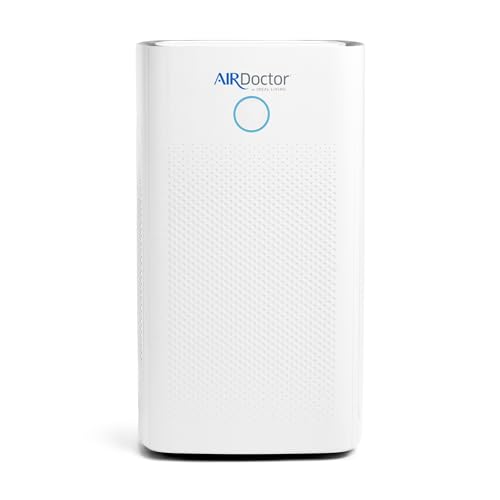
The AirDoctor AD5500 is the plastic tower that takes carbon seriously: an UltraHEPA element paired with a substantial carbon filter, a sensor and auto operation, and whole-floor ambitions at a price the Austin’s buyers will find suspiciously reasonable. For households that want gas capacity with modern manners — feedback, automation, a lighter box — it is the HealthMate’s most credible cross-shop in this cluster, and it is a verified linked pick here.
The trade is the filter calendar: the AirDoctor’s serious carbon is still a seasonal consumable where the Austin’s is a half-decade installation, and three-year costs close much of the purchase gap. Choose by your relationship with maintenance as much as by the air: the tower serves households that like feedback; the steel box serves households that like forgetting.
| Filter | UltraHEPA plus substantial carbon |
|---|---|
| Control | Sensor, auto mode |
| Build | Tower |
Strengths
- Substantial carbon with sensor and auto operation
- Whole-floor coverage ambitions in a lighter tower
- Lower purchase price than the Austin
Trade-offs
- Filters are recurring consumables, not half-decade events
- Plastic build will not see the decades the steel will
- Carbon depth still yields to the Austin’s bed
Best for: households wanting gas capacity with automation and feedback
Not suited for: owners who want to change a filter twice a decade and never open an app

Coway Airmega 150 — The particle-polished rival
The Coway Airmega 150 is what the particle-first philosophy looks like at its best: composed design, a good sensor, quiet manners and filtration tuned for the dust, pollen and dander that constitute most households’ actual load. Against the Austin it loses the gas argument completely and wins the living-room argument nearly as completely, and it is a verified linked pick in this programme.
Its presence in this list is the review’s honesty made visible: most households shopping the HealthMate’s price bracket have particle problems and would be better served — quieter, cheaper, prettier — by the Coway. The Austin’s premium is for the minority whose problem smells. Know which household you are, and the pick chooses itself.
| Filter | HEPA with light carbon |
|---|---|
| Control | Sensor, auto mode |
| Best room | Bedroom to living room |
Strengths
- Polished particle filtration with sensor and auto mode
- Quiet, composed and design-friendly
- Lower cost than the Austin in purchase and presence
Trade-offs
- Carbon stage is light — not a gas-phase machine
- Filters recur on a seasonal rhythm
- Smaller parish than the HealthMate’s whole-floor claim
Best for: particle-first households wanting the polished, quiet option
Not suited for: gas, odour and chemical briefs, where its carbon cannot follow

Alen BreatheSmart 75i — The premium quiet rival
Alen’s 75i is the premium tower for large rooms: strong particle performance, a reputation for quiet power, and filter options that let owners tune toward odour more seriously than most towers allow. It narrows the Austin’s carbon advantage without closing it, and it does so in a machine a design-led room will accept — at a premium price that makes the comparison with the steel box a genuine contest.
It is a verified linked pick in this programme. Households torn between the 75i and the HealthMate are really choosing between the modern tower at its best and the industrial box at its most itself — feedback and finish against mass and lifespan — and either choice, made knowingly, is defensible.
| Filter | HEPA with filter options |
|---|---|
| Best room | Large living spaces |
| Control | Auto mode |
Strengths
- Strong, quiet large-room particle performance
- Filter options include heavier odour tuning
- Premium design the Austin declines to attempt
Trade-offs
- Premium price with recurring filter costs
- Carbon still yields to the Austin’s deep bed
- Large tower footprint of its own
Best for: large rooms wanting premium quiet power with some odour tuning
Not suited for: deep gas-phase briefs and decade-horizon filter economics
How the Austin Air Healthmate Field Compares
Set the HealthMate beside the cluster’s other machines and the philosophical divide is total. The Blueair and Coway models in this programme chase particles with elegant airflow and modest carbon; the AirDoctor line adds serious carbon in a plastic tower; the Austin brings a carbon bed measured in pounds, wrapped around a true HEPA element, inside steel. For smoke, fumes and chemical sensitivity — the gas-phase problems — mass is the argument, and the Austin has the most mass on the shelf.
Against its own siblings the HealthMate is the generalist: the HealthMate Plus adds a carbon blend aimed at chemicals for the most sensitive households, the Bedroom Machine tunes the same platform for sleep, and the smaller HealthMate Jr. shrinks the parish to one room. The standard HealthMate remains the line’s centre of gravity — the whole-home, whole-decade answer for households whose air problem is as much chemical as particulate.
Buying Guide: Judging Austin Air Healthmate on the Right Criteria
The HealthMate competes on a different axis from the smart towers: filtration mass and filter lifespan. The criteria below therefore weigh the carbon bed, the five-year filter proposition and the cost of ownership across a decade, because judging this machine by its features list is like judging a safe by its Bluetooth.
Carbon mass: gas and odour adsorption is a capacity game measured in pounds of carbon and months to breakthrough, and no other specification in this class predicts chemical performance at all The HealthMate’s carbon is measured in pounds rather than grams, and that single specification explains its parish, its price and its weight in one number — the review’s first criterion because it is the product’s first fact.
Filter lifespan economics is where austin air healthmate stops being marketing and becomes measurable, because a five-year filter and a six-month filter produce different machines at the same purchase price, so decade cost — filters, energy, replacements — is the honest price tag A filter set that serves for years reprices the whole machine: divide the Austin’s cost by its filter’s tenure and the premium machine becomes, annually, one of the cheaper ways to filter a room seriously.
Particle honesty: a true HEPA element and a fan that can push a room’s air through it repeatedly matter more than particle marketing, especially in the smoke weeks that test every claim Its HEPA element does the orthodox work without theatre — no ionisers, no lamps, no plasma — and in a category of features, that orthodoxy is itself the specification being graded.
Noise at the working speed is where austin air healthmate stops being marketing and becomes measurable, because the Austin’s parish is the continuously-run low speed, and its acceptability at that speed — not its full-speed roar — is the figure its owners live with The Austin’s fan is a working appliance’s, and the review grades it as such: the top speed is for the room’s empty hours, and households should audition the middle speed as the machine’s true voice.
The build horizon test separates a considered buy from a hopeful one, since steel, casters and a dial are a twenty-year proposition; plastic, touchscreens and apps are a five-year one, and the purchase should be made with the horizon named A steel case and a decade’s design stability mean the HealthMate bought today is serviceable in a decade — a horizon its plastic rivals’ annual redesigns quietly decline to promise.
The feedback versus forgetting test separates a considered buy from a hopeful one, since sensors and auto modes serve households that act on information; the Austin serves households that act once, at installation, and the difference is temperament, not quality It offers no sensor and no app, and the review counts that as a philosophy rather than an omission: this is the purifier for households that want filtration as infrastructure, not as information.
Austin Air Healthmate in Real Households
The flat beside the arterial road is the situation readers describe most often. Traffic fumes are a gas-phase brief with particles riding along, and this is the HealthMate’s home fixture: deep carbon at a low continuous speed, windows managed rather than opened at rush hour, and a filter calendar measured in years. The towers in this cluster would hum politely and lose the argument the carbon was hired to win.
The house after renovation: New paint, new floors and new furniture exhale for months. The Plus sibling’s tuned blend is the specialist pick, the standard HealthMate the strong generalist, and the household’s real decision is runtime — continuous, for the season of exhaling, with the room aired whenever the outdoor air is kinder than the indoor.
The wildfire-adjacent home: Smoke arrives as particles and gases together, and the houses that fare best pair a sealed, filtered room with serious carbon. The Austin’s bed earns its keep in the gas column while its HEPA handles the particles — with the standing reminder that during evacuations and heavy episodes, official guidance outranks any appliance.
The fragrance-sensitive household: For owners who react to scented products, cleaning chemicals and traffic air, the HealthMate is infrastructure for a calmer home — run continuously, its deep bed shaving the peaks off the household’s chemical weather. The review’s care applies: the machine manages air, clinicians manage conditions, and the two conversations should both happen.
Picture the school or clinic room for a moment. Institutions buy this machine for the arithmetic its filter writes: one room, one filter, years of service, no staff time spent on consumables. Households with a home classroom or a carer’s schedule will recognise their own arithmetic in the institution’s, and buy accordingly.
How To Get Austin Air Healthmate Right, Step by Step
Step 1: Place it centrally in its parish. Give the machine the room it serves — usually the main living space or the sensitive sleeper’s bedroom — with clearance around the intake and the door discipline that defines the volume. Central beats corner for a machine whose job is the whole room’s air.
Step 2: Set a continuous low speed. Choose the speed you can live with permanently and leave it there. The Austin’s philosophy is the shaved peak and the lowered background, achieved by constancy rather than by heroics during incidents.
Step 3: Keep the pre-filter’s calendar. Vacuum the pre-filter monthly and replace it on its own cheap schedule. Five minutes of bodyguard maintenance is what the five-year promise is standing on.
Step 4: Log the filter’s installation date. Write it on the filter itself in marker. A half-decade consumable will outlast your memory of its birthday, and the machine has no app to remember for you — by design.
Step 5: Air the house when outside is kinder. The machine manages the indoor load; it does not repeal ventilation. On clean-air days, open the house and let the carbon rest — the bed’s capacity is a budget, and free air spends none of it.
Step 6: Review at the year marks. Once a year, note smells that return faster, speeds that seem louder, and the pre-filter’s condition. The Austin ages slowly and audibly, and a yearly listen is its entire service schedule.
Mistakes That Undermine Austin Air Healthmate
Buying it for a particle-only problem. The premium purchases carbon mass. A household whose brief is pollen and dust alone has paid for capacity it will never use, and the Coway or Alen picks serve it better for less.
Judging it by the features list. No app, no sensor, no auto mode is not a shortfall in this design; it is the design. Buyers who need feedback should buy a machine that gives it rather than resenting the one that never promised to.
Running it only during incidents: Deep carbon earns its keep continuously, shaving the everyday chemical background as well as the episodes. A HealthMate switched on for crises and off for calm is a fire extinguisher used as a fan — present, expensive and mostly idle.
Ignoring the pre-filter: The great filter’s five years assume its bodyguard is kept: a vacuumed pre-filter is the cheapest insurance in the whole machine, and neglecting it taxes the main filter’s life directly.
Expecting it to be a medical device: The most consequential mistake available to this machine’s audience. It cleans air measurably; it treats nothing. Households managing conditions should buy it as environmental support alongside, never instead of, clinical care.
Going Deeper on Austin Air Healthmate
The HealthMate is a survival from the era when appliances were bought as capital goods, and its continued existence is a market argument: there remains a constituency — institutions, the chemically sensitive, the maintenance-weary — that will pay for mass, steel and time. Every design decision that dates it is the same decision that recommends it to that constituency, which is why reviews that grade it as a failed smart appliance miss the object entirely. It is not behind the times. It is declining them, in writing, at a profit.
The carbon bed deserves a final technical word, because it is where the machine’s premium physically resides. Adsorption is a surface phenomenon with a finite budget: gases collect in the carbon’s pores until the bed approaches saturation, and the only defences are mass and time. A deep bed in a large cabinet simply holds a larger budget, spent over years — and no control algorithm, however smart, can negotiate with that arithmetic. The towers’ thin layers are not worse engineering; they are smaller budgets, honestly suited to smaller problems.
There is also a quiet environmental argument for the Austin’s way: a purifier that consumes two filters a decade and no standby electronics to speak of generates a fraction of the waste stream of a connected tower fed seasonally. Longevity is the greenest specification in any appliance category, and a steel box built to be serviced by its owner with a screwdriver is a small manifesto on the subject — one its buyers rarely cite and reliably enact.
So the HealthMate’s place in this cluster is as the bench’s anchor: the machine against which carbon claims are measured and found theatrical, and the standing reminder that in air cleaning, as in most engineering, mass and time beat features and novelty whenever the problem is real. Buy it for the problem it solves. It has been solving it, unchanged, since before its rivals’ brands existed — and it expects to be solving it after their apps are retired.
The HealthMate’s deepest lesson is about what filtration is for. The category’s modern machines treat air as information — measured, graphed, optimised — while the Austin treats it as a material problem: a volume of contaminated air, a mass of adsorbent, a fan, time. Both philosophies filter. But when the contamination is chemical and heavy, only the material philosophy scales, because chemistry is answered by mass and contact time, not by resolution. The Austin is unfashionable in exactly the way a sandbag is unfashionable beside a weather app — and floods do not grade fashion.
The Austin also stands as this cluster’s reminder that not every problem in a home is an information problem. The modern instinct is to measure first — to buy the sensor, read the graph, optimise the number. The HealthMate embodies the older instinct: when the room smells of smoke, the answer is a mass of carbon and a fan, applied for years. Both instincts have their parishes, and wisdom in this category is knowing which parish you are standing in before you spend. The Austin is what the second instinct looks like when it is built properly, in steel, without apology.
Placing and keeping the HealthMate
Its weight makes placement a decision rather than an experiment: choose the room’s breathing zone, on a hard floor, with clearance at the intake, and let it live there — this is not a machine to audition room by room. The keeping is correspondingly light: a vacuumed exterior, the pre-filter’s occasional attention, and the filter set’s multi-year calendar marked once, in ink, on the household’s own calendar rather than entrusted to an app.
Owners should also learn the carbon’s one message: when the room’s characteristic smell begins to return at the outlet, the bed is spent, whatever the calendar says. That nose-led signal is the machine’s only feedback loop, and it is — like everything else about the Austin — analogue, honest and sufficient.
The HealthMate beside the modern flagships
Set the Austin beside this cluster’s flagship towers and the comparison looks unfair in both directions at once. The flagships sense, adapt, report and hush; the Austin sits in steel and filters. But run the comparison on the parish the Austin claims — a room whose problem is chemical — and the flagships’ carbon stages, measured in grams, are answering a pounds question with a pamphlet. Each machine is the other’s cautionary tale, and the household’s brief, as ever in this cluster, is the only judge either respects.
The practical consequence is a two-machine household that appears in this review’s research more often than any maker would like: a flagship for the bedroom’s particles and manners, an Austin for the room where the chemistry lives. Households embarrassed by that duplication should not be — it is the category’s own specialisation, purchased honestly, and it costs less across a decade than the flagship alone replaced twice for failing a brief it never claimed.
Buying the Austin: channels and the Plus question
The Austin’s price and weight make its channel matter: buy from the maker’s authorised routes, where the filter’s provenance and the warranty’s registration are clean, and treat a dramatically discounted listing as a question rather than a gift — old stock’s carbon has been adsorbing the warehouse’s air, and a filter’s life spent on a shelf is spent. The machine’s longevity makes its paperwork a decade’s companion; file it like one.
The Plus question resolves by brief, as the FAQ records: the standard machine for smoke, odour and ordinary chemical load; the Plus where the load is fresh, synthetic and continuous — new furnishings off-gassing, a renovation next door, a chemically sensitive household member whose clinician has joined the conversation. Everyone else is buying treatment they cannot smell the absence of, and the standard machine’s parish is wide enough for most of the map.
The HealthMate’s second decade: spares and service
A machine bought for a decade must be audited for its maker’s stamina, and the Austin passes the audit its own way: a design stable enough that its filter set has remained the same purchase for years, a maker whose catalogue changes at a geological pace, and a construction — fan, switch, steel — that any competent appliance repairer can service without a proprietary sacrament. Households tired of appliances orphaned by their makers’ redesigns will recognise the value without this review’s emphasis.
The service ritual is correspondingly plain: the exterior vacuumed, the pre-filter checked, the outlet sniffed for the carbon’s one message, and the filter set changed when the message or the calendar says so. No firmware, no account, no reminder economy. In a cluster full of machines that communicate, the Austin’s silence is not an absence; it is the sound of a problem being handled by mass and time, which is the oldest sound in filtration.
Field Notes on Austin Air Healthmate
The carbon bed deserves a final technical word, because it is where the machine’s premium physically resides. Adsorption is a surface phenomenon with a finite budget: gases collect in the carbon’s pores until the bed approaches saturation, and the only defences are mass and time. A deep bed in a large cabinet simply holds a larger budget, spent over years — and no control algorithm, however smart, can negotiate with that arithmetic. The towers’ thin layers are not worse engineering; they are smaller budgets, honestly suited to smaller problems.
Households report that activated carbon’s capacity is a budget of pore surface, and the HealthMate’s budget is measured in pounds where a typical tower’s is measured in grams — the whole review is contained in that ratio zeolite, the mineral blended into the Austin’s bed, contributes pores of a different geometry that catch chemical families carbon handles less willingly, which is why the blend outlasts plain carbon on mixed household air a filter rated in years changes the owner’s relationship with the machine from subscriber to proprietor, and the second-hand market prices used Austins accordingly steel cabinets outlive their fans, and a maker that sells replacement parts for old machines is making a statement about what an appliance is for
Worth knowing: the HealthMate’s three speeds are a confession that most purifiers live at one speed anyway; the dial merely declines to pretend the other seven were features institutions adopted this platform for staff-time arithmetic as much as for air: a filter changed twice a decade consumes almost no labour budget across a school district gas-phase pollution is the domestic air problem least served by the modern market, because it cannot be sensed cheaply or marketed brightly — which is why the old steel box keeps its constituency a purifier’s carbon bed spends itself fastest in the environments that need it most, so the five-year rating and the smoky postcode should be read together with the maker’s own caveats
Separately, the machine’s weight is mostly filter, and lifting it is the most direct product demonstration in the category: the premium is in your hands, in pounds owners describe the Austin’s sound at low speed as a room tone rather than a noise, a distinction sleepers draw precisely and reviewers should respect the absence of an air-quality sensor means the machine never congratulates itself; households that need the congratulation should buy it separately and keep both instruments honest renovation exhalation follows a curve of months, and the HealthMate’s continuous low speed is shaped exactly like that curve’s answer
On the ground, for traffic-adjacent homes, the machine’s value peaks at rush hour and troughs on clean Sunday mornings, and its owners learn their street’s timetable in its filter’s patience the HealthMate Jr. exists because the platform’s parish can be one room; the standard machine’s parish is the floor it stands on, and sizing between them is the line’s only real decision a decade with two filter changes is also a decade without a single ‘your filter subscription has shipped’ email, a silence some owners cite as the product’s finest feature in the end the Austin is bought by households that have stopped shopping for purifiers and started shopping for air, and the difference between those activities is the whole of this review
Meanwhile, its carbon bed’s mass is the specification its rivals print smallest, because the comparison is unflattering: most towers carry their carbon in grams and their marketing in pounds the machine’s institutional buyers — schools and clinics — are the reason its design barely changes: a facilities manager reorders the known, and a decade of reorders is a specification no launch can claim its steel case will outlast the fan it houses, which inverts the usual appliance biography — the Austin is rebuilt by its consumables rather than retired by its cabinet in the end the HealthMate is the purifier as infrastructure: unmeasured, unreported, unglamorous, and — in the parishes where chemistry is the problem — entirely without substitute in this cluster
Worth knowing: its filter set is heavy enough that replacing it is a two-handed ceremony, and owners describe the heft with pride — the consumable as evidence, the one part of a purifier you can weigh and thereby believe the machine has no standby draw worth measuring and no light worth mentioning, so its whole electricity across a year is the fan’s honest work — an economy the connected flagships, sipping forever at the network, might envy its design stability means a filter bought today fits machines old enough to have served two households — a continuity that turns the second-hand market for Austins into a rational place, unlike most of the category’s the machine’s noise at its working speed has a quality owners describe as industrial reassurance — a sound that announces work being done, in households that prefer their infrastructure audible to their infrastructure silent
In real homes, its parish includes the new-build flat in its first year, when furnishings off-gas their manufacture into every room — a chemical season the deep carbon bed was, in effect, designed to wait out and its maker’s refusal to add a sensor has a practical dividend: there is nothing in the machine to become obsolete, so its depreciation is set by its fan and its filter, like an appliance from the era before software
Austin Air Healthmate: Cases Worth Studying
The school district’s arithmetic. A district equipping classrooms during a smoky era compared towers’ five-year filter bills against the Austin’s two-filter decade and bought the steel boxes by the pallet. The air argument was real, but the purchase order was won by the labour line: no army of seasonal filter changes across hundreds of rooms. Households rarely run that spreadsheet; the ones with a home classroom or a carer’s rota increasingly do, and it points the same way.
Final Recommendation on Austin Air Healthmate
The Austin Air HealthMate is the purifier this cluster recommends without reservation to exactly one household — the one whose air problem includes gases, odours and chemistry — and with genuine respect to everyone else. Its deep carbon bed, true HEPA element, steel build and five-year filter are a coherent philosophy: filtration as infrastructure, bought once and run forever.
Particle-only households should take the Coway or Alen picks and spend the saving elsewhere; feedback-lovers should take the AirDoctor. But the household that has read this far recognising its own road, its renovation or its sensitivities has found its machine — and will likely still be running it, on the same dial, when this review’s smart rivals are landfill.
Frequently Asked Questions About Austin Air Healthmate
Is the Austin Air HealthMate worth the price?
For gas, odour and chemical briefs, the deep carbon bed and five-year filter make it one of the few premiums in this category that buys physics rather than features, and its decade cost often undercuts cheaper towers. For particle-only households, the same money buys more purifier elsewhere — the worth is in the match, not the machine. The worth divides by parish: for a chemical, smoke or odour brief, its carbon mass has no rival at any price in this cluster; for a simple dust bedroom, the same money buys more machine than the brief requires.
How long does the HealthMate filter really last?
The maker rates the main filter for up to five years in normal household use, with severe environments — heavy smoke, industrial fumes, very large loads — shortening it. The pre-filter needs regular vacuuming and periodic replacement to protect that lifespan. Most owners experience the rating as honest-to-generous by the standards of this industry’s claims. In heavy smoke or chemical service the carbon saturates sooner than the HEPA ages, and the honest calendar is set by the nose at the outlet — when the room’s smell returns, the carbon has spoken.
Does the HealthMate help with smoke?
Its HEPA element captures smoke particles and its deep carbon bed adsorbs a meaningful share of smoke’s gases and odour — the combination wildfire-adjacent households actually need. It does not make a house a refuge during evacuations, and official guidance always outranks appliances, but for the long grey weeks of drift smoke it is among the strongest domestic tools available. It is the cluster’s first recommendation for smoke’s chemistry as well as its particles — the deep carbon bed addresses the gases that make a smoked-in room smell smoked-in after its air has been filtered.
Why is it so heavy and plain?
Because its cabinet is steel, its filter is measured in pounds, and its maker sells to institutions that buy on specification. The plainness is the honest appearance of those decisions. Households that need the machine to disappear into a designed room should look at the Alen or Coway picks and accept their lighter carbon as the trade. The weight is the product: pounds of carbon and a steel case. The plainness is the same fact viewed from the front — a machine whose budget was spent inside, on the bed, rather than on the fascia.
HealthMate or HealthMate Plus — which one?
The standard model for general gas and odour work; the Plus when the brief names chemicals — renovation exhalations, new furnishings, formaldehyde concerns — because its carbon blend is tuned toward them. The premium is modest and the tuning is real, but households without the chemical brief gain nothing from it. The Plus adds a more aggressive chemical treatment to the carbon for the most sensitive briefs — fresh paint, new furnishings, chemical work next door; ordinary smoke and odour briefs are the standard machine’s parish.
Can it run all the time, and what will it cost?
It is designed to: a continuous low speed is its intended life, drawing modest power and wearing its filter on the maker’s long schedule. The honest running-cost ledger is electricity plus one main filter per several years plus pre-filters — a decade total that surprises owners of seasonal-filter towers pleasantly. It is built for exactly that duty, and its running cost is a fan’s — modest beside any heating or cooling appliance — with the filter’s multi-year tenure making its consumable cost per year among the lowest in the cluster.
Reading: austin air healthmate — from our own guides: AirDoctor 5500 rival compared in the Coway Airmega 300 review Blueair Blue Pure 211 reviewed American wildfire index explained Coway Airmega Mighty reviewed best HEPA air purifiers what is a HEPA filter