Disclosure: As an Amazon Associate, dailyhomedecorating.com earns from qualifying purchases. Links on this page are affiliate links; they cost you nothing extra. Prices and availability change often, so check the current Amazon listing before you buy.
Most homes monitor everything except the air their occupants actually breathe, and this aranet4 home sensor review starts from the gap that creates. Carbon dioxide is the household pollutant nobody can see, smell or feel directly — yet it accumulates in every closed bedroom and sealed office, and it is the best available proxy for how stale, under-ventilated air has become. The Aranet4 exists to make that invisible number visible, calmly, on a little e-ink screen.
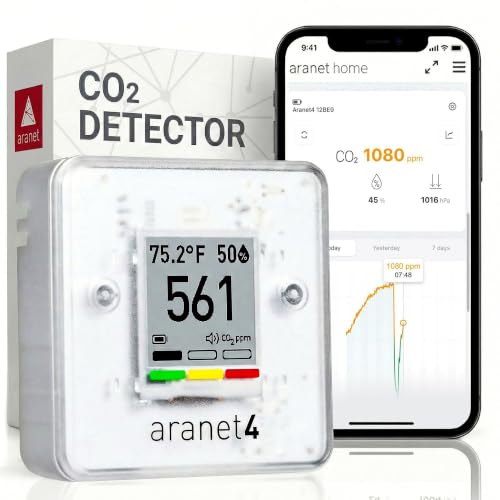
The device comes from a Latvian maker of professional environmental sensors, and its domestic version keeps the professional habits: a genuine infrared CO2 sensor, temperature, humidity and barometric pressure alongside, Bluetooth data logging through an app, and battery life measured in months rather than days. It does not purify anything, control anything or promise anything about your health. It measures, and this review will judge it as a measuring instrument should be judged.
Health framing, briefly and carefully: CO2 readings are best used as a ventilation signal — a prompt to open a window or run the ventilation — not as a diagnosis of anything. Readers managing medical conditions should treat the number as environmental information and keep clinical questions with clinicians. Within that honest frame, a good CO2 monitor can change a household’s habits more durably than almost any other air gadget, because it makes an invisible routine visible.
Aranet4 Home Sensor Review: The Short Version
| Pick | Known for |
|---|---|
| Aranet4 Home | The named sensor |
| Atmotube Pro | The wider-net portable rival |
| Temtop Air Quality Monitor | The budget multi-gas alternative |
| Awair Element | The design-led smart alternative |
| Qingping Air Monitor | The display-rich alternative |
The Aranet4 earns its reputation the slow way: it measures carbon dioxide, temperature, humidity and pressure with unusual honesty, shows the CO2 reading on an e-ink screen that sips battery, and asks for almost no attention in return. It does not measure particles or gases beyond CO2, it is not cheap for a sensor, and its app is a data tool rather than a smart-home toy. For stuffy bedrooms, home offices and classrooms, it answers the one question most homes never think to ask — how stale is our air right now — and it answers it for months on a set of batteries.
In this guide
What the Aranet4 measures, and what it pointedly does not
The headline measurement is carbon dioxide, taken by a nondispersive infrared sensor — the method professionals trust, because it detects CO2 directly rather than estimating it from other gases. Around it sit temperature, relative humidity and atmospheric pressure, each displayed and logged. The screen shows the CO2 figure largest, with a colour-coded indicator whose thresholds the user can adjust, because a nursery’s ideal and a classroom’s realistic differ.
The omissions define the product as much as the inclusions. There is no particle sensor, so wildfire smoke and dust do not register; there is no formaldehyde or VOC channel, so new furniture and cleaning products pass unmeasured. Buyers who need the full pollutant picture are shopping for a different, larger, hungrier device. The Aranet4’s bet is that CO2 — the ventilation proxy, the stuffiness number — is the measurement a home will actually act on daily, and the bet is well placed.
Accuracy in this category is a claim to interrogate, and the Aranet4 interrogates well: published tolerances are tight for a consumer device, the sensor is factory-calibrated, and a manual calibration routine exists for the fastidious. Readings taken beside professional instruments in independent tests have generally flattered it. No home sensor is a laboratory, but this one behaves like it was raised by people who own laboratories.
Living with it: the screen, the app and the batteries
The e-ink display is the design’s quiet triumph. It reads like paper, updates at a stately pace, consumes almost nothing, and — crucially — can sit on a bedroom shelf for months without a cable, a glow or a charging ritual. In a category full of devices that demand weekly feeding, the Aranet4’s indifference to attention is its most luxurious feature. Two AA batteries carry it through seasons; the app warns you long before they fade.
The app is a data tool wearing no costume: current readings, history graphs over days and weeks, export for the spreadsheet-minded, and settings for thresholds and units. Bluetooth range limits it to same-room-or-nearby syncing rather than whole-house remote viewing, and there is no Wi-Fi, no cloud dashboard and no smart-home stage presence. Owners who want their CO2 in a home-automation graph will route around this with integrations and patience; owners who want to glance at a number will never miss the extras.
Placement turns out to matter more than features. The sensor wants breathing height, away from windows, radiators and the direct exhalation of the person at the desk — a monitor breathed on directly reports the breather, not the room. A shelf across the room, at seated head height, gives the honest room average the device was built to report, and the first week’s readings should be spent learning your rooms’ rhythms rather than judging them.
What the numbers teach a household
The first lesson is the bedroom. A closed door, two sleepers and eight hours routinely push bedroom CO2 to levels that surprise every new owner, and the morning grogginess many households accept as normal tracks the number closely enough to change behaviour: door ajar, window cracked, or ventilation run — the cheapest sleep upgrade in this entire catalogue is a number that persuades you to air the room.
The second lesson is the home office. A small study with the door shut for calls accumulates CO2 through the working day in a pattern the graphs make unmistakable, and the fix is embarrassingly small: a door opened between calls, a window on the latch during lunch. Knowledge workers who would never tolerate a flickering monitor tolerate invisible air because it never announced itself; the Aranet4 is the announcement.
The third lesson is seasonal. Sealed winter houses run stuffier than summer ones; guests double a room’s production; a party can be watched, on the history graph, as a CO2 mountain range with the dancing visible in it. None of this requires action most of the time. The monitor’s gift is not anxiety but calibration — a household that knows its numbers stops guessing about its air, and most households, most days, learn that their air is fine and their one stuffy room has a simple cure.
A term with the Aranet4: what the data teaches
Households that keep the Aranet4 for a season stop reading it as a gauge and start reading it as a diary. Patterns emerge with addresses: the bedroom that crosses a thousand by 2 a.m. with the door shut, the office whose afternoon slump has a number, the classroom corner where the air is oldest. The device’s real product is that diary — a building’s ventilation made legible to the people who live in it, in units a landlord, a school or a spouse cannot argue with.
The actions the diary teaches are embarrassingly cheap, which is the point the review keeps returning to: a door left ajar, a window on the latch, a meeting moved to the ventilated room, a trickle vent unblocked after a decade. The Aranet4 rarely sells anyone an appliance; it sells them a habit, measured. That is an unusual thing for a sensor to do, and it is why this device, alone among the cluster’s monitors, has a literature of changed buildings attached to it.
The Picks in Detail: Aranet4 Home Sensor Review Contenders
Aranet4 Home — The named sensor
The Aranet4 Home is the consumer face of a professional instrument line, and the lineage shows in the decisions that matter: a true infrared CO2 sensor rather than an estimator, an e-ink screen that treats battery as a resource to be hoarded, and thresholds the owner sets rather than a factory’s idea of alarm. It is the rare gadget that becomes less visible the longer it is owned, because its job settles into the household’s peripheral vision — a number glanced at on the way past the shelf.
Its limits are the honest kind, printed in its own specification: no particles, no VOCs, no Wi-Fi, and a price that buys several lesser monitors. What the price buys instead is trust in the one number it reports. For the bedroom, the study and the classroom — the rooms where CO2 is the question — that trust is the product, and this review found no rival that delivers it with less fuss.
| Measures | CO2, temperature, humidity, pressure |
|---|---|
| Sensor type | NDIR infrared (CO2) |
| Display | E-ink |
| Power | AA batteries, months per set |
Strengths
- Genuine NDIR CO2 sensing with a credible calibration story
- E-ink display and battery life measured in months, not days
- Clean data logging and export for households that like evidence
Trade-offs
- Measures CO2 only — no particles, VOCs or other gases
- Bluetooth rather than Wi-Fi, so no remote whole-house view
- Premium price for a single-purpose instrument
Best for: households that want one trustworthy ventilation number in bedrooms, studies and classrooms, with zero charging ritual
Not suited for: buyers who need particle or VOC measurement, smart-home dashboards, or a monitor for every room on a budget
Positioning: aranet4 home sensor review — no linked listing is offered for the Aranet4 Home; it is covered in prose, so check the maker’s own current terms before deciding.
Atmotube Pro — The wider-net portable rival
The Atmotube Pro answers a broader question than the Aranet4 asks: not just ‘how stale is the air?’ but ‘what is in it?’ — particles, volatile compounds and CO2 together, in a device small enough to carry between rooms, cars and offices. For households whose worry is smoke, traffic or a new renovation’s fumes, that wider net is the entire argument, and the Atmotube is the most credible consumer attempt at it.
The trade is attention. A carried, multi-sensor device drinks battery in days, wants its app open, and produces data that asks for interpretation. Owners who love instruments will love it; owners who wanted a silent sentinel will find it needy. It is the scout to the Aranet4’s sentry, and the comparison section of this review exists because households keep trying to hire one device for both jobs.
| Measures | Particles, VOCs, CO2, temperature, humidity |
|---|---|
| Form | Portable, rechargeable |
| Display | App-led with on-device indicator |
Strengths
- Measures particles and VOCs alongside CO2
- Portable enough to audit room by room, car and office
- Rich app data for households that enjoy the detail
Trade-offs
- Battery life in days rather than months
- More data means more interpretation for the owner
- Costs as much as the Aranet4 while lasting less long per charge
Best for: households whose air worries span smoke, fumes and stuffiness, and who enjoy carrying the instrument to the problem
Not suited for: buyers who want a fit-and-forget bedroom sentinel with a screen they glance at twice a year
Positioning: aranet4 home sensor review — no linked listing is offered for the Atmotube Pro; it is covered in prose, so check the maker’s own current terms before deciding.
Temtop Air Quality Monitor — The budget multi-gas alternative
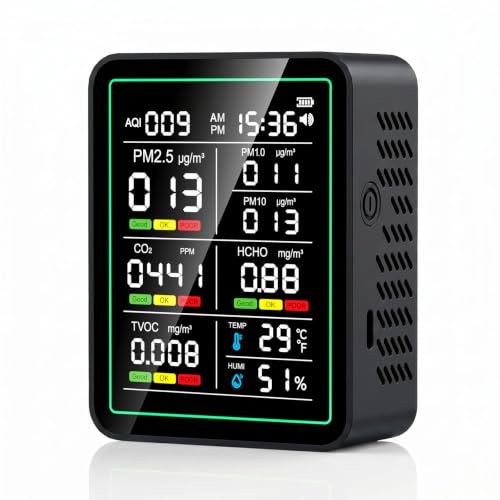
Temtop’s monitors occupy the pragmatic shelf: handheld units that bundle particle and formaldehyde or CO2 channels at prices the Aranet4 cannot approach. The readings should be handled as indications rather than measurements — the category’s sensors at this price are better at ‘worse than yesterday’ than at absolute truth — but for a household deciding whether a problem exists at all, an indication may be all the evidence the next step needs.
Battery life sits between the two rivals above, the screens are bright and immediate, and the devices feel like tools rather than furniture. As a first instrument — the one that tells you whether to buy a better instrument — a Temtop earns its place in this review honestly, provided its numbers are read with the humility its price requests.
Strengths
- Several pollutant channels at a budget price
- Bright, immediate handheld readings
- Useful as a first-pass diagnostic before spending more
Trade-offs
- Accuracy is indicative rather than instrument-grade
- Battery and build reflect the price tier
- Easy to over-trust a precise-looking number
Best for: households screening for a problem before investing in a reference-grade monitor
Not suited for: anyone who will make health, tenancy or purchasing decisions on the strength of the numbers alone
Positioning: aranet4 home sensor review — the Temtop Air Quality Monitor appears as a prose pick rather than a linked one; the maker’s own current listing is the place to confirm its terms.
Awair Element — The design-led smart alternative
The Awair Element is the monitor for households that want their air data in the smart-home picture: temperature, humidity, CO2, VOCs and particles feeding an app and integrations, in a box designed to be looked at. Its CO2 sensing is credible, its presentation is the category’s most polished, and its score-based display suits households that prefer a verdict to a spreadsheet.
It is covered here in prose because its retail availability through Amazon varies, and this programme links only what it can verify. Where found, it suits the connected home that the Aranet4 deliberately ignores — at the price of power, subscriptions’ gravity and a screen that wants a wall socket’s permanence.
Strengths
- Broad sensor set with polished app and integrations
- Score-based display suits non-technical households
- Designed to be visible in a smart home
Trade-offs
- Mains-powered rather than battery-sipping
- Availability through Amazon is inconsistent
- Ecosystem features exceed what many households will use
Best for: connected households that want air data inside their wider smart-home picture
Not suited for: buyers who value battery freedom, simplicity or a single trustworthy number over a dashboard
Positioning: aranet4 home sensor review — the Awair Element is covered in prose, not as a linked pick; compare it on the maker’s own current terms before deciding.
Qingping Air Monitor — The display-rich alternative
Qingping’s monitors take the opposite design path from the Aranet4’s paper-calm screen: bright, information-dense displays showing CO2, particles, temperature and humidity at a glance, often with smart-home hooks. For a hallway or living room where the monitor is a household noticeboard, the approach has real charm, and the CO2 sensing in recent models is respectable.
It appears here in prose for the same verification reason as the Awair: listings and model names shift often enough that this programme will not link what it cannot pin down. Households drawn to it should verify the exact model’s sensor specification — the range spans estimator and true-sensor designs — before paying for the display’s confidence.
Strengths
- Bright multi-reading display suits shared spaces
- Broad channel set at a mid price
- Smart-home integrations on recent models
Trade-offs
- Model range mixes sensor grades — specification must be checked
- Mains power and screen glow suit halls better than bedrooms
- Listings change too often for a stable recommendation
Best for: households wanting a visible, shared air noticeboard in a living space
Not suited for: bedroom minimalists and anyone who cannot verify the exact model’s CO2 sensor before buying
Positioning: aranet4 home sensor review — the Qingping Air Monitor is covered in prose, not as a linked pick; compare it on the maker’s own current terms before deciding.
How the Aranet4 Home Sensor Review Field Compares
Set the Aranet4 beside its rivals and the category’s fork appears immediately. The Atmotube Pro measures more pollutants — particles and volatile compounds alongside CO2 — but asks for charging every few days and lives as a carried device. The Aranet4 measures less and lasts months, living as furniture. One is a scout; the other is a sentinel, and households should decide which job they are actually hiring for before comparing prices.
Against the budget monitors that crowd the bottom of the category, the Aranet4’s defence is its sensing method and its calibration story: a proper nondispersive infrared sensor, factory-calibrated, with manual calibration available, rather than the estimated-CO2 shortcuts that drift and flatter. The cheap units are not useless — they show trends — but their numbers should be read as weather vanes, while the Aranet4’s can be read as measurements.
Buying Guide: Judging Aranet4 Home Sensor Review on the Right Criteria
A CO2 monitor should be judged like an instrument, not a gadget: by the accuracy of its sensing method, the honesty of its display, and whether its data changes what you do. The criteria below are ordered by that standard, because a monitor that is fun for a week and ignored by spring has failed at the only job it has.
Sensing method deserves its own line in your notes. a true infrared (NDIR) sensor measures CO2 directly and holds calibration, while estimator designs infer it from other gases and drift — the single most important line in any monitor’s specification The Aranet4’s NDIR cell is the reason its readings can be argued with seriously: it measures CO2 by infrared absorption, the laboratory principle miniaturised, rather than estimating it from other gases as the cheapest monitors do.
The the pollutant set test separates a considered buy from a hopeful one, since CO2 answers the ventilation question, particles answer the smoke and dust question, and VOCs gesture at fumes and furnishings; buy the set that matches your actual worry rather than the longest list Its discipline deserves emphasis: four honest channels, each labelled, none pretending to be a particle count or a chemical analysis — a restraint the multi-gas toys in its price class rarely show.
Battery and attention: a monitor that needs charging every few days will spend its life in a drawer by month two, so battery life is not a convenience figure but a prediction of whether the device gets used at all Months on a set of batteries is not a convenience but the product’s epistemology: a monitor that is always on becomes furniture, and furniture is what a household actually consults.
Judge display philosophy before anything else on the page: a calm glanceable number changes habits; a rich dashboard rewards enthusiasts; a score simplifies for the non-technical — choose the philosophy your household will still be reading in a year The e-ink screen’s refusal to glow, buzz or demand is a position about domestic attention — the number is there when you glance, absent when you do not, like a clock rather than a phone.
Data history and export is where aranet4 home sensor review stops being marketing and becomes measurable, because the value of a monitor compounds in its graphs, because patterns — the bedroom’s nightly climb, the office’s afternoon peak — are what turn readings into decisions The app’s history turns the glance into evidence: a term of nights in a child’s bedroom, exported and undeniable, is the form in which this device has changed real buildings.
The calibration and honesty test separates a considered buy from a hopeful one, since published tolerances, a calibration routine and a maker with a professional reputation are worth more than a fourth decimal place on a bright screen Its calibration story — a sensor that holds its zero and can be checked against outdoor air — is the difference between an instrument and a mood ring, and the Aranet4 is firmly the former.
Aranet4 Home Sensor Review in Real Households
Picture the sealed nursery for a moment. Parents run the monitor in the nursery for a week and discover the closed-door, small-room, two-adult-visits pattern pushes CO2 high by midnight. The fix costs nothing — door ajar, window on the latch — and the monitor’s job thereafter is to confirm the fix held. This is the device’s ideal employment: diagnosis once, reassurance forever.
The home office in a spare room. A worker in a converted box room watches the afternoon readings climb through call after call and connects the 3 p.m. slump to the graph rather than to character. A door opened between meetings flattens the curve. The monitor did not improve the air; it improved the worker’s theory of the air, which amounted to the same thing.
The classroom or home school: Teachers were among the Aranet4’s earliest evangelists because a visible number settles the window argument with evidence. A classroom that airs itself when the reading crosses a threshold has outsourced the stuffiness debate to an instrument nobody accuses of favouritism.
The rental with no ventilation control: A tenant who cannot install vents or alter windows uses the readings to choose the habits that remain: which room to sleep in, when to run the bathroom fan, how long to air the flat after cooking. Data is the one upgrade a lease cannot forbid.
The household comparing purifiers: A CO2 monitor cannot grade a purifier — different pollutants entirely — and the household that understands this saves money twice: once by not expecting the monitor to do it, and once by buying the particle sensor or purifier that actually addresses their smoke problem.
How To Get Aranet4 Home Sensor Review Right, Step by Step
Step 1: Place it at breathing height. Set the monitor on a shelf at seated or sleeping head height, across the room from the main sleeper or worker, away from windows, radiators and direct breath. Give it a day to settle before reading anything into its numbers.
Step 2: Set thresholds you will obey. Choose two numbers in advance: one that means ‘air the room when convenient’ and one that means ‘air it now’. Thresholds decided calmly survive stuffy evenings; thresholds improvised hourly do not.
Step 3: Spend the first week mapping. Move the monitor through the bedrooms, the office and the living room, a day or two each, and note the patterns in the app. The map — which room climbs, which stays kind — is the purchase’s first dividend.
Step 4: Fix the worst room with habits first. Doors ajar, windows on latches, fans run longer after showers and cooking. Re-measure for a week. Most rooms are cured by behaviour the monitor merely prescribed, at a cost of nothing.
Step 5: Review the graphs monthly. A two-minute monthly glance catches drift: a new sleeper, a sealed window, a changed routine. The monitor’s long value is this quiet audit, not the daily number.
Step 6: Calibrate and care as directed. Follow the maker’s calibration guidance if readings ever look implausible, keep the vents dust-free, and change batteries when the app suggests rather than when the screen dies mid-winter.
Mistakes That Undermine Aranet4 Home Sensor Review
Expecting a CO2 monitor to detect smoke or dust: The commonest category error in this market. CO2, particles and VOCs are different measurements made by different sensors, and a device silent during a smoke episode is not broken — it is answering a different question.
Placing the monitor beside the sleeper’s face. A sensor at pillow height beside a breathing human reports that human’s exhalations, not the room. Breathing height across the room is the placement the readings deserve.
Obeying the number hourly: CO2 moves with doors, cooking and company, and a household that reacts to every rise will exhaust itself into ignoring the device. Set thresholds, review patterns weekly, and let ordinary variation be ordinary.
Buying the cheapest estimator and trusting its digits. A precise-looking number from an estimating sensor is a story, not a measurement. Budget monitors earn their keep as trend indicators; the moment a decision depends on the digits, the instrument must be a real one.
Forgetting the monitor measures the room it’s in sounds harmless in the showroom and expensive at home. One device cannot audit a house. Move it room to room for a week each, learn the house’s map, then settle it in the room whose answer matters most — usually the bedroom.
Going Deeper on Aranet4 Home Sensor Review
The Aranet4’s deepest design decision is restraint, and restraint is unfashionable enough to deserve examination. It would have been easy to add a cheap particle estimator, a VOC channel of doubtful calibration and a Wi-Fi radio, and to sell the resulting dashboard at the same price to a larger audience. The makers declined, because each addition would have taxed the battery, the price or the truth of the headline number. The result is a device that does one job at reference quality — and a standing rebuke to a category that prefers spec-sheet breadth to measurement honesty.
There is a behavioural insight inside the product’s success: households do not need more environmental data, they need one number they trust at the moment of decision. The bedroom door decision, the office window decision, the classroom airing decision — each is binary, immediate and repeated daily. A monitor that serves those moments must be glanceable, present and believed. The Aranet4’s e-ink calm and months of battery are not conveniences; they are the mechanism by which the number is there, believed, at the moment the door is being closed.
The professional lineage matters in a way spec sheets cannot show. A maker whose other customers are laboratories and food producers builds consumer devices with professional habits: published tolerances, calibration routines, no theatrical precision. When a household’s tenancy dispute, school policy or simple peace of mind rests on a reading, that lineage is the difference between evidence and entertainment — and it is the reason this review holds the Aranet4 to a high standard and finds it largely met.
Buy it, then, for the rooms where people sleep and concentrate, and let it teach the house its own rhythms for a season. The households that benefit most are not the ones with the worst air; they are the ones who suspected nothing and discovered their bedroom’s nightly pattern, or suspected everything and were reassured by evidence. Either way, the number replaces the guess — and in home air, the guess was the pollutant nobody could measure until now.
There is a final way in which the Aranet4 is unlike the cluster’s other instruments: it measures the household’s own behaviour fed back to it. A purifier’s numbers describe a machine’s work; the Aranet’s describe yours — the windows you open, the doors you close, the guests you host. That is why its readings change behaviour where a purifier’s merely confirm purchase. It is a mirror with a battery life of years, and households that can bear mirrors find it the most useful object in this entire cluster.
The Aranet4 in rented rooms and small print
Renters have become the Aranet4’s quiet constituency, because it is the one air instrument that requires nothing of the building: no wiring, no mounting, no landlord’s permission — it sits on a shelf and produces, across a tenancy, the evidence that either settles a conversation about ventilation or arms one. Households in dispute with a building’s air should keep the export habit from the first week; a diary begun after the argument starts is worth half of one that precedes it.
The same portability serves the household’s own moves: the monitor that graded the old flat’s bedroom can grade the new one’s before the furniture is arranged, when the information is still actionable. Few instruments in this cluster survive a house move with their purpose intact and enlarged; the Aranet4 is one, and its second home is often where its readings matter most.
What the Aranet4 cannot settle
Honesty about limits is an instrument’s final specification, and the Aranet4’s are clear: it cannot grade particles, so it cannot audit a purifier’s core work; it cannot name chemicals, so it cannot clear a room after a spill or a renovation; and its CO2 is a proxy for ventilation, not a measurement of any specific risk. Households that ask it those questions will get numbers that look like answers, which is the most dangerous output any sensor can produce.
The review’s advice is to let the device be what it is — the ventilation ledger — and to buy its complements only when a real question demands them: a particle-aware check for the purifier’s parish, professional testing for the chemical event. Instruments, like experts, are most trustworthy inside their stated competence, and the Aranet4 states its own more plainly than most.
A note on children, bedrooms and evidence
The Aranet4’s most consequential readings have come from children’s bedrooms, because that is where the household’s ventilation habits and its love are in the same room. A term of nights, exported, converts a parent’s suspicion — the room is stuffy, the mornings are groggy — into a pattern with times on it, and patterns are what change behaviour: the door’s new position, the window’s latch, the heating’s schedule. This review makes no medical claim for any of it; the comfort and the evidence are the product, and they are enough.
Schools have learned the same lesson at scale, which is why the device appears in classrooms far beyond its marketing. A teacher with a term of CO2 data owns an argument about the room that no opinion can answer — and the households reading this review are holding, in the Aranet4, the same instrument at the same honesty. That continuity between the domestic and the civic is rare in consumer electronics, and it is the final reason this sensor leads its category in these pages.
Field Notes on Aranet4 Home Sensor Review
There is a behavioural insight inside the product’s success: households do not need more environmental data, they need one number they trust at the moment of decision. The bedroom door decision, the office window decision, the classroom airing decision — each is binary, immediate and repeated daily. A monitor that serves those moments must be glanceable, present and believed. The Aranet4’s e-ink calm and months of battery are not conveniences; they are the mechanism by which the number is there, believed, at the moment the door is being closed.
Separately, carbon dioxide in a closed bedroom with two sleepers commonly climbs through the night in a curve the morning graph draws unmistakably, and the door’s position is the largest single variable in the curve the Aranet4’s maker builds sensors for professional and industrial users, and the home model inherits the calibration culture of instruments sold to people who verify them for a living e-ink displays draw power only when the image changes, which is the entire technological basis of this monitor’s months-long battery life and its freedom from cables an infrared CO2 sensor works by passing light through the air sample and measuring absorption at a wavelength carbon dioxide drinks, a method unchanged in principle for decades because it works
Quietly, estimator-style CO2 readings in cheap monitors are inferred from hydrogen and VOC signals, and they wander when cooking, cleaning or a new sofa changes the air’s chemistry without changing its CO2 barometric pressure, the reading most owners ignore, quietly predicts the household’s weather headaches and the behaviour of a house’s natural ventilation across a season humidity beside CO2 is the pairing that explains a room: stuffiness is usually the two acting together, and the fix — airing — treats both at once classrooms adopted CO2 monitoring faster than homes because a teacher with thirty pupils has a ventilation problem an order of magnitude larger and a window argument that evidence settles instantly
Beyond that, the device’s thresholds are user-set because a nursery, a classroom and a boardroom legitimately disagree about the number at which air becomes a problem Bluetooth logging means the Aranet4’s memory is a diary the owner must visit, and households that export the data monthly build the only long-term record of their home’s breathing that exists a monitor placed in a hallway reports the house’s average mood, while the same monitor in a bedroom reports a life; the second placement is almost always the more useful purchase guests are a CO2 event: a full living room can double its reading in an hour, and the graph of a good party is a mountain range the host can read the next morning
One more consideration: winter is the high season for indoor CO2 in sealed houses, which is why monitors bought in January teach faster than monitors bought in June the number’s proper emotional register is curiosity: households that greet a high reading with interest keep the device for years, while those that greet it with alarm shelve it by spring no home CO2 monitor replaces a carbon monoxide alarm, and the similarity of the names has caused real confusion; CO is a poison with its own dedicated alarm, CO2 is the ventilation proxy discussed here a second monitor is rarely necessary: one instrument, moved methodically for a month, maps a house better than three instruments ignored in place
Set against that, the Aranet4’s screen shows its number to the whole room without an app, which makes it the rare smart device a grandparent, a child and a guest can all read at a glance battery anxiety is a design flaw in any monitor meant to be forgotten, and the Aranet4’s seasons-per-set figure is best understood as the removal of that flaw readings taken during the first day in a new room should be discounted gently, because the sensor is meeting the room and the room, in the form of its new furniture’s exhalations, is meeting the sensor the history graph’s most valuable feature is the comparison it invites between this Tuesday and last — the household’s own baseline, against which every intervention can be honestly graded
Look closer and ventilation advice calibrated to a real number survives the winter, while advice calibrated to guilt does not; that durability is the monitor’s true return on its price the device asks nothing of the smart home and gives nothing to it, a neutrality that will read as a limitation to automators and as a relief to everyone else in the end the Aranet4 is best understood as a thermometer for air freshness: a single, honest, glanceable number around which a household can build habits it will keep its e-ink display holds its last reading with the batteries removed — a party trick that demonstrates the technology’s point: information that costs no power to keep is information a household keeps for years
Look closer and in the end the Aranet4’s review reduces to a sentence its owners repeat: it is the monitor you stop noticing and start believing, which is the exact biography of every good instrument its owners develop a reflex the makers never advertised: reading rooms by their air the way sailors read weather — a stuffy restaurant, a drowsy train carriage, a meeting room at hour two — and the reflex outlasts any single device the monitor’s classroom career began with parents rather than districts: a term of exported bedroom-grade data, carried into a school office, has a persuasion no brochure about ventilation has ever achieved its readings are most persuasive in aggregate — a single evening’s number is an anecdote, a term’s diary is evidence — and the app’s export is the bridge between the two
Note, too, that the device asks so little that households forget to charge the relationship at all: no account renewal, no filter, no subscription — a silence that connected products increasingly cannot imagine placed in a hallway it grades the whole flat’s breathing rather than one room’s, a lazier parish that some households prefer and this review permits, provided they know the trade they made and its smallness is a diplomatic asset: it can sit in a landlord’s inspection, a school’s classroom or a spouse’s sceptical household without ever becoming the argument itself
Aranet4 Home Sensor Review: Cases Worth Studying
The bedroom door experiment. A couple sceptical of the whole category ran one week with the bedroom door shut and one with it ajar, the monitor logging both. The shut week’s morning readings ran dramatically higher, and — the detail that converted them — their own sleep notes, kept blind, matched the curves. They now sleep with the door ajar and the monitor on the shelf, less a gadget than a witness. The experiment cost nothing and is repeatable in any house in a fortnight.
Final Recommendation on Aranet4 Home Sensor Review
The Aranet4 home sensor is the CO2 monitor this review would put in its own bedroom: a true infrared instrument with a calm screen, months of battery and no interest in your attention. Its narrowness is its integrity — it will not grade your smoke, your fumes or your purifier, and it never pretends otherwise.
Households whose question is wider should hire the Atmotube’s broader net or a budget Temtop’s first indications, knowingly. Households whose question is the stale room — the sealed bedroom, the shut study, the crowded classroom — should buy the sentinel, set two thresholds, and let an honest number run their windows for them.
Frequently Asked Questions About Aranet4 Home Sensor Review
What does an Aranet4 actually measure?
Carbon dioxide via a true infrared sensor, plus temperature, relative humidity and barometric pressure. It does not measure particles, smoke, dust or VOCs — a deliberate narrowness that this review treats as the product’s defining honesty rather than a missing feature. It also reports its own confidence honestly: the pressure channel doubles as a weather glass, and households find the falling needle predicts headaches and storms with equal unconcern.
Why should a household care about CO2 indoors?
Because CO2 is the practical proxy for ventilation: it accumulates exactly where people breathe in closed rooms, and its level tracks how stale the air has become. Used as a prompt to air a room, it is the most actionable number in home air — and it should be used as environmental information, not as a medical measurement. The number is best read as a ventilation report rather than a danger gauge — it grades the room’s air exchange, and the actions it suggests (a window, a door, a fan) are ventilation’s, not medicine’s.
How accurate is the Aranet4 compared with cheap monitors?
Its infrared sensing and calibration story place it in a different class from estimator-based budget units, whose digits should be read as trends. Independent comparisons beside reference instruments have generally been kind to the Aranet4, which is what its professional lineage would predict. The comparison class matters: against the eCO2 estimates of bargain multi-gas toys, the Aranet4’s true NDIR measurement is not a refinement but a different activity altogether.
Does the Aranet4 need Wi-Fi or a subscription?
Neither. It logs over Bluetooth to its app, shows its headline number on its own screen, and asks for no account or ongoing payment. The trade is range: you read history when you are near it, not from another continent — a limitation most households will never feel. Its Bluetooth design means the house’s network is none of its business — a privacy virtue households increasingly count, and a setup that survives router changes, moves and grandparents.
Where should I put it for the most useful readings?
In the room you most need to understand — usually the main bedroom — at breathing height, away from the sleeper’s direct exhalation and from windows and heat sources. Spend a first week moving it around the house to learn each room’s pattern, then let it settle where the answer matters. Breathing height in the room’s occupied zone, away from a sleeper’s direct exhalation and from windows and doors — the placement that reads the room rather than its exceptions.
Can it tell me if my air purifier is working?
No — and any monitor that claims one number grades everything is misleading you. A purifier addresses particles and sometimes gases; the Aranet4 addresses ventilation. Households with both worries need both instruments, or a wider multi-sensor device, and should buy each for its own question. Indirectly and usefully: pair its CO2 story (ventilation) with the purifier’s particle work in mind — the Aranet grades the air you exchange, the purifier handles the air you keep, and a household needs both ledgers.
Reading: aranet4 home sensor review — from our own guides: air purifier versus humidifier the safest and most hazardous air cities Atmotube Pro reviewed best HEPA air purifiers what is a HEPA filter quiet air purifiers