Disclosure: As an Amazon Associate, dailyhomedecorating.com earns from qualifying purchases. Links on this page are affiliate links; they cost you nothing extra. Prices and availability change often, so check the current Amazon listing before you buy.
The best cooling mattress pad is a more modest and more honest product than its marketing suggests, and this guide will treat it that way from the first paragraph. A pad cannot refrigerate a bed. What it can do — what the five verified picks below do, in ascending order of ambition — is change the thermal character of the surface your skin actually touches: wick moisture instead of pooling it, hold air instead of body heat, and stop a warm mattress from greeting you like a stored radiator. Every pick was confirmed in the Amazon catalog on 23 November 2026. Along the way the guide will separate the three families that share the word “cooling” — quilted pads, gel foam toppers, and premium cooling foams — because they cool by different mechanisms, at different depths of intervention, and confusing them is how hot sleepers buy the wrong one twice.
In this guide
Quick Picks
| Pick | Family | Cooling mechanism |
|---|---|---|
| MATBEBY Cooling Mattress Pad | Quilted pad | Breathable quilted surface, moisture-friendly |
| Niagara Sleep Solution Pillow Top | Quilted pad, bamboo-derived cover | Loft and air, minimal insulation |
| Lucid 4-Inch Cooling Gel Topper | Gel memory foam topper | Gel moderation plus deep pressure relief |
| Sleep Innovations Cooling Comfort Dual Layer | Foam plus quilted top | Cooling gel foam under a breathable quilt |
| TEMPUR-Adapt + Cooling Topper | Premium foam topper | Cooling cover story over dense TEMPUR foam |
How Cooling Actually Works at the Surface of a Bed
Body heat leaves a sleeper three ways, and a pad can help with exactly two and a half of them. It can conduct heat away from the skin into a material that stores or disperses it — the gel foam’s trick, real but finite, since a gel layer warms through by the night’s middle. It can let air move, carrying heat and moisture with it — the quilted pad’s trick, and the fiberfill loft’s, weaker per minute but tireless all night. And it can manage moisture, because a sleeper who is dry feels cooler than a sleeper who is damp at the same temperature, which is why breathable, wicking surfaces punch above their thermal weight. What no passive pad can do is pump heat out of the bed against a warm room; active cooling systems exist, cost like appliances, and are not this guide’s subject. A hot sleeper who understands the two-and-a-half mechanisms will read every listing in this category like an editor — asking which mechanism, at what depth, for how many hours — and will buy once.

Best Cooling Mattress Pad for Most Beds: MATBEBY Queen Mattress Pad
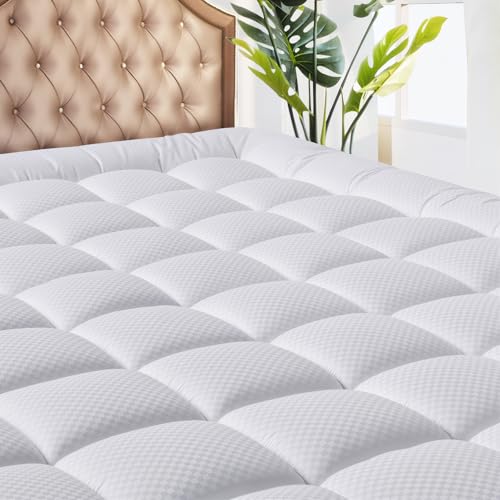
Badge: The surface fix, honestly priced in effort. MATBEBY’s quilted pad is the category’s baseline done right: a breathable, quilted fitted pad whose listing describes a cooling, breathable topper-protector hybrid that softens a surface slightly while letting air and moisture move. It will not change a bed’s firmness in any way a shoulder would notice, and that is precisely its virtue for the largest class of hot sleepers — those whose mattress is comfortable and merely warm at the interface, where a quilted layer of moving air is the entire prescription.
Facts from the verified listing title:
- Construction: quilted fitted mattress pad
- Traits in listing: cooling, breathable, pillow-top style softness
- Role: topper and protector in one
- Size referenced: queen
Strengths
- Breathable surface addresses the interface where heat is felt.
- Doubles as a protector, simplifying the bed’s layers.
- Washable, light, and effortless to rotate seasonally.
Trade-offs
- Negligible pressure relief — this is a surface, not a cushion.
- Cannot cool a mattress that is itself a heat source of consequence.
- Quilted loft compresses gradually with washing and use.
Best for: comfortable-but-warm mattresses and hot sleepers whose complaint is the surface. Not suited for: anyone needing softness, depth, or pressure relief.

Niagara Sleep Solution Pillow Top, Queen — Loft as a Cooling Strategy
Badge: Softness that breathes. Niagara’s pillow top adds a thick quilted layer of down-alternative fill under a rayon-from-bamboo cover story, per its listing, and its cooling claim rests on the oldest mechanism in bedding: loft full of air, over a cover fiber marketed for moisture comfort. It softens more than the MATBEBY — enough for a back or stomach sleeper to feel kindness — while insulating far less than any foam, which makes it the guide’s pick for the sleeper who needs softness and coolness and refuses to choose.
Facts from the verified listing title:
- Construction: quilted pillow top, down-alternative style fill
- Cover material in listing: rayon derived from bamboo
- Positioning in listing: ultra soft
- Size referenced: queen
Strengths
- Loft cools by airflow while genuinely softening the surface.
- No foam means no foam warmth and no foam smell.
- Suits back and stomach sleepers who fear sink.
Trade-offs
- Fill loses loft across seasons without fluffing and rotation.
- Pressure relief is gentler than foam’s for demanding shoulders.
- Thick quilting can shift if the fitted skirt is not secured well.
Best for: softness-seeking warm sleepers on sound mattresses. Not suited for: deep pressure-relief cases.

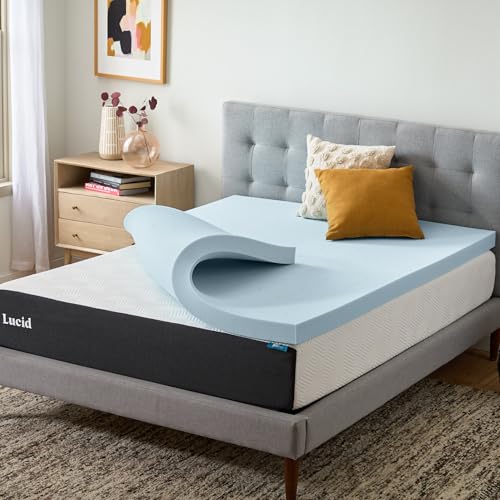
Lucid 4-Inch Cooling Gel Memory Foam Topper, Queen — When the Bed Also Needs Softening
Badge: The deep intervention. Four inches of gel memory foam is no longer a pad in any honest vocabulary; it is a change of mattress character, and Lucid’s version — plush, ventilated in its design language, gel-infused — is the pick for the hot sleeper whose problem is double: a bed too firm and too warm. The gel moderates the surface’s first hours and the depth relieves the shoulder; the physics tax is that foam, however gelled, insulates by the night’s deep hours, so this pick serves the firm-bed owner better than the merely warm one.
Facts from the verified listing title:
- Depth: 4 inches
- Material: cooling gel memory foam
- Feel stated by maker: plush, ultra sink-in
- Size referenced: queen
Strengths
- Maximum pressure relief in this guide.
- Gel and ventilation moderate foam’s warmth as well as foam can.
- Transforms a hard, sound mattress in one purchase.
Trade-offs
- Deep sink is wrong for stomach sleepers and soft beds.
- Foam insulation reasserts itself by the night’s middle.
- Demands deep-pocket sheets and a real expansion window.
Best for: side sleepers on firm mattresses who also run warm. Not suited for: surface-only heat complaints.

Sleep Innovations Cooling Comfort Dual Layer, Queen — Foam Below, Air Above
Badge: The engineer’s compromise. Sleep Innovations stacks its cooling gel memory foam beneath a quilted pillow-top layer, and the architecture is the argument: the foam does the pressure work while the quilted surface keeps the sleeper’s skin in contact with a breathable, bed-like layer rather than with foam itself. For the sleeper who needs real cushioning and has been burned by foam’s clammy first contact, this is the guide’s most thoughtful design at a mid-tier ambition.
Facts from the verified listing title:
- Depth: 4 inches, dual layer
- Construction: cooling gel memory foam plus quilted pillow top
- Size referenced: queen
Strengths
- Breathable quilted interface over genuinely cushioning foam.
- Deep pressure relief without foam’s direct skin contact.
- Balanced character suits side and combination sleepers.
Trade-offs
- Total height changes sheets and bed geometry.
- The foam core still insulates beneath the quilt.
- Heaviest pick to wash around, move, and store.
Best for: side sleepers who need cushion and hate foam’s feel on skin. Not suited for: minimalists or the hottest rooms.

TEMPUR-Adapt + Cooling 3-Inch Topper, Queen — the Premium Ceiling
Badge: For the sleeper who wants the real material. Tempur-Pedic’s topper pairs its dense, pressure-relieving TEMPUR foam with a cooling cover story and a washable cover in the listing’s description, at a premium tier the other picks do not approach. Its cooling is the cover’s and the surface’s; its glory is the foam itself, which relieves pressure with a richness budget foams imitate. It anchors this guide’s ceiling so a reader can see what the money buys: not refrigeration, but the category’s most serious foam under a cover designed to feel cool at first contact.
Facts from the verified listing title:
- Depth: 3 inches
- Material: TEMPUR premium foam
- Cover in listing: cooling, washable
- Feel described in listing: medium, luxury
- Size referenced: queen
Strengths
- Pressure relief of a depth and quality budget foams approximate.
- Cool-touch cover improves the crucial first-contact minutes.
- Washable cover and premium finish suit long service.
Trade-offs
- Premium tier — several times the quilted picks’ neighborhood.
- Dense foam still warms through across a full night.
- Heavy, slow-responding material is wrong for restless turners.
Best for: pressure-first shoppers who want premium foam with a cooler handshake. Not suited for: budget shoppers or heat-first cases in hot rooms.
Choosing Among the Three Families
The decision tree is shorter than the marketing implies. If the mattress is comfortable and the complaint is a warm, damp-feeling surface, buy a quilted pad — the MATBEBY for pure surface work, the Niagara if a little softness would also be welcome — and spend the rest of the budget on breathable sheets, which this wave’s sheet guides sort in detail. If the mattress is too firm and the sleeper is warm, buy the dual-layer Sleep Innovations, whose quilted interface was designed for exactly that double complaint, or the Lucid four-inch if the firmness is severe and the sleeper is a committed side sleeper. If pressure relief is the primary need and coolness the secondary hope, buy the TEMPUR-Adapt and accept its physics honestly. And if the room itself is the heat source — an uncooled attic, a top floor in August — no pick in this guide will rescue the night, and the money belongs first to the room: a fan, a window unit, blackout shades, in whichever order the household’s lease allows.
Setup for Maximum Cooling Effect
A cooling pad’s performance is half product and half installation, and the installation errors are always the same. Do not bury the pad under a waterproof protector of the plastic kind, which seals the surface the pad was bought to ventilate; if protection is needed, choose a breathable protector and accept the trade knowingly. Do not pair a cooling pad with flannel or microfiber sheets in summer and then indict the pad; the sheet is the skin’s actual neighbor, and this site’s cooling-sheet coverage — the best cooling sheets — is the natural companion read. Give foam toppers their full expansion and airing before the first night, because a compressed gel foam’s first evening is its warmest and least representative. Wash quilted pads before first use where the care label allows, which restores the loft the packaging flattened. And judge the result across a genuinely warm week rather than a single mild night, because cooling products, like cooling mattresses, are only honestly tested by the weather they were bought for. Readers whose heat problem lives in the pillow as much as the pad should continue with pillows for hot sleepers and cooling pillow protectors, and those whose whole bed needs rethinking can compare soft mattress toppers for the other direction and cheap toppers for the budget version of this brief.
Common Mistakes in the Cooling Aisle
The signature mistake is buying depth for a surface problem — four inches of gel foam to fix a warm interface — and discovering that the new problem, a changed bed, is larger than the old one. The second is stacking cooling products like cordwood: pad over protector over foam over flannel, each layer taxing the airflow the others promised. The third is judging in spring for a product bought for August. The fourth is expecting a passive pad to defeat a hot room, and returning three honest products in a row before cooling the room itself. The fifth is ignoring the duvet, which sits atop the whole system like a lid and can undo a well-chosen pad by itself; in genuinely warm months the correct duvet is often a sheet, and no pad purchase should be finalized until the bedding above it has been audited with the same skepticism as the pad below.
The Hot Sleeper’s Full System, in Order of Leverage
Because a pad is one layer in a system, the guide owes its reader the system’s full order of leverage, so money is spent where physics rewards it. First and largest is the room: every degree the bedroom drops is a degree the whole night inherits, and a fan’s moving air multiplies the effect by stripping the warm boundary layer from the skin. Second is the bedding’s fiber: breathable, moisture-moving sheets and a duvet weighted for the season rather than for the calendar photograph. Third is the pillow, whose small surface carries the head’s disproportionate share of perceived heat, and which this wave’s pillow coverage addresses directly. Fourth — not first — is the pad, tuning the interface between body and mattress. Fifth is the mattress itself, whose architecture sets the ceiling on everything above it, and whose replacement is the correct answer only when the first four have been honestly exhausted. Hot sleepers who shop in that order spend less and sleep cooler than hot sleepers who begin at the mattress store, and the pad’s place in the order is not a demotion but a clarification: it is the finishing instrument of a system, and finishing instruments are judged by how they complete the work, not by whether they can do it alone.
Materials Glossary for the Cooling Aisle
The aisle’s vocabulary repays a short glossary, because each term conceals a mechanism. “Bamboo” on a pad almost always means rayon derived from bamboo — a manufactured fiber with genuine moisture comfort, marketed under the plant’s name; it is a good fiber and a borrowed halo at once. “Gel” means a phase of gel material swirled or beaded into foam, moderating surface temperature by absorbing heat until it saturates. “Graphite” and “copper” name infusions whose thermal stories are real in a laboratory and modest in a bed. “Phase-change” names a treatment that absorbs and releases heat around a set temperature, effective at the surface for the early night. “Cool-touch” names a cover fabric — often a polyethylene knit — that feels cold on first contact because it conducts heat away from the hand quickly, a sensation that is real, brief, and genuinely pleasant at the moment of getting into bed, which is not nothing. A shopper armed with the glossary can read any listing in the category in ninety seconds and know which mechanisms are actually on offer, at what depth, which is the entire skill the aisle’s marketing exists to prevent.
Three Hot Sleepers, Three Correct Purchases
A lifelong warm sleeper in a mild climate, on a comfortable hybrid mattress, traced her complaint with unusual precision: the bed was fine at midnight and clammy by three, at the surface, in the small of the back. Her mechanism was moisture at the interface, and her purchase was the guide’s smallest — the quilted MATBEBY — paired with the cotton sheets she already owned and a duvet demoted to a coverlet. The fix was complete at pad scale, which is the outcome the diagnostic exists to produce: the least intervention that answers the actual mechanism.
A side sleeper in a hot apartment, on a firm foam mattress bought for his back, carried two complaints that had to be served in the right order: the shoulder first, because it woke him more often, and the heat second, because it woke him longer. He bought the Sleep Innovations dual layer for its quilted interface over real cushioning, cooled the room with a window unit the same month, and reported the two purchases as one system — which is how the guide intends them to be understood, since neither would have sufficed alone.
A couple divided by temperature — she cold at any setting he finds bearable — solved their decade-long negotiation with the category’s most underused maneuver: asymmetry. A cooling pad on his half, under a shared sheet, with the duvet folded to her side, gave each body its own climate in one bed, at pad prices. Their case generalizes beyond this guide: the surface layer is the one part of a bed that can be personalized per sleeper without splitting the mattress, and couples should exploit that before they escalate to split kings and separate rooms.
Care, Washing, and the Breathability Dividend
Cooling products have a maintenance secret that owners discover late: they cool better clean. Quilted pads accumulate the skin cells, oils, and detergent residues that clog a fabric’s pores and throttle its airflow, so a pad that breathed beautifully in June can be a warmer object by December without looking dirty at all. The routine that preserves the investment is plain — wash quilted pads on the maker’s schedule with thorough drying, which also restores loft; air foam toppers when the bedding is stripped; wash or replace covers on the premium picks as their labels allow; and keep the protector, where one is used, in the breathable family rather than the sealed one. Households that build the pad’s washing into the sheet routine, rather than treating it as an annual event, report the product performing in its second summer the way it performed in its first, which is the entire difference between a cooling pad and a warm quilt with a promising name.
Climate, Season, and the Geography of Heat
Cooling advice that ignores geography is marketing, and this guide’s recommendations bend with the map. In humid climates, moisture is the dominant mechanism and airflow is the cure: quilted pads, breathable sheets, and moving air outperform every gel chemistry, because gel cannot absorb humidity. In dry-hot climates, evaporation works with the sleeper and even modest surfaces feel cooler; the quilted family still leads, but gel foam’s first-hours moderation earns more of its keep. In temperate climates with hot spells, the seasonal strategy rules — a pad deployed for the warm quarter and stored for the rest — and washability matters more than mechanism. In cold climates with overheated winter bedrooms, the problem is often the heating system rather than the season, and the pad is a year-round interface fix against radiators and forced air. A reader who locates their climate first will find the guide’s tree collapses to one or two branches, which is as it should be: the best cooling pad is a local answer wearing a national title.
The Evidence Basis of This Guide
These picks rest on catalog verification and on the physics of their materials, not on a testing laboratory, and the distinction is maintained deliberately throughout. Every product was confirmed in Amazon’s catalog through the retailer’s own interface on 23 November 2026, and spec boxes quote listing facts only. Claims about how long gel moderates, how loft breathes, and how moisture governs perceived temperature are the settled behavior of those material families, stated as reasoning rather than as measurement. No prices, ratings, or review counts appear, because they move. The remaining variable — how a given pad behaves on a given mattress under a given sleeper in a given climate — is knowable only by trial, and the guide’s setup advice exists to make that trial a clean experiment rather than a layered guess.
When the Pad Is Not Enough: an Honest Escalation Ladder
A responsible guide ends its product advice with the ladder beyond its products. Rung one is the room — shade, ventilation, a fan, cooling where the lease allows. Rung two is the bedding system — sheets, duvet weight, pillow — audited as a system rather than as separate purchases. Rung three is this guide: the pad or topper matched to the mechanism. Rung four is the mattress itself, where a heat-trapping foam bed in a hot climate may simply be the wrong architecture, and this site’s mattress coverage — read with the same mechanism-first skepticism — sorts the alternatives. Rung five is active cooling, the appliance class that pumps heat away electrically, priced like furniture and effective like machinery. And beside the ladder stands a door rather than a rung: persistent night sweats, new snoring with witnessed pauses, or heat intolerance that arrives with other symptoms are medical matters, and no product on any rung substitutes for a clinician’s assessment. The ladder’s purpose is proportionality — most hot sleepers are rescued on rungs one through three, at a small fraction of rung five’s cost, provided they climb in order.
The History of Sleeping Cool, Briefly
The cooling pad has ancestors worth a paragraph, because they explain its design. Pre-electric households slept cool with materials chosen by climate over centuries — linen in Europe, cotton in the American South, woven plant fibers across Asia — all of them breathable, moisture-moving surfaces, which is to say the quilted pad’s mechanism is the oldest one in bedding and the foam era is the interruption. The twentieth century’s synthetic foams traded that breathability for pressure relief and durability, and the modern cooling aisle is best understood as the foam industry negotiating its way back toward the surface virtues it abandoned: gel for conduction, quilting for air, phase-change treatments for the first-contact chill that a linen sheet once provided by nature. None of this nostalgia should steer a purchase — the modern picks outperform their ancestors on every axis except poetry — but it should calibrate expectations: the goal is not a refrigerated bed, a thing no ancestor imagined, but a surface that manages heat and moisture the way good bedding always has, now with better materials at the points where the old ones wore out.
Reading Cooling Claims Like an Editor
Three editorial habits will protect a shopper in this aisle more reliably than any single review. First, demand the mechanism: a listing that says “cooling” without saying how — airflow, gel, phase-change, cool-touch fiber — is selling an adjective, and adjectives do not lower temperatures. Second, locate the claim in time: first-contact coolness, first-hours moderation, and all-night airflow are three different products wearing one word, and the listing’s photographs and construction will confess which one is actually on offer if they are read closely. Third, check the claim against the stack: a cooling pad’s mechanism can be vetoed by the protector above it, the sheet above that, and the duvet above all, so the honest listing is the one whose promises survive contact with the buyer’s actual bedding. The five picks in this guide were chosen partly for the legibility of their claims — each one’s mechanism can be named in a phrase and matched to a diagnosis — and a shopper who applies the three habits to the wider aisle will find most listings fail the first test, which is the fastest useful information in the category.
Children, Guests, and Other People’s Beds
Cooling pads earn a disproportionate share of their keep on beds the buyer does not sleep in, and the guide should say so plainly. Children’s rooms run warm in summer and children are poor reporters of their own thermal discomfort, so a breathable quilted pad on a child’s bed — the category’s cheapest, most washable tier — is a high-value, low-regret deployment, with the washability doing double duty in that household department. Guest rooms in warm climates benefit the same way: a guest who sleeps hot in a strange bed says nothing and remembers everything, and a quilted cooling pad under good sheets is hospitality that costs less than the towels. Vacation rentals and second homes, where the bedding must forgive a range of strangers’ thermostats, are the pad’s natural habitat for the same reason. In each case the logic is identical — the surface layer is the cheapest place to personalize a bed for bodies whose preferences the buyer cannot fully know — and it is the strongest argument for owning the category at all, beyond the buyer’s own nightly comfort.
The Seasonal Rotation, Revisited for Heat
Earlier guides in this wave treated the topper as a seasonal instrument for firmness; the cooling pad makes the same argument with the calendar reversed and the stakes clearer. A household in a four-season climate does not need one perfect surface but two honest ones — the warm-weather assembly of quilted pad, breathable sheets, and light cover, and the cold-weather assembly that may add foam depth and a heavier duvet — and the swap between them, performed on the same weekend as the wardrobe’s, is a small ritual with an outsized effect on the year’s sleep. The cooling pad is the cheapest component of the summer assembly and the one most often missing, because households buy bedding in the season they are cold and forget the purchase by the season they are hot. Buy it in spring, wash it before the first warm night, store it loosely when the foam comes out in autumn, and the pad will serve for years of summers — which is the correct unit in which to price it: not per night, but per season of rescued sleep.
A Short Word on Partners, Pets, and Other Heat Sources
Some heat problems arrive with names and heartbeats. A partner is a seventy-watt radiator with opinions; a dog at the foot of the bed is a smaller one with tenure. The pad’s contribution in such households is real but bounded — it manages the interface, not the occupancy — and the guide’s honest counsel is architectural: the largest bed the room allows, surface layers personalized per side where the couple’s climates differ, and a household negotiation about the thermostat conducted in daylight rather than at two in the morning. Pets, for their part, vote with their bodies and will migrate to whichever surface the household’s purchases make coolest, which owners report as either a feature or a theft depending on the pet. None of this is a reason to skip the pad; it is a reason to buy it as one instrument in a household system whose other instruments are square footage, airflow, and diplomacy.
The Midnight Summary for Hot Sleepers
Compressed for the reader shopping at the hour this problem is most vivid: if the bed feels fine but the surface feels warm and damp, buy the quilted MATBEBY and breathable sheets, and stop. If the bed needs a little kindness as well as air, buy the Niagara. If the bed is too firm and its owner sleeps on a side in a warm room, buy the Sleep Innovations dual layer, whose quilt sits between the sleeper and the foam for a reason. If the bed is a plank and depth is the real prescription, buy the Lucid four-inch and accept foam’s physics with open eyes. If pressure relief outranks heat and the budget is generous, buy the TEMPUR-Adapt and enjoy the category’s finest foam under a cool-touch cover. And whatever is bought, cool the room first, lighten the duvet tonight, and judge the purchase across a warm week — because the pad is the third rung of the ladder, and ladders are climbed from the ground.
Envoi: Modesty as a Feature
There is a temptation, in a guide of this length, to end by inflating its subject, and this one will resist it in closing as it did in opening. A cooling mattress pad is a thin, washable, inexpensive layer that manages the temperature and moisture of the few millimeters of bed a body actually touches. It will not transform a mattress, overpower a climate, or substitute for a fan in a heat wave, and any seller who promises otherwise is selling the season rather than the product. What it will do — bought by mechanism, installed with its bedding audited, washed on schedule, and judged across honest weather — is remove the specific, nightly, low-grade thermal friction that sends sleepers to mattress stores with a surface problem and a whole-bed budget. That removal, repeated across a summer, is worth many times the pad’s price, and it is why this modest object earns a long guide: not because it is grand, but because it is precise, and precision is the rarest virtue in the bedding aisle.
One More Consideration: the Pad and the Protector, Reconciled
Households with children, pets, illness, or expensive mattresses often arrive at this guide owning a protector and wondering whether the pad replaces it, doubles it, or fights it. The reconciled answer: the protector’s job is liquid defense and the pad’s job is thermal comfort, and the two coexist happily provided the order and the materials are right — pad above protector when the pad is the sleeper’s interface, each chosen in breathable form, and the waterproof layer, where one is truly needed, accepted as a thermal tax paid knowingly for insurance. Several picks blur the line helpfully: the MATBEBY is sold as a pad-protector hybrid, which suits households whose protection needs are modest and whose heat needs are primary. What the stack cannot survive is accumulation without intention — layer upon layer added by separate purchases across years until the bed’s surface is an archaeological site. Audit the stack annually, keep each layer’s job singular, and the bed will breathe the way its newest component promises.
And for the reader still weighing at the end of a long page, the deciding question is not which of the five is best in the abstract but which mechanism their own nights are missing. Put a hand flat on the bed at the hour the discomfort usually peaks, on an ordinary warm night, and read the evidence like an instrument: heat stored in the mattress argues for the surface families and a room intervention; dryness with pressure argues for depth; dampness argues for airflow and wicking above all. The bed has been reporting its diagnosis all along, in the only language it has. This guide’s whole method — mechanism before product, system before layer, season before verdict — is a translation of that report, and a reader who has followed it this far already owns the skill the aisle hopes shoppers never learn: buying the physics, not the adjective.
A Closing Note on This Guide’s Shelf Life
Cooling products churn quickly — covers are reformulated, infusions are renamed, a season’s flagship becomes next season’s clearance — and this guide’s product facts rest on the listings verified on the date in its sources, with the live listing governing any detail on the day of purchase. Its reasoning is built from slower material: heat leaves a body by conduction, airflow, and evaporation; foam insulates and quilts breathe; gel moderates for hours rather than nights; and no passive layer defeats a hot room. A reader who finds a pick here superseded has lost a link and kept a method, and the method will identify the successor product on any future shelf by the same three questions — which mechanism, at what depth, for how many hours — that organized this page. Guides to fast categories should be honest about which of their contents is perishable, and this one is: the products are dated, the physics is not.
The Last Practical Checklist
Five checks before ordering, in the order they prevent returns. Name the mechanism your nights are missing — conduction, airflow, or moisture — and refuse any product whose mechanism cannot be stated. Audit the stack above the mattress: protector, sheet, and duvet, replacing the worst thermal offender in the same order if the budget allows, because the pad cannot outvote its neighbors. Measure the mattress and match the pad’s size exactly, since a shifting pad bunches into warm ridges that defeat its purpose. Plan the first wash or airing before the first night, so the product is judged at its best rather than its flattest. And mark the verdict date a warm week out, because a cooling product assessed on a cool night has not been assessed at all. Run those five and the purchase that follows will be the rare bedding decision that survives its first August without revision.
One honest paragraph remains for the sleeper whose heat is worst in the first hour — the stored warmth of a sunlit room, a mattress that absorbed the day. For that reader the highest-leverage act costs nothing: turn the bedding down early, let the room’s evening air reach the surface, and give any cool-touch cover a cool room to work with, because a phase-change or polyethylene surface can only feel as cool as the air that recharges it. Pair that habit with the quilted family’s airflow and the first hour — the hour that decides whether sleep comes easily — improves out of proportion to the effort. It is a fitting final note for a guide about a modest product: the largest gains in this category have always come from the combination of a small, well-chosen layer and the small, well-timed habits around it.
Finally, a word to the reader who has absorbed the whole method and still faces the five picks with a credit card and a doubt: the doubt is information, and it usually means the mechanism has not yet been named. Go back to the warm bed at the bad hour, run the hand test described above, and let the surface itself cast the deciding vote between airflow and depth. If the hand comes away damp, the quilted family wins and the choice between the MATBEBY and the Niagara is a question of how much softness the back can spare. If the hand comes away merely warm over a bed that also hurts a shoulder, the dual layer was designed for that exact report. Purchases made from the body’s own evidence, at this tier, are almost never returned — and the near-certainty available here, cheaply, is the real product this guide has been selling all along.
There is one household member this guide has not addressed, and the omission ends here: the person who makes the bed. Cooling pads are lighter, washable, and easier to fit than the foam toppers they are confused with, and in households where one partner handles the laundry, that difference is a recurring kindness rather than a specification. The quilted picks strip off in seconds, wash with the sheets’ heavier cousins, and return to the bed the same day; the foam picks, by contrast, are events. A purchase that respects the labor around the bed as well as the body in it will be maintained better, washed oftener, and therefore — by the breathability dividend this guide described — will cool better in its second year than a neglected superior product. Choose, in part, for the hands that will care for the thing.
And so the guide closes where it opened, with the modesty of the object as the guide’s thesis. The sleepers who benefit most from a cooling pad are not those who buy the most aggressive chemistry but those who match a named mechanism to a named discomfort and then maintain the result like the textile it is. Five verified products, three mechanisms, one ladder of escalation, and a hand pressed to a warm bed at the bad hour — that is the whole of the method, and it will survive every reformulation the aisle invents next season. Buy the physics, keep it clean, and sleep in the climate your own house can actually provide.
A truly final observation, offered to the household that has read this far and is now, correctly, suspicious of all long guides to small products: the length is the point. A cooling pad is cheap enough to buy carelessly and consequential enough to punish carelessness nightly for years, and the distance between those two facts is exactly what seven thousand words of mechanism, method, and maintenance are for. The product costs little; the nights are the reader’s own, and they are not refundable. Choose slowly, wash regularly, judge in August.
Postscript for the methodical: keep the receipt and the verdict date together, and when the warm week has passed, write the outcome — cooler, unchanged, returned — wherever the household keeps its hard-won product knowledge. A family that records its bedding experiments accumulates, across years, a private evidence base worth more than any guide, including this one, because it is calibrated to the only variables that finally matter: their rooms, their mattress, their bodies. This page’s ambition is to be the first entry in that record, not the last word in it.
And if the warm week delivers the verdict every guide hopes for — a bed that simply stops being a topic — the pad has done the finest work a household product can do: it has disappeared into the background of a life, noticed only on the laundry days when it briefly leaves the bed and the sleeper remembers, with mild surprise, that summer nights used to be a problem.
Sleep cool, then — not by miracle or by machinery, but by a breathable layer, a lighter duvet, a room given its evening air, and a household that has learned to ask of every bedding claim the only question that matters: by what mechanism, and for how long into the night?
Final Recommendation
Start at the surface and climb only as far as the diagnosis demands. The MATBEBY quilted pad for the comfortable-but-warm bed; the Niagara pillow top where softness must breathe; the Sleep Innovations dual layer where firmness and heat arrive together; the Lucid four-inch where a hard bed needs transformation and its owner sleeps on a side; the TEMPUR-Adapt where pressure relief outranks everything and the budget allows the category’s best foam. Cool the room, breathe through the sheets, lighten the duvet — and let the pad do the honest two-and-a-half mechanisms’ worth of work it was built for, no more promised and no less delivered.
Frequently Asked Questions
Do cooling mattress pads actually work?
Within limits, yes. Quilted pads improve surface airflow and moisture handling all night; gel foams moderate surface temperature for the first part of the night. No passive pad can cool a bed below the room’s temperature, so in a hot room the pad is a mitigation, not a solution.
What is the difference between a cooling pad and a cooling topper?
Depth and intent. A pad is a thin quilted layer that changes the surface’s feel and breathability without changing the bed’s support. A topper is inches of material that changes firmness and pressure relief as well, with cooling as one feature among several. Buy the pad for surface problems, the topper for firmness problems.
Which pick is best for night sweats?
Moisture management matters most: a breathable quilted pad such as the MATBEBY or the Niagara, paired with moisture-wicking sheets and a light duvet. This is a comfort recommendation, not a medical one — night sweats with other symptoms deserve a clinician’s attention.
Will a gel foam topper keep me cool all night?
Gel foam absorbs and disperses heat for the first portion of the night, then warms through like any foam. It moderates rather than eliminates warmth, which is why this guide pairs gel picks with quilted interfaces and bedding advice rather than presenting gel as a cure.
Can I use a cooling pad on a memory foam mattress?
Yes, and it is one of the commonest good uses: a breathable quilted pad over a foam mattress improves the surface’s airflow and moisture behavior without disturbing the support beneath. Choose the quilted family rather than adding more foam depth.
How do I wash a cooling mattress pad?
Follow the specific product’s care label. Quilted pads are generally machine washable on gentle cycles and benefit from full drying to restore loft; foam toppers are not machine washable and rely on their covers and protectors. Washing restores breathability as well as cleanliness, since clogged quilting breathes poorly.