Disclosure: As an Amazon Associate, dailyhomedecorating.com earns from qualifying purchases. Links on this page are affiliate links; they cost you nothing extra. Prices and availability change often, so check the current Amazon listing before you buy.
So, what is a hepa filter, really, beyond the four letters printed on a growing share of household appliances? A HEPA filter is a dense mat of extremely fine fibres, pleated into a compact block, that removes very small airborne particles from the air pushed through it with exceptionally high efficiency. The name stands for high-efficiency particulate air, and behind it sits a defined performance idea rather than a brand: media tested to capture at least 99.95 or 99.97 percent of particles at the hardest size to catch, depending on which standard family the claim follows. This guide explains how such a filter works at the level of individual particles, how the grades and labels differ, what it captures and what it cannot, how long one lasts, and how to choose and care for the appliances built around it. If you read one explainer before buying anything with a HEPA badge, this is the one we would choose.
Key Takeaways
- A HEPA filter is a pleated mat of fine fibres that traps airborne particles through several physical mechanisms working together, not a sieve with tiny holes.
- Its defining test is performance at the most penetrating particle size, the awkward middle range where capture is hardest; strong performance there implies strong performance almost everywhere else.
- The main grading families are the European EN 1822 classes, H13 and H14, and the North American benchmark commonly quoted as 99.97 percent at 0.3 microns and marketed as “true HEPA.”
- HEPA filters capture particles: dust, pollen, pet dander, mould spores, and fine smoke particles. They do not capture gases or odours; that is activated carbon’s job.
- A filter is only as good as its appliance: sealing, airflow matched to the room, and on-time replacement decide what your room actually gets.
In this guide
The Short Answer, Then the Real One
The short answer is the one above: a HEPA filter is a high-efficiency particle filter, pleated fine-fibre media in a frame, used in air purifiers, some vacuum cleaners, and ventilation equipment to strip fine particles from air. The real answer is more interesting, because the obvious mental picture is wrong. Most people imagine a very fine sieve, a mesh whose holes are smaller than the particles, so the particles cannot pass. If HEPA media worked that way it would clog almost immediately and demand impossible fan power. Instead, the fibre mat is a deep, tangled forest that air threads through, and particles are captured by colliding with fibres along the way. The gaps between fibres are actually larger than many of the particles captured. The filter works not by blocking the door but by making the journey so hazardous that almost nothing completes it.
That forest is usually made of very fine glass fibres formed into a paper-like sheet, though synthetic fibre media also exists. The sheet is pleated, folded into tight zigzags, so that a large area of media fits a small frame. Area matters: the more media the air can spread across, the more slowly it moves through any given patch, and slower passage means more chances for particles to meet a fibre. The pleated pack is bonded into a rigid frame with a gasket or seal, and that unglamorous detail, the seal, will return throughout this guide, because air that bypasses the media has not been filtered at all, whatever the media could have done.
How a HEPA Filter Captures Particles: Four Mechanisms
Filtration science describes several capture mechanisms, and a HEPA filter uses all of them at once, each dominating at a different particle size.
Inertial impaction handles the larger end. A relatively heavy particle travelling in an airstream has momentum; when the air bends sharply around a fibre, the particle’s inertia carries it straight on, into the fibre, where it sticks. Think of it as failing to make the turn. This is why capture of coarse and medium dust is so effective.
Interception covers the middle. A particle that follows the airflow faithfully can still pass so close to a fibre that it brushes the surface and is held by the same weak forces that make dust cling to shelves. No collision course is needed; proximity is enough.
Diffusion rescues the smallest sizes. Very tiny particles are buffeted constantly by air molecules, a jitter called Brownian motion, so their path through the filter is a random walk rather than a streamline. That wandering hugely increases the chance of touching a fibre. Counter-intuitively, the very smallest particles are therefore captured very efficiently, more efficiently than the middle sizes.
Electrostatic attraction plays a supporting role in some media. Certain synthetic fibres carry a charge that draws particles in, boosting capture without adding air resistance. Media relying partly on charge can lose some of that boost as the charge fades in service, one reason mechanical glass-fibre media, which needs no charge, has remained the reference construction.
Put the mechanisms together and a pattern emerges: big particles are caught easily, tiny particles are caught easily, and in between sits a size where particles are too small for strong inertia and too large for strong diffusion. That valley is the most penetrating particle size, often shortened to MPPS, and it is why serious filter standards test there. A filter proven at its worst point is proven, conservatively, for the rest of the range. When a cheap filter advertises a percentage without naming a test size or standard, it may have been measured at a flattering size where any media looks heroic.
The Grades: H13, H14, and “True HEPA”
HEPA is a family name, and the specific grades matter when you shop. In Europe, the standard EN 1822 classifies high-efficiency filters, with H13 and H14 as its HEPA classes: H13 requires at least 99.95 percent efficiency at the most penetrating particle size, and H14 at least 99.995 percent at the same unforgiving size. Below them sit the E10 to E12 classes, efficient but short of HEPA thresholds, and above H14 the ULPA classes used in cleanrooms rather than homes. Our dedicated explainer goes deeper on the class most shoppers meet first: Hepa H13 explained in full.
In North America, the benchmark traditionally quoted is 99.97 percent capture at 0.3 microns, a figure from United States government specifications, and retail language renders it as “true HEPA.” Since 0.3 microns lies near the penetrating valley for typical media, the two traditions are close cousins: slightly different tests describing media of genuinely similar seriousness. The phrases to distrust are the unattached ones: “HEPA-type,” “HEPA-style,” “HEPA-like,” and bare percentages with no standard named. Those describe filters that may be decent but have not earned a class, and they should be priced and judged as ordinary particle filters.
One more subtlety separates careful shoppers from disappointed ones. A grade certifies filter media under test conditions. Some products apply the label to the whole appliance loosely, although the machine’s housing leaks; others test or design the complete unit so that what leaves it has truly passed through certified media. When a manual distinguishes media testing from whole-unit performance, that precision is a good sign about the manufacturer, and it is worth rewarding with your money.
What a HEPA Filter Captures, and What It Does Not
The capture list is the familiar cast of indoor particles: household dust and the fine fraction of it, pollen grains and their fragments, pet dander, mould spores, dust mite debris, textile fibres, and the fine particulate component of smoke from cooking, candles, fireplaces, and wildfires. These are exactly the particles that hang in indoor air for long periods and that people buy purifiers to reduce, which is why HEPA filtration became the default answer to “how do I clean the air in this room.” For the numbers that describe those particle loads and how to read them, see indoor air quality statistics explained.
The does-not-capture list is equally important. Gases and vapours, including cooking odours, paint and solvent fumes, fragrance compounds, and other volatile organic chemicals, pass through fibre media essentially untouched, because a gas molecule is orders of magnitude smaller than the particles the filter hunts and does not collide its way into capture. Removing gases is a different technology, adsorption onto activated carbon, and its effectiveness scales with how much carbon is present. A HEPA filter also does not humidify, dehumidify, heat, cool, or add anything to the air. And while HEPA media captures particles across the size ranges that include many airborne droplets and particle-bound microbes, a filter is not a steriliser and no purifier should be bought as a promise of preventing illness; readers who want that discussion handled carefully can find it here: do HEPA filters remove viruses. Buy a HEPA filter for particles, pair it with carbon for odours and with ventilation for freshness, and each tool does the job it is actually built for.
Where HEPA Filters Live: Purifiers, Vacuums, and Ventilation
The standalone air purifier is the HEPA filter’s most visible home: a fan, a filter stack, and a box designed to cycle a room’s air through the media repeatedly. Vacuum cleaners are the second home, where a HEPA-class exhaust filter stops the fine dust the machine has just collected from being blown back across the room, a benefit that only materialises if the vacuum’s body is sealed well enough that exhaust air truly passes through the filter. The third home is building ventilation, where high-efficiency filters protect equipment and supply cleaner air to whole zones, though central systems often compromise on grade because duct fans cannot push against the resistance of the densest media across a whole building. In each setting the same physics applies, and so does the same caveat: media grade, sealing, and airflow form a three-legged stool, and sawing any leg short tips the whole thing.
Two Appliances That Show What the Filter Does
Abstract physics becomes concrete in products, so here are two verified examples of how manufacturers build around HEPA media, chosen because their listings state their filtration plainly. Neither is presented as the only right answer; they are illustrations of the principles above, at two sizes.

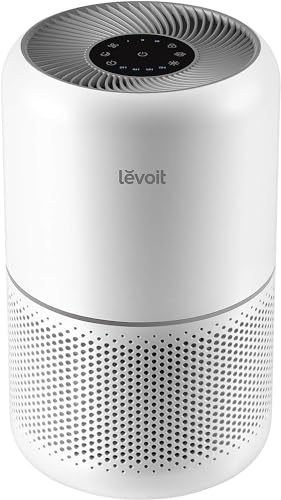
Levoit Core 300-P: The Compact Illustration
Badge: Small-room purifier built around a 3-in-1 HEPA filter cartridge.
Mini spec box (from the manufacturer’s Amazon listing): 3-in-1 filter with HEPA stage and activated carbon; AHAM Verifide; listed coverage up to 1,073 sq ft; quiet HEPA sleep mode; white finish.
The Core 300-P shows the standard domestic arrangement: one cylindrical cartridge combining a pre-filter layer for hair and lint, the HEPA media for fine particles, and a carbon layer for odours, wrapped around a central fan path. Its AHAM Verifide status is worth noticing in an explainer, because that scheme independently tests and publishes clean air delivery rates, giving the shopper a number that blends this guide’s two heroes, efficiency and airflow, into one comparable figure. In a bedroom it demonstrates the stool’s three legs at domestic scale: certified-style media, a cartridge that seats as a single sealed unit, and airflow honestly matched to modest rooms.
Strengths
- A clear, conventional filter stack that matches the textbook arrangement described above.
- Independently verified delivery-rate claims through the AHAM scheme.
- Replacement cartridges are genuine, common, and simple to fit.
Trade-offs
- Sized for small to medium rooms; the physics of airflow cannot be argued into a large space.
- The combined cartridge means the carbon and HEPA stages are replaced together.
- No sensor-driven automatic mode in this configuration.
Best for: bedrooms and first-time buyers learning the category. Not suited for: large open rooms or buyers wanting automation.

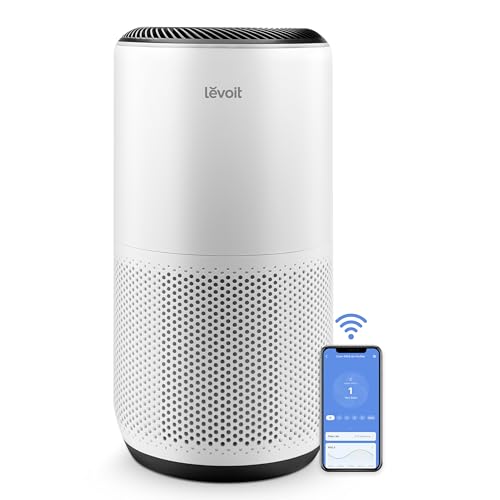
Winix 5510: The Larger Illustration
Badge: Big-room purifier pairing true HEPA media with a substantial carbon stage.
Mini spec box (from the manufacturer’s Amazon listing): True HEPA filtration; high-deodorisation carbon filter; listed coverage up to 1,881 sq ft in one hour; auto mode; app support; successor generation to the 5500-2.
The Winix illustrates the same filter at the other end of the size scale, and it makes one point beautifully: scaling HEPA filtration is mostly an airflow and filter-area exercise. A larger box carries more pleated media, so air passes more slowly through each square of it, resistance stays manageable, and the fan can deliver the repeated air changes a big room demands without excessive noise. Its listing also separates the jobs exactly as this guide does, true HEPA for particles and a distinct carbon filter for deodorisation, which is the honest architecture. We compared it directly with a sensor-led rival in PuroAir HEPA 14 240 review, where the sizing argument is worked through in detail.
Strengths
- Filter area and airflow scaled for genuinely large rooms.
- Particle and gas stages presented as the separate tools they are.
- Auto mode and app support for owners who want the machine managed.
Trade-offs
- Footprint and running costs match its size; small rooms do not need it.
- More features means more to configure than a basic compact.
- Its carbon stage still softens rather than abolishes strong odour sources.
Best for: large living spaces and households that want automation. Not suited for: small bedrooms or minimal budgets.
How Long a HEPA Filter Lasts, and How to Care for One
A HEPA filter is a consumable with a finite capacity: every particle it captures stays in the media, and as the fibre forest fills, air resistance climbs and the appliance moves less air. Manufacturers state a replacement interval for each model, typically in the span of several months to about a year of normal use, and the honest interval for your home depends on your particle load: a smoky season, a shedding dog, or a renovation next door will spend a filter faster than a quiet flat will. The symptoms of a spent filter are falling airflow, a purifier that seems to work less well on the same setting, and odours returning faster because the companion carbon stage is usually exhausted on the same schedule.
Care is mostly a list of things not to do. Do not wash the HEPA media unless the manufacturer explicitly designates that exact filter washable; water collapses the fibre structure’s effectiveness even when the filter emerges looking cleaner. Do not run the appliance with the filter still in its shipping bag, the classic unboxing error. Do vacuum or wash the separate pre-filter if one is fitted and the manual permits it, because keeping the coarse layer clear protects the expensive media behind it. Handle cartridges by their frames, store spares dry and sealed, and when a filter comes out for good, bag it before binning it and wash your hands, since it holds a concentrated sample of your home’s dust. Replacement day is also audit day: check the gasket and seating as the new cartridge goes in, because the seal you disturb is the seal this guide keeps warning about.
How to Choose: A Buyer’s Translation of the Physics
Everything above compresses into a short shopping method. First, size the appliance to the room using delivery rate and air changes per hour, not headline room claims; a HEPA filter in an undersized box is a great filter doing little cleaning. Second, verify the grade language: a named standard, EN 1822 with H13 or H14, an ISO equivalent, or the established North American benchmark, and be politely deaf to “HEPA-type” phrasing. Third, look for sealing evidence: gaskets, a cartridge that compresses into place, a manual that talks about bypass as if it matters. Fourth, price the genuine replacement filter and its interval before buying the machine, and treat that annual figure as part of the product. Fifth, match the extras to your actual problems: carbon quantity if odours matter, a sleep mode and low-speed noise figures if the machine is for a bedroom, a sensor and auto mode if you know you will not manage speeds by hand. Readers deciding between purification and moisture appliances should also settle that fork first: air purifier vs humidifier.
Common Myths About HEPA Filters
“It is just a fine sieve.” The gaps between fibres exceed many captured particles; capture happens by impaction, interception, and diffusion along a deep fibre path, which is why the media resists clogging far longer than a sieve would.
“A higher percentage always means cleaner air.” Percentages from different test systems are not directly comparable, and whole-room results depend on airflow and sealing. A verified delivery rate tells you more than a fourth decimal place.
“HEPA removes smells and chemicals.” Fibre media captures particles. Gases need activated carbon, and strong sources need removing, not filtering around.
“Washing extends its life.” For most HEPA media, washing damages the structure that does the work. The washable part of the stack, when one exists, is the pre-filter.
“Once fitted, it works forever.” Loading is the filter succeeding, particle by particle, and success fills it. Replacement on schedule is the technology working as designed, not a defect.
“Any box with a HEPA filter is a HEPA purifier.” Air that leaks around the media is unfiltered. The appliance earns the name, not the cartridge alone.
A Short History: From Wartime Laboratories to the Bedroom
HEPA filtration was not invented for allergy season. Its origins lie in the 1940s, in the demanding filtration problems of wartime research, where scientists needed to strip microscopic radioactive particles from air in laboratories working on atomic programmes. The filters developed for that work, built from fine fibres and tested against exacting standards, proved so effective that the technology moved outward after the war: into hospitals and pharmaceutical plants, into electronics cleanrooms where a single dust grain can ruin a component, into aerospace and nuclear facilities, and eventually, as manufacturing cheapened, into the domestic appliances this guide is about. The United States military and atomic energy specifications of that era are the ancestors of the 99.97 percent at 0.3 microns benchmark still quoted today, and the European EN 1822 system later organised the same territory into the class ladder of E, H, and U grades.
The history explains two things shoppers notice. The first is why the standards are so stern about the hardest particle size: the original applications could not tolerate a flattering test. The second is why the technology feels over-engineered for a living room. It is. A HEPA filter brings cleanroom-grade particle capture to a space whose main enemies are dust, pollen, and the neighbour’s wood smoke, and that over-engineering is precisely the value: the margin between what the media can do and what a home asks of it is where reliability lives.
HEPA Alongside Other Air-Cleaning Technologies
Purifier marketing bundles several technologies, and an explainer owes you the separation. Activated carbon, already covered, adsorbs gases and odours and complements HEPA without competing with it. Ionisers charge particles so they deposit on surfaces or collector plates; they can reduce airborne counts, but the particles land somewhere in the room rather than being removed, and some designs generate ozone, which is itself an irritant gas, so this guide treats ionisation as a technology to scrutinise rather than a headline feature. Ultraviolet lamps are used in some appliances with claims about microbes; their effect depends on exposure time and intensity that fast-moving room air rarely provides generously, and they do nothing for dust or pollen. Photocatalytic and plasma variants carry similarly claim-heavy marketing. The calm position is this: for particles, the problem this guide is about, mechanical HEPA filtration is the established, measurable answer, and everything else in the box should be judged as an accessory with its own evidence, never as a substitute and never as a reason to accept weaker filtration.
How to Tell Whether Your HEPA Filter Is Doing Its Job
Owners reasonably ask for evidence, and while a home cannot reproduce a laboratory, it can produce convincing signs. The tissue test is the crudest: hold a light tissue near the outlet of a running purifier and watch it stream, confirming airflow, though it says nothing about cleanliness. Better evidence comes from a particle monitor, the subject of our statistics guide, which lets you run the simplest experiment in this field: log a room’s particle trend with the purifier off, then on, across comparable hours, and watch the line fall and hold lower. The dust audit is slower but persuasive: surfaces in a filtered bedroom accumulate visible dust more slowly over weeks than identical surfaces elsewhere. And the filter itself testifies at replacement time: a cartridge darkened evenly across its pleats has been working, while one clean in patches beside filthy streaks hints at the bypass problem this guide keeps returning to. None of these is a certification. Together they are the difference between owning a filter and believing in one.
HEPA Filters in Everyday Scenarios
Consider the filter at work across an ordinary week. On a spring morning it is stripping pollen that drifted in through a bathroom window, which is why the bedroom it guards feels different from the hallway by breakfast. During a frying session it is downstream of the extractor, catching the fine fraction of cooking aerosol that the hob’s ventilation missed, and its companion carbon layer is softening the smell that would otherwise move into the soft furnishings. When the dog shakes after a walk, the visible hair heads for the floor and the vacuum, while the invisible dander fraction joins the room’s air and, over the following hour, the filter. During a smoky evening with the windows shut against a bonfire or a wildfire haze, it becomes the room’s only particle defence, and its owner’s earlier decision, to size the purifier generously and keep a spare cartridge, quietly pays off. None of these moments is dramatic. HEPA filtration is a background technology whose triumph is a week in which nothing about the air demanded attention, and understanding it, as this guide has tried to arrange, is mostly a matter of respecting the unglamorous trio of media, seal, and airflow that produces that quiet result.
Disposing of a Spent Filter
The end of a filter’s life deserves the same clarity as its beginning. A spent cartridge contains the concentrated dust of months, so change it without shaking it, ideally where its dust will not billow through the rooms it just cleaned, and seal it in a bag before it enters household waste. Mixed materials make these cartridges unsuitable for household recycling schemes in most places, so the bin, bagged, is the honest route. Wash your hands afterwards. If you keep a spare, rotate stock so the spare fitted next year has not spent that year absorbing garage damp. Small rituals, but they close the loop on a technology whose entire purpose is keeping captured particles captured.
The Filter as Part of a System: Ventilation, Sources, and Filtration
No explainer of this filter is complete until the filter is put in its place, which is third in a hierarchy that indoor air professionals repeat like a catechism. First comes source control: do not generate the particles, or generate fewer, or capture them where they are born, with a hob extractor, a lidded pan, a no-shoes habit, a smoker who steps outside. Second comes ventilation: dilute what remains with outdoor air whenever outdoor air is cleaner than indoor air, which on most days, for most indoor-generated pollutants, it is. Third comes filtration, the HEPA filter’s home, polishing the air of the room it serves. Owners who invert the hierarchy, buying filtration to fight an unaddressed source in an unventilated room, spend the most money for the least result and conclude wrongly that the technology is weak. Owners who respect the order find that a modest filter finishes a job the first two steps mostly did, and finishes it superbly. Our statistics guide quantifies the patterns involved: how indoor air quality statistics guide these choices.
Humidity is the hierarchy’s silent partner. Particles are the HEPA filter’s business, but the damp that grows mould, whose spores the filter will then be asked to catch, is a building problem solved by extraction, heating patterns, and repair. A filter downstream of an unfixed leak is a mop under a dripping pipe: useful, honourable, and not the repair. Read the filter as one instrument in a small orchestra and its performance reviews, in your home and online, suddenly make sense.
Reading a Specification Sheet: A Worked Translation
Take the language of a typical listing and translate it line by line, as a closing exercise. “HEPA filter removes 99.97 percent of airborne particles” translates to: the media follows the North American benchmark tradition, and the sentence is silent about the test size and about whether the whole appliance was tested, so ask both. “Suitable for rooms up to 1,000 square feet” translates to: at some unstated, probably gentle air-change rate; halve the claim mentally and ask what the delivery rate is. “Washable filter for long life” translates, in most cases, to: the pre-filter is washable and the headline has borrowed its virtue, so check which layer the sentence truly describes. “Five-stage purification with ioniser and UV” translates to: one stage does the particle work, one does some odour work, and the rest are accessories whose evidence you should weigh separately. “Medical-grade” translates to nothing at all, because no consumer standard defines it. A shopper who can perform these translations no longer needs a review to spot a weak product, which is the real graduation this guide exists to produce. For a brand whose marketing leans on filter language and a worked example of the translation applied kindly but firmly, see Medify MA-40 review.
Sizes, Shapes, and the Compatibility Trap
Unlike light bulbs, HEPA filters never standardised their shapes. Cartridges are cylinders, panels, towers, and proprietary blocks, each fitted to one model family, which is why the replacement market works by model number rather than by grade. Two consequences follow for buyers. The first is that a purifier is a long-term relationship with its manufacturer’s filter supply: check that the genuine cartridge for the exact model is stocked, sensibly priced, and sold by more than one retailer before the machine charms you. The second is that third-party cartridges are a gamble with asymmetric stakes. A compatible-shaped block may fit the hole while carrying media of unstated grade and a gasket that seals approximately, and approximately is where bypass lives. Saving a modest sum by quietly downgrading the one component the entire appliance exists to serve is the category’s most common false economy, and this guide’s position is consistent across every article on the site: buy genuine filters, or buy a cheaper machine whose genuine filters you can afford.
Shape also carries a quiet performance clue. Deep pleats and generous cartridge volume mean more media area, slower air through each patch of it, and a longer working life before resistance climbs. When two machines claim similar delivery rates, the one with the visibly larger filter usually holds its performance longer between changes. It is not a law, but as a shelf-side heuristic it beats comparing percentage decimals.
A Note for Households Managing Sensitivities
Many readers arrive at this explainer because someone in the home is sensitive to dust, pollen, or pet dander, and the household is trying to build a calmer indoor environment. Within the comfort framing this site keeps, the practical synthesis is simple and worth stating plainly. Put the purifier where the sensitive person sleeps, because the bedroom is the longest single exposure of the day. Run it continuously rather than reactively. Pair it with the unglamorous source work: washable bedding routines, vacuuming that does not redistribute dust, and pollen discipline in season. Keep expectations at the level the technology can honour: a HEPA filter reduces the particle load of a room measurably and continuously, and many households find that worthwhile in itself. What it cannot do is diagnose why someone is sensitive or promise an individual health outcome, and persistent symptoms deserve a professional conversation, ideally with your room-by-room notes in hand. A filter is an environmental tool, a good one, and it earns its place without borrowing the language of medicine.
Why This Filter Keeps Winning Its Category
Step back and the HEPA filter’s dominance is easy to explain. It asks nothing exotic of the user: no chemicals to replenish, no water to change, no reaction to supervise, only electricity for a fan and a cartridge on a schedule. Its performance is measurable by independent schemes and describable by public standards, which makes it one of the few air-cleaning claims a shopper can actually verify before buying. It scales from a bedside cylinder to a hospital system without changing its principle. And its failure modes are honest ones: it loads gradually, announces itself through falling airflow, and recovers completely the day a fresh cartridge clicks into place. Technologies with more dramatic promises have come and gone around it for decades. The pleated fibre mat remains, in product after product and standard after standard, because it does the plainest job in indoor air, removing particles, and does it measurably well. That is the whole answer to the question this guide opened with, and it is enough. Readers who want to continue down the path this explainer has opened will find the natural next steps elsewhere in this series: the grade ladder examined class by class, the statistics that tell you what your own rooms are doing, and single-product reviews that apply every principle here to machines you can actually buy, each linked from the sections above where the connection matters most. Taken together, those companions turn this single explainer into a small curriculum: begin with the filter itself, learn its grades, learn to read your home’s numbers, and only then spend money, in that order, with the physics firmly on your side and all the marketing translated into plain, checkable terms you can verify yourself before spending a single penny on any appliance.
A Small Glossary for the Specification Sheet
MPPS: the most penetrating particle size, where a filter is weakest and therefore where honest standards test it. CADR: clean air delivery rate, the practical figure blending efficiency with airflow. ACH: air changes per hour, how often a purifier cycles a room’s full volume. Pressure drop: the resistance a filter presents to airflow, rising as the filter loads. Pre-filter: the coarse first layer that catches hair and lint to protect the main media. Activated carbon: the adsorbent stage for gases and odours, a partner to HEPA rather than a part of it. Bypass: air leaking around the media, the silent enemy of every claim in this guide. ULPA: the ultra-low penetration classes above HEPA, at home in cleanrooms rather than living rooms. With those eight terms in hand, no listing in this category can hide much from you.
From Filter to Fresh Room: A Starter Routine for New Owners
If this explainer has persuaded you to buy your first HEPA appliance, here is the routine that turns the purchase into the result. On day one, unbag the cartridge, seat it firmly, place the machine with clearance in the room where its work matters most, and run a higher speed for an hour to clear the dust of installation. For the first week, run it continuously on automatic or a medium setting and simply notice: how the room smells on waking, how quickly cooking clears, how the surfaces behave. Resist the urge to judge it by the hour; filtration is a trend technology, and a week is its smallest honest unit. Mark the filter’s replacement month in a calendar now, while the manual is open, and put a spare cartridge on the shopping list for the month before it. Keep the pre-filter vacuumed, keep the machine’s intake unwalled, and let the hierarchy work: extract at sources, ventilate when outdoor air is kind, and let the filter polish what remains. Owners who start this way rarely join the chorus of the disappointed, because their expectations were set by the physics this guide has described rather than by the box.
And if you already own a HEPA appliance that has never impressed you, run the audit before replacing it: correct room or too large a space, cartridge genuine or anonymous, seal seated or askew, filter in date or a year overdue, machine running steadily or only when remembered. Most disappointing purifiers fail exactly one line of that audit, and the fix usually costs a filter rather than a machine.
HEPA Filters and the Rest of the House: Carpets, Curtains and Stored Dust
A filter can only capture what reaches it, and much of a home’s particle burden spends most of its life not in the air at all, but resting in textiles. Carpets, rugs, curtains, upholstered furniture and bedding act as reservoirs: they collect dust, pollen and fibres, hold them quietly, and release a portion back into the air whenever they are walked on, sat on, shaken or drawn. This is why a room can have a capable purifier running and still produce a visible puff of dust when a cushion is thumped. The filter is not failing; it is waiting for particles to become airborne, and the reservoirs decide when that happens. Understanding this cycle changes how a household spends effort, because it makes fabric care a form of air care.
The practical routine is unglamorous and effective. Vacuum soft floors slowly enough for the machine to actually lift material from the pile, and empty or maintain the vacuum so its own exhaust is not returning fine dust to the room. Wash bedding regularly, since the bed is both the largest textile reservoir in most bedrooms and the surface closest to your breathing for the longest stretch of the day. Curtains and throws benefit from a wash or a thorough outdoor shake on a schedule measured in seasons rather than weeks. None of this replaces filtration; it reduces the load filtration must handle, and it shortens the time a purifier needs to restore a room after a disturbance like making the bed or vacuuming itself.
Hard floors change the balance in the opposite direction. Without carpet to hold it, dust stays mobile: it settles on surfaces, is stirred up by the smallest draught, and becomes airborne again readily. Homes with mostly hard flooring often find a purifier has more continuous work to do, and also that damp dusting, wiping surfaces with a slightly wet cloth rather than a dry duster, matters more, because dry dusting on hard-floor homes mostly relocates dust from the shelf to the air. The filter and the cloth are partners in both kinds of home; the order of jobs simply reverses, capture in the air for one, capture at the surface for the other.
How Long Until You Notice a Difference? Setting a Fair Trial
New owners commonly ask how quickly a HEPA filter should make a difference, and the honest answer separates what is fast from what is slow. Airborne particles in a closed room fall measurably within the first hour of a correctly sized machine running at a decent speed; anyone who has watched haze from a burnt pan clear can picture the timescale. The slower differences are the ones households actually care about: dust settling more slowly on surfaces over a week or two, a bedroom feeling fresher on waking, pollen-season mornings feeling less congested for some people. Those outcomes build over days of steady running, and they are easily missed if the machine is used in short, occasional bursts.
A fair trial therefore has a simple shape. Choose one room, usually the bedroom. Run the machine there consistently for two weeks, on the highest speed you can genuinely tolerate overnight, with the door mostly closed. Keep the rest of the routine normal: same bedding changes, same vacuuming, same windows. At the end of the fortnight, judge three observable things: the dust film on a surface you cleaned at the start, how the room smells on entering after a closed night, and how your own mornings have felt, recorded honestly rather than hopefully. If all three are unchanged, the problem may be sizing, placement, a loaded filter, or a source of particles the machine cannot address, and each of those has a different remedy.
What a fair trial should not involve is chasing a number for its own sake. Consumer particle counters can be interesting and can confirm a machine is working, but day-to-day readings swing with cooking, doors, weather and occupancy, and treating every swing as a verdict on the filter leads households to abandon sound routines. The filter’s job is steady background capture, judged over weeks. Households that give it that trial, in one room, with the door closed and the routine held constant, almost always end up knowing whether HEPA filtration earns its place in their home, and that knowledge is worth more than any single specification on the box.
Frequently Asked Questions: What Is a Hepa Filter
Does a HEPA filter work in a room with the windows open?
Yes, but it works on a moving target. Open windows continuously exchange indoor air with outdoor air, bringing in fresh air along with whatever particles the outdoor air carries, such as pollen, traffic dust or smoke. The filter keeps capturing particles from the mixture, so the room will generally be cleaner than it would be with windows open and no filtration, but it will rarely reach the low, steady levels of a closed room. Many households compromise by ventilating deliberately for a period, then closing windows and letting the filter restore the room. During high-pollen periods or episodes of poor outdoor air quality, keeping windows closed for longer stretches and relying on filtration is the more protective pattern for particle control.
Why does my room still get dusty even with a HEPA purifier running?
Because most household dust is generated continuously and spends much of its life settled rather than airborne. Skin flakes, fabric fibres, pet hair fragments and tracked-in soil are produced every day by ordinary living, land on surfaces and textiles, and only enter the air when disturbed, at which point the filter can begin capturing them. A purifier reduces the airborne fraction and slows how quickly dust accumulates, but it cannot intercept particles that fall straight from a jumper onto a shelf. Regular surface cleaning and textile care remain necessary in any home; the filter’s contribution is that the dust you do clean up is no longer being topped up as quickly from the air itself.
What does HEPA stand for?
High-efficiency particulate air. The term describes filters meeting demanding efficiency benchmarks for airborne particles, tested at the particle size where capture is hardest. It is a performance description governed by standards, not a brand or a material.
What size particles does a HEPA filter capture?
Across the range that matters indoors, from coarse dust down through fine particles a fraction of a micron across. Capture is weakest, by design of the test, at the most penetrating size around the boundary between diffusion and impaction behaviour, and stronger both above and below it, which is why standards certify performance at that weakest point.
Is “true HEPA” better than H13?
They are neighbouring descriptions from different standard traditions: the North American benchmark quoted at 99.97 percent at 0.3 microns, and the European H13 class at 99.95 percent at the most penetrating size. In a real room, appliance airflow, sealing, and maintenance will separate two purifiers far more than this framing difference.
Can a HEPA filter be washed and reused?
Generally no. Most HEPA media is damaged by water even when it looks clean afterwards. Follow the specific manufacturer’s instruction for the specific cartridge; where any washing is allowed, it is almost always the separate pre-filter, not the HEPA stage.
Does a HEPA filter help with pet hair?
It helps with the airborne fraction: dander and fine debris, which are the particles that stay suspended and circulate. Visible hair itself mostly settles on surfaces and is a vacuum-and-pre-filter problem. A purifier’s pre-filter catches the hair that does reach it, protecting the HEPA media for the fine work.
How do I know if a “HEPA” product is genuine?
Look for a named standard or class, EN 1822 H13 or H14, an ISO class, or the established 99.97 percent at 0.3 microns benchmark, ideally with whole-appliance verification such as a published, independently tested delivery rate. Treat “HEPA-type,” “HEPA-style,” and standard-free percentages as marketing for an ordinary filter until proven otherwise.
The Bottom Line
What is a hepa filter? It is a pleated forest of fine fibres that turns a hazardous journey for airborne particles into near-certain capture, certified at the particle size where capture is hardest, and limited, honestly, to particles alone. Understand its four capture mechanisms and the most penetrating size, and the whole market becomes legible: grades translate, myths dissolve, and shopping reduces to room sizing, sealing, verified airflow, and filters you can afford to replace on time. That is the knowledge this category’s advertising hopes you will not bother acquiring, and it takes only one guide to acquire it. Keep this page as your reference the next time a new appliance, a vacuum, a replacement cartridge, or a too-good headline crosses your path: return to the mechanisms, ask at which size the claim was tested, check the seal and the delivery rate, and price the next filter before admiring the current one. A HEPA filter, understood properly, is not a mystery and not a miracle. It is a beautifully simple piece of physics, eighty years mature, that rewards owners who treat it as a system rather than a slogan, and it will go on quietly catching almost everything the air carries past it for exactly as long as they do.