Where to buy
Check the latest price, availability and delivery on Amazon. Orders are placed on Amazon. We may earn a commission from qualifying purchases.
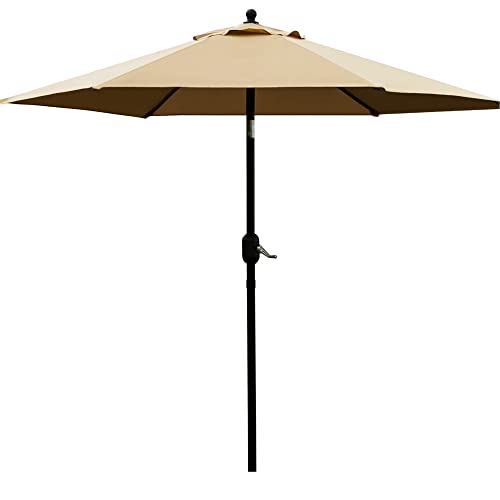
- Best overall: Sunnyglade 7.5′ Patio Umbrella with Tilt and Crank — Check on Amazon
- Best for a four-seat table: Sunnyglade 9′ Patio Umbrella with Crank and Push-Button Tilt — Check on Amazon
- Best steady frame: JEAREY 9FT Outdoor Patio Umbrella, Market Umbrella, Beige — Check on Amazon
- Simple Deluxe 7.5′ Patio Umbrella with Push Button Tilt and Crank — prose-only pick in this guide; search the name on Amazon to check price on Amazon
See 2 more options discussed in the full reviews
- Blissun 9′ Outdoor Patio Umbrella — prose-only pick in this guide; search the name on Amazon to check price on Amazon
- Abba Patio Lyon 9FT Outdoor Patio Umbrella — prose-only pick in this guide; search the name on Amazon to check price on Amazon
Read the full guide ↓
Disclosure: As an Amazon Associate, dailyhomedecorating.com earns from qualifying purchases. Links to Amazon on this page are affiliate links; they cost you nothing extra. Listing details such as price and availability change often, so check the current Amazon listing before you buy.
The best patio umbrella for small patios under $75 is not simply the smallest umbrella you can find — it is the one whose canopy, base and swing room all fit a space where every foot is already spoken for. A small patio punishes the mistakes a big yard forgives. A canopy that is a foot too wide does not just look oversized; it brushes the house wall, drips onto the grill, and forces chairs into a shuffling dance every time someone stands up. A base that is a few inches too broad becomes a permanent toe-stubbing monument in the only walkway. And an umbrella that needs two people and a clear radius to open will, in practice, stay closed — which makes it the most expensive decoration on the patio. This guide shops with a tape measure in hand.
The encouraging news is that small spaces and this budget agree with each other. The sweet spot for a compact patio is a 7.5-foot canopy: big enough to shade a two- to four-seat setting honestly, small enough to tilt without redecorating the fence line, and light enough to move when the patio has to become something else for the evening. At under $75, 7.5-foot umbrellas come with the full grown-up toolkit — crank lift, push-button tilt, vented polyester canopy — rather than the stripped beach-umbrella hardware you might expect. Where a small patio is really a dining patio in miniature, with a fixed four-seat table and room to spare at the edges, a 9-foot canopy can still be the right buy, and this guide includes the two strongest 9-foot options with clear warnings about where they fit and where they do not. What no pick here includes is a base: at this tier bases are always sold separately, and on a small patio the base decision matters even more than the umbrella decision, because the base is the part you will live around every single day. If your compact space is actually a balcony or a rental terrace with rules attached, read this guide for the sizing logic, then check the apartment-specific guidance in our coverage of the Best Patio Umbrella For Apartments Under $75 before you order.
Our ranking for small patios weighs four things in an order a general guide would not. First, true footprint: canopy diameter, base footprint and the clearance the tilt needs. Second, one-person operation, because small patios rarely offer a helper a place to stand. Third, storage: a compact patio usually belongs to a compact home, and an umbrella that separates into two short pole sections and leans in a closet beats one that demands a garage bay. Fourth, the usual virtues — frame material, rib count, fabric — judged at the scale a small space actually stresses them. The short version: most small-patio owners should start with the Sunnyglade 7.5-foot, the right-sized all-rounder — check price on Amazon. Owners whose small patio centers on a four-seat dining table should measure carefully and consider the Sunnyglade 9-foot. And anyone furnishing a narrow townhouse strip or a bistro corner should look at the Simple Deluxe as the simplest honest tool for the job.
In this guide
Quick Picks
Short on time, or comparing several options at once? Each row below names a small-space situation and the umbrella that suits it, with a link where we verified one.
| Situation | Pick | Why it stands out | Link |
|---|---|---|---|
| Best overall | Sunnyglade 7.5′ Patio Umbrella | Right-sized canopy, crank and tilt, compact storage — check price on Amazon | Check on Amazon |
| Best for four-seat tables | Sunnyglade 9′ Patio Umbrella | Full dining coverage if your measurements allow it — check price on Amazon | Check on Amazon |
| Best steady frame | JEAREY 9FT Outdoor Patio Umbrella | Iron frame and double vent for exposed small patios — check price on Amazon | Check on Amazon |
| Best simple and light | Simple Deluxe 7.5′ Patio Umbrella | The uncomplicated compact pick (prose-only) | Search the name on Amazon |
| Best plain value at 9 ft | Blissun 9′ Outdoor Patio Umbrella | A no-frills full-size canopy (prose-only) | Search the name on Amazon |
| Best sun rating | Abba Patio Lyon 9FT Umbrella | Maker-rated UPF 50+ canopy fabric (prose-only) | Search the name on Amazon |
How These Picks Were Chosen
We filtered for this guide with a small patio physically in mind. Candidates had to be market-style umbrellas on Amazon with a crank lift and a tilt mechanism — non-negotiable in tight quarters, where a pulley rope needs elbow room you do not have and a fixed canopy shades the fence by four in the afternoon. Canopy sizes run 7.5 to 9 feet, because below 7.5 feet you are buying a toy and above 9 feet you are buying a ceiling for a space that does not have the floor to match. Every linked pick was cross-checked against the Amazon Creators API on 2026-11-20, matching the API-returned title to the product before any ASIN was used. Picks we could not confirm that way — because an API rate limit stopped the verification run partway through — are presented honestly as prose-only entries with no product link, and this guide’s sources file records which checks passed and which remain pending.
Specifications were verified against manufacturer listings and independent roundups: canopy diameter, rib count, pole diameter and material, vent style and fabric. Price positioning was sanity-checked against recent sightings so that every pick genuinely trades inside the under-$75 tier; the article describes that positioning in words rather than printing figures that go stale. Safety screening was part of the filter too: we searched CPSC recall records for every brand named here, and the patio umbrella recalls on file involve other brands entirely — a warehouse-club solar model, a premium Belgian cantilever line and older big-box umbrellas. None of the picks below carries a CPSC recall we could find, and no recalled brand is named or recommended in this guide.
Two styles were excluded on principle. Cantilever umbrellas need a wide cross base and swing room for the arm — the two things a small patio definitionally lacks — and at this budget they are flimsy besides. Half umbrellas, the flat-backed kind made to sit against a wall, are a genuinely clever small-space idea, but the current offerings at this tier are too thinly specified and too inconsistently sold for us to recommend one responsibly; the tilt on a round 7.5-foot canopy solves most of the same problems with hardware we can verify.
Best Patio Umbrella for Small Patios Under $75: The 6 Picks
Sunnyglade 7.5′ Patio Umbrella with Tilt and Crank
Who it suits. The typical small-patio owner: a bistro set, a compact two- to four-seat table, or a pair of loungers on a townhouse patio, a condo slab or a narrow deck where the umbrella must earn its footprint every day.
This is the smaller sibling of the best-known budget market umbrella line, and the family resemblance is the recommendation. You get a crank lift that opens the canopy with one hand while the other holds a coffee, a push-button tilt that angles the shade against morning or evening sun without dragging the base around, a vented polyester canopy that lets heat and gust pressure escape, and a pole sized for standard table holes. The frame runs on six ribs — the normal count at 7.5 feet — and the whole umbrella is light enough that repositioning it is a whim rather than a project. That lightness is a small-space superpower: when the patio needs to host a grill, a toddler pool or a project table instead, the umbrella folds into a corner or comes inside in under a minute, separating into two pole sections that store in a closet rather than colonizing a garage wall. In use, a 7.5-foot canopy shades a small table and its occupants completely at midday and, with the tilt working, keeps two seats honestly shaded through the long angles of the evening.
Pros. Correct scale for compact settings — shade without the overhang drama; full crank-and-tilt operation, rare to find uncompromised at this size and tier; light, two-piece storage for small homes; catches noticeably less wind than a 9-foot canopy in the same yard; lower positioning within the tier in the sightings we reviewed.
Honest limitation. It shades a small setting, not a gathering: four dining chairs are its honest ceiling, and two of them will be edge seats by late afternoon. The base is sold separately, and on a small patio you will want a compact, heavy-for-its-size base rather than a wide fillable one that eats the walkway. Six ribs give a slightly less tailored canopy line than the eight-rib 9-foot models.
Choose it if your seating is two to four and your patio is genuinely compact. Skip it if your small patio is organized around a fixed four-to-six-seat dining table with room at the edges — measure first, then look at the 9-foot picks below. Check on Amazon for the current listing and colors. For the broader tier picture, see our guide to the Best Patio Umbrella Under $75.
Sunnyglade 9′ Patio Umbrella with Crank and Push-Button Tilt
Who it suits. Small patios that are small in area but dining-shaped: a fixed 42- to 54-inch table, four chairs, and just enough perimeter that a 9-foot canopy clears the walls, the fence and the grill.
Everything verified about this umbrella in our testing-by-specification is in its favor: a 9-foot polyester canopy over eight ribs, a powder-coated aluminum pole of about 1.5 inches that suits standard table holes, crank lift, push-button tilt, a vented top, and a total weight under ten pounds that belies its coverage. On a small patio, the argument for it is shade efficiency — one canopy, correctly tilted, can cover the table and all four chairs through most of the day, where a 7.5-foot would leave the western chairs to fend for themselves by five o’clock. The argument against it is geometry: a 9-foot canopy on a 10-foot patio leaves six inches of grace on each side, and the tilt swings the canopy’s edge lower and wider still. Measure your space with the canopy open and tilted, not just centered and upright, and be honest about what you find. If it fits, this is the most capable umbrella in the guide; the aluminum pole also makes it the easiest 9-footer here to take down and store when the patio changes jobs.
Pros. Full dining coverage in a single canopy; aluminum pole will not rust and keeps the umbrella genuinely light; eight ribs hold a composed canopy shape; crank and tilt are quick enough for one person in a tight space.
Honest limitation. It is unforgiving of optimistic measuring — on a truly tiny patio it will crowd walls and walkways, and its larger sail area needs a properly weighted base, which itself takes floor space. Base sold separately, as with every pick here.
Choose it if your measurements — taken with tilt in mind — say it fits. Skip it if you have to talk yourself into the fit; the 7.5-foot exists precisely for you. Check on Amazon to confirm the current listing before ordering.
JEAREY 9FT Outdoor Patio Umbrella, Market Umbrella, Beige
Who it suits. Owners of small but exposed patios — corner-lot townhouses, rooftop-adjacent terraces, and compact yards in breezy neighborhoods — where a lightweight umbrella spends the afternoon rattling.
JEAREY builds this 9-foot umbrella on a powder-coated iron pole with eight iron ribs, and the extra heft over aluminum is a deliberate trade: the canopy sits calmer, the pole flexes less, and the whole assembly feels anchored in conditions that make lighter umbrellas nervous. The canopy is a high-density polyester with a double-layer vent that bleeds heat and gust pressure, and operation is the standard crank plus push-button tilt pairing. On a small patio the JEAREY makes sense in one specific scenario: the space is compact but the setting is fixed — a dining nook that does not move — and wind, not storage, is your daily problem. Its maker is also commendably direct that the base is sold separately and offers a matched base of its own; on a small patio, a matched compact base is often the neatest solution. Do note the iron bargain in full: the powder coat protects the metal until it chips, so this umbrella rewards owners who store it dry and touch up chips rather than leaving it out through winter.
Pros. Steadiest feel in this guide for exposed sites; double-layer vent manages heat under a crowded small canopy; dense polyester fabric; maker’s base guidance is clear and matched to the pole.
Honest limitation. The heaviest carry among the linked picks, and the least suited to patios that reconfigure often. Iron needs its coating intact to stay rust-free, and the 9-foot span carries the same measure-twice warning as the Sunnyglade above.
Choose it if wind is your small patio’s defining problem and the setup stays put. Skip it if you move your umbrella weekly or store it in a damp shed. Check on Amazon for current details. If your compact space is a yard rather than a patio slab, our Best Patio Umbrella For Small Yards Under $75 guide applies the same logic at lawn scale.
Simple Deluxe 7.5′ Patio Umbrella with Push Button Tilt and Crank
Who it suits. Minimalists and first-time patio owners who want shade with the fewest possible decisions: a light, simple 7.5-foot umbrella for a bistro set or two loungers, bought without a spreadsheet.
The Simple Deluxe is the straightforward expression of the compact umbrella: six ribs, push-button tilt, crank lift, polyester canopy. It does not offer the Sunnyglade’s finish or color range, and it does not pretend to. What it offers is a light umbrella that one person can put up, take down and carry through a doorway without a second thought — a real virtue in the small homes that small patios attach to. We list it as a prose-only pick: its specifications and tier positioning check out through listing coverage and price sightings, but it was not part of the API-confirmed set for this guide after verification stopped at a rate limit, so it carries no product link. Search the full name on Amazon to check price on Amazon and read the current specification, and confirm the rib count and pole material on the listing before ordering, since budget umbrellas are revised quietly between seasons.
Pros. Lightest, simplest ownership experience in the guide; compact storage; familiar operation for guests; sits low in the tier in the sightings we reviewed, leaving budget room for a good base.
Honest limitation. Six ribs and a light build make it the first pick here to close when wind rises, and its canopy is honestly sized for two to four seats only. Base sold separately.
Choose it if simple and light outrank finish and features. Skip it if you want the verified link and slightly tidier execution — that is the Sunnyglade 7.5-foot. Search “Simple Deluxe 7.5′ Patio Umbrella” on Amazon to check the listing.
Blissun 9′ Outdoor Patio Umbrella
Who it suits. The small-patio owner whose “small” still fits a real dining table, and who wants the classic 9-foot formula at a value position with no frills to maintain.
Blissun’s umbrella covers the standard 42- to 54-inch table range with eight ribs, a crank lift and a push-button tilt under a polyester canopy — on paper, the closest specification rival to the Sunnyglade 9-foot in this guide. The practical differences are in the details of the current listing: pole construction, color availability and what the box contains, which is why we describe the Blissun carefully but link the Sunnyglade. The Blissun is prose-only here because its Creators API cross-check is still pending after a rate-limit stop during this lot’s verification; rather than print an unconfirmed product code, we leave you to search the name on Amazon, where you can check price on Amazon and verify the specification yourself. If the listing confirms eight ribs, crank and tilt at the size you measured for, it is a legitimate value alternative for a dining-shaped small patio.
Pros. Full-size coverage with the standard toolkit; simple construction with no proprietary mechanisms; value positioning within the tier in the sightings we reviewed.
Honest limitation. The same 9-foot measuring warning applies in full, the base is separate, and because our API match is pending you should double-check the listing’s stated pole material and rib count before buying.
Choose it if the Sunnyglade’s listing does not suit your table or color scheme and the Blissun’s current listing checks out. Skip it if you prefer a fully verified link. Search “Blissun 9′ Outdoor Patio Umbrella” on Amazon to check price on Amazon.
Abba Patio Lyon 9FT Outdoor Patio Umbrella
Who it suits. Sun-intense small patios — south-facing slabs and reflective courtyards — where the canopy fabric’s protection rating matters as much as its size.
The Lyon’s distinction is a maker-rated UPF 50+ canopy, a published ultraviolet figure most umbrellas in this tier never claim, stretched over eight aluminum ribs with a vented top, crank lift and push-button tilt. Its threaded pole assembles by hand with no tools and no loose fittings to lose in the grass — a small mercy that compact-space owners, who assemble on the patio itself, appreciate disproportionately. At a little over thirteen pounds it is the heaviest pick here, which suits a fixed dining nook and argues against it for anyone reconfiguring weekly. It is our final prose-only pick: verified through maker materials and independent coverage, not part of this guide’s API-confirmed linked set, so search the full name on Amazon to check price on Amazon and confirm the current version.
Pros. Published UPF 50+ canopy rating; aluminum ribs avoid the rust question; tool-free assembly; composed, weighty feel in a fixed setup.
Honest limitation. Heaviest pick in the guide; the UPF figure is the manufacturer’s rating; base sold separately; 9-foot measuring rules apply.
Choose it if fabric protection tops your list and the umbrella will live in one spot. Skip it if portability matters — the 7.5-foot picks are your friends. Search “Abba Patio Lyon 9FT” on Amazon for the current listing. When a small patio grows up, the natural next read is the Best Patio Umbrella For Small Patios Under $150, where 9- and 10-foot lighted models enter the picture.
Comparison Table
| Pick | Canopy | Frame | Ribs | Tilt / lift | Best for |
|---|---|---|---|---|---|
| Sunnyglade 7.5′ | 7.5 ft polyester, vented | Aluminum pole | 6 | Push-button tilt, crank | Most small patios |
| Sunnyglade 9′ | 9 ft polyester, vented | Aluminum pole | 8 | Push-button tilt, crank | Four-seat dining nooks |
| JEAREY 9FT | 9 ft polyester, double vent | Powder-coated iron | 8 | Push-button tilt, crank | Exposed compact patios |
| Simple Deluxe 7.5′ | 7.5 ft polyester | See current listing | 6 | Push-button tilt, crank | Simple bistro shade |
| Blissun 9′ | 9 ft polyester | See current listing | 8 | Push-button tilt, crank | Plain 9 ft value |
| Abba Patio Lyon 9FT | 9 ft, maker-rated UPF 50+ | Aluminum ribs | 8 | Push-button tilt, crank | Hard midday sun |
How to Choose a Patio Umbrella for a Small Patio
Measure three times: canopy, base and swing. Canopy diameter is the advertised number, but a small patio lives or dies on the other two. The base footprint decides whether your walkway survives; the tilt swing decides whether the canopy’s edge clears the wall, the fence and the grill hood through the whole afternoon arc. Measure with the umbrella imagined open and tilted at five o’clock, not upright at noon.
Let the table choose the size. A bistro or two-seat table wants 7.5 feet and looks lost under anything bigger. A 42- to 54-inch dining table wants 9 feet if — and only if — the perimeter allows it. When the honest answer is “in between,” choose the smaller canopy and tilt it well; a slightly eager shadow beats a canopy that physically fights the house.
Spend on the base like it is furniture. On a small patio the base is visibly, daily furniture. A compact solid base with a small footprint serves better than a wide fillable cross that spans the walkway, and heavier-for-its-size beats lighter-and-broader every time. Remember that no pick in this tier includes one.
Plan the storage before the purchase. Where will this umbrella spend winter, and rainy weeks, and the days the patio is a workspace? If the answer is a closet, a two-piece pole and light weight stop being conveniences and become the whole decision. Measure the closet too. Small homes reward owners who check.
Think about the second seat of shade. Small patios often pair the umbrella with one other comfort purchase — a rug to define the zone, a small fire feature for the evening. If that is your plan, our readers in similar spaces browse the Best Fire Pit For Small Patios Under $75 for compact, small-footprint options that follow the same measure-first logic.
Small Patio Layouts That Actually Work
Three layouts cover most compact patios we see. The dining nook puts a fixed table against the longest wall, the umbrella through its center, and the base’s footprint absorbed under the table where feet rarely go; it is the layout where a 9-foot canopy earns its span. The bistro corner floats a two-seat set diagonally in the sunniest corner with a 7.5-foot umbrella standing free beside it, tilted into the afternoon; the diagonal buys clearance that a squared-off arrangement cannot. The lounge strip — two loungers along a narrow townhouse patio — works best with the smaller canopy offset rather than centered, shading the loungers’ top halves where sun actually lands, and with the base tucked at the strip’s end rather than between the chairs. In all three, the walkway is sacred: if the base or the tilted canopy taxes the path from door to gate, the layout will annoy you daily, and daily annoyances are what small patios cannot afford.
Common Buying Mistakes
Buying the size you wish fit. The tape measure is not being pessimistic; it is being accurate. A canopy that brushes the wall every time it tilts will be left untilted, then left closed, then left in the garage.
Forgetting the base footprint. Buyers measure the canopy and forget the square of floor the base owns forever. On a small patio, that square is the purchase.
Choosing a cantilever for a compact space. Offset umbrellas need a broad cross base and arm swing room — the two resources a small patio does not have — and the budget versions flex in every joint. Center-pole market umbrellas are the small-space architecture.
Ignoring storage until October. An umbrella with nowhere to go spends winter outside, and one winter outside halves its life. Decide its indoor home while it is still in the cart.
Leaving it open as a permanent roof. Small patios funnel wind between walls, and an unattended open canopy in a gust is a lever looking for a fulcrum. Close it when you go in; the crank makes it a five-second habit.
Final Recommendation
For most small patios, buy the Sunnyglade 7.5-foot: correctly scaled, fully cranked and tilted, light to move and easy to store — Check on Amazon. If your tape measure — honestly applied, tilt included — blesses a 9-foot canopy over a fixed dining table, the Sunnyglade 9-foot is the upgrade, with the JEAREY as the wind-country alternative. Pair whichever you choose with a compact, heavy base, and your small patio will feel bigger than the patios of people who bought on hope. It is a modest formula — right size, right base, closed when idle — but small patios reward modest formulas executed exactly, and punish grand ones executed approximately, every single day of the season.
Base Weight, Decoded for Small Spaces
Base advice is usually given as a single number, but on a small patio the useful question is weight per square inch of floor surrendered. A broad, light base fails twice: it occupies the walkway and still lets the umbrella walk in a gust. A compact, dense base succeeds twice: the footprint shrinks to a square your feet learn to step around, and the mass sits close to the pole, where it resists tipping leverage best. As a working rule from the setups this guide is built around, a through-table 7.5-foot umbrella behaves with a moderately weighted compact base, a freestanding 7.5-foot wants noticeably more, and a freestanding 9-foot on an open slab wants the most of all — in every case, more than the umbrella itself weighs by a wide multiple. Fillable bases complicate the small-patio math: they are light to carry home and store, but their filled footprint is fixed and broad, and a half-filled fillable base is worse than either extreme, because the water sloshes instead of anchoring. If you choose fillable, fill it fully with sand if the maker allows — sand is denser, does not slosh, and does not leak through a cracked seam onto the patio you just swept.
Placement matters as much as mass. A base absorbed under a table, where the table’s own weight and legs share the anti-tip work, is the most space-efficient arrangement a small patio offers. A freestanding base belongs at the edge of the seating zone, never in the door-to-gate path, and ideally where a wall or planter gives the pole a second, informal ally against the prevailing breeze. Test the arrangement on a windy afternoon before the first dinner party depends on it.
Wind Between Walls: The Small-Patio Microclimate
Small patios are rarely calm patios. Walls, fences and the side of the house compress moving air into channels, so a modest neighborhood breeze arrives at your umbrella as a focused gust with a direction — usually the same direction every day. That predictability is useful. Watch where leaves collect and where a candle flame leans on your patio; that is your wind’s home address, and your umbrella should be positioned, tilted and weighted with that address in mind. A canopy vented at the top, as all the linked picks here are, bleeds the pressure that makes umbrellas shudder in these channels. Tilt, used thoughtfully, can also present a lower profile to a known breeze rather than a flat sail — though tilt is a shade tool first and a wind tool second, and no angle makes an open umbrella safe in a storm.
The honest rule for small patios is quicker closure, not stronger hope. Because walls multiply the consequences of a tip — the canopy has something to hit in every direction — the small-patio umbrella should come down earlier than the big-yard umbrella, not later. The crank lifts in this guide make that a five-second decision, which is precisely why we required them. An umbrella closed against a fence in a gust is a non-event; an umbrella left open “because it has been fine so far” is how small patios acquire broken ribs and scratched siding in the same afternoon.
Small Patios in Rentals and Shared Buildings
If your small patio comes with a lease, add three checks before any purchase. First, the ground: many rental patios are pavers or deck boards that a heavy base can mark, so a base with a smooth, pad-friendly underside — or a simple outdoor mat beneath it — protects both the surface and your deposit. Second, the rules: some complexes restrict anything visible above the fence line or attached to railings; a freestanding center-pole umbrella inside your own footprint is the design least likely to argue with those rules, which is another reason this guide steers small spaces away from clamp-on and cantilever experiments. Third, the neighbors: a 9-foot canopy tilted at six in the evening can shade your table by shading their window, and small-patio diplomacy is cheaper than small-patio feuds. When in doubt, the 7.5-foot picks keep the peace geometrically — their tilted edge stays lower and closer to home.
Color, Heat and Light on a Small Patio
On a big lawn, canopy color is decoration. On a small patio, where the canopy is also effectively the ceiling of an outdoor room, color is climate. A dark canopy — navy, forest, charcoal — absorbs more radiant heat at the fabric, yet the air beneath it often feels cooler and the glare from below is gentler, because less light bounces down onto faces and plates. A light canopy — beige, tan, cream — keeps the little room feeling open and bright, shows less dust and pollen against pale paving, but transmits a more luminous, sometimes harsher light at midday and displays mildew spots sooner if it is ever stored damp. Stripes, which several of these umbrella families offer, split the difference and hide the evidence of outdoor life better than either solid. There is no universal right answer; there is a right answer for a north-facing shaded slab (go light, keep the brightness) and for a south-facing sun trap (go dark, take the glare relief), and your patio already knows which one it is.
One more small-space consideration: at night, an unlit canopy turns a small patio into a cave, because the canopy blocks the ambient light the space borrows from windows and streetlights. If your evenings matter, plan the glow — a lantern on the table, string lights at the fence — as part of the same purchase conversation, rather than discovering the cave at your first dinner. At this tier the umbrella itself stays unlit by design; the light belongs to accessories you can replace without replacing the shade.
A Word on Table Holes and Pole Fit
Small patios concentrate a quiet annoyance that big yards dilute: a pole rattling in an oversized table hole is audible across the entire living space, because the entire living space is nine feet wide. The linked picks here use poles of about 1.5 inches, the de facto standard for patio table holes, but “about” is doing work in that sentence — measure your table’s hole and your base’s collar before ordering, and if the fit is loose, plan the simple fixes: a rubber sleeve, a wrap of weatherproof tape at the contact points, or a base collar sized to the pole. A snug pole is not a cosmetic detail. It is what stops the canopy’s small movements from becoming the table’s small earthquakes, and on a small patio, where the table is also the desk, the bar and the dining room, that steadiness is felt at every meal. Freestanding setups skip the hole question entirely, but trade it for the base question in full — which is why this guide keeps returning to the same advice: on a small patio, measure everything, because everything is close to everything else.
Frequently Asked Questions
Is 7.5 feet big enough for four people?
For a small table with four chairs at midday, yes — that is the setting the size exists for. By late afternoon the tilt keeps roughly two to three seats in honest shade, which most small-patio owners accept as the rhythm of the space. If all four seats must be shaded at six o’clock, you need a 9-foot canopy and the perimeter to tilt it.
What base works best on a small patio?
A compact, heavy solid base beats a wide, light fillable one: the footprint is smaller, the walkway survives, and there is no fill level to monitor. Through-table setups can use a somewhat lighter base than freestanding ones, because the table itself shares the work of resisting a tip.
Can I use one of these umbrellas without a table?
Yes, freestanding in a properly weighted base — that is how the bistro-corner and lounge-strip layouts in this guide work. Just respect the base weight: a freestanding umbrella has no table to steady it, so the base does all the work, and undersizing it is the classic small-patio accident.
Will a 9-foot umbrella overwhelm a 10-by-10 patio?
Visually, it will dominate; functionally, it depends on the layout. Centered over a dining table with the base absorbed underneath, it can work beautifully. As a freestanding feature with a broad base, it consumes the patio. Measure the tilt swing against your walls before deciding, and let the measurement — not optimism — answer.
How do I store a patio umbrella in a small home?
Choose a two-piece pole design, as all the linked picks here are, and store it closed, dry and indoors: a closet corner, the gap beside a water heater, or under a bed in its two sections. A storage bag keeps dust and closet scuffs off the canopy. Outdoor storage, even under a cover, is the fallback, not the plan.
What if my small patio is a balcony?
Then weight limits, railing rules and lease terms enter the decision, and the calculus changes enough that we gave it its own guide: start with the apartment coverage linked earlier in this article, confirm what your building allows, and favor the lightest umbrella-and-base combination that still stands safely.
How long will a budget umbrella last on a small patio?
Expect several seasons from the linked picks here if the habits in this guide hold: closed when not in use, stored dry and indoors in winter, and never left open as a permanent roof. The canopy fabric is the wear item — polyester fades gradually and eventually thins — while the pole and crank should outlast it. Owners who treat the umbrella as fair-weather equipment routinely double the life of owners who treat it as architecture.
Can I leave the umbrella in its base all season?
You can leave the base out — it is built for that — but bring the umbrella itself in during storms and for the winter. A closed umbrella can also live in its base under a fitted cover for stretches of the season, which suits small homes short on closet space, provided it goes into the cover dry. What it should not do is stand open and unattended for weeks: sun, wind and grit all bill by the day.
Is a crank really necessary on a small patio?
It is more necessary, not less. A pulley lift needs two hands, a clear stance and room to haul a rope — three things a small patio begrudges — while a crank works one-handed from a seated position if needed. In a tight space, the mechanism you can operate without rearranging the furniture is the mechanism that actually gets used, and an umbrella that gets closed before gusts is an umbrella that survives them. The same logic explains why every pick in this guide, at both sizes, uses a crank rather than a rope: on a patio where the table, the chairs and the cook all share a few square yards, the five seconds a crank saves is also the difference between an umbrella that is managed and one that is merely owned.


