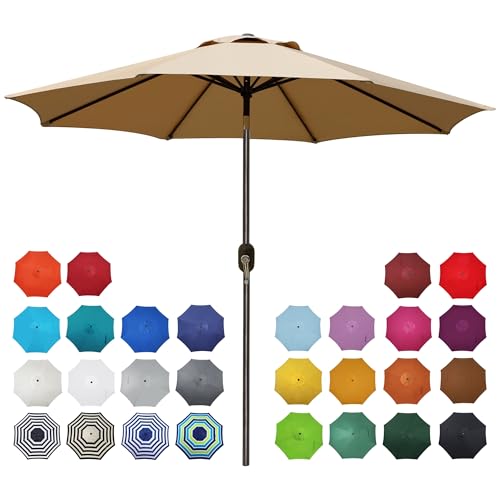
Best patio umbrella for small patios under $150
Where to buy
Check the latest price, availability and delivery on Amazon. Orders are placed on Amazon. We may earn a commission from qualifying purchases. Patio umbrella bases are almost always sold separately — budget for the base as well as the umbrella.
- Best overall: Blissun 9′ Outdoor Patio Umbrella — Check on Amazon
- Best lightweight pick: Sunnyglade 9′ Patio Umbrella with Tilt and Crank — Check on Amazon
- Best sturdier frame: Abba Patio 9FT Lyon Outdoor Patio Umbrella — Check on Amazon
See more Amazon options
- Best wind-vented design: EliteShade USA 9ft 3-Tier Market Patio Umbrella — Check on Amazon
- Best budget stretch: JEAREY 9FT Outdoor Patio Umbrella — check price on Amazon (see the review below for why this pick is listed without a direct link)
- Best if you want 10 ft on a tight budget: wikiwiki 10ft Patio Umbrella — check price on Amazon (see the review below for why this pick is listed without a direct link)
Read the full guide ↓
Disclosure: As an Amazon Associate, dailyhomedecorating.com earns from qualifying purchases. Links to Amazon on this page are affiliate links; they cost you nothing extra. Listing details such as price and availability change often, so check the current Amazon listing before you buy.
Finding the best patio umbrella for small patios under $150 is a different problem from finding the best patio umbrella, full stop. On a big deck, a too-large umbrella is a minor annoyance. On a small patio — a townhouse slab, a narrow terrace, the paved corner behind a condo — a too-large umbrella is a daily obstacle: the canopy brushes the house wall every time it opens, the pole lands exactly where the second chair needs to go, and the base eats the only patch of floor that was not already spoken for. Small-patio shade is an exercise in fit first and features second, and this guide is written in that order.
The good news is that the under $150 tier is exactly where the sensible small-patio umbrellas live. At this level you can buy a proper 9-foot market umbrella with a crank lift and a tilt function from several established Amazon brands — the same basic format that shades most café terraces — without paying for premium fabrics or oversized canopies you have no room to open. What you cannot honestly buy at this level is a big cantilever or a genuine Sunbrella canopy, and this guide will not pretend otherwise: the picks below are all center-pole market umbrellas in the 9-foot class, plus one 10-foot value option for the small patios that are long rather than square, because that is what the budget and the footprint genuinely allow.
Three measurements decide everything in this category, and it is worth taking them before you fall for any particular umbrella. First, the open diameter you can actually use: an umbrella needs clearance on every side, so pace out the circle, not just the spot where the pole will stand, and check it against walls, railings, gutters and the swing of the back door. Second, the table question: if the umbrella will stand through a patio table, the table itself adds real stability and you can run a lighter base; if it will stand alone in a corner, the base does all the work and must be heavier. Third, storage: a 9-foot umbrella is roughly eight feet of pole and folded canopy, and on a small patio there is no spare corner to lean it in over winter, so think about where it lives when it is closed — a storage bench, a garage wall, or laid along the fence line.
Every pick below was chosen for a small footprint first. All six are 9-foot-class umbrellas except the one deliberate 10-foot exception, all open with a crank rather than a pulley and a pin you have to wrestle at head height, and all tilt, because on a small patio the sun’s angle matters more, not less: you cannot move the seating out of the sun when the seating only fits in one place, so the shade has to move instead. We also weighted how each umbrella behaves closed — its folded bulk, its weight, and how easily one person can lift it out of the base and carry it inside ahead of a storm.
In this guide
Quick Picks
| Pick | Best for | Canopy | Key feature |
|---|---|---|---|
| Blissun 9′ Outdoor Patio Umbrella | Most small patios with a table | 9 ft | Crank + push-button tilt |
| Sunnyglade 9′ Patio Umbrella with Tilt and Crank | Renters and anyone moving it often | 9 ft | Aluminum pole, light to carry |
| Abba Patio 9FT Lyon Outdoor Patio Umbrella | Breezy small patios | 9 ft | Heavier-feeling rib frame |
| EliteShade USA 9ft 3-Tier Market Patio Umbrella | Exposed, gusty corners | 9 ft | 3-tier vented canopy |
| JEAREY 9FT Outdoor Patio Umbrella | The tightest budgets | 9 ft | Full crank-and-tilt feature set |
| wikiwiki 10ft Patio Umbrella | Long, narrow patios | 10 ft | Maximum canopy per dollar |
How These Picks Were Chosen
We started from the constraints of the space rather than the marketing of the umbrellas. The first filter was size: only umbrellas whose open canopy a genuinely small patio can absorb — 9 feet as the working standard — stayed on the list, with a single 10-foot exception kept for long, narrow patios where the extra reach runs along the space instead of across it. The second filter was mechanism. On a small patio you open and close the umbrella constantly, because an open canopy you are not sitting under is a canopy blocking your path, so every pick had to have a crank lift; pulley-and-pin umbrellas, which are awkward to operate in a tight corner, were cut. Tilt was the third filter, for the reason given above: fixed seating means moving shade.
We then checked each candidate against the maker’s own specifications — canopy size, rib count, pole diameter and material, fabric type — and against the Amazon listing itself, confirming the exact variant before linking it. Where we could confirm a listing through the Amazon Creators API, the pick carries a direct link; where a variant could not be confirmed with confidence, the pick is presented in prose so you search the model name yourself rather than landing on the wrong color or size. We also screened every candidate against US recall records for patio umbrellas; any model under a safety recall was excluded outright, and you will find no recalled solar-battery umbrella recommended anywhere in this guide.
Finally, we were honest about the tier. Under $150 buys polyester canopies, not solution-dyed acrylic, and it buys bases separately, not included. Rather than hide those limits, each review states them plainly, because on a small patio the costliest mistake is not a faded canopy — it is an umbrella that does not fit, bought twice.
The Picks in Detail
Blissun 9′ Outdoor Patio Umbrella — Best overall
Who it suits: a small patio with a standard four-person table, where the umbrella stands through the table and shades the whole setting without overwhelming it.
The Blissun is a classic center-pole market umbrella: a 9-foot octagonal polyester canopy on eight ribs, opened with a crank and angled with a push-button tilt. The pole is about 1.5 inches in diameter, so it drops through the umbrella hole of a standard patio table and into most universal bases. The canopy fabric is a solution-tinted polyester that sheds light rain and is treated for UV resistance; the vent at the peak lets hot air escape and reduces the sail effect in a breeze.
Key specs: 9 ft canopy, 8 ribs, push-button tilt, crank lift, polyester canopy, 1.5-inch pole.
Pros:
- A true 9-foot canopy — big enough for a four-seat table, small enough for a tight slab
- Crank lift and push-button tilt are both easy to reach from a seated position
- The 1.5-inch pole fits standard tables and universal bases, so replacement parts are easy
- Vented peak helps it sit calmer in a breeze than a sealed canopy
Honest limitation: The polyester canopy is the tier talking: expect it to fade gradually over a few sunny seasons, and treat the water resistance as shower-shedding rather than stormproof.
Choose it if you want one sensible umbrella that does everything a small patio asks, without research fatigue. Skip it if your patio is exposed and windy enough that you should be shopping heavier frames and vented canopies first.
Sunnyglade 9′ Patio Umbrella with Tilt and Crank — Best lightweight pick
Who it suits: renters and anyone who moves the umbrella often — in and out of the base, in and out of storage — because the aluminum pole keeps the whole thing easy to carry.
The Sunnyglade pairs a 9-foot polyester canopy with an aluminum pole, which matters anywhere the umbrella lives outdoors year-round because aluminum does not rust the way painted steel can once the finish chips. It opens with a crank, tilts with a push button, and the canopy is a waterproof-coated polyester with a small vent at the top. The whole umbrella is noticeably lighter than steel-pole rivals, which makes it easier to lift in and out of a base or table hole.
Key specs: 9 ft canopy, aluminum pole, push-button tilt, crank lift, waterproof polyester canopy.
Pros:
- Aluminum pole will not rust when it lives outdoors, unlike chipped painted steel
- Noticeably lighter than steel-pole rivals, so one person can move it without drama
- Crank and push-button tilt, the full basic feature set, nothing missing
- Waterproof-coated canopy shrugs off light showers
Honest limitation: The lighter build that makes it easy to carry also makes a properly weighted base non-negotiable — this is not an umbrella to stand in a featherweight base on an exposed patio.
Choose it if you carry your umbrella in and out, or you are furnishing a rental you will leave in a year or two. Skip it if you want the heaviest, most planted feel; look at the sturdier-framed picks instead.
Abba Patio 9FT Lyon Outdoor Patio Umbrella — Best sturdier frame
Who it suits: a small patio that catches more wind than average — a corner unit, a hilltop terrace, an end-of-row townhouse — where flimsy rib arms are the first thing to fail.
The Lyon is Abba Patio’s mainstream 9-foot market umbrella: eight ribs, a crank lift, a push-button tilt, and a canopy the maker rates for UV protection and water resistance. The frame geometry is a touch sturdier than the very cheapest 9-footers, with a thicker feel to the rib arms, and the canopy fabric is a heavier polyester that holds its shape better in a breeze instead of fluttering at the edges.
Key specs: 9 ft canopy, 8 ribs, push-button tilt, crank lift, UV-protective waterproof canopy.
Pros:
- Eight-rib frame feels a step sturdier than the cheapest 9-footers
- Heavier canopy fabric holds its shape instead of fluttering at the edges
- Full crank and push-button tilt mechanism
- UV-protective, water-resistant canopy finish
Honest limitation: It is a little heavier to move than the aluminum-pole picks, and the fabric is still polyester — sturdier frame, same fabric class as the rest of this tier.
Choose it if your small patio is breezy and you have watched a cheap umbrella invert before. Skip it if weight matters more than sturdiness because you move the umbrella daily.
EliteShade USA 9ft 3-Tier Market Patio Umbrella — Best wind-vented design
Who it suits: the small patio that is also an exposed patio — rooftop terraces, hilltop slabs, anywhere gusts arrive without warning and a normal canopy turns into a sail.
The 3-tier version of EliteShade’s 9-footer splits the canopy into three overlapping tiers. The gaps between tiers give wind and rising heat a path out, so the umbrella flutters less and feels calmer in gusty weather than a single-skin canopy of the same size. The fabric is the same solution-dyed, UPF 50+ performance material as the standard EliteShade, with the same long non-fading claim from the maker.
Key specs: 9 ft canopy, 3-tier vented design, solution-dyed performance fabric, UPF 50+, crank open.
Pros:
- Three-tier canopy gives wind and hot air an escape path, so it flutters less in gusts
- Solution-dyed performance fabric is a class above polyester for fade resistance
- UPF 50+ rated shade
- Commercial-grade build quality aimed at heavy use
Honest limitation: This is the premium end of this guide’s budget, and the tiered canopy is slightly bulkier folded than a plain 9-footer — measure your storage spot.
Choose it if wind, not size, is your small patio’s main problem and you can stretch to the top of the budget. Skip it if your patio is sheltered and calm, where the venting advantage buys you little.
JEAREY 9FT Outdoor Patio Umbrella — Best budget stretch
Who it suits: shoppers whose total budget — umbrella plus base — has to stay low, and who would rather have the full crank-and-tilt feature set than a fancier badge.
JEAREY’s 9-footer is a value-tier market umbrella with a crank lift, a tilt function and a polyester canopy, sold in a wide spread of colors. On paper it matches the Blissun and Sunnyglade feature for feature; the differences are in the smaller hardware — thinner rib arms and a simpler crank housing — which is typical of the price step it sits on.
Key specs: 9 ft canopy, crank lift, tilt, polyester canopy (maker listings).
Pros:
- Full crank lift and tilt at value-tier positioning
- Wide color range, useful when you are matching existing cushions
- Standard 9-foot size suits small patios and standard tables
Honest limitation: Hardware is the compromise: rib arms and crank housing are built to a price, so treat it gently, close it in wind, and expect a shorter service life than the picks above.
Choose it if every dollar counts and you are disciplined about closing the umbrella in bad weather. Skip it if you want a buy-it-for-years umbrella; the frame and fabric picks above are the honest upgrade.
Check price on Amazon by searching the model name — we list this pick without a direct buy link because we could not confirm the exact listing variant at review time, and we would rather send you to search than to the wrong product page.
wikiwiki 10ft Patio Umbrella — Best if you want 10 ft on a tight budget
Who it suits: the long, narrow patio — a side terrace or a rectangular slab against the house — where a 10-foot canopy’s reach runs along the space and shades a lounger as well as the table.
wikiwiki sells a broad family of market umbrellas, including 10-foot versions with crank lift and tilt at value-tier positioning. The draw is canopy size per dollar; the trade-offs are the usual value-tier ones in fabric weight and hardware finish.
Key specs: 10 ft canopy options, crank and tilt (maker listings).
Pros:
- 10-foot canopy at value-tier positioning is rare
- Crank and tilt formats available in the range
- Extra reach can shade seating a 9-footer leaves at the edge
Honest limitation: Size is the risk as well as the reward: a 10-foot canopy needs more clearance and a heavier base than any 9-footer here, and on a truly square small patio it will crowd the space.
Choose it if your patio is narrow but long and you have measured the open circle carefully. Skip it if your patio is small in every direction — stay with the 9-foot picks.
Check price on Amazon by searching the model name — we list this pick without a direct buy link because we could not confirm the exact listing variant at review time, and we would rather send you to search than to the wrong product page.
Comparison Table
| Umbrella | Size | Type | Fabric class | Tilt | Base note |
|---|---|---|---|---|---|
| Blissun 9′ Outdoor Patio Umbrella | 9 ft | Center pole | Polyester | Push-button | Base sold separately; 50 lb+ freestanding |
| Sunnyglade 9′ Patio Umbrella with Tilt and Crank | 9 ft | Center pole, aluminum | Polyester, coated | Push-button | Base sold separately; weight it well |
| Abba Patio 9FT Lyon Outdoor Patio Umbrella | 9 ft | Center pole | Polyester, heavier weave | Push-button | Base sold separately |
| EliteShade USA 9ft 3-Tier Market Patio Umbrella | 9 ft | Center pole | Solution-dyed performance | Crank/tilt by variant | Base sold separately |
| JEAREY 9FT Outdoor Patio Umbrella | 9 ft | Center pole | Polyester | Tilt by variant | Base sold separately |
| wikiwiki 10ft Patio Umbrella | 10 ft | Center pole | Polyester | Tilt by variant | Base sold separately; go heavier |
Sizing Shade for a Small Patio: The Numbers That Matter
The rule of thumb used by shade professionals is that an umbrella canopy should extend about two feet beyond the area you want shaded on every side, because the sun rarely sits directly overhead. For a small patio that rule collides with reality: a four-person table is roughly three feet across, which argues for a seven-to-nine-foot canopy, and a nine-footer already covers most of a small slab once it is open. That is why 9 feet is the sweet spot in this guide. A 7.5-foot umbrella looks safer on paper but shades so little at morning and evening angles that owners end up dragging chairs around chasing a small pool of shade; a 10- or 11-foot canopy shades generously at noon and spends the rest of the day brushing the wall, the railing and the gutter.
Height matters as much as diameter. A standard market umbrella stands about eight feet tall, which clears a seated adult easily and a standing adult mostly — but on a small patio under a balcony, a soffit or a pergola beam, check the closed and opening height too. Crank umbrellas sweep their canopy upward as they open, and the finial needs a clear path. If your patio sits under the balcony above, measure from the base socket to the lowest obstruction and compare it with the umbrella’s listed height before ordering, not after.
Then there is the base, the most under-bought part of every small-patio setup. A 9-foot umbrella through a sturdy table can live happily on a 30-to-50-pound base because the table adds a second anchor point. The same umbrella standing alone in a corner needs at least 50 pounds, and 70 or more if the corner catches wind. On a small patio, consider a flat, low-profile base you can slide partly under a chair or a planter, or a base with wheels you can roll into the corner — footprint spent on the base is footprint taken from your chairs, so choose a base shape that shares space instead of claiming it.
How to Choose the Right Umbrella for a Small Patio
Start with the open circle, not the pole spot. Chalk or pace the full canopy diameter where you plan to stand the umbrella. If the circle hits a wall, the umbrella will too, every breezy day, and the canopy edge will wear against brick or siding. If it clears by a few inches all round, you have your size.
Decide table or freestanding before choosing a base. Through-table setups are the small patio’s best friend: two anchor points, a lighter base, and the pole lands in the one spot — the middle of the table — that was never going to hold a chair anyway. Freestanding setups free the table but demand the heavier base and the best corner.
Prioritize tilt over diameter. On a small patio your seats are fixed by the walls, so as the sun moves, the shade must move. A tilting 9-footer will keep a fixed bistro set shaded from late morning to late afternoon; a fixed 10-footer will shade it beautifully at noon and abandon it by three.
Match the pole material to your habits. If the umbrella lives outside all season, an aluminum pole avoids the rust streaks that painted steel develops once the finish is scratched. If it lives in storage and comes out for guests, steel’s extra weight is a stability bonus and its lower price is real.
Plan the closed umbrella’s home. Measure the folded length against your storage bench, shed wall or balcony corner. An umbrella with nowhere to go gets left open, and an umbrella left open in a storm becomes next season’s replacement purchase.
Common Mistakes on Small Patios
Buying the biggest canopy the budget allows. The classic small-patio error. Shade you cannot open is not shade, and a canopy that scrapes the house wall will wear through its own fabric at the contact points within a season or two.
Forgetting the base in the budget. Shoppers spend the whole budget on the umbrella and stand it in a hollow plastic base filled with a splash of water. The first gust writes the review. Hold back real money for a base of honest weight.
Leaving it open ‘because it’s a small patio.’ Small patios between buildings can funnel wind surprisingly hard. Close the umbrella when you go in; it takes ten seconds with a crank.
Ignoring the door swing and the walkway. On a tight slab, the umbrella pole often ends up exactly in the path between the back door and the seating. Live with the layout on paper first — chalk the pole spot and walk the route before you buy.
Choosing color by the listing photo alone. Canopy colors render differently in sun. Darker canopies give denser-feeling shade and show pollen less; lighter canopies feel airier on a small, enclosed patio and show dirt more. Pick for your space, not the studio shot.
Final Recommendation
For most small patios under $150, the Blissun 9′ is the umbrella to buy: the right size, the full crank-and-tilt mechanism, standard fittings, and nothing in the design that a small space will punish. If you move your umbrella constantly, the lighter aluminum Sunnyglade makes that chore easy. If your small patio is a windy one, spend toward the top of the budget on the vented EliteShade 3-tier or the sturdier Abba Lyon frame — on an exposed slab, structure is the feature. And whichever you choose, spend what remains on base weight before you spend it on anything else.
Setting Up a Small-Patio Umbrella: A Step-by-Step That Prevents the Usual Damage
Most small-patio umbrella damage happens in the first ten minutes, not the tenth month, so setup deserves more care than the instruction leaflet suggests. Start with the base, empty and alone: place it where the pole will live, and check it sits flat. On pavers and deck boards, a base that rocks even slightly will work the pole loose over weeks and wallow out the socket, so shim or reposition until it is dead level. Fill or load the base to its working weight before the umbrella goes anywhere near it — a base that is ‘heavy enough for now’ tends to stay that way until the first gust files its report.
Assemble the umbrella horizontally if your space allows it. Most 9-foot market umbrellas arrive in two pole sections; join them on the ground, check the spring button has clicked fully into its hole, and only then stand the joined pole into the base and tighten the base’s locking knob or bolt by hand until the pole cannot rotate. Raising a joined umbrella vertically in a tight patio is where finials meet gutters and canopy tips meet walls, so if you must assemble upright, keep the canopy tied closed until the pole is locked in the base.
Open it slowly the first time. Crank a quarter, check that no rib is caught against a wall or railing, crank another quarter, and walk the circle once with your eyes on the canopy edge rather than the crank. On a small patio this first opening is your clearance audit: note exactly where the canopy passes closest to the house, because that is the spot to watch on windy days and the spot where a slightly rotated base position might buy you two precious inches. Set the tilt both ways once, so you know its range before you need it at glare o’clock with guests seated.
Finish with the habits that keep it alive. Fit the canopy tie or strap and use it every time you close the umbrella — a tied canopy cannot belly open in a night gust. If your patio gets standing water, raise the base on a paver so the pole foot is not sitting in a puddle all winter. And take one phone photo of the setup, base position included: after the first storm shuffle or the first storage season, that photo is the fastest way back to the arrangement that worked.
Care, Cleaning and Storage on a Small Patio
Polyester canopies — which is what this budget buys — ask for three kinds of care. The first is cleaning: brush loose dirt off dry, then wash with lukewarm water and a small amount of mild soap, working with a soft brush along the panels rather than across the seams. Rinse thoroughly, because soap residue attracts dirt, and open the umbrella to dry completely before closing it. Mildew is the small patio’s particular enemy because canopies stored in damp corners against a house wall never quite dry; if spots appear, a solution of one part white vinegar to ten parts water, applied and left for half an hour before rinsing, handles most cases without attacking the fabric’s coating.
The second is mechanical care. Once a season, work the crank through its full range and listen: grinding means grit in the housing, which a blast of compressed air and a drop of silicone lubricant on the moving parts usually cures. Check the tilt button’s spring action, tighten any rib screws that have worked loose, and inspect the canopy’s rib pockets — the little sleeves the rib tips sit in — because a torn pocket lets a rib poke through and turn a repairable canopy into a torn one. The pole’s lower section deserves a wipe and a look for rust blooms on steel models; a bloom sanded and touched up in spring is a non-event, while the same bloom ignored becomes a seized, weakened joint by autumn.
The third is storage, the small patio’s hardest problem. The folded umbrella is about eight feet long and wants a dry, vertical or high-horizontal home: a storage bench if it fits diagonally, a pair of hooks high on a garage or shed wall, or the top of a storage rack in a basement. What it must not do is spend winter leaning in the damp corner behind the bins, canopy down in the wettest spot. A breathable storage cover — never a sealed plastic bag, which traps condensation against the fabric — keeps dust off without sealing moisture in. Store the base separately and dry: drain a water-filled base before the first freeze, because ice expansion splits more bases than wind ever has, and a split base discovered in May delays your shade by exactly one delivery cycle.
Do this much and an under $150 umbrella gives you the seasons its price promises. Skip it, and the same umbrella becomes the internet’s favorite story: faded by July, mildewed by October, and replaced by spring at a total cost higher than the better umbrella you talked yourself out of.
Canopy Shapes, Colors and Heat: Small-Space Details That Change Daily Comfort
On a small patio the canopy is also the ceiling of your only outdoor room, and its shape and color change how the space feels every day. The standard market canopy is octagonal, which sheds wind reasonably and looks classic from below. Square canopies exist in this class and suit square patios geometrically — their corners reach the corners of the space — but their corners also catch wind harder and sit closer to walls at the diagonal, so measure a square canopy by its diagonal, not its side. Round canopies are the forgiving shape in tight quarters: no corners to aim at the wall, and a softer look against brick and siding.
Color is a comfort decision disguised as a style one. A dark canopy — navy, forest, charcoal — blocks more visible light and feels cooler and more private underneath, which on a small patio overlooked by neighbors is a genuine feature. It also absorbs more heat at the fabric itself, which matters little to the people below because the vent lets the hot air escape upward. A light canopy — beige, cream, pale grey — brightens the space under it, shows dirt and pollen sooner, and lets the patio feel larger, which on a genuinely tiny slab can be worth the extra washing. Stripes read as café charm and hide fading better than any solid, because the eye cannot track a uniform color change across a pattern; if your patio gets brutal sun and you are buying polyester, a stripe or a mid-tone solid is the forgiving choice.
Heat under the canopy is governed less by color than by air movement. A vented peak lets the hottest air, which collects at the canopy’s apex exactly where the sun strikes hardest, escape instead of radiating down onto the table. On a still day the difference between a vented and sealed canopy is the difference between shade and a low warm ceiling. This is why every pick in this guide is vented, and why, on a small patio enclosed by walls that block the breeze, the vent matters more than any other single feature after size itself.
Finally, consider the view from inside the house. A small patio is usually seen through the kitchen or living-room window more often than it is sat in, and the closed umbrella — tied, vertical, its color a vertical accent against the wall — is part of that view for most of the year. Choosing a canopy color that belongs with your house’s palette is not vanity; it is the difference between a patio that looks kept and one that looks stored.
Three Small Patios, Three Right Answers
The townhouse slab with a four-person table
This is the canonical small patio: a paved rectangle, a table that seats four, two walls and a fence deciding where everything goes. The umbrella stands through the table, the base can be modest because the table is the second anchor, and the whole question is whether the open 9-foot circle clears the house wall and the fence with room to breathe. For this patio the Blissun is the answer nine times in ten — standard pole, vented canopy, crank and tilt — with the base money spent on a flat, honest 50-pound-class base that slides under the table’s footprint rather than expanding it. The failure mode to avoid is upgrading the canopy size with the money saved on the base; on this patio, that trade buys wall contact and sells stability.
The narrow side terrace
Long and thin changes the geometry completely. A 9-foot circle fits across the width with inches to spare, but the terrace’s life happens along its length — door at one end, seating in the middle, grill at the other — and the umbrella’s job is to shade the middle without barricading the route. Here the lighter Sunnyglade earns its place, because this umbrella gets moved: morning shade over the coffee chairs, evening shade over the lounger, and a pole light enough that moving it is a whim rather than a project. The alternative worth considering on this exact shape is the one deliberate exception in our picks, the 10-foot wikiwiki class, whose reach runs along the terrace — but only if the width genuinely clears its circle, measured, not hoped.
The exposed corner patio
The third patio is small and punished: a corner unit where wind arrives around the building with opinions. Size stops being the question entirely; behavior in gusts is the whole purchase. The vented EliteShade 3-tier or the sturdier Abba frame is the right spend here, in a base at the heavy end of the range, with the canopy tie used religiously and the umbrella closed ahead of weather as a matter of household policy. Owners of this patio who buy the cheapest umbrella buy it three times; owners who buy structure buy it once. The tier’s ceiling exists for this patio more than for any other in the guide.
When to Buy, What to Keep, and the Total-Cost View
Patio umbrellas are seasonal products with a seasonal market, and a small-patio buyer who understands the calendar keeps money that a hurried buyer spends. The year’s best selection arrives in early spring, when every maker lists every color and the sizes in this guide are all in stock at once; the year’s best prices arrive at the season’s end, when retailers clear canopies to make room for autumn stock. Neither extreme is wrong — spring buyers pay for choice, autumn buyers accept the colors that remain — but the expensive mistake is the mid-summer emergency purchase, made the week the old umbrella fails, at full seasonal pricing, in whatever size is left. If your current umbrella is aging, shop its replacement in the calm of the off-season and let it wait in its box; shade bought without urgency is shade bought well.
Keep the paperwork the way you would for any appliance. Photograph the receipt, the model name and the canopy’s fabric code, because the two events that define an umbrella’s middle age — a warranty question and a replacement canopy or part — both begin with those identifiers. Makers in this tier warrant frames and fabrics separately and for different periods, and the claim process is painless exactly when the buyer can name the model and the purchase date without excavating a inbox. Store the identifiers with the umbrella’s winter home, and the spring ritual of inspection starts with everything it needs already in hand.
Finally, run the total-cost view before judging any pick in this guide expensive or cheap. The honest ledger for a small patio reads: umbrella, base, cover, and across five summers either one replacement canopy or one replacement umbrella, depending on the tier you chose. Priced that way, the gap between the entry picks and the vented, better-built picks narrows to very little per summer — and the gap in daily experience, in a space you use every day, does not narrow at all. Buy the umbrella your patio’s wind and your own horizon justify, weight its base properly, close it when the day ends, and the smallest room of your home will also be its most reliable one.
FAQ
Does a patio umbrella come with a base?
Usually not. Most market and cantilever umbrellas on Amazon are sold as the umbrella only, and the product photos that show a handsome weighted base are showing an accessory you buy separately. Always check the listing’s ‘what is included’ line, and budget for the base before you compare umbrella prices, because a safe base can cost a meaningful share of the umbrella itself.
How heavy should an umbrella base be?
As a working rule, a 9-foot market umbrella used freestanding wants at least 50 lb of base weight, and more — 70 to 90 lb — if it stands alone in an exposed, breezy spot rather than through a heavy table. A 10- or 11-foot canopy needs more again, and a cantilever needs substantially more than a center-pole umbrella of the same size because the load hangs off to one side: plan on filling all four weight plates of a cross base, typically 150 lb or more of sand or water in total. When in doubt, go heavier; a base that is too heavy costs money once, while a base that is too light can cost an umbrella, a table, or worse.
Should I leave my patio umbrella open all the time?
No. Close it when you are not using it, and always close it ahead of wind. An open umbrella is a sail, and most umbrella damage — bent ribs, snapped poles, tipped bases — happens to umbrellas left open and unattended in gusts. Closing it also keeps the canopy cleaner and slows fabric fading, so the habit pays twice.
Is a 9 ft umbrella too big for a small patio?
For most small patios, no — 9 feet is the size that shades a four-person table with the overhang the sun’s angle demands, and it is the most common café size for a reason. It becomes too big when the open circle cannot clear your walls and railings, which is a measurement, not a guess: pace the diameter before you order. If a 9-foot circle truly does not fit, drop to a 7.5-foot umbrella and accept that you will chase the shade a little, or consider a half-canopy wall umbrella designed to stand flat against the house.
Can I use a patio umbrella without a table on a small patio?
Yes, with a heavier base. Freestanding, a 9-foot umbrella wants at least 50 lb of base weight, and more in an exposed spot. On a small patio, a flat steel plate base or a wheeled base that tucks into the corner usually works better than a round resin base, because the shape shares floor space with your furniture instead of competing with it.
What is the difference between push-button tilt and auto-tilt?
Push-button tilt is the standard in this guide’s price tier: you press a button on the pole and lean the canopy to a fixed angle or two. Auto-tilt, found on more expensive umbrellas, keeps tilting as you turn the crank, giving finer control without reaching up. On a small patio either works; push-button tilt simply asks you to stand up and set the angle, which most owners do once or twice an afternoon.
Related Guides
- Best Patio Umbrella Under $150
- Best Patio Umbrella For Beginners Under $150
- Best Patio Umbrella For Small Yards Under $150
- Best Patio Umbrella Under $300
- Best Patio Umbrella For Homeowners Under $300


