Where to buy
Check the latest price, availability and delivery on Amazon. Orders are placed on Amazon. We may earn a commission from qualifying purchases.
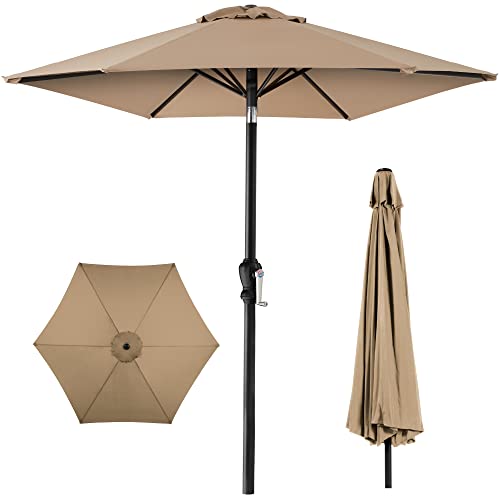
- Best coverage upgrade: Best Choice Products 10ft Market Patio Umbrella — Check on Amazon
- Sunnyglade 9′ Solar LED Patio Umbrella with 24 Lights — Check on Amazon
- Best Choice Products 7.5ft Solar LED Market Patio Umbrella — Check on Amazon
- Blissun 7.5 ft Solar Umbrella with 18 LED Lights — Check on Amazon
- JEAREY 9′ Patio Umbrella with Solar Lights — Check on Amazon
- Blissun 9′ Outdoor Patio Umbrella with 8 Ribs — Check on Amazon
Read the full guide ↓
Disclosure: As an Amazon Associate, dailyhomedecorating.com earns from qualifying purchases. Links to Amazon on this page are affiliate links; they cost you nothing extra. Listing details such as price and availability change often, so check the current Amazon listing before you buy.
Shopping for the best patio umbrella for backyards under $75 raises the obvious question: what does the extra money actually buy over the under-$50 tier? The honest answer is three specific upgrades, and this guide is organised around them. The first is size — a genuine 10-foot canopy enters the chat, and with it real shade for a six-person table with elbow room. The second is light: solar LED umbrellas, which turn the umbrella from a daytime appliance into the ceiling of your evening yard, live in this tier. The third is depth of choice in the 9-foot class — better-known brands, eight-rib frames, and solar versions of proven designs. What the extra money does not buy is equally important: it does not buy a base, which remains a separate and non-negotiable purchase for every pick here, and it does not buy storm-proofing, because no umbrella under $75 — or under several hundred — is a leave-it-open-in-a-gale product. Buyers who understand both halves of that sentence will spend this budget very well.
A backyard, specifically, is where these upgrades earn their keep. Backyards are the largest, most varied outdoor spaces most homes have: a dining patio, a lawn with loungers, a pool surround, a grill station, often all four in one property, with sun that crosses the whole plot between morning and evening. A 10-foot canopy over the table changes what a family dinner feels like; a solar umbrella over the loungers changes whether the yard gets used after 8 p.m. at all. The picks below were ranked for that multi-zone backyard reality — which is why this guide contains both the biggest canopy the budget allows and the lighted umbrellas that extend the yard’s day, alongside one deliberately unglamorous pick: the best plain 9-footer from the tier below, carried up because some backyards need strength and simplicity more than they need features.
The base warning bears repeating at this tier because the stakes grow with the canopies. A 10-foot umbrella is a bigger sail than a 9-foot one, and a solar umbrella carries a panel and battery at its crown; both facts argue for a properly weighted base, sited on the patio slab or deck rather than grass, and for the household habit that protects every umbrella in this guide: crank it closed when you go in for the night. The owners who get five summers from a $75 umbrella are not lucky — they are simply the ones who close it. Every pick below cranks and tilts, every pick was verified against its current Amazon listing through the Amazon Creators API, and every pick was screened against US CPSC recall records — a check that matters doubly for the solar models, given that the category’s one famous recall involved a lighted umbrella from another maker with an overheating battery. None of the umbrellas in this guide is a recalled product.
The short version: backyard owners who seat six should start with the Best Choice Products 10-foot market umbrella, the coverage king of this budget — check price on Amazon. Owners whose yard comes alive in the evening should take a solar pick — the Sunnyglade 9-foot for a lit table, the compact Blissun for a lit corner. And owners in open, windy country should consider the eight-rib Blissun 9-footer, the strongest plain frame here, and put the savings toward the heaviest base in the yard’s history. The reviews give each pick its full case and its honest limits; the sections after them cover sizing, solar care, bases and the mistakes that waste a $75 budget.
In this guide
Quick Picks: the best patio umbrella for backyards under $75
Short on time, or comparing several options at once? Each row below names a backyard situation and the umbrella that suits it, with a link to the listing.
| Backyard situation | Pick | Why it stands out | Link |
|---|---|---|---|
| Best coverage | Best Choice Products 10ft Market Umbrella | A full 10 ft of canopy for six-person tables — check price on Amazon | Check on Amazon |
| Best for evenings | Sunnyglade 9′ Solar LED Umbrella | 24 solar lights on 8 ribs over a full-size table canopy | Check on Amazon |
| Best solar value | Best Choice Products 7.5ft Solar LED Umbrella | An established brand’s lighted umbrella at the tier’s friendly end | Check on Amazon |
| Best compact solar | Blissun 7.5 ft Solar Umbrella | 18 rib lights on a manageable canopy for corners and loungers | Check on Amazon |
| Best 9 ft solar alternative | JEAREY 9′ Solar Umbrella | Full-size lighted canopy with 8 ribs, tilt and crank | Check on Amazon |
| Best plain and strong | Blissun 9′ Outdoor Patio Umbrella | The eight-rib workhorse for owners who skip the lights | Check on Amazon |
How the picks were chosen
The filters began as they do throughout this series: the umbrella itself — never including a base at these prices — had to sit credibly inside the under-$75 band on its current Amazon listing, verified through the Amazon Creators API; every pick had to crank open and tilt; and every pick passed a US CPSC recall screen before it was allowed onto the list, with recalled models excluded outright. The recall screen deserves its sentence here, because four of these six picks are solar models and the category’s known recall was precisely a solar umbrella — a different make, sold through a warehouse club, whose lithium battery could overheat. The four solar umbrellas below are different products from different makers with no recall, and their lighting systems are small rib-mounted LED arrays; even so, the care guidance in this guide — store dry, keep the panel clean, never charge a solar umbrella’s battery indoors with third-party adapters — is written with that history in mind.
Backyard ranking at this tier then weighed three things the $50 guide weighed less. First, coverage per zone: a backyard is not one seating area but several, so canopy size was judged against real furniture — a 10-foot canopy for the six-person table, 9-foot canopies for four-to-six, 7.5-foot solar canopies for the lounger pair or the grill corner. Second, evening value: a backyard umbrella that lights itself extends the usable day of the entire property, and at this tier that feature is finally affordable without gutting the frame budget, so four picks carry it. Third, frame honesty at larger sizes: a 10-foot canopy multiplies wind load, so the biggest pick here comes from an established brand with a track record, and the strongest plain frame — eight ribs — anchors the non-solar end of the list. What was not rewarded: headline features that do not survive contact with a backyard, such as decorative fringe on a 10-foot sail, or a 10-foot canopy on a six-rib frame, a combination this guide deliberately avoided.
The six picks divide by job. One maximises coverage, three bring light at descending sizes and prices, one offers full-size solar value from a younger brand, and one is the plain strong umbrella for owners who would rather spend on base weight than on LEDs. Read them by the zone you are shading — table, loungers, pool, corner — and the right pick usually names itself.
Detailed reviews
The six reviews below are written zone by zone, because that is how backyards are actually used and how this tier’s money should be spent. As you read, keep your own yard’s map in mind — where the table sits, where the loungers live, where the sun enters in the morning and where it glares from at dinner, and which corner of the property goes dark and unused every evening at eight. Each pick below is the best answer to one of those mapped problems at this budget, and each review is explicit about the problem it does not solve. An umbrella chosen against a real map of a real yard will satisfy for years; one chosen against a listing photograph will satisfy until the first Saturday.
Best Choice Products 10ft Market Patio Umbrella — best coverage upgrade
Who it suits. Backyard owners whose table seats six and whose current 9-footer leaves the end chairs in the sun by mid-afternoon — the single most common upgrade story in this category. Also the pick for new patio sets bought big, where the umbrella needs to match furniture that has already committed to a scale.
What you get. A 10-foot market canopy with six sturdy ribs, push-button tilt, crank lift and a UV-resistant canopy, from an established US outdoor brand. The extra foot over a 9-footer sounds marginal and is not: canopy area grows with the square of the radius, so the 10-foot throws roughly a quarter more shade than the 9-foot — in practice, the difference between four comfortable seats and six, between a shade pool that covers the table and one that covers the table plus the people leaning back from it. The tilt extends that coverage into the evening, when low sun otherwise evicts the west-facing half of the table.
Pros. Coverage is the whole case and it is decisive for big-table households. The brand behind it brings a real support channel and years of volume sales, which matters more as canopies grow and forces rise. The UV-resistant canopy suits the sun-blasted yards where big tables live. The market profile — no valance, clean lines — scales gracefully; a 10-foot umbrella is a presence in any yard, and this one looks like furniture rather than equipment.
Honest limitation. A 10-foot sail is a serious wind instrument: it needs the heaviest base in this guide — think in terms of the top of the backyard range, through-table bracing wherever possible — and the strictest closing discipline. Its six-rib frame is adequate for the size in normal service but this is not the pick for an exposed hilltop plot; windy-country owners should take the eight-rib Blissun below and accept 9 feet. Storage, too, scales with size: confirm the garage corner before ordering. And the base, needless to say by now, is a separate purchase.
Choose it if your table seats six and your yard is reasonably sheltered. Skip it if your plot is open and gusty, or your table seats four — where a 9-foot solar pick gives you light instead of surplus canvas.
Sunnyglade 9′ Solar LED Patio Umbrella — best for backyard evenings
Who it suits. Households whose backyard peaks after dinner: summer evenings around the table, cards, drinks, the conversation that runs to ten. If your yard’s problem is that the party moves indoors at dusk for want of light, this umbrella is the fix that also happens to be a full-size shade.
What you get. Sunnyglade’s 9-foot market platform — eight ribs, crank lift, push-button tilt, fade-resistant canopy — with 24 solar-powered LED lights set into the ribs and a solar panel at the crown. By day it is a mainstream 9-foot table umbrella with the strongest rib count in the solar class; by night the ribs glow downward onto the table, warm and even, with no cord to the house, no outlet to fight over and no separate lighting rig to store. The panel charges during the same hours the canopy is shading you, a small closed loop of backyard logic that never stops being satisfying.
Pros. The combination is the value: one purchase covers the two shifts a backyard umbrella can work, on a frame — eight ribs — that does not ask you to trade strength for sparkle. Light quality is genuinely social, from above and all around, flattering to faces and food. Sunnyglade’s parts ecosystem applies here too, so the canopy side of the umbrella has a future even as the electronics age. For households that entertain outdoors weekly, this is the pick that changes habits, not just shade.
Honest limitation. The LED system is the component with the shortest lifespan in the umbrella — solar batteries fade over seasons — so value it as a strong multi-year feature, and store the umbrella dry in winter to protect the wiring. A deeply tree-shaded yard will undercharge the panel; if your canopy lives under oaks, expect a dimmer evening or choose a plain pick. The solar panel also wants an occasional wipe — pollen film is a charger tax. None of this diminishes the daytime umbrella, which stands comparison with any 9-footer here.
Choose it if your table hosts evenings and your yard gets real sun by day. Skip it if your yard is shaded by trees around the clock, or if you want maximum wind strength above all — the plain eight-rib Blissun is your umbrella.
Best Choice Products 7.5ft Solar LED Market Patio Umbrella — best solar value
Who it suits. Backyard owners who want the lit-evening effect at the friendliest spend in the tier, over a four-person table, a pair of loungers or the grill corner — and who prefer an established brand’s name on the box.
What you get. A 7.5-foot market umbrella with six sturdy ribs, push-button tilt, crank lift, UV-resistant fabric and solar LED lighting. Seven and a half feet is the connoisseur’s size for a second zone: big enough to shade four at a compact table or two loungers generously, small enough to base modestly, move easily and store without a campaign. With lights aboard, it becomes the backyard’s evening room — the spot the household drifts to after dinner because it is, quite literally, lit for them.
Pros. Price-to-effect is superb: this is the least expensive route in the guide to a brand-backed solar umbrella, and the effect — a glowing canopy over your evening seat — punches far above the spend. The brand’s support and sales history de-risk the electronics as much as anything can at this price. The UV-resistant canopy suits the sunny corners where a second umbrella usually stands. Handling is one-person throughout, from spring setup to winter storage.
Honest limitation. It will not shade a six-person table, and owners who buy it hoping otherwise will join the long line of hosts who learned that canopy size is physics, not optimism. The LED lifespan caveat applies as to all solar picks. Through a table it behaves best; freestanding beside loungers it wants a properly weighted base like everything else here. If your main table is the problem, buy the 10-footer or the 9-foot solar and let this one’s smaller stage go to someone else’s yard.
Choose it if you want evening light over a four-person zone at the tier’s gentle end. Skip it if your main table seats six — coverage first, lights second.
Blissun 7.5 ft Solar Umbrella with 18 LED Lights — best compact solar
Who it suits. Backyard owners shading a defined smaller zone — the lounger pair by the pool, the reading bench, the two-chair fire-pit circle — who want that zone to stay alive after sunset without running power across the yard.
What you get. A 7.5-foot market umbrella carrying 18 solar LED lights on its ribs, with push-button tilt and crank lift. Blissun’s version of the compact solar formula leans on simplicity: the lights trace the ribs so the canopy’s underside glows as a structure, the tilt does the low-sun work in the early evening, and the whole package stays light enough to reposition as the yard’s social centre moves with the seasons — by the pool in June, by the fire pit in September.
Pros. Mobility plus light is a combination unique in this guide: most solar umbrellas get planted for the season, while this one can plausibly follow the household around the yard. The 18-light array is ample for a two-to-four-person zone. Blissun’s canopy colour range is wide, so the second-zone umbrella can either match the main table’s or deliberately contrast with it. The price sits at the friendly end of the tier, which suits a pick that is, for many yards, an addition rather than the main event.
Honest limitation. Zone-sized means zone-limited: it shades its corner beautifully and the rest of the yard not at all, so buy it as a complement to a main umbrella, not a substitute for one. Solar charging needs daylight on the panel — a corner chosen for being shady all day is, paradoxically, a poor home for a solar umbrella. The brand is Amazon-native, with support through the listing. And the base is, as ever, separate.
Choose it if a specific corner of your yard deserves light and shade in one object. Skip it if you need one umbrella to do the whole yard — start with the 10-footer or the 9-foot solar instead.
JEAREY 9′ Patio Umbrella with Solar Lights — best full-size solar alternative
Who it suits. Buyers who want the Sunnyglade solar formula — full 9-foot canopy, lights, eight ribs — and are happy to take it from a younger value brand, perhaps as a second lit umbrella to match an existing main one, or as the main umbrella in a yard where the budget is being shared with a serious base.
What you get. A 9-foot market umbrella with solar LED lighting, eight sturdy ribs, crank lift and push-button tilt, and a polyester canopy with UV protection and water resistance. The specification sheet reads like the tier’s ideal: full table size, full rib count, lights for the evening, and nothing exotic in the mechanism for a guest to defeat. JEAREY’s plain 9-footer earned its place in the under-$50 guide on exactly this formula; the solar version is that umbrella grown into the evening.
Pros. Full-size solar coverage at a value brand’s price is the headline — hosts who need the 9-foot table shaded and lit, and who would rather allocate the difference to base weight, will find this the most rational spend in the guide. The eight-rib frame keeps the canopy taut and even, which matters more, not less, when lights trace the ribs at night. Colour availability is broad. As a matched second solar umbrella across a big yard from the main one, it has no real rival here.
Honest limitation. The younger brand caveat applies in full: long-term parts support is unproven, so regard this as strong value for its working life rather than a decade-long platform. The LED system shares the class caveats — charge it with real sun, store it dry, expect the battery to age. And a 9-foot solar canopy wants a 9-foot umbrella’s base: budget the ballast honestly, especially freestanding.
Choose it if you want full-size solar shade and your priorities run value-first. Skip it if brand heritage matters more than the saving — the Sunnyglade solar above is the same idea from the category’s veteran name.
Blissun 9′ Outdoor Patio Umbrella — best plain and strong
Who it suits. Backyard owners in open country, on hilltops, beside water — anywhere the wind has a vote — and owners everywhere who simply do not want lights: the umbrella as a strong, plain tool, bought once and used hard.
What you get. A 9-foot market umbrella on eight sturdy ribs with push-button tilt and crank lift, carried up from the under-$50 guide because at $75 it remains, for a certain buyer, the smartest money in either tier. The eight-rib frame spreads gust loads across more joints than any six-rib rival, holds the canopy drum-taut so shade stays even through a breezy afternoon, and asks for nothing — no charging, no panel cleaning, no electronics to age. In a guide full of upgrades, this is the pick that argues some backyards should upgrade their base and their habits instead, and keep the umbrella simple.
Pros. Frame strength per dollar is unbeatable across both tiers. The taut, even canopy is the best pure shade here. There is nothing aboard to fail except the mechanism every pick shares, and that mechanism is the proven crank-and-button pattern. Money not spent on LEDs is money available for the heavy base this umbrella deserves in an exposed yard — an allocation this guide endorses without reservation.
Honest limitation. When the sun sets, its shift ends — evening households will light the yard some other way or choose a solar sibling. The steel frame is the heaviest here to move and wants a seasonal glance at its joints for coating chips. It is also, deliberately, the least exciting pick in the guide: owners who want their $75 to feel like an upgrade in the hand, not just in the wind, may prefer the solar Sunnyglade’s extra trick.
Choose it if wind is your yard’s defining weather and simplicity is your preference. Skip it if evenings are your yard’s defining hour — that is what the solar picks are for.
Comparison table
| Pick | Canopy size | Ribs | Lighting | Best for |
|---|---|---|---|---|
| Best Choice Products 10ft | 10 ft | 6 | None | Six-person tables, max coverage |
| Sunnyglade 9′ Solar | 9 ft | 8 | 24 solar LED | Evening tables |
| Best Choice Products 7.5ft Solar | 7.5 ft | 6 | Solar LED | Solar value, four-person zones |
| Blissun 7.5 ft Solar | 7.5 ft | Market frame | 18 solar LED | Poolside and corner zones |
| JEAREY 9′ Solar | 9 ft | 8 | Solar LED | Full-size solar value |
| Blissun 9′ | 9 ft | 8 | None | Windy yards, plain strength |
How to choose a backyard patio umbrella under $75
Decide what the extra money is for — before you shop. This tier sells three different upgrades wearing one price tag: coverage (the 10-footer), evening (the solar picks) and refinement (brand and frame depth in the 9-foot class). A household can only spend the same dollars once, so name your yard’s actual deficiency first. If guests bake at the table’s ends at 4 p.m., that is a coverage problem and lights will not fix it. If the yard empties at dusk, that is an evening problem and a bigger canopy will not fix it. The most common $75 mistake is buying the upgrade that photographs best instead of the one the yard asked for.
Size by seats, then check the sail. The working ladder for backyards: 7.5 feet shades four at a compact table or two loungers; 9 feet shades four to six at a standard table; 10 feet shades six properly, with margin for leaning back. Then run the second check — every step up in size is a step up in wind load, base requirement and storage bulk. A 10-foot canopy on an exposed plot is a liability wearing a bargain’s clothes; the same canopy on a sheltered patio with a serious base is the best seat in the house. Buy the largest size your yard’s shelter, not your ambition, supports.
If you go solar, site for the panel. A solar umbrella is two products sharing a pole, and the second product — the charger — needs direct sun for a good part of the day. Place it where the crown sees open sky at midday, keep the panel wiped of pollen, and expect the best light in the weeks after the longest days. Under heavy tree cover, be honest: choose a plain umbrella and light the evening with something that plugs in or burns, rather than paying for LEDs that will spend the summer undercharged.
Weight the base for the biggest canopy you bought. No pick here includes a base, and the ballast ladder rises with size: a 7.5-foot canopy through a table behaves on a moderate base; a 9-foot wants a solid one; a 10-foot wants the heaviest base in this guide’s world, through-table bracing wherever the layout allows, and a slab or deck beneath rather than grass. Fillable bases filled with sand give the most hold per dollar. Remember that a base is a ten-year purchase that will outlive umbrellas — buy it like one.
Poolside buyers: add two checks. Around a pool, the umbrella lives with chlorine splash, wet concrete and afternoon gusts that come off open water with nothing to slow them. Favour aluminium or well-coated poles — the solar Sunnyglade’s family is at home here — rinse the crank and pole at season’s end, and site the canopy so its tilt cannot dip fabric into the water or shade the lifeguard chair you actually sit in. Weight the base generously: pool decks are open slabs, and an umbrella that travels on a pool deck travels toward the water. The compact Blissun solar, planted by the loungers, is this guide’s natural poolside pick precisely because it combines modest sail, evening light for night swims, and a price that forgives the harder life.
Keep the closing covenant. It is repeated in every guide in this series because it is the single variable that decides lifespan: umbrellas die open and unattended, in weather, at night. At this tier the covenant matters more, not less — bigger sails, crown-mounted panels and higher prices all raise the cost of the one storm you sleep through. Crank closed at bedtime, tie the canopy, and your $75 umbrella becomes a five-summer fixture instead of a one-season story.
A season with an under-$75 umbrella: what ownership actually looks like
Spring is for inspection, not just unveiling. When the umbrella comes out of storage, open it slowly the first time and look at the things winter hides: the crank cord for fraying, the tilt button for grit, the ribs for any bend that crept in last autumn, and — on solar models — the panel for film and the lights for a full evening’s test before the first party depends on them. Five minutes of spring honesty converts most mid-summer failures into early, cheap fixes, and it is the moment to touch up any chipped coating on steel parts before the season’s humidity finds the bare metal.
Summer is for rhythm. The households that love these umbrellas run a simple loop: open in the morning when the yard’s day starts, tilt as the sun walks, close at night when the household goes in. Solar owners add a weekly panel wipe to the loop — ten seconds with a damp cloth while the canopy is open — and are repaid with visibly brighter evenings. Nothing in the loop is maintenance in the heavy sense; it is closer to the way you treat a good grill, and it is the entire difference between equipment that ages in dog years and equipment that is simply, unremarkably, there every summer.
Autumn is for putting it away like you mean it. Wash the canopy with mild soap and water on a calm day, rinse it, and let it dry fully open — hours, not minutes — before closing and tying it. A canopy stored damp returns in spring wearing mildew spots that no amount of scrubbing fully forgives. Solar models should go into storage clean and dry, ideally where the panel can catch occasional light. The base, which will outlive several umbrellas, wants its drain hole checked and its fill — if it is a fillable — left full of sand rather than water anywhere a freeze is possible. Do this once, properly, and spring’s inspection becomes a formality instead of an inquest.
And the years are for perspective. A well-kept umbrella from this tier is a multi-summer fixture whose canopy will fade gradually and whose lights, if it has them, will soften slowly — ageing, not failing. The replacement-canopy ecosystem around the bigger brands means a tired canopy in year four can be a refresh rather than a re-buy. Owners who understand that arc — strong years, graceful ageing, cheap renewal — consistently report these umbrellas among the best-value objects in their yards. Owners who expected a $75 umbrella to behave like a $700 contract-grade installation wrote the angry reviews. This guide has tried, in every section, to put you in the first group.
Common mistakes
Buying the 10-footer for a windy plot. Coverage is seductive and sail area is physics. On exposed land the 10-foot canopy will spend its life closed against the very afternoons it was bought for, while the 9-foot eight-rib umbrella next door works daily. Match the canopy to the shelter, not the table alone.
Paying for solar and planting it in shade. A solar umbrella under a mature oak is a plain umbrella with a dead panel. If the crown cannot see the sky, the lights cannot do their job — choose the plain pick and spend the difference on the base.
Under-basing the upgrade. Owners step up a canopy size and keep the old tier’s base, then blame the umbrella when the bigger sail walks it across the patio. Ballast must scale with canvas: new size, new base maths, every time.
Storing solar umbrellas wet or in the dark all winter. Damp storage corrodes contacts and mildews canopies; months in a dark garage also leave the battery flat and ageing. Dry the canopy fully, store the umbrella somewhere dry, and let the panel see daylight occasionally if the storage spot allows — or accept a dimmer first evening in spring while it recovers.
Expecting any umbrella here to be a storm product. The $75 tier buys size, light and refinement — not a new relationship with the weather. Every pick in this guide, babied, will outlast several summers; every pick, left open in a gale, can be destroyed by the first one. The tier changes the features, never the physics.
Forgetting that the base is also furniture. At this tier the umbrella often gets chosen with care and the base as an afterthought, yet the base is the part guests see at ankle level and trip over in the dark. Choose its profile for the space — flat where feet pass, domed where it hides under a table, finished to match the patio rather than fight it — and the whole installation reads as designed. A considered base also protects the umbrella investment better than any other single decision, which makes its styling a practical matter disguised as an aesthetic one.
Judging the tier by the showroom, not the season. A solar canopy’s lights impress in a listing video and a 10-foot canopy impresses across a showroom floor, but the purchase is actually made of Tuesday afternoons: the crank you turn half-asleep with a coffee in the other hand, the tilt you adjust without standing on a chair, the base you never think about because it never moves. Before ordering, run one ordinary weekday through your imagination with each finalist, not one imaginary garden party — the umbrella that wins the Tuesday is the one still earning its place in year three.
Final recommendation
For the classic six-person backyard table, the Best Choice Products 10-foot is the buy — the coverage upgrade is real, the brand is established, and on a sheltered patio with a serious base it will anchor family summers for years; check price on Amazon. For yards that live after dark, the Sunnyglade 9-foot solar is the most complete umbrella in this guide, and the JEAREY solar its value-priced twin. For windy country, skip the features entirely: the eight-rib Blissun and the heaviest base you can justify will shade more actual afternoons than any lighted canopy that spends them closed. Name your yard’s real deficiency, buy the upgrade that answers it, weight the base like you mean it, and close the canopy at night — that is the whole formula, and at $75 it buys a backyard that works from breakfast to bedtime. It is worth pausing on how much yard that really is: the morning coffee in early shade, the long lunch with every seat covered, the loungers lit and occupied at nine in the evening while the house sits dark behind you. Backyard square footage is the most expensive space most families own, and it is mostly wasted without shade and light. An umbrella chosen this carefully is not really an umbrella purchase at all — it is the recovery of a room you already paid for, at the price of a single family dinner out.
FAQ
What does under $75 buy that under $50 does not?
Three things: access to a true 10-foot canopy for six-person tables, solar LED models that light the yard after dark, and deeper brand and frame choice in the 9-foot class. It does not buy an included base or storm resistance — those remain a separate purchase and a matter of habit respectively, at any price in this range.
Is a 10 ft umbrella too big for a normal backyard?
For a sheltered patio with a six-person table, no — it is the correct size, throwing roughly a quarter more shade than a 9-foot canopy. For small or exposed yards it is too much sail: it will crowd the space, demand a very heavy base and spend windy days closed. Size to the table and the shelter together.
Are solar patio umbrellas safe?
The solar picks in this guide are current models from their makers with no CPSC recall, using small rib-mounted LED systems. The category did see a recall years ago involving a different maker’s warehouse-club umbrella whose battery could overheat, which is why this guide screens every lighted pick against recall records and advises ordinary care: keep the panel clean, store the umbrella dry, and use only the maker’s own charging arrangements.
How heavy a base does a 10 ft umbrella need?
The heaviest in this guide’s range — plan on a substantial base, ideally with the pole also braced through a table, set on a slab or deck. A 9-foot canopy needs a solid mid-to-heavy base and a 7.5-foot a moderate one, with freestanding positions always wanting more than through-table ones. When in doubt, buy the heavier base; it outlasts umbrellas.
Can one umbrella cover both the table and the pool loungers?
Not honestly, even at 10 feet — a single shade pool serves one zone. Backyards with two busy zones do better with a main umbrella over the table and a compact solar pick over the loungers, a combination this tier makes genuinely affordable.
Is a 10 ft umbrella hard to open and close daily?
No — every 10-foot pick here uses a crank, and the daily open-close routine takes seconds once the umbrella is based. What scales with size is not effort but consequence: the bigger canopy catches more wind, so the closing habit and the base weight matter more. If anything, owners of big umbrellas become the most disciplined closers in the neighbourhood, because they can feel what the wind is holding.
Should I choose a solar umbrella or a plain one plus separate lights?
Choose solar when the umbrella stands in open sky and you want zero-install evening light exactly over its own zone — the common backyard case. Choose plain plus separate lighting when the umbrella lives under trees, when you want brighter or warmer light than rib LEDs give, or when the yard already has powered outdoor lighting. Both are legitimate; the mistake is paying for solar and planting it where the panel starves.
How long will a solar umbrella’s lights last?
Expect several seasons of useful light with ordinary care, gradually diminishing as the battery ages — the umbrella itself, frame and canopy, typically outlasts the lighting system. Store it dry in winter and keep the panel clean to get the best of both lifespans.
Related guides
More backyard guides at neighbouring budgets: