Where to buy
Check the latest price, availability and delivery on Amazon. Orders are placed on Amazon. We may earn a commission from qualifying purchases.
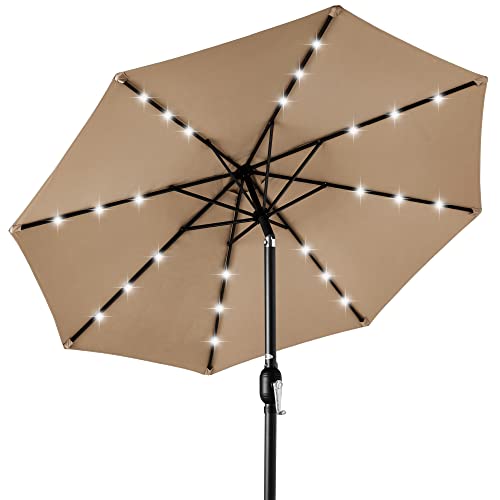
- Best overall: Best Choice Products 10ft Solar LED Market Patio Umbrella, Tan
- Best for evening dining: ABCCANOPY Solar Led Patio Umbrella with 32 Lights, 9FT, Tan
- Best vented canopy: Best Choice Products 10ft 3-Tier Solar LED Market Patio Umbrella, Navy Blue
- Best proven lighted 9-footer: Sunnyglade 9′ Solar LED Patio Umbrella, Light Tan
- Best for windy yards: JEAREY 9FT Outdoor Patio Umbrella, Market Umbrella, Beige
- Best unlit value: Sunnyglade 9′ Patio Umbrella with Crank and Push-Button Tilt
Read the full guide ↓
Disclosure: As an Amazon Associate, dailyhomedecorating.com earns from qualifying purchases. Links to Amazon on this page are affiliate links; they cost you nothing extra. Listing details such as price and availability change often, so check the current Amazon listing before you buy.
The best patio umbrella for backyards under $150 has a different job description from its patio-slab cousins. A backyard is not one outdoor room; it is three or four — the deck by the door, the table on the lawn, the chairs by the pool or the fire pit — and the shade has to work across all of them, in real wind, over grass as often as over boards. Backyard umbrellas live harder lives: they get dragged across lawns, left standing through weather that would send a balcony umbrella indoors, and asked to cover everything from a six-seat dining set to a pair of loungers at the pool’s edge. This guide ranks for that reality. Coverage and wind manners come first, lighting second — because backyard evenings are the best evenings — and portability third, because an umbrella that cannot move between the deck and the lawn will only ever shade one of your outdoor rooms.
The $150 tier is the backyard sweet spot, and the reason is the 10-foot canopy. At $75, umbrellas top out at 9 feet with unlit canopies; at $150 you can buy a 10-foot market umbrella — the size that honestly covers a six-seat table with elbow room — with solar LED lighting in the ribs, a three-tier vented canopy on some models, and frame finishes a step above the budget tier. What $150 still does not include, anywhere, is a base. Backyard bases deserve their own paragraph in every buyer’s plan: on a deck, a weighted base under or beside the table; on grass, a base heavy enough to resist the leverage of a big canopy in a gust, placed on a flat paver or a leveled patch rather than directly on soft turf. Buy the base in the same order as the umbrella, sized for the largest canopy you are buying, and your backyard setup will survive its first thunderstorm with its dignity intact. For the broader tier, including unlit options at every size, see our guide to the Best Patio Umbrella Under $150.
Our backyard ranking weighs shade coverage first — diameter, tilt and how the canopy behaves at the low angles of a long evening — then wind construction: rib count, venting, frame material. Lighting comes third, judged on whether it turns the umbrella into an evening fixture without cords across the grass. Portability and storage round out the scoring, because backyard umbrellas winter in sheds and garages and travel in pieces. The short version: most backyard owners should start with the Best Choice Products 10-foot solar market umbrella, the size-and-light benchmark of the tier — check price on Amazon. Owners in genuinely windy yards should weight the JEAREY’s iron frame more heavily than its missing lights. And anyone furnishing a deck dining set first and a lawn second should consider the ABCCANOPY or the three-tier Best Choice Products, which trade a foot of span for better venting and brighter evenings.
In this guide
Quick Picks
Short on time, or comparing several options at once? Each row below names a backyard situation and the umbrella that suits it.
| Situation | Pick | Why it stands out | Link |
|---|---|---|---|
| Best overall | Best Choice Products 10ft Solar LED Market Umbrella | 10 ft canopy, 24 solar LEDs, tilt and crank — check price on Amazon | Check on Amazon |
| Best for evening dining | ABCCANOPY 9FT Solar LED Umbrella | 32 solar lights, 45-degree tilt, wind vent — check price on Amazon | Check on Amazon |
| Best vented canopy | Best Choice Products 10ft 3-Tier Solar LED Umbrella | Three-tier venting sheds heat and gusts — check price on Amazon | Check on Amazon |
| Best proven lighted 9-footer | Sunnyglade 9′ Solar LED Umbrella | 24 LEDs, aluminum pole, eight ribs — check price on Amazon | Check on Amazon |
| Best for windy yards | JEAREY 9FT Outdoor Patio Umbrella | Iron frame, double vent, unlit and sturdy — check price on Amazon | Check on Amazon |
| Best unlit value | Sunnyglade 9′ Patio Umbrella | The proven budget canopy, a tier up in budget — check price on Amazon | Check on Amazon |
How These Picks Were Chosen
We built this list from the backyard outward. Candidates had to be market umbrellas sold on Amazon, 9 or 10 feet across, with crank lift and tilt — the two mechanisms that survive being operated by everyone in the family — and construction suited to outdoor exposure: at least eight ribs on the full-size models, a vented canopy, and a pole finish that tolerates weather. Every pick was cross-checked against the Amazon Creators API on 2026-11-20, with the API-returned title matched to the product before its ASIN was used, and specifications were confirmed against manufacturer listings, manuals and independent roundups. All six picks in this guide are linked picks; there are no prose-only entries here, because the API-confirmed set for the backyard brief was complete.
Price positioning was sanity-checked internally against recent sightings — listing coverage, retailer pages and manuals — so that each pick genuinely trades inside the under-$150 tier; the article describes positioning in words and prints no product prices, and it contains no fixed ratings or review counts. Safety screening included a CPSC recall search for every brand named: the patio umbrella recalls on file involve other brands entirely — a warehouse-club solar model recalled over a battery fire hazard, a premium Belgian cantilever line, and older big-box models — and none of the picks below is subject to a CPSC recall we could find. The recalled brands are not named or recommended anywhere in this guide. One category note: we excluded cantilever umbrellas deliberately. At $150, offset models exist, but their cross bases are at their best on a fixed deck corner, and this guide optimizes for umbrellas that can work the whole yard — table, lawn and poolside — from a standard base.
Best Patio Umbrella for Backyards Under $150: The 6 Picks
Best Choice Products 10ft Solar LED Market Patio Umbrella, Tan
Who it suits. The backyard’s main stage: a six-seat dining table on a deck or patio, in a yard where evenings run long and the umbrella is expected to be both roof and lamp.
Size is the headline and it is a real one. A 10-foot canopy covers the table class that 9-footers serve tightly — six chairs with room for serving dishes, elbows and the occasional standing host — and Best Choice Products builds it as a complete market umbrella: eight sturdy ribs, a push-button tilt, a crank lift, UV-resistant fabric in the maker’s description, and 24 solar-powered LED lights along the ribs that independent coverage credits with roughly six to seven hours of light on a charge. In a backyard, that lighting changes the umbrella’s shift pattern: it stops being daytime equipment and becomes the ceiling of the evening room, with no cord snaking across the deck for bare feet and dog paws to find. The tan colorway is the diplomatic choice for a big canopy — a 10-foot umbrella is a visual event in a yard, and neutrals age more gracefully against fences and planting. Assembly is the familiar two-section pole; the base, as always, is separate, and for a canopy this size it should be a serious one, particularly in any freestanding position off the deck.
Pros. Largest coverage in the guide with light included; eight-rib frame and full tilt-and-crank operation; solar light with no wiring across the yard; color range beyond the tan listed here, per the current listing.
Honest limitation. A 10-foot canopy is a 10-foot sail: it needs the heaviest base discipline in this guide and the quickest closing hand when weather turns. The LEDs are ambience, not floodlighting, and the umbrella’s size makes it the least casual pick here to move between zones — plan its home base rather than planning to carry it daily.
Choose it if one umbrella must anchor a dining deck and light it too. Skip it if your yard is small or wind-scoured — the 9-foot picks will behave better. Check on Amazon — and if your yard’s other anchor is a fire feature, our Best Fire Pit For Backyards Under $150 guide covers the backyard-scale options.
ABCCANOPY Solar Led Patio Umbrella with 32 Lights, 9FT, Tan
Who it suits. Backyard hosts whose signature event is dinner after dark — the long table, the string of evenings all summer — on a deck or lawn corner that functions as an outdoor dining room.
With 32 solar LED lights, four on each of eight heavy-duty ribs, this is the brightest built-in lighting in the guide, and ABCCANOPY surrounds it with the right supporting specification: a 9-foot fade- and UV-resistant polyester canopy, a wind vent at the crown, a crank lift, and a tilt the maker rates to 45 degrees — the widest stated tilt here, and the one that keeps a west-facing dinner table shaded through the whole golden hour. The brand’s manual for this umbrella family claims a long overnight runtime for the lights; treat that as a maker’s figure, but even discounted, the practical report from coverage of this model is a full evening’s glow from a day’s sun. In a backyard the 9-foot span is sometimes the smarter size even when 10 feet fits: it leaves air around the table, catches less wind, and pairs naturally with a second shade zone elsewhere in the yard rather than trying to be the only one.
Pros. Brightest integrated lighting in the guide; wide stated tilt range; vented canopy on heavy-duty ribs; thorough maker documentation; top-of-tier finish without leaving the tier.
Honest limitation. It sits toward the top of the tier, so the base must be budgeted with discipline. Solar runtime depends on the panel actually receiving sun — a canopy parked under a tree all day will light like it. Base sold separately.
Choose it if evening dining is your backyard’s main event. Skip it if raw coverage matters more than light — the 10-foot Best Choice Products above — or if your table sits in day-long shade. Check on Amazon for the current listing and colors.
Best Choice Products 10ft 3-Tier Solar LED Market Patio Umbrella, Navy Blue
Who it suits. Hot, still yards and low-altitude sun country: anywhere the air pools under a canopy at midday and a standard vent feels like a token gesture.
The three-tier canopy is this umbrella’s thesis. Instead of a single vent at the crown, the canopy is built in stacked tiers that let hot air rise out and gust pressure bleed off across the whole roof — the same principle as a pagoda roof, applied to a 10-foot market umbrella with eight ribs, push-button tilt, crank lift and solar LED lighting. Under a crowded table in August, the difference between a vented and a three-tier canopy is the difference between shade that feels like a room and shade that feels like a lid. The navy colorway listed here is the classic backyard choice — dark canopies glare less from below and hide pollen well — and the 10-foot span matches the guide’s top pick for dining coverage. For yards where wind arrives in gusts rather than a steady push, the tiered roof is also the calmer structure: pressure escapes instead of accumulating, so the canopy shudders less and the ribs work less hard.
Pros. Best heat and gust venting in the guide; full 10-foot dining coverage; solar lighting included; dark canopy option that flatters evening use.
Honest limitation. The tiered canopy has more seams and more fabric to keep clean, and it is the most visually assertive design here — a look not every yard wants. Same 10-foot base and closing discipline as the top pick. Base sold separately.
Choose it if heat build-up under the canopy is your known problem. Skip it if you prefer the classic single-canopy silhouette or your yard is breezy enough that venting is already adequate. Check on Amazon to confirm the current colorways. Homeowners planning the whole yard at once may also like the Best Patio Umbrella For Homeowners Under $150 rankings.
Sunnyglade 9′ Solar LED Patio Umbrella, Light Tan
Who it suits. The mobile backyard: owners who move shade between the deck table at lunch and the lawn loungers at four, and who want lights without giving up a light carry.
Sunnyglade’s solar model keeps the family’s virtues — a 9-foot canopy over eight ribs, an aluminum pole of about 1.5 inches that will not rust and keeps weight down, crank lift, push-button tilt, a vented fade-resistant polyester canopy — and adds 24 solar LEDs, three per rib, which independent coverage describes as running about six hours per charge. In backyard terms this is the balanced tool: enough canopy for a four-to-six-seat table, enough light for the evening, and a carry weight that makes the deck-to-lawn relocation a one-person, one-trip job rather than a negotiation. The aluminum pole matters more in backyards than anywhere: it will be rained on, leaned against sheds and stored in damp garages, and aluminum simply declines to rust through all of it. If your yard’s umbrella leads an itinerant life, this is the pick built for the itinerary.
Pros. Light, rust-proof and genuinely portable for a lighted 9-footer; proven family design; balanced price positioning within the tier; six-hour class evening light.
Honest limitation. Fewer LEDs and a smaller span than the two picks above it — it is the versatile choice, not the maximal one. Polyester canopy care rules apply as everywhere here. Base sold separately.
Choose it if your shade changes location with the day’s plan. Skip it if the umbrella will live permanently over one big table — buy the coverage instead. Check on Amazon for current availability.
JEAREY 9FT Outdoor Patio Umbrella, Market Umbrella, Beige
Who it suits. Wind-country backyards: open lots, hilltop yards, prairie and coastal properties where the breeze is a daily fact and an umbrella’s first job is to stay composed.
JEAREY builds this 9-footer around a powder-coated iron pole and eight iron ribs — heavier metal than the aluminum picks, chosen for stiffness — under a high-density polyester canopy with a double-layer vent that bleeds heat and gust pressure. It has no lights, and in this guide that is a deliberate placement rather than an omission: the money here is in the frame, and for a yard where lighter umbrellas spend the summer rattling, frame money is the right money. The crank and push-button tilt are the standard, guest-proof pairing, and the maker is direct about the base being separate, even pointing to its own matched base. The iron bargain must be stated whole: keep the powder coat intact and store it dry, because chipped iron in a damp shed will rust where aluminum would not. For a fixed position — the dining corner that does not move — that maintenance is trivial and the composure is daily.
Pros. Steadiest frame feel in the guide; double vent for gusty, hot yards; dense canopy fabric; honest maker guidance on base pairing.
Honest limitation. No lights, the heaviest carry here, and iron asks for coating care. If your evenings are the main event, the lighted picks serve you better.
Choose it if wind defines your yard and the umbrella’s post is permanent. Skip it if you move shade often or want light built in. Check on Amazon for the current listing. For a permanent shade structure instead, see the Best Gazebo For Backyards Under $150.
Sunnyglade 9′ Patio Umbrella with Crank and Push-Button Tilt
Who it suits. The value-minded backyard owner — often furnishing a first house — who needs honest shade now and would rather keep the tier’s difference for a second umbrella, a better base, or the rest of the yard.
Nothing about this umbrella is a compromise except its lack of lights: a 9-foot polyester canopy over eight ribs, an aluminum pole around 1.5 inches, crank lift, push-button tilt, a vented top, and a weight under ten pounds that makes it the easiest full-size canopy here to deploy, move and store. Its sightings place it at the lower end of this tier and below it — it is a $75-class umbrella that a $150 budget buys with money left over, which is precisely its backyard strategy. Two of these — one on the deck, one by the lawn chairs — give a yard zoned shade that a single 10-foot umbrella cannot match, at a combined spend this tier can hold. For owners building a yard piece by piece, that arithmetic is the recommendation.
Pros. Proven design at the tier’s value end; lightest full-size carry; aluminum pole shrugs off weather and storage; enables the two-umbrella zoning strategy.
Honest limitation. No built-in light; polyester fades over seasons; base sold separately — and if you buy two, that is two bases to budget.
Choose it if coverage-per-dollar and flexibility top your list. Skip it if you want one flagship umbrella with light included. Check on Amazon — and note the sibling guide for the same umbrella at its home tier, the Best Patio Umbrella For Backyards Under $75.
Comparison Table
| Pick | Canopy | Lights | Frame note | Best for |
|---|---|---|---|---|
| BCP 10ft Solar Market | 10 ft, UV-resistant per maker | 24 solar LED | 8 ribs, tilt and crank | Main dining decks |
| ABCCANOPY 9FT Solar | 9 ft polyester, vented | 32 solar LED | 8 heavy-duty ribs, 45° tilt per maker | Evening dining |
| BCP 10ft 3-Tier Solar | 10 ft, three-tier vented | Solar LED | 8 ribs, tilt and crank | Hot, still yards |
| Sunnyglade 9′ Solar LED | 9 ft polyester, vented | 24 solar LED | Aluminum pole, 8 ribs | Moving shade zones |
| JEAREY 9FT | 9 ft polyester, double vent | None | Iron pole and ribs | Windy yards |
| Sunnyglade 9′ | 9 ft polyester, vented | None | Aluminum pole, 8 ribs | Value and zoning |
How to Choose a Patio Umbrella for a Backyard
Zone the yard before you size the umbrella. Walk the yard at the hours you use it and mark where shade is actually wanted: the table, the loungers, the pool’s shallow-end chairs, the grill cook’s station. Most backyards want one anchor umbrella over the dining zone and freedom to add a second, smaller zone later — which is why this guide values a strong 9-foot portable as highly as the 10-foot anchor.
Match the base to the surface. On a deck or patio slab, a weighted base under or beside the table is standard. On grass, never plant a base directly on soft turf: level a paver or a compacted pad first, and go heavier than the deck equivalent, because a lawn gives a tipping base no resistance. A canopy of 10 feet freestanding in the open wants the most serious base in this guide — treat the maker’s freestanding recommendation as a minimum.
Take wind personally. Every yard has a prevailing direction and a gust personality. Vented canopies — single, double or three-tier — are your first defense, frame material your second: aluminum for lightness and rust immunity, iron for stiffness at a fixed post. The third defense is a habit, not a product: umbrellas closed when the yard is empty survive to shade another season.
Decide what evenings are for. If the yard’s best hours are after sunset, solar LED models convert the umbrella into the evening’s ceiling light with no cords to mow around or trip over. If your evenings live by the fire pit instead, save the light money and buy frame or coverage. Both are respectable answers; buying lights you will not use and skipping a base you will is not.
Plan winter now. Backyard umbrellas die in storage more often than in service. A two-piece pole, a dry shed corner and a cover if it must live in the garage will return your umbrella each spring ready to work. Buy with the storage you actually have.
Poolside and Lawn: Two Special Cases
Poolside umbrellas live in splash range, which changes two calculations. The base must tolerate wet feet and standing water without becoming a slip film or a rust farm — one more argument for aluminum poles and for bases with drainage-friendly designs. And the canopy will be opened and closed with wet hands by people in a hurry, which is the crank lift’s finest hour. Position poolside shade so the tilted canopy clears the pool’s edge coping and never invites a dive-path obstruction; shade the chairs and the shallow-end steps, not the water’s middle.
On the lawn, the recurring mistake is the wobble that becomes a lean: a base set on unlevel grass lets the pole sit a few degrees off vertical, the canopy’s weight works that angle all summer, and by August the umbrella has a posture. The paver-and-level habit in the how-to section prevents it entirely. Lawn umbrellas also meet sprinklers, mowers and string trimmers; a pole stored indoors between uses and a canopy closed when the yard is being maintained will outlast one left standing as a permanent lawn ornament by years.
Common Buying Mistakes
Under-basing a 10-foot canopy. The bigger the roof, the longer the lever. A 10-foot umbrella on a casual base is a storm claim waiting for a date.
Buying one umbrella for a three-zone yard. Shade that cannot move will be wrong two-thirds of the day. Either buy the portable 9-footer or plan the second zone from the start.
Leaving umbrellas open as yard furniture. An open, unattended canopy is a sail with a schedule. Close it when you go in — the crank makes it seconds — especially overnight and in any forecast with gusts.
Ignoring the sprinkler arc. A canopy parked in the irrigation pattern gets watered nightly from below, which is how mold and mineral spots colonize a polyester roof in one season.
Storing it damp in the shed. The classic. Dry it open for an hour after the last use of the season, then close it, bag it and store it dry. Spring-you will be grateful.
Final Recommendation
For most backyards, the Best Choice Products 10-foot solar market umbrella is the anchor to buy: real six-seat coverage, evening light with no cords, and complete crank-and-tilt manners — Check on Amazon. Add the Sunnyglade solar 9-foot when a second, movable zone joins the yard, choose the JEAREY instead if wind rules your property, and in every case buy the base like you mean it. A backyard umbrella is a small roof you reposition by hand; buy the roof well, anchor it honestly, and it will host a decade of summers.
What $150 Still Does Not Buy — And Why That Is Fine
Honesty about a tier’s ceiling helps buyers spend inside it well. At $150 you do not get solution-dyed acrylic canopies, the fade-proof fabric class that premium umbrellas brag about; you get good polyester, which asks for the closing and storage habits this guide teaches. You do not get a cantilever mechanism worth owning, a motorized anything, or a base in the box. And you do not get commercial-grade frames rated for restaurant patios. What you do get — and the picks above prove it — is the complete residential formula: 9- and 10-foot canopies, eight-rib frames, crank and tilt, serious venting, and solar light, from makers whose specifications can be verified line by line. For a family backyard, that formula is not a compromise position. It is the point at which additional money starts buying refinement rather than function, and refinement can wait for the second umbrella.
Kids, Dogs and the Working Backyard
Backyard umbrellas share space with the household’s least predictable members, and a few buying details follow from that. A crank positioned at a comfortable height keeps small hands from treating the mechanism as a ride, and a canopy that closes fully — with a tie, as these market models provide — removes the half-open sail that tempts both wind and children. Bases with smooth, low profiles trip fewer running feet than tall, narrow ones, and a base tucked under a table is out of the play pattern entirely. Dogs contribute their own specification: a pole finish that wipes clean and a canopy height that clears a leaping retriever’s ambitions are both, in practice, durability features. None of this requires special “family” models. It requires reading the standard specification with the household in mind — which is, in the end, what this entire guide is for.
Deck, Patio or Lawn: Placing the Anchor Umbrella
The anchor umbrella’s home surface shapes everything downstream. On a deck, the base sits on boards that flex slightly and telegraph every wobble to the table; a broad, low base and a snug table-hole fit turn that into stillness, and a mat under the base protects the finish from a season of micro-movement. On a concrete or paver patio, the questions are level and drainage: a base rocking on a high paver will worry its pole loose over a summer, so shim it level once and check it after the first storm. On the lawn, as this guide has said, the paver pad is non-negotiable, and so is a mowing plan — an umbrella island in the grass needs an edge the mower respects, or the pole will collect a season of small collisions. In all three settings, the anchor belongs where the afternoon shade geometry works, which is usually a step or two west of where instinct first puts it: the sun moves, the shadow travels, and the table should be standing in the shadow’s evening address, not its noon one. Spend one afternoon watching where the shade of a borrowed umbrella — or a ladder, or a tall chair — actually lands at five o’clock, and you will place the anchor correctly the first time.
Shade Geometry for Long Backyard Evenings
Backyard shade is a moving target with a predictable path, and owners who learn the path get twice the value from the same umbrella. At noon the shadow pools almost directly under the canopy, slightly north of the pole in most of the country. By three it has stretched and slid; by six, on a summer evening, the useful shade of a 9-foot canopy may sit almost entirely outside the circle the canopy occupies overhead. This is why tilt is a coverage feature and not a luxury: angling the canopy toward the low sun pulls the shadow back over the seats at exactly the hours when backyard life peaks. It is also why placement beats size. An anchor umbrella positioned so that its evening shadow travels across the table — rather than away from it — outperforms a larger umbrella placed by noon logic. When you site the base, site it for six in the evening. Noon takes care of itself; noon always does.
The second zone follows the same geometry in miniature. Loungers and pool chairs are late-day furniture, and their shade should be planned from the evening shadow line backward: put the portable umbrella where its tilted canopy will cover the chairs at five, even if that spot looks oddly far from the chairs at breakfast. Hosts who mark the shadow’s edge with a garden hose at hourly intervals on one Saturday will never misplace an umbrella again — it is the cheapest education in this entire guide, and it is the difference between a yard that feels designed and one that feels almost right.
Season-by-Season: A Backyard Umbrella Maintenance Rhythm
Spring is for inspection. Work the crank and tilt through their full travel before the first party depends on them; a tilt button that seats vaguely in April will not hold an angle in July. Check rib tips where they meet the canopy pockets, brush the winter’s grit out of the folds, and confirm the base still sits level and full. Summer is for habits: close the canopy when the yard empties, rinse pollen and sprinkler spots off before they bake in, and let the umbrella dry open after storms rather than furled and damp. Autumn is for the honest decision — the umbrella comes in before the first real storm season, not after its first casualty — and winter is for storage done properly: dry, closed, bagged if you have a bag, in the driest corner you own. Solar models add one line to the rhythm: bring the lighted canopy in like the others, and do not leave the solar panel to bake or freeze detached on a shelf; the battery ages with the weather it sits in. Followed loosely, this rhythm is the entire difference between the umbrella that hosts a decade of summers and the one that becomes a cautionary tale at the curb in year two.
Two-Umbrella Backyards: A Worked Example
Consider the commonest real layout this guide is bought for: a deck off the kitchen with a six-seat table, a lawn below it, and two loungers that migrate with the weekend. The anchor decision comes first — the 10-foot solar Best Choice Products over the table, on a serious base, where it shades lunch at noon and lights dinner at eight without a cord ever crossing the deck boards. The second decision is mobility: the Sunnyglade solar 9-foot, light enough to start the day by the loungers and end it over the lawn’s card table, its aluminum pole indifferent to being carried, rained on and stored in the shed. Together they cost what this tier holds, they share no weaknesses — one is fixed and maximal, the other light and itinerant — and between them the yard has no hour without a shaded seat. The example generalizes: anchor the eating, mobilize the lounging, and let the fire pit own the night after the canopies close. Yards planned this way stop buying umbrellas after the second one, which is the surest sign the plan was right.
Frequently Asked Questions
Is a 10-foot umbrella too big for an average backyard?
Over a six-seat dining table, no — it is the correct size, and the extra foot over a 9-footer is exactly the margin that keeps the end chairs shaded. Freestanding in a small yard’s center, it can dominate; anchor it to the dining zone, keep its base serious, and it behaves like furniture rather than a monument.
Can I leave a backyard umbrella in the ground on grass all summer?
The base can live on its paver all season; the umbrella should come in for storms and for winter, and be closed whenever the yard is empty. Grass setups fail by leaning and by weather, not by sitting — keep the base level, the canopy closed when idle, and the pole stored dry in the off-season. If the yard is also a play space, fold the umbrella’s presence into the household’s habits: a closed canopy at the lawn’s edge is garden furniture, while an open one left standing through a week of weather and games is an accident rehearsing itself.
Do the solar lights need direct sun all day?
They need a solid dose of it. A canopy that spends the day under a large tree will light dimly and briefly; the same umbrella in open yard sun delivers the full evening. If your dining zone is tree-shaded, that is a genuine argument for the unlit picks plus lanterns you charge indoors.
What is the difference between single-vent, double-vent and three-tier canopies?
All three let heat and gust pressure escape instead of building under the canopy. A single vent handles ordinary conditions; a double-layer vent sheds more heat at a crowded table; a three-tier design vents across the whole roof and is the calmest in gusty, hot yards. The trade-off is complexity and cleaning — more tiers, more seams.
How many umbrellas does a backyard actually need?
One per shade zone you genuinely use at the same time of day. For most yards that is one anchor over dining and, eventually, one portable for loungers or poolside. Buying the anchor well first — as this guide’s top picks do — and adding the second zone later beats buying two mediocre umbrellas on day one. It also beats the commonest backyard pattern of all: one umbrella bought for the deck, dragged to the lawn for a season, and quietly resented in both places because it was the right size for neither.
Will these umbrellas survive being left out in rain?
The canopies are water-resistant polyester and shrug off showers; the ownership mistake is storage, not weather. Rain followed by a closed, damp canopy in a hot shed is the mold recipe. Let it dry open after storms when you can, and never put it away wet for the season. A backyard umbrella that is rained on weekly and dried properly will outlast one that is rained on monthly and stored damp — the water is not the enemy; the mildew that follows trapped water is, and it is entirely within the owner’s control.
Should the umbrella match the house or the furniture?
Match it to the light first and the furniture second. A backyard canopy is the largest single color field in the yard, and it tints everything beneath it: dark canopies make food and faces look calm and shaded, light canopies keep a north-facing yard feeling bright, and the strong colors some of these families offer will be the yard’s accent whether you planned it or not. The neutral colorways listed in this guide — tan, beige, navy — are the ones that survive furniture changes, which is why they lead the picks.
How do I stop a backyard umbrella from fading unevenly?
Uneven fading comes from uneven exposure: the canopy left open in the same orientation all season cooks one face and spares the other. Closing it when the yard is empty is the main defense, and rotating the pole a quarter turn now and then evens what exposure remains. Some fading across seasons is the honest price of polyester at this tier; the habits above are what stretch the timeline from one summer to several.
Is it worth repairing a bent rib, or should I replace the umbrella?
A single bent rib on an otherwise sound umbrella is often repairable or replaceable through the maker’s parts channel, and on the sturdier frames here it is worth asking. A canopy with multiple bent ribs, a cracked tilt joint or a pole bent at the crank housing is telling you the structure is done — replace it, and treat the autopsy as shopping information: the replacement deserves a heavier base and a quicker closing hand.
What size base should a backyard umbrella have?
Start from the umbrella maker’s freestanding recommendation and treat it as a minimum, then adjust for exposure: an open lawn in a windy yard wants more than a sheltered deck corner, and a 10-foot canopy wants more than a 9-foot one. The base should be bought with the umbrella, set level — on a paver if the home is grass — and checked after the first storm of the season, because that is when an under-weighted setup announces itself. If the umbrella also passes through a dining table, the table shares some of the anti-tip work, but on a lawn or an open deck the base is the whole story, and it should be sized like it.


