Where to buy
Check the latest price, availability and delivery on Amazon. Orders are placed on Amazon. We may earn a commission from qualifying purchases.
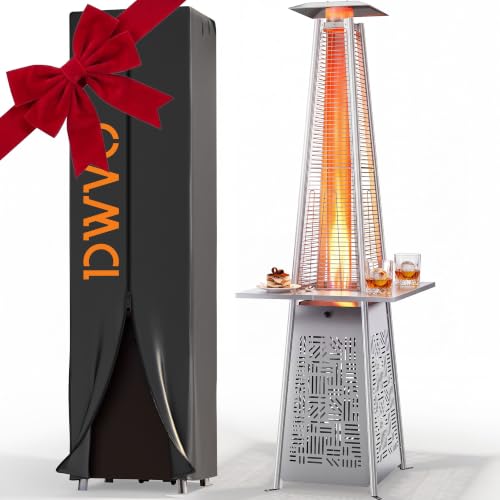
- Best overall for backyards: DWVO 48,000 BTU Pyramid Patio Heater with Wraparound Table, 89-Inch Propane Heater — Check on Amazon
- Best flame showpiece: Pamapic 89-Inch Pyramid Patio Heater, 48,000 BTU Propane Flame Tower (Black) — Check on Amazon
- Best portable around the yard: Mr. Heater 18,000 BTU Big Buddy Midnight Series Heater — Check on Amazon
See more Amazon options
- Best mounted powerhouse for a covered zone: Dr. Infrared Heater DR-239 3,000W Infrared Patio Heater, Wall or Ceiling Mount — Check on Amazon
- Best value tower: Aoxun 48,000 BTU Pyramid Patio Heater with Wheels and Waterproof Cover (Black) — Check on Amazon
- Best ready-to-store bundle: PATIOPIA Flame Pyramid Patio Heater with Cover, Triple Safety Protection — Check on Amazon
Read the full guide ↓
Disclosure: As an Amazon Associate, dailyhomedecorating.com earns from qualifying purchases. Links to Amazon on this page are affiliate links; they cost you nothing extra. Listing details such as price and availability change often, so check the current Amazon listing before you buy.
A backyard changes the patio heater question completely, and the search for the best patio heater for backyards under $300 should start from what a yard gives you that a patio or balcony cannot: room. Room to give a full-height flame tower the clearances it demands without measuring in millimetres, room to build warmth in zones — a dining corner, a fire pit circle, a covered porch edge — and room to store a 20 lb tank and a covered tower without either becoming a household negotiation. That freedom is why this guide leads with propane towers: in a backyard, the format’s costs (size, fuel logistics, wind exposure) are at their lowest and its pleasures (a visible flame column, 360-degree radiant warmth, a heater that organises the whole seating area around itself) are at their highest. Under $300 buys the complete tower class — every pick below was verified inside that tier during research — with money-thinking left over for the second-heater strategy that larger yards eventually adopt.
The ranking below is a toolkit, not a podium. The two leading towers split the classic backyard brief: one adds a wraparound table that turns the heater into the yard’s social centre, the other is the purest expression of the flame-tower idea with the fullest safety specification. A portable radiant heater makes the list because backyards are big and evenings move — the group that starts at the table ends at the fire pit, and heat that walks with you beats a second fixed appliance for many households. A mounted 3,000W electric covers the one zone towers serve badly, the covered porch or outdoor kitchen, with wired-in power and no flame under a roof. And two value-minded towers close the list for buyers heating a second zone or a second property without paying the class premium twice. Many backyard households end up owning one pick from two different families here, and the under $300 tier is precisely what makes that a plan instead of an indulgence.
Every pick was verified against its manufacturer’s specifications and its exact Amazon listing through Amazon’s own catalogue data, and screened by brand and model against U.S. Consumer Product Safety Commission recall records, with no open recalls among the six. One honest omission, stated as policy across this batch: the classic mushroom-top reflector heater is a legitimate backyard format, but our catalogue cross-check for its leading consumer listings could not be completed at research time, so it appears in this guide as prose guidance in the how-to-choose section rather than as a linked pick — this guide links only what it can verify end to end. Prices in this category swing with the season, so no static prices are printed: under $300 is the verified tier, and the live number is on the listing — check price on Amazon before you buy.
In this guide
Quick Picks
Short on time? Each row names a backyard job and the heater that does it, with a link to the listing. Every pick sat inside the under $300 tier on the sightings recorded while researching this guide — check price on Amazon before you buy, because outdoor heating pricing is seasonal.
| Buyer type | Pick | Why it stands out | Link |
|---|---|---|---|
| Best overall | DWVO 48,000 BTU Pyramid Patio Heater with Wraparound Table | Tower heat plus a table at its centre — the backyard’s social anchor, drinks included | Check on Amazon |
| Best showpiece | Pamapic 89-Inch Pyramid Patio Heater, 48,000 BTU | The complete flame tower: full safety trio, wheels, fitted cover, variable flame | Check on Amazon |
| Best portable | Mr. Heater 18,000 BTU Big Buddy Midnight Series Heater | Carry-to-the-corner radiant heat with oxygen and tip-over shut-offs | Check on Amazon |
| Best for covered zones | Dr. Infrared Heater DR-239 3,000W Infrared Patio Heater | Mounted 3,000W infrared for the porch or outdoor kitchen — needs a 220–240V supply | Check on Amazon |
| Best value | Aoxun 48,000 BTU Pyramid Patio Heater with Wheels | Full-size tower specification at the value end of the tier, cover included | Check on Amazon |
| Best bundle | PATIOPIA Flame Pyramid Patio Heater with Cover | Pyramid flame with triple safety protection, wheels and a fitted cover in the box | Check on Amazon |
How these picks were chosen
Backyard selection started with the yard itself. We weighted the things a yard changes: exposure (a tower in an open yard takes weather a patio unit never sees, so weather hardware, covers and corrosion-resistant burners counted double), distance (the heater may sit thirty feet from the house, so output and radiant throw mattered more than in any other variant of this guide), and zoning (a yard is rarely one seating area, so the list deliberately spans fixed towers, a mounted unit for the covered zone and a portable for everywhere else). Every candidate then faced the batch’s standard filters. Verification first: an exact Amazon listing, cross-checked through Amazon’s own catalogue data, whose brand, model and title matched the manufacturer’s specification material. Safety second: propane picks needed tip-over shut-off and flame-failure protection as a minimum; the electric needed a recognised outdoor weather rating and proper mounting hardware. Recall screening third: each brand and model checked against Consumer Product Safety Commission records — a live filter in this category, where a natural-gas patio heater sold online was recalled in 2026 for gas-release and fire hazards, and where no model with an open recall appears in this guide in any form.
Two editorial decisions deserve stating. There is no natural-gas pick, here or anywhere in this batch: a plumbed heater makes sense for permanent commercial installs, but a backyard’s flexibility — move the tower for the party, store it for the storm — is propane’s whole argument, and the category’s recent recall history sits on the natural-gas side. And coverage claims were discounted everywhere they appeared. When a maker rates a 48,000 BTU tower at around 200 square feet, we read that as a still-evening outer boundary and ranked on the dependable inner ring — the seats within roughly eight to ten feet — because that is where backyard evenings are actually lived. The result is a list with no weak seat: three towers at three price-and-feature points, one portable, one wired powerhouse, and one bundle pick for the buyer who wants the storage problem solved in the same box.
Backyard heater safety: siting on grass and deck, clearance, carbon monoxide and tip-over
A backyard removes the balcony’s legal problems and replaces them with physical ones. The rules below decide where each heater in this guide can stand in a real yard.
Surface first. A propane tower belongs on a level, hard, non-combustible surface — pavers, concrete, a stone pad — never directly on grass and never on a timber deck without the manual’s explicit allowance and a suitable protective base. Radiant heat and a hot base scorch lawns and dry decking alike, and a tower on soft or sloping ground is a tip-over waiting for its moment. The simplest infrastructure purchase in this whole category is a small paver pad at the yard’s social centre: it solves siting, stability and scorch in one afternoon. Portable radiant heaters need the same discipline at smaller scale — flat, firm, out of the footpath — and their hot faces need a clear zone in front that accounts for children, dogs and chair legs.
Clearance from the yard’s combustibles. Towers in this guide call for roughly two feet or more to the sides and rear and about three feet above, per their manuals — the Pamapic specifies 24 inches at the sides and 36 above — and a backyard adds combustibles a patio forgets: fences, sheds, stored firewood, dry planting, the cushion box, the trampoline. Measure to all of them, in the position the heater will actually occupy, and remember wind leans a flame and carries heat sideways; a calm-evening measurement is a fair-weather promise. Keep the heater’s parking spot, covered and cold, to the same standard as its working spot.
Carbon monoxide and the covered corner. Propane heaters are outdoor appliances because their combustion gases, carbon monoxide included, must disperse into open air. A backyard tempts two violations: the heater pulled into the garage doorway “just while it rains,” and the heater under a low porch roof where gases pool at head height. Both are the same mistake in different clothes. The covered zone of a yard is electric infrared’s job — that is exactly why the DR-239 is in this guide — and the portable Buddy family’s oxygen depletion sensor, engineered for the recreational enclosures its manual describes, is a safeguard, not a permit to bring combustion under a roof or indoors.
Tip-over, wind and the yard’s traffic. Every propane pick here cuts its gas automatically if it tilts past its threshold and if its flame fails — the backup systems. The plan in front of them is stability: level pad, base weighted or staked where the maker provides for it, wheels chocked or the unit parked against drift, and a site chosen out of the yard’s traffic lines — not beside the gate swing, the ball game’s run-up or the dog’s racetrack. Never move a lit tower; wheel it cold, light it placed. And when a genuinely windy evening arrives, the correct operation is the one the flameout protection will eventually enforce for you: shut it down and move the evening to the covered zone.
Fuel discipline at yard scale. Towers run on a standard 20 lb cylinder with an overfill protection valve; check every connection with soapy water after a tank change. Spare cylinders live outdoors, upright, shaded, away from the heater and the fire pit — never in the house, and not in a sealed, sun-baked shed where heat and any leak can concentrate. Close the tank valve first at shutdown so the line burns clear, and let any heater cool completely before its cover goes on.
The best patio heater for backyards under $300: detailed reviews
Best overall for backyards: DWVO 48,000 BTU Pyramid Patio Heater with Wraparound Table
Who it suits. The DWVO leads this guide because a backyard’s heater is rarely just a heater: it is the place the evening collects. The wraparound table at this tower’s waist — four sides of surface at seated drink height — turns a 48,000 BTU pyramid into the yard’s furniture anchor, the spot chairs get dragged toward and conversations finish at. For the household whose backyard life is a seated group with glasses in hand, that table is the difference between a heater near the party and a heater that is the party.
What it does well. The heating specification underneath is full class: 48,000 BTU on propane, a quartz flame tube in a stainless frame, electronic ignition, an adjustable control knob for flame and output, and the safety pairing of a tilt sensor and flame-out protection with an automatic shut-off valve. The maker rates coverage at up to about 200 square feet; in backyard terms, trust the ring the table defines plus a seat beyond it, and you will never be disappointed. At roughly 58 lb on built-in wheels it moves between the pad by the house and the far seating corner like the other towers here, a PVC cover is included for the wet weeks, and the double-layer stainless burner is the right durability answer for a unit that will thermal-cycle outdoors for years.
- Wraparound table makes the heater the seating group’s centre of gravity
- Full 48,000 BTU tower output with tilt and flame-out shut-offs
- Electronic ignition, adjustable flame, wheels and an included PVC cover
- Double-layer stainless burner for outdoor longevity
The honest limitation. The table widens the unit’s claim on space and puts a surface within reach of a hot column — it is for drinks and phones, not elbows and laptops, and it will not suit a yard whose seating is a long dining arrangement rather than a gathered ring. It shares the pyramid family’s wind sensitivity in full: an exposed yard on a blustery night will bend its heat and may trip its flame protection, correctly, mid-evening.
Choose it if your backyard evenings gather in a ring and you want one purchase to anchor them. Skip it if your seating is linear, your pad is small, or your yard is a wind tunnel — the portable and mounted picks below answer those yards better. Check on Amazon
Best flame showpiece: Pamapic 89-Inch Pyramid Patio Heater, 48,000 BTU (Black)
Who it suits. The Pamapic is the purist’s tower: no table, no gimmick, just the tallest expression of the format — 89 inches of black pyramid with a live flame running up a quartz glass tube, visible from every corner of the yard and from the kitchen window besides. It suits the backyard that hosts, the garden designed to be looked at, and any buyer for whom the heater’s evening job is half warmth and half firelight.
What it does well. Its safety specification is the fullest in the tower class here: automatic shut-off if the unit tilts beyond 45 degrees, flameout protection that cuts the gas if the flame dies, and overheat protection — the complete trio, where several rivals fit two of three. Output is the class-standard 48,000 BTU through a variable control valve, so the flame show can be moderated on a mild night rather than merely survived. The ownership details are equally complete: pulse ignition, integrated wheels for its roughly 62 lb, a standard 20 lb tank concealed in the base, a fitted protective cover in the box, and maker clearances — 24 inches to sides and rear, 36 above — that a backyard, uniquely among this batch’s settings, can usually grant without argument. The footprint is about 23 inches square: a lot of presence for very little pad.
- Complete safety trio: tilt shut-off, flameout protection, overheat protection
- Full 48,000 BTU with variable flame — spectacle you can turn down
- Wheels and a fitted cover included; tank hidden in the base
- Maker clearances a real backyard can actually meet
The honest limitation. A glass-tube flame is a fair-weather performer: gusts bend it, rattle the evening’s warmth downwind and can trigger a protective shutdown. Assembly is a genuine project, and the black finish shows dust and pollen between cleans in a way stainless forgives. Neither matters on the sheltered, hosted evenings this heater is for; both matter if your yard is exposed and your use is nightly.
Choose it if the flame is the point and your yard can give it shelter and clearance. Skip it if you want the table’s utility (the DWVO above) or your site is unsheltered and windswept. Check on Amazon
Best portable around the yard: Mr. Heater 18,000 BTU Big Buddy Midnight Series Heater
Who it suits. Backyards defeat fixed heaters in one specific way: they are bigger than one seating area. The Big Buddy is the answer that walks — a portable radiant propane heater with three settings up to 18,000 BTU that you carry to the fire pit circle, the potting bench, the open garage door or the far corner where the teenagers have exiled themselves, and set down facing the chairs.
What it does well. The Buddy family’s engineering is the story: an oxygen depletion sensor that shuts the unit down if oxygen falls, and an automatic tip-over shut-off, fitted to a heater designed from the start to be moved, knocked about and used in the real world. Output steps through 4,000, 9,000 and 18,000 BTU; the maker rates it for spaces up to about 450 square feet in enclosed terms, and outdoors that translates to a fierce forward throw of radiant heat that takes a small group from cold to comfortable in the time it takes to sit down. It runs on 1 lb cylinders for true portability or, via the maker’s hose accessories, from a 20 lb tank parked beside the chairs for the long version of the evening. No assembly, no pad, no planning: it is the only pick here that can be heating a new spot ninety seconds after the idea occurs.
- Total placement freedom: heat follows the evening around the yard
- Oxygen depletion sensor plus tip-over shut-off, engineered in
- Three output settings from a gentle 4,000 to a full 18,000 BTU
- 1 lb cylinders for mobility, 20 lb tank via hose for endurance
The honest limitation. It heats a direction, not an area: the group in front of its face is warm, the group behind it is scenery. On 1 lb cylinders at high output the fuel is a short-evening supply, so the hose-and-tank setup becomes the regular configuration for long sessions, tethering the freedom that justified it. And the family’s indoor-rated marketing language belongs to the recreational enclosures its manual describes — in this guide’s terms it is an outdoor yard heater, full stop, never a house or tent heater and never left running unattended.
Choose it if your yard has several stations and one budget. Skip it if your evenings are one fixed seating group — a tower serves that group better, hands-free. Check on Amazon
Best for covered zones: Dr. Infrared Heater DR-239 3,000W Infrared Patio Heater
Who it suits. Every backyard has one zone the towers cannot serve: under the porch roof, inside the outdoor kitchen’s cover, beneath the pergola where the dining table lives permanently. The DR-239 owns that zone — a 3,000W infrared bar that mounts on a wall or ceiling and pours directional heat down onto the seats below, with no flame under the roof, no combustion gases at head height and nothing standing on the floor.
What it does well. Three thousand watts is double the plug-in class, and in a covered zone — where the roof holds the benefit instead of letting it blow away — that output translates into the strongest, widest comfort wedge in this guide: a long dining table or a deep porch seating run warmed from a single mounted unit. It carries an IP55 weatherproof rating for indoor and outdoor use, mounts with the included kit, and is remote-controlled, which on a wired-in, high-mounted appliance is a necessity properly provided. Once installed it is the lowest-effort heat in the yard: no tanks, no covers to wrestle, no lighting ritual — a button, and the covered zone is warm before the drinks are poured.
- 3,000W infrared: the strongest covered-zone heat in this guide
- IP55-rated; wall or ceiling mount with kit and remote included
- No flame or fumes under the roof — the covered zone’s correct technology
- Install once; operate for years with zero fuel logistics
The honest limitation. It is a 220–240V appliance, and most yards do not have that supply waiting at the porch: for most households this pick means an electrician and a planned circuit before it means warmth, a project cost that belongs in the decision. It is also permanently directional — it warms the zone it is mounted over and no other — so it complements a tower rather than replacing one for households whose evenings roam the whole yard.
Choose it if your yard’s favourite zone is covered and you are willing to wire for it once. Skip it if you need heat this weekend with no electrical work — the towers above are self-contained. Check on Amazon
Best value tower: Aoxun 48,000 BTU Pyramid Patio Heater with Wheels (Black)
Who it suits. The Aoxun is the second-zone and second-property pick: the full flame-tower experience at the value end of the under $300 tier, for the big yard that wants a tower at the far seating area as well as the near one, the holiday home, or the buyer who would rather own two good towers than one premium one.
What it does well. The specification that matters is complete: 48,000 BTU through a high-temperature glass tube, tip-over auto shut-off and flame-failure auto shut-off both fitted, wheels for repositioning, and a waterproof cover in the box — the accessory whose absence quietly taxes owners of cheaper bundles. The black finish suits the modern end of backyard furniture, the tank hides in the base as it should, and the variable flame does the same double duty as every pyramid’s: heat on high, firelight on low.
- Full 48,000 BTU tower specification at the tier’s value end
- Tip-over and flame-failure shut-offs; waterproof cover included
- Wheels fitted — a second-zone heater must be movable to earn its place
- The economical route to two-zone backyard warmth
The honest limitation. Value is earned in the unphotographable places — panel fit, finish longevity, fastener quality, documentation and support all run a step behind the established names — and in an exposed yard, weather finds those differences faster. Buy it with its cover discipline planned: covered when cold, parked sheltered, and it will repay the bargain; leave it naked through a winter and the saving evaporates. It also shares the family’s wind sensitivity in full.
Choose it if the budget is doing two zones or the value brief is explicit. Skip it if this is your one heater and finish and support are worth the premium — the Pamapic is that buy. Check on Amazon
Best ready-to-store bundle: PATIOPIA Flame Pyramid Patio Heater with Cover
Who it suits. The PATIOPIA closes the list for the organised backyard: a pyramid flame tower sold as a complete ownership bundle — heater, wheels, fitted patio cover — for the buyer whose storage reality is a shed corner and whose spring ritual should be “uncover and light,” not “order the parts I forgot.” Its listing leads on triple safety protection, which is the right headline for a family yard.
What it does well. The pyramid formula is all here: a visible flame column in a glass tube doing the social work of a fire without smoke or ash, propane power from a standard tank in the base, wheels to roll the unit between its working pad and its parking spot, and the cover included rather than upsold — which matters more in a backyard than anywhere, because a backyard tower lives outdoors in a way a patio unit under a roof edge does not. For households with children orbiting the seating area, a safety-led specification and a heater that parks tidily under its cover are not details; they are the purchase.
- Triple safety protection headline in a family-yard format
- Fitted cover and wheels in the box: the storage problem pre-solved
- Classic pyramid flame presence with tank concealed in the base
- Rolls between working pad and parking spot in seconds
The honest limitation. As with the other value-adjacent towers, the long game is finish and component quality against the premium names, and the pyramid family’s universal caveats apply undiluted: wind bends its heat and can shut it down protectively, and its clearances must be measured against fences, sheds and planting rather than assumed. Treat its cover as part of the heater, not an accessory, and store it on.
Choose it if you want the tower, the wheels and the cover settled in one box at a bundle price. Skip it if ultimate finish quality is the priority — that is the Pamapic’s ground. Check on Amazon
Comparison table
| Pick | Type | Output | Key safety features | Best for |
|---|---|---|---|---|
| DWVO Pyramid with Table | Propane flame tower | 48,000 BTU | Tilt sensor, flame-out shut-off | The gathered seating group |
| Pamapic Pyramid | Propane flame tower | 48,000 BTU | Tilt shut-off (45°), flameout and overheat protection | Flame presence and hosting |
| Mr. Heater Big Buddy Midnight | Portable propane radiant | 4,000–18,000 BTU | Oxygen depletion sensor, tip-over shut-off | Heat that moves around the yard |
| Dr. Infrared DR-239 | Electric infrared, mounted | 3,000W (220–240V) | No flame or fumes; IP55-rated | Covered porch and kitchen zones |
| Aoxun Pyramid | Propane flame tower | 48,000 BTU | Tip-over and flame-failure shut-off | Second zones and value buyers |
| PATIOPIA Pyramid | Propane flame tower | Pyramid class | Triple safety protection (per listing) | Bundle buyers, family yards |
How to choose a patio heater for a backyard
Zone the yard before you buy anything
Sketch the yard as its evenings actually happen: the dining spot, the lounging spot, the covered spot, the far spot. Most yards have two real zones, not five. Assign the primary zone the best heater it deserves — usually a tower on a pad — and solve the second zone with the format that fits it: a portable for roaming warmth, a mounted electric under the roof, a second value tower if the zone is fixed and far. Buying one heater and expecting it to serve a whole yard is how households end up dragging a lit-evening’s worth of disappointment between corners.
Build the pad, then place the tower
A tower’s address should be infrastructure, not improvisation: a level paver or concrete pad at the primary zone, clearances measured to fence, shed, planting and stored gear, and a parking position — covered, out of the traffic lines — decided in advance. The mushroom-top reflector format belongs in this planning too: it throws heat downward from a pole-mounted disc onto a defined dining area and can suit a fixed table arrangement well. It is discussed in prose here because its leading consumer listings could not be catalogue-verified in this research round; if you shop for one, demand the same evidence standard as the linked picks — exact listing, tip-over shut-off, flame-failure protection, stated clearances, clean recall check.
Match the fleet to the fuel reality
Two propane towers mean two tanks in rotation and a spare stored lawfully outdoors; a tower plus an electric means one tank and one circuit; a portable means cylinders or a hose. None is wrong, but the household that plans its fuel wins its evenings: nothing ends a backyard night like a tank running dry at the exact moment the conversation peaks. Keep the rotation boring — full tank on, spare outdoors, exchange on the weekly shop — and the heaters disappear into the background where they belong.
Respect the wind map
Every yard has one: the corner the breeze finds, the funnel between house and fence. Towers belong out of it; the portable can be aimed from shelter; the covered zone does not care. Spend one windy evening noticing before you spend anything at all, because placement against your yard’s actual weather is worth more output than any specification on any box in this guide.
Common mistakes to avoid
Standing a tower on the lawn. Scorch, sink and tilt in one decision. A pad is cheap; a tipped tower is not.
Heating the garage doorway with propane. The moment a combustion heater’s gases stop dispersing into genuinely open air, the appliance is out of its design brief. Covered and enclosed zones are electric’s job.
One heater, whole yard. Distance defeats output. Zone the yard and heat the zones, or accept that the far chairs are decorative.
Storing the spare tank in the house or the sealed shed. Cylinders live outdoors, upright and shaded. The fire pit’s wood pile is not a tank store either — keep fuel and flame neighbours apart.
Covering a warm heater. Covers go on cold units. A cover over residual heat is a melt, a scorch and a ruined accessory in one gesture.
Skipping the recall check on a “commercial-style” bargain. This category has genuine recall history, including a 2026 natural-gas model sold online. Five minutes on the CPSC database for the exact brand and model is part of the purchase, every time.
A backyard heater through the seasons
Spring is the tower’s season: evenings that are one jumper short of perfect, a flame column lit at dusk, the yard reclaimed a month earlier than the neighbours manage. Summer narrows the work to late evenings and ambience — towers turned low for firelight while the portable takes the chill off the pool towels — and to the covered zone, where the mounted electric answers the hour after a storm without anyone fetching a tank. Autumn is the main event, the season this entire category exists for, when a zoned yard with a tower at its centre and warmth at its edges hosts dinners that would have moved indoors in September. Winter sorts households honestly: sheltered yards with a pad, a tower and a wind map keep their evenings longest; exposed yards retreat to the covered zone and the portable at the garage door for the working hours. Off-season, the disciplines decide next year’s first evening: covers on, tanks disconnected and stored outdoors, mounts and connections checked, so the first cold night starts with a light, not a project.
The two-heater backyard: how experienced yards combine these picks
Talk to households that have heated a backyard for years and a pattern emerges: almost none of them rely on a single heater, and almost none of them bought their combination on purpose at the start. The combinations that work share a logic worth copying deliberately. The anchor is always a tower at the primary zone — the pad where the main seating lives — because that zone hosts the most hours and deserves the format with the most presence. The second heater is chosen to cover the anchor’s blind spot, and the blind spot is always one of three things. If evenings migrate, the blind spot is distance, and the second heater is the portable: it costs the least commitment, lives in the shed, and appears wherever the group lands. If the favourite zone is covered, the blind spot is the roof, and the second heater is the mounted electric: wired once, warm forever, and immune to the wind that shuts the tower’s season down early. If the yard is simply large and social at both ends, the blind spot is a second fixed zone, and the answer is the value tower on its own pad, accepting a second tank in the rotation as the price of a yard with two warm rooms in it.
What does not work is doubling down blindly: two towers side by side in one zone adds cost and fuel logistics without adding comfort, because the ring around one tower is already the warm part and a second flame mostly warms the first heater. Spacing is the discipline — heaters serve zones, zones are separated by genuinely cold ground, and the walk between them is short and worth it. Budget-wise, the under $300 tier is what makes the strategy civilised: an anchor tower this season and a second-zone pick next season keeps every purchase inside the tier where this category’s value lives, and a household that phases its buying also phases its learning — the second purchase is made by someone who already knows their yard’s wind map, traffic lines and evening habits, which is to say, by an expert on the only yard that matters.
Final recommendation
For the typical backyard, buy the DWVO
: its table makes it the one heater in this guide that organises the evening around itself, and its tower specification underneath is complete. If your yard’s pleasure is the flame itself and your hosting is the point, the Pamapic is the purer showpiece with the fullest safety set. Add the Big Buddy when the yard proves bigger than one zone, wire the DR-239 when the covered corner becomes the favourite room in the house, and let the Aoxun or PATIOPIA stretch the plan to a second zone without stretching the budget past sense. Measure the pad, respect the wind, store the fuel properly — a backyard rewards exactly the households that plan it like one.
FAQ
How many patio heaters does a backyard need?
Most yards need one per genuine seating zone, and most yards honestly have two zones. Start with the primary zone’s heater — usually a tower — live with it for a season, and add the second zone’s format (portable, mounted electric or value tower) once you know where evenings actually migrate. Buying the fleet on day one usually means heating one zone brilliantly and storing the mistake.
Can a patio heater sit on a deck or on grass?
Not on grass: heat scorches it, soft ground destabilises the unit, and the combination invites a tip. On a timber deck, only if the specific model’s manual allows it and with the protective base it prescribes — many manuals require a non-combustible surface outright. A small paver or concrete pad is the solution this guide recommends for any fixed tower position.
How far should a patio heater be from a fence or shed?
Follow the model’s manual — the towers in this guide call for roughly two feet or more to the sides and rear and about three feet above — and treat those as calm-air minimums. In a backyard, also account for what the fence and shed are made of, what is stored against them, and how wind moves heat sideways; more distance is always available in a yard, and using it costs nothing.
Is one 48,000 BTU tower enough for a large yard?
It is enough for one seating group in a ring around it — roughly eight to ten feet of dependable radius in still air. It is not enough for a large yard as a whole, because radiant heat does not fill space the way central heating fills a room. Large yards are a zoning problem, and this guide’s portable, mounted and value picks are the zoning answers.
Can I leave a patio heater outside all year?
A tower with its fitted cover on, parked in a sheltered position with the tank disconnected or its valve closed per the manual, is designed for outdoor life — that is what the covers in these bundles are for. What shortens a heater’s life is being left uncovered through wet winters and being run with corroded connections in spring; the cover discipline and a seasonal connection check are the whole secret.
Propane tower or fire pit for a backyard — which is better?
They do different jobs, and the honest comparison is about smoke and effort as much as heat. A fire pit demands dry wood, tending and a shower afterwards; a tower asks for a tank check and a button. A fire pit is an event: smoke, ash, tending, and a real fire’s pleasures. A tower is infrastructure: instant on, instant off, no smoke on the guests or the laundry, and warmth at exactly the height seated people need it. Many backyards in this guide’s world end up with both — the pit for the nights that are about the fire, the tower for the far more numerous nights that are about the people.
Related guides
Planning the rest of the yard? These guides on this site cover the neighbouring tiers and the pieces that share the space:


